
Parmigiani Fleurier Toric Qualité Fleurier
The Parmigiani Fleurier Toric Qualité Fleurier blends a gorgeous hand-guilloché dial, exquisite proportions and a supremely refined self-winding movement. Lastly, as its name implies, this watch has been independently scrutinised by the Fleurier Quality Foundation.

Recently, I discovered that someone I know had spent a three-figure sum on a pair of trainers. I was aghast that such a seemingly insignificant item of footwear could command such a ridiculously high price.
As a former marketing professional, I quizzed the profligate youngster about his purchase. Firstly, he talked about having to enter some form of ballot where a small number of successful entrants were invited to purchase the overpriced trainers. Secondly, he felt the high asking price inferred quality. Lastly, because the trainers had been promoted by a celebrity in a prominent advertising campaign, my young friend perceived them as superior. To this fiftysomething, it all sounded like commercial opportunism and, to be frank, absolute nonsense.
I reflected on the trainers and considered the watch industry. While the price of many watches is commensurate with complexity, materials and quality, there are some expensive watches which are devoid of virtue. Indeed, in some quarters it seems that a prominent name or logo is the primary justification for purchase. Likewise, a strong presence at televised sporting events is a further tool used to tempt the naive to part with their money. Craftsmanship, materials and watchmaking virtuosity seem of little importance to those who succumb to such marketing-led bunkum.
Thankfully, there are many watch brands that do exhibit notable quality and mechanical refinement. Parmigiani Fleurier is a perfect example of this. Several years ago, I wrote articles for the brand’s own blog, aptly called ‘Le Blog’. Ultimately, the firm changed its website design and decided to discontinue said blog. However, while writing my features, I spent time touring Parmigiani’s various factories: Atokalpa, Elwin, Les Artisans Boîtiers, Quadrance & Habillage and Vaucher, as well as the company’s eponymous facility in Fleurier.
Parmigiani’s in-house capabilities are among the best. Indeed, a Parmigiani Fleurier model is made totally in-house, save for its Hermès strap. Some of the sites make components for other watch brands, something some of these companies choose to reveal, eager to convey the quality of the components used in its products.
Despite touring numerous watch factories over the years, I cannot think of many brands that can surpass the excellence I have witnessed at Parmgiani Fleurier. The Maison is one of only a handful of companies that subject its watches to the independent scrutiny of the Fleurier Quality Foundation or Fondation Qualité Fleurier, a testament to the confidence it places in its timepieces.
The Qualité Fleurier
Watches that bear the Poinçon de Genève have met the criteria of the Poinçon de Genève Office which includes at least 12 independent audits per annum. For a watch to carry this prestigious hallmark, the assembly, casing up, adjustment and testing must be carried out in Geneva.

However, there are many watches made to similar high standards which are produced outside the canton of Geneva. For example, Parmigiani Fleurier is based in the Val de Travers region within the canton of Neuchâtel.
The Fleurier Quality Foundation is an independent body that has put in place a set of criteria against which it scrutinises the watches submitted for approval. For instance, the FQF criteria states that the watch head must be ‘100% manufactured in Switzerland’. This should be contrasted with many watches that are labelled ‘Swiss Made’ when only 60% of the watch head has been produced in Switzerland. The watch brand is required to provide a dossier detailing the source of each component, the identity of suppliers and subcontractors along with accompanying certificates of origin. Both the applicant and its suppliers may be subject to audits.
Another example is that the ‘movement must have a finish of exclusive aesthetic quality’, every watch must be COSC certified and it must pass the Chronofiable test. This latter test, performed by Laboratoire Dubois, subjects the watch to an ageing cycle. The watch head is exposed to shocks, wear, water and magnetism. Moreover, watches undergo an ageing cycle equivalent to six months on the wrist. Tests include measuring the pull and push forces on the stem and pushpieces, where appropriate. The watch head is also subjected to a series of shocks using a heavy pendulum.
Depending on the number of models being produced, the watch brand must submit a specified number of samples. For example, a series of 1 – 100 units requires the brand to submit 5 units for testing.
Perhaps the most arduous test is the ‘Fleuritest’ which simulates the wearing of the test watch. A computer-controlled device recreates the movements of the test watch during a ‘nycethemeral cycle’, alternating between active, extremely active and calm phases. At times the robotic simulator moves violently and at speed, eg when simulating a wearer running with their arms flailing. The precision of the watch, having been subjected to the aforementioned tests, must fall within a range of 0 to +5 seconds per day.
Only a watch that meets all of the aforementioned criteria is entitled to the certification ‘FQF, La Haute Horlogerie certifiée’. Indeed, the independent scrutiny of the Fleurier Quality Foundation, as well as COSC and Laboratoire Dubois, provides much reassurance to discerning watch buyers.
The dial
Over the last few days, I have been wearing the Parmigiani Fleurier Toric Qualité Fleurier. As its name implies, the watch has attained the Fleurier Quality certification. However, beyond its impressive horological credentials, it has many other qualities worthy of discussion.
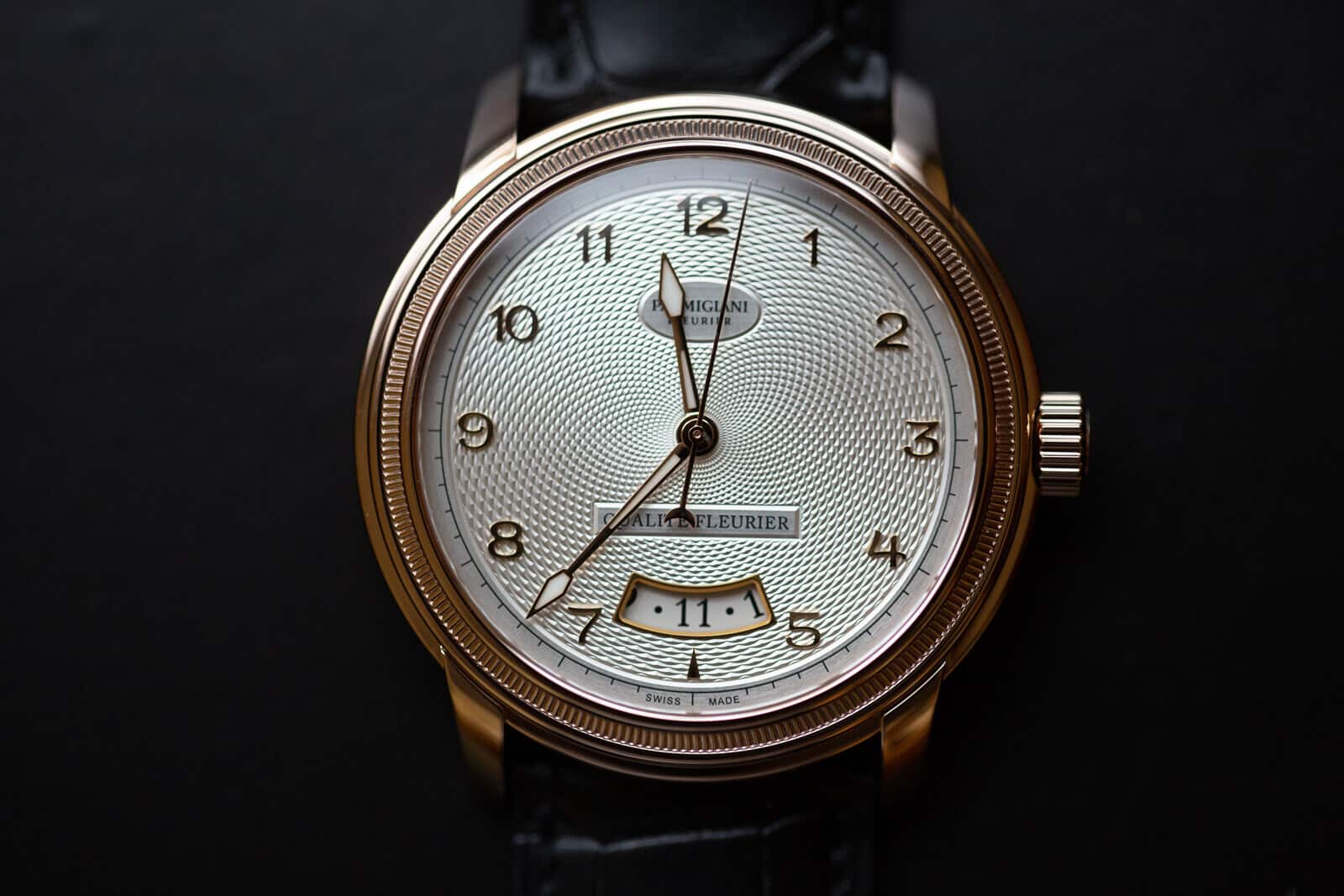
The Toric Qualité Fleurier is offered in two case options, 18-carat white gold case or 18-carat red gold. Both variants feature the same silver-coloured guilloché dial, adorned with a ‘Grain de riz’ motif which has been executed on a traditional rose-engine lathe. Each curving wave is exquisitely imparted to the dial membrane and wonderfully engages with available light.
Parmigiani has equipped this model with its elegant javelin-shaped hour and minute hands, both lined with luminescent treatment. The hands converse with 18-carat rose gold indexes. These Arabic numerals encompass numerous arcing edges and introduce becoming depths to the overall composition.
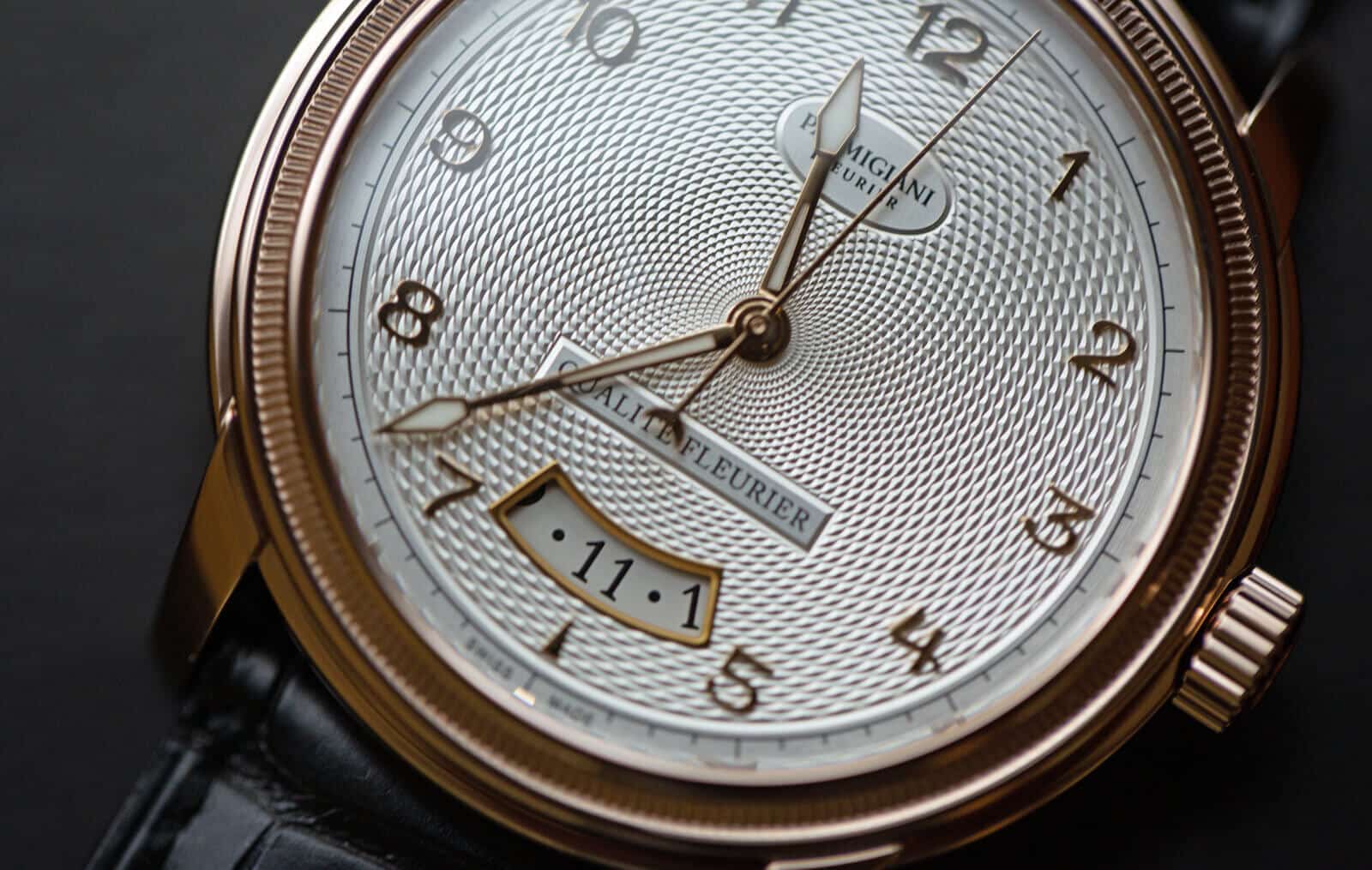
The Maison’s name is presented on an oval-shaped cartouche positioned below noon. A second rectangular cartouche is located below the fulcrum of the dial and marked with ‘Qualite Fleurier’ in capital letters.
At the base of the dial is a curved aperture, framed with a golden border, that reveals the date. While most watches only reveal the prevailing date, Parmigiani Fleurier has chosen to depict the neighbouring values as well. Black numerals sit atop a white date disc, save for the first day of the month which is shown in an ebullient shade of red. While some date displays can appear perfunctory, no such allegations can be levelled at the indication found on this timepiece.
A supremely slender central sweep seconds hand, endowed with a crescent-shaped counterweight, stretches outwards and floats above a neatly marked minute track.
The case
Measuring 40.8mm in diameter, the Parmigiani Fleurier Toric Qualité Fleurier sidesteps unnecessary bulk or ostentation. Every aspect of the case is refined and tasteful. The case thickness is 9.5mm, allowing the watch to readily slip beneath a cuff.
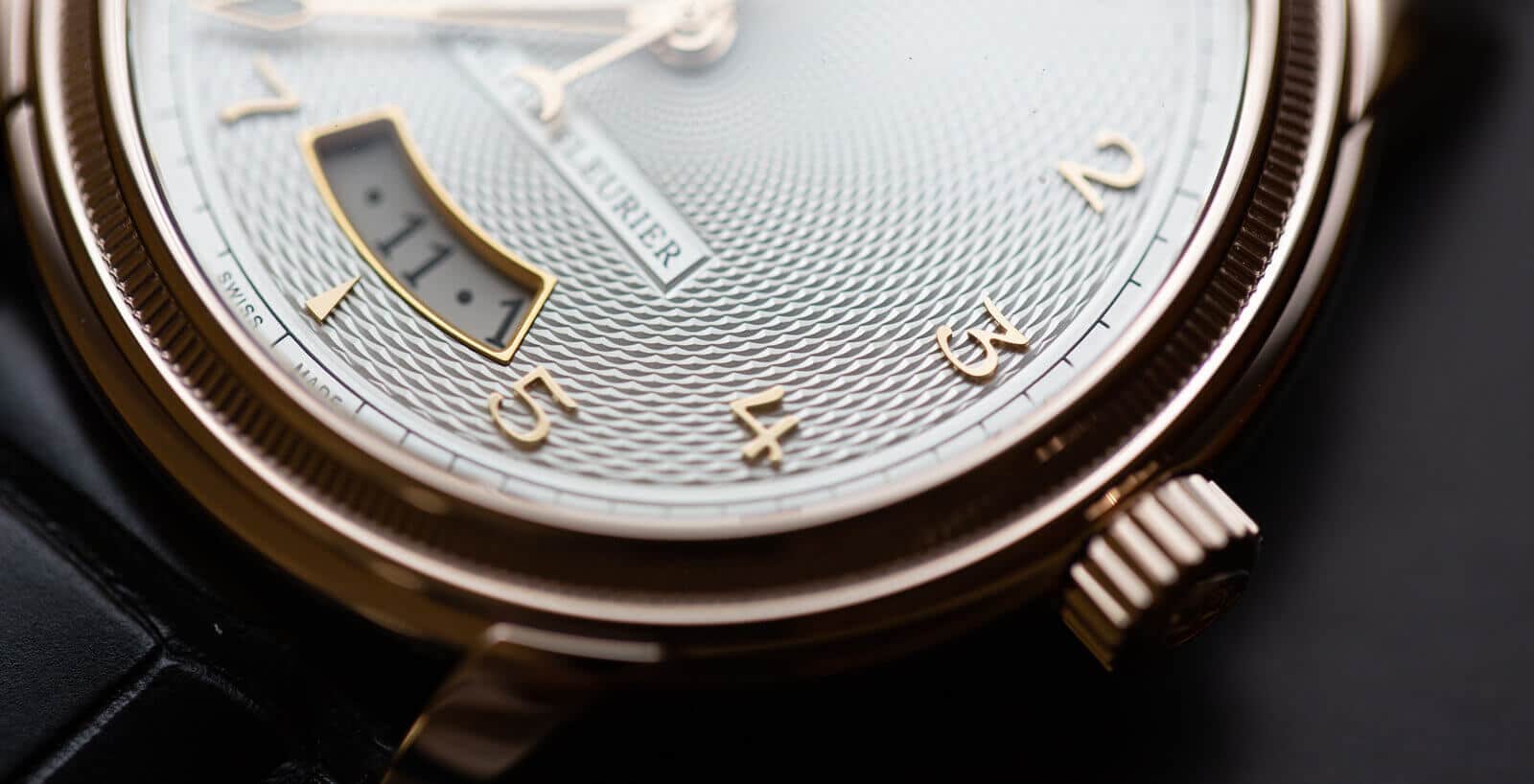
Consistent with other members of the Toric family, this timepiece features a bezel ‘formed of two gadroons alternating with knurling based on the harmonious proportions of the golden ratio’.
Michel Parmigiani, the founder of the Haute Horlogerie brand has always paid close attention to the golden ratio. In mathematics, the golden ratio is approximately 1.618. In geometry, it is defined as ‘the division of a line into ‘extreme and mean ratio’ and is sometimes termed the ‘golden section’. Some people refer to the golden ratio as the ‘divine proportion’ because of the numerous examples found in the natural world.
When designing a watch, Michel Parmigiani tries to abide by the golden ratio. For example, ‘the ratio of the bezel opening to the case diameter, the size of the counters versus that of the dial; the length of the minute hand compared to that of the hour hand. Each ratio of size is a simple expression or a multiple of the ratio 1: 1.618 – the golden number.’
The result is that everything looks optimally sized. Not one element looks too large or too small. Everything appears to be the product of much thought.
Returning to the knurling on the bezel, this is performed by hand using a rotating wheel. As the wheel touches the metal surface it displaces some of the material, effectively creating a groove. It is a detail that was first seen in 1999 on the brand’s first wristwatch, the Toric QP Retrograde. This decoration has since featured on every Toric model. As the knurling is performed by hand, the number of grooves varies from watch to watch.
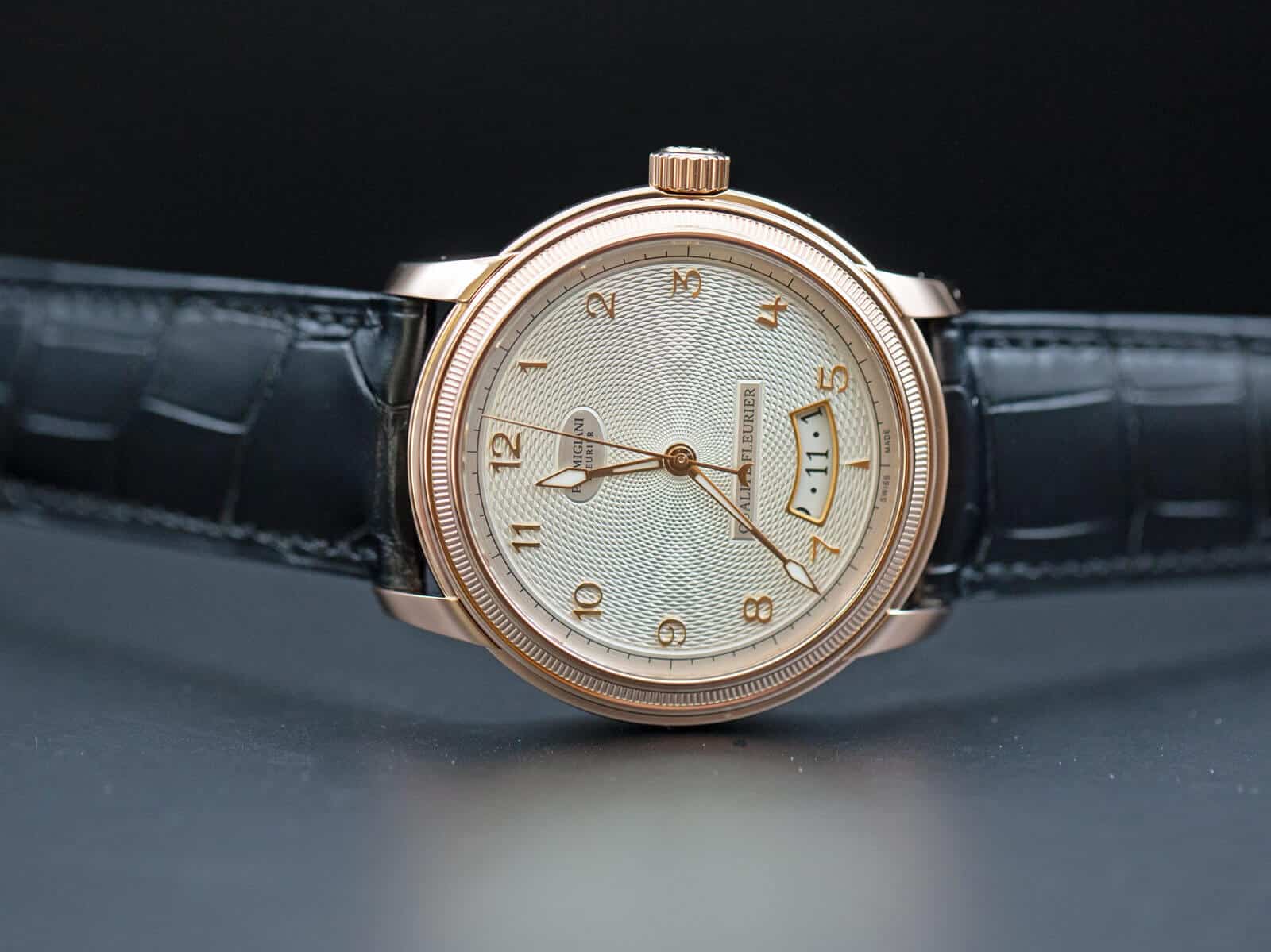
The lugs gracefully arc downwards, contributing to the watch’s cosseting wrist-fit. A black Hermès alligator strap with an 18-carat red gold pin buckle affixes the watch steadfastly to the wrist.
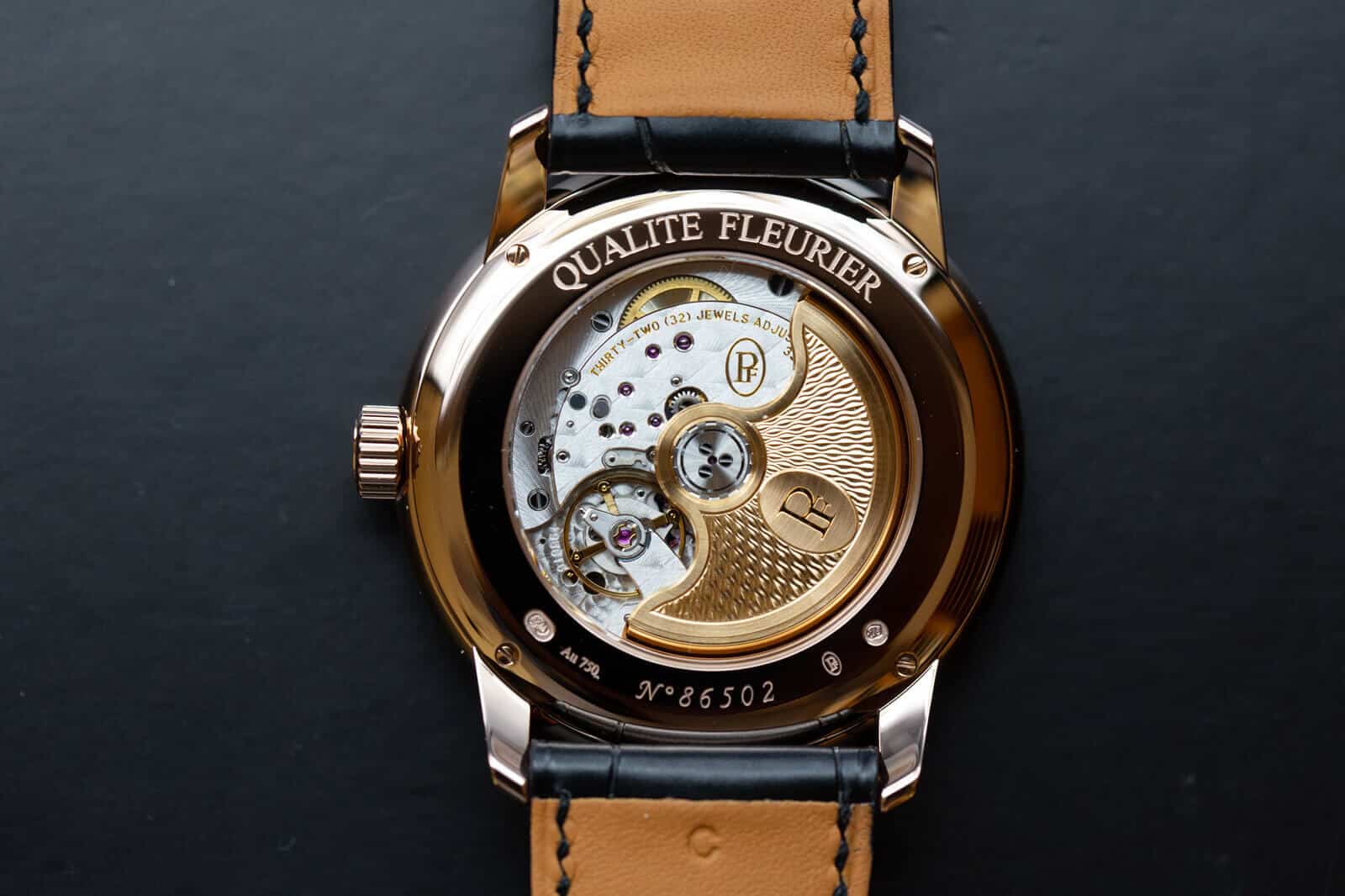
A pane of sapphire crystal positioned to the rear of the case affords sight of the self-winding movement, the PF331-QF calibre.
The movement
The automatic movement features twin barrels, granting a power reserve of 55 hours. By equipping the movement with two barrels the energy supplied to the escapement is more consistent, ensuring the amplitude remains relatively uniform and thereby aiding precision.
The oscillating mass is formed of 22-carat gold and embellished with the brand’s logo and grain d’orge motif. The bridges are adorned with an unusual ‘crossed’ Côtes de Genève decoration. The jewels sit in polished sinks and the bridges feature gilded text. Indeed, wherever you choose to look there are beautifully finished components positioned in close proximity to each other.

While some brands finish visible components, Parmigiani Fleurier painstakingly finishes each part to an exacting standard even when these surfaces are beyond the wearer’s gaze. Parts are bevelled, polished and filed. There are no signs of machining and no burrs which could foul moving parts. In addition, by polishing surfaces, the company’s artisans enhance the corrosion resistance of parts. It is this practice that is a key facet of the firm’s paradigm.
Parmigiani Fleurier is known for its restoration of automata, clocks and watches. As a result, Michel Parmigiani has gained a rare insight into the making of exquisite objects, free of compromise, often crafted in centuries past. His experience has led him to select materials and techniques that deliver longevity, a trait often lacking with many rival brand’s products.
As mentioned previously, not only must the movement finishing pass muster with Monsieur Parmigiani it also has to fulfil the rigorous, independent scrutiny of Fleurier Quality Foundation.
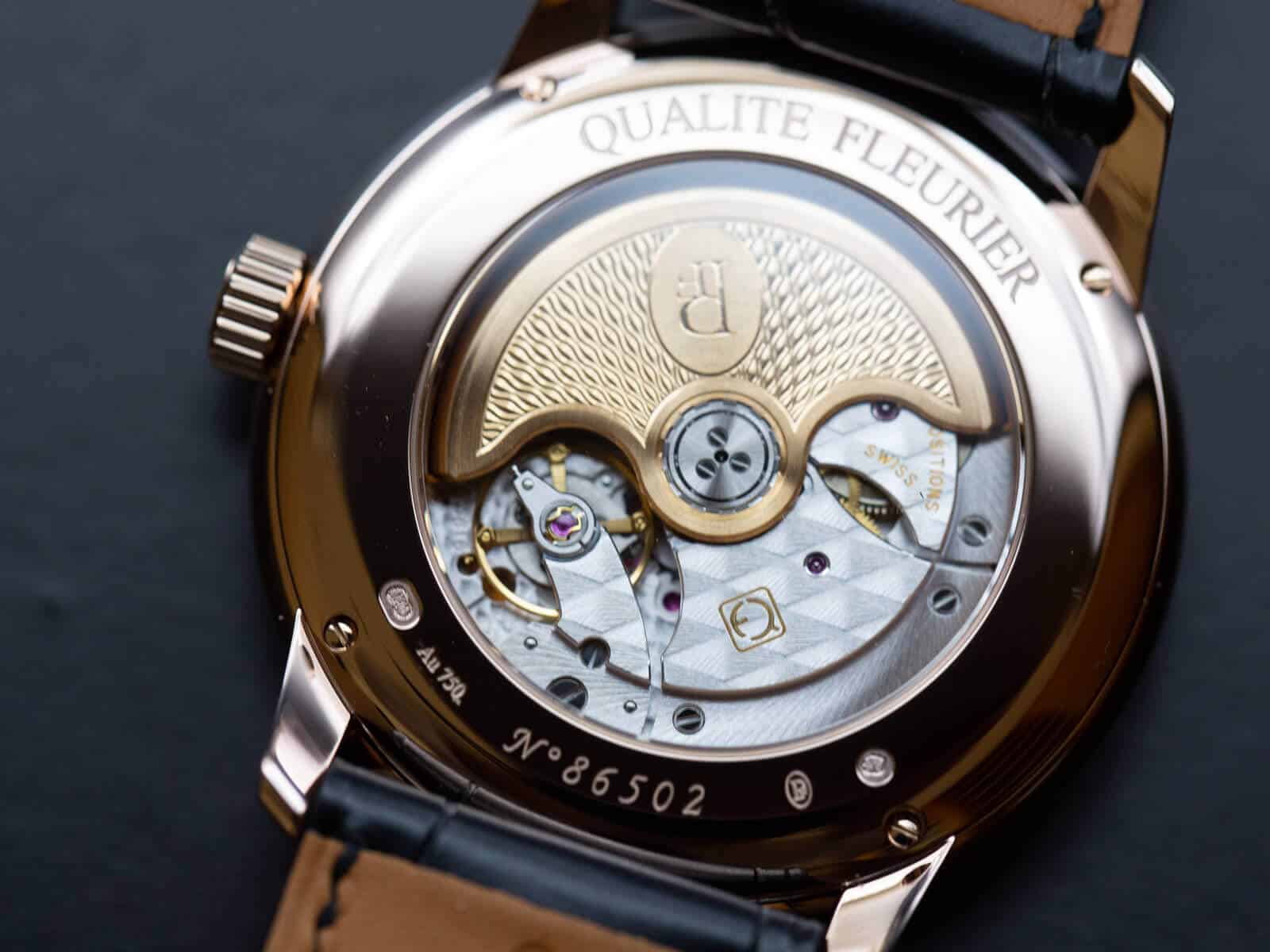
The PF331-QF calibre features 220 components of which 32 are jewels. The balance has a frequency of 28,800 vph (4Hz). Once again, Parmigiani has indulged purists by equipping the movement with a free-sprung balance.
A regular balance found on most watches features an index adjuster. By moving the index adjuster or raquette towards or away from the stud alters the effective length of the hairspring which in turn alters the rate. With a free-sprung balance, sometimes termed a variable inertia balance, the effective length of hairspring never changes. The rate is altered by moving weights on the balance wheel which changes the moment of inertia. By adopting this approach, the rate is less susceptible to positional influence, can be regulated more precisely and provides superior rate stability.
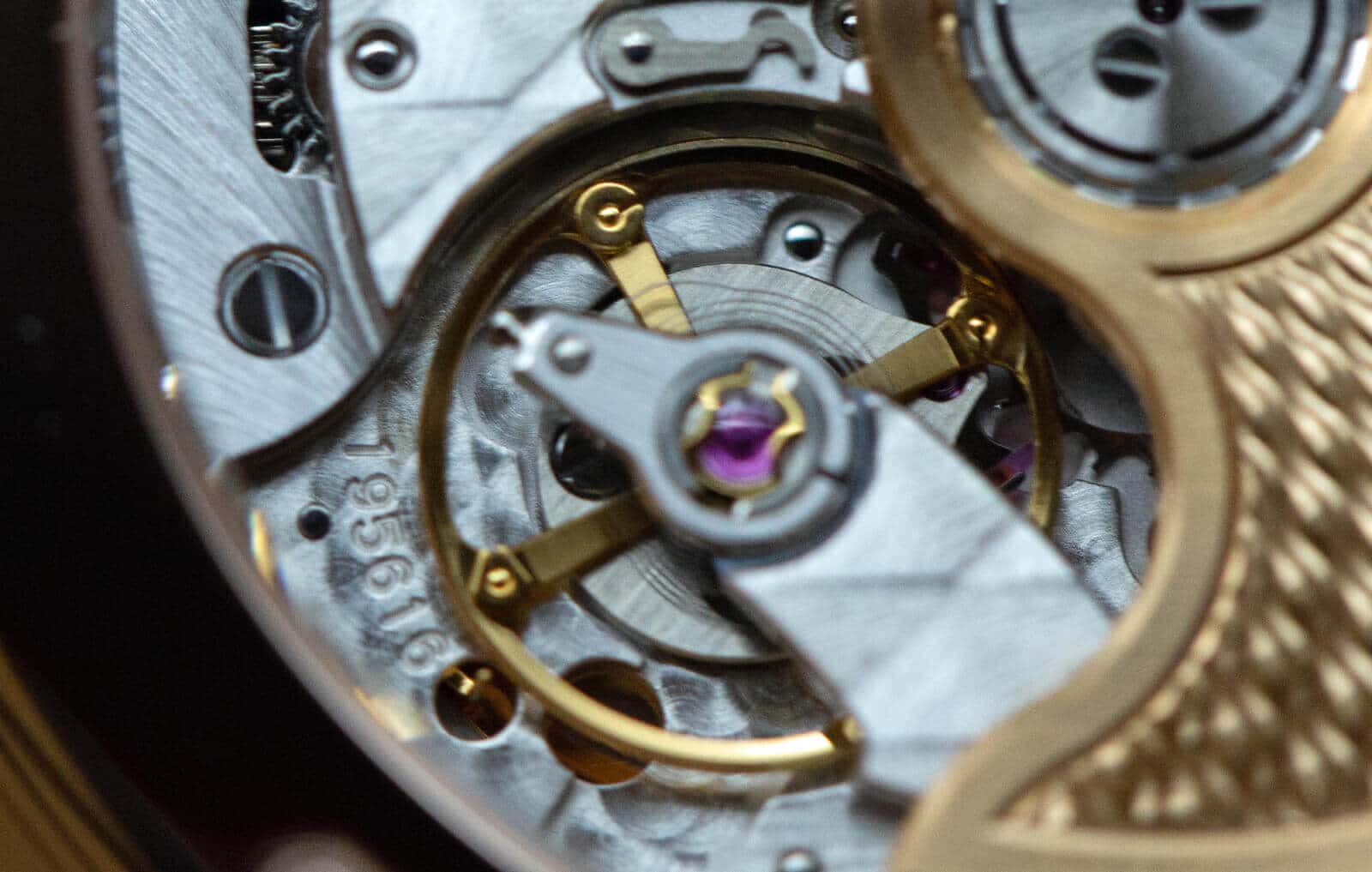
On older movements, the weights were often screws set into the rim of the balance wheel. However, Parmigiani has fitted C-shaped masselottes (weights)to the spokes of the balance wheel. As the masselottes are positioned in-board, there is less air turbulence created as the balance wheel oscillates to and fro, thereby enhancing precision. Indeed, this is just one of the features of this movement which contributes to the watch’s impressive chronometry; a quality that is manifest with the model’s chronometer status (COSC).
Closing remarks
The Parmigiani Fleurier Toric Qualité Fleurier possesses a highly legible dial, an ergonomically shaped case and confers high precision courtesy of its chronometer-certified movement. However, such functional attributes don’t tell the whole story.
Close examination of the Toric Qualité Fleurier reveals a plethora of additional attributes. Craftsmanship abounds, evidenced by the hand-guilloché dial, the knurling on the bezel, applied with deft use of hand, and, lastly, the flawless finishing of numerous movement components even those beyond the wearer’s gaze.
Every aspect of this watch has been appraised, measured and independently tested by Fleurier Quality Foundation, Laboratoire Dubois or COSC. No stone has been left unturned, no sins dwell in the darkness and no marketing hyperbole has been employed to fool the unwary.
This refined timepiece from Parmigiani Fleurier does not seduce the gullible with slick branding or ridiculous pricing to attract the ‘it must be good if it costs so much’ contingent of unsophisticated brand junkies. No, this exemplar of Haute Horlogerie simply bestows an extraordinary quotient of excellence which, to my mind, is the true definition of luxury.
Further reading
Technical specifications
- Model: Parmigiani Fleurier Toric Qualité Fleurier
- Reference: PFC422-1600100-HA1441
- Case: 18-carat red gold; diameter 40.8mm; height 9.5mm; water resistance 3ATM (30 metres); sapphire crystal to front; exhibition case back.
- Functions: Hours; minutes; central sweep seconds; date
- Movement: PF331-QF; self-winding movement; 32 jewels; power reserve 55 hours; 220 components.
- Strap: Black Hermès alligator strap with 18-carat red gold pin buckle
- Price: €23,700 (RRP as at 17.4.2021)