
Parmigiani Fleurier Toric Quantième Perpétuel Rétrograde
The Parmigiani Fleurier Toric Quantième Perpétuel Rétrograde features a perpetual calendar, precision moon phase and retrograde perpetual date. Since its inception some 25 years ago, Parmigiani Fleurier has become known for making sublime examples of Haute Horlogerie. Carl Eady explores the composition of the Toric Quantième Perpétuel Rétrograde, finding much to admire.

Introduction
Michel Parmigiani was born in Neuchâtel 1950. He studied at the Val-de-Travers school of watchmaking, then at La Chaux-de-Fonds Technicum, before embarking on a career as a watch restorer. In 1976, during the height of the so-called ‘quartz crisis’ and against all advice, Parmigiani set up his own restoration workshop. By day he worked restoring some of the finest historical movements and complications including those from the Musée Patek Philippe. The craftsmanship in these great works proved such an inspiration that Parmigiani spent his spare time pursuing his dream of creating timepieces under his own name.
His restoration skills were admired by many and, in particular, leading figures in the Sandos Family Foundation, who actively encouraged and supported Parmigiani in his quest. The brand, Parmigiani Fleurier was subsequently launched in May 1996, with its inaugural piece, the Toric QP Retrograde, revealed some three years later. Several design cues from the original Torics are evident in today’s models.
In 2000, the Parmigiani Fleurier watchmaking centre was born. Already awash with talent, there was a recognition that to reach the exacting standards demanded in Michel Parmigiani’s vision, the Sandos Foundation would need their star watch brand to become a vertically integrated manufacturer. A series of clever acquisitions followed, including casemaker ‘Les Artisans Boîtiers’, expert component manufacturers ‘Atokalpa’ and ‘Elwin’ and, later, the highly respected dial manufacturer ‘Quadrance et Habillage’. These ventures proved very successful leading Parmigiani Fleurier to form Vaucher Manufacturer Fleurier in 2003, a specialist movement company making calibres for its own use as well as supplying other high-end watch brands.

Since those early days, the reputation of Parmigiani Fleurier has grown exponentially. Recognition has duly followed, with its founder and his creations picking up multiple GPHG awards. One of Michel Parmigiani’s obvious skills has been his ability to attract great talent. Among the brand’s list of notable ex-employees are Kari Voutilainen, Stepan Sarpeneva and De Bethune founder, Denis Flageollet, all of whom have gone on to enjoy success with their own brands. Whilst artisans have come and gone, what has remained consistent is the brand’s watchmaking prowess and its beloved Toric collection. The perpetual calendar is one of horology’s finest complications and for Michel Parmigiani, it is the complication that launched his brand. Two decades on from that debut, Parmagiani combines a Toric case with a perpetual calendar in the exquisite Quantième Perpétuel Rétrograde.
Case

The great consumer brands of the world can conceive such a strong design language that their products become unmistakable, whether their logo is visible or not. For Parmigiani Fleurier, it is perhaps the case design that carries the highest distinction. Inspired by the Greek (and more latterly Roman) architectural style known as the Doric order, the Toric cases are endowed with gadroons and knurling. The Parmigiani Fleurier Toric Quantième Perpétuel Rétrograde is presented in 18k red gold and with its exceptionally polished case, it epitomises luxury. A three-part construction, it measures 42.5mm, perhaps considered generous in today’s market but beautifully proportioned. Comfort on the wrist is paramount and Parmigiani has paid particular attention to the ergonomic fit by subtly making the case more slender than previous iterations. The crown is furnished with a blue cabouchon and has a bold fluted design which complements the knurling on the case.

The sapphire crystals front and back are treated with anti-reflective coating to ensure perfect views of the exquisitely crafted dial and the finely finished movement.

Dial and Hands
The discovery of the ‘Golden Ratio’ has long been celebrated in the natural world and subsequently adopted in design and architecture. The familiar slate-coloured dial of the Quantième Perpétuel Rétrograde is a wonderful example of this geometric phenomenon. The pattern of its guilloché design perfectly mimics the concentric scales of a pinecone. Alternatively, the model is also offered with a white grained dial. I have chosen to focus on the slate dial hereafter.

Being a perpetual calendar, there is a wealth of information being conveyed by the dial, but it is done so with a modern twist. A pointer date indication arcs from 8 o’clock to 4 o’clock with each value represented with silver Arabic numerals. A red crescent tipped hand points to the prevailing date. On the first day of the month, this hand returns to ‘1’ and its journey continues anew.
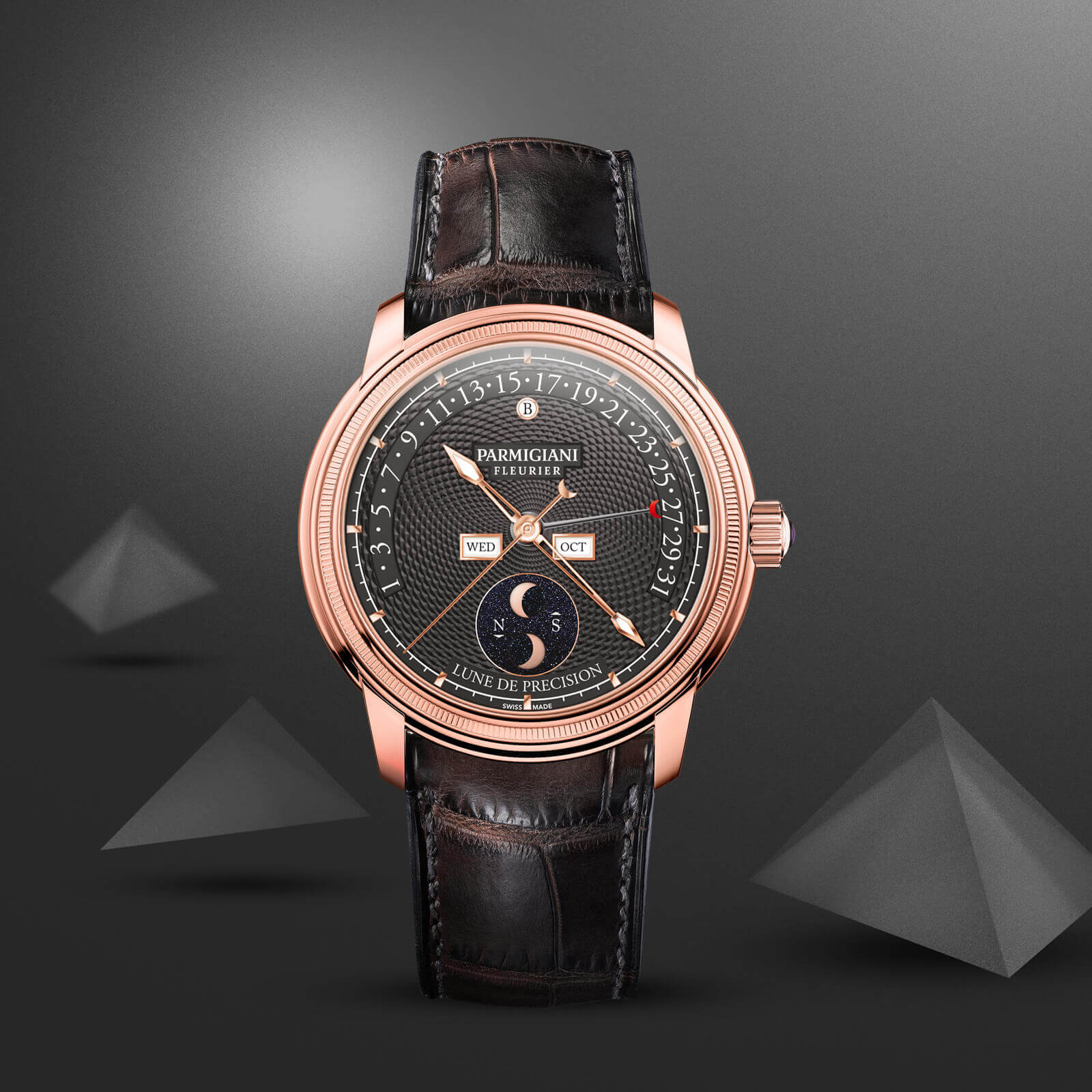
A moon phase indicator assumes a dominant position at 6 o’clock, depicting the lunar cycles in both the Northern and Southern hemispheres. A deep blue aventurine backdrop confers a celebration of colour that perfectly complements its polished gilded moons.

More often than not, luxury brands will use a series of sub-dials to communicate the day and month on a perpetual calendar. Parmigiani has taken a more novel route and used beautifully gilded windows to frame the day of the week and the month. Cleverly positioned just below the centre line, they ensure that the overall appearance of the watch is uncluttered, granting impressive legibility. Just below the 12 o’clock position, a tiny circular window, again gilded, indicates the Leap Year cycle.
The hour and minute are indicated using red gold Javelin shaped hands, a characteristic shared with other Toric models. Partially skeletonised, these slender red-gold hands are tipped with a luminescent coating to aid legibility. A simple, yet elegant, second hand reaches out to the applied hour markers and silvered minute track.
The overall look of the watch is a challenge to define; each feature within the dial exhibits a classical character while overall the composition bestows a modern aura. While the Quantième Perpétuel Rétrograde looks modern it also evinces a timeless quality. Lastly, the styling delivers a respectful nod to the brand’s inaugural piece of 1999.
Movement
The automatic calibre PF333 is visible through the exhibition caseback. As one would expect from a brand of Parmigiani Fleurier’s standing, the quality of each of the 414 components is refined to an exceptional standard. The rotor, finished in red gold, carries a deeply engraved Parmigiani Fleurier logo and is embellished with a beautiful wave pattern.

The bridges are bevelled and decorated with exceptional Côtes de Genève, while adjacent spaces afford partial views of the gear train below. Intricate levers which enable the calendar functions are all finished with a light linear brush, while mirror-polished screws are used throughout.

Finishing to this impeccable standard is admirable though not exceptional in the luxury watch world. What is extraordinary with the PF333 movement is the technical brilliance required to create the Perpetual Calendar. The challenge of February’s extra day in each leap year is overcome by the ingenious calendar module. Its cam, governing the months, is equipped with a planet gear. This ensures the retrograde calendar indicator automatically springs back to the first of the next month and negates the onerous task of resetting. The moon phase governor is also integrated into the calendar module and through a sophisticated gearing system, it can accurately indicate the phases of the moon with only one correction required every 122 years.

Powered by two mainsprings housed within two series-coupled barrels, the 4Hz PF333 movement will run autonomously for up to 50 hours once fully wound.
Strap
As with all Parmigiani’s leather straps, the band is fashioned by Hermès which in 2006 became a stakeholder in the Parmigiani Fleurier watchmaking centre. Synonymous with luxury, the Hermès strap is tan alligator leather with a red gold ardillon buckle. This perfectly complements the sumptuous gold Toric case.

Closing Thoughts
In the world of luxury watches there are brands that can trace their heritage back over 250 years. Although Parmigiani Fleurier is maybe one of the younger brands to grace the highest echelons of Haute Horlogerie, it proves one of the most capable. The shrewd acquisitions within the group allow the brand to manufacture all its own components, save for the Hermès straps. Therefore, Parmigiani Fleurier has incredible control over the making of its watches and can be fully confident in the quality of its products. Another benefit of independence is the creative freedom afforded to Michel Parmigiani and his team – which inevitably results in exciting creations.

To pair a perpetual calendar with a precision moon phase indicator represents a significant, almost daring challenge for even the most experienced master watchmaker. The Maison has uniquely interpreted the pairing of these complications and housed them within its classic Toric case, creating what is, for me, arguably the brand’s most impressive watch to date.
Further reading
Technical specifications
- Model: Parmigiani Fleurier Toric Quantième Perpétuel Rétrograde
- Reference: PFH427-1600200-HA1241 (slate) / PFH427-1602400-HA1241 (white grained)
- Case: 18-carat red gold; diameter 42.5 mm; height 12.1mm; water resistance 3ATM (30m); sapphire crystal to the front and exhibition case back.
- Functions: Hours; minutes; seconds; retrograde perpetual calendar; precision moon phase
- Movement: PF333; self-winding movement; frequency 28,800 vph (4Hz); 32 jewels; power reserve 50 hours; 414 components.
- Strap: Brown Hermès alligator strap with 18-carat red gold pin-buckle
- Price: €66,900 (slate) / €65,900 (white grained) – (RRP as at 13.3.2021)