
Parmigiani Fleurier Tonda 1950 Lune
The Parmigiani Fleurier Tonda 1950 Lune has received a facelift. This new model, housed in a luxurious 18-carat rose gold case, looks even more beautiful than its predecessor. However, while this watch is new, it continues to uphold the brand’s reputation for impeccable finishing and exquisite proportions. Angus Davies spends time with this paragon of high-end watchmaking.

When observing nature we often witness incredible, aesthetic beauty. Flowers often exhibit a becoming symmetry while the branches of a tree invariably emanate from the trunk such that its profile is balanced.
However, not everything in nature is balanced or symmetrical. The inside of a spiral-shaped Nautilus shell is comprised of several cavities. As the Nautilus grow they vacate one chamber and create a new living chamber adjacent, leaving a cavity behind. Each chamber increases in size, the nearer it is to the opening of the shell.
If the Nautilus shell is cut in half, it reveals several arcing cavity walls, each gradually increasing in magnitude. Mathematicians describe this phenomenon as the ‘golden ratio’. This can be defined as a ‘special number found by dividing a line into two parts so that the longer part divided by the smaller part is also equal to the whole length divided by the longer part’.
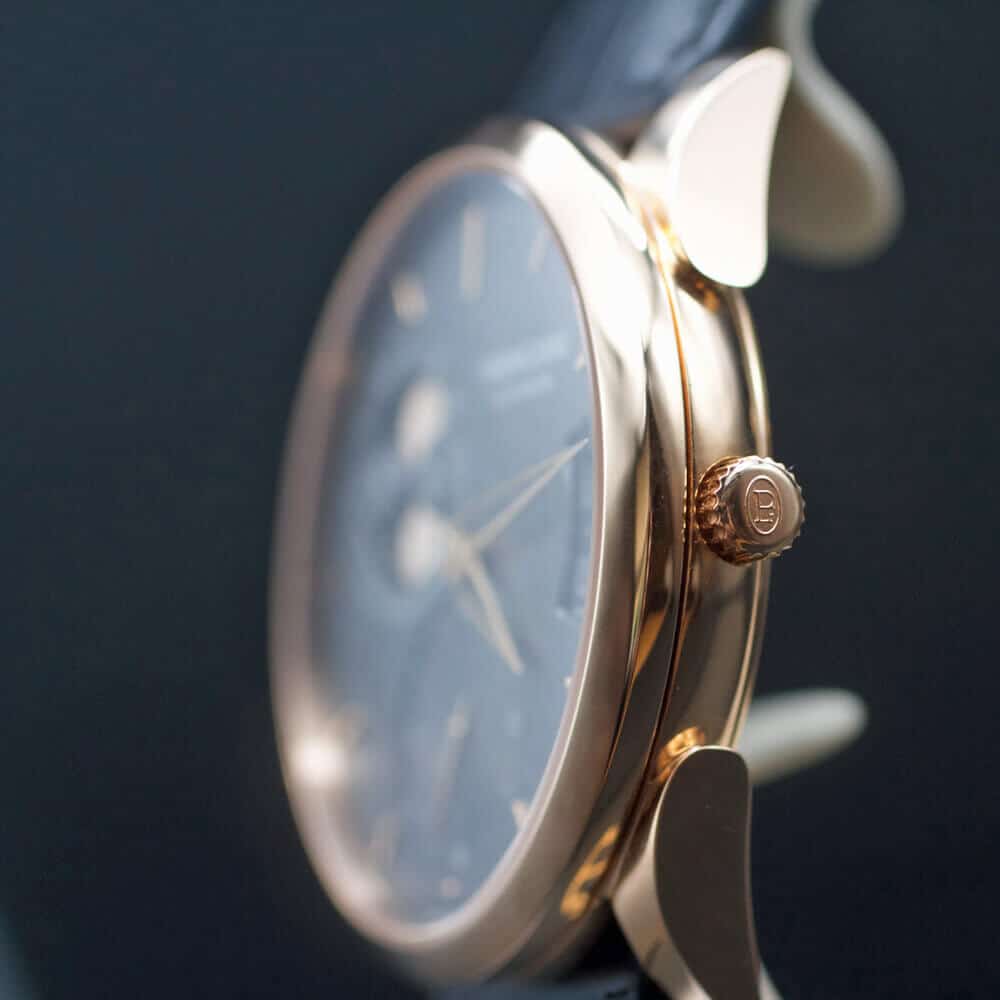
Michel Parmigiani, the founder of the eponymous firm, Parmigiani Fleurier, is obsessed with the golden ratio. He is a firm believer in the importance of proportions, lines and balance. The teardrop shaped lugs found on most of his watches subscribe to the golden ratio. If the lugs are closely examined, the upper surface assumes a different trajectory to the lower edge of the lug, however, the ratio between the two adheres to the golden ratio.
Every design element of a Parmigiani Fleurier watch is the culmination of protracted thought. Recently, the high-end Maison from the Val-de-Travers region revisited one of its existing designs, refining each element of its composition to a splendiferous conclusion.
While the previous Tonda 1950 Lune was undoubtedly a handsome watch, the styling of the new Parmigiani Fleurier Tonda 1950 Lune represents a huge step forward. Recently, I had the opportunity to wear the watch for a few days and I have detailed my thoughts herein.
The dial
A characteristic of many Parmigiani Fleurier watches is that they exhibit tasteful restraint. In an age where an increasing number of people, subscribing to today’s ‘celebrity culture’, choose to flaunt their wealth, Parmigiani Fleurier craft understated, elegant watches imbued with timeless appeal.
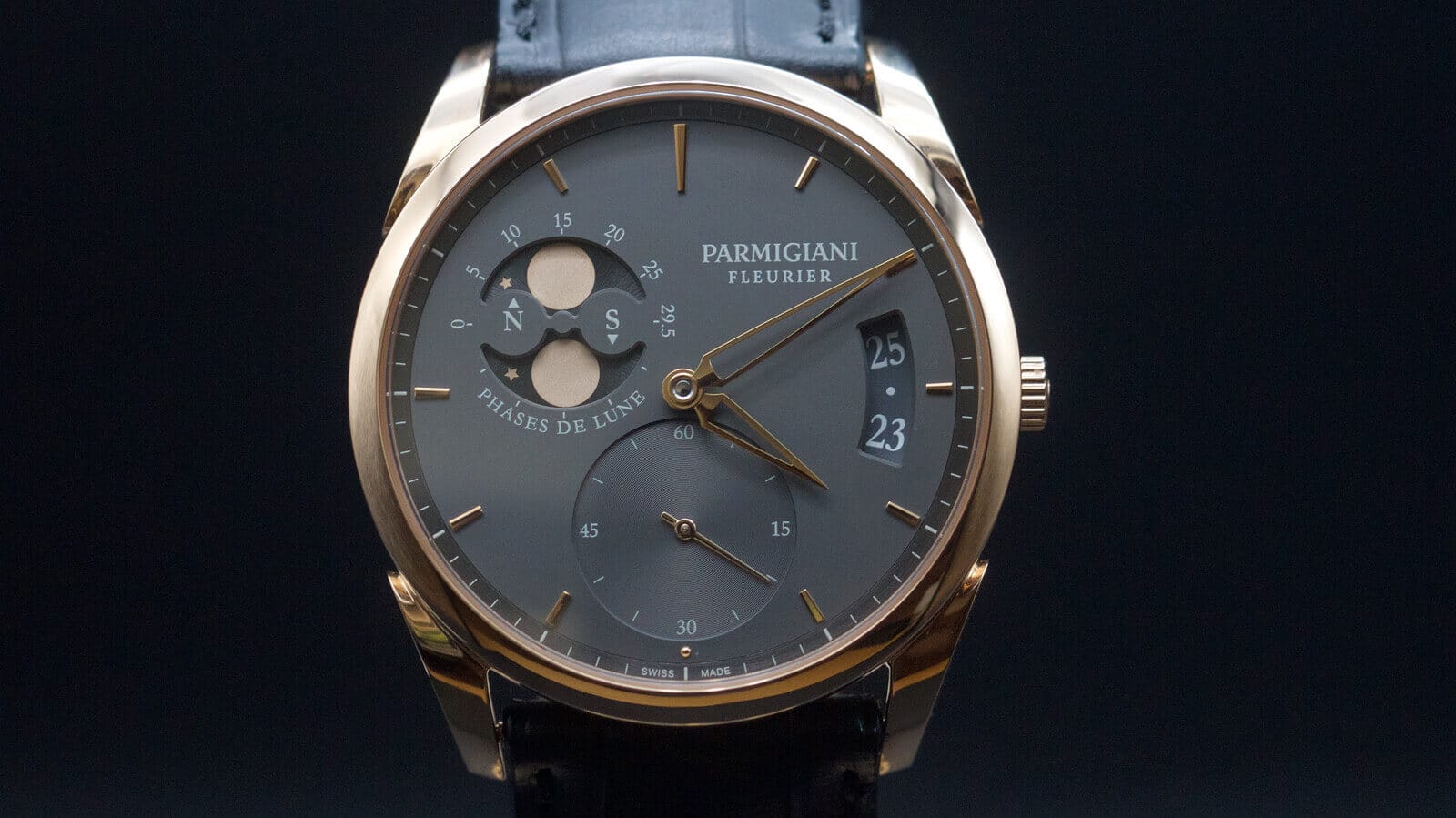
The dial is presented in a slate opaline finish which exhibits a soft, muted quality. It does not shout loudly but instead quietly converses with the wearer in seemly fashion. Moreover, the gentle nature of the dial tone provides the perfect foil for the functions presented, allowing each indication to succinctly communicate with the wearer.
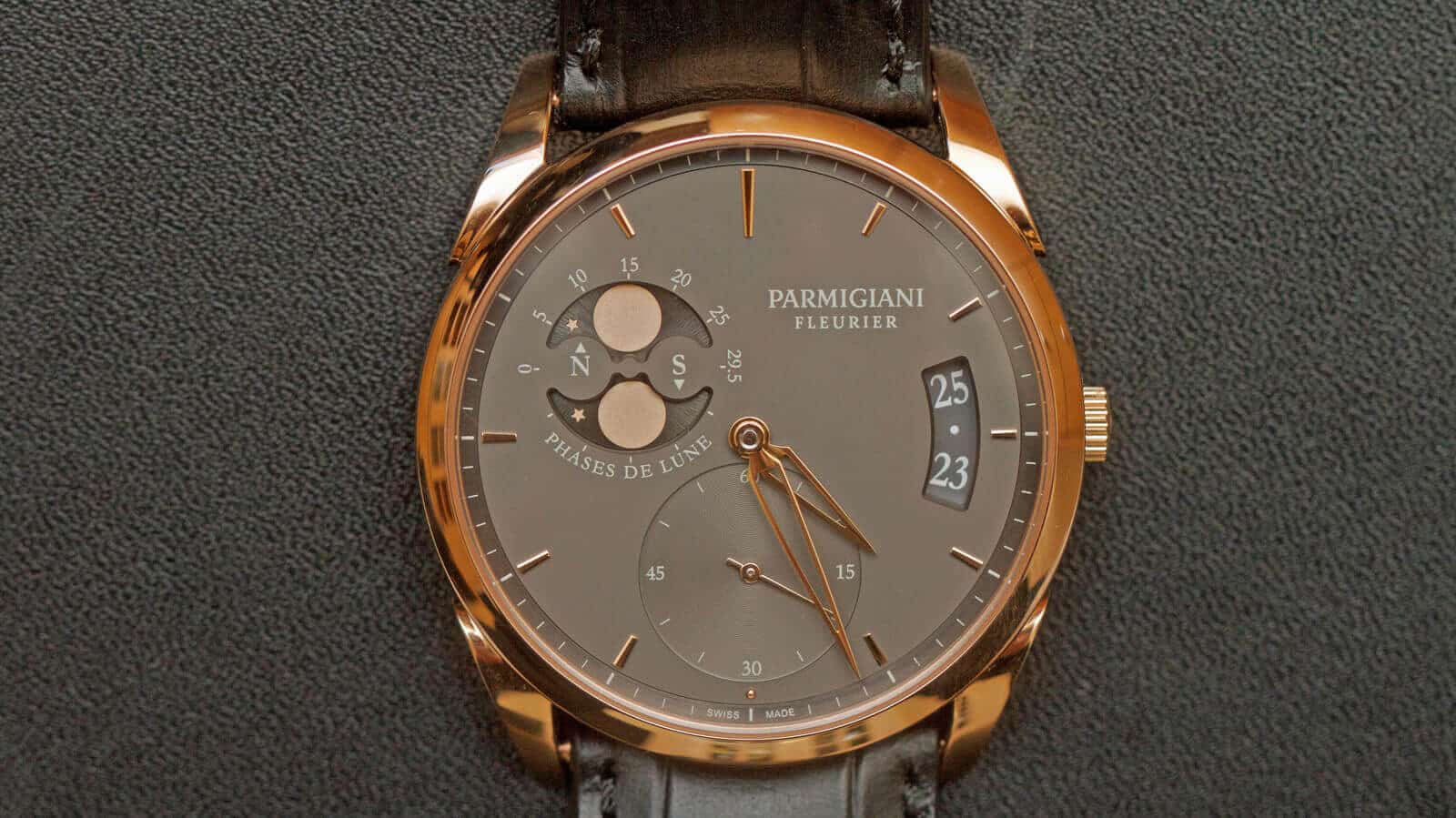
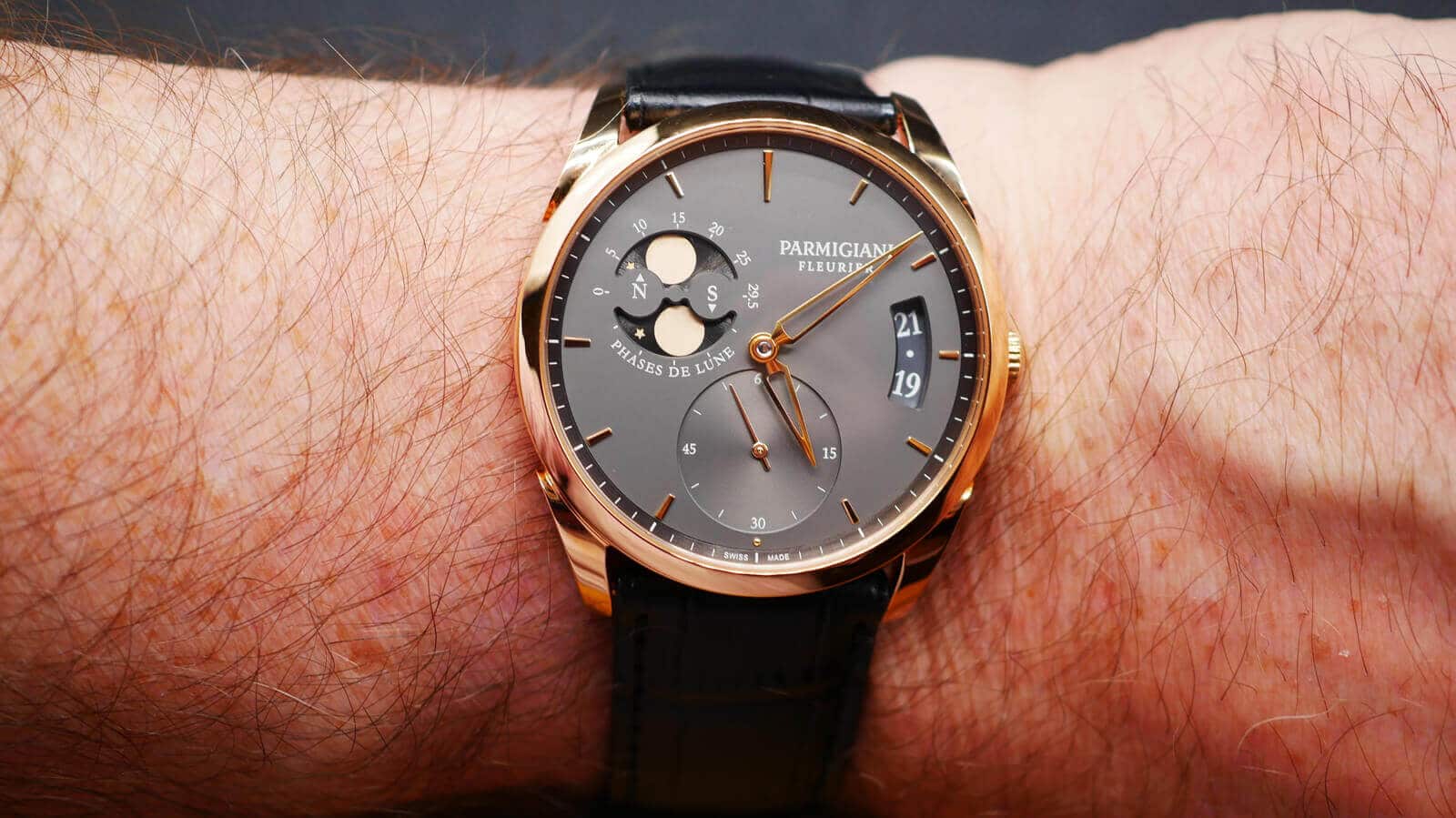
Delta-shaped hour and minute hands uphold the Maison’s proven design language. However, in recent months, Parmigiani Fleurier has endowed several of its newer models with openworked Delta-shaped hands. My first impression on seeing an image of the watch was that the hands, whilst clearly stylish, could prove difficult to read. Thankfully, having worn the watch for an extended period, my fears have been allayed.

Each hour is denoted with an applied index, while a minuterie hugs the periphery of the dial, aiding read-off. Consistent with its predecessor, the small seconds display is positioned at the base of the dial and incorporates snailed detail.
While the small seconds on the previous version of the Tonda 1950 Lune also incorporated a date display, the small seconds indication on this newer model sits alone. Instead, it features a separate elongated date aperture at 3 o’clock. By separating both functions, each proves easier to read and the overall appearance of the dial is tidier.
The lunar calendar on this latest model continues to show the moonphases for the northern and southern hemispheres. However, it has been relocated to 10 o’clock. The scale of the display remains unchanged, but by simply moving the indication the dial appears more balanced and each function has more room to breathe.
The brand’s nomenclature is now positioned between 1 and 2 o’clock and is much larger, providing a visual counterbalance to the aforementioned lunar calendar.
The case
Measuring 39.1mm in diameter, the case of the Parmigiani Fleurier Tonda 1950 Lune should suit the majority of potential wearers. While the watch is not marketed as ‘ultra-thin’, it does have a slender waist, measuring 9.6mm in height, allowing it to easily fit beneath a stylish shirt cuff.
Consistent with other Tonda models, the watch is fitted with teardrop-shaped lugs which seamlessly unite with the case without the merest hint of welding. While it would be cheaper for the brand if the flanks of the case were straight, Parmigiani Fleurier has chosen to embrace curving lines with the bezel projecting slightly from the neighbouring case band. These small details may sound inconsequential, but it is the brand’s attention to the minutiae which engenders lasting affection.
The crown features a crimped grip, facilitating adjustment, while the vertical flank of the crown is adorned with the brand’s logo, presented in relief.
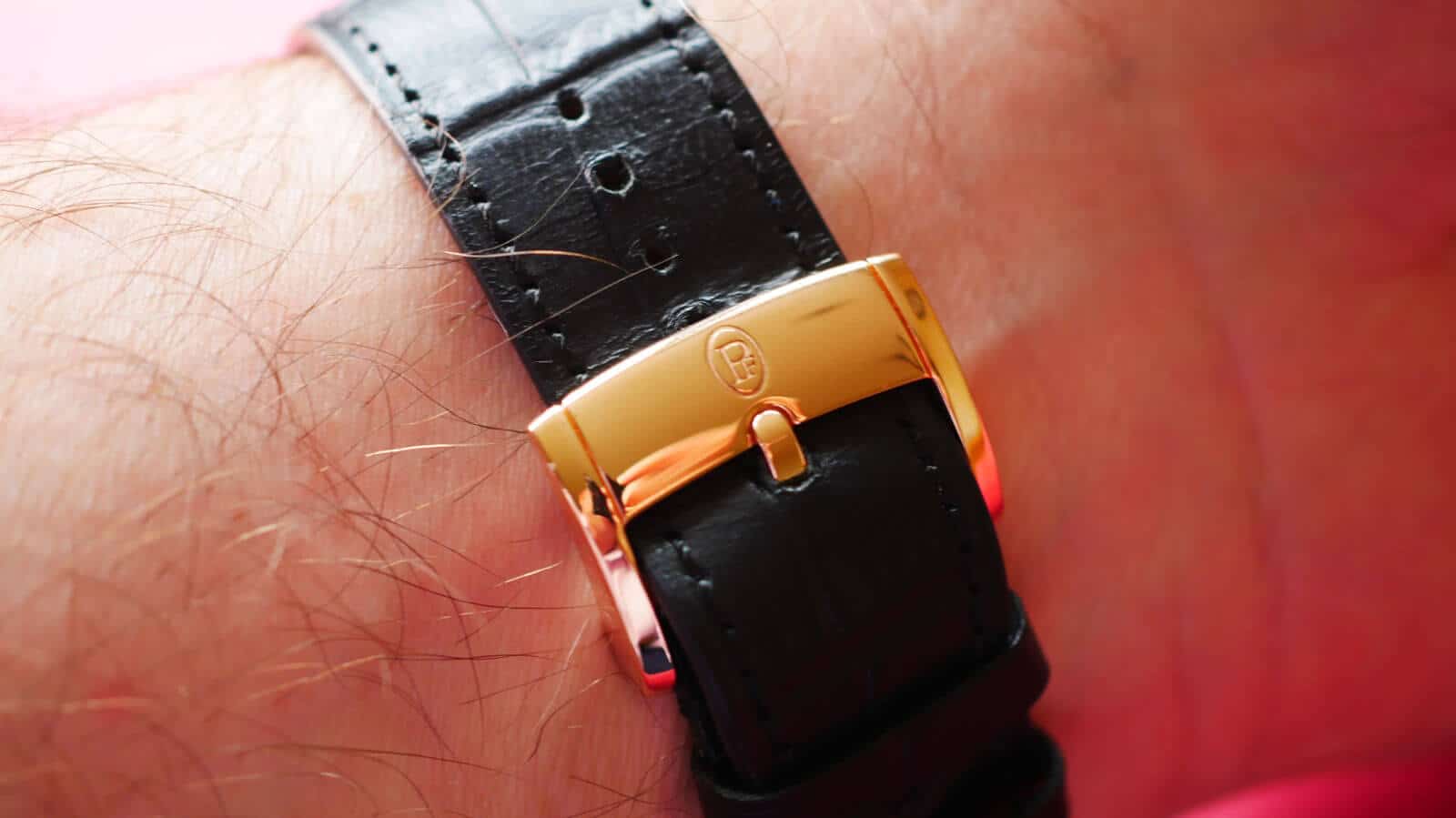
Consistent with all other Parmigiani Fleurier models, the Tonda 1950 Lune is supplied on a sumptuous Hermès strap paired with an 18-carat rose gold pin buckle.
The movement
The Parmigiani Fleurier Tonda 1950 Lune is equipped with an exhibition case back, affording views of the self-winding movement within. The Calibre PF708 measures just 4mm in depth, explaining why the watch’s svelte torso hugs the wrist with minimal protrusion.
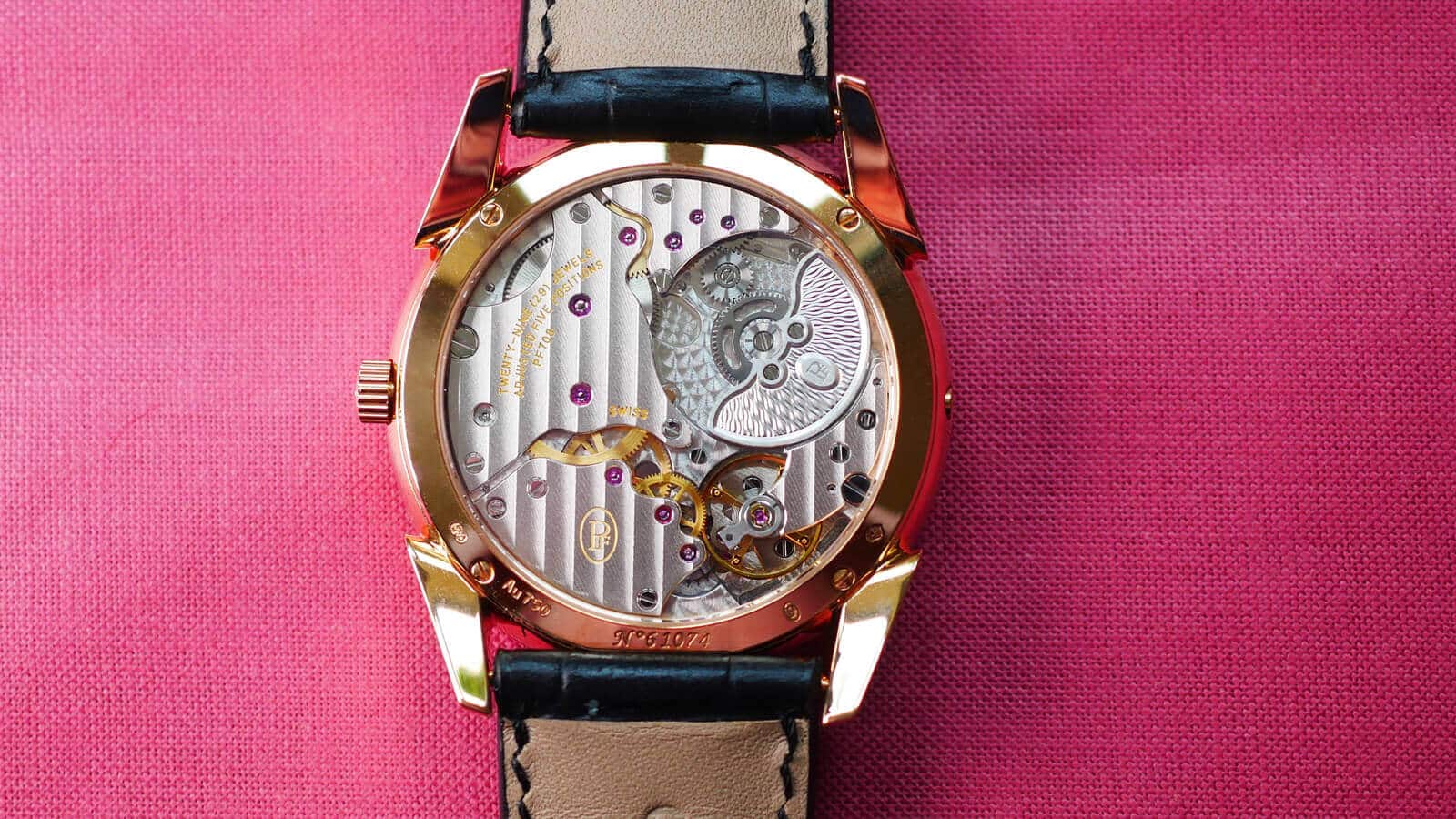
Another reason for the slender appearance of the watch can be attributed to the platinum micro-rotor within the watch. Where a conventional oscillating weight rotates above the bridges, the micro-rotor sits flush with the adjacent surfaces. Only a few companies make models fitted with a micro-rotor and Parmigiani Fleurier is one of the finest exponents in this field.
A notable attribute of the Parmigiani Fleurier Tonda 1950 Lune is the finishing. The bridges are adorned with beautifully defined Côtes de Genève. Moreover, they feature gleaming bevels, polished jewel and screw sinks and golden engraved text. The platinum micro-rotor is embellished with grain d’orge and the mainplate is decorated with perlage in two different sizes. Everything is executed to a decorous standard and fine watchmaking practise is manifest.
The variable inertia balance ensures the hairspring breathes concentrically and delivers superior performance to the ubiquitous curb-adjusted balance. Moreover, masselottes affixed to the spokes of the balance wheel cause less air turbulence than protruding screws, further enhancing precision. Incidentally, the Swiss firm Atokalpa, part of the Parmigiani family, makes the hairspring within this watch. Few watch brands make hairsprings, again highlighting the Maison’s impressive range of competencies.
The balance has a frequency of 21,600 VpH (3Hz) and the movement contains 194 components, including 29 jewels. The lone spring barrel provides 48 hours of autonomous operation.
Closing remarks
The Parmigiani Fleurier Tonda 1950 Lune is a highly accomplished performer. Its dial provides impressive readability coupled with an abundance of elegance and style. By repositioning various dial elements, each indication has more room to breathe, aiding interpretation as well as conferring a more harmonious aesthetic.
Michel Parmigiani’s obsession with the golden ratio is evident with this watch. The mathematical theory has imbued the case with a graceful mien. In addition, the arcing profile of the lugs confers a comfortable relationship between the case and the wrist.

When viewing a timepiece from Parmigiani Fleurier, it should be remembered that all the components, with the exception of the sapphire crystals, rubies and Hermès straps, are made in-house. There are very few companies capable of matching this degree of vertical integration.
The in-house Calibre PF708 offers the convenience of automatic winding while proving slim, courtesy of its platinum micro-rotor. This latter detail bestows unhindered views of the finely finished bridges. Again, while the Maison has considered the aesthetic appearance of components, each action confers a practical benefit. For example, the finissage not only removes signs of machining, but also enhances corrosion resistance.
Viewing the Parmigiani Fleurier Tonda 1950 Lune in its entirety, it is clear to see the successful marriage between form and function. Moreover, Mr Parmigiani has cleverly embraced the aesthetic balance and optimal proportions found in nature, bestowing an elegant mien.
Although this watch captures the majesty of nature, it also harnesses peerless craftsmanship, the finest materials and much technical skill. Indeed, while nature can often provide inspiration it is no substitute for expertise, an attribute Parmigiani Fleurier has in abundance.
Further reading
Technical specifications
- Model: Parmigiani Fleurier Tonda 1950 Lune
- Reference: PFC284-1000200
- Case: 18-carat rose gold; diameter 39.1mm; height 9.6mm; water resistance 3ATM (30 metres) sapphire crystals to the front and back
- Functions: Hours; minutes; small seconds; date; lunar calendar
- Movement: Calibre PF708; automatic movement; frequency 21,600 VpH (3Hz); 29 jewels; power reserve 48 hours; 194 components
- Strap: Black Hermès alligator strap paired with an 18-carat rose gold pin buckle
- Price: £24,900 (RRP as at 19.9.2019)