
Patek Philippe Ref. 5236P in-line perpetual calendar
The Patek Philippe Ref. 5236P in-line perpetual calendar displays the day, date and month via an elongated rectangular aperture, perfectly optimised for ease of understanding. While this form of display is new for the Genevan brand, the refined platinum case and superbly finished movement play to the luxury marque’s long-standing strengths.

In most countries, but not all, people read from left to right. Indeed, from a young age, we are conditioned to interpret information in such a way. When it comes to calendar watches, virtually all watch brands present the day, date and month via individual apertures. Few of us have questioned this, it is simply a horological convention.
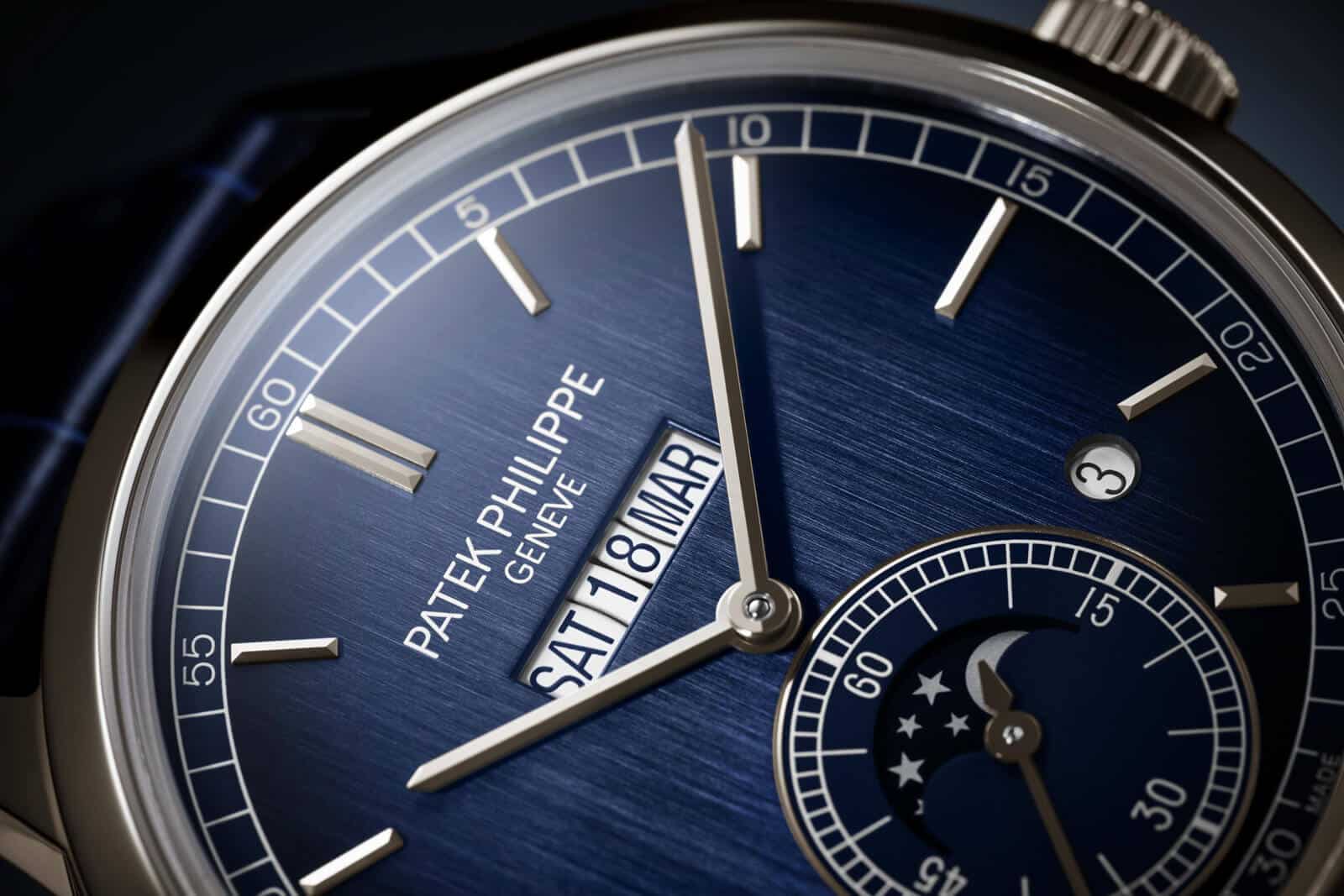
However, a few weeks ago, Patek Philippe unveiled its first model to be equipped with a fully in-line perpetual calendar display. With the new Ref. 5236P, the day, date and month are positioned adjacent to one another and revealed via an elongated rectangular aperture. There is no ambiguity, everything is expressed in a highly intelligible format. Indeed, a notable aspect of the display is that it is optimised for individuals accustomed to reading from left to right.

The Patek Philippe Ref. 5236P in-line perpetual calendar includes much ingenuity. This is manifest with three pending patent applications relating to innovations embedded in the mechanism which drive the fully in-line perpetual calendar displays.

In the lower portion of the dial, two circular apertures frame the leap year and day/night indications. An oversized small seconds display, positioned at 6 o’clock, incorporates a moon phase indication. The blue dial transitions to black near its periphery and its epidermis is enriched with vertical brush. White gold baton-style hands converse with matching applied hour markers as well as the chemin de fer encircling the dial.
Despite this model’s complex psyche, its face appears eminently simple. Unlike many indication-rich displays typically found on perpetual calendars, there is a welcome absence of clutter. Indeed, with the Patek Philippe Ref. 5236P in-line perpetual calendar, clarity is the watchword.

Housed in a 41.3mm platinum case, measuring 11.07mm in height, the dimensions of the Patek Philippe Ref. 5236P in-line perpetual calendar are comparatively restrained especially considering its complexity. Upholding Patek Philippe convention, a diamond is positioned between the horns at 6 o’clock, a visual reminder that the hand-polished case is formed of platinum.

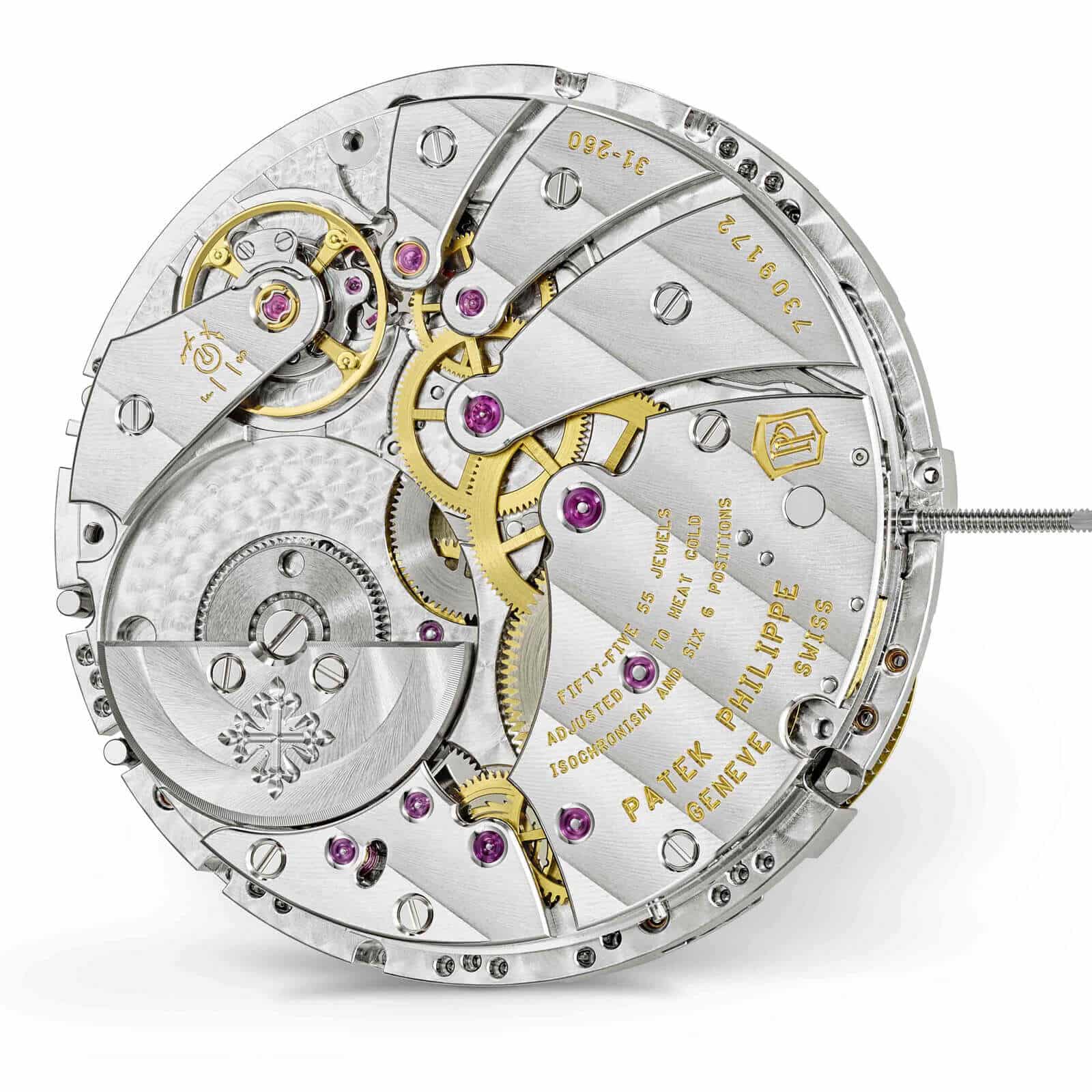
Powering the various indications is the Calibre 31-260 PS QL, a self-winding movement visible through an exhibition caseback. The day, date and month are conveyed with a complex mechanism of four discs. The date is imparted using the outer discs, one indicating tens and the other units.
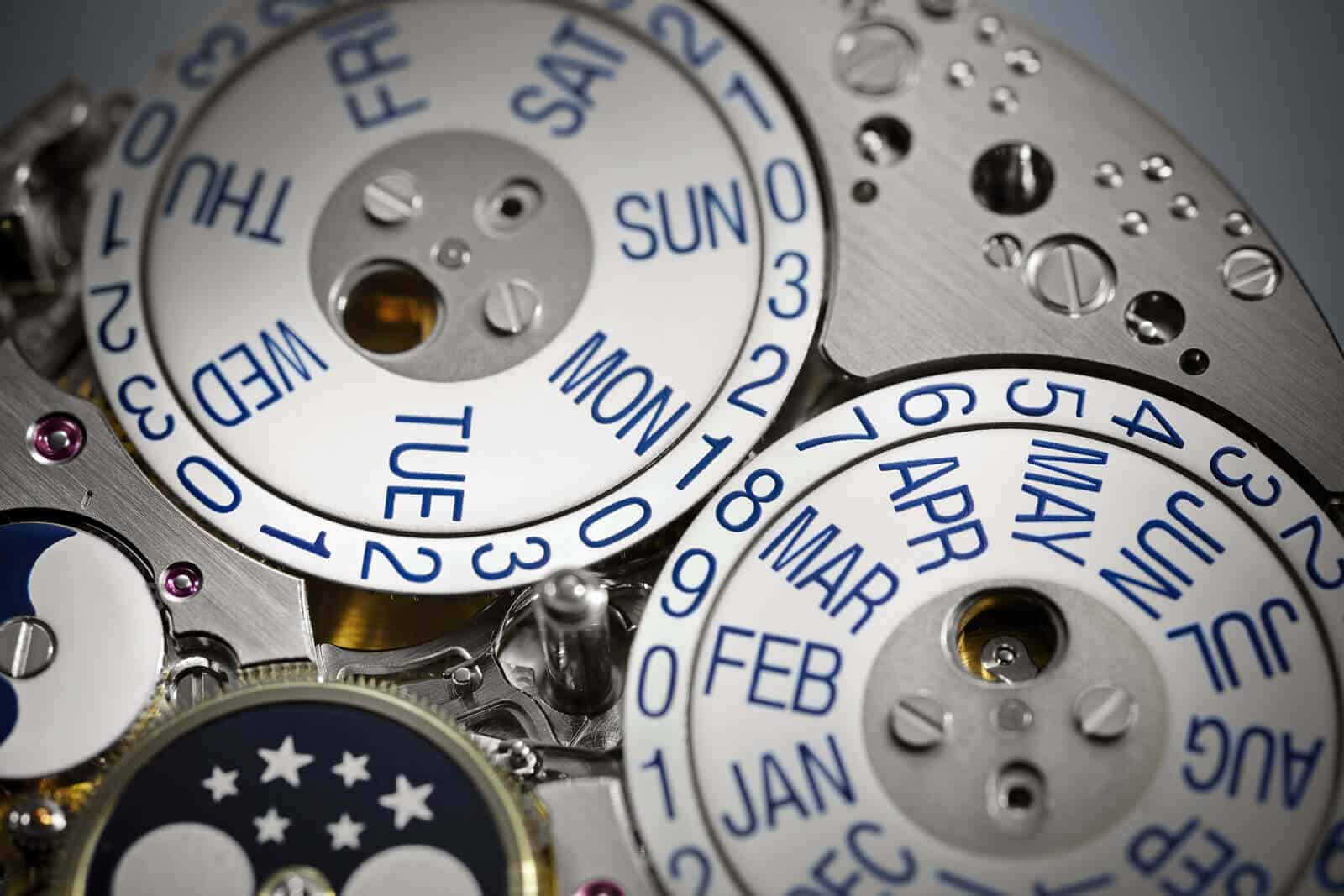
Other points to note include the micro-rotor is made of platinum. This noble metal is denser than gold and thereby generates greater inertia, energising the mainspring more efficiently. Furthermore, the micro-rotor is unidirectional, hence it will rotate with greater alacrity, again harnessing more energy. The variable inertia balance is a further refinement, delivering superior precision to an index-adjusted balance.
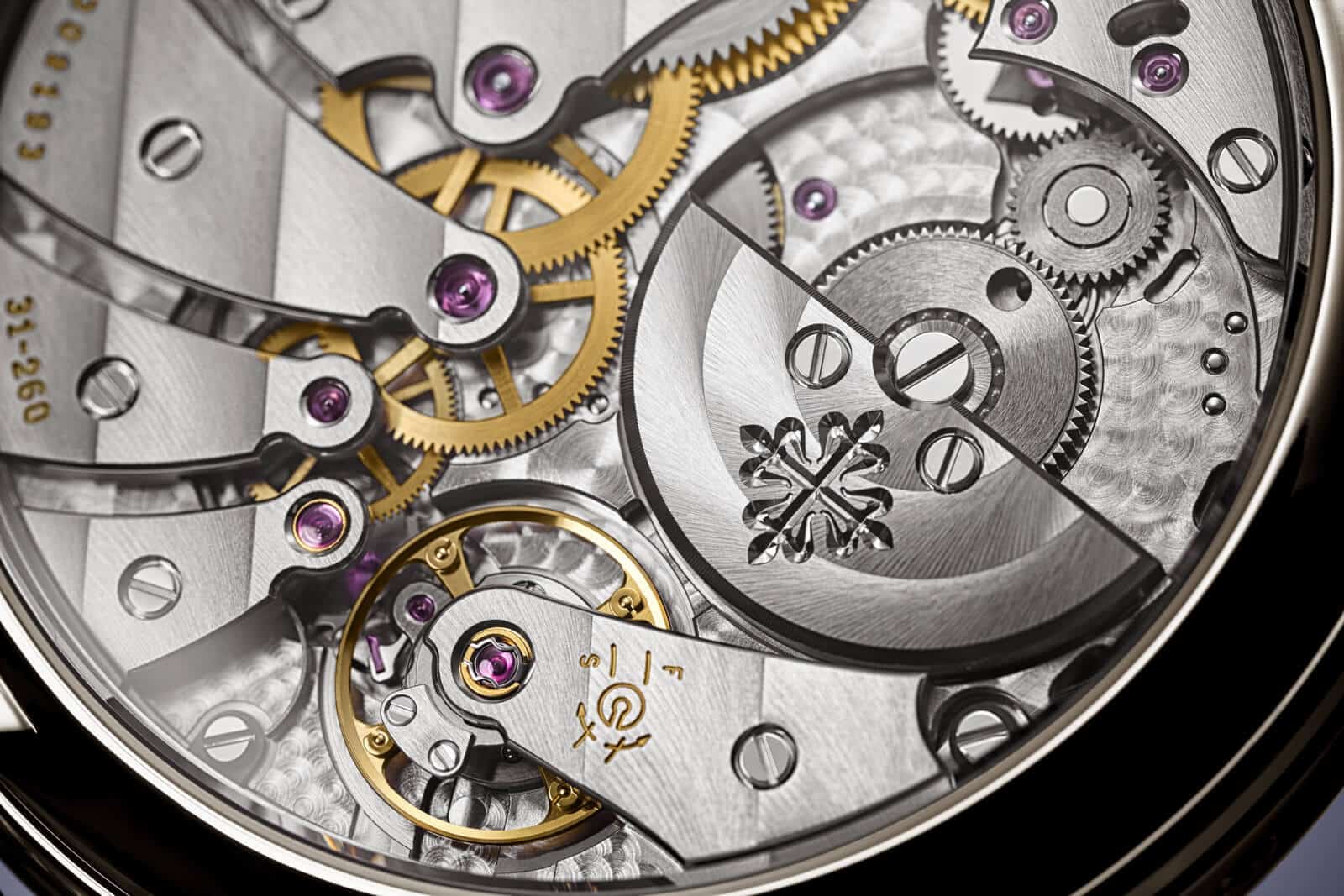
Beyond its technical virtues, the Calibre 31-260 PS QL is beautifully appointed. The bridges and cocks are adorned with Côtes de Genève motif, bright anglage, polished sinks for the screws and jewels as well as gilded engraved text. The finger-like cocks reveal numerous circular-grained wheels, showcasing their rotational behaviour. This refreshing characteristic provides a wonderful departure from the all too often modern approach of hiding everything from view beneath expansive bridges. Lastly, the mainplate is adorned with beautifully defined perlage, consistently sized and exquisitely crisp.

The elegant and understated appearance of the Patek Philippe Ref. 5236P in-line perpetual calendar should confer lasting eye-appeal and certainly promises to exhibit seemly conduct in all social settings.
The brand’s press release
Patek Philippe introduces a totally new perpetual calendar with an innovative patented one-line display
The manufacture has expanded its rich range of calendar watches with the addition of a perpetual calendar that displays the day, the date, and the month on a single line in an elongated aperture beneath 12 o’clock. To combine this unique feature with crisp legibility and high reliability, the designers developed a new self-winding movement for which three patent applications have been filed. This new in-line perpetual calendar premières in an elegant platinum case with a blue dial.

As classic grand complications par excellence, perpetual calendars have always been prominently featured in Patek Philippe’s collections. In 1925, the Genevan manufacture presented the first wristwatch with this highly elaborate complication (movement No 97’975; the watch is on display at the Patek Philippe Museum in Geneva, No. P-72). Patek Philippe perpetual calendars offer a wide range of design elements with analog or aperture displays and dial configurations. Models with the famous self-winding ultra-thin caliber 240 Q movement, such as the Ref. 5327, can be recognized by their day, date, and month displays in three separate subsidiary dials. The self-winding caliber 324 S Q, which among others powers the Ref. 5320, exhibits another traditional face among the manufacture’s perpetual calendars. It features a dual aperture for the day and month at 12 o’clock and a subsidiary dial at 6 o’clock for the analog date and the moon-phase display. The caliber 324 S QR also ticks in the Ref. 5160 and features an added complication: the date display with a retrograde hand that sweeps an arc from 8 to 4 o’clock. It is complemented with four aperture displays for the day of the week at 9 o’clock, the month at 3 o’clock, the leap year cycle at 12 o’clock, and the moon phases at 6 o’clock.
A new face for a brand-defining grand complication
With the launch of the Ref. 5236P-001, Patek Philippe gives the perpetual calendar a new face. For the new Ref. 5236P-001, this watch presents an innovative indication of the day, date, and month in an elongated aperture at 12 o’clock. A panoramic aperture of this kind is not totally unprecedented in the manufacture’s collections. In the course of time, the manufacture had already crafted pocket watches with an in-line calendar display for the American market. Customers in the new world were enthusiastic about complicated watches that were easy to operate and showed the indications of the perpetual calendar at a glance. One example of such timepieces is on display at the Patek Philippe Museum: it is a pocket watch from 1972 (No. P- 1450) that features a calendar format “à l’américaine” (month, date, day). But never before has the manufacture introduced a wristwatch with a full calendar on a single line as exemplified by the new Ref. 5236P-001.
To implement this masterpiece of miniaturization, Patek Philippe had to overcome totally new technical challenges. To assure the largest possible calendar display on a single line with optimized legibility, the developers were asked to design a system with two date disks – one for the tens and one for the units. So the calendar display consists of four disks, one for the day, two for the date, and one for the month – all four perfectly embedded in the same plane. A single date disk with 31 numerals would have been too small and less easily legible. In compliance with the manufacture’s basic principles as set forth in the directives of the Patek Philippe Seal, the new, complex mechanical ensemble had to be implemented with the smallest possible diameter and minimized height without compromising its maximum long-term dependability. For this reason, the project team proceeded on the basis of the caliber 31-260 REG QA that was originally launched in 2011 with the Ref. 5235 Annual Calendar Regulator. Not least because of its eccentric recessed minirotor, this self-winding movement with subsidiary seconds at 6 o’clock is extremely slender.
A new self-winding movement with optimized performance
While retaining the diameter and height of the basic movement (31.74 x 2.60 mm, hence the designation 31-260), the engineers completely reworked the new caliber 31-260 PS QL (PS for petite seconde [subsidiary seconds] and QL for “quantième perpétuel en ligne“ [in-line perpetual calendar]) and integrated the manufacture’s latest technical achievements. The movement was “tuned”, so to speak, so it could drive the particularly energy-hungry perpetual calendar mechanism. The torque of the spring barrel was increased by 20% and the winding power boosted with a platinum minirotor that has more mass than 22K gold that is normally used for Patek Philippe minirotors. Rate stability was improved by increasing the frequency from 3.2 to 4 Hz (28,800 semi-oscillations per hour) which also simplifies precision adjustments to the rate tolerance specified by the Patek Philippe Seal. Moreover, the caliber 31-260 PS QL is fitted with a reduction wheel that uncouples the automatic winder as soon as the movement is being manually wound. This is a Patek Philippe invention patented in 2019 that reduces wear. The aesthetic appeal of the movement is subtly evolved with two distinctive bridges for the escapement and the fourth wheel. Their configuration made the work of the engineers more difficult but it affords a better view of the basic movement’s wheel train, overall architecture, and refined finissage as revealed by the sapphire-crystal caseback. This back can be substituted with a solid platinum back that is delivered with the watch.

An innovative display mechanism crowned by three patents
The perpetual calendar mechanism (including a 12-month cam and a satellite cam for the month of February) is designed as a separate module with its own plate. This is a preferred solution for this movement, thanks to which the overall height of the caliber is smaller than with a partially integrated mechanism. The connection of the calendar with the basic movement is established with an intermediate wheel that engages with the hour-wheel pipe (a pinion that controls the minute hand). This second minute wheel is suspended between two jewels and meshes with a 24-hour wheel, also between jewels, which guarantees optimized energetic efficiency.
But the most innovative aspect is the single-line calendar display with four rotating disks, assuring optimized legibility, minimal energy consumption, and superb reliability. This mechanism alone required 118 additional parts in comparison with a conventional perpetual calendar display, including several bridges and wheels with jewel bearings that reduce energy consumption, especially of the two date disks. To keep all the indications on one plane without any overlap, Patek Philippe’s engineers developed a display system composed of two coplanar double ball bearings for which a patent application has been filed. The dependable date display and the perfect synchrony of the two date disks are optimized with an “anti-double-jump” feature for the units disk to prevent disk bounce in the event of a jolt or when a date correction is being performed (second patent application). The transition from the 31st day to the 1st day of the next month is the subject of the third patent application for a mechanism that immobilizes the units disk. This is done with a 31-point date star from which two teeth were removed.

The switching of the calendar displays is gradual. The display of the day, date, and month on a single line is complemented with two small round apertures, one at 4 o’clock for the leap year cycle and one at 8 o’clock for the day/night indicator. This information is very useful when the calendar needs to be set. The moon phases, an essential element of Patek Philippe’s perpetual calendars, are tracked with very high precision in a window within the subsidiary seconds dial at 6 o’clock. To facilitate the adjustment of the functions, three correctors – for the day, the date, and the month – are recessed in the case flank between 9 and 2 o’clock, in the same order as the respective displays. The moon phase corrector is positioned at 8 o’clock.

Timeless beauty
The looks of the new Ref. 5236P-001 in platinum are inspired by the Ref. 5235 Annual Calendar Regulator. It features a very sleek case with a diameter of 41.3 mm and a chamfered bezel. This unassuming architecture is emphasized with polished finissage that is executed by hand according to venerable Patek Philippe traditions. Slightly angled strap lugs extend the line of the chamfered bezel and assure optimized comfort on the wrist. As in most of Patek Philippe’s platinum wristwatches, the case flank features a small diamond at 6 o’clock. The blue dial with the black gradation to the periphery creates a harmonious contrast against the silvery shimmer of platinum. A vertical satin finish causes the light to sparkle. The progression of time is tracked with applied hour markers and baton hands in white gold. The technical accent of the railway track minute scale is echoed by the subsidiary seconds scale at 6 o’clock. The day, date, and month displays are clearly and legibly printed in blue on white. A navy blue alligator strap with a platinum fold-over clasp rounds out the inimitable personality of the Ref. 5236P-001 Perpetual Calendar with perfection. It opens up a new chapter in the storied history of Patek Philippe calendar timepieces.

Further reading