
Perrelet Turbine Yacht
The Perrelet Turbine Yacht collection has recently grown to include two new models, one housed in black PVD steel and another in stainless steel. Both watches feature the brand’s double rotor. Furthermore, when the uppermost ‘turbine’ is rotating, a series of fine lines is revealed which emulate the appearance of teak decking.

Abraham-Louis Perrelet (1729-1826), the son of a carpenter and farmer, helped his parents on the family’s farm, however, from a young age, he expressed a desire to become a watchmaker. The son of Le Locle began a watchmaking apprenticeship, but according to various accounts his instruction was poor. Thereafter, Perrelet elected to work independently and taught himself many aspects of watchmaking.
During the 18th century, Perrelet became known for his in-depth knowledge of escapements. However, he is probably best known for inventing the automatic pocket watch, equipped with a bi-directional rotor (1777). Perrelet’s self-winding concept has since been adapted for wristwatch use and, despite the passage of time, is still used by most watch brands.

In 1995, building on the legacy of Abraham-Louis Perrelet, the eponymous watch brand created its first ‘double rotor’ watch. A recess near the centre of the dial played host to a rotor which, in conjunction with a second rotor to the rear of the watch, energised the mainspring. While the double rotor system was said to enhance the self-winding action of the movement, the oscillating weight positioned dial-side also delivered a fascinating visual spectacle.

No doubt mindful of the visual allure granted by the front-facing rotor, Perrelet unveiled its first Turbine model in 2009. The dial-side rotor on this timepiece resembles the blades seen within an aeroplane engine and spins with extraordinary alacrity. The rotor is not connected to the spring barrel as this would slow its rotational speed. Indeed, the rationale for using the turbine is to endow the dial with an unusual dynamic appearance. In some instances, the dial surface beneath the turbine has been adorned with bright hues, patterns and even a depiction of playing cards. Over the years, the brand’s creativity has led it to produce numerous Turbine models.
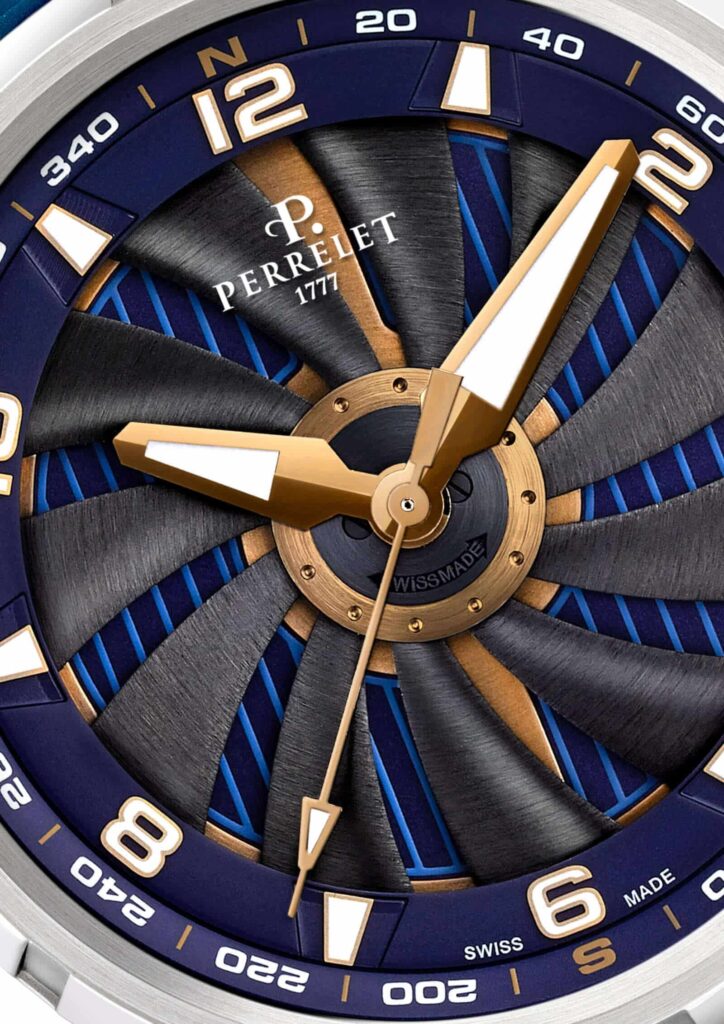
Now the Maison from Biel/Bienne has unveiled two new versions of the Perrelet Turbine Yacht, enlarging its portfolio of nautical-themed watches. One model is housed in a black PVD steel case, while the second is presented in a stainless steel case. Both watches measure 47mm in diameter, conferring notable wrist presence. Each model features 11 black titanium blades front of house and when in flight reveal a series of fine lines which emulate the appearance of teak decking. At the heart of the watch is Perrelet’s in-house calibre P-331 movement. Lastly, the model is water-resistant to 30 ATM (300m), making it ideal for sailing, swimming or other aquatic pursuits.
The brand’s press release
Perrelet welcomes the summer with two new timepieces in its TURBINE YACHT collection. With seaside holidays and nautical sports on the horizon, the prestigious Swiss watchmaker proposes a versatile watch suited for all occasions. The TURBINE YACHT is Perrelet’s resilient seagoing companion, ideal for yacht and sailing adventures or even just relaxing in elegant maritime resorts.
Perfectly rigged for nautical activities, the iconic Turbine – patented by Perrelet in 2009 and one of the distinctive elements of the new TURBINE YACHT – incorporates the useful compass rose function. Often featured on nautical maps, the wind rose displays the orientation of the four cardinal directions.

The new TURBINE YACHT models boast an attractive and refined design that echoes the colours of the sea and the aesthetic codes found on board on some of the most prestigious maritime vessels, combined with a high-performance automatic manufacture movement that powers the TURBINE YACHT models.
Offered in a 47mm stainless steel or steel with a black PVD case, these new creations are characterised by the intriguing and dynamic Turbine dial with its 11 black rotating titanium blades that evoke the shape of a yacht propeller.

Mounted on ball bearings with five tungsten counterweights underneath, the blades rotate with the slightest movement of the wrist and return to their starting point. As they spin around the dial, the blades reveal an attractive sub-dial. In alternating black/silver or electric blue/black tones, the vertical lines of the sub-dial are reminiscent of the teakwood decking of the yachts and further enhanced with a metallic applique in a silver or bronze colour.
The flange displays a mix of applied Arabic numbers and indices treated with luminescent material, just like the hands for the hours, minutes, and seconds. On the periphery of the flange is a bidirectional rotating ring indicating the cardinal points of North and South on a scale of 360°. It’s the integrated compass rose, the star function of the TURBINE YACHT. Activated by the crown at 10 o’clock, the compass allows you to maintain the set course. By establishing specific reference points and the sun’s orientation, calculating the different cardinal points is a straightforward task.

To balance harmoniously the design of the case, the winding and time-setting crown is positioned at 4 o’clock, perfectly symmetrical with the one that drives the compass rose.
In addition to their excellent precision and reliability, the 30 ATM (300m) water-resistance of the TURBINE YACHT makes them useful companions on deck as well as for exploring the depths.

The new TURBINE YACHT watches are powered by the automatic manufacture movement, calibre P-331, which beats at a frequency of 28,800vph and offers a power reserve of 42 hours. A ring embellished with the same fluting pattern of the case flanks secures the anti-reflective sapphire crystal porthole on the case-back and allows to admire the refined finishings, including Côtes de Genève decoration on the bridges and the open-worked rhodium-plated oscillating weight with the Perrelet logo.
The new models are fitted with a comfortable rubber strap – black or blue depending on the version – with a pin buckle to match the case material.
Further reading