
Piaget Altiplano Ultimate Concept Tourbillon 150th Anniversary Watch Review
The Piaget Altiplano Ultimate Concept Tourbillon 150th Anniversary is the latest creation from ‘the uncontested master of thin watches’, just unveiled at Watches & Wonders 2024. Mark McArthur-Christie delves into the history of the esteemed Manufacture before examining its latest svelte creation.

Piaget watch review
The great magician Harry Houdini wasn’t as much a magician as someone who redefined what magic could be. While other magicians were pulling things out of hats, he managed to escape water-filled tanks, milk cans and boxes, free himself from straitjackets suspended from cranes and even dig his way out of a grave. He could shed a pair of handcuffs – even specially-made models – as easily as you or I could take off a watch.
Piaget depuis 1874
Watching Piaget unveil a new release gives you a sense of what it must have been like seeing Houdini in action. You never quite know what trick they’re going to pull next. It’s also wholly fitting they both started out in the same year – 1874.
Piaget has come a long way from those early days of watch part manufacture. And they’ve done it by giving their customers less, rather than more, watch for their money.

Piaget calibre 9P
The story starts in 1957 when Piaget introduced the world’s thinnest mechanical movement, the Calibre 9P. It was just 2 mm in height. To give you an idea of how remarkable that was, the glorious 20-jewel Omega Calibre 471 was 5.5 mm high. OK, the Calibre 471 is a self-winder, so one needs to take the winding weight and gears into account, but even the hand-winding cal. 265 measured in at 4 mm.
It says a lot that even the tech development team at Richard Mille has only managed to chip 0.25 of a millimetre from Piaget’s record with its RM UP-01 aided by modern materials and manufacturing technology. Mind you, that’s still a 25% reduction and not for sneezing at.
Making ultra-thin calibres
Bear in mind that making a movement at least half the depth of anything else out there isn’t just a case of taking a hacksaw to the components and reducing their height. For starters, the power of a mainspring comes not just from its length but how much force can be stored in the coiled metal. Reduce the size of the spring and (in practical terms at least) you reduce its power. So your new thin watch won’t run for very long. Then what are you going to do about things like balance pivots, the ratio of the spring barrel to the spring inside, the depth of the gear wheels… putting a watch on a radical diet isn’t an easy thing. It’s even harder if you choose to retain a ‘normal’ case diameter rather than flattening everything out like a beer mat.

This wasn’t about to stop Piaget. The Calibre 9P was just the start of a run of record-breaking ultra-thin movements, including the 12P in 1960, the 1200P and the 1208P in 2010 and the ground-breaking 900P in 2014.
Piaget is celebrating its 150-year anniversary
This year is Piaget’s 150th anniversary, so the firm thought they’d do something special. It’s also been 67 years since the 9P and a mere 6 years since they introduced the thinnest watch in the world, the Altiplano Ultimate Concept, so you can bet it’ll be something worth waiting for.

Piaget Calibre 970P-UC
But what’s this? Piaget’s 150th anniversary watch is a lardy, positively pie-munching 2mm thick! What’s going on? It’s the Piaget Altiplano Ultimate Concept Tourbillon 150th Anniversaire powered by the new Calibre 970P-UC – a watch where the movement is a great deal more compact than the name. That name also tells you what you need to know; Piaget has managed to get a tourbillon in there somewhere. That’s like getting an elephant into a Mini (a proper one) – and there’s no joke involved.
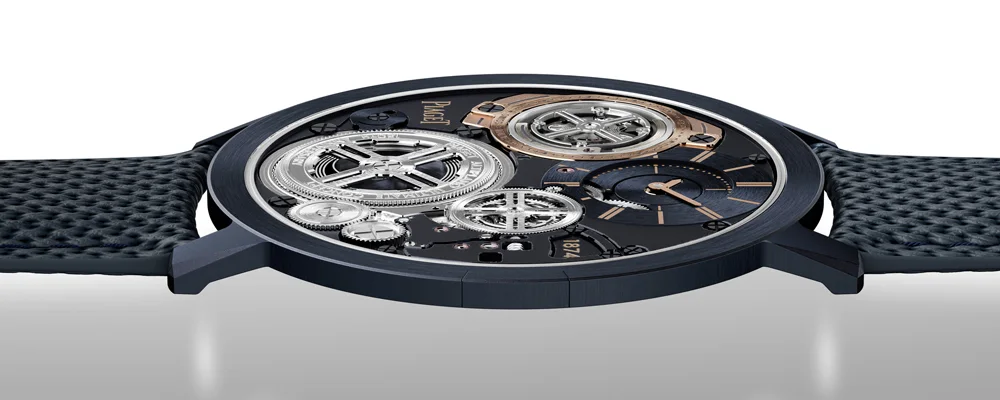
There’s no beer mat of a case, either. The Anniversaire measures in at just 41.5 mm. Remember the thing about the mainspring – that making it thinner means less power? That’s even more of a challenge when you’re trying to run a tourbillon. Spinning the cage takes an extra 30% more power than a standard watch. Perhaps there really is some magic in La Côte-aux-Fées. More likely, a great deal of hard work, many late nights and a lot of coffee. The new movement has, after all, taken the firm three years to design, prototype and manufacture.
Piaget – more than adding a tourbillon
Piaget’s CEO, Benjamin Comar, is being unusually modest for a Watchworld chief exec who’s just gone Houdini. He says, “The connection with the Altiplano Ultimate Concept is clear but we did far more than merely add a tourbillon. We reinvented everything.” Merely adding a tourbillon? Because most of us can come up with a way to fit one into a waiflike case before breakfast most mornings. Good grief.
Piaget Altiplano Ultimate Concept Tourbillon 150th Anniversary – flying tourbillon
So how did they do it? Well, at the risk of getting struck by a lightning bolt from Abraham the Father, by doing the same thing Swatch does. If you’ve ever wondered why the tick of a Swatch will wake the dead, it’s because the caseback is actually part of the movement; it’s the mainplate, so the caseback acts as a resonator. Same with the rather more exalted Anniversaire. Using the caseback this way saves a significant amount of space, especially when it’s made from a deep blue treated cobalt alloy, which offers the ideal thinness to hardness ratio. And if you thought that meant a display caseback was off the menu, nope. There’s a tiny circular window so you can watch the tourbillon rotating, jewels and all.

A case 2 mm thick (or should that be thin?) will struggle to cope with a conventional crown. So Piaget has integrated the ‘crown’ into the case edge and you pull it out and operate it with a dedicated stylus. Naturally, this contains a gear reduction and torque control system. Of course it does; crowns are so last year, darling.
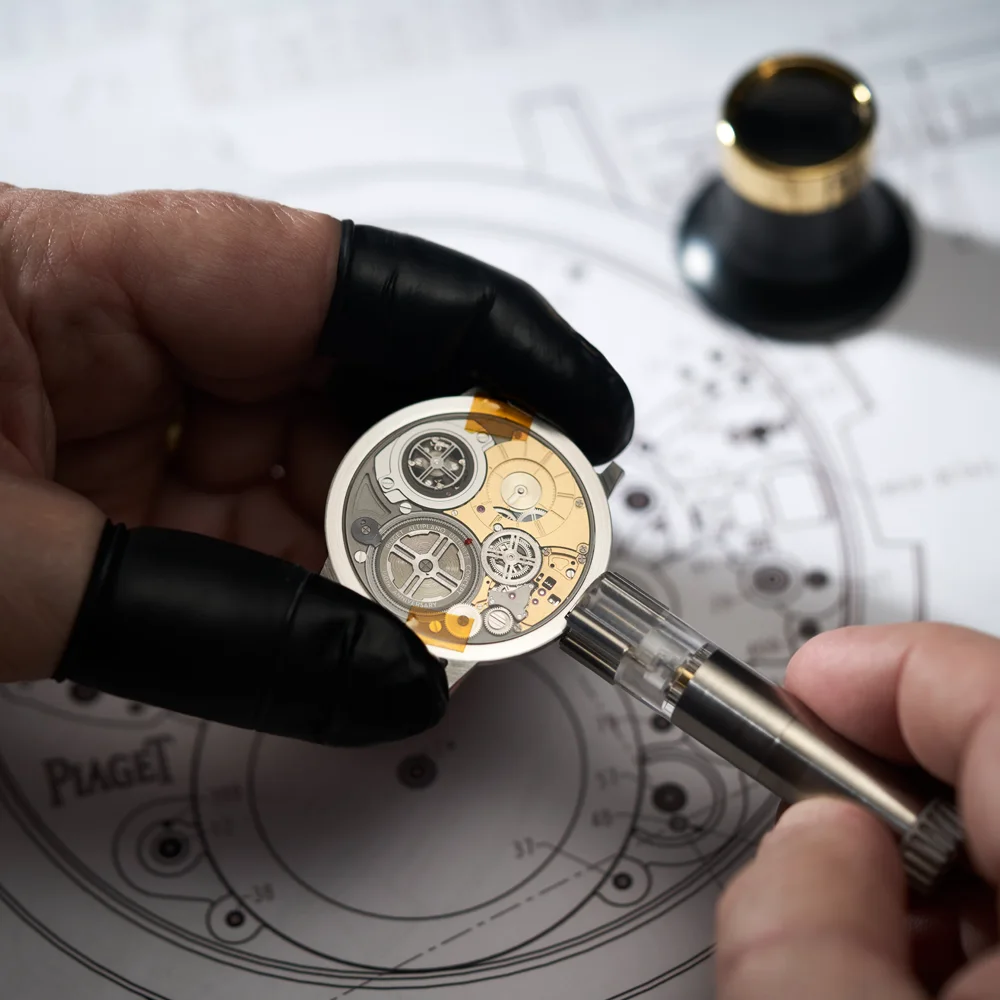
This is all very well, but what about that tourbillon? To be fair, Piaget already had form where spinny things are concerned. The Calibre 670P is hardly lardy at 4.6 mm and that runs a flying tourbillon, for goodness’ sake, and still it remains sylph-like, fitting comfortably into a 7.35 mm thick case. It manages the trick by not having an upper bridge, so it’s just held in place by its underside, hence the term ‘flying tourbillon’.
At this level of watchmaking, craftspeople are working in hundredths of a millimetre, but even then they can come up short. Despite their best efforts they still couldn’t persuade the tourbillon into the Anniversaire’s movement. And a tourbillon isn’t really the sort of thing you can just shoehorn in and hope.
Piaget Altiplano Ultimate Concept Tourbillon 150th Anniversary – tolerances
Even machining parts to such tolerances represents a serious challenge. With the balance wheel rim and the sapphire crystal both just 0.2 mm thick, the machines that craft them have to work to an accuracy of around 2 microns – two thousandths of a millimetre. And that’s before the parts have been decorated. Why make things easy? A watchmaker diamond polishes and chamfers the train wheels, now made with four arms instead of the six the firm previously used, by hand. Imagine the sheer skill you’d need to hand-finish a wheel with tolerances that would make a hair look like a transatlantic cable without deforming them.
Piaget Altiplano Ultimate Concept Tourbillon 150th Anniversary – ‘three years of work’
One imagines there was a great deal of trying, testing, planning, thinking and a significant amount of swearing. It must have been wonderful to watch a process of engineering and creativity coming together like this.

Eventually, the idea emerged that if the tourbillon couldn’t be held in place by a top or bottom bridge (the logical way to hold it as it rotates) it could be held in place by its circumference. That’s quite the challenge, given the whole point of a tourbillon is to rotate. Piaget’s watch engineers worked out that if they could turn the tourbillon into, in effect, the inner race of a bearing with the baseplate acting as the outside, they’d have a working watch.
So in the Anniversaire, the tourbillon’s outer edge is held in place by a ceramic ball bearing, which drives its one-minute rotation. It is mainly made of titanium, and steel where possible. Easy enough to write, but just getting to this point took 70 versions of the cage in which the tourbillon sits.

But this was only half the problem. Remember Piaget needed 30% more power from their mainspring than for the earlier Altiplano Ultimate Concept Tourbillon? That was clearly not sufficiently challenging for the firm’s watchmakers; they also wanted to produce a watch that would run for at least 35 hours without a wind.
When you’re working on a power-based challenge like this, there are two options; increase the power of the mainspring or reduce friction within the movement. At this scale, the best option was both of them.
Piaget Altiplano Ultimate Concept Tourbillon 150th Anniversary – bespoke mainspring
The Calibre 970P-UC mainspring is, unsurprisingly, made to measure. But it has also been reworked by increasing the thickness of the blade. That extra mass and area boosts its power. Then, Piaget ditched almost every pivot and replaced them with ball bearings. Bearings allow parts to move with far less friction than pivots but they’re a lot harder to manufacture. Neatly, because there’s less friction, the parts also wear at a far slower rate. Between the new Charles Atlas mainspring and ironing out friction, there is now enough energy for the power reserve while allowing the watchmakers to achieve an even thinner outcome.

Making a watch like this even a few years ago would have been unthinkable. Materials and tolerances simply weren’t up to it – even if watchmakers’ skills were. But with finer machining and better materials, movements this slim move from the drawing board to the wrist. Even so, this was far from a simple project. It took 15 versions of the anchor and 30 versions of the case frame before the Piaget team were happy.
Piaget M64BC cobalt alloy
You’d think that a watch two thirds as thick as a pound coin would be a shy little thing, designed more for looking at than wearing. Not so, says Piaget, “the Altiplano Ultimate Concept Tourbillon is made to be worn.” A look at the case material confirms this. It’s M64BC cobalt alloy – the sort of stuff you use for permanent surgical implants, so it’s really not the sort of watch you’ll have to baby. And you don’t even need to panic about getting it wet – the case is water resistant to 100ft, but probably best not to go diving in it.
Piaget Altiplano Ultimate Concept Tourbillon 150th Anniversary – what next?
So for its 150th, the firm from Côte-aux-Fées has, yet again, managed to delight its fans by giving them less. It seems to be a bit of a theme. I can’t help wondering what on earth is next?
Further reading
Technical specifications
- Model: Piaget Altiplano Ultimate Concept Tourbillon 150th Anniversary
- Case: M64BC cobalt alloy, blue PVD-treated, diameter 41.5 mm, height 2 mm (including crystal), water resistance 2 ATM (20 m), sapphire crystal to the front. Exhibition case back with sapphire crystal porthole
- Functions: hours, minutes, small seconds on tourbillon cage
- Movement: Piaget Manufacture 970P-UC ultra-thin tourbillon, hand-wound movement, frequency 28,800 vph (4 Hz), 13 jewels, power reserve at least 35 hours
- Price on application