
Piaget Polo Chronograph Watch
The Piaget Polo Chronograph Watch upholds the Swiss brand’s reputation for making high-end timepieces blessed with pre-possessing looks. However, this model also possesses much inner beauty. Angus Davies get’s ‘hands-on’ with this supremely refined chronograph equipped with a column wheel and vertical coupling ensemble.

Not all watches are created equal
Stereotypes are often misguided and sometimes cruel. Marilyn Monroe was one of the most beautiful women of the 20th century and frequently played a ‘dumb blonde’. However, she reputedly had an IQ of 163 and spent much time in the company of various literary figures such as Truman Capote, Isak Dinesen and Arthur Miller, whom she eventually married. Marilyn would be seen reading books by James Joyce or Dostoyevsky. The idiom ‘don’t judge a book by its cover’ seems most appropriate when referring to this Hollywood icon.
In the world of watches, not all creations are equal. A dial that spangles with gems and is dressed in vivid colours does not a masterpiece make. A truly splendid watch is authentic, beautiful and mechanically virtuous. Indeed, if Marilyn Monroe taught us anything, it is beauty and intelligence are not mutually exclusive.
Piaget has a rich history of crafting pulchritudinous timepieces rich in technical virtue and endowed with sublime finishing. Indeed, the brand’s handsome watches are not merely objects of beauty, they also encompass incredible substance.
Piaget depuis 1874
Founded in 1874, Piaget set up its inaugural workshop on a farm in the village of La Côte-aux-Fées, located in the Swiss Jura. The company was a family business dedicated to the production of high-end watch movements. At the time, specialist firms such as Piaget made movements for so-called établisseurs.
In 1943, the movement specialist became a watch brand in its own right. Most notably, Piaget became known for making ultra-thin movements. Initially, the firm produced the hand-wound 9P caliber (1957) and, just three years later, the Maison created the thinnest automatic movement, the 12P caliber (1960).

Making ultra-thin watches is not for the faint-hearted. Indeed, in the pursuit of slenderness, a watch firm must ensure the movement retains sufficient torsional rigidity to confer reliability and precision. Piaget is also known for its skeleton watches. In order to create a timepiece with a near-diaphanous movement, material has to be carefully removed. However, it is essential that material near the jewel beds, screws, gear train etc is left intact, again, ensuring that reliability and precision are preserved.
Today, the Manufacture operates from two sites, La Côte-aux-Fées and Plan-les-Ouates on the outskirts of Geneva. Beyond its expertise, making ultra-thin watches and skeleton timepieces, Piaget is highly proficient at making chronographs as well as high-complications such as tourbillons and minute repeaters. And, lastly, Piaget is renowned for enriching each composition with flawless finishing.
Quite simply, a Piaget watch is not merely a pretty face, it encompasses the finest watchmaking skill and is a paragon of refinement.
Piaget Polo Chronograph Watch – dial
The dial of the Piaget Polo Chronograph Watch is lavishly dressed in silvery hues. This provides a perfect complement to the 42 mm stainless steel case. The ‘guilloché’ dial is adorned with horizontal ridges, introducing both texture and depths, two qualities that often enrich the finest dials.

The lancine-shaped hour and minute hands, lined with Super-LumiNova, chat with luminescent batons. The central chronograph seconds hand is lithe and elegant. In contrast, the counterweight affixed to the central chronograph seconds hand is bold, openworked and features the Piaget ‘P’ emblem. However, rest assured while this latter detail is comparatively conspicuous, it remains seemly and tasteful.
At the epicentre of Piaget’s culture is an extraordinary appreciation of style, hence it comes as no surprise that the brand has successfully fused different curves and lines. For example, the case of this model is cushion-shaped while the outer edge of the bezel is round. A minute track hugs the inner surfaces of the case and facilitates ease of read-off. Finally, a trapezoidal date aperture sits at 6 o’clock, revealing black numerals set atop a white disc.
However, the pièce de résistance is undoubtedly the gorgeous blue counters. Often termed a ‘Panda dial’, this bi-compax configuration proves sublime. Firstly, the silver tones that are in widespread use provide a wonderful foil for the cerulean hues. Secondly, two registers always look preferable to three. Quite simply, the alluring symmetry is difficult to resist.
The chronograph register, positioned adjacent to the crown, indicates the elapsed minutes (up to 30 minutes). The second chronograph register, located at 9 o’clock, displays the elapsed hours (up to 12 hours). As I reveal later (see movement), there is much intelligence dwelling behind these bewitching blue eyes.
Piaget Polo Chronograph Watch – case
As stated previously, the stainless steel case measures 42mm in diameter. Personally, I find this size suits my wrist perfectly, albeit I am aware some horophiles are now favouring sub-40mm cases. However, don’t dismiss the Piaget Polo Chronograph Watch based on its stated diameter. The lugs are very short, hence the model ‘wears smaller’ than its dimensions would suggest. I recommend readers try on the watch before making a hasty decision and potentially missing out on a fabulous watch.

While I am not averse to watches housed in noble metal, I do like the honesty and unpretentiousness of stainless steel. In this instance, the bezel is satin-brushed, horizontally orientated from left to right and has a gleaming bevelled edge. This juxtaposing of different finishes is repeated throughout. Both forms of polishing are discrete and beautifully executed. Furthermore, Piaget has skilfully blended both forms of decoration, tastefully navigating a shrewd path between ebullience and conservatism.
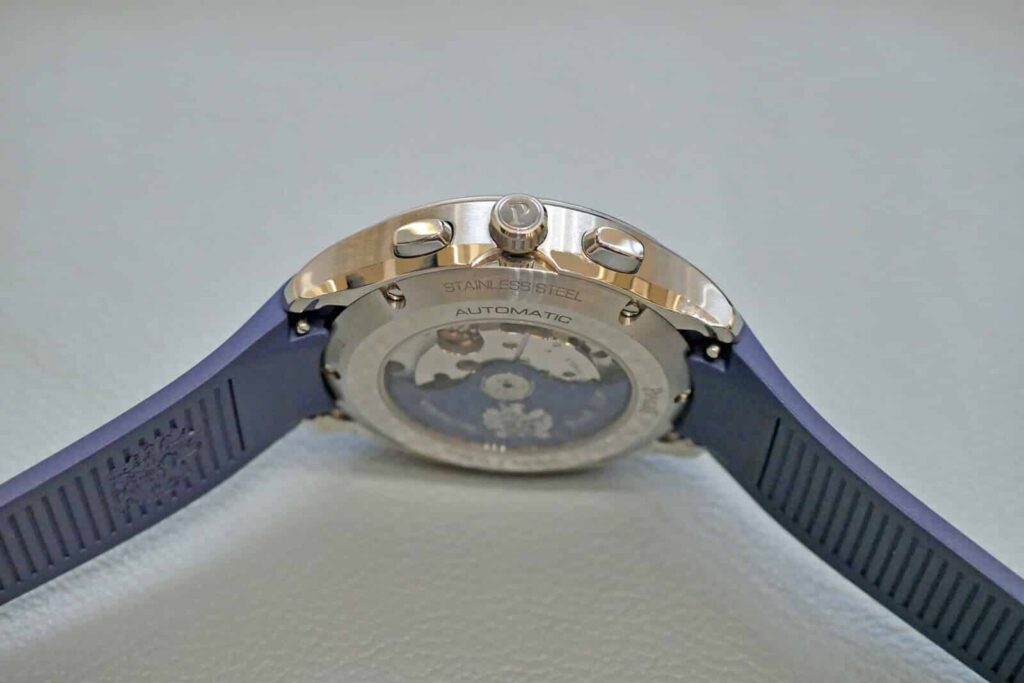
The Piaget Polo Chronograph Watch is supplied on a sporty, blue rubber strap. This specification detail imbues the watch with a contemporary air and proves eminently practical. Simple quick-release fittings to the rear of the watch allow the wearer to remove the strap without the need for tools.
Piaget Polo Chronograph Watch – Calibre 1160P
The self-winding Calibre 1160P is visible via an exhibition caseback. It’s a purist’s movement featuring the optimum specification of a column wheel and vertical coupling.

When actuating some chronographs, the central chronograph seconds hand momentarily stutters or wobbles. However, a vertical coupling is always in mesh, hence when started, the central chronograph seconds hand begins its journey with a smooth gait, free of any hesitation or jumping.
Another problem afflicting some chronographs is that a base movement (modular type) can experience ‘drag’ when the chronograph is in use. Drag is where the amplitude of the balance falls as some of the base movement’s energy is diverted to the chronograph module. This ultimately impairs precision. Again, no such problems blight this exquisite column wheel and vertical coupling ensemble.
Lastly, there is less wear with a vertical coupling and pressing the pushpieces rewards the fingers with a buttery smoothness.
Quite simply, this movement should not be contrasted with a low-priced modular or cam-actuated chronograph. On the contrary, the Calibre 1160P is far more sophisticated than that.
Piaget is synonymous with Haute Horlogerie, hence the Calibre 1160P is finished to the highest order. The mainplate is circular-grained, the oscillating mass is engraved with the Piaget coat of arms and blued screws adorn the bridges. The bridges and the oscillating weight are embellished with circular Côtes de Genève. Dressed in blue PVD, the appearance of the oscillating weight reinforces the sense of modernity.
Piaget Polo Chronograph Watch – closing remarks
Every week, my inbox almost brims over with press releases from watch brands. Moreover, there are numerous watches that on the face of it look very attractive. However, the Piaget Polo Chronograph Watch is more than a pretty face. Although there is no escaping the dial of this Piaget is rich in both depths and textures, the focal point of the dial is undoubtedly the model’s blue counters. These serve a functional role as well as bestowing a becoming symmetry to proceedings.
While the Piaget Polo Chronograph Watch is contemporary and sporty, it also encompasses traditional finishing typical of fine watchmaking. Indeed, despite its exalted execution, this model represents remarkable value when contrasted with other exemplars of Haute Horlogerie.

However, returning to a comment I made earlier, ‘there is much intelligence dwelling behind those bewitching blue eyes’. The self-winding Calibre 1160P features a column wheel with a vertical coupling. In my opinion, this is the ultimate expression of chronograph ownership for the various reasons I outlined previously.
In the esoteric world of luxury watchmaking, there are many attractive faces to seduce the onlooker, however, not all timepieces are imbued with such extraordinary intelligence and inner beauty as this Piaget model.
Further reading
Technical specifications
- Model: Piaget Polo Chronograph Watch
- Reference: G0A46013
- Case: Stainless steel; diameter 42 mm; height 11.2mm; water resistance 10ATM (100m); sapphire crystal to the front and exhibition case back.
- Functions: Hours; minutes; date; chronograph
- Movement: Calibre 1160P; self-winding movement; frequency 28,800 vph (4Hz); 35 jewels; power reserve 50 hours.
- Strap: Blue rubber strap
- Price: £13,100 (RRP as at 18.1.2022)