
Piaget Polo Skeleton Gold Watch GOA46009 Review
The Piaget Polo Skeleton Gold Watch GOA46009 unites two of the brand’s specialties, namely skeletonisation and ultra-thin calibres. Both of these horological genres require an extraordinary amount of expertise, something which is much in evidence with this eye-catching exemplar of Haute Horlogerie.

Note – protective film affixed to the bezel
Skeleton watches
A few years ago, I chatted with a highly accomplished watchmaker about his time attending watchmaking school in Switzerland. At the time we spoke, he was a well-respected, industry veteran, hence his memories had acquired a sepia-hued tint around the edges. Nevertheless, he still recalled the occasion when his tutor handed him a regular hand-wound calibre and tasked him with transforming it into a finely executed skeleton movement.
He spent every waking minute removing every morsel of surplus material from the mainplate. Thereafter, he ensured that each minuscule section of metal was exquisitely finished. Perlage, anglage, blued screws and mirror polishing were just some of the refinements he imparted to his masterpiece.
On completing the task, the trainee watchmaker presented his prized skeleton movement to his tutor. Cradling the movement in his hands, the tutor smiled and nodded. He remarked, “It’s very beautiful”, but just as the young watchmaker began to beam with pride, the tutor proceeded to press the movement against his desk, causing it to bend and proclaimed, “But it’s very weak.”
I have always remembered this tale and to be honest, it has made me wary of some skeleton watches. However, Piaget is different. The Manufacture has vast experience making skeleton watches and is also referred to as ‘the master of ultra-thin’. Indeed, this latter form of timepiece also presents many challenges in terms of rigidity and positioning components.
Piaget – savoir faire
The high-end brand can trace its origins to 1874 when Georges-Édouard Piaget founded his eponymous company. Initially, the company was a movement specialist, supplying high-end calibres to various établisseurs. However, in the 1940s, the Jura-based firm became a fully-fledged watch company.
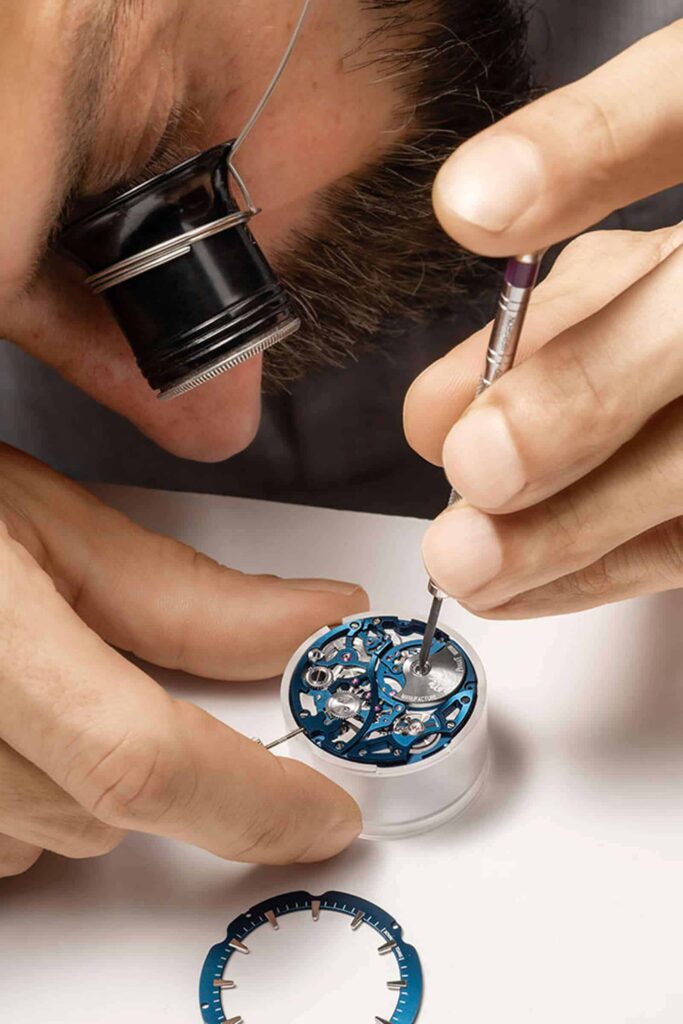
In 1957, the Manufacture released the now-legendary, hand-wound Caliber 9P. Measuring just 2mm in height, the movement featured optimally designed and positioned components skilfully arranged to achieve unprecedented svelteness.
Two years later, the Swiss brand released the Caliber 12P. At the time, the automatic calibre was billed as ‘the thinnest automatic movement in the world’. Rather than employ a full-sized oscillating weight positioned atop the bridges, Piaget employed a micro-rotor that sat flush with the neighbouring plates. This ingenuity culminated in a total thickness of 2.3mm, a remarkable figure even today.

It may sound like a simple task to make an ultra-thin movement, but the shape, size and position of each component must be carefully considered. There are few pockets of air left uninhabited. Moreover, with less brass in evidence, greater consideration has to be given to rigidity. The potential for flex could lead to individual parts unintentionally fouling one another.
In the modern era, CAD systems are used for watch design. Calculations are made in order to establish the forces at play and to determine the torsional rigidity of each component. Piaget understands ultra-thin better than anyone, hence it is a leader in the field.
History of skeleton watches
André Charles Caron (1697-1775) was a French watchmaker, widely attributed with making the first skeleton watches. The raison d’être for this horological genre is to reveal numerous movement parts usually hidden from view and to endow the composition with a degree of visual lightness.
Traditionally, a ‘regular’ movement would be skeletonised using handsaws and files. Any extraneous material was removed. A competent artisan would retain all of the material near the jewel beds, screws or gear train, to ensure the reliability of the movement was not impaired. These days, an increasing number of companies pare back the movement using CNC or a combination of CNC and traditional methods.
By removing material, often rhodium-plated brass, the exposed movement can exhibit a delightful diaphanous-like appearance. Furthermore, certain moving parts can be seen by the onlooker, delivering a dynamic performance par excellence. Lastly, the most accomplished finisseurs have their day, showcasing their skills by imbuing each surface with peerless finishing.
In many cases, skeleton watches share the same thickness as a watch fitted with a regular movement to preserve as much torsional stiffness as possible. However, ever since 1975, when Piaget unveiled the Calibre 9S, the Maison has been creating wonderful expressions of Haute Horlogerie that fuse the esoteric genres of skeletonisation and ultra-thin calibres.
Piaget Polo Skeleton Watch GOA46009 – front of house
Appraising the Piaget Polo Skeleton Gold Watch GOA46009 from the front, there are numerous details to absorb. The golden hour and minute hands are facetted and employ an openwork design. A problem with many skeleton watches is that the hands can become lost within a sea of exposed parts. Thankfully, no such problems afflict this Piaget model. The Swiss Maison has dressed the skeletonised main plate in a bewitching shade of blue, creating a useful degree of contrast.

A blue flange hugs the inside of the case and is marked with a minute track, the brand’s name and the watch’s country of origin. The flange also plays host to rose gold indexes. These are secured to the flange at one end and then cantilever over the movement and, in so doing, masterfully combine blue and gold hues as well as delightfully playing with depths.
Perusing the movement from the front, one is able to see parts of the keyless works adjacent to the crown and the hour wheel and minute wheel positioned centre stage. However, the two headline acts are the openwork barrel between 12 and 1 o’clock and the balance wheel at 6 o’clock. Finally, the micro-rotor resides between 8 and 10 o’clock and bears the Manufacture’s signature, visible via an aperture in the main plate.
By employing a palette of blue, gold and silvery hues, Piaget has created an extraordinary degree of contrast, thereby allowing the wearer to identify movement parts while easily reading the prevailing time.
Piaget Polo Skeleton Gold Watch GOA46009 case
Presented in a 42 mm 18-carat rose gold case, the Piaget Polo Skeleton Gold Watch GOA46009 doesn’t overwhelm the wrist. Indeed, this model upholds the luxury marque’s reputation for making ultra-thin watches. In this instance, the case is just 6.5 mm in height, a remarkable figure made possible by the svelte physique of the movement, the Manufacture Piaget 1200S1, which measures just 2.4 mm in thickness.

Note – protective film affixed to the bezel
The outer edge of the bezel features a gleaming bevelled edge, while the upper surface is adorned with a brushed finish, running east to west. This interplay of brushed and polished surfaces is repeated throughout. Interestingly, the interior of the bezel is a fusion of circular and square forms, differentiating this model from many of its contemporaries.
A pane of a sapphire crystal is affixed to the rear of the case, affording sight of the blue-toned, Calibre 1200S1. Piaget has chosen to present the watch on a blue alligator strap paired with a folding clasp. The strap has quick-release fittings, allowing the wearer to swap the supplied blue item for an alternative without the need for tools.
Rear of the watch (verso)
The beauty of skeleton watches is that they often afford front to rear views, allowing the wearer to look through the movement when held against the light. However, on some occasions, this can prove annoying if the wearer is somewhat hirsute. I am pleased to report that no such issues afflict the Piaget. Despite having hair-clad arms, the Piaget spared my blushes by keeping my unsightly hairiness out of view.

Similar to the front of the watch, Piaget has revealed much to the rear. The micro-rotor is, once again, displayed in all of its glory and, in this instance, is engraved with the brand’s historic coat-of-arms. The transmission wheel is positioned adjacent to the crown and sends power via two intermediary transmission wheels which rotate the ratchet wheel. On most watches, the wearer rarely sees the outcome of the ratchet wheel turning, however, the Piaget is different. As the ratchet wheel rotates, the wearer is able to observe the mainspring being tensioned, courtesy of the openwork barrel.
Above the micro-rotor, the wearer can see the train for the self-winding mechanism which also drives the ratchet wheel when worn. The main gear train or going train is only partially visible, but the four rubies, positioned to the right of the transmission wheel, provide a clue as to their whereabouts.
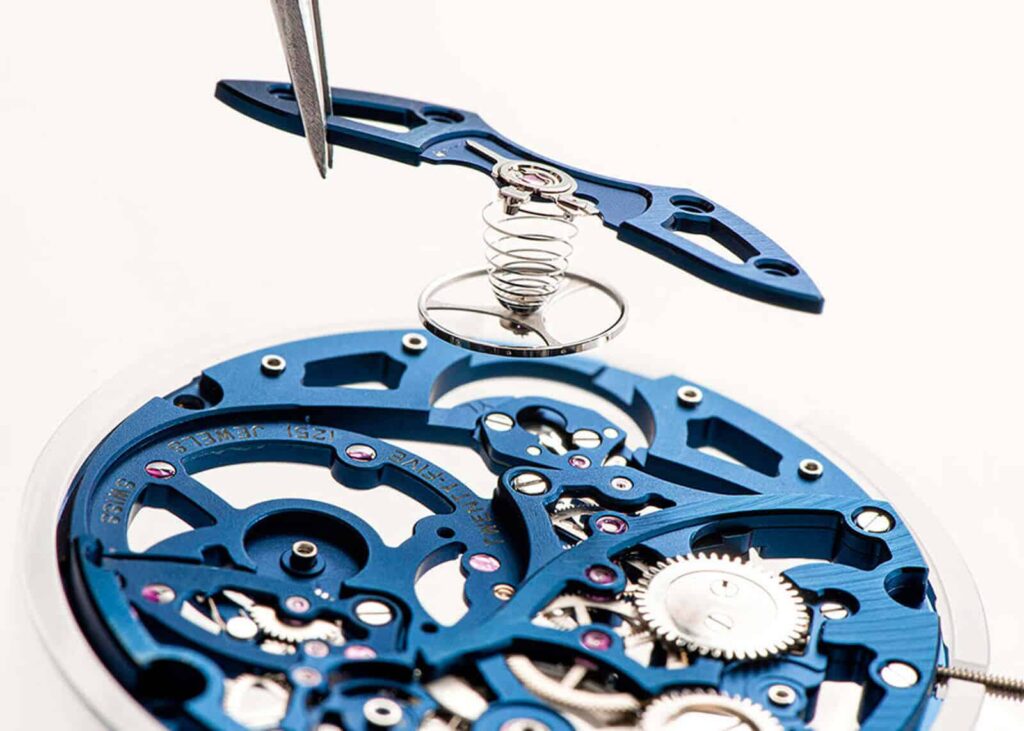
At the base of the movement, the enthusiastic horophile can see the escape wheel, pallet lever and the balance wheel. Personally, I derive much pleasure watching a balance wheel rotate to and fro and this Piaget sates such horological fetishism with notable aplomb.
Piaget Calibre 1200S1 – additional comments
The Piaget Polo Skeleton Watch GOA46009 features the Calibre 1200S1 which is executed in a vivid shade of blue.

When it comes to finishing, the brand provides a long inventory of refined details, including ‘circular and sunburst brushed wheels, sunburst satin-brushed plate and bridges, plate and bridges bevelled, polished blind tapped screws, bevelled slots…’ The list of refinements is extensive, however, I would expect nothing less from this paragon of fine watchmaking.
The movement has a frequency of 21,600 vph (3Hz) and features 25 jewels. Assuming the mainspring is fully wound, the watch will run autonomously for approximately 44 hours.
Piaget Polo Skeleton Gold Watch GOA46009 – closing remarks
Occasionally in life, there may come a time when a surgical procedure is needed. Before allowing a surgeon to wield a scalpel, it is not a bad idea to check their credentials first. Likewise, cutting, filing and drilling a timepiece should only be undertaken by the most competent specialists. After all, as my watchmaker friend discovered to his cost, skeletonising a movement is not merely about making it look good.
Rest assured, Piaget know what they are doing. I once visited the company’s site on the outskirts of Geneva and observed staff expending many hours working on CAD systems. They consider the forces acting on each square millimetre of the movement and the optimal position for each constituent part. Most importantly, Piaget’s products not only look fabulous, but they also remain strong, functional and reliable. Indeed, should you desire a skeletonised watch, especially an ultra-thin version, Piaget is definitely a brand to add to your shortlist.
Further reading
Technical specifications
- Model: Piaget Polo Skeleton Gold Watch GOA46009
- Reference: GOA46009
- Case: 18-ct rose gold; diameter 42 mm; height 6.5 mm; water resistance 3 ATM (30 m); sapphire crystal to the front and exhibition case back.
- Functions: Hours; minutes;
- Movement: Calibre 1200S1; self-winding movement; frequency 21,600 vph (3 Hz); 25 jewels; power reserve approx. 44 hours.
- Strap: Blue alligator leather strap with folding clasp
- Price: £41,300 (RRP as of 26.1.2024)