
Roger Dubuis Excalibur Single Flying Tourbillon
At first glance, the Roger Dubuis Excalibur Single Flying Tourbillon, recently unveiled at Watches & Wonders, looks reassuringly familiar. However, close examination reveals a watch that is completely new and brimming with ultra-refined details. Interestingly, as Angus Davies discovers, this latest model incorporates much mechanical intellect, yet reveals many of its thoughts and horological machinations.

In the beginning
When Roger Dubuis founded his eponymous company in 1995, he must have overheard the doomsayers talk of the so-called ‘quartz crisis’ and listened to voices prophesying about the impending demise of the traditional watchmaking industry. However, thankfully, Monsieur Dubuis, together with Carlos Dias, still embarked on their horological adventure, thereby creating a remarkable luxury brand.
From the outset, Roger Dubuis chose to focus on making exemplars of Haute Horlogerie, an esoteric domain which at the time was dominated by centuries-old Maisons. Where Roger Dubuis chose to differentiate itself from other brands was by combining the finest craftsmanship, materials and know-how, typical of Haute Horlogerie, with neoteric, sometimes avant-garde, design. Furthermore, the company produced its first in-house calibre in 1999, a supremely refined movement stamped with the Poinçon de Genève (Hallmark of Geneva).
Poinçon de Genève
The Poinçon de Genève, found on some of the finest expressions of Genevan watchmaking, is a standard encompassing a variety of criteria, including provenance, quality, craftsmanship and reliability. The standard covers the components used, finissage and the precision of a timepiece. To ensure the standards of the Poinçon de Genève are maintained, auditors from the accreditation body make unannounced visits to the Manufacture, at least 12 times per annum. A high percentage of the company’s models continue to bear the coveted Poinçon de Genève.
The Excalibur and a new era
Roger Dubuis’ early models proved popular, culminating in the brand moving to a new Manufacture in Meyrin, on the outskirts of Geneva, back in 2001. The Goldensquare, Kingsquare and Easydiver where just three of the brand’s collections that contributed to the bottom line, however, it was in 2005, with the advent of the Excalibur, that the company’s fortunes ascended to a new level. Indeed, the Excalibur has since become the bedrock on which the esteemed Maison now sits and the collection has since acquired legendary status within the sphere of Haute Horlogerie.

In 2008, Richemont purchased a 60% stake in Roger Dubuis, acquiring the remaining shares in 2016. While the brand has continued to operate with much day-to-day freedom, allowing it to explore the outer reaches of its imagination, it also benefits from the financial resources that comes with being a subsidiary of one of the world’s leading conglomerates operating in the luxury sector.
Specialisation has been a recurring theme with Roger Dubuis. In 2016, the Maison chose to slim down its inventory of collections to just two, the Excalibur and the Velvet. This latter collection comprises feminine timepieces often suffused with gems and dressed in bright hues, but always encompassing exalted levels of watchmaking.
Flying Tourbillons
Since the Excalibur was unveiled in 2005, Roger Dubuis has released a number of complications, including a chronograph, rattrapante, world time, calendar and a minute repeater, to name but a few. However, the Excalibur will forever be associated with the flying tourbillon.

A regular tourbillon places the regulating organ and escapement within a cage which, in turn, rotates 360° every minute. Invented by Abraham-Louis Breguet (patented in 1801), the device negates the adverse influence of gravity on the regulating organ, thereby aiding precision. The flying tourbillon, invented by Alfred Helwig in 1927, delivers the same benefits as a regular tourbillon, however, it provides an additional attribute. The flying tourbillon eschews the upper bridge found on a regular tourbillon, allowing the wearer to see more of the rotating cage, balance wheel, hairspring and escapement in motion.
While other firms offer flying tourbillons, few companies are able to match Roger Dubuis’ expertise in this field. Indeed, the Manufacture even produces models equipped with two flying tourbillons, linked by a differential, further augmenting precision.
Now, the Manufacture has released a new creation to whet the appetite of any self-respecting watch afficionado, the Roger Dubuis Excalibur Single Flying Tourbillon.

The new Roger Dubuis Excalibur Single Flying Tourbillon 42mm
Avid followers of Roger Dubuis will be aware of the previous version of the watch. However, after revisiting the former model, the Swiss marque has looked at each element. Indeed, while the family likeness is clear to see, the watch has been totally reworked.
Openworked
The openworked design affords views of various components normally hidden behind a conventional dial. In this instance, there is no place for mediocrity to hide, perfection is absolute. This necessitates that each element is refined to the highest order with peerless finishing omnipresent.
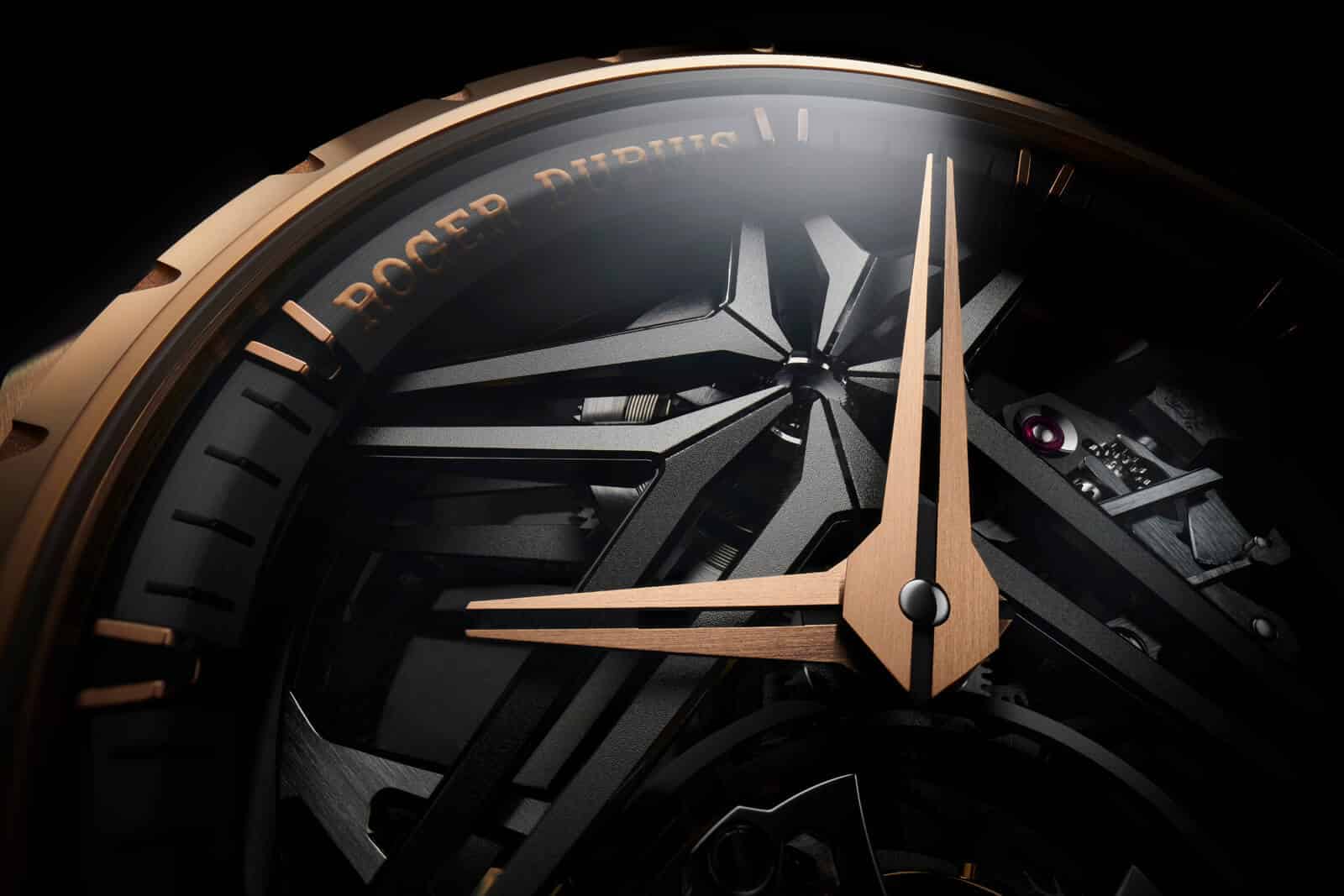
Roger Dubuis has incorporated its star symbol within the movement design. Twin-spoke arms emanate from the centre of the jewel above the openworked barrel, reaching outwards towards the inner case walls. These arms, which are part of the mainplate, sit below the flange.
The barrel eschews a conventional cover, allowing the wearer to view the mainspring. Likewise, the keyless works and motion works are freely disclosed, indulging inquisitive eyes.

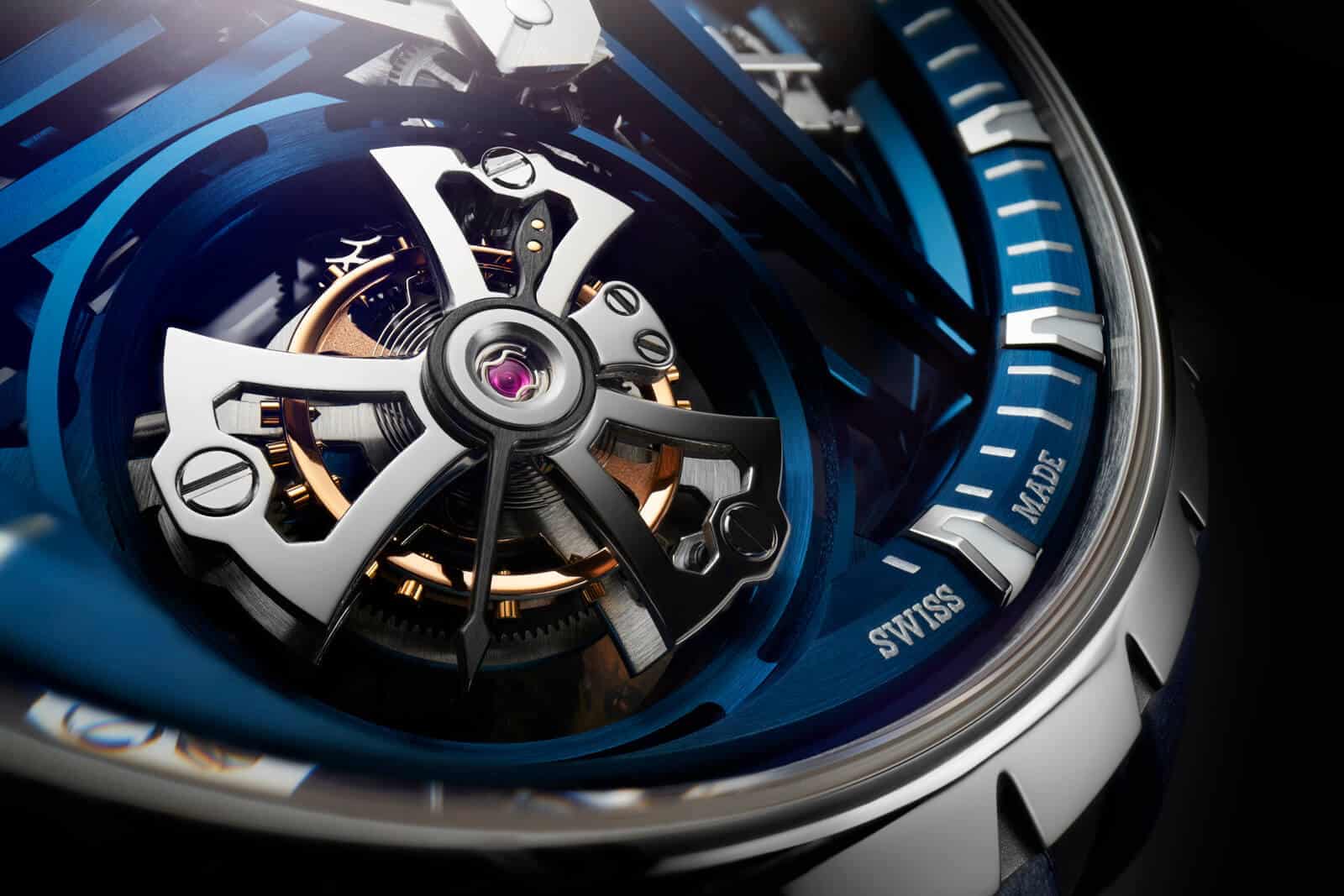
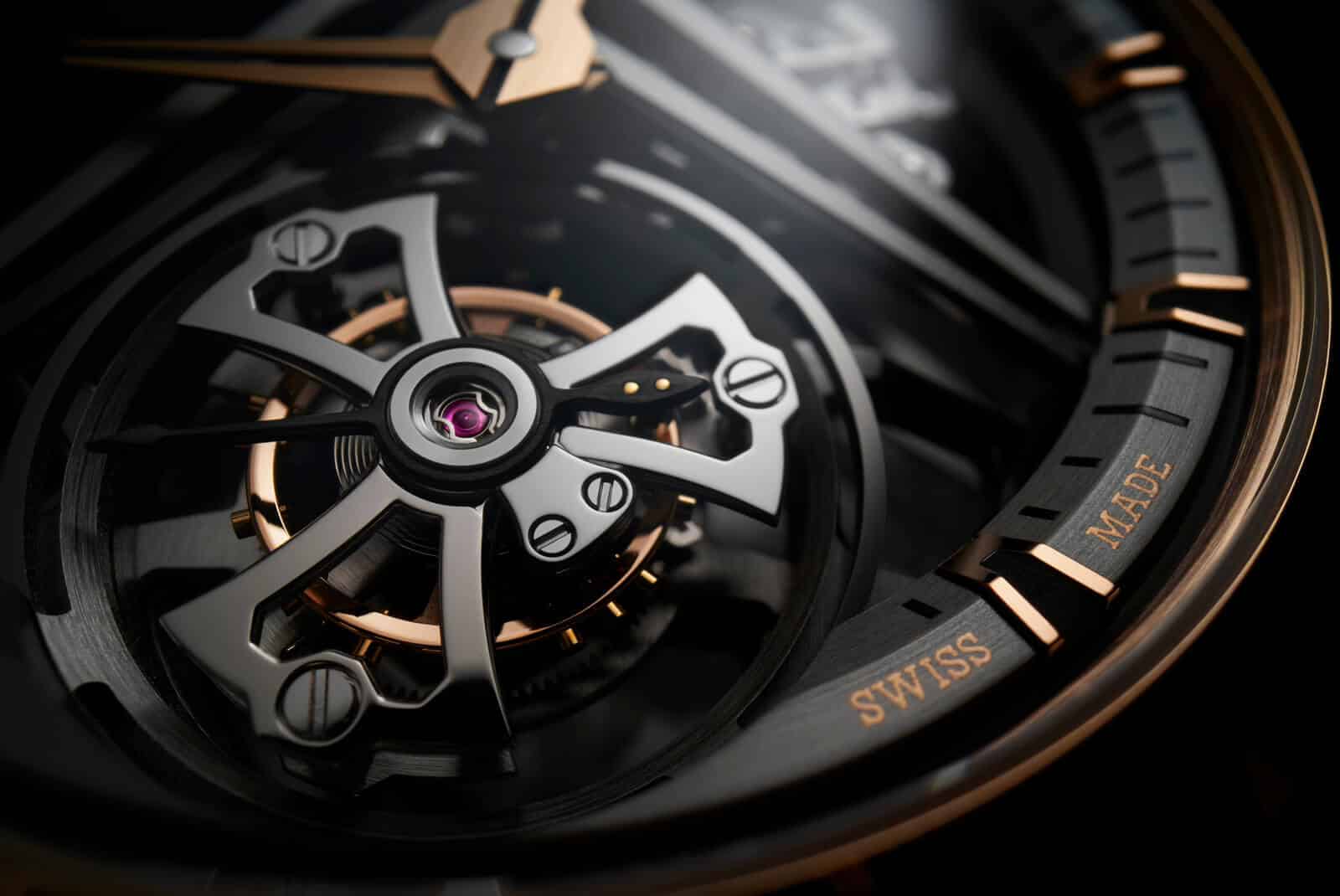
Undoubtedly though, the pièce de resistance is the flying tourbillon, twirling away in the south westerly region of the dial, it bestows an animated spectacle that is impossible to ignore. I will return to this highlight later.
In the 18th century when openworked watches first appeared they were based on regular movements. Hand saws and files were used to remove surplus material, creating a wonderful degree of transparency. However, this process of openworking, or skeletonising, a movement necessitates much expertise. For example, the watchmaker must always ensure that the areas near jewel beds, screws and the gear train remain untouched. Moreover, care is needed to prevent the torsional rigidity of the movement from being compromised. Should the watchmaker introduce a degree of flex to the movement then its reliability may be impaired.
However, the mainplate of the Excalibur Single Flying Tourbillon was intended to be openworked from the outset. The movement’s architecture is optimally designed to simultaneously deliver transparency, rigidity and reliability. Components are made using modern machinery to exacting tolerances and thereafter parts are embellished using traditional hand-finishing techniques.
The Calibre RD512SQ
Developing a new movement represents a huge financial undertaking for any brand. However, it is clear that Roger Dubuis did not wish to make a few mere cosmetic changes to the previous model. On the contrary, the luxury firm has revisited the former model, created something wholly new and delivered notable improvements as a result.
The lower part of the flying tourbillon cage is made of titanium while the upper part is formed of ‘Cobalt chrome’. This combination proves lighter than titanium alone, thereby reducing energy consumption and, by default, increasing the power reserve to an impressive 72 hours. The upper tourbillon cage is mirror polished, widely considered the most difficult form of polishing to execute.
Roger Dubuis has also expended much effort looking at the gear train design in order to optimise the transmission of power from the mainspring to the escapement. Indeed, the brand shows an incredible attention to some of the smallest of details such as introducing a new lubricant for this latest model.
While the esteemed Maison is known for its no-compromise finishing, it has not shied away from embracing new finishes and techniques. Perlage and Côtes de Genève, typically seen on most fine watches, have been set aside. Instead, the Calibre RD512SQ has been embellished with sandblasted surfaces. However, such modernity had to be approved by the accreditation body before the coveted Poinçon de Genève could be applied to the movement and case. Needless to say, the resultant appearance of this contemporary movement is beyond reproach.
The habillage – familiar, but new
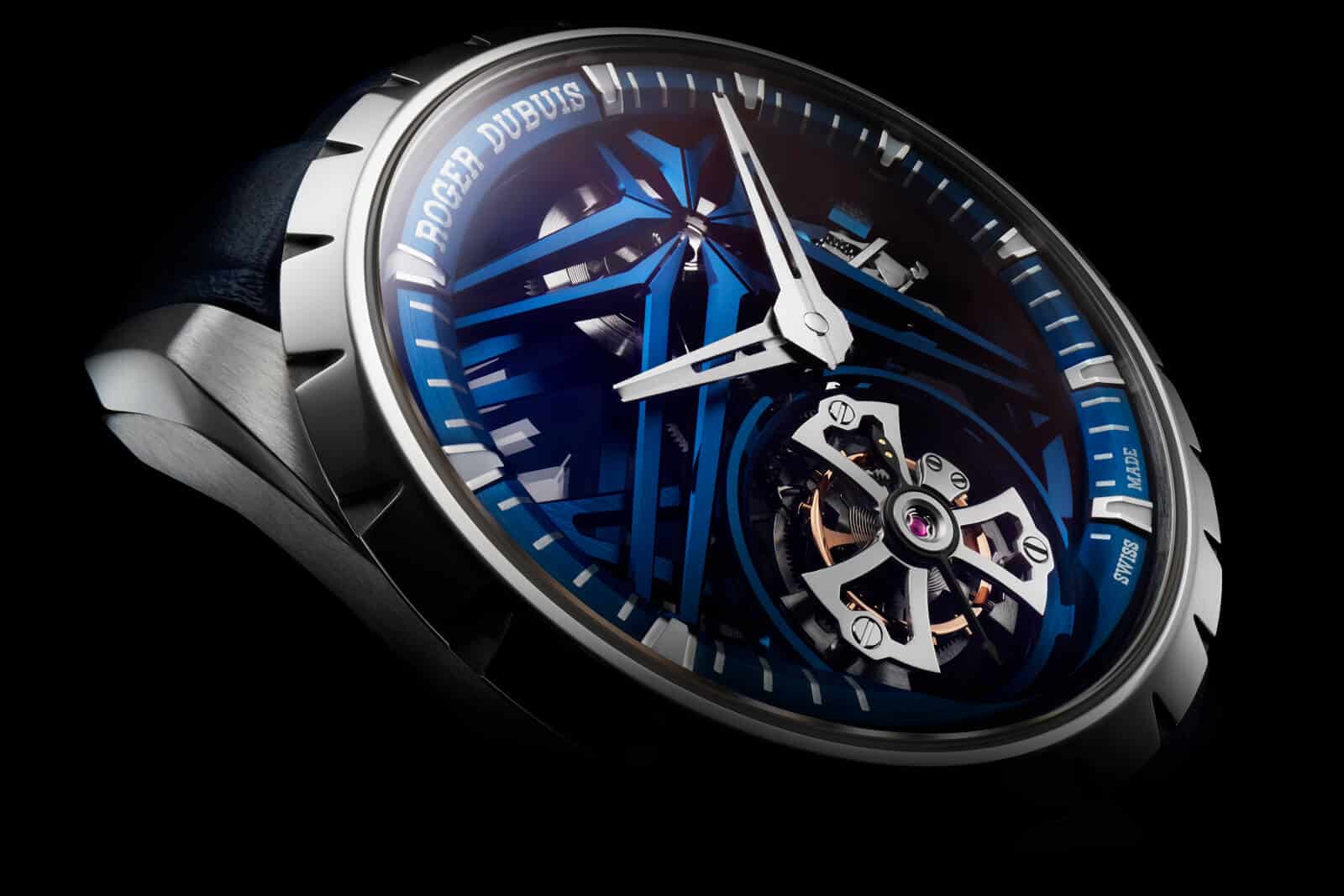
At first glance, the case looks reassuringly familiar, however, closer inspection reveals it is much cleaner. The bezel features 24 v-shaped incisions, a characteristic it shares in come with the previous model, however, the crown now features a newly designed grip. Furthermore, the crown nestles between the shoulders of a crown protector, heightening the model’s robustness without spoiling its overall eye appeal.

Prospective purchasers are presented with three case options to choose from: dark grey DLC titanium, Cobalt Chrome CarTech Micro-Melt BioDur CCM™(® in the USA) and, lastly, EON gold. This latter metal is 18-carat pink gold with the addition of palladium and tin. It resembles pink gold in shade but is said to be ‘more stable thanks to non-tarnish technology’. Personally speaking, I am particularly drawn to the coquettish charms of the Cobalt Chrome option.

The lugs and strap ensemble are wholly new. Close attention has been paid to the ergonomic relationship between the watch, the strap and the wearer’s wrist. Unusually, the Genevan firm now offers the strap in five sizes, ensuring the watch head is perfectly centered upon the wrist. A ‘Quick Release System’ allows the wearer to exchange the strap for an alternative without the need for tools. Each strap is three dimensional and made of calf leather.
A bewitching face
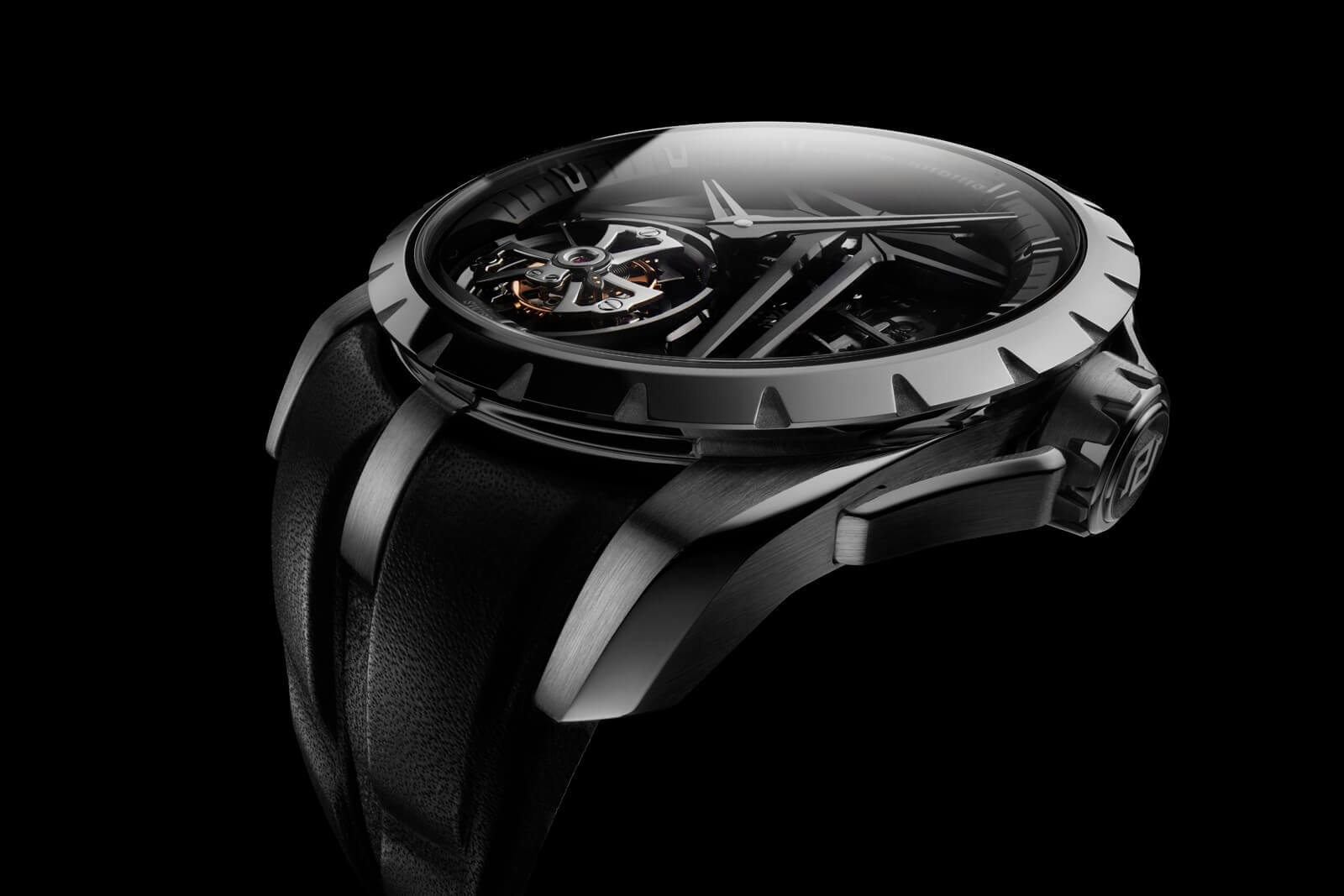
Close examination of the dial reveals a plethora of nuances likely to engender enduring affection. Focussing on my favourite Cobalt Chrome option, the blue twin-spoke arms spanning the dial are coated in NAC. The minute track, executed in blue CVD, is positioned on a flange and engraved with 1-minute markings. In addition, the flange features two facets and incorporates rhodium plated hour markers endowed with luminescent treatment.
The hour and minute hands have also been updated. They include a two-spoke design, upholding the styling of the mainplate’s beam sections, and feature truncated tips. Each hand is intricately formed in white gold and sports three surfaces. The angled surfaces are satin-brushed, while the flat surfaces are shot-blasted. White luminescent treatment (Super-LumiNova) aids legibility in restricted light conditions. A small second hand sits atop the tourbillon cage, imparting meaning and completing the inventory of functions. Indeed, despite its bold design language, the use of colour, shapes and textures confers impressive readability.
Complexity and openness
Many psychiatrists have struggled to understand the complexity of the human mind. In fact, sometimes it seems complexity and openness are mutually exclusive with the most intellectual minds proving the most challenging to understand. The Roger Dubuis Excalibur Single Flying Tourbillon sets aside this accepted wisdom. Indeed, this latest model incorporates much mechanical intellect, yet reveals many of its thoughts and horological machinations.
Further reading
Technical specifications
- Model: Roger Dubuis Excalibur Single Flying Tourbillon
- Reference: RDDBEX0889
- Case: Dark grey DLC titanium; diameter 42mm; height 12.7mm; water resistance 10ATM (100 metres); sapphire crystal to front; exhibition case back.
- Functions: hours; minutes; flying tourbillon with small seconds
- Movement: RD512SQ Calibre; hand-wound movement; 19 jewels; power reserve 72 hours.
- Strap: Black 3D calf leather strap, interchangeable with Quick Release System.
- Buckle: Dark grey DLC Titanium cover with titanium blades, triple folding.
- Price: £124,000 (RRP as at 8.4.2021)
- Limited Edition: 88 pieces
- Model: Roger Dubuis Excalibur Single Flying Tourbillon
- Reference: RDDBEX0838
- Case: White gold case; bezel and crown – CarTech Micro-Melt BioDur CCM™(® in the USA); diameter 42mm; height 12.7mm; water resistance 10ATM (100 metres); sapphire crystal to front; exhibition case back.
- Functions: hours; minutes; flying tourbillon with small seconds
- Movement: RD512SQ Calibre; hand-wound movement; 19 jewels; power reserve 72 hours.
- Strap: Blue 3D calf leather strap, interchangeable with Quick Release System.
- Buckle: Titanium cover with titanium blades, triple folding.
- Price: £129,000 (RRP as at 8.4.2021)
- Limited Edition: 88 pieces
- Model: Roger Dubuis Excalibur Single Flying Tourbillon
- Reference: RDDBEX0836
- Case: Eon gold case, bezel and crown; diameter 42mm; height 12.7mm; water resistance 10ATM (100 metres); sapphire crystal to front; exhibition case back.
- Functions: hours; minutes; flying tourbillon with small seconds
- Movement: RD512SQ Calibre; hand-wound movement; 19 jewels; power reserve 72 hours.
- Strap: Black 3D calf leather strap, interchangeable with Quick Release System.
- Buckle: Eon gold cover with titanium blades, triple folding.
- Price: £134,000 (RRP as at 8.4.2021)
- Limited Edition: 88 pieces