
TAG Heuer Monaco Evergraph Watch Review
Recently released at Watches & Wonders 2026, the TAG Heuer Monaco Evergraph features a highly innovative ‘compliant chronograph mechanism’ that promises to deliver improvements in quality, durability and precision. In addition, the state-of-the-art Calibre TH80-00 incorporates a plethora of additional attributes. Angus Davies takes an in-depth look at this paragon of Swiss avant-garde watchmaking.
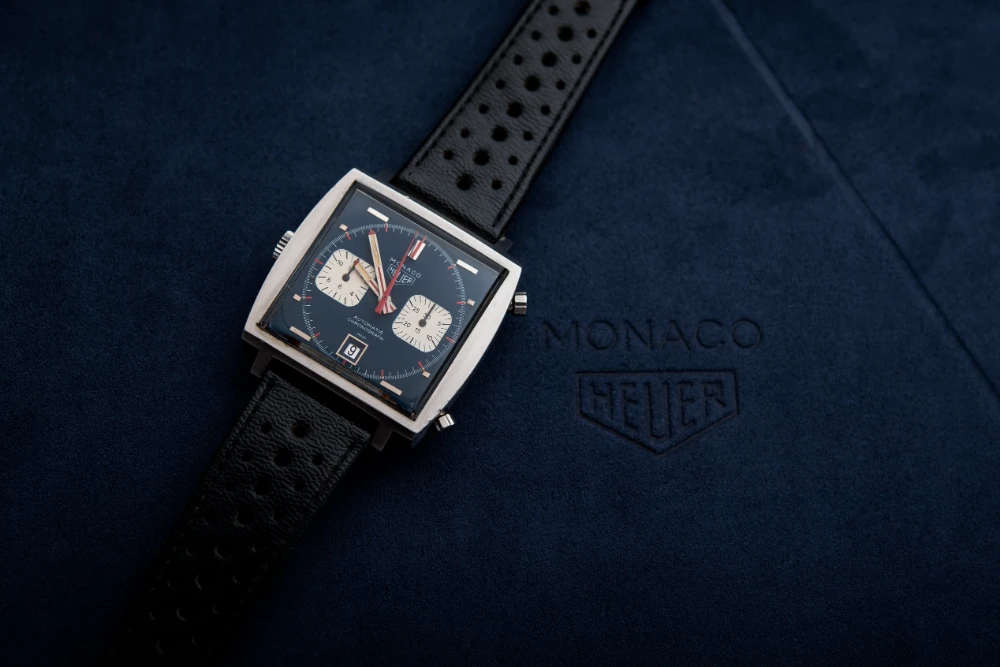
Image – Heuer Monaco reference 1133
Heuer Monaco depuis 1969
Back in 1969, when Fleetwood Mac’s Albatross was topping the charts, Heuer, the Swiss avant-garde brand, unveiled the Monaco reference 1133. Launched simultaneously in New York and Geneva, its release ushered in a new era of contemporary horology. Housed in the first water-resistant square case and powered by the first self-winding chronograph movement (Calibre 11), the Heuer Monaco was unlike anything else on the market at the time. Indeed, even the position of the crown, hugging the left flank of the case, broke with convention.
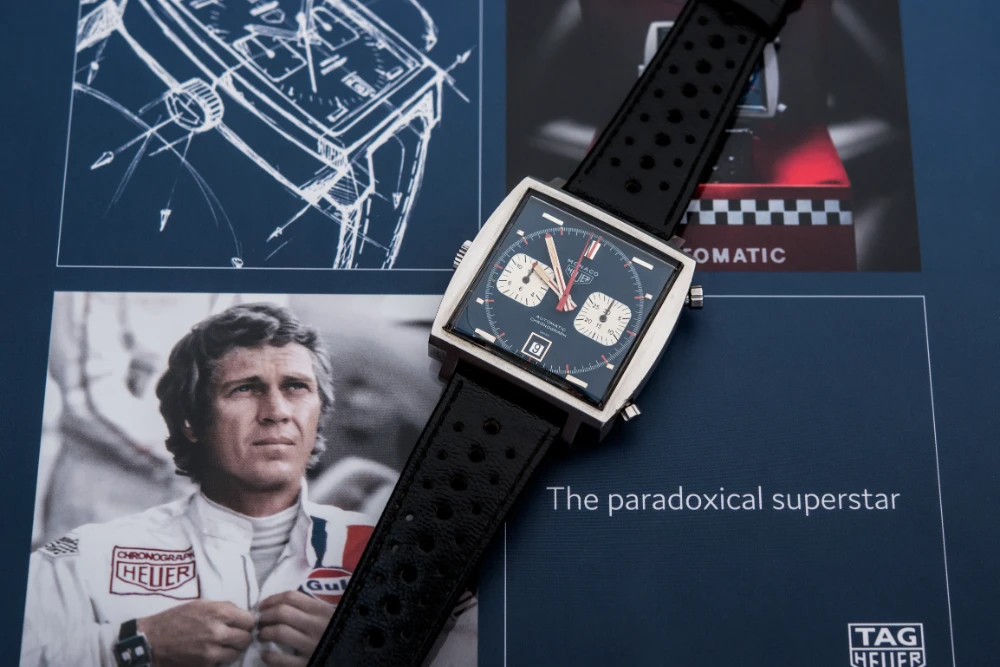
Image – Heuer Monaco reference 1133
With the help of some shrewd marketing, including a pivotal moment spent on Steve McQueen’s wrist, the Monaco went on to cement its place in watchmaking history. Some 57 years later (and counting), the model’s unique shape has changed little over the years. However, the Maison, famous for its innovative spirit, has not sat on its hands. On the contrary, it has worked with different case materials, embraced a variety of dial designs and colours, as well as incorporating a vast array of movements.

Image – TAG Heuer Monaco Chronograph Calibre TH20-11
At Watches & Wonders 2026, TAG Heuer introduced a Monaco equipped with the impressive Calibre TH20-11. Housed in an über-desirable Grade 5 titanium case and capable of running autonomously for 80 hours, this modern-day descendant of the 1969 reference 1133 has much to recommend it. Most notably, the movement features a column wheel and vertical clutch, a configuration that sees the chronograph perform stutter-free starts and confer a silky smooth pushpiece action; a winning combination beloved by purists.
TAG Heuer Monaco Evergraph – introduction
Clearly wishing to push the performance envelope still further, TAG Heuer also revealed the Monaco Evergraph during the Geneva fair. This model is equipped with the new Calibre TH80-00, a cutting-edge movement featuring a groundbreaking compliant chronograph mechanism. Moreover, the movement is equipped with a carbon balance spring and silicium escape wheel and pallet lever, while the balance has cadence of 5 Hz and the movement is COSC certified. Each characteristic, when considered in isolation, is impressive, but when combined, distinguishes the Monaco Evergraph as revolutionary.

The chronograph – often undervalued
A popular complication, the chronograph is often undervalued. It is one of the few functions where the wearer interacts with the movement. The chronograph can lie dormant for hours, days or weeks but will immediately perform on demand with just the press of pushpiece.
Typically, a chronograph employs a series of levers and springs that start, stop and reset the mechanism for recording elapsed periods. When actuated, the chronograph mechanism couples with the gear train using a clutch (horizontal or vertical). The clutch usually works in conjunction with a column wheel or a cam, orchestrating the stop, start and reset functions.
Interestingly, the forces at play within a chronograph are significant. If the movement is not correctly adjusted, the levers can be easily scarred. During the R&D phase, watch brands will often use a high-speed camera to record the ‘reset to zero’ phase, observing the behaviour of the chronograph seconds hand. In some instances, the forces experienced during the reset phase have caused said hand to bend.
The Monaco Evergraph is radically different from what has gone before. Let’s start by discussing the aforementioned ‘compliant chronograph mechanism’.
Compliant Chronograph Mechanism
‘Developed and refined over five years within the TAG Heuer LAB’, the ‘compliant chronograph mechanism’ obviates the need for ‘virtually all of the levers and springs traditionally associated with the start, stop and reset functions’. It looks radically different from all existing mechanisms used in watchmaking. It contains ‘two flexible bistable components: one governing start and stop, the other reset’.

So, what is a ‘bistable component or bistable compliant mechanism?’ Put simply, it is a single, mechanical structure that maintains two different stable states but requires no energy to maintain either position. For example, if you hold a train ticket between your forefinger and thumb, it may form an arc, resembling the letter ‘C’. It is stable in this position, but push the ticket with a spare finger and it will toggle or switch to its second stable position, a mirror of the letter ‘C’. This is essentially what is happening with two flexible bistable components within the new TAG Heuer Monaco Evergraph.
As previously stated, the compliant chronograph mechanism looks radically different from regular watch components. Flat and intricately formed, the component is made using high-precision LIGA technology. This is an additive manufacturing technology that combines UV lithography (using ultraviolet radiation) and electroplating, effectively growing parts to infinitesimal tolerances.

I recently chatted to Carole Forestier Kasapi, TAG Heuer’s Haute Horlogerie & Movements Strategy Director, and asked her what the reasons were for developing the compliant chronograph mechanism.
Kasapi explained, “Our focus for the project centred on three main pillars: improved quality, improved durability and improved precision. With the new chronograph mechanism there is less friction, less need for adjustments at the time of manufacture but also during ownership, less lubrication and, lastly, superior precision.” She also went on to point out, the pressure required to activate the chronograph mechanism, from the first activation until 10 years later, will be the same. And, in terms of the pushpiece action, I can attest it is remarkably smooth, free of notchiness and operates with a distinct sound that needs to be experienced to be fully appreciated.
TAG Heuer Calibre TH80-00 – other highlights
As I stated earlier, the new Calibre TH80-00 has many additional qualities that distinguish it from most other chronographs. Allow me to elaborate.

Inverted design and movement decoration
The movement was ‘developed in close partnership with Vaucher Manufacture Fleurier’. The two companies have worked together before, most recently on the Carrera Split-Seconds (Calibre TH81-01).
In terms of the Calibre TH80-00, the team effort has led to the creation of an inverted movement with the barrel, gear train, regulating organ and escapement positioned front of house. The movement decoration adheres to Haute Horlogerie standards, but is expressed in a contemporary form. For instance, rather than the bridges being adorned with traditional Côtes de Genève motif, they are embellished with a checkerboard pattern. Likewise, the oscillating mass bears the brand’s shield emblem, is partially openworked and comes dressed in a sultry shade of black.

TH-Carbonspring and silicium components
Rather than feature a balance spring formed of the usual nickel-steel alloy (found in most movements), the Calibre TH80-00 is fitted with the TH-Carbonspring, a material that is anti-magnetic, not liable to corrode and uniform.

TAG Heuer has chosen to make the escape wheel and pallet lever in silicium (aka silicon), a glass-like material which, once again, is anti-magnetic, not liable to corrode and uniform. Silicium can be made into intricate shapes, not achievable using CNC or EDM machines, optimising their profile. Moreover, silicium is incredibly light and is virtually friction-free, obviating the need for lubricants. These latter characteristics are particularly helpful when producing high-frequency calibres (see later).
High frequency (5 Hz)
Typically, watch movements will operate at 2.5 Hz, 3 Hz or 4 Hz. Few watch brands choose to exceed 4 Hz because they present an array of technical obstacles. For example, when the balance has a frequency of 5 Hz or more, it will have a tendency to consume greater energy. Moreover, the higher cadence can result in greater lubricant consumption and increased wear.
However, by using a silicium escape wheel and pallet lever, the issue of wear and lubricant consumption is addressed. Moreover, as the silicium components are especially light, they use less energy when in motion, a characteristic reflected in the 70 hour power reserve. This latter figure is particularly impressive for a 5 Hz movement.
A high-frequency movement offers several benefits. As the balance wheel is rotating at a higher speed, it is less susceptible to positional influence. Moreover, if the watch is subject to a physical shock, the rate of the balance is less likely to be affected and, if it is, the higher rate of oscillation will cause it to return to its optimum frequency more readily. Put simply, a high frequency movement offers superior precision and stability.
Variable-inertia balance
Another characteristic that distinguishes the Calibre TH80-00 as special is its regulation system. With most watch movements, the rate is adjusted by altering the effective length of the balance spring using an index. This is a simple means of regulation and works well.
However, a variable-inertia balance is technically superior. With this means of regulation, the length of the balance spring is fixed and the rate is adjusted by moving masselottes (weights) mounted on the balance wheel, altering the moment of inertia, ie making the watch run faster/slower.
It takes longer to regulate a movement fitted with a variable-inertia balance, but it offers superior precision and should the watch be subjected to a shock, the movement is less likely to require remedial regulation.
Traditionally, the inertia weights took the form of screws located on the exterior rim of the balance wheel. However, TAG Heuer has chosen to place circular C-shaped masselottes on the interior of the balance wheel, mitigating air turbulence, thereby enhancing isochronism.
COSC-certified
The Calibre TH80-00 movement has been independently tested by the COSC and is certified as a chronometer.
TAG Heuer Monaco Evergraph – dial
When creating the TAG Heuer Monaco Evergraph, the Swiss avant-garde brand has cleverly introduced new design elements while still retaining several signature details from the reference 1133 of 1969.

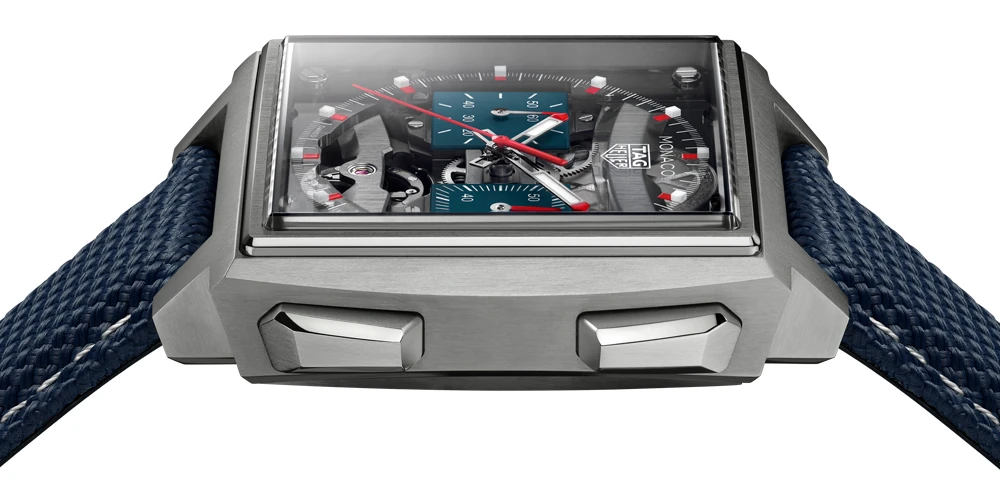
The hour and minute hands unite white SLN with red lacquered tips, echoing the look of the 1133, but now incorporate openworked sections that straddle the fulcrum of the dial. The circular track with its two-tone indexes subscribes to the design of the 1969 model, but is now presented on a pane of transparent acrylic glass, revealing various movement components below. And lastly, the TAG Heuer Monaco Evergraph shares the same two register approach of the classic, albeit now the counters are executed in blue or black, depending on the model, and have a more pronounced square profile.

TAG Heuer has chosen to showcase several movement components usually hidden from view. A large bridge with a grained finish spans the top of the dial, holding the barrel in place. Similarly, a second bridge, straddling the bottom of the dial, holds the balance in position. This latter detail indulges the wearer with views of the balance wheel oscillating to and fro.

Sometimes, openworked dials can appear cluttered, impairing readability; however, having had the watch on my wrist, I can attest the indications on the Monaco Evergraph are eminently legible.
TAG Heuer Monaco Evergraph – case
Measuring 40 mm in diameter, the TAG Heuer Monaco Evergraph is a smidgen larger that the ‘regular’ 39 mm Monaco, albeit I only determined this from looking at the technical specification sheet.

The model is offered in a choice of two case executions: Grade 5 titanium (with blue registers and a blue rubber strap) or DLC coated Grade 5 titanium (with black registers and a black rubber strap). Grade 5 titanium is becoming increasingly popular in high-end watchmaking. Harder and stronger than Grade 2 titanium, the metal is light, corrosion-resistant and hypoallergenic. A further attribute of Grade 5 titanium is that the alloy can be polished to a brilliant gleam, something the Swiss marque has tastefully exploited on various surfaces.

Crafting a case in Grade 5 titanium is costlier than producing a steel or Grade 2 titanium housing, but as you will have no doubt ascertained by now, TAG Heuer has not skimped on the specification of the Monaco Evergraph.
Closing remarks
Back in 1969, the Heuer Monaco reference 1133 broke with convention. It rejected the idea of playing it safe, embracing a cutting-edge movement and a bold, fresh aesthetic. Over time, the Monaco has evolved, but the essence of the original has been preserved, standing testament to its enduring style.

TAG Heuer has respected its icon, while simultaneously looking into the future when creating its groundbreaking compliant chronograph mechanism and complementing this with a number of additional, and highly desirable, features. Recalling the words of Carole Forestier Kasapi and her quest for, ‘improved quality, improved durability and improved precision’, TAG Heuer has clearly succeeded in its aims. Moreover, it has created a watch that is not only avant-garde but also highly wearable. It seems TAG Heuer’s visionary flair is better than ever.
Further reading
Technical Specifications
- Model: TAG Heuer Monaco Evergraph
- Reference: CEW5181.FT812 (Grade 5 titanium case, blue counters)
- Reference: CEW5180.FT8122 (black DLC coated Grade 5 titanium case, black counters)
- Case: Grade 5 titanium, diameter 40 mm, thickness 14.51 mm, water resistant to 10 bar (100 metres); sapphire crystal to front and exhibition caseback.
- Functions: hours, minutes, central chronograph seconds, 60-minute counter, small seconds
- Movement: Calibre TH80-00, self-winding movement, frequency 36,000 vph (5Hz), power reserve of 70 hours.
- Strap: blue or black rubber strap with Grade 5 titanium folding clasp with double safety push-button release.
- Price: £20,750 (RRP as of 20.5.2026)