
Cyrus Klepcys DICE (Part Two) Watch Review
Continuing the story of the Cyrus Klepcys DICE, Angus Davies looks closely at the composition of this new watch, a timepiece which represents a new chapter in the history of the chronograph.

Cyrus Watch Review
Previously, in the first part of this two-part feature, I provided a brief overview of the chronograph, detailing its history from 1816, when the first example was invented, to the present day. Indeed, there have been several milestones including the first time the complication appeared in a wristwatch, the advent of the flyback and the rattrapante, etc. However, since the unveiling of the self-winding chronograph in 1969, the rate of innovation has slowed considerably.
However, the recently released Cyrus Klepcys DICE (Double Independent Chronograph Evolution), not only represents a milestone in chronograph history, it is also a notable event in the story of the brand.
The Cyrus Klepcys DICE allows the wearer to measure the elapsed times of two separate events. This should not be confused with a rattrapante. This latter complication requires two events to commence at the same time, whereas the Klepcys DICE, with its two completely independent chronographs, is able to time two totally unrelated events. I am not aware of any other modern-day watch that offers this facility. However, Cyrus has always had a tendency to walk on virgin snow and to follow a different path to other brands.
Recently, I had the opportunity to affix the Klepcys DICE to my wrist and appraise its composition at close quarters. I share some of my observations herein.
Cyrus Klepcys DICE case
Nobody could ever accuse Cyrus of plagiarism, its watches always brim with ingenuity. The Cyrus Klepcys DICE does not subscribe to the ubiquitous round case, round dial ensemble. The luxury marque describes the housing of its latest watch as a ‘cushion-shaped’, however, this description does not adequately convey the complexity of its profile.

The sides of the 42 mm case arc from the horns towards the crowns at 3 and 9 o’clock. As the sides of the case emanate from the lugs, a chamfered edge of increasing width emerges between the upper surface and the flank. When viewed from the side, both lugs are recessed, a characteristic that causes light to transition into darkness as it enters the contours of the case.
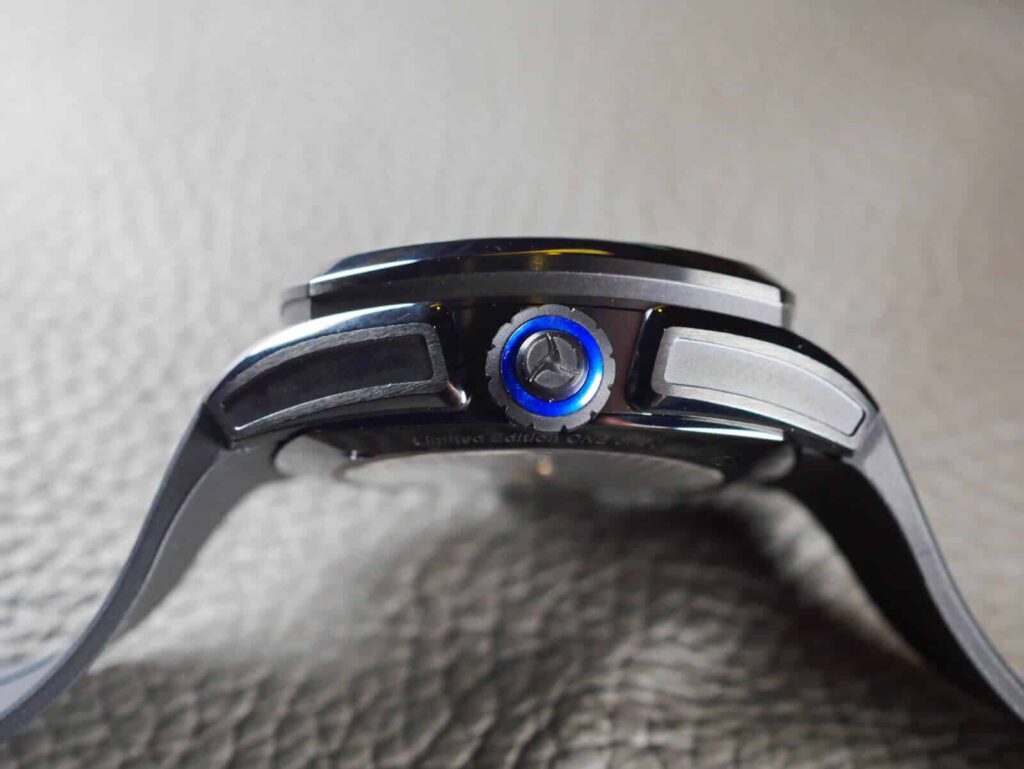
The outer edge of the bezel is square-shaped but with softly curving lines. This is juxtaposed with a circular aperture accommodating the dial. The region between the inner and outer edges of the bezel encompasses flat and sloping sections.
To the rear of the watch, the complex marriage of shapes continues. For example, the caseback blends flat and angled sections. Interestingly, it is retained with four bespoke Cyrus screws, each one endowed with a slot replicating the brand’s logo.
Cyrus states the case comprises 26 parts and is made from Grade 5 titanium, either with or without black DLC treatment. Cyrus has suffused each case with a combination of different finishes including polished, satin-brushed and sandblasted surfaces.
Grade 5 titanium and CNC
Grade 5 titanium should not be confused with cheaper Grade 2 titanium. While this latter grade is pure titanium, Grade 5 is an alloy of titanium (circa 90%), aluminium (6%), vanadium (4%) as well as small amounts of iron and oxygen. Both grades of titanium are corrosion-resistant, non-magnetic, lightweight and hypoallergenic, making them ideal for watchmaking. Furthermore, Grade 5 titanium is stronger and can also be polished to a brilliant gleam.
As stated previously, the case of the Klepcys DICE is incredibly complex. While some cheaper steel cases are stamped, the complexity of this case design and its composition mean that CNC (computer numerical control) is the preferred method of production.
Heat generation is a major problem when milling (CNC) Grade 5 titanium as the alloy is very hard. The cutting tools have to operate at slower speeds to prevent unwanted hardening of the metal and avoid the milling tools wearing out prematurely. This heightens production times and thereby increases costs.
Furthermore, even when milling goes to plan, tools will wear out sooner when working on Grade 5 titanium, compared with other metals such as brass, steel, gold and Grade 2 titanium. This means that the cost of additional replacement tools has to be met, again inflating the production costs. Moreover, as the machines need to be stopped while tools are replaced, the case manufacturer will seek to recover the cost of downtime.
Often, those companies making cases will leave a CNC machine running, milling brass or steel overnight without any supervision. However, few firms will leave a machine milling Grade 5 titanium unattended. This is because titanium can catch fire during milling. Lastly, even if there isn’t a fire, the metal can overheat to the point that it harms the CNC machine.
As the above factors show, the cost of making a case from Grade 5 titanium is substantially greater than producing a case from steel. Indeed, while the unit cost of 18-carat gold is greater than Grade 5 titanium, the cost of machining the latter alloy proves far greater. Put simply, making a case from this lightweight alloy is expensive, usually making it the preserve of high-end wristwatches.
Colour-coding
Despite the mechanical complexity of the Cyrus Klepcys DICE, the Maison has ensured that operating the watch is simple. Two crowns are located at 3 and 9 o’clock. Each one starts, stops and resets the corresponding chronograph. Beyond the black fluted rubber grip of each crown, a circlet of red or blue aluminium distinguishes one chronograph from another. The crown at 3 o’clock also winds the mainspring.

The movement, the Calibre CYR718, features two colour-coded column wheels which correspond to the respective colour-coded, crown-based circlet. The crown at 3 o’clock (see red circlet) engages with the red column wheel at 12 o’clock. Likewise, the crown at 9 o’clock (see blue circlet) converses with the blue column wheel at 6 o’clock.
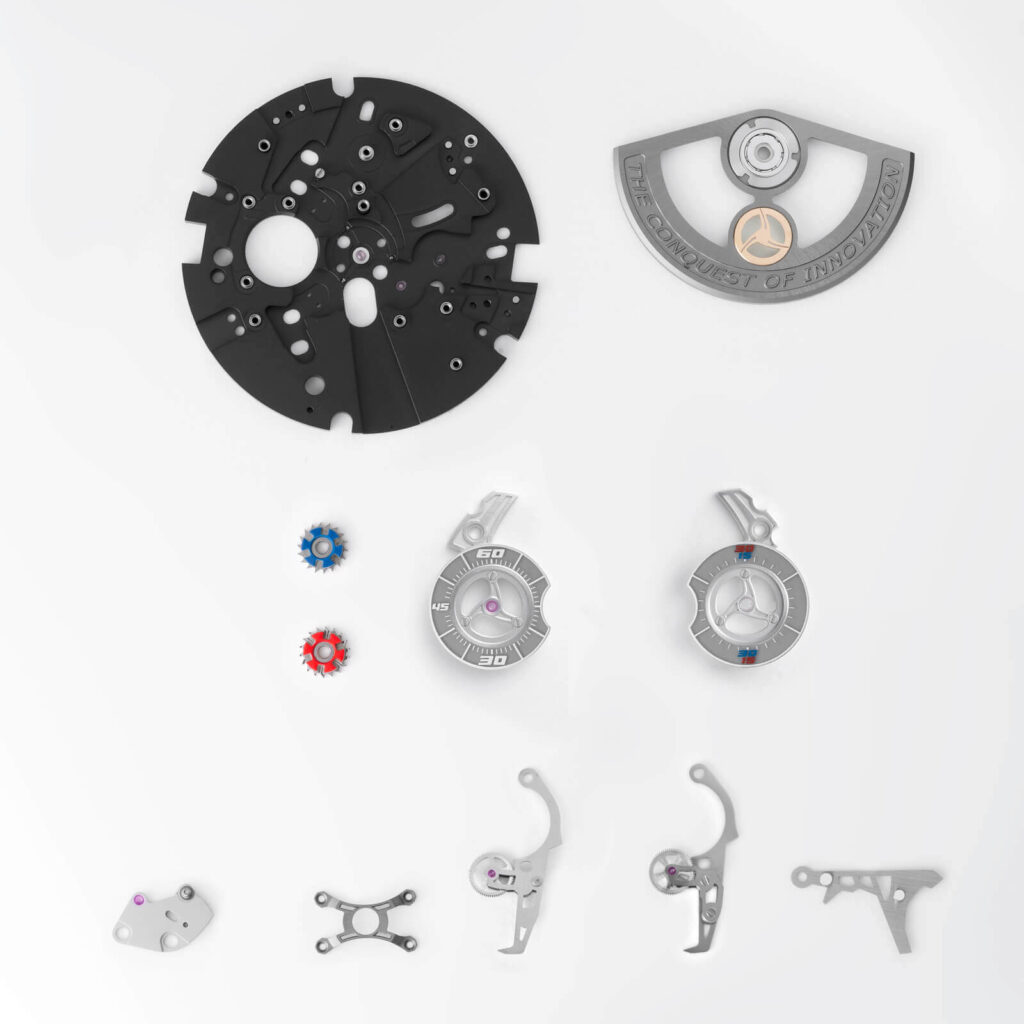
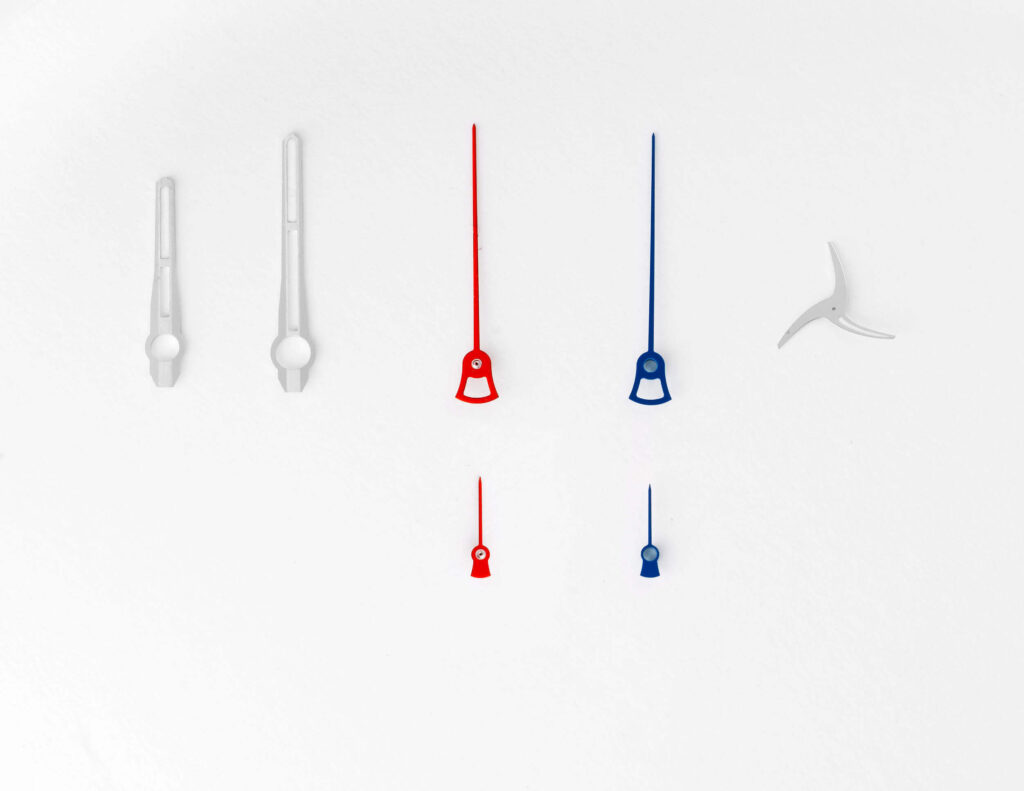
The eminently logical colour-coding system extends to the central chronograph seconds hands, the 30-minute registers at 3 o’clock (one subdial featuring a scale for each chronograph) and the minute track (two scales – one for each chronograph). Positioned at 9 o’clock is a small seconds display, featuring the brand’s logo sans colour. The two central chronograph seconds hands are of differing lengths, so that each precisely reaches the corresponding colour-coded scale positioned on the outer track.
Each hour is denoted with stylised Arabic numerals, save for 3, 9 and 12 o’clock. These hour markers are presented in white and positioned atop a sapphire crystal hour track. Once again, Cyrus has not subscribed to a rudimentary approach. Making the hour track from sapphire crystal is technically challenging. Indeed, when making such parts, they can easily break during the manufacturing process. However, once encased this eccentrically shaped sapphire track looks fabulous and affords improved sight of the components below, thereby justifying the effort involved. The use of sapphire components extends to the counters which are also made of the clear material, albeit in smoked form.

Cyrus Calibre CYR718
When viewing the rear of the watch, the eyes are afforded with a view of the self-winding Calibre CYR718. The openworked oscillating mass features the brand’s helix logo in 18K 4N gold and is engraved with the slogan, ‘The Conquest of Innovation’. This statement underpins everything that Cyrus does.

Conceived by the legendary watchmaker, Jean-François Mojon, the movement sidesteps convention, employing two mainplates instead of the customary one. The mainplates are dressed in a stealthy shade of black microbeaded PVD. The movement comprises 443 components, including the chronograph module which is responsible for DICE system.
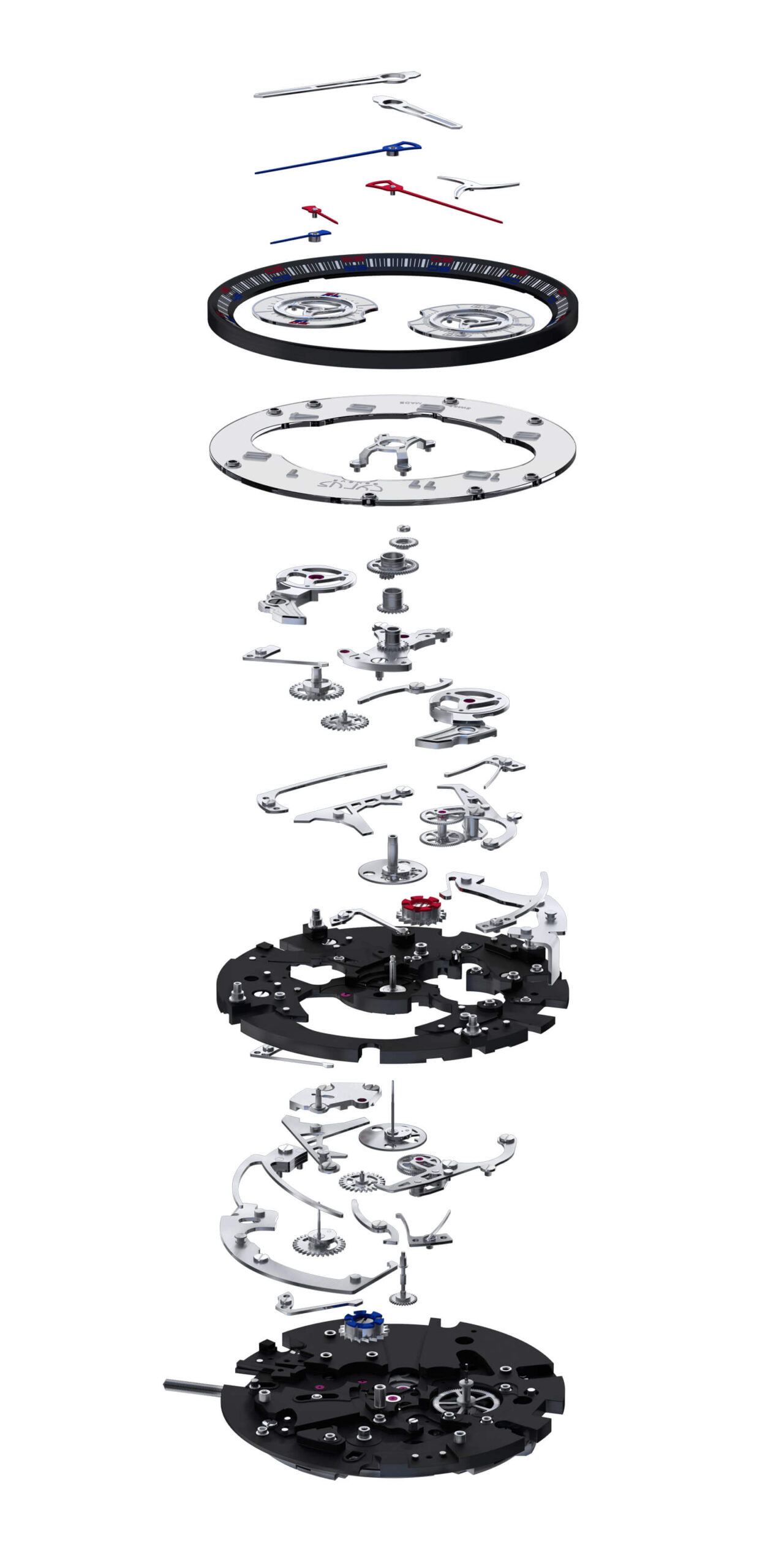
Interestingly, the module is inverted with a plethora of parts visible dial side, granting a spellbinding view of wheels, levers and various gears all ready to be awakened with the press of a pushpiece. Moreover, when pressing the pushpiece, the finger tips are rewarded with a silky-smooth action.

While the Klepcys DICE is a highly original watch with a very innovative movement, it still employs traditional no-compromise craftsmanship typical of fine watchmaking. For example, the wheels, levers and gears are finely decorated with numerous grained parts in evidence.
With any chronograph, the central chronograph seconds hand is subject to colossal forces as the reset pusher is pressed (return-to-zero phase). When this hand is viewed using a high-speed camera, it can be seen moving to and fro, often passing the central 12 o’clock position, before it comes to a rest. Indeed, the forces can be so great, some central chronograph seconds hands have been known to bend under the strain.

Mindful of the extreme forces involved with the return-to-zero phase, Cyrus has developed ‘a special system of insulation’ which mitigates potential shocks, ensuring the two chronographs work independently without influencing one another.
Again, breaking with convention, when resting, the two chronograph hands are positioned 180° apart. When the red central chronograph seconds hand is reset, it rests at 12 o’clock awaiting further instructions. Meanwhile, after the blue central chronograph seconds hand is reset, it returns to zero at 6 o’clock.
Cyrus Klepcys DICE – closing thoughts
When appraising the design language of the Cyrus Klepcys DICE there are several points to note. Firstly, there is a sublime symmetry to the composition courtesy of the two crown arrangement, the two counter design and the twin chronograph seconds hands. The result is a watch blessed with a wonderfully harmonious appearance
Secondly, Cyrus has expended much effort on the case. It encompasses 26 parts, involves a technically challenging production process and is endowed with numerous facets and finishes. There is nothing perfunctory about this housing, indeed, it is the result of a protracted, painstaking creation process. Furthermore, although the shape of the case is unusual and complex, it also proves eminently comfortable to wear.

Lastly, the dial features three-dimensional architecture, presenting numerous chronograph components at different levels. The wearer can see a performance of horological choreography as parts, usually hidden from view, engage with one another. The result is a spellbinding vista that transcends mere functionality, delivering a visual allure par excellence.
Without doubt, the Cyrus Klepcys DICE brings something new to the world of Haute Horlogerie and clearly reinforces the company’s mantra, ‘The Conquest of Innovation’.
Further reading
Technical specifications
- Model: Cyrus Klepcys DICE
- Reference: 539.508.TT.A (polished titanium)
- Reference: 539.508.DD.A (black DLC titanium)
- Case: Diameter 42mm excluding crown, water resistance 10ATM (100m), sapphire crystal to the front and exhibition caseback.
- Functions: Hours, minutes, small seconds, 30-minute counter of the double independent chronograph at 3 o’clock, double hands in red and blue, two central chronograph hands; red hand resets-to-zero at 12 o’clock, blue hand resets at 6 o’clock
- Movement: Calibre CYR718; automatic movement; frequency 28,800 vph (4Hz); 51 jewels; power reserve=60 hours
- Strap: Grey Cordura fabric strap with folding clasp in the same material as the case, customised with Cyrus logo. Additional black rubber strap
- Price: £33,250 (polished titanium) / £34,250 (black DLC titanium) – recommended retail prices as at 19.10.2021
- Limited: 50 pieces in each case material