
Urwerk UR-112 Aggregat
The Urwerk UR-112 Aggregat is yet another spellbinding creation from the inventive duo, Felix Baumgartner and Martin Frei. This independent brand has a remarkable talent for combining avant-grade styling with matchless finishing. Mark McArthur-Christie provides an insight into this fascinating and highly original timepiece.

No need for marketing hype – simply mindblowing horology
The lights dim as the dry-ice swirls around the stage. Miggins et Cie’s managing director, Herr Walter Miggins (grandson of the firm’s founder, the great watchmaker Alphonse Miggins, rumoured to have been a distant relative of Breguet himself) adjusts his tie as he prepares to announce the Maison’s ChronoMiggins IVa/Bleu, the latest novelty from the prestigious company. The music rises to a crescendo as the Head Watchmaker whisks the silk drapes away to reveal the new offering in all its glory. The crowd of assembled horophiles lean forward and gasp as they see the results of hours of testing, craft and PR – the new ChronoMiggins is identical to the ChronoMiggins IV/Bleu but with a slightly lighter blue dial! Revolutionary!

That’s never going to happen with Urwerk, is it? We’d be more likely to see Messrs Baumgartner and Frei developing a small nuclear fusion engine encased in purest Urreignium (an element they’d created themselves over coffee last Tuesday morning) to replace the mainspring.
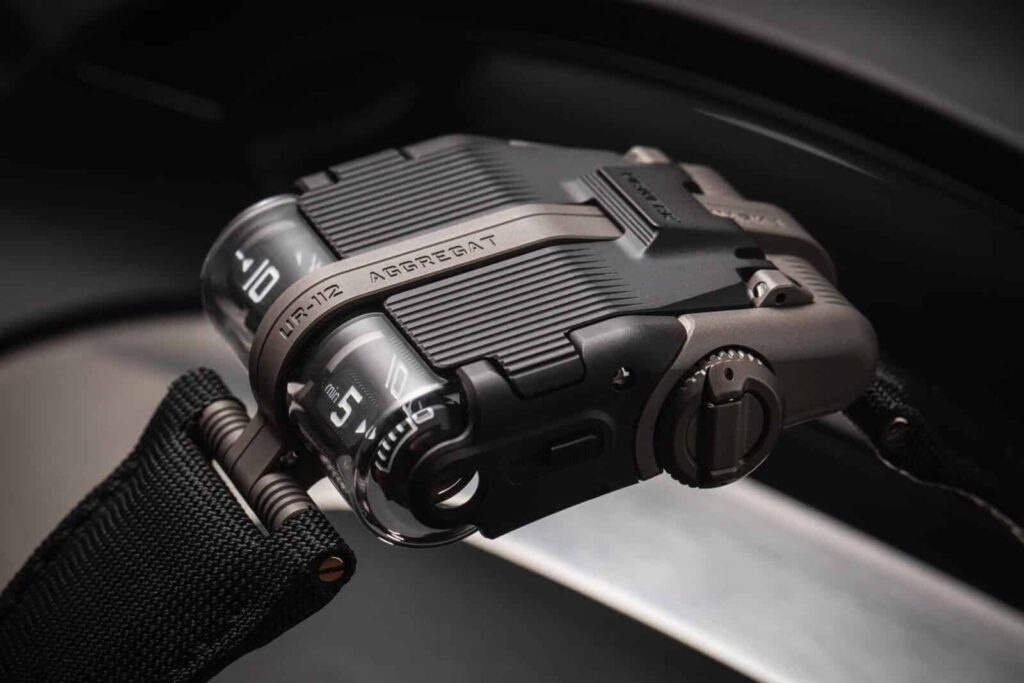
Urwerk UR-112 Aggregat – remarkable design and engineering
It’s easy to be blasé about Urwerk; “Yeah, those two guys who make crazy watches.” But the thinking, design and engineering that goes into one of their ’crazy’ pieces is remarkable rather than whimsical. This new UR-112, for example, transmits power from the movement to the time display via a stainless steel shaft, less than 40 mm long and fractions of a millimetre thick. Making one of those isn’t too much of a challenge for your average micro-engineer. What is tricky, however, is designing and making a tiny transmission that will route power through 90 degrees to three different displays on two different planes moving at different rates.

Urwerk UR-112 Aggregat – hours and minutes
A lot of this challenge is down to the way the watch displays the time. Being an Urwerk, there’s nothing as conventional as a dial, no matter how ornate or rarefied. Instead, there are two groups of four spinning triangular prisms, one group looks after minutes, the other shows the hours. They sit under two sapphire domes that face you with the watch on your wrist. The movement sits further back in the case with that shaft transmitting power to both sets of prisms. Seconds, on the other (non-existent) hand get looked after behind that little red anodised bridge under the top case.

Urwerk UR-112 Aggregat – luminescent details
Those triangular, tooth-edged prisms are cut from corrosion-resistant Beryllium copper and fixed on tiny geared carousels that make an Audi Ur Quattro’s diff arrangement look neanderthal. Each numeral is picked out in white Super-LumiNova (glows blue in low-light) against a brushed black background. Because the four minute prisms are calibrated in five minute intervals (so 5-10-15-20 etc.), each has a tiny triangle pointer on its edge that runs against a minute scale, calibrated 0-5 and also lumed, on the right of the display. This shows the exact minute. Each prism is geared so that it’s always easily visible when it gets its moment to shine at the front of the display. It’s rather reminiscent of an old Bosch UDW1 mechanical/electrical clock where the hours and minutes flip.

Urwerk UR-112 Aggregat – UR 13.01 movement
So how does it all work? Well, it starts with the UR 13.01 movement. The technical details are simple enough; it’s a 28,800 vph (4 Hz) automatic with a 48 hour power reserve and a conventional lever escapement. But that’s like saying a Bristol 410 is an old car with a Chrysler V8. It’s a lovely thing with straight and circular graining on the power reserve and seconds, sanding, Côtes de Genève and polished screw heads elsewhere. Not everything on an Urwerk has to be satin black, y’know.
But then take a look at how it works and you’ll see a different sort of beauty. The fact it has 66 jewels should be a bit of a tip-off – that’s way more bearings than a standard movement. The secret is partly in the power generation, but the real boggling, ‘how the HECK did they come up with that?!’ cleverness is in the power transmission.
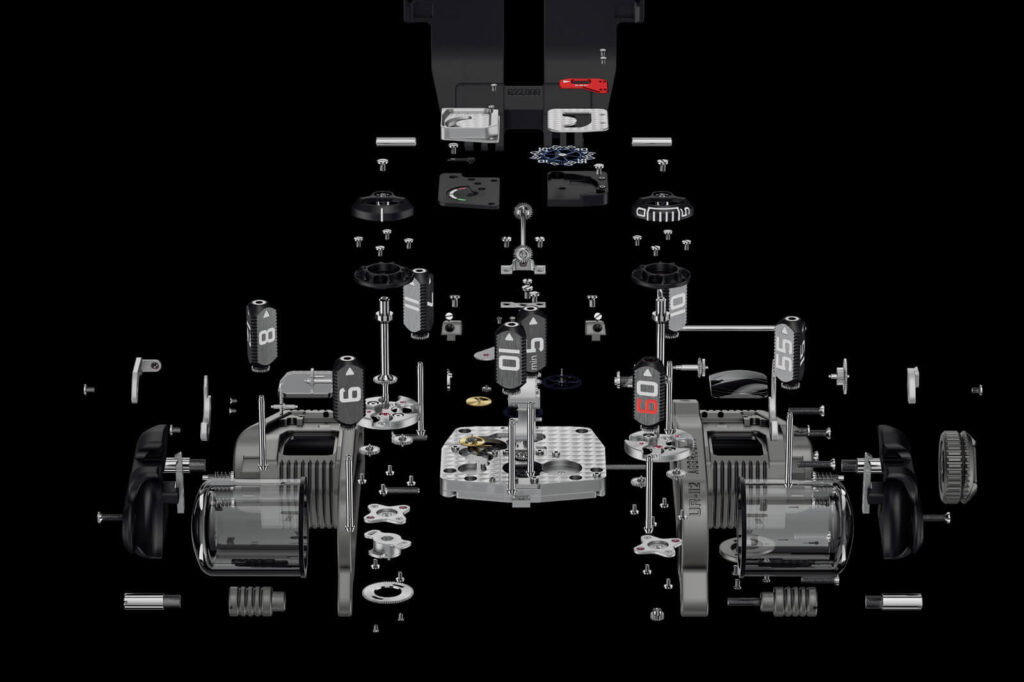
You already know about the shaft that runs from movement to display. Once it gets there, as those minute prisms spin, they generate power that gets stored to click the next hour prism smartly over. As Felix Baumgartner explains, “From a single source of energy, we power all displays and mechanisms of this UR-112. This force is distributed sparingly, some even ‘recycled’ so that from the digital second at the top of the dial to the dragging minutes and the jumping hours at the opposite extreme, each display receives precisely its required dose of energy with none wasted.”

The snail-shaped mechanism that handles the job is a neat differential and power take-off that sits in the middle of the case. It uses a series of minute cams, gears and springs and has 18 parts and 9 jewels all of its own. This miniature mechanical marvel is only slightly bigger than a pocket-watch crown. The rest of the in-movement power transmission duties are taken care of by 8 titanium planetary gears.
The case is no less remarkable, as befits a movement like the UR 13.01. It is, of course, titanium; nothing else would be cool enough apart from, maybe, ceramic or material re-purposed from the Antikythera mechanism. It uses a combination of satin black (wouldn’t be an Urwerk without it) and gunmetal PVD coating. There are two distinct finishes to the case; the vertical ribs of the case top, segueing into the rear and underside, and the sandblasted gunmetal of the main body. That, in turn, is broken up by the winding/setting crown on the right of the case.

Urwerk UR-112 Aggregat – five-part case
It’s actually a five-part case – nine if you include the two sapphire domes that cover the hour and minute prisms and the two smaller crystals over the power reserve and running seconds (more of those later). The main parts are the halves of a titanium clamshell that join at the case’s central rib. These are neatly secured with four-prong screws but also the mounting mechanism for the free-floating strap. The rib separates the hour and minute domes, gives a visual indication of the power transmission shaft that runs underneath it as well as adding strength to the case. Screwed to the case side are two black shrouds that both cover the domes as well as the activating mechanism for the hunter case. Yes, that case cover flips open when you push the two levers in the shrouds, rather like the hunter case on the Urwerk Streamliner.

Under the hunter case top you’ll find a running seconds on a silicum disc, also Super-Luminova coated, and the power reserve indicator, likewise.
Urwerk UR-112 Aggregat – closing thoughts
You have to try a bit harder with an Urwerk; it won’t wave gold filigree hands at you. Instead, it calmly gets on with a level of mechanical design and engineering thinking that doesn’t need ornament because it’s interesting enough in itself. Yes, you still get the levels of finishing you’d expect from a Haute Horlogerie maker but you don’t get any of the fuss. The Urwerk UR-112 Aggregat might be just the thing for the person who wants a luxury watch but doesn’t want the ostentation that sometimes comes with it.
Further reading
Technical specification
- Model: Urwerk UR-112 Aggregat
- Case: Black and Gunmetal PVD-coated titanium; dimensions 42 mm x 51 mm; height 16 mm
- Functions: Jumping digital hour on triangular prisms; running digital minute on triangular satellite prisms; digital seconds; power reserve
- Movement: Calibre UR-13-01; automatic movement; frequency 28,800 vph (4 Hz); 66 jewels; power reserve 48 hours
- Price: CHF 250,000 excluding tax (RRP as of 21.3.2022)
- Limited Edition: 25 pieces