
URWERK – 25 years and counting (Part One)
URWERK, the high-end Swiss watch brand, is 25 years old. Throughout its history, it has made numerous thought-provoking timepieces, each distinctive in appearance and brimming with horological virtue. To begin, Angus Davies examines the early years of the brand and the personal stories of its founders, Felix Baumgartner and Martin Frei.

Image – early drawing by Martin Frei of the UR-101
Who is URWERK?
Today, URWERK is known for its unique blend of Haute Horlogerie and neoteric, almost other-worldly, design language. The Swiss firm splits its operations across two sites in Geneva and Zurich and is currently celebrating its 25th anniversary. The brand is popular with legions of watch aficionados and its products are regularly seen gracing the wrists of movie stars, sports personalities and prominent business figures. But how did the brand get to this point? Allow me to elaborate.
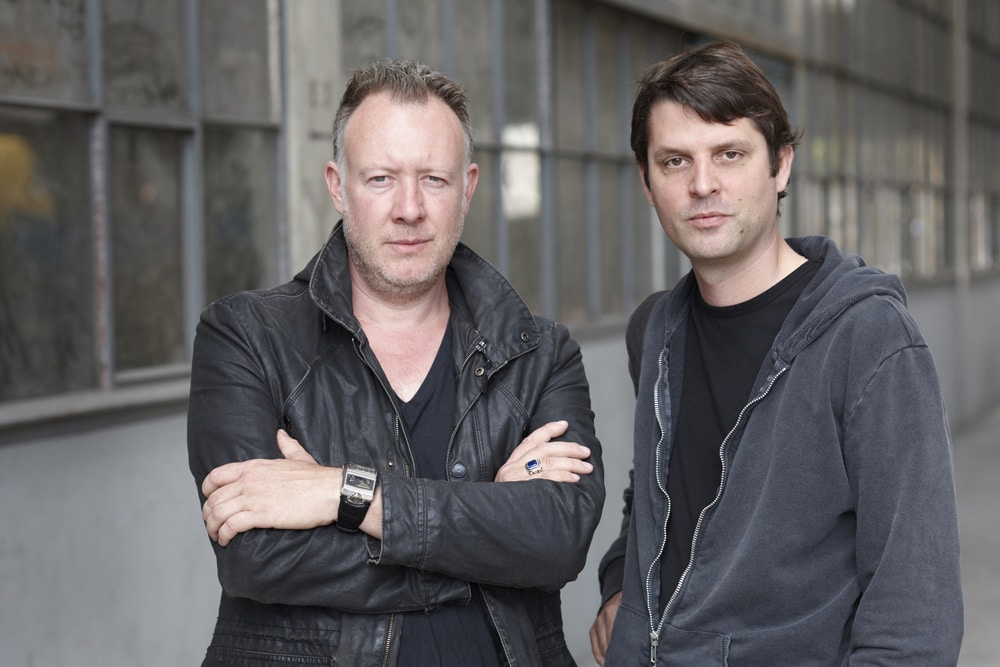
Image – Martin Frei (left) and Felix Baumgartner (right)
Felix Baumgartner
Felix’s grandfather worked as a watchmaker at IWC Schaffhausen, while his father had his own workshop dedicated to antique clocks. Growing up, Felix was surrounded by clocks, some of which were especially complicated. Despite once having a fleeting dream of becoming a fireman, it was perhaps inevitable that Felix would ultimately pursue a career working at a bench with a loupe to his eye. It was during his time in his father’s workshop that Felix discovered the clocks produced by the Campani brothers.
Back in the 17th century, the Campani brothers, based in Rome, made a papal night clock that eschewed the verge escapement, typical of the period, in favour of a silent escapement linked to a pendulum. No longer was the Pope’s sleep disturbed with the incessant tick-tock typical of most clocks. Instead, he could enjoy sleeping to the accompaniment of a monastic hush. This type of clock was made of wood and featured a wandering hours display, serving as means of indication. Moreover, they housed a candle that provided a means of illuminating the display. These historic night clocks were the inspiration for Urwerk’s inaugural models, the UR-101 and UR-102.
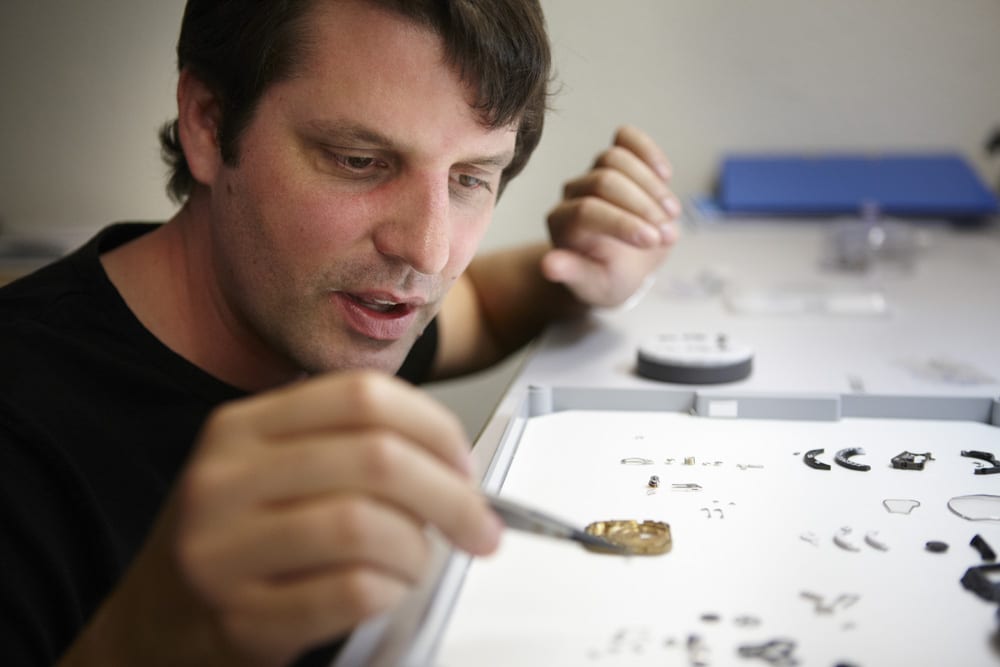
Determined to pursue a career as a watchmaker, Felix enrolled at the watchmaking school in Solothurn and successfully graduated in 1995. Like his father, Felix did not want to work for a ‘company engaged in large-scale production’. Having heard of Svend Andersen, the famous independent watchmaker, Felix approached him for a position at his Genevan atelier. Apparently, Svend ‘immediately hit it off’ with Felix. His employment status was unusual, as Svend Andersen recently explained, ‘Felix worked for us partly as a salaried employee and partly as a freelancer’. Certainly, the arrangement worked well.
During his time working for Svend Andersen, Felix was exposed to a variety of complications, working on different types of calendar watches and restoring several complicated timepieces made by a number of prestigious brands. Moreover, Felix was involved in the making of a wristwatch featuring an erotic automaton, a horological genre first seen about 300 years earlier in a pocket watch.

Image – early URWERK movement created for the UR-101 and UR-102 models
While working for Svend, the young watchmaker was also able to work on his ‘satellite’ display which would ultimately become a defining facet of URWERK’s DNA.
Martin Frei
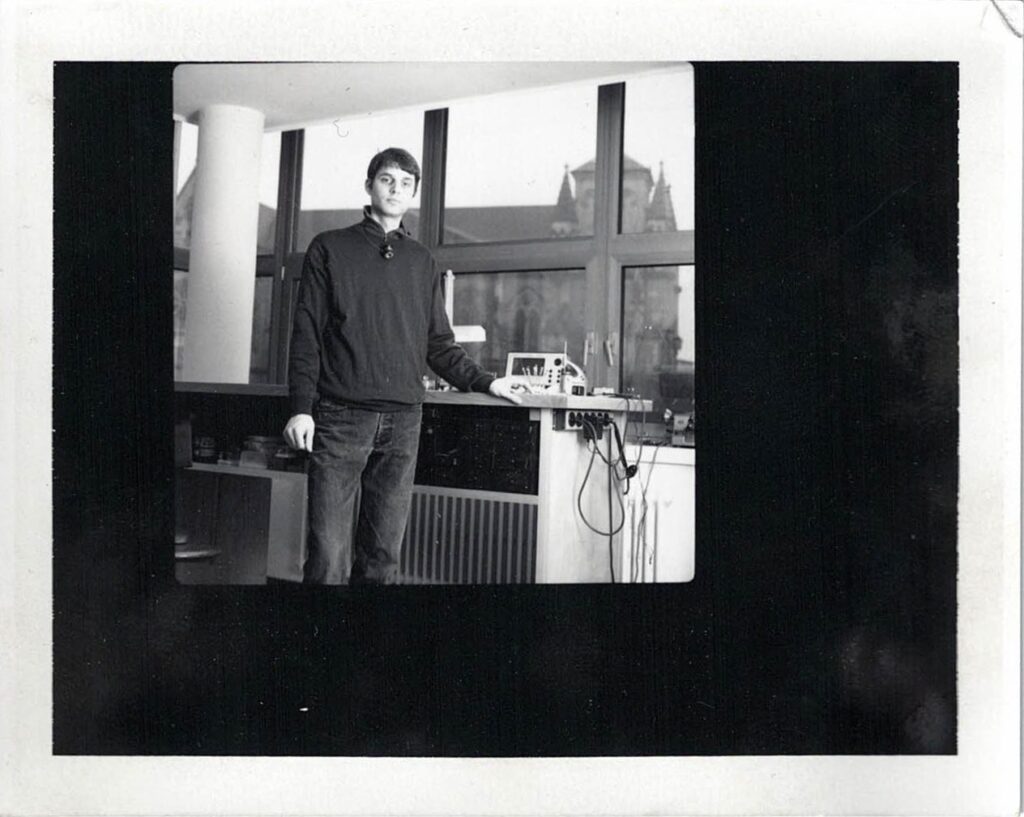
Martin Frei was born in the Swiss city of Winterthur, but at the age of three, his parents relocated to the picturesque town of Greifensee within the canton of Zürich, positioned adjacent Lake Greifen. Chatting with Martin, he recalled fond childhood memories, sailing along the lake in his parents’ boat. Martin also spent time living in Windisch in the canton of Aargau. All three locations are located in the German-speaking areas of Switzerland, which has clearly contributed to Martin’s distinctive accent.
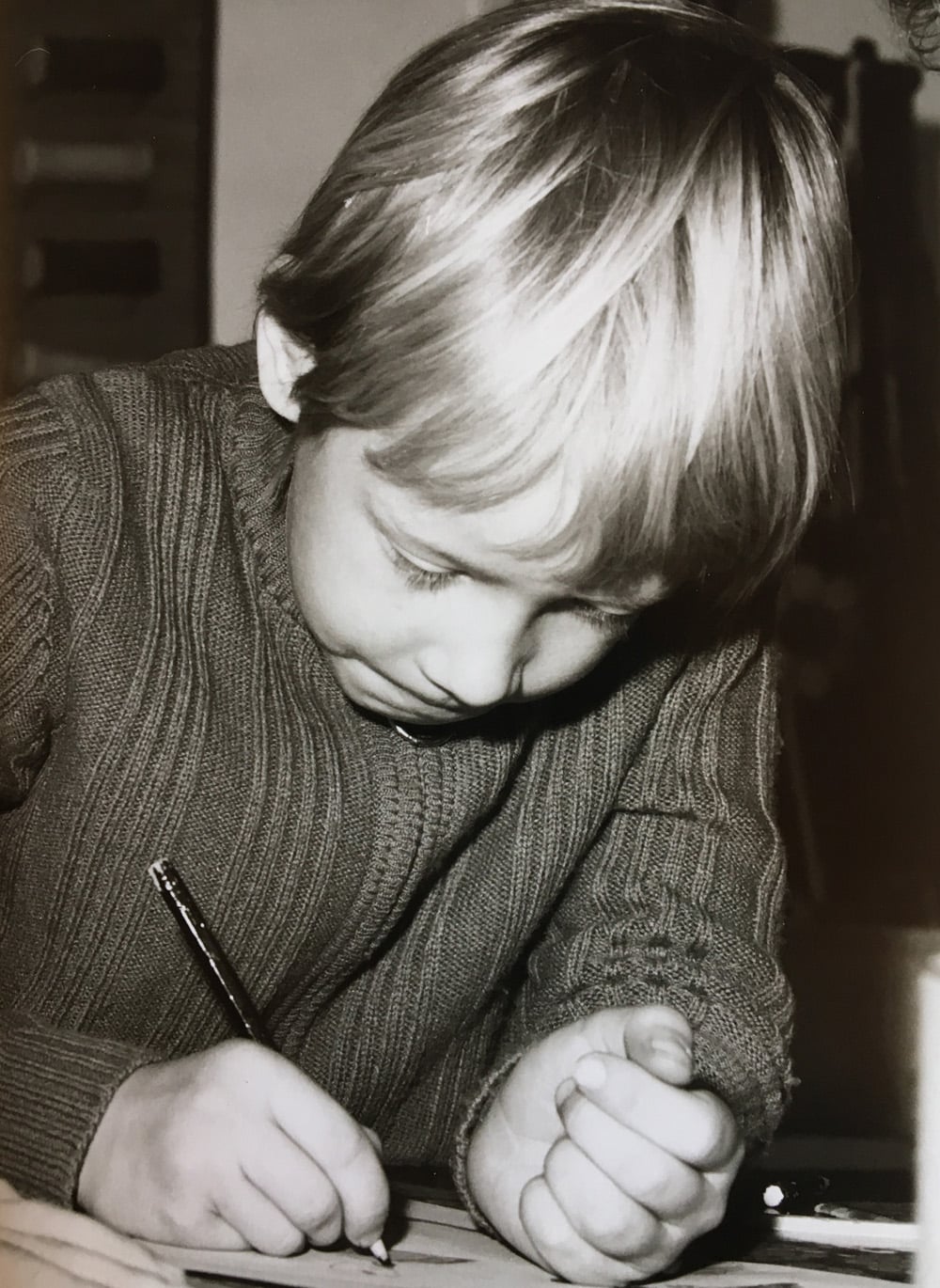
His father was an engineer, at one stage working at ETH Zürich (Swiss Federal Institute of Technology in Zürich), while his mother was an art teacher. No doubt his parents’ professions influenced Martin during his formative years, serving him well later in adulthood. Indeed, Martin cites his mother as his first art teacher, encouraging him to express his creativity using a variety of mediums.
As Martin grew older, his passion for art grew exponentially. This was manifest with the time he spent studying for a diploma in Graphic Design at the School of Visual Arts of Zürich. Thereafter, he studied at the Lucerne School of Art and Design where he graduated with a Bachelor of Arts degree. Interestingly, Martin studied under Roman Signer, the famous visual artist known for ‘sculpture, art installations, photography and video’.
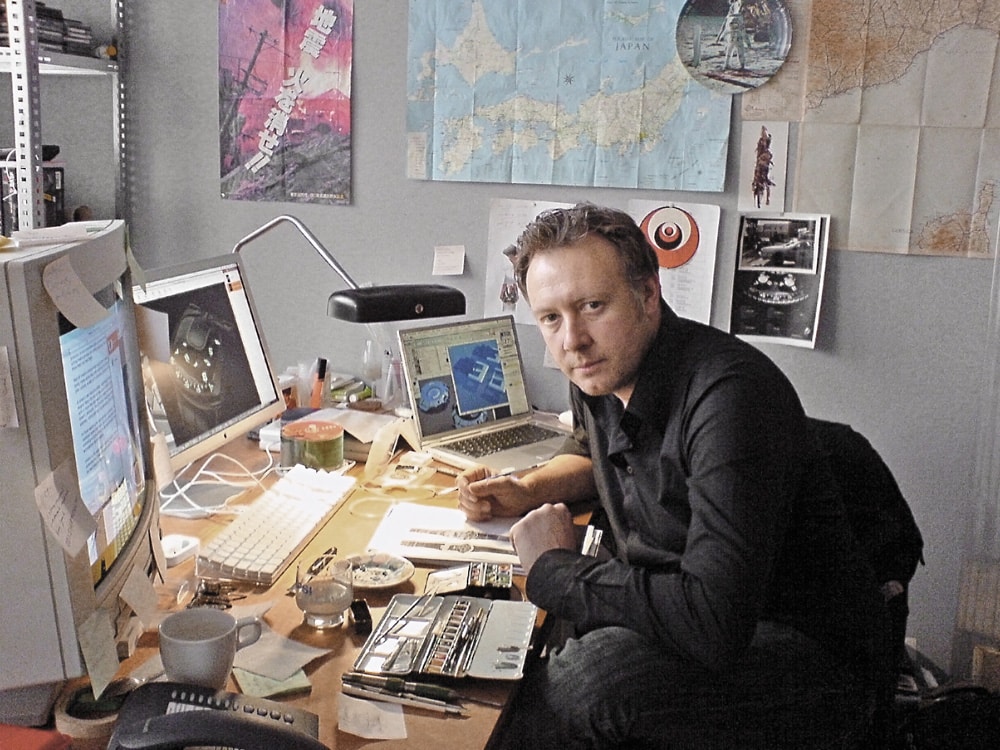
Later, Martin founded ‘United Swiss Artists’ (USA) along with Christoph Draeger. They had studied together at the Lucerne School of Visual Arts and shared an interest in ‘Sputnik Art’. On one occasion, Martin remembers being loaned a Sputnik satellite from a museum in Lucerne, on the proviso USA insured it. Martin, together with three fellow artists, donned space suits, mounted the satellite on a pedal boat and proceeded to cross Lake Lucerne a number of times. Martin’s interest in astronomy and, in particular, satellites would help define his future career. Indeed, the satellite was a key factor in the birth of URWERK.
Felix Baumgartner and Martin Frei – two young men with lots of ideas
Thomas Baumgartner, an accomplished watchmaker, was introduced to Martin by Christoph Draeger. As well as being Martin’s flatmate and co-founder of USA, Christoph was also Thomas’s cousin. Martin and Thomas immediately got on. Thomas was incredibly skilled and adept at making objects, so when he saw Martin making an improvised tool that was below par, he came to his aid. Martin recalls, ‘I thought these watchmakers can really make stuff’.
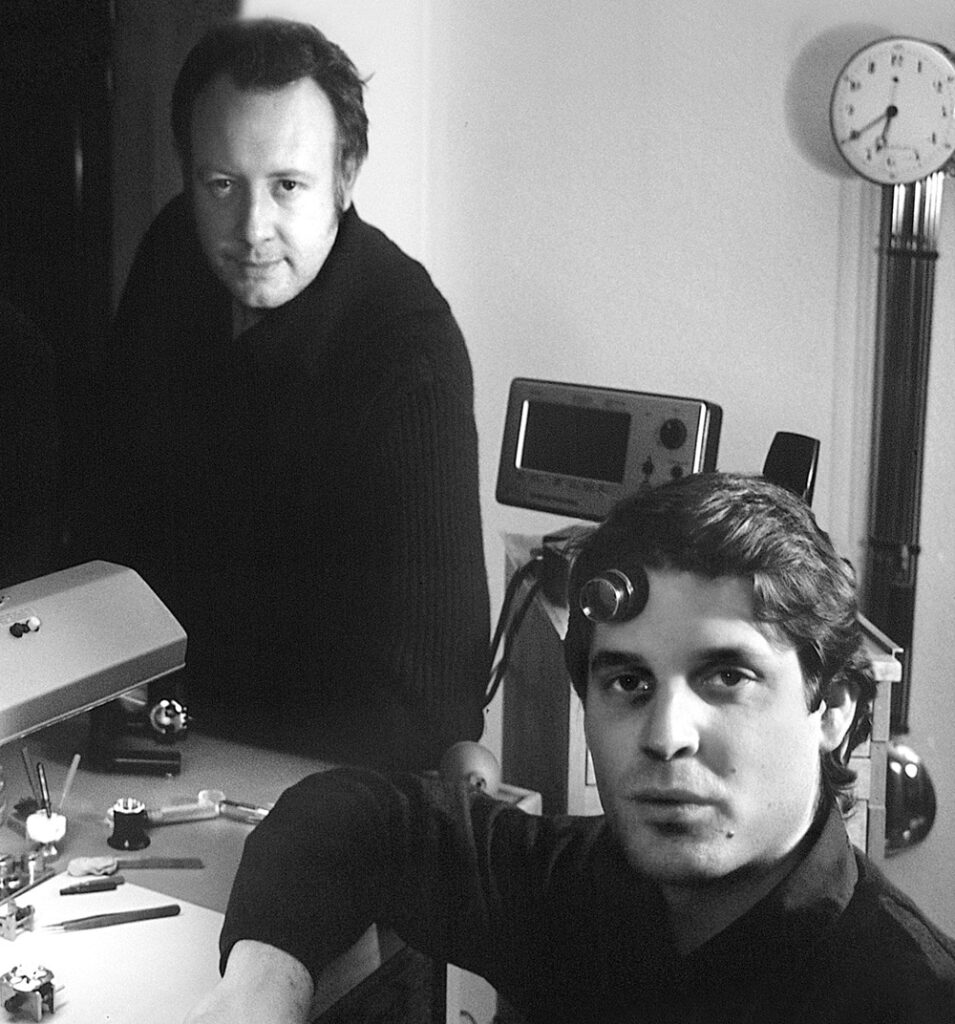
Image – Martin Frei and Felix Baumgartner (1997)
Mindful of Martin’s obsession with Sputnik Art and satellites, Thomas invited his brother, Felix, to meet the visual artist. The Baumgartner brothers went on to explain their idea of creating a watch featuring a satellite system, inspired by the clocks produced by the aforementioned Campani brothers where the rotating hours also indicate the minutes.
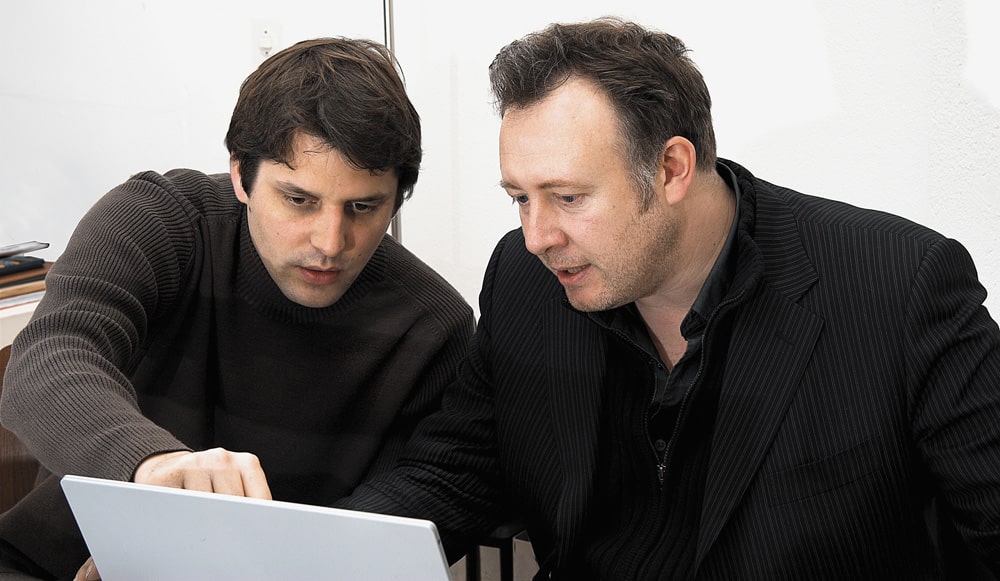
Having met in 1995, Felix and Martin, launched their new business, URWERK, in Geneva two years later (1997).
While French-speaking Geneva is widely considered the birthplace of Swiss watchmaking, a legacy of Calvinism, both Felix Baumgartner and Martin Frei, the founders of URWERK SA originate from German speaking regions of the landlocked nation. However, Felix was already based in Geneva, working for Svend Andersen at the time and there were many specialist component suppliers based in or near the city, making it an obvious base for the newly formed company.
Svend, the co-founder of the AHCI (Académie Horlogère des Créateurs Indépendants), supported URWERK’s application to join the trade association. In April 1997, Felix and Martin presented their inaugural watches, the UR-101 and UR-102, on the AHCI booth at Baselworld, showcasing a contemporary interpretation of the wandering hours concept.
URWERK – the origins of the name
Recently, while chatting to my former German teacher about watches, I mentioned URWERK. He smiled and commented on the brilliance of the firm’s name. The first two letters ‘UR’ refer to the city of UR in Mesopotamia, a place where the ideas of time were shaped some 6000 years ago. However, ‘Uhr’ is also the German word for clock or timepiece, a clever means of reinforcing the brand’s personality. As for ‘WERK’, it is derived from the German word meaning ‘work, create, evolve, shape, forge and to arouse emotions.’
Despite most of the brand’s activities being located in Geneva, the name URWERK will always serve as a connection between the company’s founders and the German-speaking regions from where they both originate.
The URWERK UR-101 & UR-102 (1997) – the first timepieces
Back in 1997, Felix and Martin had limited financial resources, hence the inaugural watches were made of steel as the creative duo could not afford to make the models in gold. However, while these prototype watches were made of steel, they clearly demonstrated a remarkable capacity for design and fine watchmaking. Ultimately, the serially produced versions of the UR-101 & UR-102 were made in noble metals as well as an array of other materials.

Image – URWERK UR-102
Although URWERK is now known for its heavily sculpted three-dimensional objects, endowed with numerous textures and facets, the designs of the UR-101 & UR-102 were minimalistic by comparison. The smooth circular cases resembled pebbles, eroded by the sea, devoid of any sharpness. The UR-101 had conventional lugs at the base of the dial and the upper section of the strap was integrated within the case. In contrast, the UR-102 was endowed with complex strap attachments, comprising four elements, positioned both above and below the watchhead. From the outset, URWERK’s design language was non-conformist.

Image – URWERK UR-102 Cooper Jacoby
Both models measured 38mm in diameter and were equipped with automatic movements. Most pertinently, the models featured a wandering hour display, with the prevailing hour shown in an aperture running along a minute track.
Although the UR-101 & UR-102 are now 25 years of age, they have not suffered the indignity of ageing. Not an age spot or wrinkle in sight. Interestingly, in December 2022, the Swiss watch marque created the ‘Cooper Jacoby x UR-102 “Reloaded” one of-a-kind creation’. This unique piece sold at auction in support of the Swiss Institute of New York.
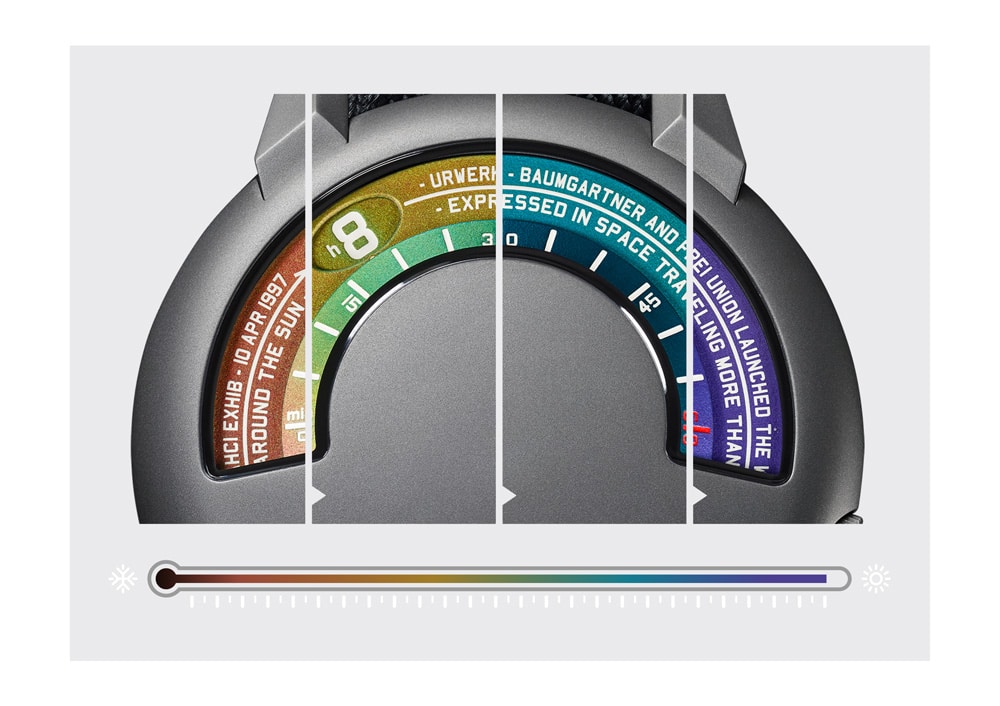
Image – URWERK UR-102 Cooper Jacoby
Measuring 41mm in diameter, this charity watch was a little larger than the original UR-102. The case was made of titanium and overall it looked slightly more refined. It was endued with a display incorporating ingenious ‘thermal colour indexing’. This latter detail means the minute track assumes a different hue depending on the prevailing temperature. However, despite the aforementioned details, the design remained true to the original UR-102, testament to its ageless looks.
Coming next
In the next instalment of the URWERK story, I catalogue some of the firm’s models, the brand’s many achievements and some of the challenges it has encountered along the way.