
Vacheron Constantin Les Cabinotiers Grande Complication Bacchus
Since it was founded in 1755, Vacheron Constantin has always catered for its well-heeled patrons with off-the-peg and bespoke timepieces. Les Cabinotiers Grande Complication Bacchus is the latest one-of-a-kind timepiece to leave the brand’s atelier, located on the outskirts of Geneva. It wonderfully demonstrates the Manufacture’s ability to unite its remarkable watchmaking expertise with sublime Métiers d‘art.

Huguenots, French Protestants, fled persecution during the 16th and 17th century. Many of these individuals chose to settle in Geneva, home to the Huguenot preacher, John Calvin. Some of these immigrants had a talent for business and an appreciation for education. Moreover, many of the Huguenots were highly skilled in goldsmithery and making jewellery.
Calvinism encouraged sobriety, understatement and shunned forms of extravagance. Regulations relating to the manufacture of jewellery prohibited the making of ‘crosses, chalices or other instruments of popish idolatry’. Therefore, the highly talented French refugees employed their skills to make watches. Moreover, the artisanal crafts previously used for making jewellery were reappropriated for decorating timepieces.
In the 18th century, Geneva’s skyline was dotted with tall buildings, some of which had five or six floors. The attics, located on the top floor of these buildings, were commonly known as ‘cabinets’. This is where the craftsmen or ‘cabinotiers’ worked. Due to their elevated position they were distanced from the noise below and their workbenches were bathed in natural light, free of shadows. The term ‘cabinotiers’ referred to the watchmaking elite, enamellers, engravers and goldsmiths. Similar to the Huguenot refugees of the 16th and 17th centuries, these individuals were highly educated and often spent their spare time studying.
‘Les Cabinotiers’ can trace its origins to 1755 when Vacheron Constantin was founded. Indeed, throughout its history, the prestigious Maison has always been known for making one-of-a-kind creations. Vacheron Constantin famously made bespoke timepieces for Maharaja of Patiala Sir Bhupindra Singh (1916), James Ward Packard (1919), Count Guy de Boisrouvray (1928), His Majesty Fouad I (1929) et al.
While the names of the aforementioned clients are widely known among watch aficionados, many aspects of ‘Les Cabinotiers’ are shrouded in secrecy. Many commissions are hidden from the public gaze. Indeed, the privacy of clients is closely guarded and discussions regarding price are a matter for the Maison and its individual clients.
However, some one-of-a-kind timepieces are produced on a speculative basis and shown to the world’s media. In addition, these watches will often travel the globe where they will be displayed in the luxury marque’s boutiques.
The latest pièce unique to leave the Manufacture in Plan-les-Ouates is the Vacheron Constantin Les Cabinotiers Grande Complication Bacchus. This horological masterpiece honours the Roman god of agriculture, wine and fertility. It fuses high horology with various artistic crafts.
This rare timepiece is endowed with 16 complications, including several astronomical and calendar-related functions. Technical highlights include a perpetual calendar, tourbillon and, the pinnacle of horological virtuosity, a minute repeater. Les Cabinotiers Grande Complication Bacchus is a double-sided watch, exquisitely displaying information both to the front and rear.

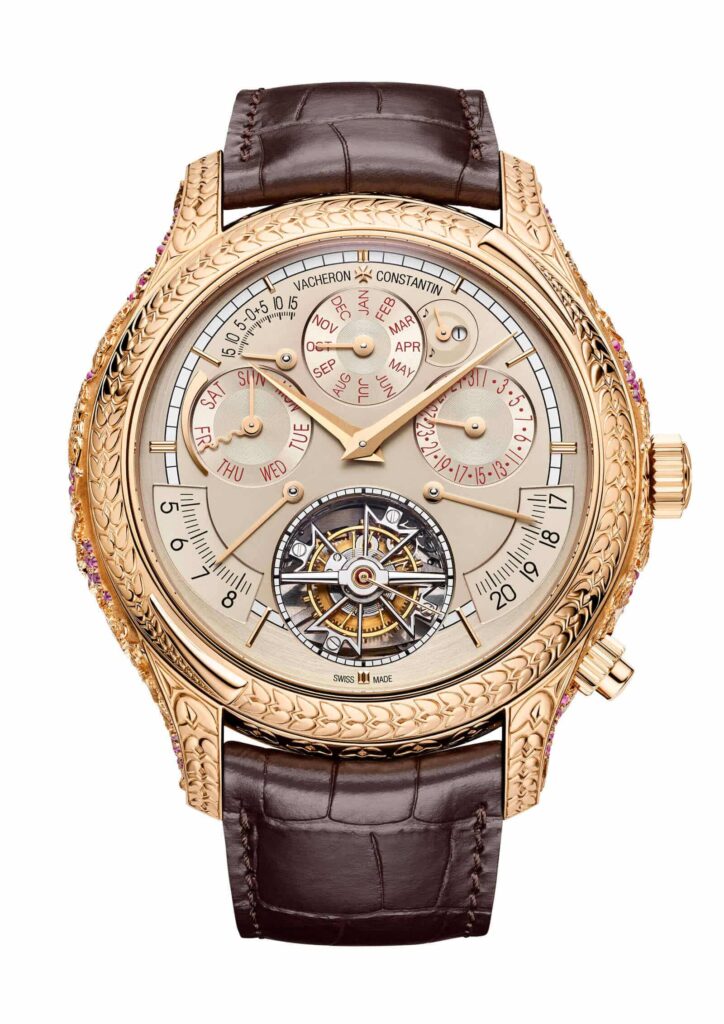
Housed in an 18-carat 5N pink gold case measuring 47mm diameter, the Vacheron Constantin Les Cabinotiers Grande Complication Bacchus showcases the Maison’s mastery of Métiers d‘art. Various case surfaces are hand-engraved with vine leaves and the case band is set with 113 rubies which artistically represent grapes.
Once again, Vacheron Constantin demonstrates its remarkable talents along with a capacity to produce sublime horological compositions and quintessence of Haute Horlogerie. The Genevan watch industry came to prominence in the 16th and 17th century and, based on this timepiece, its pre-eminence continues to endure.
The brand’s press release
The single-piece edition Les Cabinotiers Grand Complication Bacchus offers proof that the tradition of combining artistic crafts with watchmaking expertise remains alive and well within the Maison. Vacheron Constantin’s master engravers and gem-setters have worked together to make this watch an applied arts masterpiece powered by in-house Calibre 2755 GC16, whose complexity is expressed through its 16 complications. This double-sided creation dedicated to Bacchus, the Roman god of vines and wine is adorned with ruby grapes set in gold foliage hand-carved. In addition to these mythological references, the tourbillon and minute repeater movement displays virtually every astronomical and calendar-type complication a timepiece can muster. This association between the study of the stars and the divine world, between Bacchus and Johannes Kepler, makes this timepiece doubly remarkable.
Artistic crafts perform a duet
The 18K 5N pink gold case of this Les Cabinotiers timepiece features a decoration composed of vine leaves interspersed with bunches of ruby grapes. The engraver’s work is complemented by that of the gem-setter on the outside of the case in giving life to figurative motifs, making this watch a piece of fine craftsmanship. The two master artisans working on this model took turns, with the gem-setter first taking the case from the engraver’s hands and then returning it for the last finishing touches, a progressive duet-style operation that required more than 300 hours of combined dexterity.

Before embarking on such a project, an initial gem-setting test had to be performed on part of the case middle that had been prepared beforehand, so as to ensure the feasibility of the project and the various phases of its development. After putting the decoration in place using a scribing tool, the engraver began to prepare the model using the bas-relief technique that consists of creating cells or troughs by delicately “gouging” the material with a burin to make the foliage motif stand out. This preparation included the 113 recessed spaces for the five different sized rubies that form the grapes along with enough surrounding material to hold them in place. The gem-setter then took over, in successive phases, in order to set the cabochon-cut rubies using a technique combining prong and bezel setting, involving a minimum of three points of attachment.
Once the bunches of grapes had been formed, the engraver took over the model to perform the finishing, while facing the added difficulty of having to work around the gem-set parts without touching them. The vine leaves were thus delicately modelled using the intaglio engraving technique that involve hollowing out the material and then polished. And because every detail is important, the engraver took the trouble to dig slightly below the outline of each leaf so as to accentuate the 3D visual effect. This foliage thus emerges clearly against the case middle, especially as the base has been delicately chased. To achieve this sandblasted effect, the engraver hammers the surface point by point so as to enhance the contrast with the raised polished elements.
Calibre 2755 GC16
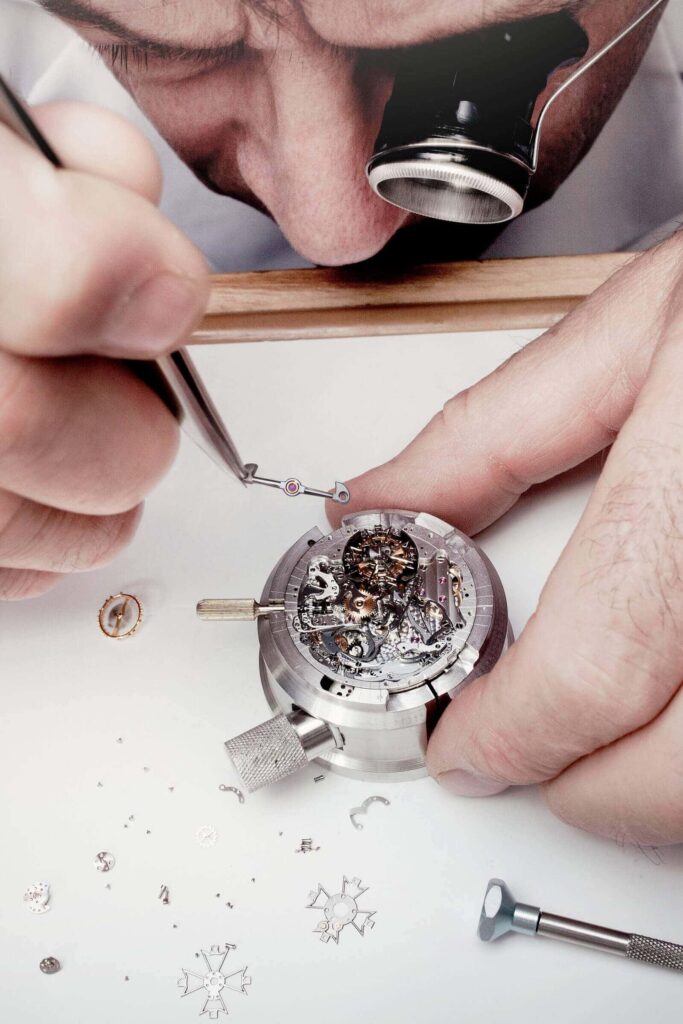
To create the movement of this highly complicated watch, Vacheron Constantin’s watchmakers took the Tour de l’Île as a reference, a timepiece presented in 2005 as a tribute to 250 years of watchmaking expertise cultivated by the Geneva-based Manufacture. In the same spirit, the Les Cabinotiers – Bacchus timepiece combines 16 complications, making it one of the most complex watches produced by the Maison. For the sake of precision timekeeping, its manual winding Calibre 2755 GC16 is equipped with a tourbillon regulator to compensate for the effects of the earth’s gravity on the mechanism. Featuring a cage shaped like Vacheron Constantin’s signature Maltese cross emblem, the tourbillon completes one full rotation per minute, thus serving as a small seconds indicator. This watch also incorporates a minute repeater chiming the hours, quarters and minutes on demand. To avoid unnecessary noise as well as wear and tear on the mechanism, the striking of the gongs is equipped with an ingenious centripetal flying strike regulator. This perfectly silent device regulates the duration of the musical sequences so as to obtain clear, distinct and regular sounds.
The calendar and astronomical functions play a starring role on both sides of the watch. On the front, where the mechanical ballet of the tourbillon can be admired at 6 o’clock, the perpetual calendar indications are displayed on three counters. Positioned in the upper part of the dial, they respectively show the date, day and month. Designed to keep track of the Gregorian calendar’s vagaries without any need for adjustment until 2100, this horological complication is further enhanced by the indication of the leap-year cycle. The latter appears in a small aperture next to the hand indicating the torque of the minute repeater mechanism between 1 and 2 o’clock. This striking mechanism power reserve is matched by an indication of the movement power reserve, which can be read by means of a serpentine pointer coaxial with the day of the week hand.

The complex mechanics of this piece also provide an astronomical reading of time representing a tribute to Johannes Kepler (1571-1630), regarded as one of the founders of modern astronomy for having discovered the laws of planetary motion, in perfect agreement with Copernicus’ heliocentric hypotheses. The first astronomical functions thus appear on this same opaline champagne-coloured dial, starting with the equation of time positioned between 10 and 11 o’clock. As the Earth’s path around the Sun is not circular but elliptical, and since the Earth’s axis is inclined at 24° to the plane of its orbit, the time between two zenith passages of the Sun is not the same throughout the year. This difference between the (true) solar day and the (average) 24-hour civil day ranges from -16 to +14 minutes depending on the time of year and coincides only four times a year. Called the equation of time, or time correction in astronomical language, this differential is displayed by a dedicated pointer, while sunrise and sunset times – adjusted according to a reference city – appear at the bottom of the dial.
An astronomical watch as conceived by the watchmakers at Vacheron Constantin would not be complete without a sidereal time indication. This display finds its place the back of the watch in the shape of a rotating disc depicting the celestial vault with its constellations observable from the Northern hemisphere. Taking a fixed star in the sky as a reference point, the time required for the Earth to complete a full 360° rotation, or sidereal day, is exactly 23 hours, 56 minutes and 4 seconds. Since the Earth is both spinning on its axis and revolving around the Sun, it takes about four minutes less than a calendar day to return to its point of origin relative to a given star. On this model, the “celestial” disc thus performs a complete rotation according to sidereal time with the time displayed on the periphery, opposite the date appearing on the periphery of the mobile disc. This same date is read off by a large central hand moving over the fixed outer flange bearing a scale graduated in five-day increments. This hand also indicates the sign of the zodiac, the season and the four dates corresponding to the solstices and equinoxes. Finally, the small central hand indicates the age of the moon, i.e. the number of days that have elapsed since the last full moon.

Comprising 839 parts and measuring a total 33.90 mm in diameter and 12.15 mm thick, this movement endowed with a 58-hour power reserve represents a technical feat that is all the rarer in that it displays all its functions in a perfectly legible manner on both sides. Equipped with a balance oscillating at a rate of 18,000 vibrations per hour (2.5 Hz), it is housed in a 47 mm-diameter 18K 5N pink gold case, of which the characteristics been specifically designed to provide the best possible sound quality for the minute repeater.
“Le Temps Céleste”
Each year, the Les Cabinotiers department unveils a range of single-piece editions relating to a theme cherished by Vacheron Constantin. The year 2021 is dedicated to “Le Temps Céleste” (which means Celestial Time), with timepieces referring to the astronomical origins of time measurement.
From the dawn of civilisations, the cycle of days and seasons, the evolution of constellations in the night sky, the phases of the moon and eclipses have exerted an almost mystical fascination. Eager to unravel the mysteries of the universe, the first human beings found in mythological tales a cosmogony blending legends with poetry. At a very early stage, the first scientific minds attempted to decipher the rhythms of Nature and to organise them according to predictable patterns.
It was from these calculations, and with the appearance of writing, that the first calendars were born, before the Babylonian sexagesimal system gave meaning to the physical division of time into units of angle. Traditional watchmaking is a direct heir to this rigorous and scientific approach, expressed today on watches with depictions of the calendar, the sky chart, moon phases, tides and seasons, and even civil, solar and sidereal time with their differentials. Vacheron Constantin has nevertheless sought to endow these genuine observation instruments with all the charm of the founding myths through the subtlety of its craftsmanship, through its work in guilloché engraving and the engraving of symbolic motifs, or in the “stellar” glittering of gem-set stones. This new Les Cabinotiers range is the expression of exceptional expertise in astronomical watches, dedicated to the poetry of time.
Vacheron Constantin and astronomical watches
Astronomical watches enjoy a rich and longstanding tradition within the Maison. The Vacheron Constantin archives reveal a first perpetual calendar in 1884, integrated into a double-sided yellow gold pocket watch, now part of the Maison’s private collection. This was the beginning of a mechanical “epic” that would singularly take shape at the turn of the century. In 1900, the Maison set up a workshop exclusively dedicated to the assembly of watches with complications, often incorporating astronomical functions. Orders flooded in for complicated and even very complicated watches. The perpetual calendar was then combined with other technical feats such as those enriching a 1905 pocket watch comprising a minute repeater, split-seconds chronograph and perpetual calendar with phases and age of the moon.

Delivered in 1929, the pocket watch made for King Fouad I of Egypt with chronograph, perpetual calendar, Grande and Petite Sonnerie and minute repeater functions is characteristic of this golden age. This exceptional watchmaking expertise, later applied to wristwatches, would be powerfully expressed in the Tour de l’Île with its 16 horological and astronomical complications, produced in 2005 to mark the 250th anniversary of the Maison. It features a sky chart, a complication that has become a speciality of Vacheron Constantin. Reference 57260, which has 57 complications, also features a sky chart, notably accompanied by sidereal time and a secular Hebrew calendar. In 2017, Vacheron Constantin once again innovated with Calibre 3600, powering displays of civil, solar and sidereal time, the latter synchronised with a mobile representation of constellations.
Les Cabinotiers: single-piece editions
In the Vacheron Constantin universe, Les Cabinotiers represents a department in its own right dedicated to the personalisation of Grand Complication models and single-piece editions. This tradition dates back to the 18th century, an age when master-watchmakers were called cabinotiers and worked in ateliers bathed in natural light, known as cabinets and located on the top floors of Geneva’s buildings. In the hands of these learned artisans, open to the new ideas of the Enlightenment, exceptional timepieces were born, inspired by astronomy, mechanical engineering and the arts. This expertise, which constitutes the great Geneva watchmaking tradition, has been flowing through Vacheron Constantin’s veins since 1755.
Sum-up
Astronomy and mythology meet and mingle in the Vacheron Constantin Les Cabinotiers Grand Complication Bacchus watch. This union of science and art finds an original field of expression in this highly sophisticated Grand Complication timepiece. The mythological references to Bacchus, the god of vines and wine, are symbolised by the ornamentation of the case with a vineyard motif. The Maison’s master engravers and gem-setters have worked together to create a bas-relief vine foliage on the case middle of the watch, embellished with ruby-set bunches of grapes. A masterpiece of applied arts, this model is doubly remarkable for its Calibre 2755 GC16 movement powering 16 complications and representing one of the most complex ever made by the Manufacture. A tourbillon and striking watch with a minute repeater mechanism, Les Cabinotiers Grand Complication Bacchus brings together on its double-sided display the essential calendar and astronomical functions in tribute to Johannes Kepler, one of the founders of modern astronomy. The perpetual calendar offers an equation of time indication as well as sunrise and sunset times on the front, complemented on the back by a display of sidereal time with a rotating sky chart of the constellations, the age of the moon along with indications of the date, seasons and signs of the zodiac. Through this timepiece, Vacheron Constantin perpetuates the grand watchmaking tradition of pocket watches that are both mechanically complex and richly decorated.
Further reading