
Vacheron Constantin Overseas tourbillon skeleton 6000V/110T-B935 Watch Review
The Vacheron Constantin Overseas tourbillon skeleton 6000V/110T-B935 showcases the vast talents of the venerable Maison founded in 1755. Housed in Grade 5 titanium, the model features a skeleton movement, tourbillon and supremely refined finishing.

Vacheron Constantin Historiques 222
At Watches & Wonders, whilst surveying Vacheron Constantin‘s impressive exhibition space, I couldn’t help but notice the buzz around one particular display cabinet. There, shrouded from sticky fingers, bathed in bright retina-detaching light, sat the Historiques 222. A faithful reproduction of the legendary 1977 model, it looked fabulous in its yellow gold suit. The watch elicited a favourable response from the assembled press, rightly so, and has gone on to receive much coverage both online and in print.
However, whilst I don’t wish to be burned for heresy by legions of horophiles, my favourite VC at the Genevan fair was dressed in contemporary attire. The Vacheron Constantin Overseas tourbillon skeleton shares some of its DNA with the Historiques 222, but, in common with other members of today’s Overseas collection, it celebrates the here and now.

Indeed, the Vacheron Constantin Overseas tourbillon skeleton subscribes to the horological zeitgeist of today with its 42.5mm case. Much larger than the 222, the generous scale of the Overseas provides a vast canvas, affording the Maison’s artists sufficient space to showcase their incredible talents. Moreover, this remarkable exemplar of Haute Horlogerie wonderfully fuses the Maison’s mastery of aesthetics, craftsmanship and technical virtuosity to form a supreme creation.
Vacheron Constantin Overseas tourbillon skeleton 6000V/110T-B935 – case
Would-be, well-heeled aficionados are indulged with a choice of two variants: 18K 5N pink gold or Grade 5 titanium. Interestingly, this latter alloy was much in evidence at Watches & Wonders. A couple of brands even chose to describe it as a new type of noble metal. Beyond the excessive marketing-inspired embroidery of the truth, there is no escaping Grade 5 titanium makes some compelling arguments for selection.

Grade 5 titanuim case
Grade 5 titanium is an alloy of titanium (90%), aluminium (6%) and vanadium (4%). Compared with its cheaper sibling, Grade 2 titanium, it is stronger and can be polished to a brilliant gleam. The alloy is lightweight, corrosion-resistant, weakly magnetic and hypoallergenic, all useful attributes in watchmaking.

Having viewed both references, I prefer the Grade 5 titanium model (Ref. 6000V/110T-B935) and as such it is the focus of this review.

Skeleton watches
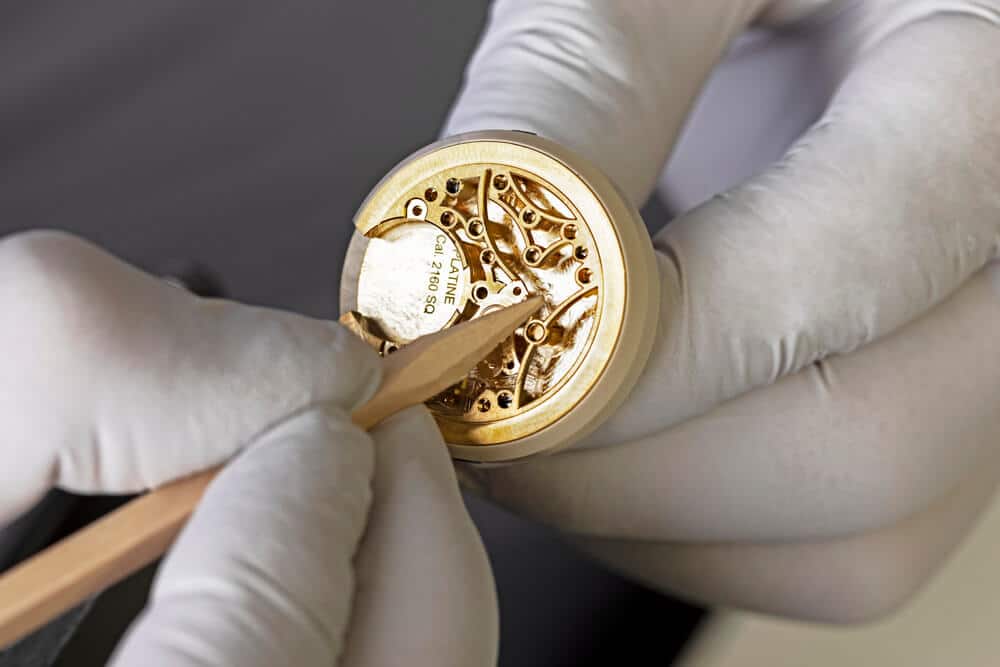
Dating back to the 18th century, skeleton watches forgo a regular dial in order to expose the movement, often presented in a filigreed form. It is the spectacle of seeing components that are ordinarily hidden from view that enriches the ownership experience.
Traditional openworked movements
For many years, an accomplished artisan would take an existing movement and remove surplus material from the bridges and the mainplate using a small handsaw. Great care was needed to ensure the brass was cut in such a way as to produce a straight, downward flank as slanted cuts would compromise the movement. Once cut, the sides of the bridges and mainplate would be drawn out with a file to remove any signs of sawing. Thereafter, the openworked parts would be bevelled and decorated. By employing this protracted process, the numerous openings would reveal the beauty of the movement.
Bridges and mainplate are made using CNC
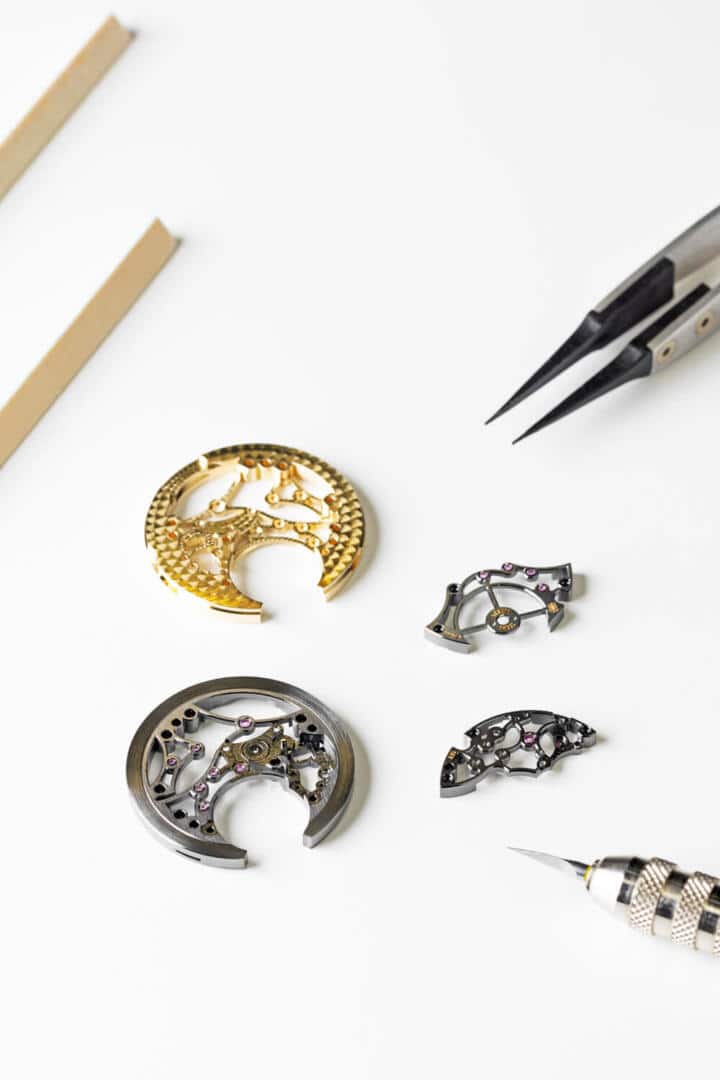
Today, most openworked movements are designed from the outset to be skeletonised. Due consideration is given to the position of components. The constructeur ensures that there is sufficient material near the jewel beds, screws and gear train to ensure smooth, reliable operation. Much emphasis is also placed on the torsional rigidity of the movement, in order to obviate any undesirable flex. The mainplate and bridges are typically cut to shape on a CNC machine, after which the surfaces are subjected to various finishing techniques.
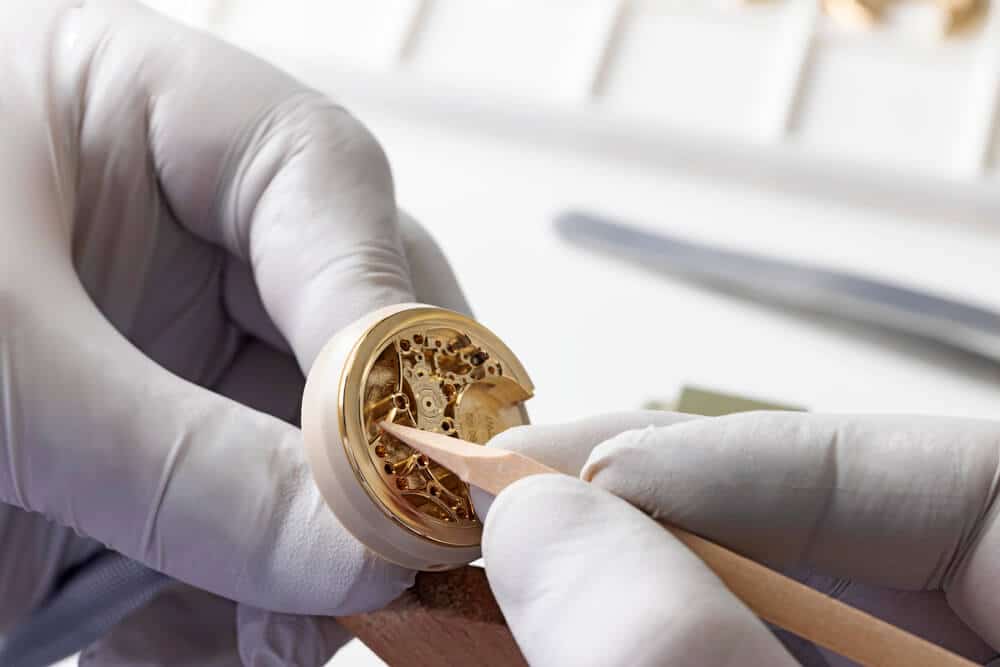
This latter approach is technically better as CNC machines can mill parts to infinitesimal tolerances, ensuring product consistency and optimum performance.
Manufacture Calibre 2160SQ – finissage
Composed of a mainplate and four bridges, the Manufacture Calibre 2160SQ is infused with the Maison’s vast watchmaking know-how. Indeed, the Genevan firm has a long history, dating back to 1755, of crafting movements to a flawless standard.
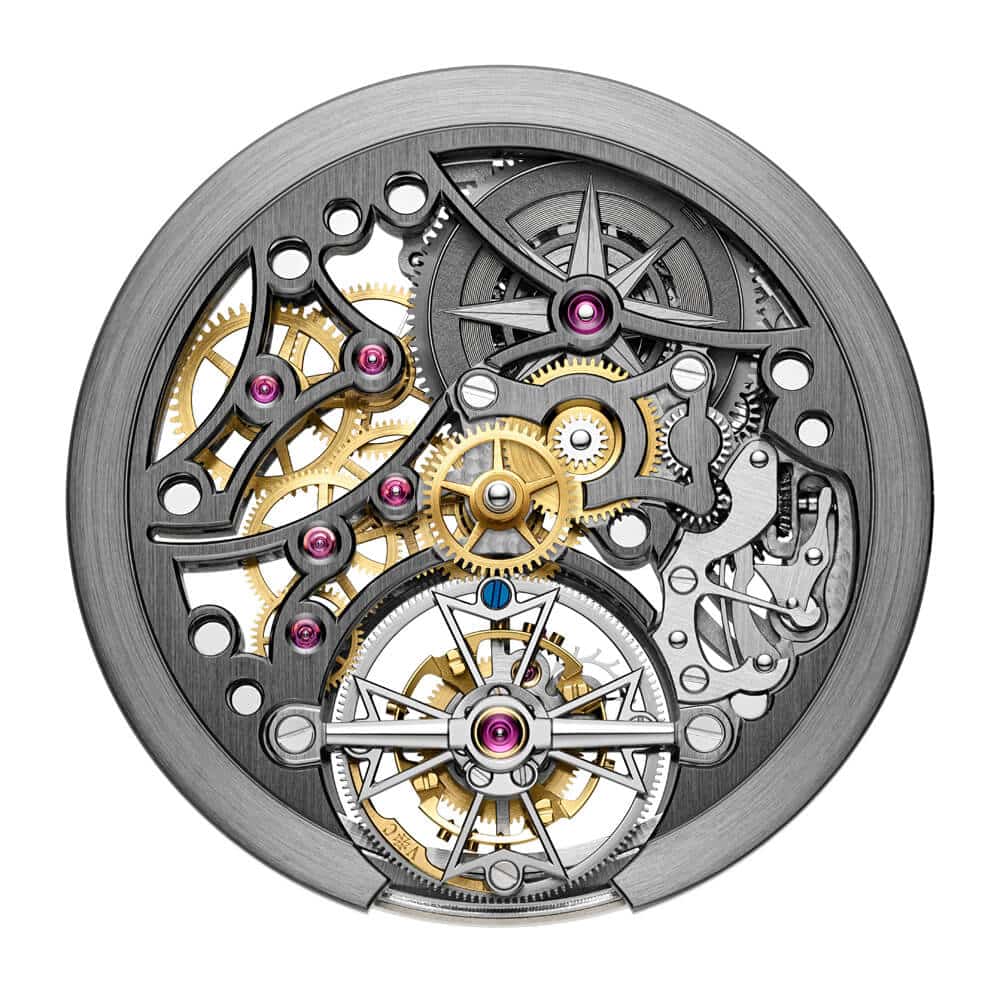
The mainplate and bridges are NAC-treated, evincing a dark grey appearance. The company’s artisans remove all signs of machining, a strict requirement of the Poinçon de Genève.
Hand-drawn flanks, hand chamfering and polished bevels are much in evidence. In the past, I’ve visited the Manufacture in Geneva where I witnessed first-hand timed-served finisseurs refine components with gentian wood. A close look at the bridges found on the Manufacture Calibre 2160SQ reveals neatly defined internal angles where two flanks meet on an inside corner. This crisp delineation of two straight sections, devoid of round edges, indicates the angle has been created by hand. Quite simply, no form of machine can replicate this characteristic, hence internal angles have become highly prized by connoisseurs.

Manufacture Calibre 2160SQ – the tourbillon
Patented by Abraham-Louis Breguet in 1801, the tourbillon was originally designed to counter gravity’s adverse influence on the regulating organ. The escapement and regulating organ are placed within a rotating cage that makes one revolution every 1, 4 or 6 minutes. Any positional errors are averaged out during the rotational cycle.

While the tourbillon mitigates positional errors, it is often selected for aesthetic reasons rather than any chronometric benefits it may potentially offer. Moreover, the tourbillon is a wonderful expression of high watchmaking, employing the rare talents of the most accomplished Master Watchmakers, conferring a notable degree of scarcity.
With the Overseas tourbillon skeleton, the cage performs one revolution per minute. Fitted with a thermally blued screw which points to a nearby blue seconds track, the tourbillon also serves as a small seconds display.

When discussing a timepiece made by the high-end brand, conversations frequently revert to the matter of finishing. In this instance, the carriage has been produced in the image of the firm’s Maltese cross emblem. It has been polished to a blemish-free conclusion and, once again, the internal angles have been painstakingly crafted by hand and polished to a mirror-like conclusion.
Manufacture Calibre 2160SQ – the bar
An upper bridge, sometimes termed a bar, sits above the tourbillon, spanning the associated aperture. The bar tapers towards each end and is mirror-polished by hand. This latter form of finishing is difficult enough to perform on a flat surface, however, when applied to a rounded surface, it borders on being torturous. Indeed, it takes approximately 12 hours to endow the upper bridge with its sparkling appearance.
Manufacture Calibre 2160SQ – other technical refinements
Viewing the watch from the front, it would be safe to assume it is powered by a hand-wound movement, however, this is not the case. The model is actually fitted with the Manufacture Calibre 2160SQ automatic movement. It is only when viewed from the rear, via a pane of sapphire crystal, that everything becomes clear. The Manufacture Calibre 2160SQ features a 22K gold peripheral rotor which runs in a channel (a trottoir) encircling the bridges.

By positioning the peripheral rotor to the side of the bridges rather than above them, Vacheron Constantin has been able to deliver a slender movement, measuring just 5.65mm in height. Moreover, the location of the peripheral rotor allows the wearer to see through the movement and survey the many finely appointed components.
Variable-inertia balance
The movement features a free-sprung balance (a variable-inertia balance) which, when compared with an index-regulated balance, is less susceptible to positional errors. Moreover, a free-sprung balance delivers superior rate stability.
Breguet overcoil
Vacheron Constantin has designed a new balance spring equipped with a Breguet overcoil. Originally conceived in the 18th century, the Breguet overcoil involves upraising the outer curve of the hairspring and reducing its curvature. By incorporating this feature, the hairspring breathes more concentrically, improving isochronism.
Sliding stud cap
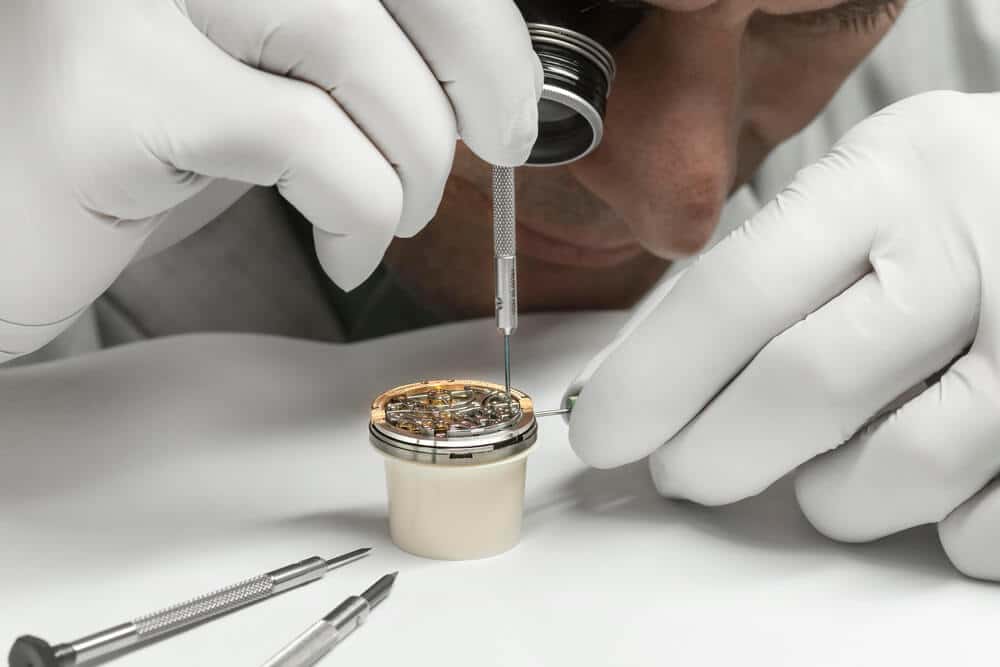
The balance is also fitted with a sliding stud cap with a rounded head (mirror polished, of course). When regulating a timepiece, the watchmaker may detect a beat error. This is where the clockwise swing of the balance and the anticlockwise swing differ. This happens when the impulse pin is not dead centre between the banking pins when at rest.
On many watches, the beat error is corrected by moving the collet on the balance staff, a task which can often prove time-consuming. However, with the Overseas tourbillon skeleton, the sliding stud cap allows a trained watchmaker to reposition the complete balance, easily eliminating the beat error. This is just one of several refinements found on this movement that will undoubtedly meet with the approval of the cognoscenti.
Poinçon de Genève
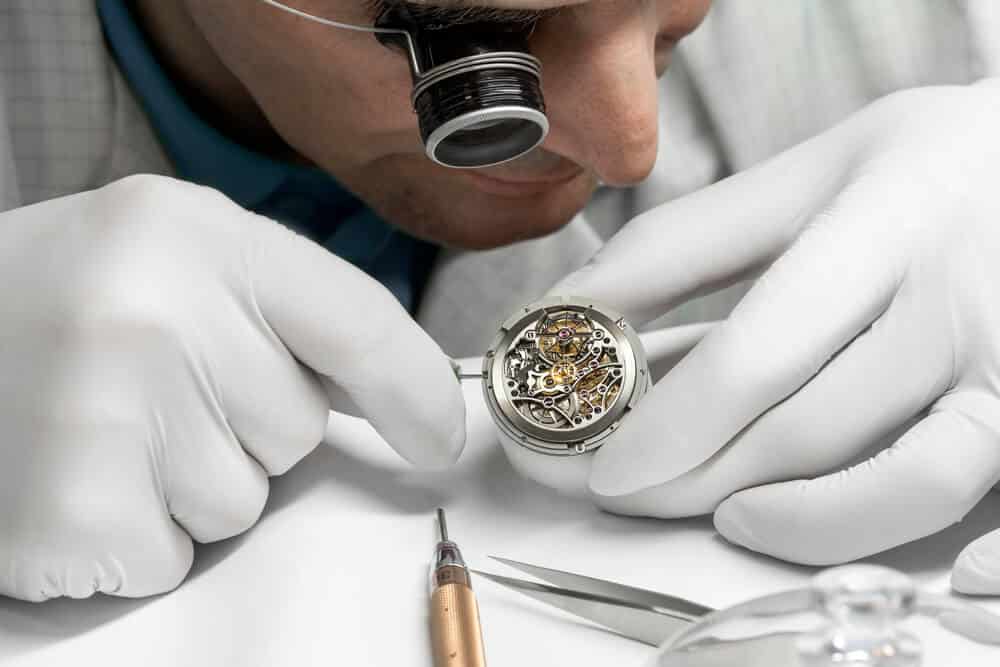
The Vacheron Constantin Overseas tourbillon skeleton carries the Hallmark of Geneva, more commonly known as the ‘Poinçon de Genève’. Introduced in the 19th century, the ‘punch’ was designed to counter individuals selling inferior watches labelled ‘Geneva’. All watches bearing the punch must be assembled, cased and adjusted within the Canton of Geneva.
All the criteria specified by the Poinçon de Genève are subject to the scrutiny of TimeLab, the independent organisation tasked with inspecting the making of watches bearing the revered hallmark. Typically, participating brands are inspected on a monthly basis. A timepiece marked with the ‘punch’ must conform to various standards of craftsmanship, regularity and durability of operation. In addition, certificates of origin must also be available for inspection.
Sapphire dial
Usually, when reviewing a watch, I begin by discussing the dial, however, the Vacheron Constantin Overseas tourbillon skeleton is different. This watch implores the wearer to look into the distance and savour every nuanced detail. Nevertheless, a requirement of any watch is the wearer should be able to read the hours, minutes and any additional indication presented.

18K white gold hands and indexes
Clearly, Vacheron Constantin understands this. The Overseas tourbillon skeleton is fitted with a sapphire dial that affords views of the movement, while the 18K white gold hands and matching 18K white gold indexes lucidly convey meaning. Furthermore, consistent with the model’s sporting remit, the hands and indexes are lined with Super-LumiNova, ensuring excellent readability in poor light conditions.
Two concentric minute tracks, one clear and one in blue PVD-treated 18K white gold, frame the dial without covering any of the bridges below. As stated earlier, the blued screw affixed to the tourbillon carriage converses with the blue seconds track positioned adjacent.
Vacheron Constantin Overseas tourbillon skeleton – readability
Where many skeleton or openworked watches can inhibit readability, the Overseas tourbillon skeleton masterfully uses colour, design and position to convey meaning free of ambiguity.

42.5mm case diameter
While Grade 5 titanium is a lightweight alloy, the Overseas tourbillon skeleton does not feel malnourished when affixed to the wrist. Personally, I find comfort in a degree of heft and this watch does not disappoint. However, do not misconstrue, this model is not unwieldy or cumbersome. To my mind, the Genevan Maison has judged the size and weight to perfection.

The case and bracelet encompass both polished and vertical satin-brushed surfaces. Both finishes are discrete, delineating one section of titanium from another. By juxtaposing both types of finishing, the case and bracelet exhibit a sumptuous, refined appearance. Interestingly, imparting both forms of finish proves exceptionally challenging as Grade 5 titanium is far more difficult to polish than ubiquitous stainless steel.

Soft iron casing
The watch is fitted with a soft iron casing ring. Similar to a Faraday cage, the soft iron casing ring helps to shield the movement from electromagnetic fields, however, the rear of the movement remains visible via the exhibition caseback.
Vacheron Constantin supplies the model on a matching Grade 5 titanium bracelet comprised of half Maltese cross-shaped polished and satin-brushed links. The bracelet is paired with a Grade 5 titanium triple-folding clasp equipped with push-pieces and a comfort adjustment system.

In addition, the Overseas tourbillon skeleton comes with two additional straps, one in blue calfskin and a second in blue rubber. The brand’s ‘interchangeable system’ employs two release catches to the rear of the watch, allowing the wearer to simply swap the straps/bracelet without the need for tools. This is just one example of how the Swiss marque has made the Overseas a very versatile ownership proposition.
Vacheron Constantin Overseas tourbillon skeleton – closing remarks
A problem that afflicts some skeleton watches is that the hands and indexes can sometimes become lost in a sea of intricately shaped bridges and components, inhibiting readability. In creating the Vacheron Constantin Overseas tourbillon skeleton, the Maison has cleverly used colour, SLN, depths and volumes to deliver a degree of legibility beyond reproach.
By equipping the model with a peripheral rotor, the Overseas tourbillon skeleton proffers the convenience of an automatic movement coupled with the transparency of a hand-wound skeleton movement. Cleverly, the trottoir encircles the bridges, ensuring that each finely decorated surface and flank is freely shown, devoid of any obstructions. Likewise, to the front, the minute tracks don’t overlap the bridges below but allow them to be seen in full.
The mechanical virtuosity of the Manufacture Calibre 2160SQ and its peerless finishing uphold the Maison’s esteemed reputation and are worthy of the term ‘Haute Horlogerie’. While the Historiques 222 is a superb watch, it’s the Vacheron Constantin Overseas tourbillon skeleton that stole my heart at Watches & Wonders 2022, a modern-day watch that deserves the same recognition as its retro-themed sibling.
Further reading
https://www.vacheron-constantin.com
Technical specifications
- Model: Vacheron Constantin Overseas tourbillon skeleton
- Reference: 6000V/110T-B935 (Grade 5 Titanium)
- Case: Grade 5 Titanium; diameter 42.5 mm; height 10.39 mm; water resistance 5ATM (50m); sapphire crystal to front and exhibition case back
- Functions: Hour; minutes; perpetual calendar (day of the week, date, 48-month display with leap year indication)
- Movement: Calibre 2160SQ; self-winding movement, frequency 18,000 vph (2.5Hz); 30 jewels, power reserve of approximately 80 hours
- Bracelet: Grade 5 titanium with matching triple folding clasp with push-pieces and comfort adjustment system (6000V/110T-B935)
- Additional straps: supplied with blue calfskin leather and blue rubber strap
- Price on request