
Abraham-Louis Breguet – the ‘complete watchmaker’ – part 1
Mark McArthur-Christie details some of the remarkable achievements of Abraham-Louis Breguet (1747-1823), widely considered the complete watchmaker.

Abraham-Louis Breguet and Joseph Tattet
History turns on the smallest of pivots. Had Jonas-Louis Breguet lived beyond the age of 39, his son, Abraham-Louis, would probably have had a happy and utterly unremarkable life running an inn in Les Verrières. He might have even bought one of those new-fangled watch things with some of the profits. Instead, his mother’s second marriage, to Joseph Tattet, a watchmaker, set him on course to change the entire history of horology.
The innovations Breguet went on to create were remarkable and could easily have allowed him licence to be an utter divo. He seems instead to have been one of those rare individuals who combined engineering genius, commercial and promotional savvy, chutzpah with loyalty as well as kindness and decency.

Image – Breguet hour and minute hands
Xavier Gide
George Daniels’ book ‘The Art of Breguet’ sets out a story that explains it clearly. In 1787, Breguet, aged 40, went into partnership with another Parisian watchmaker, Xavier Gide. Gide brought much-needed capital and stock to Breguet’s business and realised allying himself with watchmaking’s rising star was a smart move. Like most partnerships, it had its problems but one of the grittiest appears to have been the fundamental differences in character between the two men.
Gide seems to have been a pure bottom-line man – the sort who, today, sees organisations through the lens of a spreadsheet and loves a KPI. He also intensely disliked the aristocracy – as his letters delightedly supporting the Revolution show – and Daniels describes him as “…bad-tempered and plain spoken…” Breguet, on the other hand, was focused on being creative; he wanted to innovate as well as to sell. He already had a reputation as a watchmaker to the aristocracy and had friends at the French court. And although the notion of the Rights of Man appealed to him, he was no Revolutionary. Not an ideal combination.
One suspects the partnership, originally intended to run for six years but dissolved after just four, was probably kept alive as long as it was through Breguet’s forbearance and good nature. It must have been frustrating for Gide, though, to have written in 1791 “I hope when you return [from Switzerland] we can proceed along different lines. The trouble with your methods is that you do not make two watches alike. You have grand ideas but they must be put into practice.”
This was the eighteenth-century equivalent of a string of passive aggressive emails signed merely ‘regards’. But Breguet didn’t bite. Instead, when he returned to Paris he bought Gide out and managed to dissolve the partnership amicably. That amiability was at the heart of nearly all his business and personal relationships.
Despite Gide’s snark, Breguet was all for making his ‘grand ideas’ reality. And those ideas extended way beyond just designing and making watches. He had a genius for the sort of subtle marketing that had half of France’s well-to-do citizens happily emptying their wallets at his Quai de l’Horloge workshops.
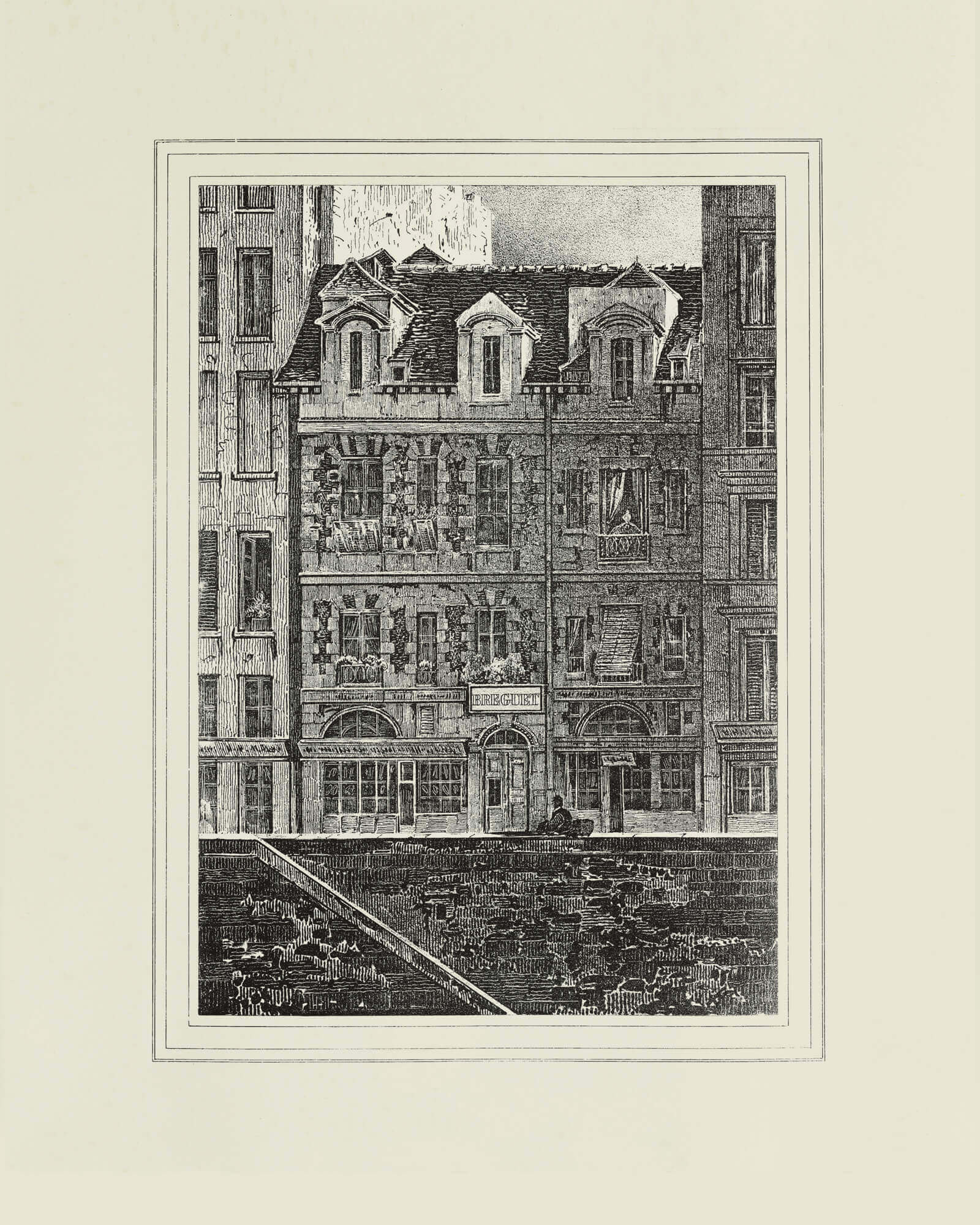
Image – Quai de l’Horloge
For example, every watch carried Breguet’s ‘secret signature’. This was etched with a diamond-pointed pantagraph that enabled him to reduce his name to just a few millimetres on the enamel dial of any watch he made. It supposedly distinguished a real Breguet from a fake. In fact, there’s a good argument that this ‘secret signature’ was relatively easily copied and certainly not secret. So why bother carefully etching it on the surface of each dial?
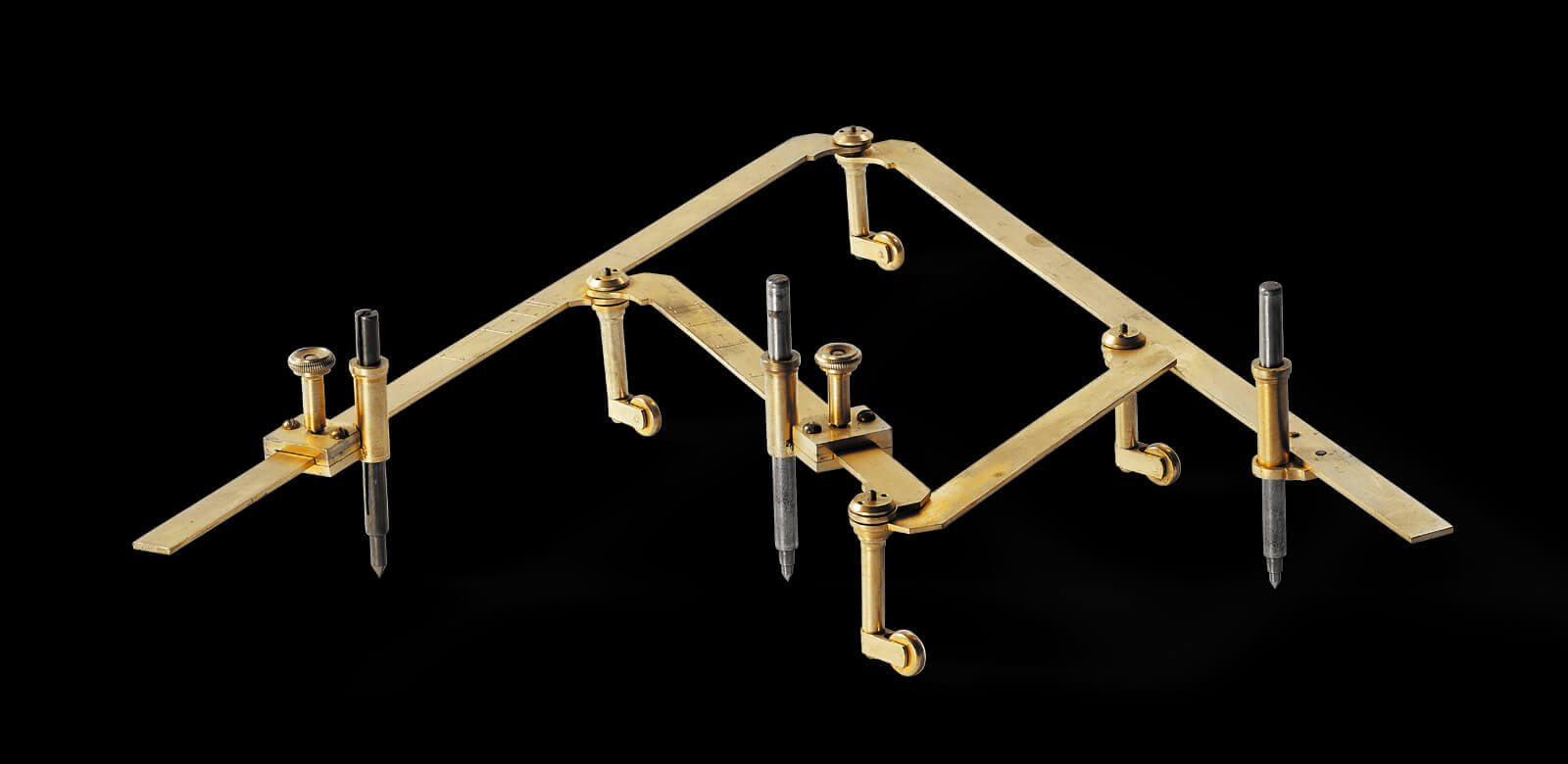
Image – pantograph
If one thinks of it as a tiny, perfect and exclusive logo, a symbol of the care, effort and detail he put into each watch, it makes more sense. And anyone thinking about buying a Breguet would probably have been told about the signature. “Look here, my friend. No – closer. You see it now? Isn’t that remarkable?” They’d become an initiate, a member of the Breguet club. Abraham-Louis Breguet understood the power of detail and symbols; he was a man who would even round the top surface of a balance wheel to make it appear visually more appealing.

Image – Breguet 5157 (current collection)
Abraham-Louis Breguet – an instinctive marketer
Breguet also realised, like all instinctive marketers, that dramatic demonstration is the most effective form of promotion. So, at a smart Paris party, when he took out one of his watches and threw it on the ground in front of the well-heeled partygoers – his target market – he knew exactly what he was doing. Any lesser timepiece would have stopped dead. Instead, when Breguet picked it up and showed it to his fellow guests it hadn’t missed a beat and was running happily – his new pare-chute shock-absorbing mechanism had seen to that.
The story would have been around the salons by lunchtime the next day; “Have you heard, my dear, about Breguet’s latest stunt?” Talleyrand, France’s foreign minister, had clearly experienced this sort of guerrilla marketing before as he simply commented, “One can never tell what that devil Breguet will do next!”

Image – The ‘Perpétuelle’ watch (1780)
The ‘Perpétuelle’ watch (1780)
But this wasn’t marketing style over substance. Breguet had already proven himself at the bench. His work on developing and perfecting the perpetuelle self-winding mechanism from Abraham-Louis Perrelet, for example. Perrelet’s watches were indeed self-winding, but the system was erratic and unreliable. It was the eighteenth-century version of beta technology. Breguet looked at the problems in this early stage release and developed v.2.0.
His new system used a spring-mounted platinum weight (denser than gold and just as corrosion-resistant) to convert movement through a ratchet and pawl mechanism to power for the mainspring. This one-way power transmission system meant that a mile’s worth of walking would be enough to fully wind your watch. Breguet designed an ingenious finger wheel, star wheel and lever system that, once the watch was wound, prevented over-winding by locking the weight in place. Then, as the mainspring uncoiled, the star wheel would move back into position and allow the weight to move and wind the watch again. No chance of the watch over-winding and no weight flailing about when it didn’t need to.
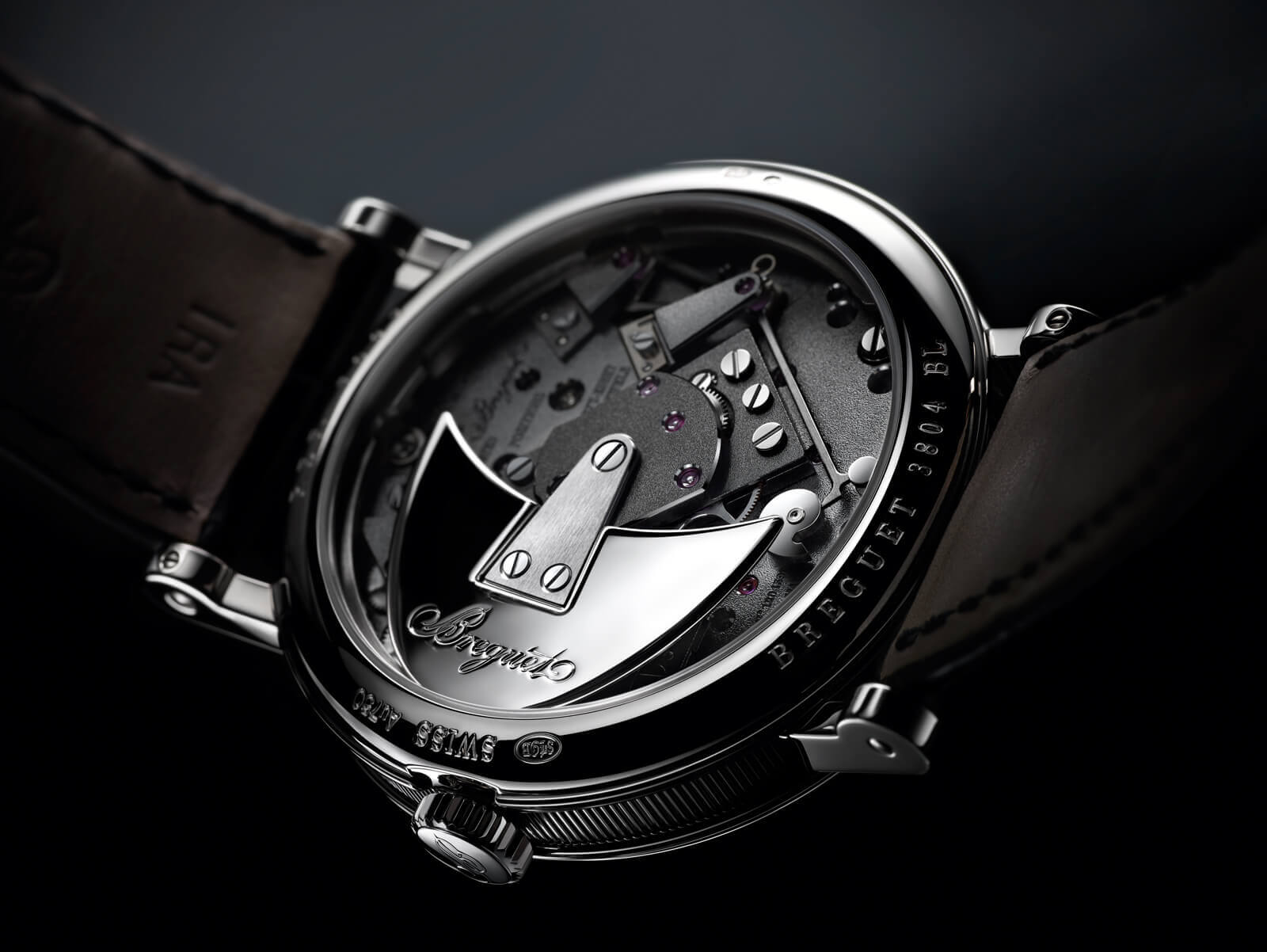
Image – Breguet 7097 (current collection)
And, because a platinum weight moving around in a watch case is something of a potential shock liability, Breguet designed two retaining springs or bumpers to reduce some of the impact. On some of the perpetuelles he also mounted the mechanism in flexible jewelled pivots to further ease shocks.
These early perpetualles were only motion-wound, one couldn’t hand-wind them. As one wasn’t able to put in the key and test the mainspring’s tension, Breguet also designed a winding indicator as part of the winding and decoupling mechanism that would show the power reserve on the watch dial. Its owner would know just how much movement would be needed to wind the mainspring back to tension by shaking the watch or walking with it. There is clearly scope for a horological thesis arguing that, in developing the perpetuelle, Breguet also invented the Fitbit.
Looking at the perpetuelle’s mechanism one can only be struck by its simplicity – but it’s the simplicity that comes from removing everything extraneous. “Everything should be made as simple as possible, but no simpler”.
Editor’s comment
Mark is clearly passionate about Abraham-Louis Breguet and he has written extensively on the life and work of the legendary watchmaker. We invite you to read the second instalment of this two-part feature and learn more about this remarkably talented man and the watches bearing his name.