
Breguet watchmaking part two – Abraham-Louis Breguet
Breguet watchmaking part two – Mark McArthur-Christie details some of the remarkable achievements of Abraham-Louis Breguet (1747-1823), widely considered the complete watchmaker.

Image – Breguet Tourbillon No. 1188
Abraham-Louis Breguet – gravity and temperature
Watchmaking is about detail – finding minute solutions to tiny problems that have a big impact. Breguet pondered everything from the effect of gravity and temperature on watches to the viscosity of lubricants. He absolutely understood, and was frustrated by, the limitations of eighteenth and nineteenth-century mineral lubricants – well before the synthetic watch oils of today. He’s reported as exclaiming to Louis XVI, “Find me the perfect oil, Majesty, and I will make you the perfect watch!”
When it came to temperature, Breguet had plenty of experience. Ferdinand Berthoud, with whom Breguet probably studied, had already worked out that temperature affected the balance and hairspring of a watch in 1773. Arnold – another friend of Breguet’s – then developed balance wheels that compensated for temperature change. Breguet took his colleagues’ work, and as was so often the case, improved on it in the perpetuelles endowed with a bi-metallic screwed balance.

Image – Breguet balance spring (1795)
Breguet watchmaking – balance springs
Unlike most balances, this compensating balance was not a perfect, whole circle. Instead, it was cut at two points on its circumference to allow space for adjusting weights and expansion. The watchmaker could adjust the position of threaded weights at the free ends of the rims to allow for temperature changes. At the same time, the inner balance rim was faced with steel, a copper, zinc and silver alloy on the outer edge. Because metals expand when they’re heated, a change in the weather can mean a balance will increase in diameter. That’s bad news for good timekeeping as it increases the balance’s rotational inertia. The watch will run slower. Breguet’s bimetallic balance stopped this and the adjustable weights made it far simpler to regulate accurately.

Image – Breguet balance wheel with two arms (Breguet No.2667) – thin ‘resonance-type’ watch
Look at a watch like The Prince Regent’s No. 2788. Breguet made this with not one but two compensating balances working in resonance with each other. Detail, detail, detail again – so the balances could be as large and, by default, as stable as possible, Breguet mounted the adjusting screws on the inside faces to save them adding to the outer width of the balance. You can see that this isn’t just an engineering complication but a thing of beauty too.

Image – Breguet Tourbillon No. 2667 (very similar to the No. 2788)

Image – Breguet Tourbillon No. 2667 (very similar to the No. 2788)
Abraham-Louis Breguet – the tourbillon
And then there’s gravity. Daniels believed that Breguet conceived the tourbillon – that gravity-defying method of rotating the escapement and the balance within a cage, once each minute – during his Revolutionary exile in Switzerland in 1793, releasing the first watch featuring it in 1795. The first patent, however, for the invention is dated 1801 using it first in his No.282. Whatever the precise dates, the idea seems to have been entirely Breguet’s and – remarkably – entirely original. There are no historical precedents we’ve yet found for the tourbillon.

Image – Breguet Tourbillon No. 986
Like all Breguet’s inventions, the genius of the tourbillon comes from its simplicity. Until the twentieth century, most watches were carried vertically in a pocket and only extracted to show the time, or propped up on a desk or table in the same position. This meant the effect of gravity on the balance was more pronounced, causing the watch to lose time. Even Breguet couldn’t change gravity, but he could minimise its effects on time. Turning your watch over every minute would be daft, impractical and irritating, but why not make the balance and the escapement rotate slowly through 360 degrees over (usually) one, four or six minutes? That way, the positional effects of gravity would even out.

Image – Breguet Tourbillon No. 2567
The result? ‘I have succeeded in cancelling, through compensation, the anomalies caused by the different positions of the centres of gravity of the regulator movements …’
The name tourbillon doesn’t, as has been suggested, come from the modern sense of ‘whirlwind’. Instead, it derives from the rather more elegant description Descartes applied to the planets revolving around the sun in a vortex. He called this a ‘tourbillon’. The encyclopedist d’Alembert went on to use it to describe the movement of planets around a single axis. These are the uses of the word Breguet would be more familiar with.
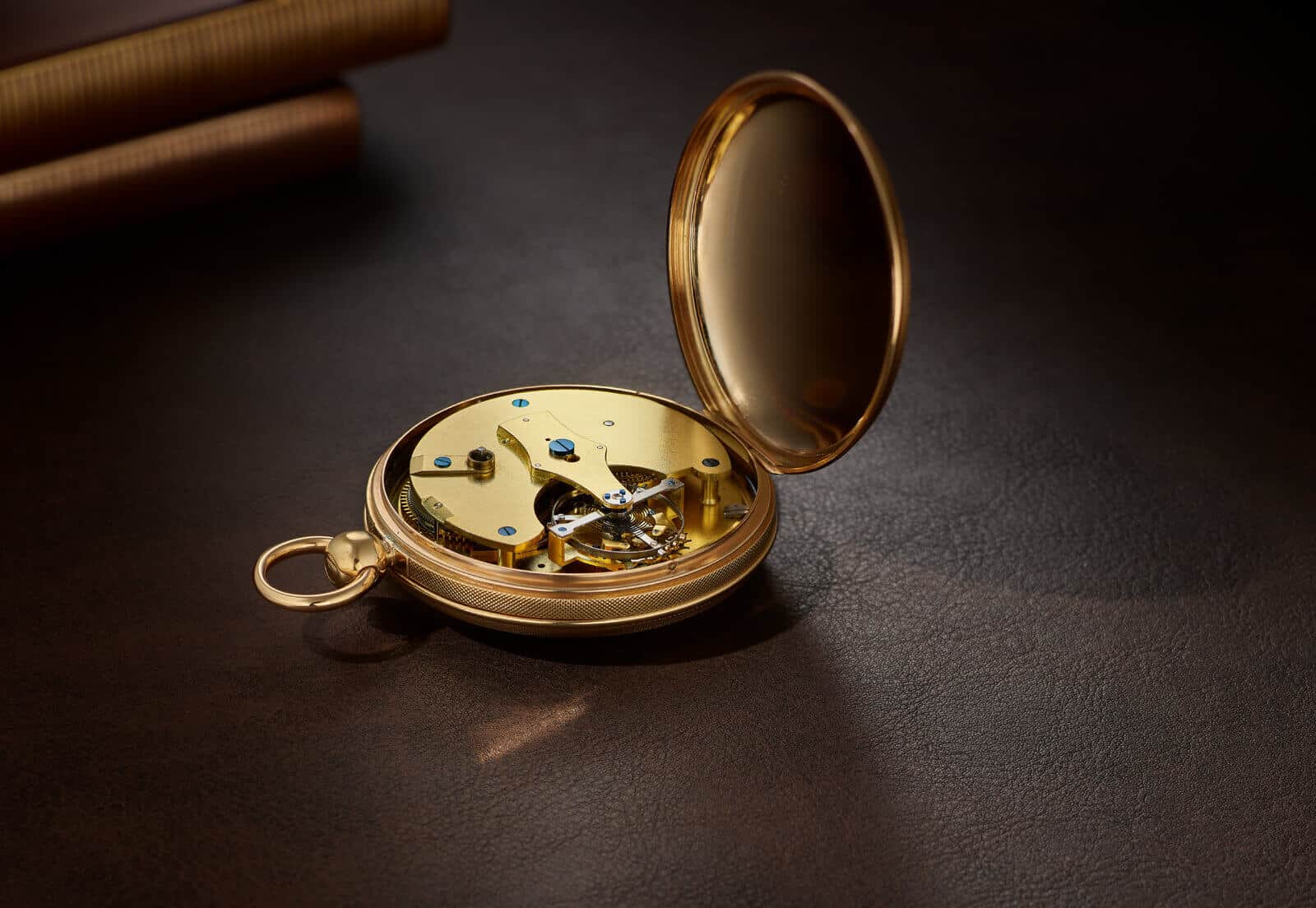
Image – Breguet Tourbillon No. 2567
To mount a watch’s escapement on a tiny rotating platform was an astonishing piece of engineering, yet between 1805 and 1823, Breguet made 35 tourbillon watches, and they are amongst his most beautiful. Even if they didn’t tell the time they’d be works of art in themselves. He was proud enough of his invention – or perhaps cannily realised its marketing potential as a ‘halo’ product – to put ‘Regulateur a Tourbillon’ on No. 282’s dial.

Image – Breguet Souscription watch No. 3424
Breguet watchmaking – the Souscription
But Breguet’s time in Switzerland also brought forth his idea for a cheaper (relatively speaking, this is Breguet after all) watch, the Souscription. He had already sold a single-handed watch to Talleyrand in 1792 (no. 188), which perhaps allowed an idea he’d had for some time to take firmer shape.
The Souscription combined all of Breguet’s commercial, advertising and watchmaking genius in one watch – or rather, a series of watches. The whole concept reeked of his thinking, right from using a buyer’s initial cash deposit to secure the watch (and, of course, to fund buying the basic materials to make it) through to its simplicity of design and even its marketing brochure:
“The price… will be 600 livres; a quarter of this sum will be payable on subscription; there will thus be no delays in the manufacture, and delivery will be according to the order of subscription…” it proclaimed.
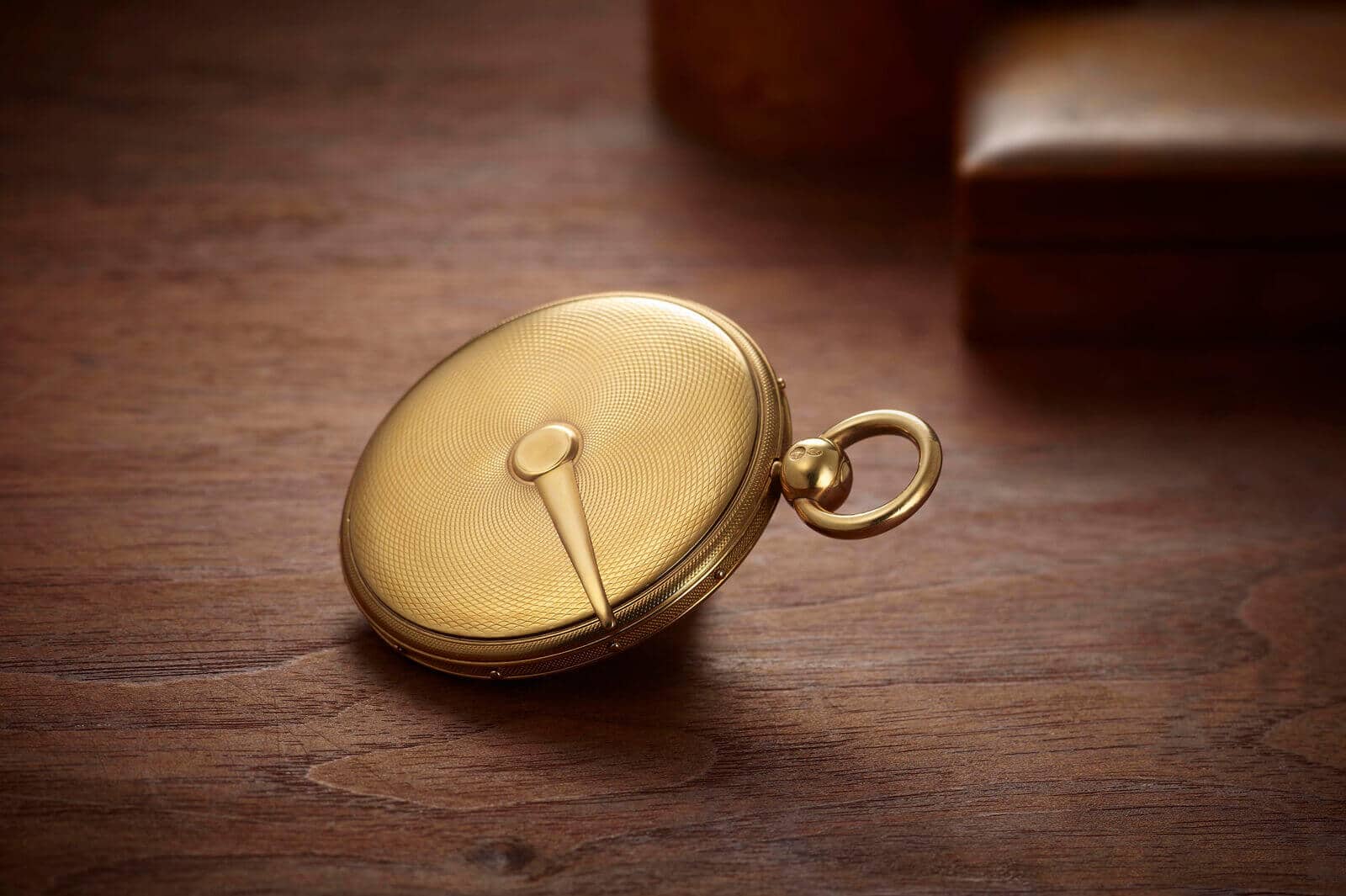
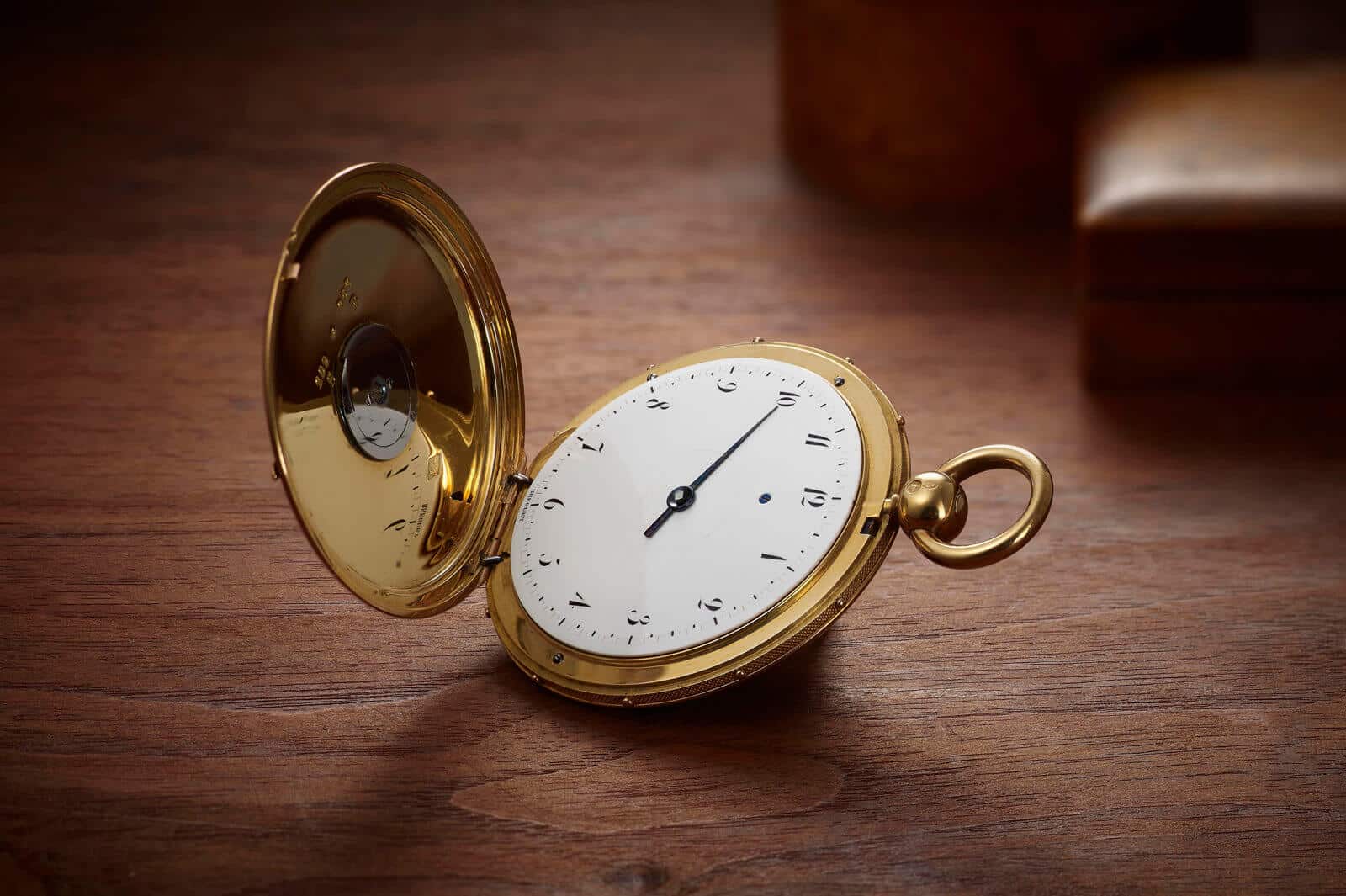
Image – Breguet Souscription watch No. 263
It’s worth remembering that Europe at the time was in the midst of the massive changes that started with the Enlightenment, through the initial stages of the 1789 Revolution and the subsequent Terror. The Revolutionaries had rioted through Paris and destroyed, looted and burned whole areas of the city. Food was in perilously short supply, let alone watchmaking tools and materials.
It was in this atmosphere of chaos that Breguet developed and made the souscription watches. They were designed to be produced relatively quickly and with some measure of short-run mass production (although calling anything of Breguet’s seems almost heretical). The cases were silver, gold or a mixture of the two and the movements were much simpler in execution than his custom-made, unique watches. That said, they had his usual elegance and economy of design and were typically Breguet.

Image – Breguet Souscription watches No. 3424 & No.263
Abraham-Louis Breguet – secret signature
The enamel, secret-signature signed dials were domed, with just a single blued hand to tell the time. The track at the dial’s edge is marked in five-minute intervals, so one doesn’t really feel the loss of a minute hand.
The technology for the price (around £600) was impressive. They had compensating balances, shock-absorbing measures and a 36-hour power reserve. The escapement was a ruby cylinder – something complex enough to produce with the help of today’s watchmaking tools but boggling in an ‘economy’ watch in the late eighteenth century. The movement’s central barrel also held the single hand, doing away with even more gear train complication and allowing the owner to wind the watch from either the front or the back of the case. You set your souscription simply by moving the hand to the right time.

Image – Ruby escapement – Copyright: The Naked Watchmaker
Breguet’s brochure aimed them squarely at astronomers and the military, but as is so often the case they soon caught on with civilians keen to have their very own Breguet. He sold around 700 souscriptions mostly between 1798 and 1805.
Abraham-Louis Breguet – closing thoughts
Breguet clearly realised his abilities and talents and wasn’t shy of promoting them. Yet he also was eager to share his ideas, skills and techniques with his fellow craftsmen and friends. He was even happy (although it was, as ever, a neat mutual marketing technique) to allow watchmakers who’d worked under him in Paris to use ‘éléve de Breguet’ (‘a pupil of Breguet’) on their timepieces. And he appears to have been almost universally liked and well-regarded.
Charles Dupin’s speech at his funeral perhaps illustrates this most clearly, “The grief of all these eminent men crowding around your tomb… is your finest eulogy. The entire nation will mourn your loss, for you have contributed so greatly to the triumph of her arts. In this important field … you have raised French industry to a level beyond compare with that of other nations.”
How true this was. Breguet’s inventions and developments of earlier ideas changed horology for good. He catapulted watchmaking and timekeeping forward by a factor of generations in just a single lifetime.
Editor’s comment
Mark is clearly passionate about Abraham-Louis Breguet and he has written extensively on the life and work of the legendary watchmaker. Over the coming weeks, there will be further instalments of the Breguet chronicles with more details about this remarkably talented man and watches bearing his name.