
A. Lange & Söhne Triple Split Watch Review
The A. Lange & Söhne Triple Split was originally launched in 2018 with a white gold case and a grey dial. At the time it was lauded as the ultimate chronograph of the modern era. This year, the Glashütte-based Manufactory has unveiled a new version of the ‘Triple Split’ model presented in pink gold and paired with a blue dial featuring ‘rhodié-coloured subsidiary dials. Carl Eady explores the composition of this horological tour de force and shares some of his thoughts.

Who invented the first chronograph?
The term ‘chronograph’ is of Greek origin, derived from the words ‘Chrono’ meaning time and ‘gráphō’ meaning write. However, it was the great French horologer, Louis Moinet (1768–1853), who first invented the ‘chronograph’. Moinet’s spectacular ‘Compteur de Tierces’ was designed to assist him in understanding the magic of astronomy. The instrument was devised in 1815 and completed the following year. Coincidentally, Ferdinand Adolph Lange was born in 1815.
Ferdinand Adolph Lange
Lange hailed from Dresden, Saxony in eastern Germany and attended the city’s technical school. Here, his love of horology and precision instruments blossomed, culminating in an apprenticeship with acclaimed watchmaker, ‘Gutkaes’. Lange’s ambition led him to learn from various masters in Paris before he went on to secure a post in the factory of Austrian watchmaker, Joseph Thaddeus Winnerl, whilst simultaneously studying at the Sorbonne.
Returning to Dresden in 1841, Lange embarked upon a business plan to start his own watchmaking facility. In 1845, having won a significant grant from the ‘Royal Saxon Ministry of the Interior’, Ferdinand secured premises in Glashütte and gainfully employed fifteen apprentices. His entrepreneurial spirit and desire for the highest quality motivated him to become a pioneer in the field of watchmaking. He introduced metric measurement within his manufacture and also the ‘division of labour’ concept, enabling each worker to become a specialist in producing components, rather than a ‘jack of all trades’. His passion for perfecting movements led to his adoption of three-quarter plates which conferred unrivalled levels of stability. Indeed, Lange’s Manufactory continues to equip its models with three-quarter plates today.

Emil & Richard Lange
Ferdinand’s son, Richard, joined the business and the company became known as A. Lange & Söhne in 1868. His other son, Emil, also joined the firm in 1871. Following Ferdinand’s death in 1875, the brothers’ complementary skills took the company to new heights. At the pinnacle of their success, the brand had illustrious clients all over the world, including the most daring of explorers, who required precise scientific instruments, transport companies, such as Zeppelin, and numerous royal courts throughout Europe.
Walter Lange
Stewardship of the brand eventually passed to Richard’s three nephews, Otto, Rudolf and Gerhard. However, on the last night of WWII, in 1945, Lange’s main building was destroyed by a bomb. Despite the family’s best efforts to maintain the business, the A. Lange & Söhne name disappeared soon after. The hiatus would last for over forty years until in 1990, shortly after the fall of the Berlin wall, Ferdinand’s great-grandson, Walter Lange, resurrected the business and put in place the infrastructure for A. Lange and Söhne to return to its former prominent standing as a luxury watchmaker par excellence.
Sadly, Walter Lange passed away in 2017, however, his inspired leadership has left the company in rude health, and the brand sits comfortably in the ‘Ultra Luxury’ tier of watchmaking, producing just a few thousand timepieces per year. Whilst the clarity, legibility and supreme finishing found with all of the brand’s timepieces are beyond reproach, it is arguably the chronographs that stand out as the firm’s finest creations.

A. Lange & Söhne Split seconds
Prior to 2004, the company’s most sophisticated chronograph was the ‘split-seconds’. This complication enables the wearer to record two separate events, courtesy of its ‘rattrapante’ hand which is positioned above the chronograph second hand. Once the chronograph is actuated, both hands run in tandem, with the chronograph hand barely visible to the naked eye. With a simple press of the pushpiece, the rattrapante hand stops, showing the split time, whilst the chronograph seconds hand continues running, recording the overall elapsed time. A second click of the same pusher causes the rattrapante hand to ‘catch up’ with the seconds hand, once again, run in tandem. This complication proves particularly useful for events lasting short periods of time, such as track sprints. To the layperson, the concept may sound relatively simple, but in truth, the split-seconds chronograph is one of the three most challenging complications in mechanical watchmaking, the other two being the tourbillon and minute repeater.
Given the technical expertise required to create such a complex movement, it may seem unfair to talk of these watches having limitations. However, a regular rattrapante can only record split times lasting up to sixty seconds.
A. Lange & Söhne Double Split
In 2004, Lange launched its groundbreaking ‘Double Split’. This represented a milestone in watchmaking. Its chronograph could measure intervals up to 30 minutes but, surprisingly, the split-second function could also measure events lasting up to thirty minutes.
A. Lange & Söhne Triple Split in white gold (2018)
Never a brand to rest on its achievements, in 2018, A. Lange & Söhne released the unthinkable. The world’s first ‘Triple Split’ chronograph. This model is able to record split times in seconds, minutes and even hours for events up to 12 hours. Despite the complexity of this creation, the operation of the ‘Triple Split’ remains remarkably simple. On the right-hand side, the upper pusher starts and stops the chronograph, while the lower pusher resets the stopwatch function (as with most of today’s chronographs). During event timing, the split time is recorded by pressing the pushpiece adjacent 10 o’clock. This stops the three rattrapante hands (hours, minutes and seconds). The chronograph seconds hand continues recording the overall event time and is only reunited with the rattrapante second hands when the left pusher is pressed again.
At the time of its launch in 2018, the A. Lange & Söhne triple split was limited to 100 pieces, all finished in white gold with a grey dial. It remains a remarkable creation that still engenders respect among the cognoscenti. Now, three years on, the luxury marque has delighted its fans by releasing the Triple Split in a new colour combination.
A. Lange & Söhne Triple Split in pink gold (2021)
Given the complexity of a triple split chronograph, it is staggering that A. Lange & Söhne has managed to fit everything within a case measuring 43.2mm in diameter and 15.6mm in height. Certainly, such proportions confer much wrist presence, however, rest assured, everything still remains very tasteful. As one would expect from a brand of Lange’s pedigree, the case finishing is exemplary. The beautiful pink gold housing along with the three pushers are beautifully executed, blending polished and brushed surfaces. At the 3 o’clock position, a well-proportioned fluted crown bears the A. Lange & Söhne moniker, presented in relief. The flange is marked with the brand’s name and a tachymeter scale. It draws the eye towards the blue dial which beautifully contrasts with the polished case.

To the rear of the watch, the Triple Split confers one of the most exquisite sights in horological history, the Calibre L132.1, rightfully celebrated through a screw down exhibition caseback.
A. Lange & Söhne Triple Split – Calibre L132.1
The manually wound Calibre L132.1 proves a stunning sight with numerous components presented on different levels. Viewing the movement provides an insight into watchmaking at its finest, an esoteric domain where timepieces can command prices well into six figures. All of the 567 parts have been perfectly engineered without compromise. A broad selection of fine finishing techniques are employed, including circular and straight graining, perlage, solarization, polished and blued screws, chamfering and superbly executed Glashütte ribbing on the bridges. Engraved and gilded lettering embellishes each bridge, whilst the balance cock features the brand’s legendary hand engraving.

In addition to showcasing the finest in horological artisanship, the A. Lange & Söhne Triple Split is a mechanical masterclass. It features two chronographs, one to operate the chronograph hands and the other for the rattrapante hands. The rattrapante mechanism needs to continually track the chronograph hands, so that once the split time is recorded, the rattrapante hand is able to catch up with the moving chronograph hands. The engineering required to achieve this is mind-blowing.

As previously mentioned, the Triple Split’s movement is formed of many intricate layers and resembles a breathtaking three-dimenisional cityscape. Beneath the bridges is micro engineering at its finest, with an array of levers, jumpers, gear wheels, column wheels and clutches all working in perfect harmony to deliver supreme timekeeping. Once one has an understanding of how all the components work together, it is easy to see why there was a thirteen-year gap between the release of the Double Split and the Triple Split.
A. Lange & Söhne Triple Split – the ultimate sports-timer
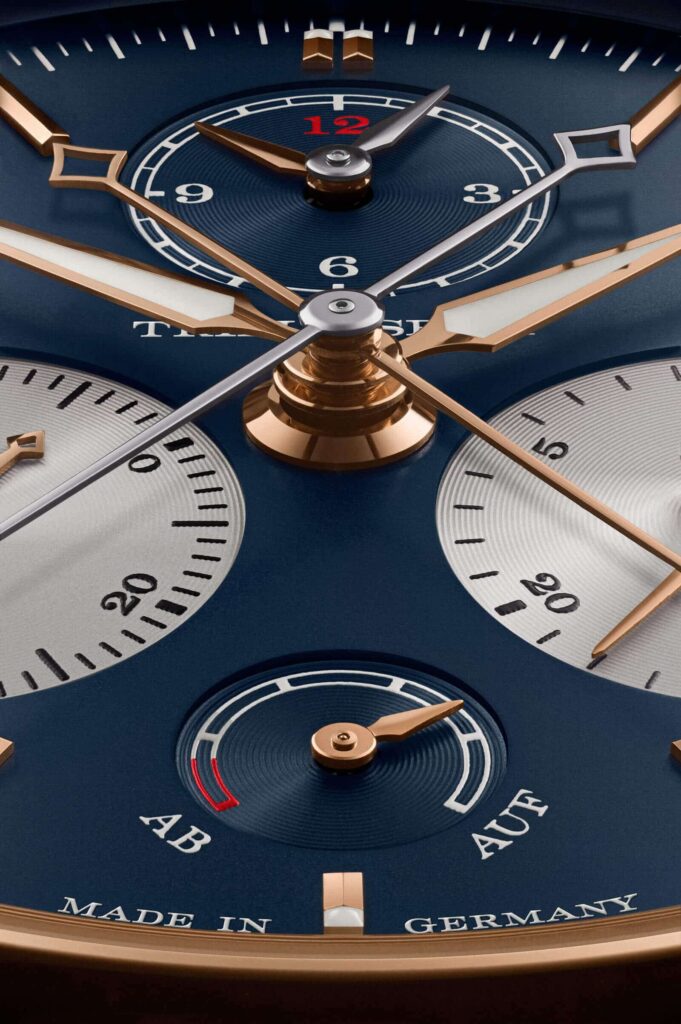
Creating the world’s most technically complex chronograph is only one part of the task. To cement its credentials as the ultimate sports-timer, it needed to be easy to operate and supremely legible. The challenge for the designers of the A. Lange & Söhne Triple Split was made more complex given that the dial includes ten hands, three sub dials, a power reserve indicator and a tachymeter scale. The rich blue tones of the dial provide the perfect contrast to the pink gold case, ensuring the hands and sub-dials are able to ‘pop’ from the canvas.

A. Lange & Söhne Triple Split – rattrapante hands
Chronograph and split times are indicated by three pairs of hands. Firstly, a pair of long elegant hands extend from the centre of the dial to its periphery, recording elapsed seconds. In the right-hand sub-dial, simple yet refined baton-shaped hands record the minutes, while the hours are tracked in a discreet sub-dial below 12 o’clock. The Triple Split chronograph cleverly distinguishes the ‘split-time’ via rhodium plated rattrapante hands which overlay the pink gold chronograph hands. Both the chronograph seconds and rattrapante hands are incredibly close to one another, thereby giving the impression of being one lone hand. The reason for this intimacy is to mitigate any parallax error where the tips of both hands appear to point to different markings on the minute track.
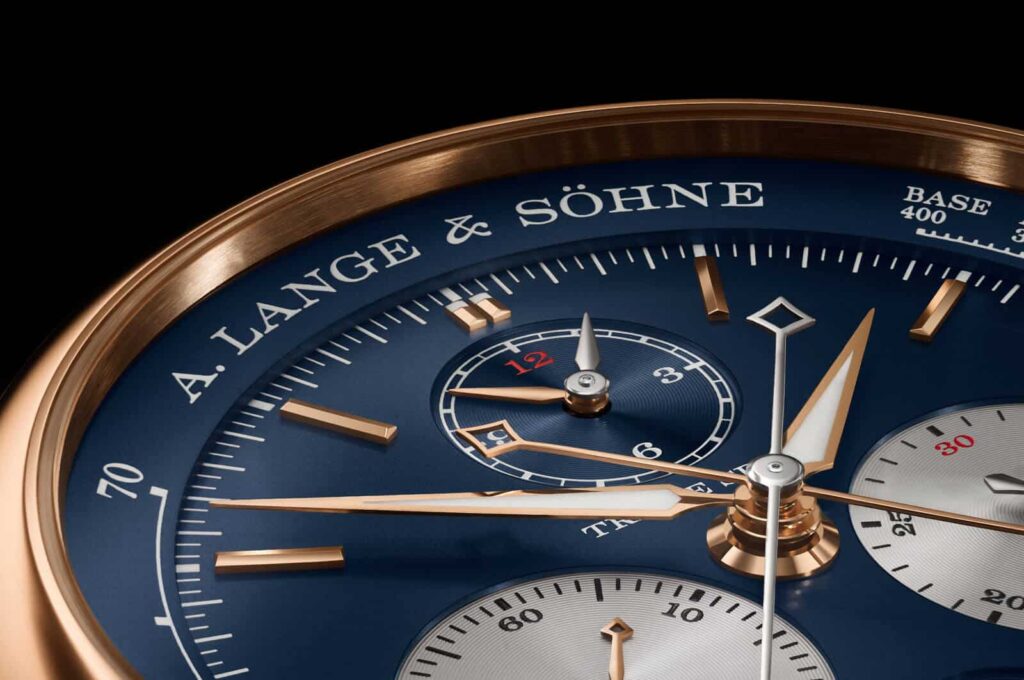
Daytime hours and minutes are expressed via Lange’s distinctive Alpha hands, each lined with a tasteful application of lume. The slender pointed tips reach out to the pink gold hour markers, articulating the time precisely.
Being a manually wound movement, the addition of a power reserve indicator proves very useful. It is shown on a small dial at 6 o’clock and features the words “Auf/Ab”, Up and Down, informing the owner when winding is necessary.
A. Lange & Söhne Triple Split – strap
The Triple Split is paired with a deep dark blue alligator leather strap, finished with contrasting grey stitching, wonderfully complementing the dial. A pink gold deployant, marked with the ‘Lange’ nomen, secures the watch to the wrist.
A. Lange & Söhne Triple Split – closing thoughts
In 2018, with the launch of the Triple Split, A. Lange & Söhne reaffirmed its status as the leading top-tier chronograph manufacturer. Three years later, the brand’s decision to release this pink gold version will undoubtedly have delighted the firm’s fans and watch aficionados. Just like its white gold predecessor, the rose gold Triple Split is limited to just 100 pieces.
One could argue that the watch is Split by name and split by personality. It has unquestioned sports watch credentials, but the exceptional movement and fine finishing throughout place Lange’s masterpiece firmly in the luxury camp. Very few brands could even contemplate tackling this ultimate chronograph complication, yet for Germany’s premium watch brand, it proved too irresistible a challenge to ignore. Based on the merits of the Triple Split, arguably the finest chronograph in existence, Lange’s competitors will need their finest artisans and engineers to match the German marque’s extraordinary chronograph.
Further reading
https://www.alange-soehne.com/
Technical specifications
- Model: A. Lange & Söhne Triple Split in Pink Gold
- Reference: 424.037
- Case: 18-carat pink gold, diameter 43.2 mm, height 15.6 mm, water resistance 10 ATM (100 m), sapphire crystal to the front and exhibition case back.
- Functions: Hours, minutes, running seconds, power reserve, tachymeter, rattrapante chronograph displaying split times up to 12 hours and including a flyback function.
- Movement: Calibre L 132.1; hand-wound movement; 46 jewels; power reserve 55 hours; components=567
- Strap: Blue alligator leather strap paired with a pink gold deployant
- Price: £152,100 (RRP as of 9.7.2021)
- Limited: 100 pieces