
F.P.Journe Chronomètre Optimum
The F.P.Journe Chronomètre Optimum is yet another demonstration of François-Paul Journe’s watchmaking expertise and breathtaking inventiveness. The hand-wound movement, the Calibre 1510, features a Remontoir d’Égalité, a ‘natural’ dead-beat seconds and a patented escapement, the ‘Echappement Bi-axial Haute Performance’ (EBHP). Angus Davies examines the watch in detail.

How does a watch work?
In the world of watchmaking, the energy harnessed in one or more barrels is transmitted via the gear train to the escapement and ultimately the regulating organ. In a perfect world, the energy supplied to the escapement and the regulating organ should be uniform. The balance wheel, part of the regulating organ, will oscillate to and fro at a consistent rate. The length of the hairspring or the balance wheel’s moment of inertia will determine this rate.
When a balance wheel rotates clockwise or counterclockwise, one swing in either direction is termed a ‘beat’. The amplitude is the term used to describe the balance wheel’s maximum angle of rotation, expressed in degrees. With many watches, when the mainspring is fully tensioned, the energy supplied to the escapement is too much, sometimes causing ‘banking’ or ‘knocking’. This can adversely affect the precision and may potentially damage the impulse pin and pallets.
Once the mainspring has relaxed a little, the energy delivered to the escapement is ideal, the amplitude is within the desired range and the movement delivers a high degree of precision.

The amplitude of the balance
When the energy drops, the rate of the balance increases. This is because the amplitude of the balance is lower than the optimal range. Moreover, by moving the watch, especially when holding it in a vertical position, the amplitude drops further, making the watch run faster.
Most brands are aware of this situation, but accept it as inevitable. Sometimes timepieces are equipped with two or more barrels to help mitigate the problem of fluctuating energy or power. However, the esteemed watchmaker François-Paul Journe has always strived for excellence, manifest in the many innovative timepieces he has made and the numerous awards he has received.
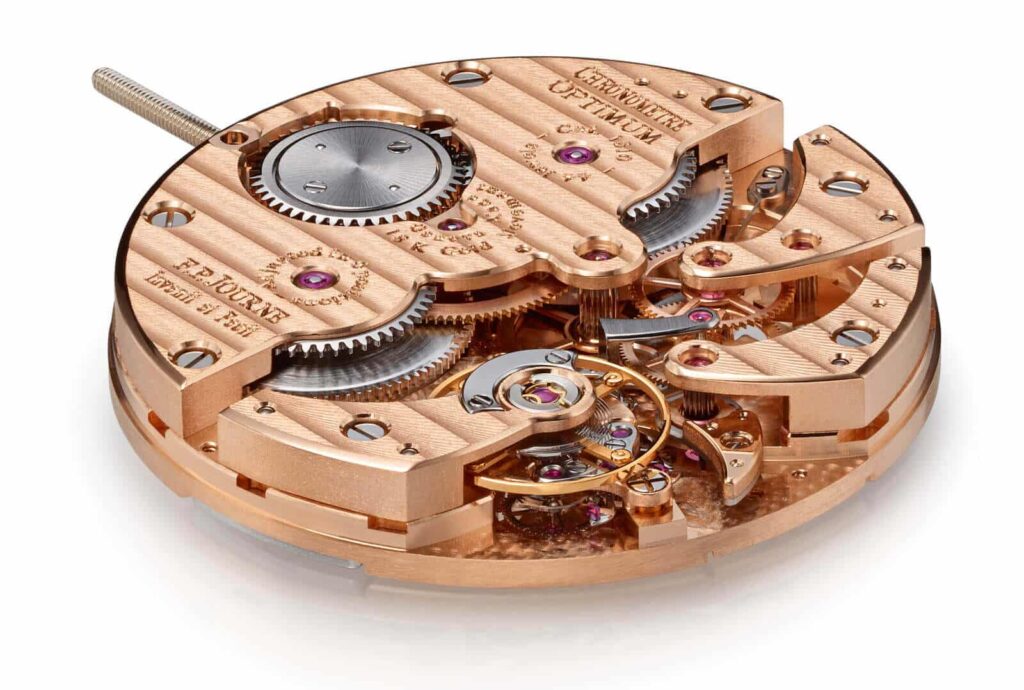
In 2012, F.P.Journe released the Chronomètre Optimum, a watch equipped with the Calibre 1510. This movement is endowed with a Remontoir d’Égalité, a device that ensures a consistent supply of energy to the escapement. F.P.Journe chose to make the remontoire from titanium, a first for the company. The low mass of this lightweight metal means the remontoire requires less energy to rotate, thereby mitigating energy consumption.
The quest for chronometry
The fact that Monsieur Journe began working on this model back in 2001, perfectly illustrates the exhaustive lengths he is willing to go to in order to bring a watch to life. At the time of its launch, the model attracted praise from the world’s press and watch aficionados alike. In this feature, I seek to explore why this watch is incredibly close to watchmaking perfection. I say ‘incredibly close’ because in the elevated heights of F.P.Journe, perfection is an elusive goal, but one the great man never ceases to pursue.
F.P.Journe Chronomètre Optimum – Calibre 1510
The hand-wound Calibre 1510 has two barrels, arranged in parallel. These feature comparatively supple springs, delivering a more stable source of energy than one barrel alone. Moreover, this arrangement generates less friction on the great wheel.
Remontoir d’Égalité
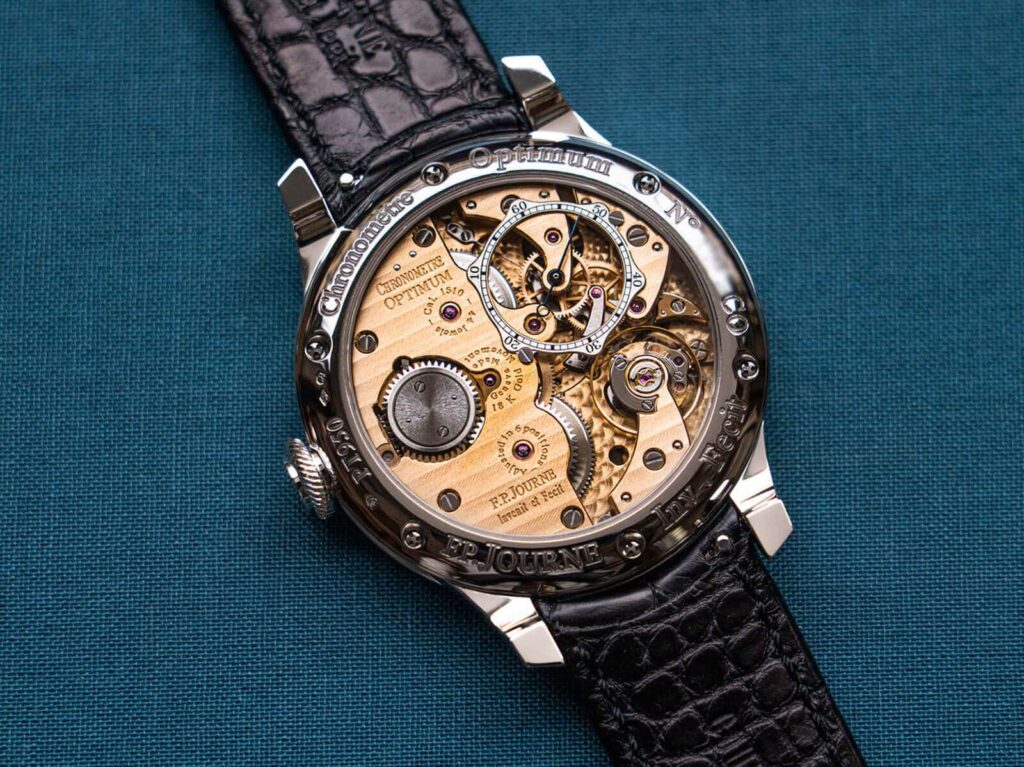
As stated earlier, François-Paul has equipped the movement with a Remontoir d’Égalité. This mechanism features an additional wheel, positioned between the fourth wheel of the gear train and the escapement. This wheel features a short duration spring which pulses energy every second. This spring is very different to a regular mainspring which is made to harness vast amounts of energy, often delivered over a number of hours or even days, not seconds.
Echappement Bi-axial Haute Performance
Journe has also looked closely at the escapement. The system he conceived is a hybrid of Breguet’s natural escapement and the Swiss lever escapement. Unlike Breguet’s natural escapement, the Journe system, the ‘Echappement Bi-axial Haute Performance’ ( – meaning High Performance Bi-Axial Escapement), is self-starting. His ingenious system is patented.

Image – Copyright © F.P.Journe – technical drawing of the ‘Echappement Bi-axial Haute Performance’ (Patent EP 2 487 546 A1) and Remontoir d’Égalité (Patent EP 1 528 443 A1)
Lubrication-free escapement
The design of Journe’s escapement obviates the need for lubricants, a factor which can adversely affect precision of a timepiece, especially when the lubricants have dried out. Some brands have selected silicium as a route to friction-free operation, however, this material is inherently fragile and will not facilitate servicing in centuries to come. Needless to say, François-Paul, a fastidious man by nature, would never countenance the use of such a material.

EBHP system
Instead of having one escapement wheel receiving all of the force from the gear train, the EBHP system shares the force between two wheels, thereby mitigating friction. Furthermore, as there is an absence of lubricants, the rate stability is superior to ‘normal’ watches.
In addition, the EBHP system, a direct impulse escapement, ‘has a far greater output than the majority of escapements’. This aspect makes it possible for the movement to run for an impressive 50 hours without loss of amplitude. The total power-reserve of the watch is 70 hours.
Journe has equipped the hairspring with a Phillips curve. This feature ensures the hairspring breathes concentrically, enhancing isochronism and, by default, precision.
Two forms of seconds indication
A small seconds display is positioned at 9 o’clock and is driven by the fourth wheel of the gear train ie receiving energy before the Remontoir d’Égalité. Consistent with the movement’s 3Hz frequency, the seconds hand makes six small steps every second.
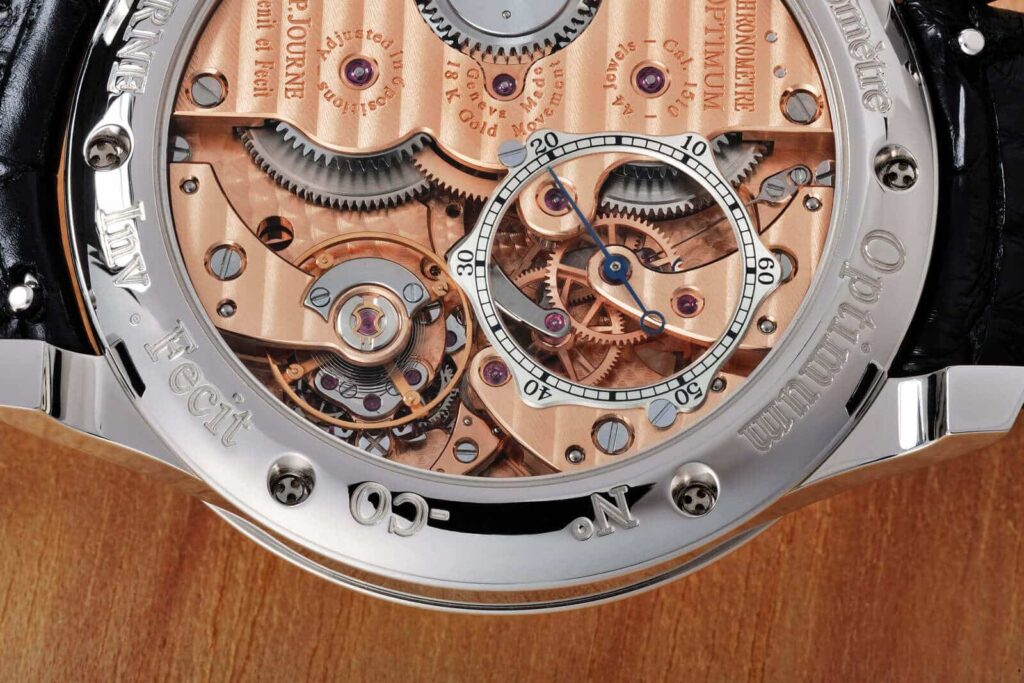
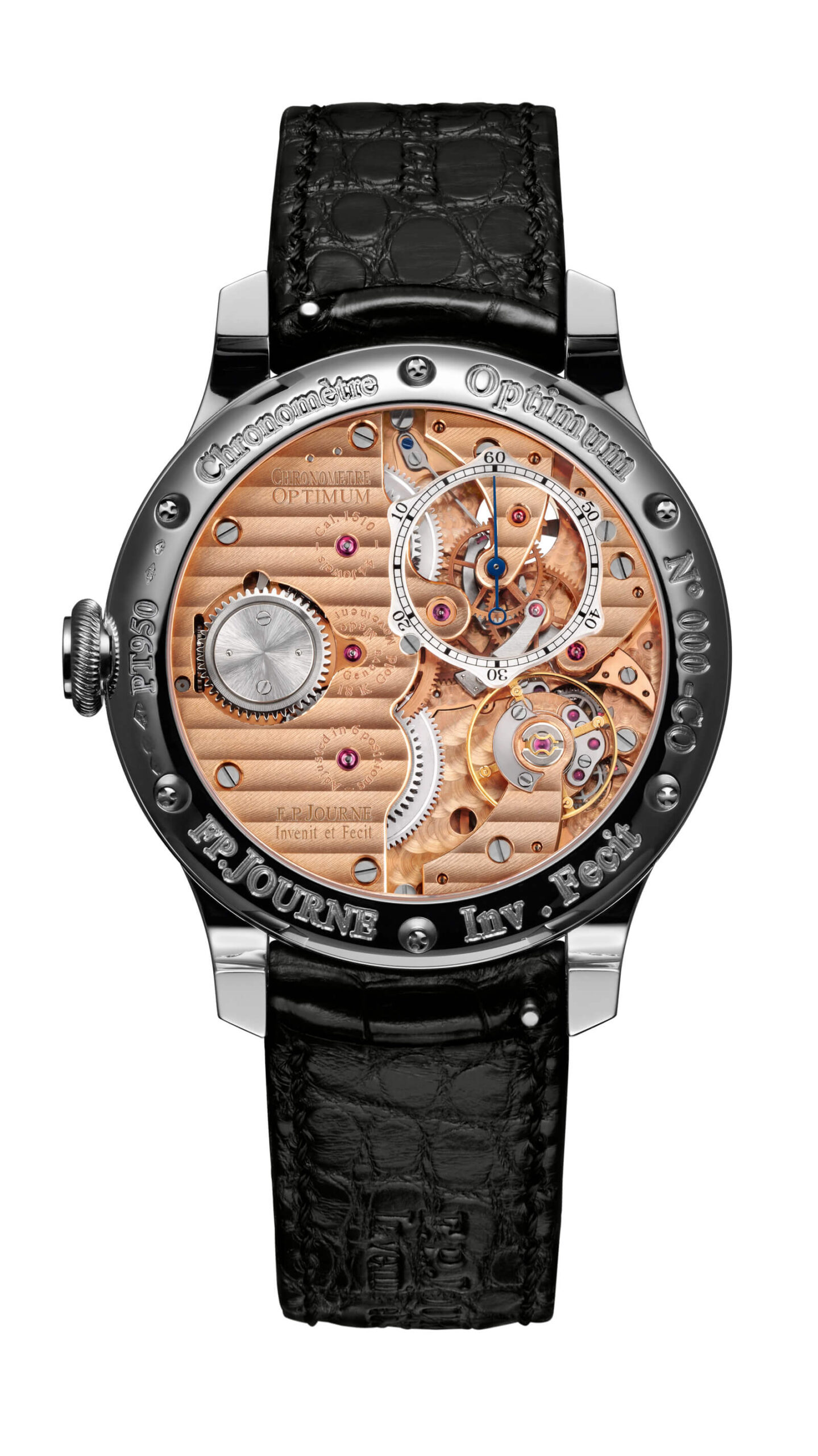
The F.P.Journe Chronomètre Optimum has an additional seconds display to the rear of the watch. This is a ‘natural’ dead-beat seconds and it receives its energy after the Remontoir d’Égalité. It advances in discrete one-second steps. Indeed, unlike a conventional seconds display with its shuffling gait, the ‘natural’ dead-beat seconds marches forward, moving with purposeful steps with its tempo dictated by the Remontoir d’Égalité.
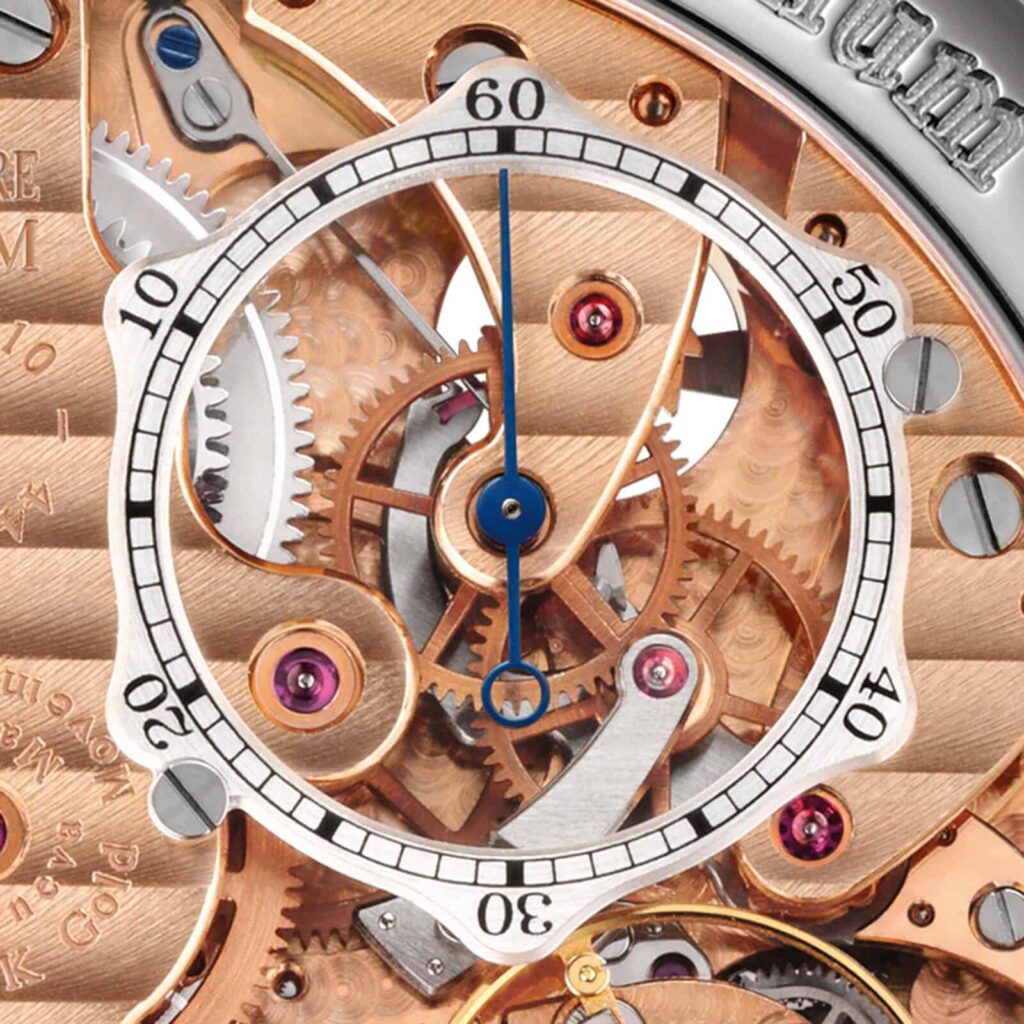
Interestingly, the hand on this display rotates counter-clockwise. To understand why this is the case, one has to appreciate the overriding objectives with this timepiece, namely to reduce the number of parts and thereby mitigate friction. In order to make the hand of the ‘natural’ dead-beat seconds rotate clockwise it would have been necessary to fit additional components, contrary to the intended goal.
Calibre 1510 – other technical highlights
The Calibre 1510 is fitted with a variable inertia balance. Unlike an index-adjusted balance, the effective length of the hairspring remains constant. The watchmaker regulates the movement by rotating four C-shaped masselottes, positioned on the four spokes of the balance wheel, to alter the moment of inertia.
This system is far superior to an index-regulated balance. Indeed, as a result, the Calibre 1510 is less susceptible to positional errors and the rate stability is much better. By placing the masselottes in-board instead of using traditional timing screws set in the rim of the balance wheel, the balance wheel is more aerodynamic, creating less air turbulence and, as a result, making the movement more precise.
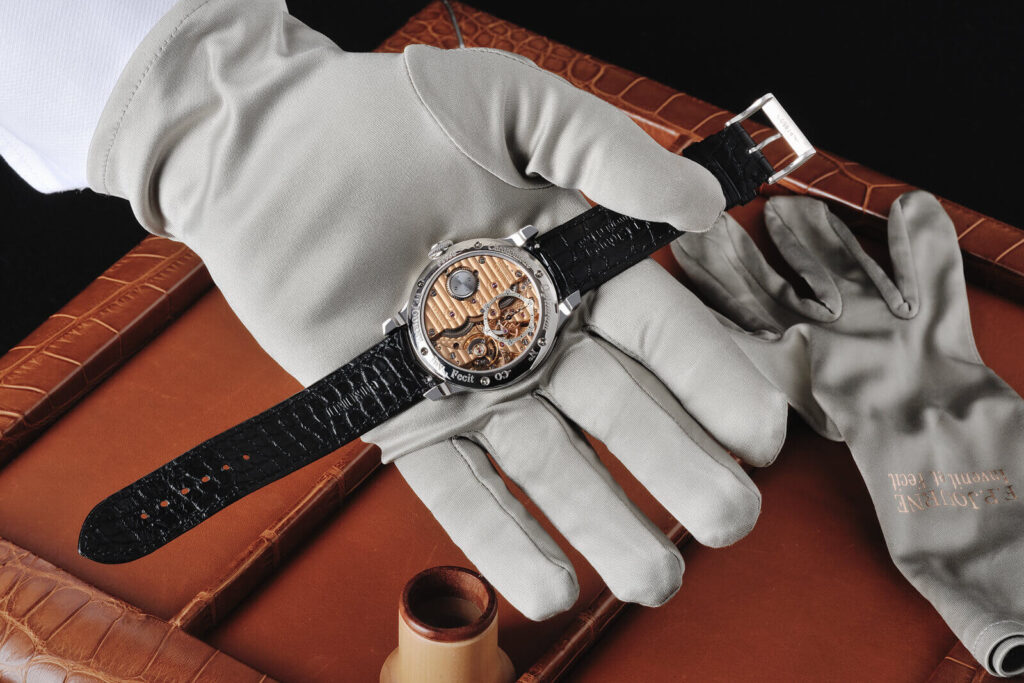
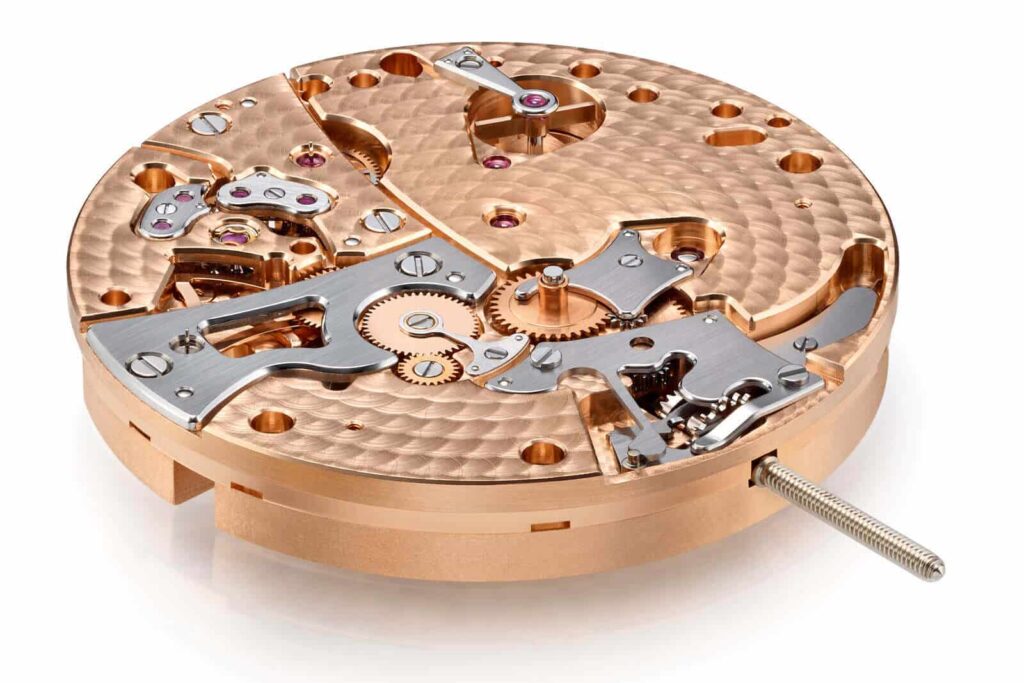
Consistent with many of F.P.Journe’s creations, the movement is formed of 18-carat rose gold, a distinguishing feature common to most of the Maison’s models. The benefit of gold is that it does not require plating as it is one of the least reactive metals in existence and confers extraordinary longevity. Furthermore, the lustrous characteristics of gold enrich the aesthetic appearance of the watch and are consistent with the company’s reputation for exclusivity and no-compromise luxury. However, the noble metal is very soft, hence it has to be carefully handled by the watchmaker.
As one would expect from a Maison of F.P.Journe’s standing, the movement finishing is exemplary. All of the movement components as well as each type of decoration are performed at the company’s atelier, located in the heart of Geneva. The baseplate is adorned with circular graining and the bridges are enlivened with Côtes de Genève. The screws feature polished heads and chamfered slots. The pegs also feature polished rounded ends. The anglage delivers a gleaming bevelled border, delineating each bridge’s upper surface from its flank. Surprisingly, the underside of components, despite never being seen, are also decorated to the same exalted standard.
F.P.Journe Chronomètre Optimum dial
Beyond his technical prowess, François-Paul is an aesthete. A mere glance at just one of his creations demonstrates the Master Watchmaker has an impressive understanding of proportions, readability, textures and lines. The F.P.Journe Chronomètre Optimum proves no exception. It is blessed with a prepossessing appearance and masterfully conveys time in a notably intelligible form.

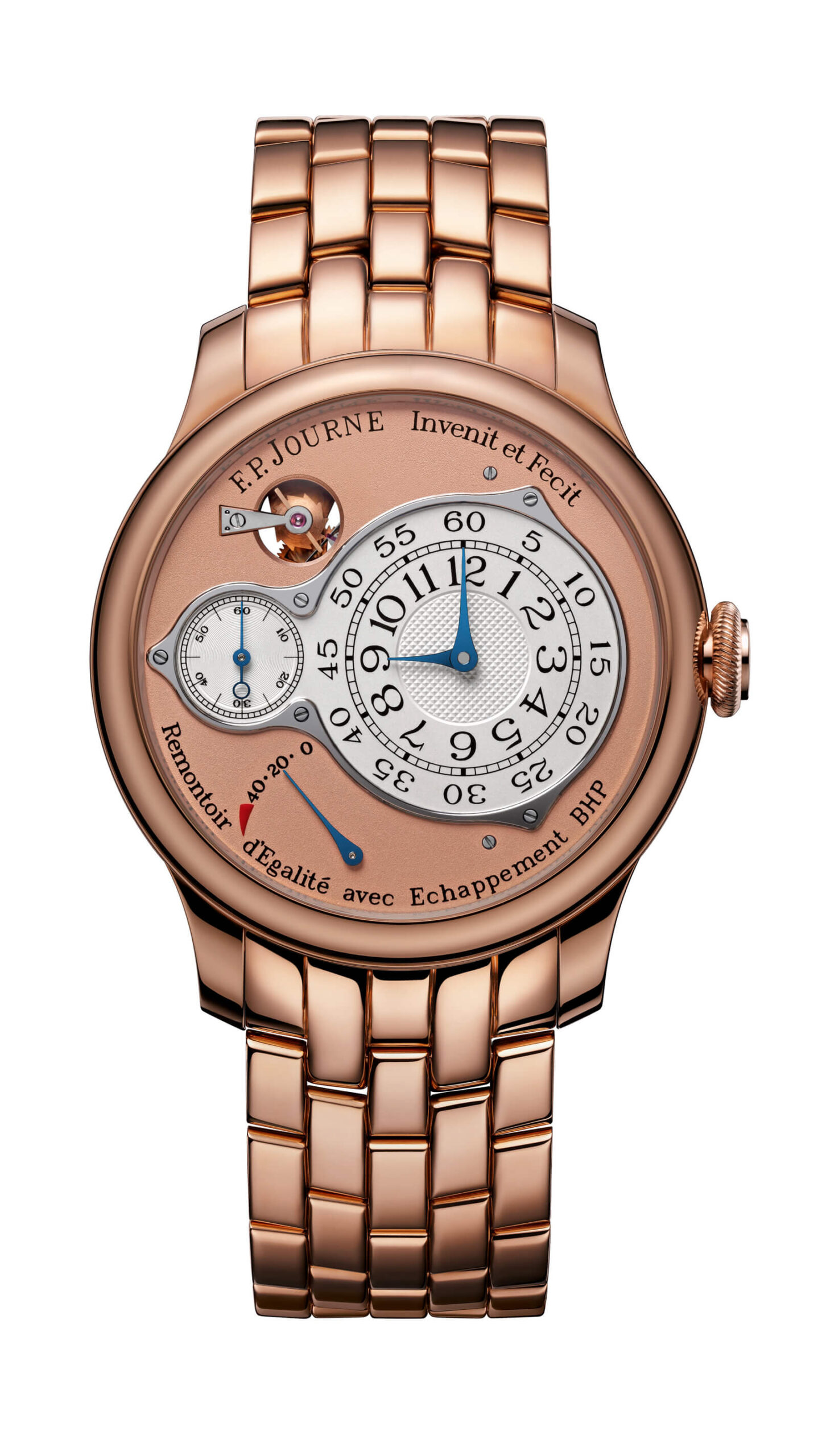
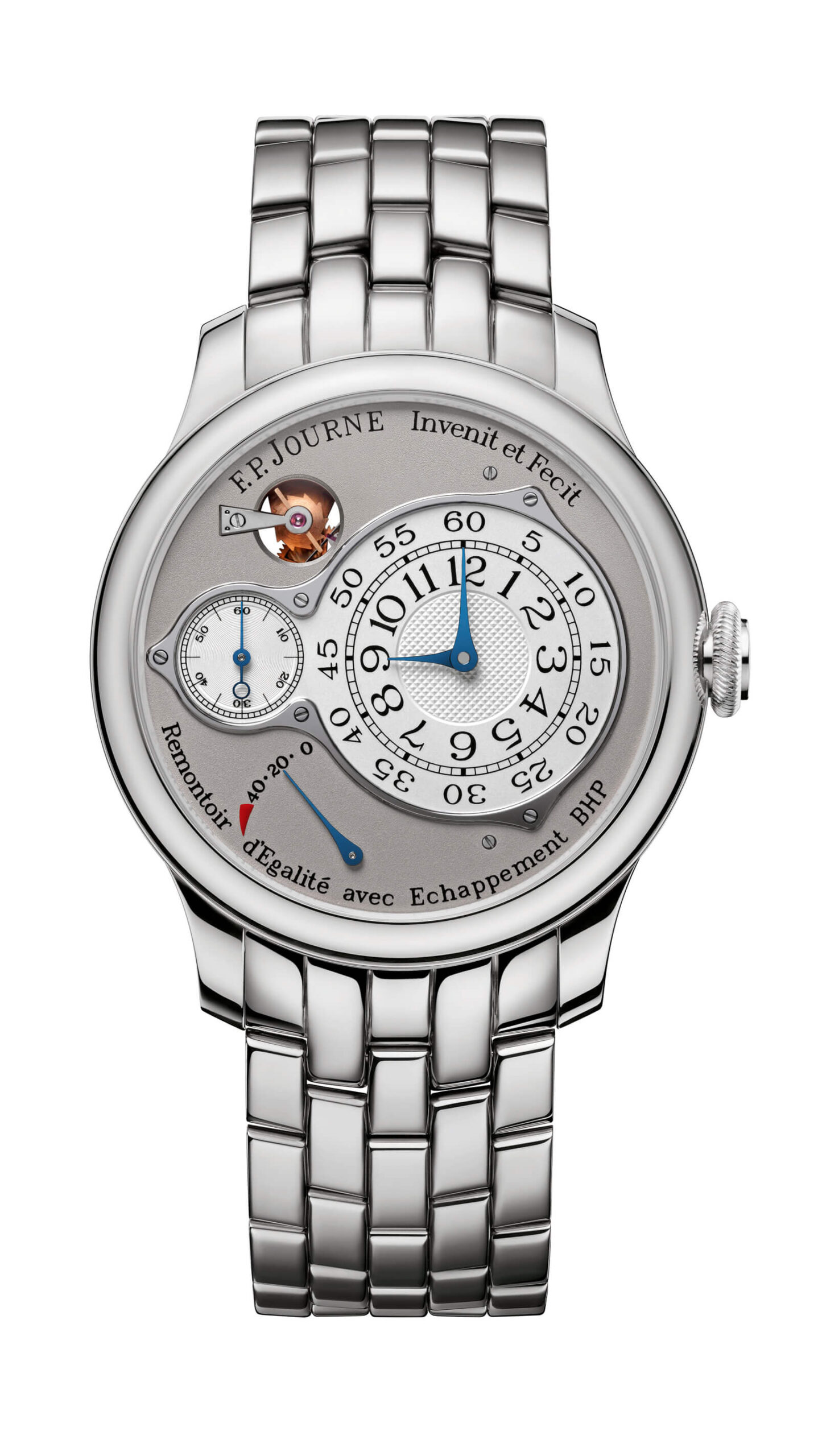
Part of the charm of any F.P.Journe timepiece can be attributed to its handsome dial, beautifully crafted in the company’s own dedicated production facility. The Chronomètre Optimum is offered in a choice of two case materials, platinum or 18-carat red gold. Both options are supplied with a gold and silver guilloché dial, with the latter featuring Clous de Paris decoration. Upholding F.P.Journe tradition, the guilloché section is held in position with a patented screwed steel frame.
An off-centre dial indicates the hours and minutes using blued hands which are executed in the Maison’s unique style. The hours are denoted with Arabic numerals and presented on an inner track. The minutes are shown on a dedicated outer track. A chemin de fer delineates the hour track from the minutes track.
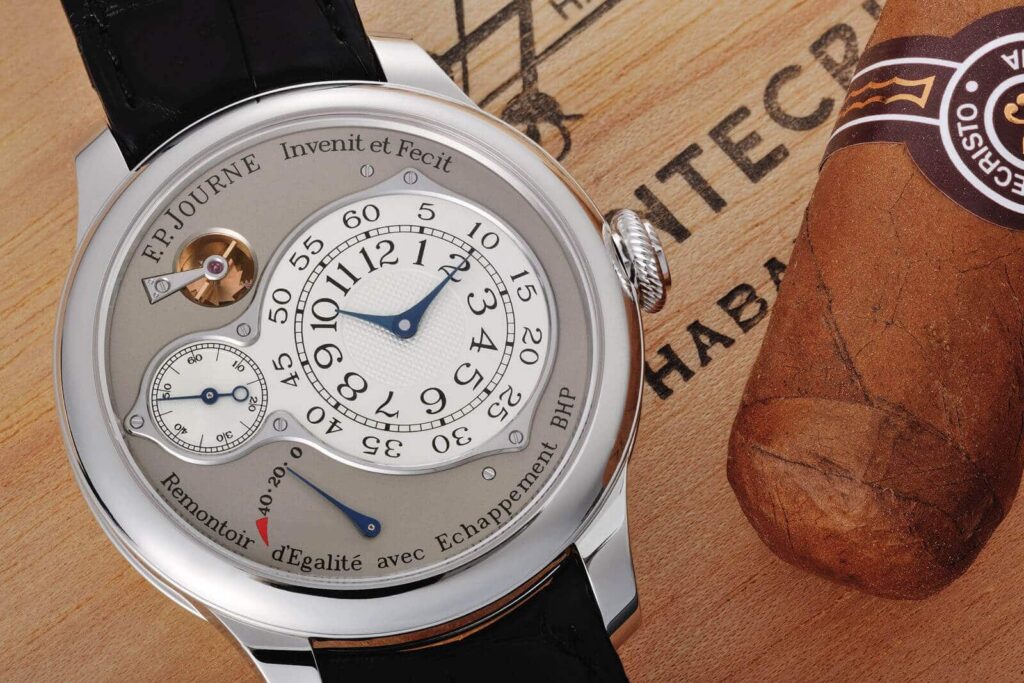
The aforementioned small seconds indication is presented on a circular dial, again framed with a chemin de fer. This display is conjoined with the hour and minutes display, granting a wonderfully stylish aspect.
Horological voyeurs are indulged with a wonderful spectacle at 10:30. An aperture reveals the remontoire performing a pirouette once every second.
A power-reserve indicator sits at the base of the dial, set against a gold backdrop. Overall the dial is highly functional, conveying information lucidly while exhibiting an extraordinary quotient of style.
F.P.Journe Chronomètre Optimum case
As previously stated, the F.P.Journe Chronomètre Optimum is available in a choice of platinum or 18-carat red gold. However, the venerable Maison offers the prospective client even more choice, providing both 40 mm and 42 mm case options. The watch is available on a sumptuous leather strap or a matching metal bracelet. Indeed, customer choice seems to be at the heart of the F.P.Journe paradigm.
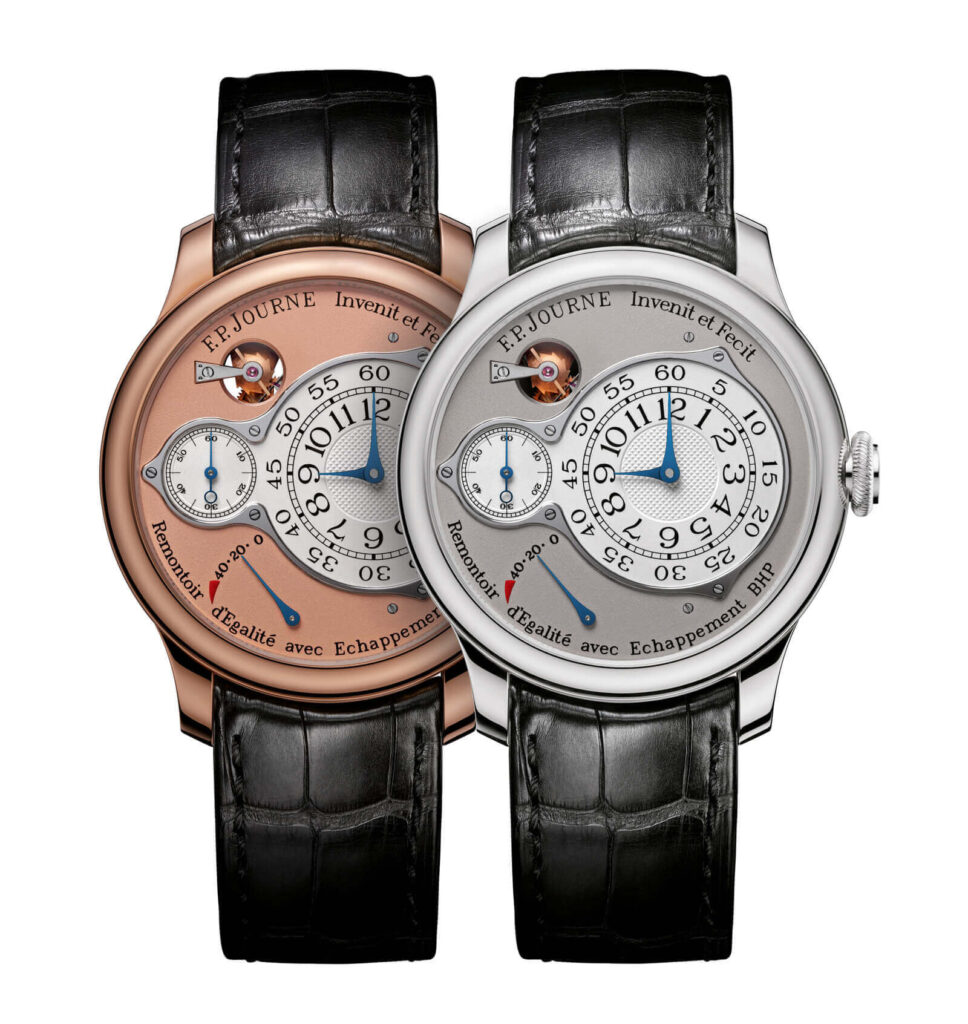
Longstanding admirers of Journe will note the familiar crown design, featuring a charming knurled silk cord pattern. The crown is relatively slim, sitting close to the caseband and sports two circular indentations on its vertical flank.

Gleaming surfaces abound but, rest assured, everything remains seemly and elegant.

F.P.Journe Chronomètre Optimum – closing thoughts
Throughout his career, François-Paul Journe has repeatedly rejected the limitations of convention. He has recognised potential weaknesses in a number of horological components and designs like some of his contemporaries, however, he has chosen to devote inordinate amounts of time and energy in trying to surmount such weaknesses and problems. Quite simply, Journe is an innovator, a man desirous of progress.
However, beyond his capacity to solve problems, refine mechanisms and conceive new ways to deliver superior chronometry, François-Paul has always ensured that his timepieces are blessed with enduring beauty. There are no gimmicks or outlandish details, his design language promises an enduring appeal and the materials he employs proffer longevity and facilitates servicing not just in the immediate term, but also in 200 years’ time.
The F.P.Journe Chronomètre Optimum is a perfect example of Journe’s fastidious attention to detail and his exceptional technical expertise. It wonderfully showcases his capacity to create watches blessed with pulchritudinous looks.
F.P.Journe is the darling of the auction scene with pre-owned watches attracting much interest. Moreover, the cognoscenti are fully aware of Journe’s remarkable talent, a fact reflected in the long waiting lists for his extensive range of models.
The eponymous company’s motto is ‘Invenit et Fecit’, meaning ‘Invented and Made’, an apt description for a Maison that seems incapable of accepting compromise and has an amazing track record when it comes to making ingenious ideas come to life.

Further reading
Technical specifications
- Model: F.P.Journe Chronomètre Optimum
- Case: 18K red gold (6N) / platinum; diameter 40 mm or 42 mm; height 10.1mm; sapphire crystal to front and rear
- Functions: Hours and minutes; small seconds; power reserve indicator; ‘natural’ deadbeat seconds to the rear
- Movement: Calibre 1510; hand-wound movement; frequency 21,600 vph (3 Hz); 44 jewels; power reserve 70 hours; 240 movement components.
- Price: Price on application