
Frederique Constant Classic Tourbillon Meteorite Manufacture Watch Review
This year, Frederique Constant celebrates its 35th anniversary by releasing Frederique Constant Classic Tourbillon Meteorite Manufacture. In order to mark this important milestone, the Genevan Maison recently released three new references, each equipped with a tourbillon escapement. This ultra-desirable, gravity-defying mechanism, much loved by watch aficionados, required much expertise to bring to fruition.
Now, the Swiss firm has unveiled a fourth variant of this watch, the ultimate expression of Frederique Constant ownership, the Classic Tourbillon Meteorite Manufacture reference FC-980MT3HPT. This timepiece unites the noblest of precious metals, a tourbillon and a degree of hand-finishing usually only found on watches costing six-figure sums. Angus Davies explores the story behind this exceptional creation.

Huguenots and watchmaking
Today, Switzerland is world-renowned for crafting fine timepieces. However, the story of Swiss watchmaking began in Geneva during the 16th and 17th centuries. The Huguenots, French Protestants, had suffered years of persecution and many of them sought sanctuary in the Swiss city, no doubt attracted by Calvanism.
John Calvin, a Huguenot and theologian, was the architect of religious reform in Geneva. In 1541, the council of Geneva passed the Ordonnances ecclésiastiques, setting in place a regime that governed many areas of life. Calvin ruled Geneva with a rod of iron, rooting out all forms of immorality and Catholicism. Adultery, excessive consumption of alcohol, gambling and promiscuous conduct were sometimes punished with the most brutal of sanctions.
A consequence of this strict regime saw the making of jewellery (indeed any ostentatious displays of wealth) outlawed in Geneva. The rules at the time prevented the making of ‘crosses, chalices or other instruments of popish idolatry’. The French refugees, many of whom were highly skilled in artisanal crafts such as engraving, enamelling, etc, adapted their talents to making watches and an industry was born. Ultimately, watchmaking emanated from Geneva to other areas of Switzerland such as the Vallée de Joux and Neuchâtel. However, today, Geneva still remains home to some of the most prestigious watch companies in the world as well as numerous specialist suppliers, master watchmakers and highly skilled artisans.
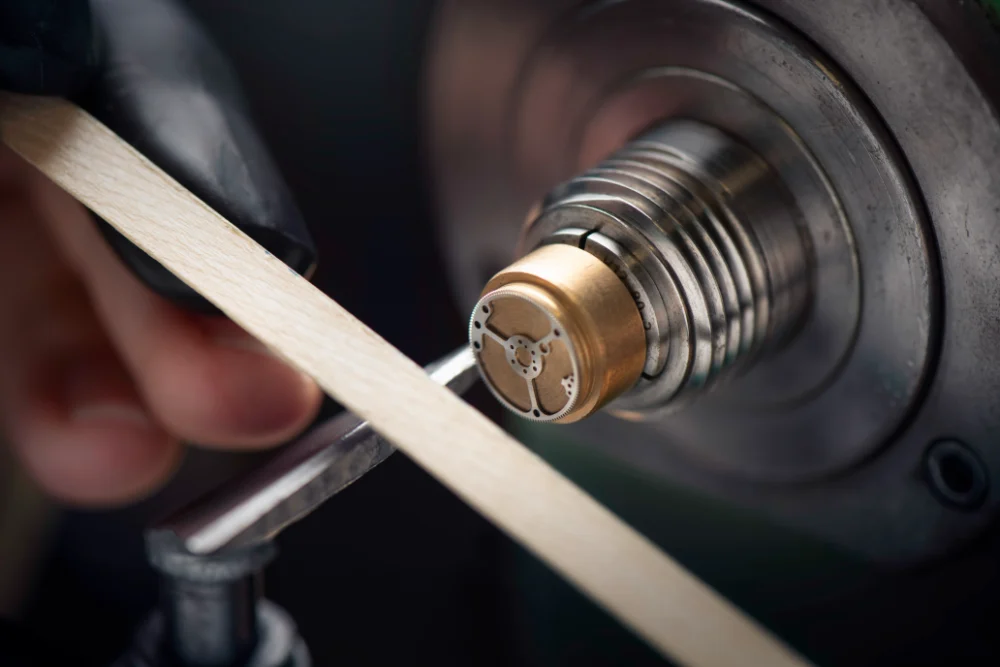
Image – cerclage
Frederique Constant depuis 1988
Dutch couple, Aletta and Peter Stas, founded Frederique Constant in 1988. The brand’s soubriquet is a compound of Aletta’s grandmother’s name, Frederique Schreiner, and Peter’s grandfather’s name, Constant Stas.
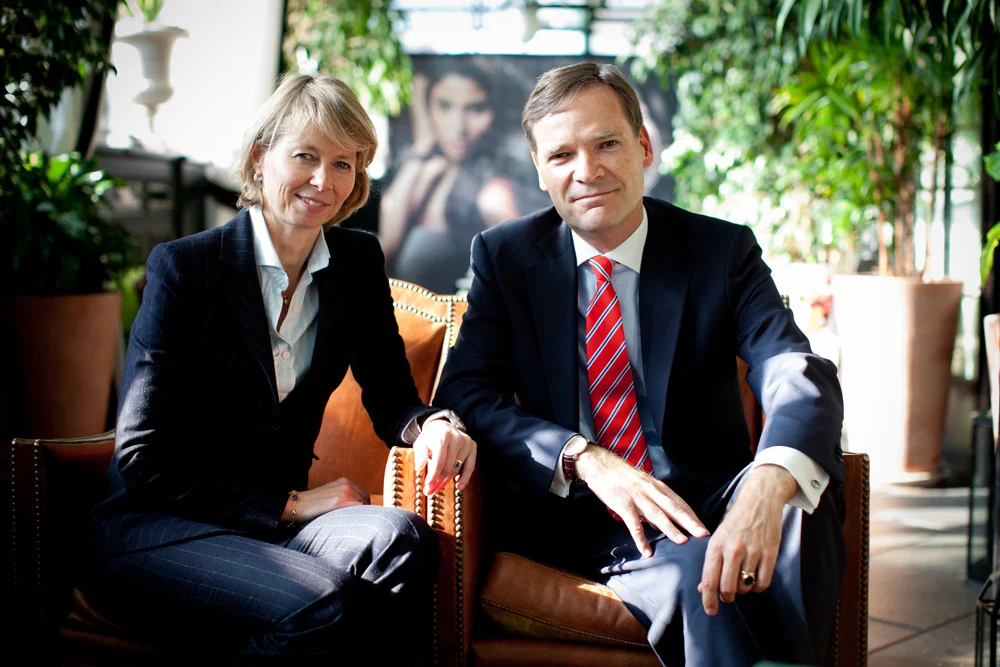
After spending four years putting in place the infrastructure for their newly formed company, including spending time designing the brand’s inaugural watches, the couple unveiled the ‘18th Century Collection’. These models were equipped with Swiss movements and assembled by a Geneva-based watchmaker. A few years later (1994), the brand released its first Heart Beat timepiece. Over the years, the brand has released several additional models that reveal the regulating organ via a dial aperture. Indeed, this characteristic has become very much part of the brand’s DNA.

Image – anglage
Manufacture movements
In 1997, the brand relocated to Carouge, a suburb of Geneva. Since then, the company has relocated again and again in order to meet growing demand. The Swiss Maison, once again, signalled its horological ambitions when it recruited the Dutch watchmaker Pim Koeslag in 2001. Three years later (2004), Frederique Constant released its first Manufacture calibre, the FC-910.
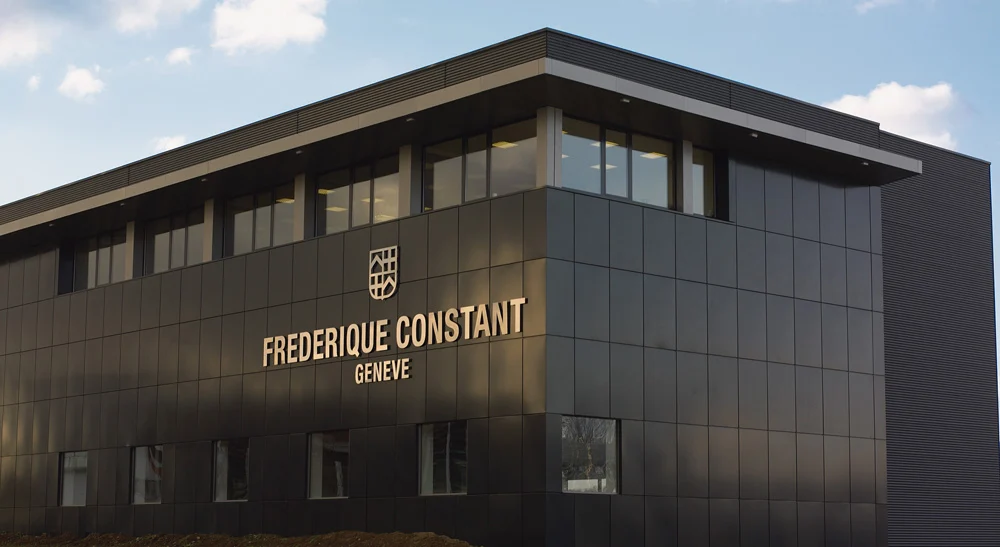
Since it unveiled its inaugural Manufacture calibre, Frederique Constant has continued to design, develop and assemble in-house movements within the confines of its modern Manufacture in Plan-les-Ouates, Geneva. Currently, the inventory of Manufacture movements totals 30 in number, albeit, based on past experience, this figure will inevitably increase.

Image – Grate de Paris Charbonnage
Silicon movement components since 2008
Throughout its history, Frederique Constant has embraced classical styling and cutting-edge know-how. For example, the company was an early adopter of silicon technology. This lightweight material (silicium in French) is friction-free, not susceptible to corrosion nor magnetic influence and can be formed into intricate shapes. In 2021, the Maison utilised the glass-like material for its Monolithic oscillator. Billed as a new type of escapement with an ultra-fast cadence of 40Hz, it employed a single wafer-thin component, replacing a total of 26 parts that are usually found within a Swiss lever escapement.
Challenging convention
Frederique Constant’s spirit of innovation has also extended to reimagining traditional complications, sometimes masterminding simpler, more efficient mechanisms. When the luxury marque released its FC-760 Manufacture calibre, a flyback chronograph movement, it shunned complexity by employing a patented star-shaped wheel. It is this unwavering strategy of challenging convention and embracing fresh ideas that have helped define this dynamic firm.
Showcasing creativity
Back in 2008, Peter Stas, Pim Koeslag and Robert van Pappelendam created a new company, Ateliers de Monaco. Still belonging to the Frederique Constant Group, this brand operated in the rarefied heights of Haute Horlogerie. In fact, some of the firm’s products were hallmarked with the coveted Poinçon de Genève.

Image – Grate de Paris Charbonnage
With an abundance of talent working within the company, some of the watchmakers showcased their mechanical virtuosity crafting high-end Ateliers de Monaco watches alongside Frederique Constant and Alpina timepieces. During this process, they developed innovative solutions that would, in some instances, trickledown to some of the more accessibly priced Frederique Constant watches.
It is this hotbed of creativity which led to the creation of the Frederique Constant Classic Tourbillon Meteorite Manufacture, a watch I will return to shortly.
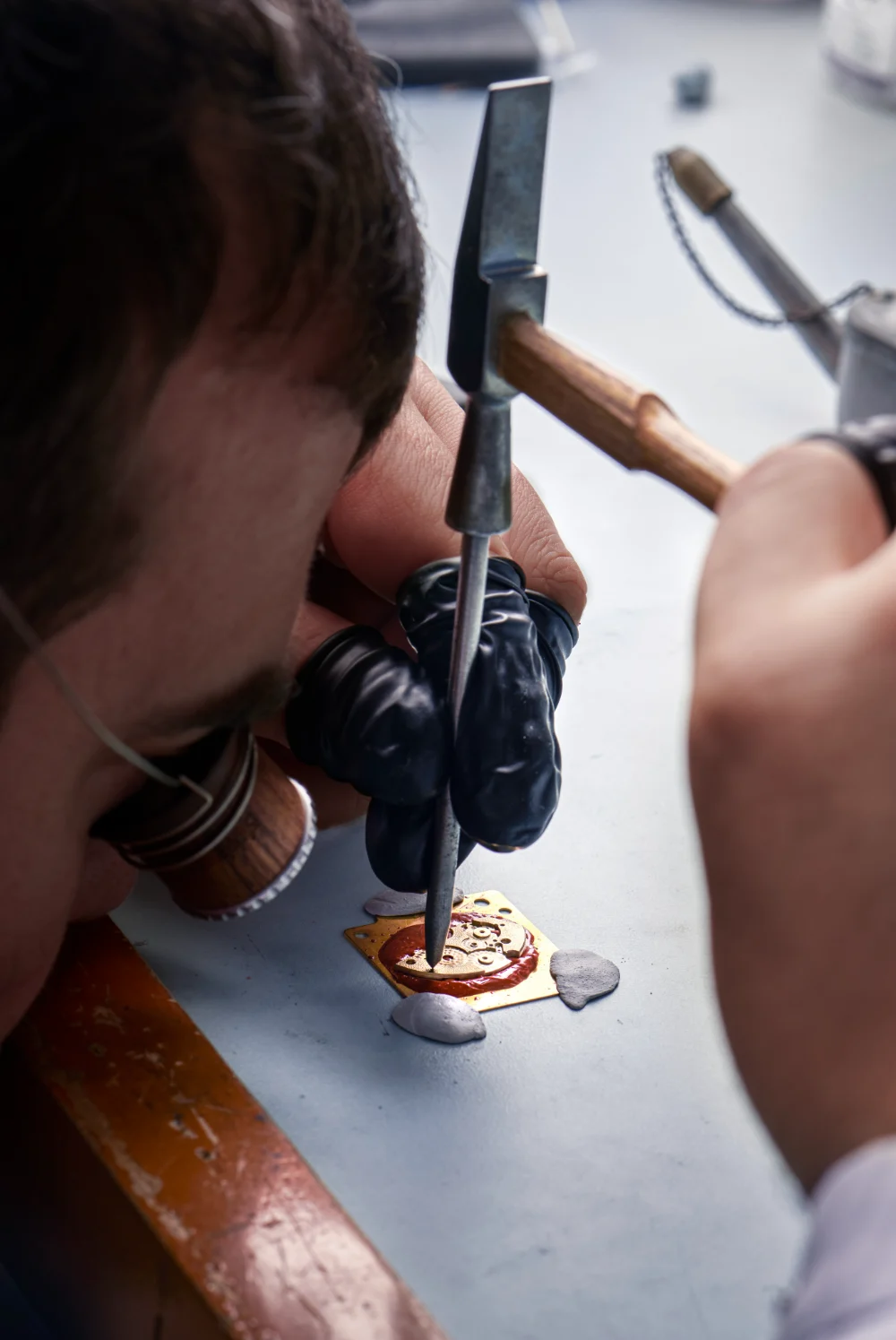
Image – martelage
Marking the 35th anniversary of Frederique Constant
Five years ago, Frederique Constant celebrated its 30th anniversary in style releasing a highly ambitious timepiece endued with a tourbillon and perpetual calendar. With its combination of classic design and high complications coupled with an impressive quality-price ratio, the watch was favourably received.

Image – Frederique Constant Classic Tourbillon Manufacture in steel FC-980N3H6
Now, the Swiss brand is celebrating its 35th anniversary with the release of a new model, equipped with a tourbillon and encompassing a clean dial design and, pertinently, modest case dimensions. Presented in four variants, each encased in a 39mm housing, this new horological quartet is deliberately sized to appeal to watch collectors. The references, each limited in number, include: steel with a silver-coloured dial (350 pieces), steel with a blue-coloured dial (350 pieces), 18-carat rose gold with an anthracite dial (150 pieces) and platinum with a meteorite dial (35 pieces).

Image – Frederique Constant Classic Tourbillon Manufacture in rose gold FC-980G3H9
While the aforementioned steel and gold references were unveiled earlier in 2023, the platinum model, the reference FC-980MT3HPT has only just been released. It is this latter model which is the focal point of my gaze hereafter.
Frederique Constant Classic Tourbillon Meteorite Manufacture
Romain Valette and Roland Pel work at the brand’s Manufacture in Geneva. Both men bear the title ‘Complications Watchmaker’, a description that merely hints at their remarkable expertise at the bench. These gentlemen have amassed many years of experience, working on an array of timepieces of varying complexity. Moreover, they are well-versed in finishing components to an exalted standard.
History has a habit of repeating itself. Just in the way Ateliers de Monaco was born out of Pim Koeslag’s desire to showcase his watchmaking prowess, the Frederique Constant Classic Tourbillon Meteorite Manufacture is the product of Romain and Roland wanting to demonstrate their own extraordinary talent.

Image – anglage
While the platinum version bears a strong resemblance to its identically named steel and gold siblings, it is endowed with a bewitching meteorite dial and incorporates peerless hand-finishing rarely seen and, most pertinently, seldom found at this price point. Quite simply, the Frederique Constant Classic Tourbillon Meteorite Manufacture provides an artistic canvas for both watchmakers to impart a degree of artistry usually only found on timepieces crafted by the best independent watchmakers.
Without further ado, I will examine this model in close detail and, where appropriate, point out each flourish of horological virtuosity.
Meteorite dial
The dial of the Classic Tourbillon Meteorite Manufacture is dressed in Gibeon Meteorite from Namibia. It fell to Earth in prehistoric times and was named after the nearby town of Gibeon. This material, one of the costliest meteorites available, was selected for its prominent pattern of interwoven lines.
The meteorite dial has a thickness of 0.5mm and is coated with ruthenium. This treatment bestows the epidermis of the dial with a contemporary palette of grey hues and also prevents any oxidisation of the meteorite’s surface.

Lancine hands
Lancine-style hands enunciate the hours and minutes clearly and with a degree of balletic grace. Each hour is denoted with a tear-shaped index, except for the hours between 5 and 7 o’clock where the tourbillon aperture resides. Both the hands and indexes are executed in steel and hand-polished to a refined gleam.
Tourbillon
As previously stated, Frederique Constant has often revealed the regulating organ on its Heart Beat models using a dial aperture. It’s a characteristic that has indulged the desires of many horological voyeurs, eager to see various moving parts in conversation. The Classic Tourbillon Meteorite Manufacture takes this idea to another level.
The regulating organ and escapement are located within a rotating cage that revolves 360° every minute. This complication, patented by Abraham-Louis Breguet in 1801, counters any positional errors caused by the adverse influence of gravity on the regulating organ.

Image – tourbillon cage. Note the purple-hued silicium escape wheel
Regarded as a ‘high complication’, this mechanism requires an inordinate amount of skill on the part of the watchmaker to bring the coveted whirlwind to life. Originally, intended to enhance chronometric performance, the tourbillon is now highly prized for its choreographed dance, performed centre stage for the delectation of onlookers.
The wearer is indulged with a view of the escape wheel chatting with the pallet lever, the balance wheel twirling to and fro and the hairspring pulsating concentrically. A feuille-style hand, positioned above the tourbillon cage, imparts the running seconds.
Silicon parts
As mentioned earlier, Frederique Constant was an early adopter of silicon technology and has repeatedly utilised its many attributes. This lightweight material has, once again, been employed on this latest watch. Both the escape wheel and pallet lever are intricately formed using silicon. These purple-hued parts when combined with the rest of the escapement, regulating organ and tourbillon cage, weigh just 0.59 grams. This featherlike mass requires little energy to operate, merely sipping the available power held within the barrel.
Why do the silicon parts have a purplish colour?
Silicon components are made in a dust-free environment using an elaborate manufacturing process encompassing photolithography, DRIE (Deep Reactive Ion Etching), stripping and finally thermal treatment. This latter step involves using a special oven that leads to the silicon achieving the optimum blend of hardness and flexibility. During the thermal treatment, the escape and pallet lever (sometimes termed the ‘anchor’) assume a purplish hue.
Calibre FC-980
The Calibre FC-980 first appeared in the steel versions of the Classic Tourbillon Meteorite Manufacture launched earlier this year (2023). The balance has a frequency of 28,800 vph (4Hz) and the self-winding movement contains 33 jewels. Assuming the mainspring is fully tensioned, the watch will run autonomously for 38 hours.

The oscillating mass comprises brass with a tungsten section positioned to the outer edge. This latter material was selected because it has a greater density than 18-carat gold, producing greater inertia when worn, hence energising the mainspring more efficiently. All parts of the oscillating mass are coated in ruthenium, bestowing a contemporary aesthetic.
However, while the Frederique Constant Classic Tourbillon Meteorite Manufacture essentially shares the same movement as its slightly older siblings, its execution embraces alternative materials and a far superior level of finishing (see later).
Regulation and tests
When regulating this model, the watchmakers test the balance in six different positions using a Witschi timing machine. They will move the raquette, adjusting the effective length of the hairspring, in order to alter the rate. After regulation, the rate variation will be -3 to +7 seconds per day. Thereafter, the balance is fitted within the tourbillon cage and further adjustments are made where necessary. The assembled watch is then tested in a further three positions.
Frederique Constant subject the watch to an array of additional tests. For example, the watch is placed on a Cyclotest machine to ensure the automatic winding of the watch functions correctly. The watch is also tested for water resistance. In this instance, the Classic Tourbillon Manufacture has a stated water resistance of 50m.
Frederique Constant Classic Tourbillon Meteorite Manufacture – finishing
The Calibre FC-980 found within the Classic Tourbillon Meteorite Manufacture incorporates a level of finishing that surpasses that of some other watches that purport to be Haute Horlogerie. The model’s components are painstakingly decorated, not using automated methods but with the deft use of hand. Moreover, consistent with high-end watchmaking, this finishing extends to every facet, flank and horizontal surface, including those areas hidden from view. It takes a total of 120 hours of work to decorate each movement to this no-compromise standard.
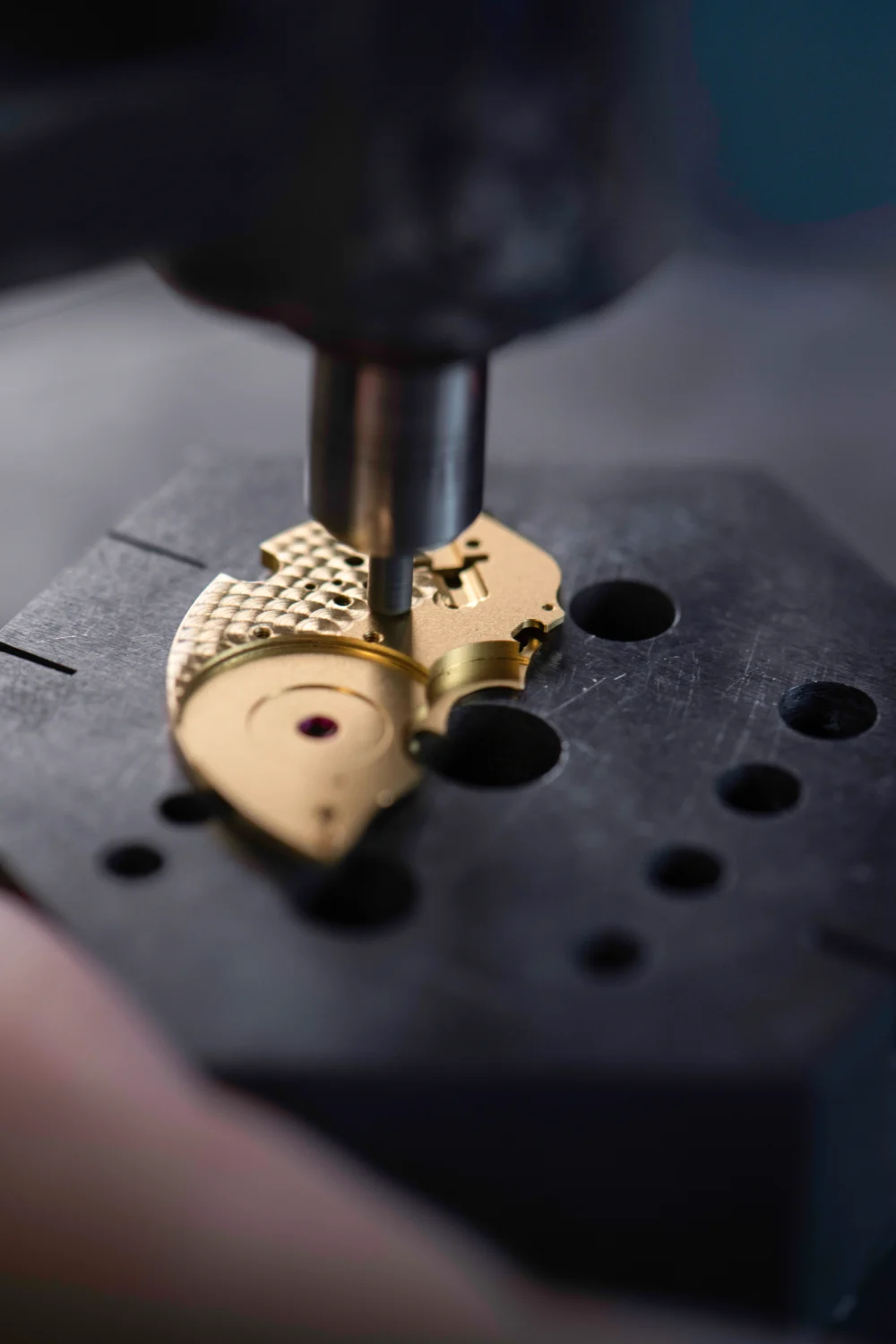
Image – perlage
In creating this version of the Calibre FC-980, Roland and Romain have chosen to respect watchmaking traditions while simultaneously delivering a neoteric appearance. The traditional Côtes de Genève motif found on ‘regular’ versions of the movement has been set aside in favour of ‘coal frosting’ (on the automatic bridge). Likewise, hammering has replaced much of the perlage decoration typically found on the mainplate, albeit there is a small section of hand-executed perlage adjacent to the ratchet wheel.
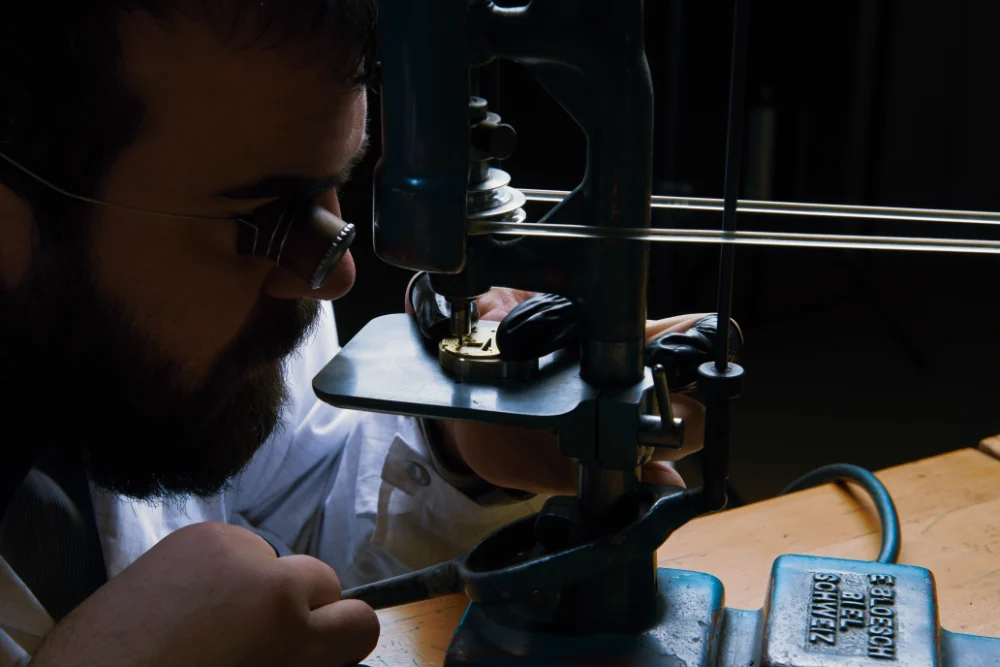
Image – perlage
The wheels are circular satin-finished, a decoration performed using a traditional Schaublin lathe. Roland and Romain have used a traditional tin plate and diamantine paste to impart a mirror-polished finish to the ratchet wheel. This latter technique, sometimes termed ‘black polishing’ is the most challenging to execute and is normally only found on the finest exemplars of Haute Horlogerie. This protracted polishing technique culminates in a supremely flat surface that confers distortion-free reflections. Furthermore, the resultant surface appears almost white from some angles, transitioning to black when held in other positions. Even the screws are mirror-polished to a flawless conclusion.
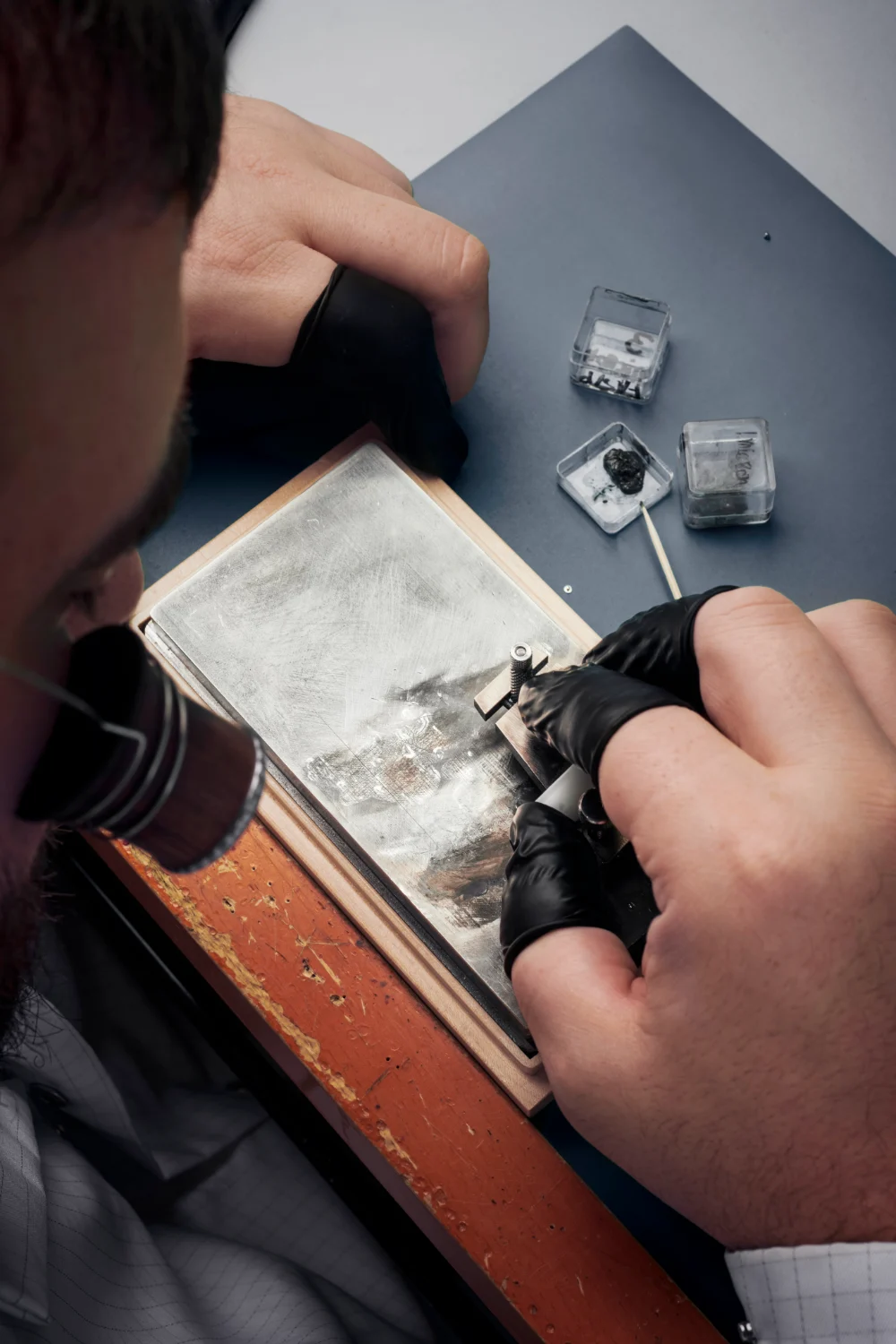
Image – mirror-polishing
Surveying the workshop that Roland and Romain call home, one cannot help notice the usual watchmaking paraphernalia such as screwdrivers, loupes, tweezers and cloches. However, there is also an array of equipment typically employed by finisseurs, the finishing specialists who inhabit a rarefied world of watchmaking excellence. Besides the aforementioned tin plate, there are numerous files and sticks of gentian wood used to perform anglage (the various bevelled edges presented at 45°). An observant visitor may even spot a Champagne cork used for ‘dressage’, or graining, and a series of hammers to impart a pitted finish to the mainplate.
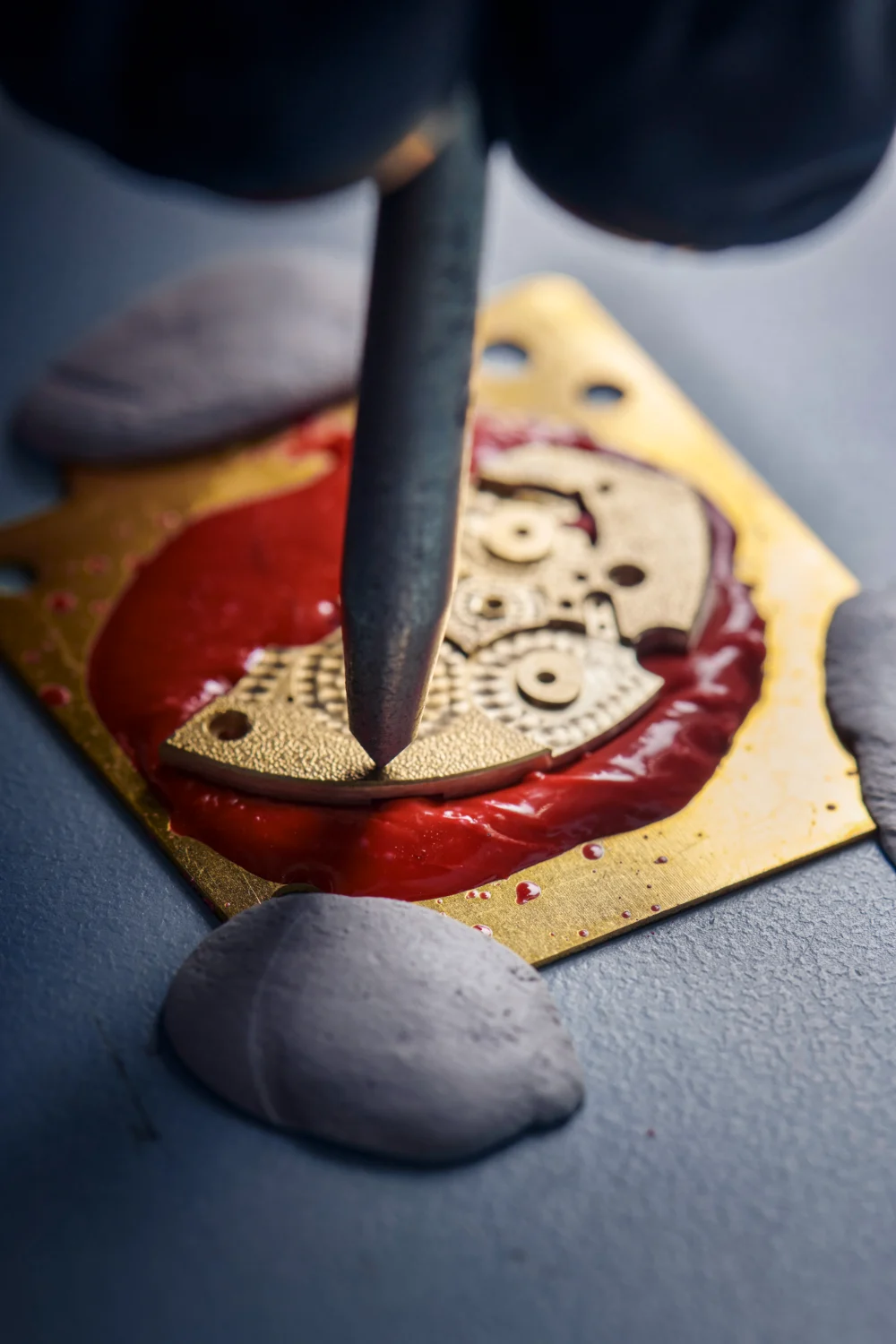
Image – martelage
Frederique Constant Classic Tourbillon Meteorite Manufacture – celebrating the past
Since it was founded in 1988, Frederique Constant has enjoyed the sweet taste of success, witnessing its sales grow exponentially. The Maison has gained a reputation for making classically-styled luxury watches that deliver an impressive quality-price ratio. In 2016, Citizen acquired the Frederique Constant Group, however, the Swiss firm continues to follow the same successful formula as before.
As stated earlier, the company was an early adopter of silicon technology, a material that delivers several wearer benefits. Furthermore, the Swiss Maison has invested heavily in CNC machines and other state-of-the-art technology, allowing it to mitigate labour costs and deliver impressive yet accessible timepieces.

However, in the case of the Frederique Constant Classic Tourbillon Meteorite Manufacture, the luxury marque has set aside many modern-day, automated methods preferring to embrace hand craftsmanship of the highest order. The resultant watch celebrates the history of Frederique Constant and demonstrates the remarkable proficiency of Roland and Romain. Furthermore, it upholds the traditions of Genevan watchmaking: the place where Swiss watchmaking began.
Further reading
https://frederiqueconstant.com/
Technical specifications
- Model: Frederique Constant Classic Tourbillon Meteorite Manufacture
- Reference: FC-980MT3HPT
- Case: platinum 950, diameter 39 mm, sapphire crystal to front and exhibition caseback, water resistant to 5 ATM (50 metres).
- Functions: Hours, minutes, small seconds on tourbillon
- Movement: FC-980 Manufacture calibre, automatic movement, frequency 28,800 vph (4 Hz), 33 jewels, 38-hour power reserve
- Strap: Alligator leather paired with a folding buckle
- Price: €42,995 (RRP as at 18.7.2023)
- Limited Edition: 35 pieces