
Patek Philippe 5204R-011 – (part 2 of 2) Watch Review
Continuing his in-depth review of the Patek Philippe Reference 5204R-011, a split-seconds chronograph and perpetual calendar, Angus Davies checks out the model’s case and movement in microscopic detail before sharing his closing thoughts.

Patek Philippe perpetual chronograph – cases
Over the last 80 years, watches have grown in size. The 1518 measured 35 mm in diameter, the 2499 was a tad larger at 37.5 mm while the 5270 has a contemporary width of 41 mm. In the current era, a case measuring 40 – 41 mm has widespread appeal and should suit most wrists.

Image – Reference 1518
Despite its additional complexity, the Patek Philippe Reference 5204R-011 is actually 1mm narrower than the simpler Reference 5270, albeit it is slightly thicker at 14.3 mm in height. Once again, Patek Philippe has ensured the dimensions of this tour de force are tastefully restrained.

Image – Reference 2499
Returning to the reference 1518, the design of the lugs was quite simple by modern standards. With the advent of the 2499, the lugs became more sophisticated, adopting a charming stepped design. This particular look can also be seen on the Reference 5204R-011 and distinguishes the model from the Reference 5270 which has swooped sides. With the 5204R-011, Patek has looked to the past, respected its patrimony and distilled former elements for use on this modern-day model.
In the rarefied heights of Patek ownership, aficionados don’t simply know numbers, they also become experts in understanding letters. In this instance, the letter ‘R’ after Reference 5204 means the case is formed of rose gold. Historically, push pieces on the references mentioned are either square or round. In this instance, the 5204 is fitted with round pushers.

Image – Reference 5270/1R
Four correctors grace the caseband. Although some horophiles prefer to adjust the indications purely with the crown, the complexity of this model justifies the number of dimples gracing the flanks of the case. The sapphire crystal is cambered and sits adjacent to a concave bezel. The watch comes supplied with two case backs as standard: a solid case back and an exhibition case back. Just a word of caution, don’t be tempted to perform the exchange yourself, only a Patek trained technician should be entrusted with this task.
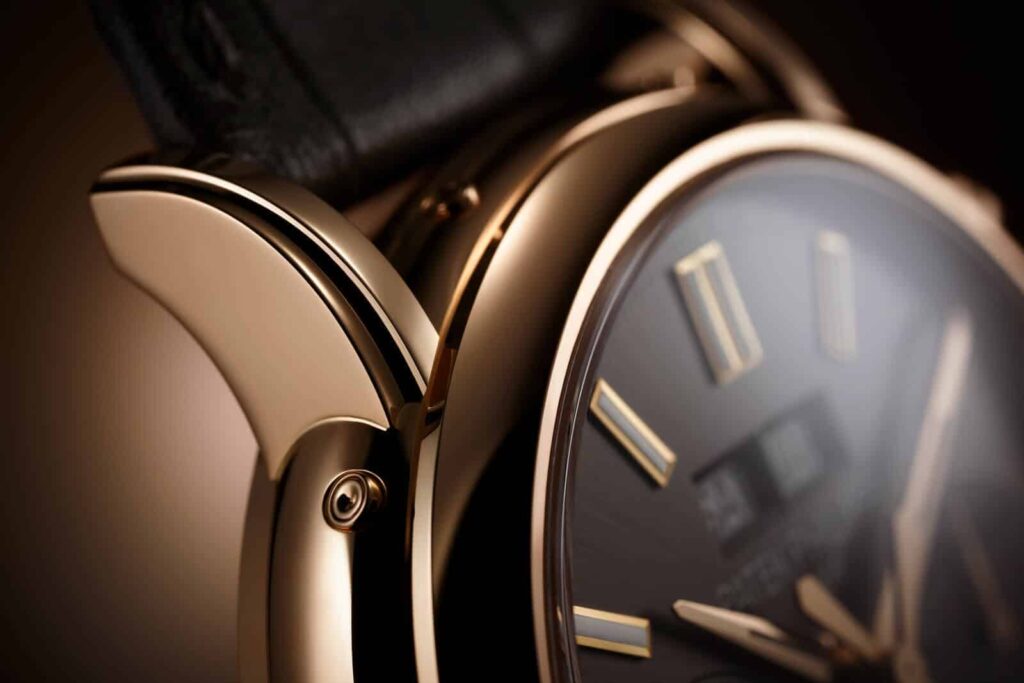
The watch comes supplied on a slate grey calfskin strap embossed with an alligator pattern. This may come as a surprise to some individuals expecting genuine reptile skin. Indeed, for many years, the watch industry has been a keen advocate for the use of alligator and crocodile skin when procuring straps. However, since 2020, it has been illegal in California to import or own products made from these skins. Personally, I think this is a positive step and I suspect many other countries/states will follow California’s example. It’s good to see that Patek is ahead of the curve.

Patek Philippe perpetual chronograph – movement history
Historically, Patek Philippe was an établisseur, procuring ébauches and various parts and then assembling them. An ébauche is defined by the Fondation Haute Horlogerie as ‘a watch movement with or without jewels but always without its regulating organ, mainspring, dial and hands. It is also known as a blanc roulant.’ In the current era, when an increasing number of firms are making in-house movements, this may sound strange, however, in the past it was the norm. Indeed, if we consider the so-called ‘holy trinity’, namely Audemars Piguet, Patek Philippe and Vacheron Constantin, all three firms have procured ébauches from movement specialists. For example, the Reference 2499 featured a Valjoux base. Ultimately, Patek Philippe became a Manufacture, making a number of in-house movements, however, there were exceptions.
In 2012, the Genevan Maison stated, ‘for decades, Patek Philippe’s emphasis has been on crafting its movements in-house and endowing them with the manufacture’s inimitable signature. But for a long time, there was an exception to this rule’. The brand was referring to the 27-70 caliber, a much admired movement made by Nouvelle Lémania but modified to meet Patek’s precise requirements. The 27-70 Q featured in the Reference 5004, a split seconds chronograph with perpetual calendar (released in 1994). While the movement was outsourced, it was assembled and regulated at Patek’s Geneva site.

Image – Caliber CHR 29-535 PS Q
However, while the Reference 5004 was in production, there was a mood of change in the air. In 2009, Patek released its own in-house movement, the CH 29-535PS in ‘a basic configuration’. Later, the high-end brand would add a calendar module and split-seconds mechanism to the CH 29-535PS and named it the Caliber CHR 29-535 PS Q. It’s this hand-wound movement which sits at the heart of the Patek Philippe Reference 5204R-011.
Caliber CHR 29-535 PS Q
Hand-wound movement
Many horophiles prefer the convenience of a self-winding movement, however, I suspect just as many share my predilection for hand-wound movements. Indeed, there is something quite cathartic about quietly energising the mainspring and momentarily escaping the hubbub of daily life.
The Caliber CHR 29-535 PS Q has a wonderfully traditional appearance. There are no oversized bridges to hinder the view of an inquisitive wearer. On the contrary, numerous, exquisitely finished parts are on show, some of them coquettishly moving for the gratification of the owner.
Perpetual calendar
As previously stated, the Patek Philippe Reference 5204R-011 features a perpetual calendar. The watch displays the day, month, moon phase, date, leap year and features a day/night indicator. Unlike other types of calendar watch, this type of mechanism is capable of identifying those months containing 28, 29, 30 and 31 days, automatically advancing to the 1st day of the following month. Furthermore, a perpetual calendar has the mechanical intellect to distinguish between a ‘common year’ and a ‘leap year’. Assuming the watch is kept wound, the date won’t require adjustment until 2100.
Two column-wheels and a horizontal clutch
The Caliber CHR 29-535 PS Q features two column-wheels, one for the chronograph and the second for the split-seconds. These days, most high-end brands have a tendency to pair a column wheel with a vertical coupling. By using this approach, there is less tendency for the central chronograph seconds hand (the trotteuse) to stutter once actuated.

Patek has kept with the traditional approach of using a column wheel with a horizontal coupling. However, before you ask, there is no stuttering with the Patek. The brand has incorporated an ‘optimised toothing profile’ which delivers suppression of hand quiver or rebound at the start. This is just one of six patented innovations to be found on the Caliber CHR 29-535 PS Q. The luxury marque has explained the rationale for such inventiveness, stating the six patented innovations ‘contribute to long-term reliability; the simpler and more precise adjustment of specific functions; more convenient servicing; greater energy efficiency and reduced wear’.

Some traditionalists favour a horizontal coupling because they enjoy seeing the chronograph engage and disengage. Unusually, Patek prefers to place an eccentric cap above the column wheel. Historically, this has been done to prevent the column-wheel levers popping out should the watch be subject to a shock/impact. With regards to the Caliber CHR 29-535 PS Q, the brand cites another reason for using an eccentric cap, namely, it allows ‘the very precise mesh depth adjustment of the chronograph wheels at the outermost end of the clutch lever’. Incidentally, this is another patented innovation found on the movement (as stated earlier there are six in total).
Gyromax
The balance has a frequency of 28,800 vph (4 Hz). It features Patek’s Gyromax system, a term it uses to describe a variable-inertia balance (sometimes termed a free-sprung balance).
Most watches are equipped with an index-regulated balance. With this latter system the hairspring passes between two curb pins mounted on a ‘raquette’. When the raquette is moved towards or away from the stud, the effective length of the hairspring changes, making the watch run faster or slower.

However, the Caliber CHR 29-535 PS Q is fitted with Patek’s Gyromax system which means the effective length of the hairspring never changes. The rate is adjusted by rotating four weights positioned on the spokes of the balance wheel which alter the moment of inertia. With the Gyromax system, the weights are placed in-board thereby producing less air turbulence which, once again, enhances precision. Furthermore, a watch fitted with the Gyromax system is less susceptible to positional errors and confers superior rate stability.
The regulating organ features a Breguet balance spring. This involves raising the outer coil of the balance spring, thereby reducing its curvature. By equipping the Caliber CHR 29-535 PS Q with this feature, the balance spring breathes more concentrically, enhancing isochronism and, by default, enhancing precision.
Finissage
In the esoteric world of Haute Horlogerie, there is much emphasis placed on finishing (finissage). For example, to remove signs of machining, the main plate is traditionally decorated with a series of overlapping circles, termed ‘perlage’. However, there are other reasons for finishing. Burrs or protruding metal need to be eliminated in order to ensure parts move as intended, wear is mitigated and energy-sapping friction is ameliorated. Sometimes, finishing is used to remove blemishes such as scratches. The typical tools used by high-end watch firms include buffs, burnishers, files (various grades), gentian wood, polishing lathes, a tin plate, etc.
Patek has enriched the Caliber CHR 29-535 PS Q with several types of finishing including perlage, Côtes de Genève, hand chamfered surfaces and graining. The screws and jewels sit in polished sinks, while the eccentric cap has been mirror-polished, widely considered one of the most challenging forms of decoration.
All finishing must adhere to the company’s own quality label, the Patek Seal, a notably rigorous standard introduced back in 2009.
Patek Philippe Reference 5204R-011 – closing thoughts
As you have no doubt ascertained, when it comes to the Patek Philippe Reference 5204R-011, there is much to say.
In this instance, functionality and beauty are interwoven. Indeed, it is often difficult to categorise one detail as solely functional or purely aesthetic. For example, the eccentric cap serves a practical purpose and yet it is mirror-polished to a flawless conclusion. It is this reoccurring characteristic that differentiates this exemplar of Haute Horlogerie from other more pedestrian timepieces offered by some of Patek’s competitors.
Appraise the dial and it is eminently legible. Despite displaying numerous indications, everything has room to breathe. Legibility and looks happily co-exist. With its own dial factory, Cadrans Flückiger, Patek has a specialist within its ranks. Explore the dial with your eyes and you will discover depths, textures and a fascinating interaction with light conferring brilliance and shade.

The Nouvelle Lémania movement, 27-70 Q caliber, is viewed by the cognoscenti as an icon and rightly so. However, I suspect that one day, when Patek chooses to replace the Caliber CHR 29-535 PS Q in the spirit of continuous improvement, this present-day movement will be also viewed with the same respect. Personally, I adore the traditional appearance of the movement and its penchant for showing each thought process. And yet, while it doffs its hat to classical movement design, Patek has simultaneously embraced innovation, manifest with the movement’s six patents.
Arguably, the greatest strength of the Ref 5204R-011 is that it is blessed with an eonian allure. Despite the Maison releasing numerous models that pair a chronograph (or split-chronograph) with a perpetual calendar, they all share a family likeness. Indeed, the aesthetic appearance of the Reference 1518 and this modern-day Reference 5204 are very similar almost to the point that only their mother can tell them apart. I predict, therefore, that Reference 5204 will still look applicable to its time, one hundred years from now. How many other watches are worthy of this claim?
And so, I have to conclude my sojourn into this sometimes bewildering world of reference numbers. I may have a poor memory, but I will forever remember the Reference 5204, oh and the 2499!
Further reading
Technical specifications
- Model: Patek Philippe Reference 5204R-011
- Case: Rose gold; diameter 40 mm; height 14.3 mm; water resistance to 3 ATM (30 m); sapphire crystal to the front and exhibition case back.
- Functions: Hours; minutes; small seconds; date; moon phases; perpetual calendar (day, month, leap year, day/night indicator); split-seconds chronograph
- Movement: Caliber CHR 29-535 PS Q; hand-wound movement; frequency 28,800 vph (4 Hz); 34 jewels; power reserve with the chronograph disengaged min. 55 hours – max. 65 hours
- Strap: Calfskin, embossed alligator pattern, hand-stitched and shiny grey paired with a fold-over clasp
- Price: £243,170 (RRP as of 6.2.2022)