
Breguet Marine Hora Mundi 5557 Watch Review
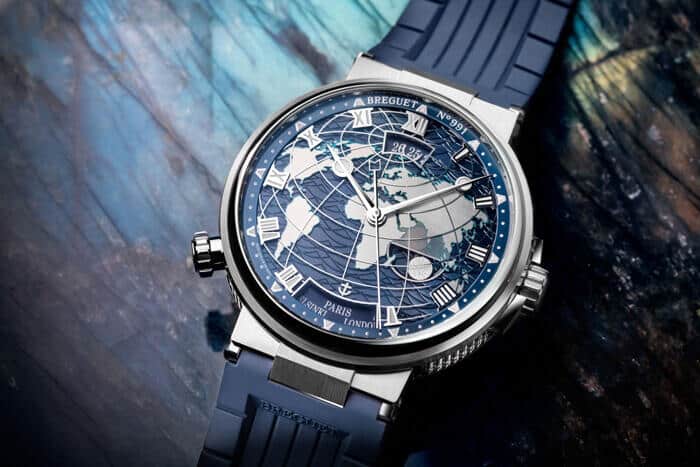
The Breguet Marine Hora Mundi 5557 features an ingenious dual time-zone mechanism coupled with a sublime dial enriched with hand-guilloché waves. Moreover, the dial features numerous levels that masterfully play with perspectives, once again, wonderfully demonstrating the Manufacture’s attention to detail. Mark McArthur-Christie, a self-confessed Breguet fanatic, shares his thoughts.

For the price of the most expensive Breguet Marine Hora Mundi 5557 you could buy 3,280 resin-cased, Japanese, quartz digital watches that would do the same job of telling the time around the world. But this is like saying one could also have six showroom-fresh Honda Civics for the price of a perfectly restored 1967 Bristol 410. It’s missing the point; you don’t buy a Breguet because it tells the time, you buy a Breguet because of how it does it.

Breguet Marine Hora Mundi 3700
This new Hora Mundi (the nearest you can get in Latin to ‘world timer’) is a rather different proposition from the original Hora Mundi ref. 3700, launched in 1996. Where the ref. 3700 used a collar around the crown tube to change the world time on a rotating disc that ran around the bezel edge in clear sight, the ref. 5557 does it with a series of internal cams, springs and levers that changes the time behind the scenes. Like the 3700, the new watch has only one, central pair of hands – nothing as nouveau riche as an extra GMT hand here – but it looks even simpler from outside the case. Just a simple press of a pusher at 8 o’clock gets things moving, but when you peer inside the case you realise things are very different and rather more complicated.
Dual time-zone mechanism
It’s worth seeing what the Breguet Marine Hora Mundi 5557 does and how it does it in a bit more detail. Let’s say you happen to be in New York when you receive news that your great Aunt Millicent has, sadly, shuffled off and left you the family fortune. Like any sensible person, your first telephone call will be (or would have been, before his sad death in April 2020) to a certain well-known dealer of Bristol motor cars, based in the UK. London is four hours ahead of New York at the moment, so, with your watch already set to NY EDT time, you’d pull the crown positioned next to 8 o’clock on the dial to its second click and turn it until London pops into the six o’clock window. Line it up with the little anchor motif just above – this is a Marine watch, after all. You’ll actually see three place names – Paris, London, Azores but don’t let that worry you. Once you’ve set London time, push the 8 o’clock crown in again and, in the snap of a lizard’s eyelid, the main hands will jump from NY time to London time and you can see if it’s a civilised hour to call and put a deposit on your Bristol 410. Push it again and you’re back in NY to make sure it’s time to open a bottle to celebrate.

This is all quite clever enough, given that it’s all completely mechanical. But over at 4 o’clock, the night/day subdial will also tell you if the date is the same and whether it’s the middle of the night or the morning – all at the press of a single pusher. We’re sure that, given time and sufficient coffee, Breguet could build a mechanical calculator that would launch an Apollo mission.
Heart-shaped cams
The engineers at Breguet have actually done a neat bit of lateral thinking to come up with the mechanism in charge of all this cross-global hand-whirling. It’s actually borrowed from the principle behind the reset mechanism of a chronograph. There are two heart-shaped cams, linked by a differential, controlling the hour hand as well as the day/night and date functions. Activating the 8 o’clock pusher moves a double-ended lever, one triangular point of which will come to rest on one of the heart pieces. The heart piece turns until the triangular point of the lever engages between its two lobes, setting the hour, day/night and date. The differential between them enables the watch to switch snickilly between the two timezones. ‘Travel at a click,’ as Breguet says.
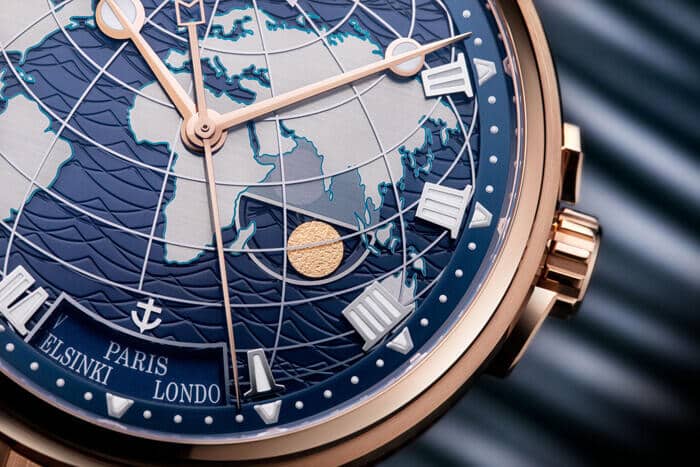
And should you decide you’d like to replace one of the 24 places on the world time disc with your own favourite location, Breguet will happily do this for you.
Calibre 77F1
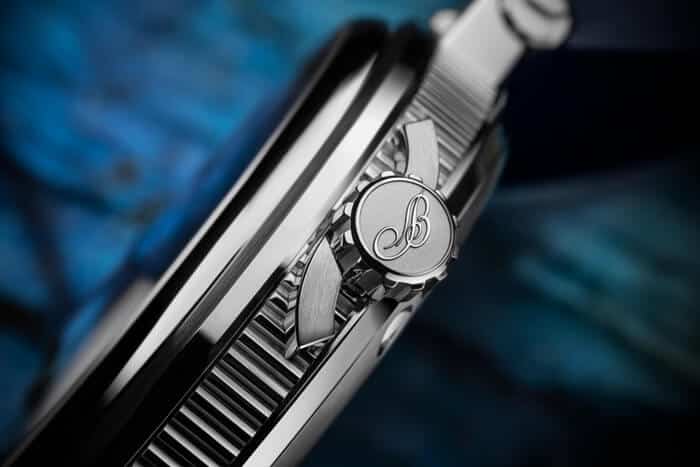
The calibre 77F1 movement, as well as doing all that clever timezone stuff, uses its 384 components to run at 4Hz with 40 jewelled bearings all driven by a decent 55-hour power reserve. The balance wheel has inboard weights (lower air resistance as it spins) and uses a silicon escapement. That means no lubricant to dry out and so minimal wear over time. It’s all powered by an 18ct gold oscillating weight just like the Breguets of old – God the Father was always eager to use gold for self-winding weights because of its mass. We’re not sure if it’s intended to evoke a ship’s wheel, but it certainly looks like it. You’ll see the same motif on the strap fastener. 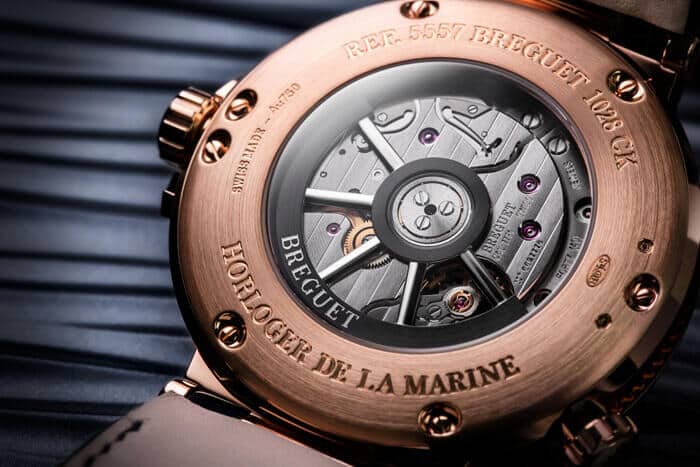
Swiss guilloche main
The dial actually has three layers. They’re made up from the base layer of the two discs carrying the world’s places and the date. This layer also holds the neat date half-moon-on-a-stick indicator that brackets the current date. Breguet has used a brouillage finish for this; an old technique that looks like a far more sophisticated, slightly shinier sandblasting. The next layer is a hand-guilloched plate that carries the day/night circles as well as the deep blue ocean wave background that fills the space between the continents on the final, upper sapphire plate. In case you forget, just next to the bezel are the words “Swiss guilloche main”. This layer carries metallised meridians too and the continents are horizontal satin brushed with metallic turquoise coastlines. The night and day indicators, a moon and sun, are both hand-finished to give them texture. The sun is made from rose gold with the moon contrasting in a silvered rhodium-plate. The level of craft involved in just the hand-finishing alone is mind-boggling. Breguet says, unsurprisingly and with some understatement, that it takes ‘several weeks of work’. I’m not surprised – you can even see Madagascar off the southeastern coast of Africa.

You’ll be able to see the dial just as well at night. The hour and minute hands, as well as the hour markers, have a coating of lume. Handy when the cabin crew turn the lights down in First.

The 43.9mm diameter case (just shy of 14mm thick) is offered in a choice of white or rose gold along with a leather strap, a rubber strap (fitting as the watch has a useful 100m of water resistance) and a white or rose gold bracelet. The case back is held on with seven recessed screws, so no shearing on the gasket by twisting it on. The crown screws down. That 100m water resistance rating reminds you that this isn’t just a dress watch but a practical sports watch you can wear without worrying – at least in theory. One can’t imagine too many owners taking it on the tennis court or into the pool though.
 Abraham-Louis Breguet
This is a typically Breguet variation on the theme of a world timer. Other firms do it very well in their own way and, typically, the L’Orient makers have chosen their own path. Again, typically, they’ve decided to produce a world timer that appears simple from the outside but uses traditional techniques inside the case in a very different way. The Breguet Marine Hora Mundi 5557 is a significant evolution of earlier Breguet world timers and one can believe Abraham-Louis himself would be heartily impressed.
Further reading
Technical specifications
- Model: Breguet Marine Hora Mundi 5557
- Reference: 5557BR/YS/5WV and 5557BB/YS/5WV
- Case: white gold or rose gold; diameter 43.9 mm; height 13.80 mm; water resistance 10ATM (100m); sapphire crystal to the front and exhibition case back.
- Functions: hours; minutes; seconds; calendar; dual time zone; day/night indicator
- Movement: Calibre 77F1; self-winding movement; frequency 28,800 vph (4Hz); power reserve 55 hours.
- Strap: leather strap, rubber strap and gold bracelet. Triple-blade folding clasp
- Price: £63,200 (strap) or £82,700 (gold bracelet) (RRP as at 7.5.2022)