
Delma Continental Pulsometer Watch Review
The Delma Continental Pulsometer is endued with a bicompax chronograph and features tachymeter, telemeter and pulsometer scales. Mark McArthur-Christie, a man with a nose for a decent chronograph, shares his thoughts on this latest creation from the Lengnau-based brand.

Smartwatches
Although The Boss and I agree on most things – the importance of dogs, a good pub, proper whisk(e)y and a dislike of snobbery in all its forms – we disagree about quartz. I’m a huge quartz fan with a particular and slightly guilty love of early digitals. The Boss has significantly better taste than me and is not. So if quartz is beyond the pale, my recent purchase of a smartwatch will almost certainly result in an interview without coffee.
In mitigation, I had a bit of a heart thing and wanted to keep an eye on my own balance’s beat error. That said, after less than a week it’s now firmly back in its box and heading home to its maker. I may be a quartz watch nerd, but smartwatches are, in my opinion, misnamed. They’re not watches; they’re very clever computers you wear on your wrist. And that’s the problem.
Wearing a smartwatch is the equivalent of being handcuffed to one of those public health people on the radio lecturing you about the evil of currant buns. You’ve been sitting still for too long reading – get up and run about. You haven’t climbed enough stairs – go and find some. You have an email – chop-chop, answer it! Why haven’t you drunk more water? Apparently, Wadsworth 6X doesn’t count.
Delma Continental Pulsometer
I should have just bought one of these – a Delma Continental Pulsometer. It would have just got on with the job quietly, unobtrusively and wouldn’t have behaved like a sort of electronic Jiminy Cricket.
Pulsometer
Given that one’s heart is quite important, it’s not surprising that pulsometers have been around a while. The first were developed in the early eighteenth century and were really proto-chronographs. They were also very much hands-on. Rather than pushing a button to start and stop an independent second hand you pushed a lever that started and stopped the whole movement. You’d then work out how many beats per minute your patient’s heart was managing, ideally before you elevated it with your bill.
At this point in watchmaking history, most watches didn’t even bother with a second hand at all, simply because they weren’t accurate enough to need one. Error was often measured in minutes per day. A watch that could count your pulse was serious technology. It still didn’t nag you about how many pies you’d eaten, mind.

Sphygmograph
If your practice’s bank balance couldn’t run to a pulsometer, you could measure your patient’s heart rate with a gadget called a “sphygmograph”. The best medics made sure they had one in their bag along with a few leeches and a lancet for a little light blood-letting. The name comes – as usual – from Greek; sphygmos means ‘pulse’ and graphein is ‘to write’ – a sphygmograph would literally draw your heartbeat. Neat, given that’s how early chronographs worked too.
When commercially-available pulsometer watches emerged in the early twentieth century, they were standard three-handers with a scale around their rehauts. Doc would watch the second hand while he counted your heartbeat and measure the beats-per-minute from the scale. Once wrist chronographs became mainstream and cost less than the price of a small house, you could simply use the start/stop pusher that worked the chronograph hand (no need to stop the whole movement anymore), so you didn’t have to make polite small talk as you waited for the second hand to come round to 12 before you took a pulse.
Delma Continental Pulsometer – Sellita SW510
This Delma uses cutting-edge, nag-free twentieth-century technology and is all the more lovable for it. It runs a Sellita SW510 automatic chronograph movement (with a date too) that ticks along at 28,800 beats per hour for 48 hours without bother. Although launched in 2017, the SW510 evolved from the manual-wind, 17-jewel Venus cal.188 from the late 1940s. Modern materials and engineering make it a very different animal today.
It’s an Audi A4 Avant of a movement – it doesn’t get prizes for looks, style or pizzazz but it will get you where you want to go with absolutely no fuss and do it reliably for years. Rather than a column wheel, the SW510 uses a cam and lever to actuate and control the chronograph mechanism. Again, some people will mither about this but in the real world, a cam and lever are just as useful. This incarnation of the Sellita is decorated, with a customised Delma winding rotor.

Tachymeter
In terms of functions, it won’t read your email for you, tell you your altitude or how many calories you’ve burned, but it will give you hours, minutes, seconds and chrono seconds. And you can use the latter in conjunction with the tachymeter scale on the rehaut as well as the telemeter and pulsometer around the edge of the dial. All far more useful and not one of them will give you a lecture about anything.

Telemeter
A pulsometer does what it says on the tin, a tachymeter measures how many things you can produce per minute for the length of time you’ve measured (or how many miles or kilometres you’d cover in the same time). A telemeter is a bit of a rarer thing. These started life on military watches and were used for measuring your distance from an event you can see first, then hear – like an artillery shell bursting. You can use it to work out how far away a storm is, too.
All of this cleverness is no use at all unless your watch’s dial is easy to read. The Delma scores here both in terms of placement and colour. With the tachymeter on the rehaut, that leaves space for the telemeter and pulsometer on the edge of the dial. Here, Delma has differentiated them by putting the telemeter in black and, rather appropriately, the pulsometer in red. The last scale – running just inside the pulsometer scale – is the minute/second/fifths scale. OK, if you’re of a certain age with the corresponding eyesight and look at Navitimers with horror, you’ll need your specs but otherwise the Delma is simple to read all-round.
Bicompax chronograph
The thirty-minute counter and running seconds – at 3 and 9 respectively – are equally easy to see, although silver hands on a silver dial need the help of the circular graining on the subdials to stand out. The central chrono seconds, being red, is a snap to see even at a quick glance and links with the pulsometer scale. Choose the black dial model and everything becomes even easier. Super-LumiNova infill on the hands and hour markers makes it easy to tell the time (although not used for the chrono functions) in the dark.

Well-screwed together
Then there’s the case. Delma has something of a tradition of building defence-spec cases. Drop one of their Blue Shark models on your foot and you’ll know why. The standard Continental weighs in at nearly a quarter of a kilo, so it feels less well-screwed together and more well-hewn from billet. This Continental Pulsometer is no different. It’s a decent 42 mm and cut from stainless steel with polished and brushed surfaces. The screw-down crown helps the 100m/330ft water resistance rating and this is a chunk of steel that’d double as a submarine engine mount without too much worry. There’s a domed sapphire crystal and a display caseback too.
Opt for the bracelet
You get two options to keep it on your wrist – a brushed and polished (like the case) 7-link bracelet with a neat pusher-controlled butterfly clasp, or a black or slate grey handmade Italian leather strap with white stitching. The watch’s character changes quite dramatically depending on your choice – it seems much more modern on the bracelet. But as the bracelet models are only £50 more (and they’re so well-finished they rather call into question the bracelets on some much more expensive watches), why not buy one of those and choose a strap later?
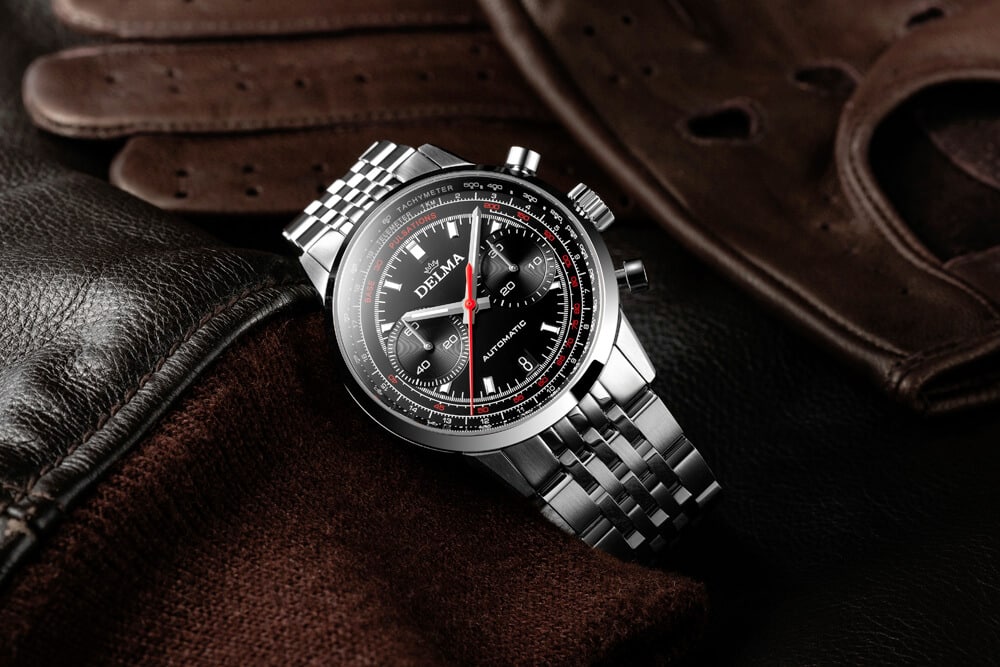
A watch incapable of nagging you or lecturing
Everything turns up in a smart, polished wooden box with brass hinges. Properly traditional. You won’t get a little sticker with a piece of fruit on it, a charging cable and all the bother that goes with it or a guilty conscience either.
So here’s a watch that’ll do plenty of things a smartwatch will do but, crucially, is utterly incapable of nagging you or lecturing you about how many steps you’ve not taken. You won’t need to upgrade this one to the newest model in six months, either. All it’ll need is a service in about five years’ time – which with the Sellita movement should be a cinch. I know which one I should have opted for. After all, shouldn’t you be in control of your watch, not the other way around?
Further reading
Technical specifications
- Model: Delma Continental Pulsometer
- Reference: 41701.702.6.038 (black dial/bracelet), 41701.702.6.039 (black dial/leather strap), 41701.702.6.068 (silver dial/bracelet), 41701.702.6.069 (silver dial/strap)
- Case: stainless steel; diameter 42 mm, height 15.2 mm, water resistance 10 ATM (100 metres), sapphire crystal to front, solid case back.
- Functions: hours, minutes, small seconds, date, chronograph, pulsometer, telemeter, tachymeter
- Movement: Sellita SW 510, automatic movement, frequency 28,800 vph (4 Hz), 27 jewels, power reserve 48 hours.
- Price: £2350 on strap / £2400 on bracelet (RRP as of 7.3.2023)