
NOMOS Glashütte Tangente Watch Review
The NOMOS Glashütte Tangente is over 30 years old. Since the inaugural model was unveiled in 1992, the German marque has released differently hued dials, an array of case sizes and various movements some of which feature complications. However, while NOMOS Glashütte has been prolific, creating numerous new models, every iteration of the Tangente stays true to the original watch of 1992. Angus Davies tells the story of the Tangente and enjoys a hands-on experience with the latest version of the watch, the Tangente neomatik blue gold.

NOMOS Glashütte seit 1990
In 1992, I married the girl of my dreams. Looking back at my wedding pictures, I was fresh-faced and relatively slim. Today, I’m a balding fiftysomething with a ‘dad bod’ and numerous concertina-like lines beneath my eyes.
Also in 1992, in Glashütte, a town in Saxony, some 950 miles from where I got wed, a fledgling watch brand released four new watches. This quartet, namely the Ludwig, Orion, Tangente and Tetra, continues to remain popular today, especially the Tangente which is the firm’s bestselling collection. Despite the passage of time, the Tangente remains fresh-faced with a slim torso. Indeed, when I contrast my wedding photos with the appearance of the Tangente, it is clear to see that time has been much kinder to the German thirtysomething.

Image – Copyright: NOMOS Glashütte
Although 1992 was the year that NOMOS Glashütte burst onto the watch scene, the story of the brand actually began in 1990. Just two months after the fall of the Berlin Wall, Roland Schwertner established his company in Glashütte, a town that was formerly part of the German Democratic Republic (GDR).
Ferdinand Adolph Lange
Glashütte has a proud history of making mechanical watches dating back to 1845 when Ferdinand Adolph Lange opened his Manufactory with 15 apprentices. With the demise of communism, the German town, set in the Ore Mountains, has enjoyed a horological renaissance with several brands rekindling operations in Glashütte. Today, there are a total of nine brands operating in the small town that is widely considered the epicentre of German watchmaking.
Design
So, what is the secret to the Tangente’s ageless beauty? Allow me to elaborate.
Bauhaus Watch
Throughout its history, NOMOS has looked at three doctrines of design, namely Bauhaus, Deutsche Werkbund and the Ulm School. All three design influences are German in origin, but each has its own characteristics (see my article on the Ludwig Neomatik 41 Date Ref 262 for more details).
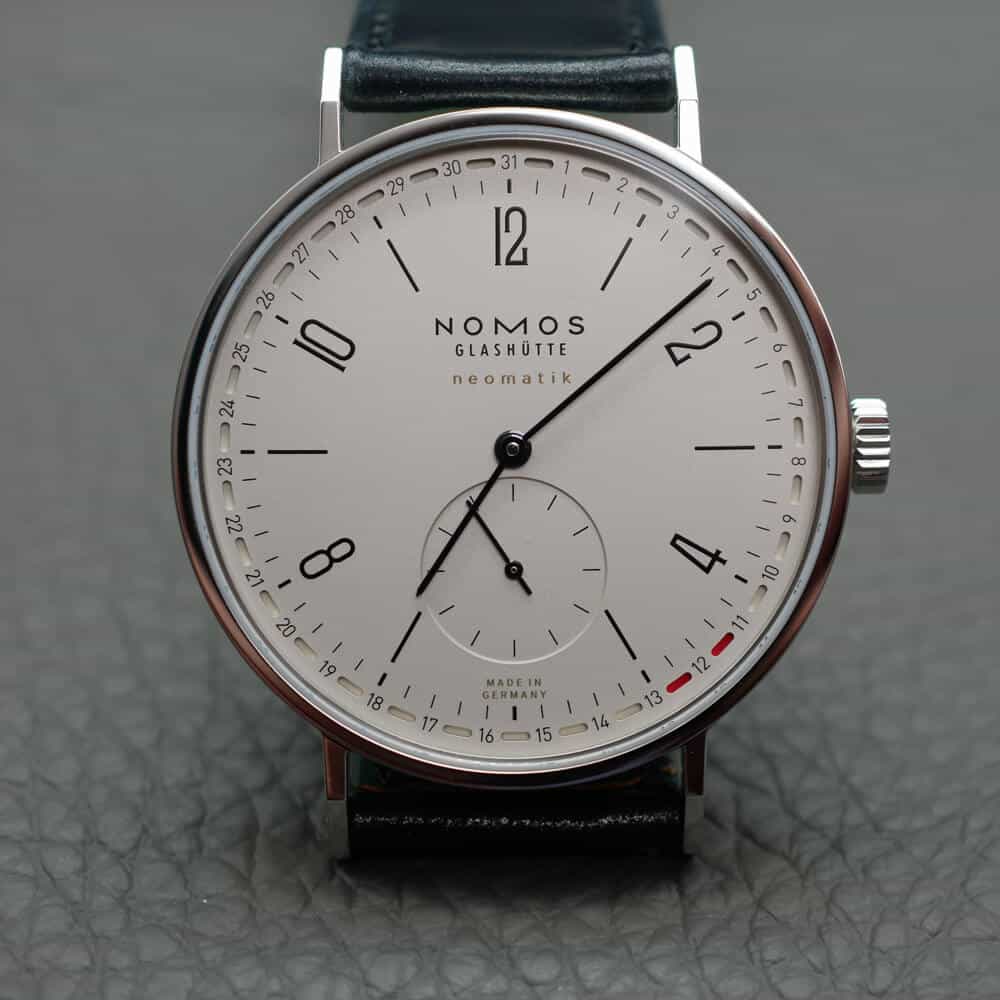
The resultant styling of the first Tangente, measuring a comparatively modest 35mm in diameter, embraced minimalism. The hour and minute hands were thermally blued and supremely slender, a characteristic that would be repeated throughout the composition. Arabic numerals, Bauhaus-inspired, were used to denote even-numbered hours. The odd-numbered hour markers were simple batons, elongated and slim. A recessed small seconds display was positioned at 6 o’clock and featured softly-spoken snailing. Nothing was superfluous. ‘Clean’ and ‘intelligible’ were the order of the day.
This simplicity extended to the case with its two-part construction and slender bezel. Cylindrical in form and with straight flanks, the case did not subscribe to the oversized look that was popular at the time. Another defining characteristic of the Tangente was its slim, angular and elongated lugs. When worn, the lugs made the watch appear larger than the stated dimensions would suggest.

NOMOS Tangente Reference 139
Fast forward to the present-day, the Tangente Reference 101 and Reference 139 look identical to their 1992 antecedent. Indeed, place both watches side by side and only their mother could tell them apart. Both are housed in a highly polished 35mm steel case. The Reference 101 is fitted with a solid caseback, providing a suitable canvas for a hand-engraved message. The Reference 139 features a sapphire caseback, affording sight of the hand-wound movement within. Personally, I recommend scraping together a few extra pfennigs and opting for the dorsal glazing; the sight of seeing the beautiful movement justifies the additional expense.

Alpha Calibre
The original Tangente of 1992 was equipped with an ETA movement, however, in 2005, NOMOS signalled to the watchworld its ambition when it released its first in-house movement, the hand-wound Alpha calibre. This movement continues to be used on several NOMOS models, including the Reference 101 and Reference 139 models. As I will explain later, NOMOS’s desire for independence has led to the firm creating 11 in-house movements to date, six hand wound and five automatic.

Berlinerblau
Berlinerblau, a wholly-owned subsidiary of the German watch brand, is a creative agency located in Germany’s capital and is dedicated to the design and branding of NOMOS watches. Considering the Tangente Reference 139 looks identical to its forebear from 1992, some NOMOS newbies may question what actually takes place in the company’s studios.

Image – Copyright: NOMOS Glashütte
However, visit the NOMOS website and you will discover that the firm has been prolific over the years, conceiving new models encompassing different colours, textures, sizes, movements and complications. I’ve visited Berlinerblau on a number of occasions and always enjoy looking at the drawings, moodboards and numerous Pantone swatch samples. Located in Kreuzberg, a district of Berlin that was formerly in the East, the area buzzes with creativity in many forms and vitality is omnipresent.

Image – Copyright: NOMOS Glashütte
The creation of new NOMOS models is a joint effort, drawing on the design talents of Berliner Blau and the watchmaking expertise of the Glashütte Manufactory. It’s a method of working that has delivered some incredible watches over the years and has led to the watch brand receiving ‘more than 160 prizes for good design, watchmaking craft and sustainability’.
Swing System (2014)
An important constituent of the NOMOS paradigm is the need to be independent. As I previously mentioned, the company produced its first in-house movement in 2005. However, for many years, like most watch companies, NOMOS sourced its escapements and regulating organs from a specialist company based in Switzerland.

Image – Copyright: NOMOS Glashütte
Therefore, eager to be less dependent on third parties, the German company embarked on a seven-year research and development programme. This culminated in the brand unveiling its ‘Swing System’, the term NOMOS uses to describe its escapement and regulating organ, in 2014. This was a huge financial undertaking costing the company €11M.
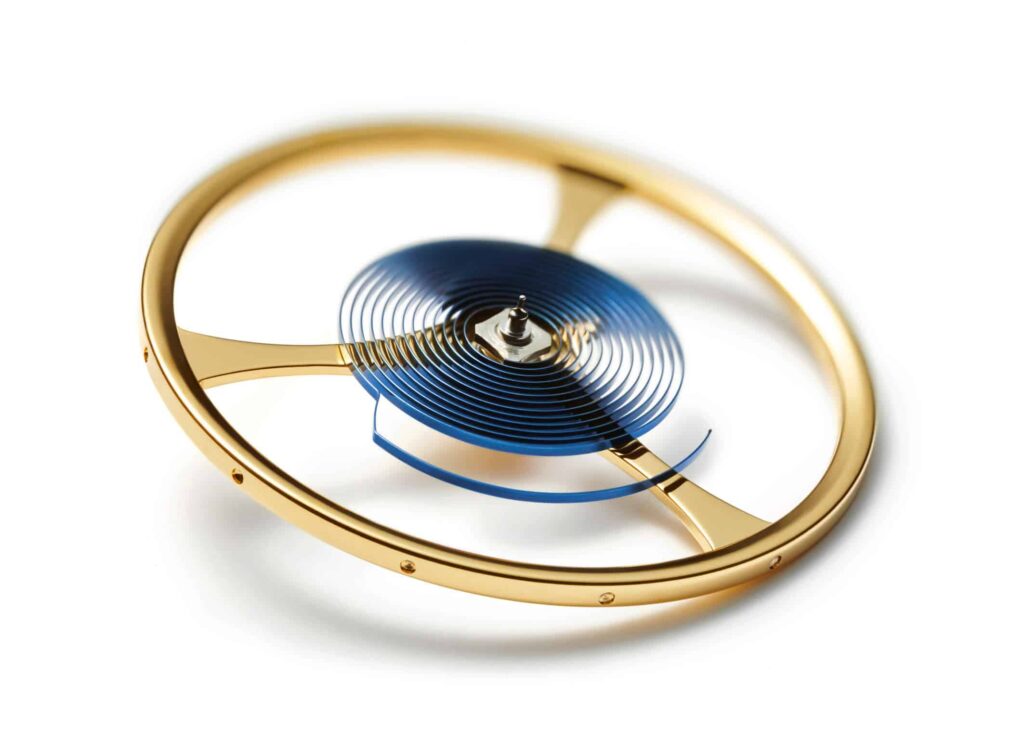
Image – Copyright: NOMOS Glashütte
For the Swing System to be viable, each minuscule component has to work in harmony in order to deliver precision and reliability. Arguably the most technically challenging part to make is the hairspring. An alloy wire (the composition is a closely guarded secret) is carefully stretched over a series of rollers, a process that takes several days. The diameter of this wire is reduced by passing it through a series of dies while ensuring its cross-section remains uniform. Ultimately, the wire is cut into blades, coiled, heated and cooled. The precise details of the operation, including cooking temperatures and times, are confidential. However, to provide some context, the tolerances involved in making hairsprings are measured in nanometres (1,000,000 nanometres = 1mm).
By surmounting the various challenges in making its Swing System, NOMOS is immune from potential supply issues that may potentially afflict other companies.
Neomatik (2015)
The following year (2015), NOMOS stunned the watch-collecting community when it released its inaugural Neomatik movement, the Calibre DUW 3001.
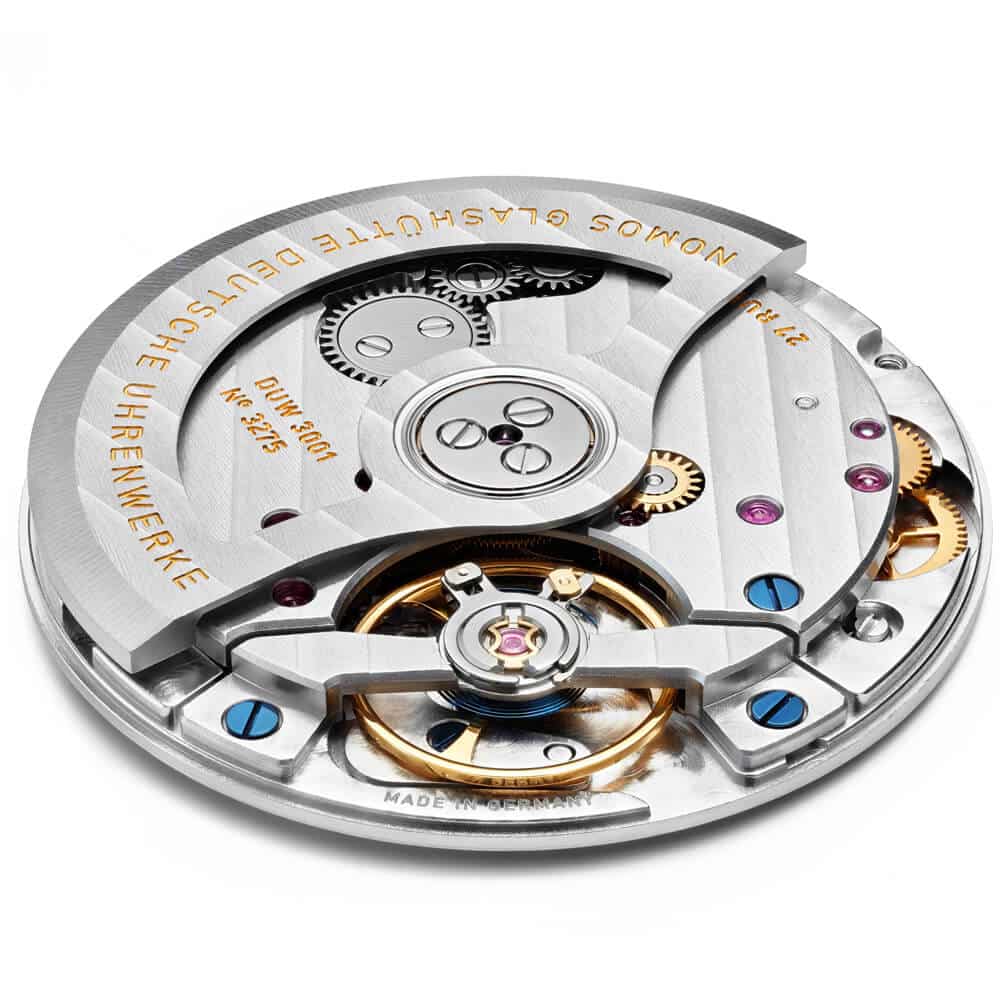
Image – Copyright: NOMOS Glashütte
Calibre DUW 3001
Usually, an automatic movement is thicker than a hand-wound movement due to the additional bulk of the oscillating weight sat atop the bridges or three-quarter plate. However, the Calibre DUW 3001, a self-winding movement, is only 0.6mm thicker than the Calibre Alpha and remains thinner than many hand-wound movements from rival brands.
Gear train efficiency
So, how did NOMOS create its groundbreaking automatic movement? In several ways, but most notably by revisiting the gear train. NOMOS identified that with most watches, the transfer of energy from the barrel to the escapement is not very efficient with sometimes only 80% of the power from the barrel reaching the escapement. The company looked at each wheel within the gear train and reviewed the order, angle and number of teeth. By optimising the design of the gear train, the firm achieved an efficiency of 94.8%. This allowed NOMOS to reduce the size of the mainspring, making the movement less bulky while at the same time delivering a power reserve of up to 43 hours.
Calibre DUW 6101
A few years later, in 2018, the brand released the Calibre DUW 6101, another slender automatic movement. On this occasion, the date disc is positioned right at the edge of the movement, allowing the firm to present date values in large format.
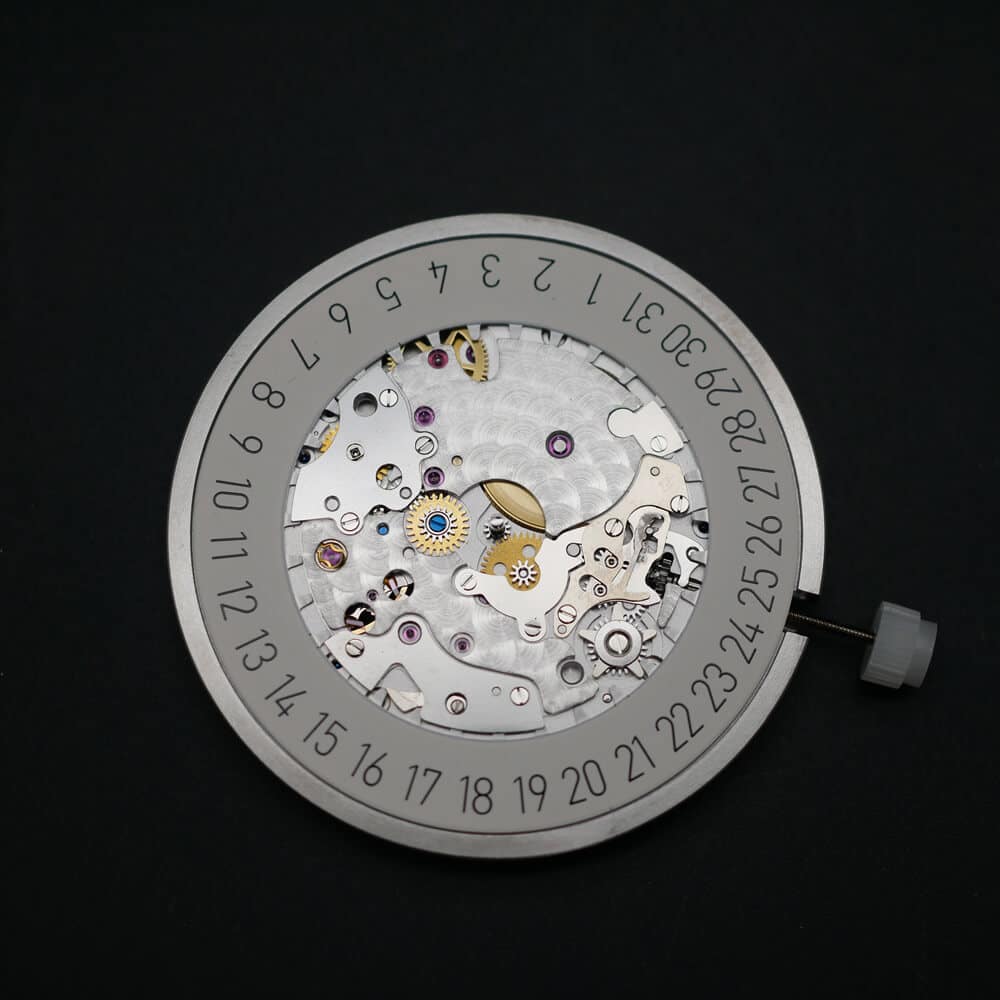
The movement also incorporates two safety features. Firstly, the wearer can rotate the crown in either direction without fear of harming the movement. Secondly, on most watches fitted with a date display, there is a window when the date should not be adjusted (typically between 2000 hours – 0030 hours). With the Calibre DUW 6101, the window when the date must not be adjusted is just 90 minutes.

NOMOS Glashütte Tangente 41 Update
Interestingly, while the Calibre DUW 6101 has the capacity to display the date in a widescreen format, the Tangente 41 Update, arguably the most innovative watch to house the movement, eschewed customary numerals. Instead, it presents the prevailing date is framed with two lozenge-shaped markings. Unusual, but intelligible; the model was immediately a hit and went on to win the GPHG ‘Challenge Watch Prize’ in 2018.

Great design does not need revisiting
While NOMOS has released numerous versions of the Tangente over the last 30 years, the foundations were put in place back in 1992 and the model’s styling continues to prevail. The Bauhaus-inspired hour makers, the slender hour and minute hands, the small seconds display at 6 o’clock, the slender bezel, the cylindrical case and the elongated lugs have never changed.
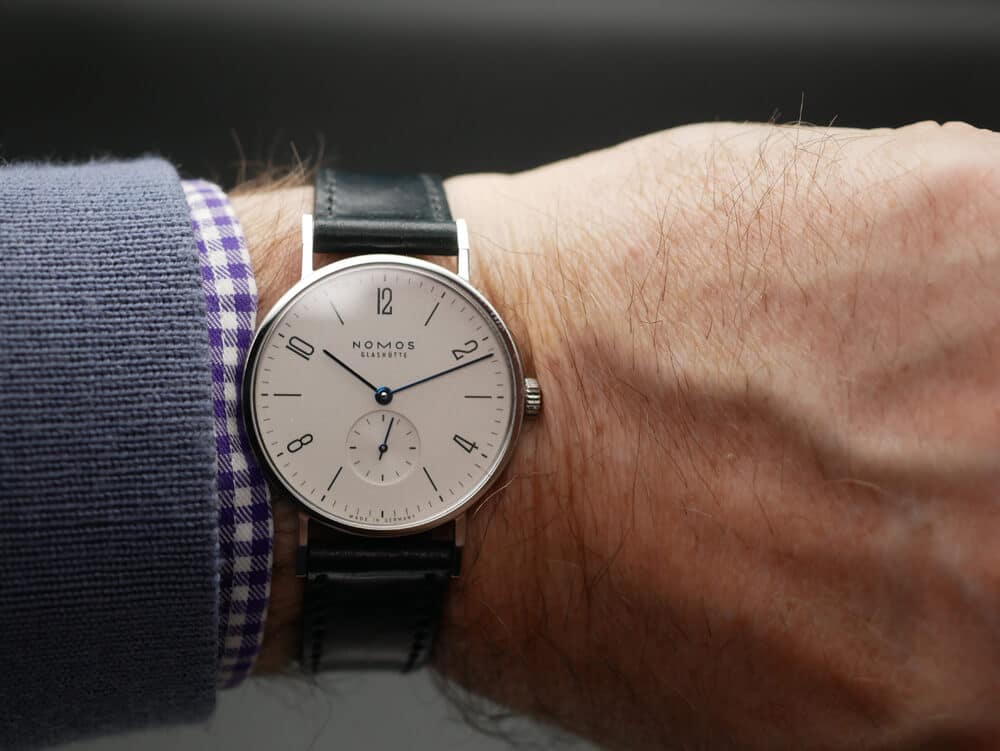
Stand back and appraise the Tangente, what could be added or taken away without diminishing its cohesive and elegant appearance or, worse still, corrupting its timeless charm? Nothing, the Tangente is an exemplar of great design.
NOMOS Glashütte Tangente neomatik platinum gray (2022)
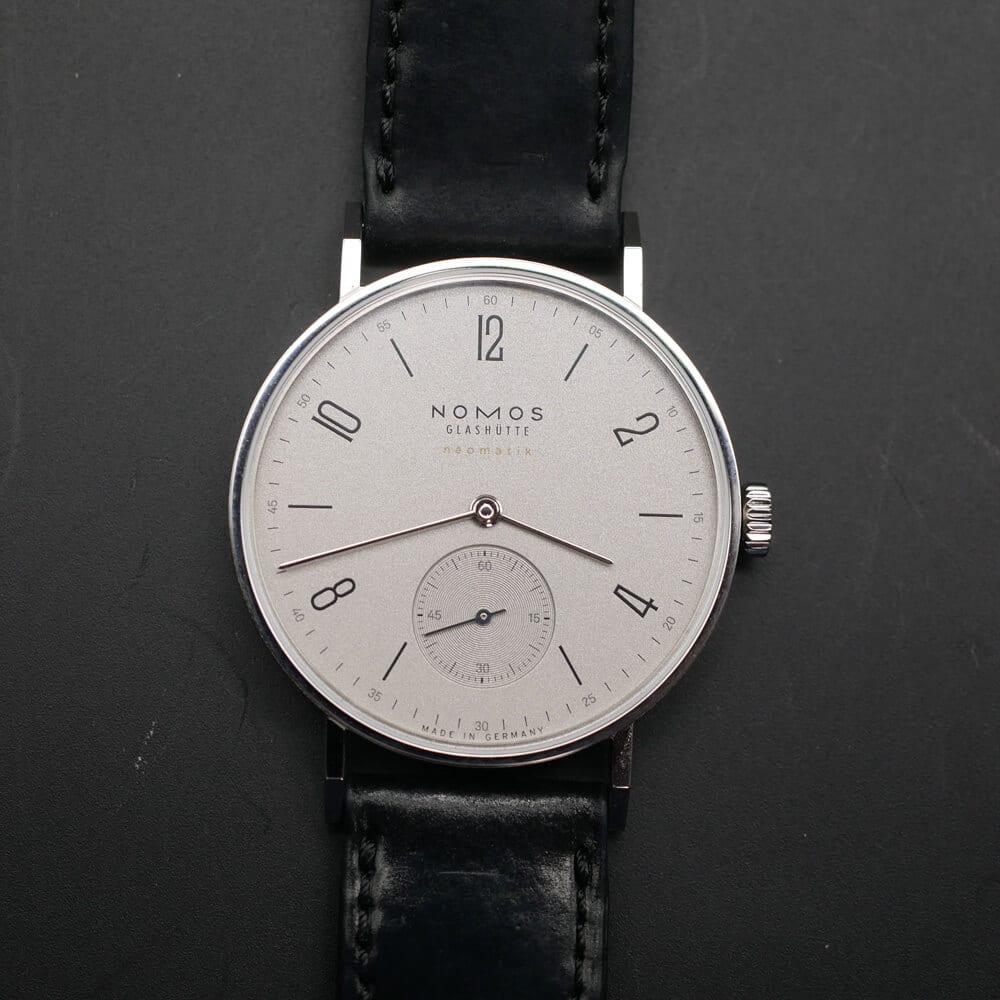
Last year (2022), NOMOS unveiled the Tangente neomatik platinum gray (US-English spelling). Examine the model at close quarters and everything appears the same as the 1992 model, save for its movement and the colour of the dial which is presented in a rhodium finish (one of the six platinum group metals). The Calibre DUW 3001 sits at the heart of the watch and the model is offered in 35mm and 39mm options, available with or without a sapphire caseback. However, while the Tangente neomatik platinum gray is comparatively new, it remains reassuringly familiar.
NOMOS Glashütte Tangente neomatik blue gold (2023)
This year, the teams in Berlin and Glashütte have conceived a new expression of Tangente ownership, the neomatik blue gold. Essentially, its identical to the platinum gray, apart from the dial’s blue complexion. And what a dial it is!
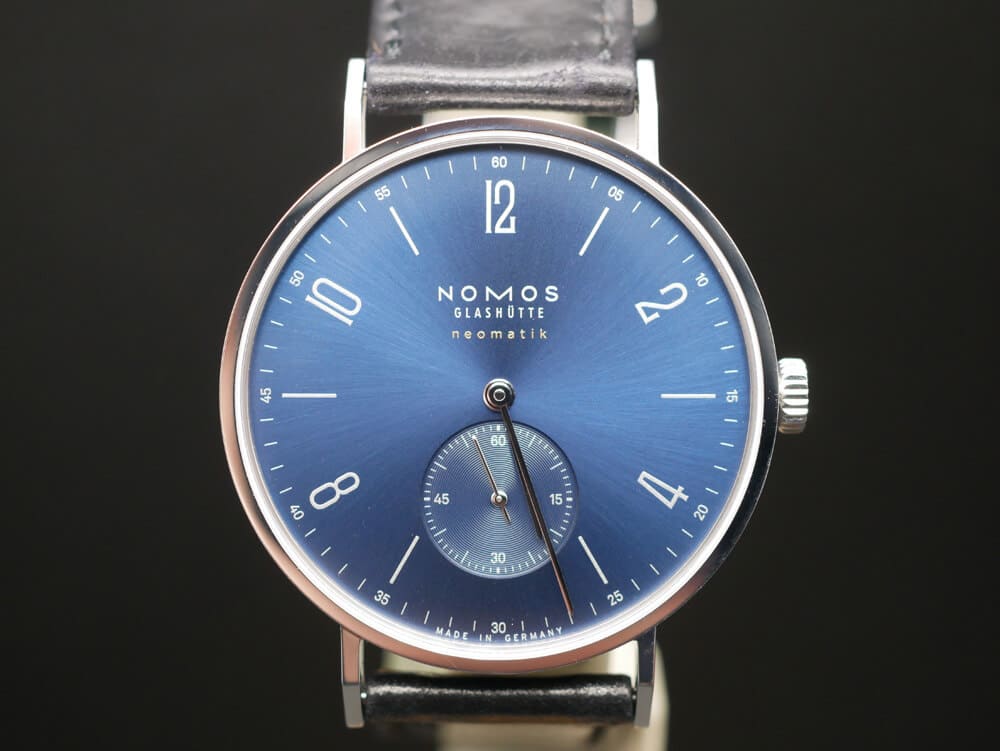
The name alludes to the process of making the dial. Initially, the dial is gold-plated before being galvanised and subsequently polished to impart a sunburst finish. The dial evinces a rich blue tone that flirts with light, creating contrasting areas of brilliance and shade. Unlike other Tangente models, the small seconds display at 6 o’clock appears much darker than the main dial plane. However, close examination reveals it is actually the same colour; the tonal contrast is merely an optical illusion.
Closing remarks
A multiple prize-winner, the Tangente’s styling has stayed true to the original blueprint, masterminded over 30 years ago. However, with greatness comes responsibility. The creative minds at Berliner Blau will be fully aware that they are custodians of the Tangente’s appearance and to date they have done an excellent job.
The Tangente has a great history and based on the evidence a very bright future.