
Delma 1924 Tourbillon (Part Two) Watch Review
Produced as part of the company’s centenary celebrations, the Delma 1924 Tourbillon incorporates the eponymous, ultra-desirable high-complication. In this second instalment of his two-part feature, Angus looks at the specification of the hand-wound movement, the Calibre DT100.01, before concluding with his thoughts.

Swiss-Made mechanical movements
Throughout its history, Delma has always been very honest, freely disclosing it procures Swiss movements from specialist firms including Landeron, ETA and Sellita. When selecting a suitable movement for the new Delma 1924 Tourbillon, the family-run firm was insistent that the calibre within the watch had to be Swiss.
Delma approached Olivier Mory of BCP Tourbillons, a man with much experience producing this genre of movement. Based in La Chaux-de-Fonds, the watchmaking capital of Switzerland, Mory works with several local industry experts. For example, Olivier works with Atokalpa, one of the leading producers of escapements and regulating organs, a firm trusted by some of the most prestigious watch brands in the world.

100% Swiss-made mechanical tourbillon
Considering the relatively keen price of the Delma 1924 Tourbillon, it wouldn’t have been unreasonable if the brand had looked overseas in its quest to create a low-cost model endowed with a tourbillon escapement. However, as previously stated, the Swiss watch brand was unwilling to countenance such an idea.
‘To be marked Swiss made, a watch has to meet the requirement of a minimum of 60% Swiss value’. The movement within the Delma 1924 Tourbillon, the Calibre DT100.01, is 100% Swiss.
The world of commerce is becoming more transparent. For example, an increasing number of supermarkets now declare the origin of their products, even specifying the name of the farm supplying the meat, fruit, etc. Likewise, with its Calibre DT100.01, Delma has also been very transparent, openly sharing the source of each component. The list of suppliers is shown below:
- Movement finishing – Ora Temps, Delémont and CV Décor, Le Locle
- Geartrain – Gimmel Rouages, Villiers
- Escapement and regulating organ – Atokalpa, Alle
- Transmission and mechanism – Tavadec, Tavannes
- Screws and shock absorber- KIF Parechoc, Le Brassus
- Barrel – Générale Ressorts, Bienne
Now, let’s look more closely at the specification of the Calibre DT100.01.

Variable-inertia balance
The Calibre DT100.01 is equipped with a variable-inertia balance, providing a wonderful dose of horological loveliness.
Most watches are equipped with an index-regulated balance (raquette) where the balance spring passes through two curb pins fitted to the raquette. By moving the raquette towards or away from the stud, the effective length of the hairspring alters, making the watch run faster or slower.

Image – Calibre DT100.01 tourbillon escapement
With a variable-inertia balance, the effective length of the hairspring is fixed. The rate is altered by adjusting inertia weights fixed to the balance wheel. This system confers superior precision. Moreover, should the watch be subjected to a shock, it’s less likely to require remedial regulation.
Traditionally, inertia weights took the form of timing screws set in the rim of the balance wheel (a screwed balance); however, the balance on the Calibre DT100.01 adopts a more contemporary approach. It features C-shaped masselottes positioned on the spokes of the balance wheel. This design mitigates air perturbation, thereby augmenting precision. Another benefit of using the C-shaped masselottes is that when the watch is being regulated, the balance can be adjusted in situ, obviating the need for disassembly and thereby reducing servicing costs.
Mobile stud holder
A Swiss lever escapement features a pallet lever fitted with two pallet jewels that interact with the escape wheel. At the other end of the pallet lever, the pallet fork sits between two banking pins and engages with a pin that impulses the balance wheel.

Image – Calibre DT100.01 escape wheel and pallets
When the balance wheel oscillates to and fro, the magnitude of the clockwise and counterclockwise swing should be the same. Moreover, for the balance to be isochronous, the time taken for the balance wheel to swing in each direction should also be the same.
In reality, there will often be a small difference, termed a ‘beat error’, measured in milliseconds (ms). This will show up when the watch movement is regulated with a Witschi machine. When the movement is devoid of power and the pallet fork is at rest, it should ideally sit dead centre between the banking pins, ie the beat error = 0. If the beat error is significant, the watch will not be precise, hence the balance has to be repositioned.
In common with some of the finest expressions of Haute Horlogerie, the Calibre DT100.01 features a mobile stud holder. This system provides a trained watchmaker with a quick and simple means of repositioning the complete balance and specifically the position of the pallet fork relative to the banking pins. If a movement lacks this feature, it requires the watchmaker to remove the balance and place it on a mount termed a ‘balance tack’ in order to move the collet (the part that unites the balance staff with the balance spring). This latter procedure is more time-consuming; hence the Delma model should help mitigate ongoing service costs.
Shock protection and resistance to magnetic fields
The balance on the Calibre DT100.01 is fitted with a shock absorption system, again supplied by KIF, and the movement is shock-protected up to 5000 G. In addition, the movement comprises non-magnetic components such as the alloy hairspring and Glucydur balance wheel, making the movement capable of withstanding magnetic fields up to 2000 gauss, a rare feat for a tourbillon.
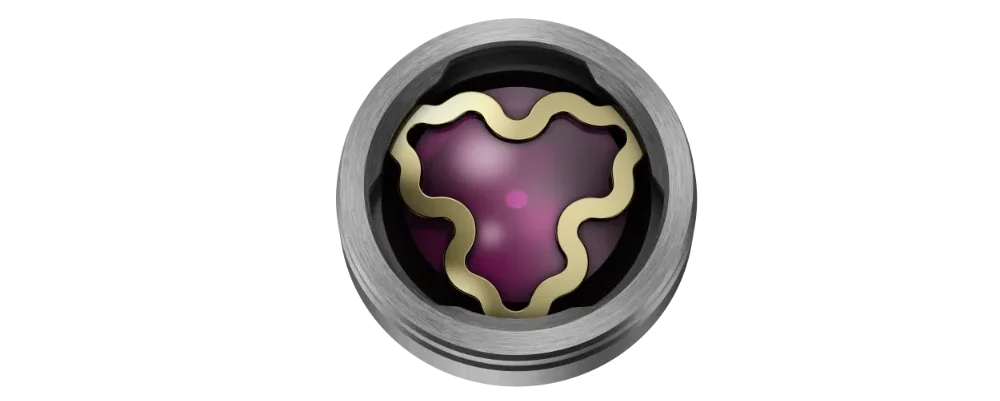
Image – Calibre DT100.01 KIF shock absorber
Calibre DT100.01 – finishing and other details
Calibre DT100.01 – recto
The underside of the baseplate that sits below the dial is decorated with neat rows of perlage. After this motif has been applied, the baseplate (both sides), together with the bridges (verso), are ruthenium treated. In this instance, the treatment is executed in a dark grey finish.
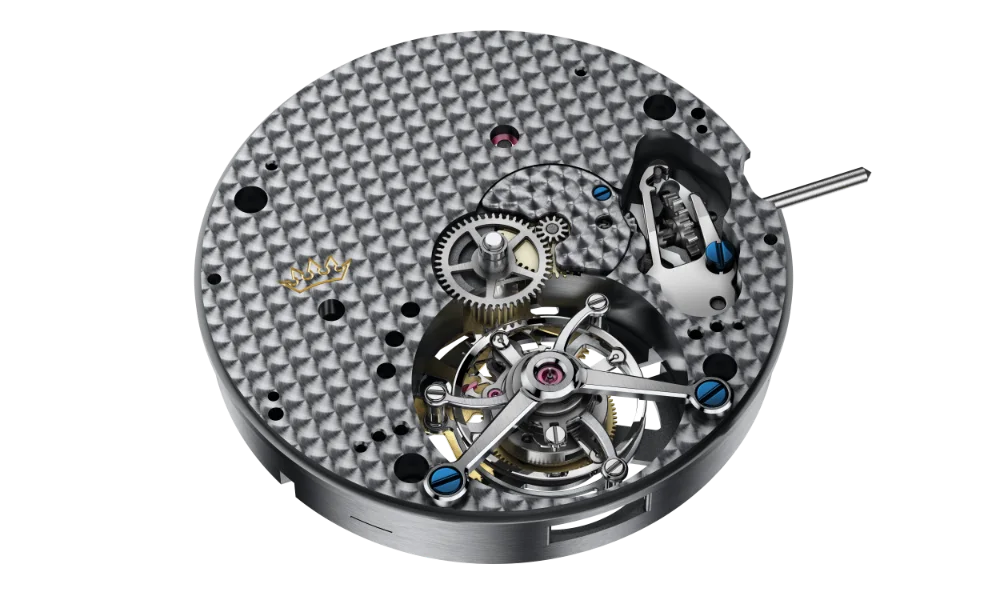
A large dial opening accommodates the tourbillon and, in doing so, affords views not only of the escapement and regulating organ (as previously mentioned in Part One) but also the gear train and motion works. Quite simply, horological voyeurs have never had it so good!
The rhodium-plated tourbillon cage features three slender, curving arms that allow the wearer to see the silver-toned balance and escape wheel. The screws affixed to the arms of the cage as well as the inertia weights/masselottes (see later) are silver-hued complementing the watch’s monochromatic theme.
Calibre DT100.01 – verso
Viewing the movement via the exhibition caseback proves equally stunning. The bridges of the hand-wound movement are embellished with Côtes de Genève motif, while the recess accommodating the ratchet wheel is adorned with perlage.
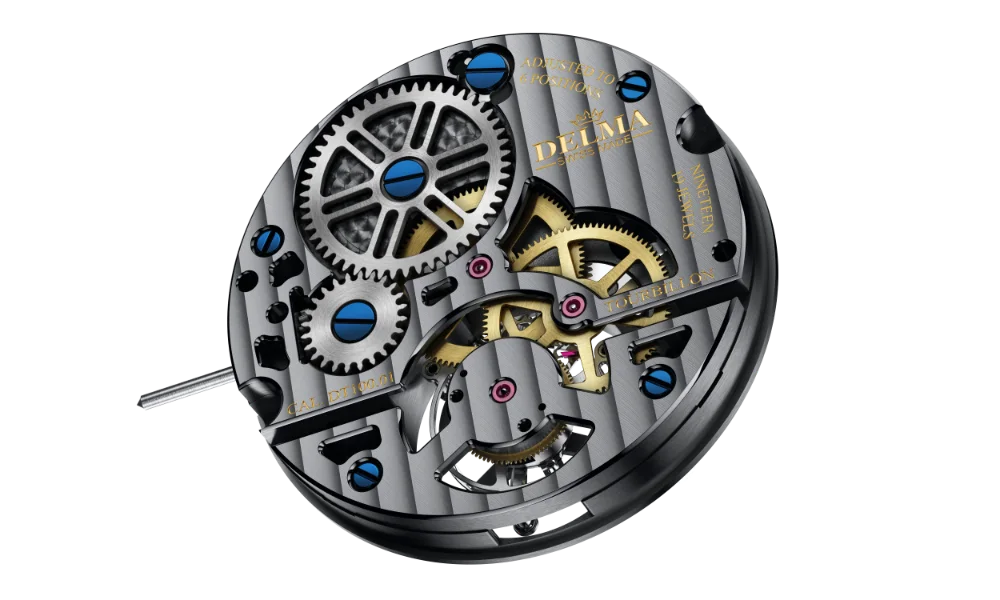
After said forms of decoration have been applied to the bridges, they are also subject to the same ruthenium coating as the baseplate, imbuing the movement with a contemporary character.
Delma has indulged inquisitive wearers with many tantalising views of parts that are typically out of sight. The ratchet wheel is a double spoke design, revealing more of the perlage beneath as well as affording partial sight of the centre wheel. Moreover, additional parts of the gear train are revealed. The Calibre DT100.01 is unquestionably a beautiful movement, enriched with smile-inducing finishing. Indeed, golden text adorns the bridges, blued screws add an additional pop of colour and the bridges are bevelled and polished, attributes that will no doubt resonate with purists.
MCH – movement assembly and regulation
The Calibre DT100.01 is assembled and regulated by MCH, a company operating from the same building as BCP Tourbillons. A movement is often influenced by its relative position; hence it is industry practice to test a calibre in a variety of situations eg 3 o’clock, 6 o’clock, 9 o’clock, dial up, dial down, etc. In the case of the Calibre DT100.01, the movement is regulated and then tested in six positions. Once regulated, the presence of a tourbillon escapement will negate typical variances in rate caused by positional influence. The movements have an average daily rate of -4/+6. While the Calibre DT100.01 is not a certified chronometer, the stated accuracy does compare very favourably.
Delma – watch assembly, regulation and quality controls
Once the movement has been assembled and regulated by MCH, it is sent to Delma in Lengnau where it is checked upon receipt. Thereafter, the movement is housed within the case and the dial is fitted. At this stage, a series of procedures takes place such as water-resistance checks. The Delma 1924 Tourbillon is water resistant to 200 metres.
The cased watch is also tested on a Witschi machine to confirm that the rate variation, amplitude and beat error are within tolerance.
Finally, the bracelet is attached and everything is subject to a thorough visual inspection.

Delma 1924 Tourbillon – closing thoughts
Despite the complexity of the Delma 1924 Tourbillon, the display is simple to read. The dial is free of unnecessary clutter and lucidly imparts the hours, minutes and seconds, while simultaneously indulging the mechanically inquisitive wearer with views of numerous parts in motion, all coming together in a choreographed performance.
The sophisticated case, melding numerous lines, curves and facets, has a handsome appearance. However, this is not a watch that needs mollycoddling, it is shock resistant to 5000 G and resistant to magnetic fields up to 2000 gauss making it ideal for daily wear.

Unquestionably, the pièce de resistance of this watch is its movement, the Calibre DT100.01. Delma could have sourced a low-cost tourbillon from a faraway land, but they have remained true to their Swiss origins and engaged the services of BCP Tourbillons. The resultant movement features the über desirable high-complication, delivering a bewitching spectacle as intricate parts dance to a hypnotic beat. Moreover, beyond this headline-grabbing performance, there are numerous features that aid precision, protect the movement from harm and mitigate service costs.
When considering purchasing a watch equipped with a high-complication, thoughts should not be restricted to the capital outlay alone. A high-performance sports car costs more to run than a small family hatchback. This can be attributed to the costly skills needed to perform the service and the expense of replacement parts. Watches are exactly the same.

BCP Tourbillons has created a movement with due consideration to ongoing servicing. For instance, the ease of adjusting the masselottes fitted to the balance or the ability to address a beat error without removing the regulating organ, helps reduce servicing costs.
The Delma 1924 Tourbillon is an impressive watch. It is the most complicated Delma timepiece to date while at the same time, it perpetuates the brand’s reputation for delivering an impressive quality-price ratio. Moreover, with its accomplished styling and a Swiss movement at its heart, this watch reaffirms why the brand from Lengnau continues to thrive some 100 years after it was founded by the Gilomen brothers.
Further reading
https://www.delmawatches.com/en-gb/collections/1924-tourbillon
Technical specifications
- Model: Delma 1924 Tourbillon
- Reference: 41601.770.6.031
- Case: stainless steel, diameter 41 mm, height 14 mm, water resistance 20 ATM (200 metres); sapphire crystal to the front and rear
- Functions: hours, minutes, tourbillon fitted with small seconds indication
- Movement: Calibre DT100.01, hand-wound movement; frequency 21,600 vph (3 Hz); 19 jewels; power reserve 105 hours
- Strap: steel bracelet and black Italian calf leather strap with white stitching. Fitted with a deployant clasp and quick-release spring bars.
- Price (pre-order): CHF 8,900 / USD 9,900 (orders received between 16.1.2024 – 16.3.2024)
- Price (once released): CHF 12,500 / USD 13,900 (RRP as of 16.3.2024)