
Armin Strom Dual Time GMT Resonance Watch Review
The Armin Strom Dual Time GMT Resonance has been launched to coincide with the Swiss marque’s 15th anniversary. It incorporates the firm’s ingenious take on Janvier’s resonance clock, employing a patented clutch spring system first seen back in November 2016. This new model is presented in a neater 39 mm case but still incorporates the same horological loveliness found on the Manufacture’s larger models. Mark McArthur-Christie shares his observations in his own unique way, while resting in a recumbent position.
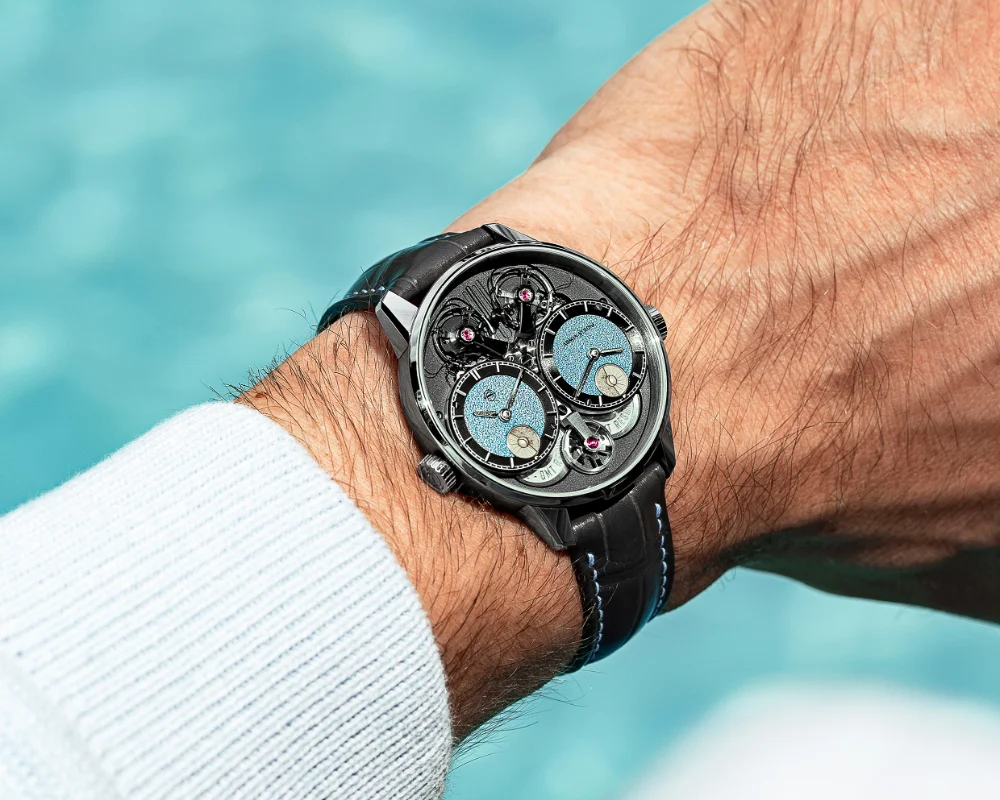
Armin Strom watch
There are benefits to being stuck in bed with a case of the nasties; all too topical this winter with half of Watchworld, including the Escapement team, down with the plague. Scientist and mathematician Christiaan Huygens wasn’t immune to bugs either. So the story goes, he took to his bed ill and, as he was feeling sorry for himself, he spotted the pendulums of two of his clocks, fixed to the same beam, began drifting until they were moving with the same amplitude and period but in opposite directions. Rather than leaping Archimedes-style from his sickbed, he at least waited until he’d recovered to find his clothes and conduct further experiments into this newly discovered phenomenon of resonance.

Antide Janvier (1751-1835)
Huygens was never a practical horologist (he left that to his friend and fellow resident of The Hague, Salomon Coster), but his theories and experiments galvanised Louis XVIII’s clockmaker, Antide Janvier to see if he could replicate them and use them to boost the accuracy of his timepieces as he’d realised that resonance gave stability and resilience to the two in-sync timekeepers. Breguet followed suit and after trying to create resonance in pendulum clocks – one of which, Breguet No. 3177, is still in Le Musée des Arts et Métiers in Paris – he moved on to watches. This – the move from pendulums to balances – is a remarkable feat of watchmaking. Breguet’s watches (Nos. 2667, 2788, and 2794) all use the resonance principle with two balances running their own gear trains. Interestingly, with his three watches, Breguet appears to have experimented with balance positions – two of the watches have their two balances side by side, one has them at 180° opposed.

Armin Strom released the first resonance watch in November 2016
Bringing the concept up to date is this watch from the Biel workshops of Armin Strom. The firm has been busy with resonance since developing its Mirrored Force Resonance watch approximately ten years ago. Claude Greisler, Armin Strom’s co-founder and master watchmaker, pioneered a clutch spring that links the movement’s dual balances directly by acting on the outer terminal curves of both balance springs. As well as linking the balances physically so they’re better able to resonate, the clutch spring also acts as a shock absorber and speeds up synchronisation if one is knocked out of whack.
It’s an example of something appearing seemingly elegant and simple, but in reality, being the opposite. Indeed, to conceive, develop and put a solution like this into production takes some serious watchmaking know-how and, in this case, three years of work.
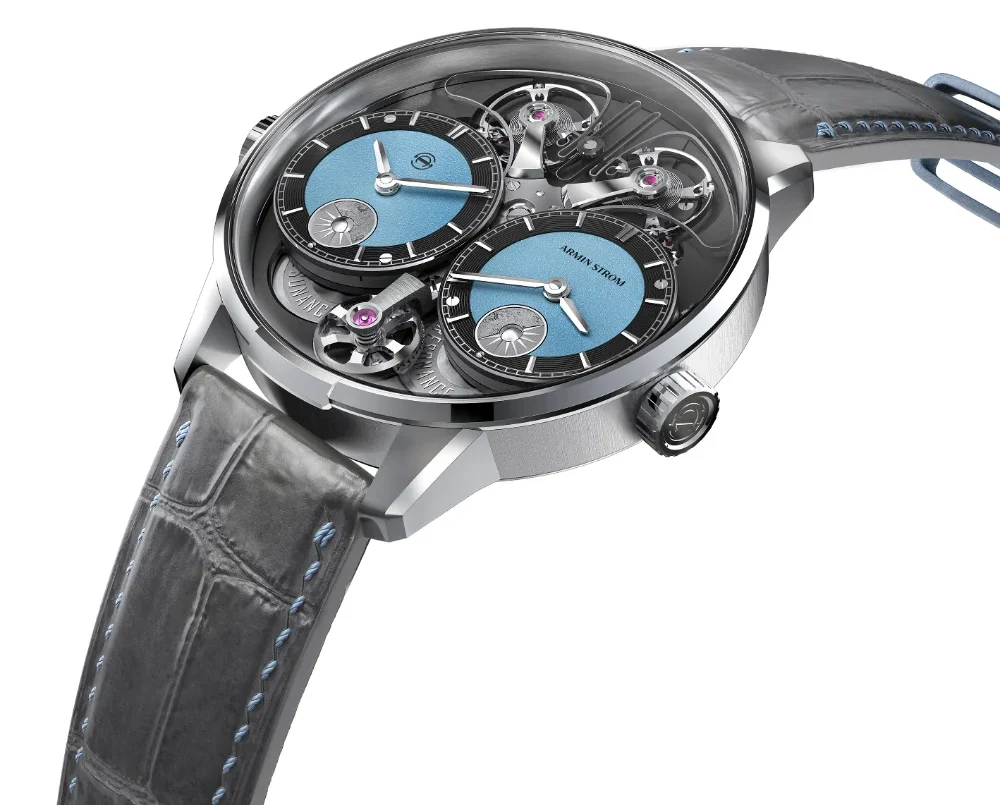
Armin Strom celebrates its 15th anniversary (2024)
This year, in August, the Swiss independent brand celebrated its 15th anniversary. Most people would just have blown up a few balloons and sent out for a cake or two. Not Armin Strom. Instead, the Manufacture has built 25 of these 39 mm cased Dual Time GMT Resonance First Edition watches you see here.
Using a resonance watch with its twin balances and trains as a dual time GMT makes perfect sense, as founder Serge Michel explains:
Having two completely independent watch movements in a single timepiece creates the logical demand for an iteration that displays two time zones. The success of our first Dual Time inspired us to build a smaller and more elegant Dual Time Resonance watch. To do this, we further developed our concept and arranged the two movements vertically. And we couldn’t be happier with the result.”
A watch with essentially two movements in one is also a practical solution to the problem of timezones that aren’t in neat units of hours. Having a conventional GMT watch is fine if you fancy heading for Hong Kong (+8 GMT, seeing as you asked), but what about Eucla in Western Australia? OK, it’s a strange example and, unless you’re a fan of telegraphic history you’ve probably not even heard of it, but should you fancy a visit to the remains of Eucla’s old telegraph station, you’ll need to set your watch +8.45 GMT. Good luck doing that with a standard GMT third hand; however, it’s a cinch with this new Armin Strom.
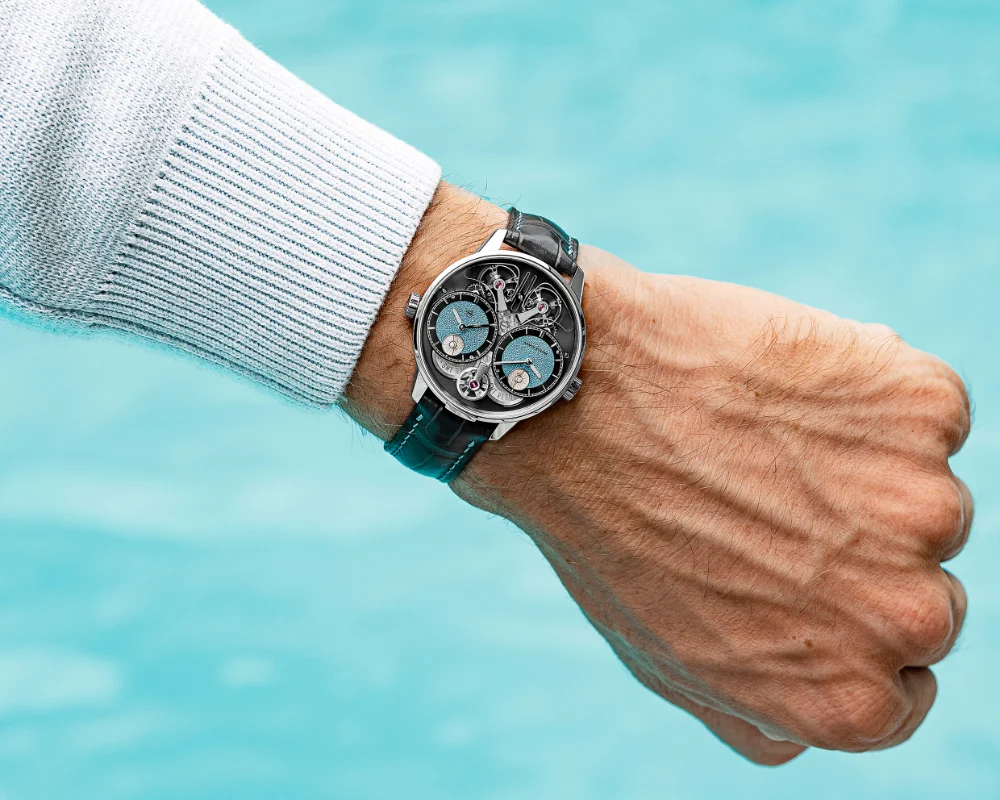
Armin Strom manufacture Caliber ARF22
The Dual Time GMT Resonance First Edition is the first outing for the Armin Strom manufacture Caliber ARF22. It may be the movement’s debut, but it’s far from Claude Greisler’s. He’s the brains behind the watch as Armin Strom’s co-founder and master watchmaker and this is the 18th new calibre he’s produced at the firm.
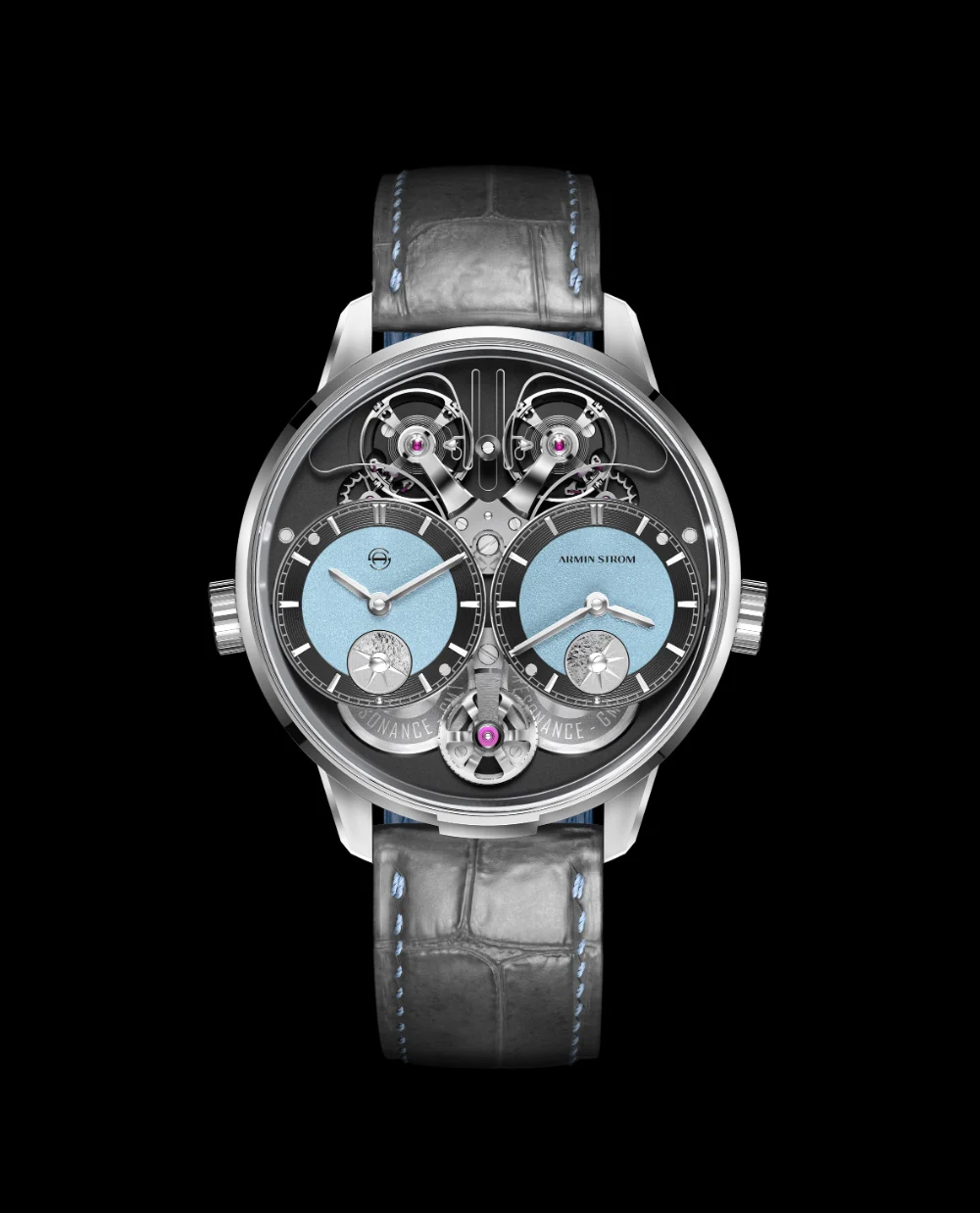
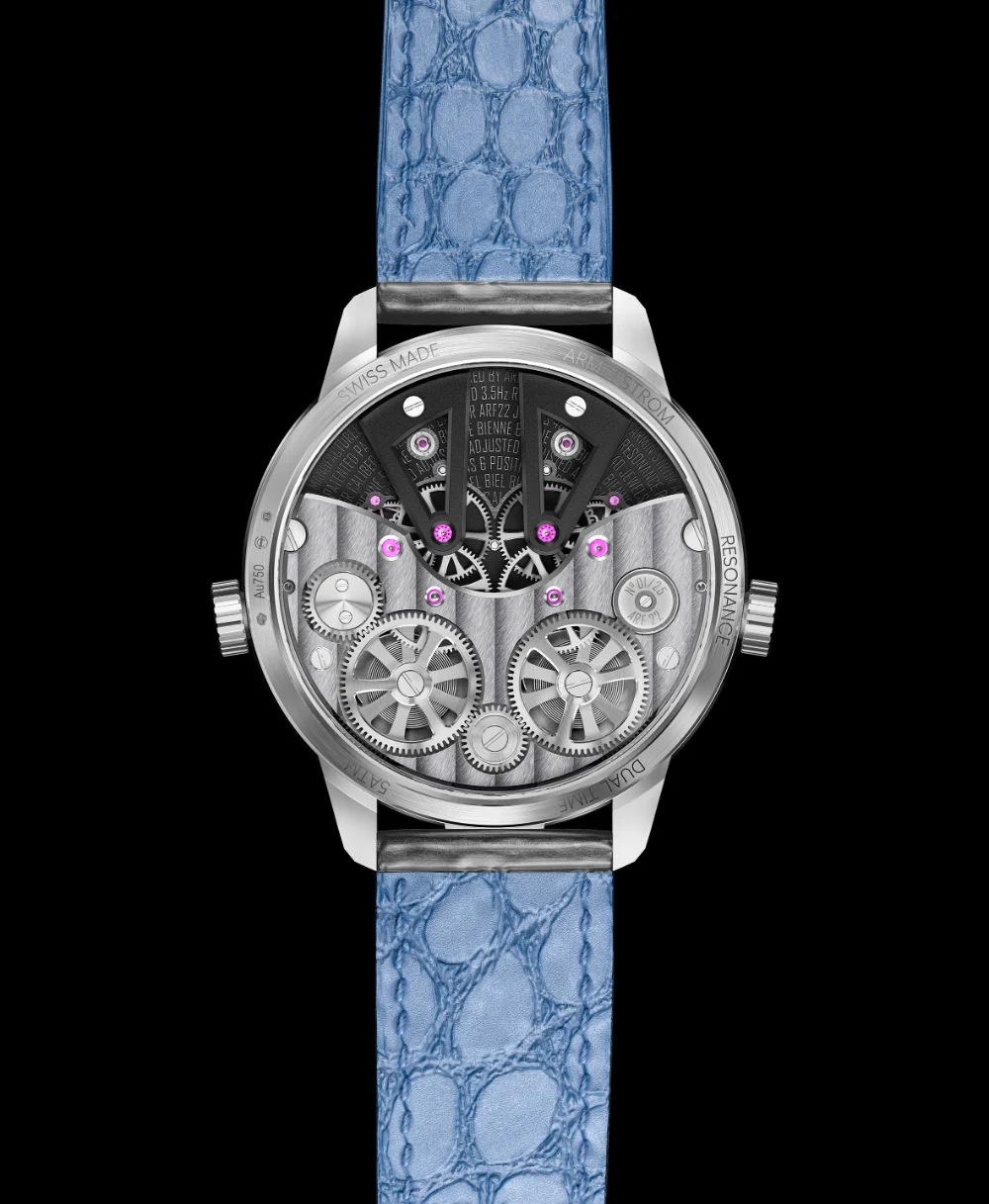
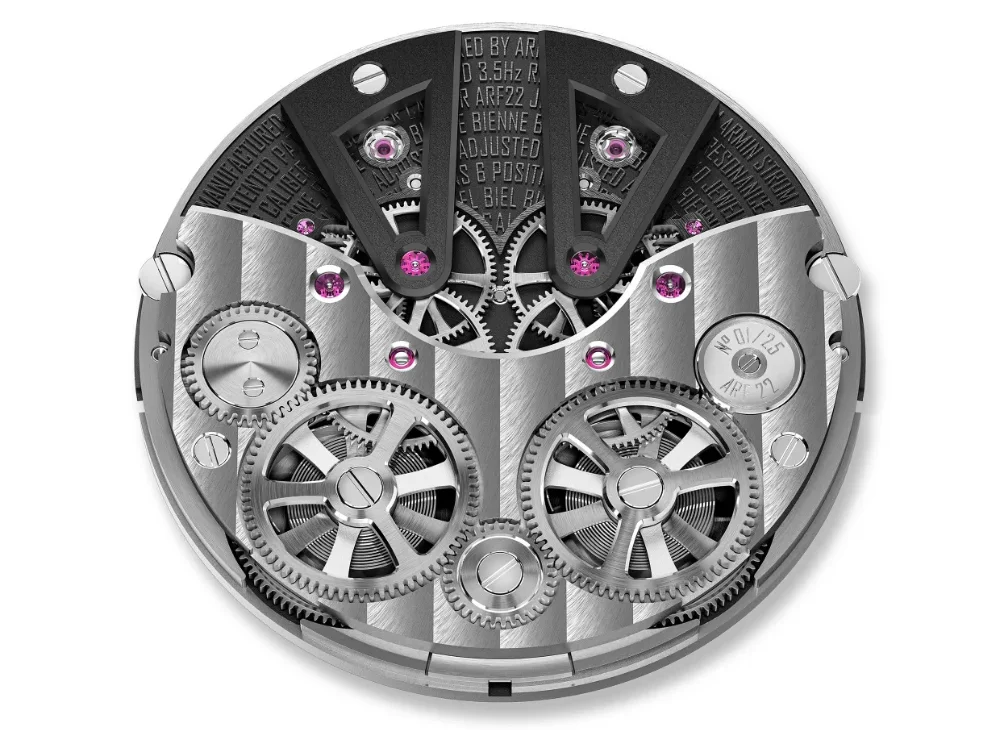
It’s a manually-wound resonance movement beating at 25,200 vph (3.5 Hz) with two independent, symmetrically mirrored balances that become synchronized mirror images of each other as they resonate. Each ‘side’ of the movement has its own gear train, balance, balance spring and escapement, all linked by that resonance spring. And the firm has made the ARF22 fit into a 39 mm case. Given its previous resonance watch measured 59 mm by 43 mm, that’s quite the ‘honey, I shrunk the watch’ moment and required serious horological engineering to its complement of 231 parts. It’s not surprising it took three years to design and build.
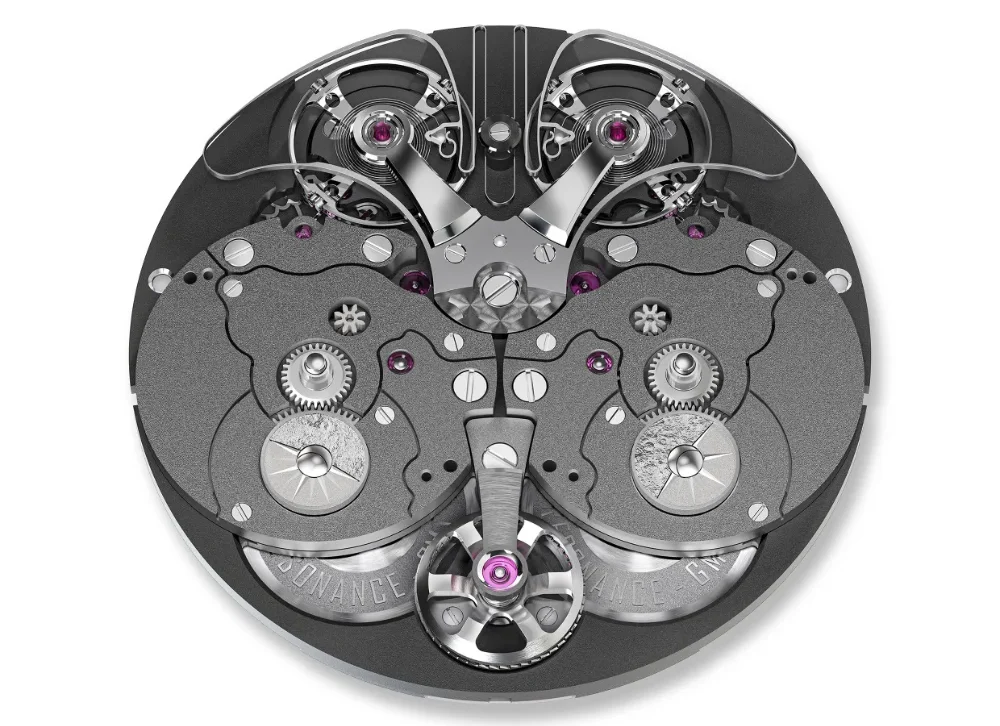
Powering things are two mainspring barrels, giving the watch a 42 hour power reserve. You have to do your own winding, but this is no hardship. Unlike a conventional watch, while you’re turning the crown, the ratchet click system on the dial side (rather than on the back of the movement where you can’t see it as easily) rotates to show you what’s happening.
Most traditional click mechanisms are connected to flat ratchets. Easy, simple, not very interesting. Of course, Armin Strom wasn’t about to do anything the easy way. Instead, the Resonance’s three-dimensional ratchet mechanism is connected to a pinion, running in a jewelled bearing between the two barrels, distributing the winding load more evenly. It’s a two-part system with a Breguet-toothed bottom gear that’s fixed to the main plate and a top gear with a spring that’s connected to the axis. Engaging and disengaging the winding mechanism feels much more precise and, from an engineering perspective, means winding energy is more efficiently transferred, there’s less friction and wear on components, the watch winds more smoothly and the whole winding mechanism is more durable. From an aesthetic point of view, it creates a balanced triangle with the dual balances at the top of the dial.
While we’re looking at winding, the left crown, logically, sets the time on the left dial, while its counterpart on the right side looks after the right dial and energises the mainsprings.
Given the amount of thought that’s gone into simply winding the watch, you’ll not be surprised to discover exemplary finishing. On the back of the movement alone you can see Geneva striping, anglage on the bridges and gears, circular-grained gears, mirror polished screws and two different types of finish: rhodium plating on the bridge and anthracite PVD on the mainplate. The jewel sinks are polished too and even the finger-like balance wheel bridges are mirror-polished.
Armin Strom Dual Time GMT Resonance – a practical ownership proposition.
Despite the refinement, there’s still a decent 50 m of water resistance and the GMT is a thoroughly wearable real-world watch. That said, it would be a brave owner who chooses to wear their Armin Strom to wash the car.
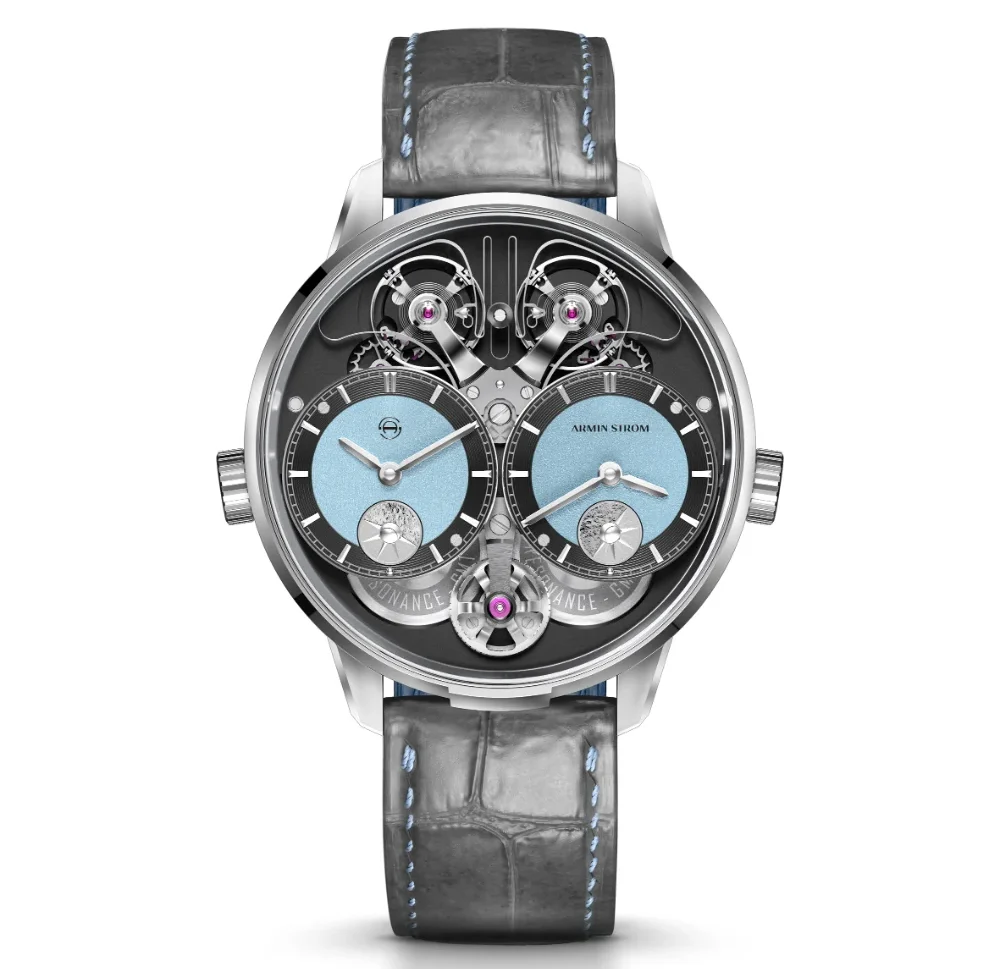
From a time-telling point of view, you read both time zones from the two symmetric sky-blue dials, each adorned with a grenage finish. And, in fact, this is the only Resonance watch in current production with dual symmetric time dials with black circular ridged chapter rings set with applied polished baton indexes and yet more mirror polished screws. The baton design also picks up the faceting on the rhodium hour and minute hands.
If you’ve ever called someone in a different timezone only to be greeted with a blearily grumpy ‘Don’t you know what time it is, you idiot?’, you may appreciate the thoughtful day/night indicators gracing each dial at 6. Just so you really can’t make a mistake, the ‘moon’ side is hand hammered to create craters and the ‘sun’ side features faceted rays.
Keeping things on your wrist, you’ll have a choice of two 18 mm straps – a matt-grey alligator strap with sky-blue stitching and a light-grey alligator strap with pearl-grey stitching – each fitted with an 18-carat gold pin buckle.
Armin Strom Dual Time GMT Resonance – closing remarks
The GMT Resonance sells for £114,000 and there will, as is usually the case with Armin Strom’s first editions, only be 25 watches made. But, given there are basically two movements in one, that’s really only £57,000 a watch, isn’t it? A positive bargain in Haute Horlogerie terms.
Mechanical watches never operate in a straight line – there are always differences in the transmission of energy, shocks, wear… two movements iron out the errors. More precise, but crucially more consistent.
Further reading
Technical specification
- Model: Armin Strom Dual Time GMT Resonance
- Reference: WG24-DT.90
- Case: 18-carat white gold, diameter 39.00 mm, height 9.05 mm, water resistance 5 ATM (50 metres), sapphire crystal to front, exhibition case back.
- Functions: two independent time displays each indicating hour, minutes and day/night
- Movement: Caliber ARF22, hand-wound movement, frequency 25,200 Vph (3.5Hz), 40 jewels, power reserve 42 hours, 231 components.
- Bracelet: delivered with two straps – a matt-grey alligator strap with sky-blue stitching and a light-grey alligator strap with pearl-grey stitching – with 18-carat white pin buckle
- Price: £114,000 – (RRP as of 4.11.2024)
- Limited Edition: 25 pieces