
Chopard L.U.C Lunar One Salmon Dial Watch Review
The Chopard L.U.C Lunar One Salmon Dial is a new release housed in Ethical 18-carat white gold that features a perpetual calendar, a large date display and an astronomical moon phase. The Swiss marque has revisited the former model of 2005 and refined its appearance with a ‘reshaped aesthetic’. The new L.U.C Lunar One is also available in Ethical 18-carat rose gold paired with a blue dial. A hand-guilloché dial, automatic micro-rotor movement and Poinçon de Genève are just a few of the many product highlights revealed by Mark McArthur-Christie.
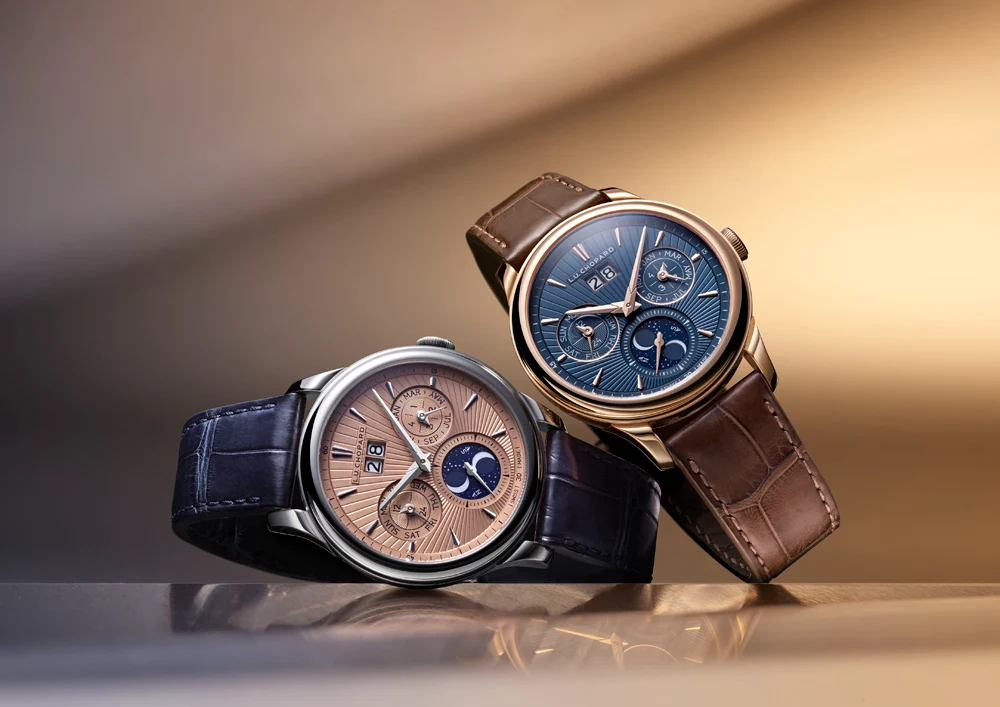
Image – ©Fédéral Studio
Chopard Watch
Should he be interested, that tuna-can sized smartwatch on your colleague’s wrist can probably show him not just the current phase of the moon but whether Armstrong and Aldrin left the kettle on in the Lunar Module.
In a world where connected devices can tell you everything you want to know about the solar system, why does anyone need a moon phase watch? But that’s like asking, “Why do we need buildings like Milan Centrale rather than Oxford Parkway?” Sure, you can get on a train at either, but one will make you smile, perhaps even give you a sense of awe, whereas the other will send you on your way with all the joy and élan of a tax form.
All the more reason then to enjoy the opportunity to look at Chopard’s two new mechanical moon phases, one in a white gold case with a salmon pink dial and a second in rose gold with a blue dial. In this instance, I’ll focus on the salmon dial option. The L.U.C Lunar One features a perpetual calendar, another elegant means of conveying information that’s far preferable to a bleepy screen.
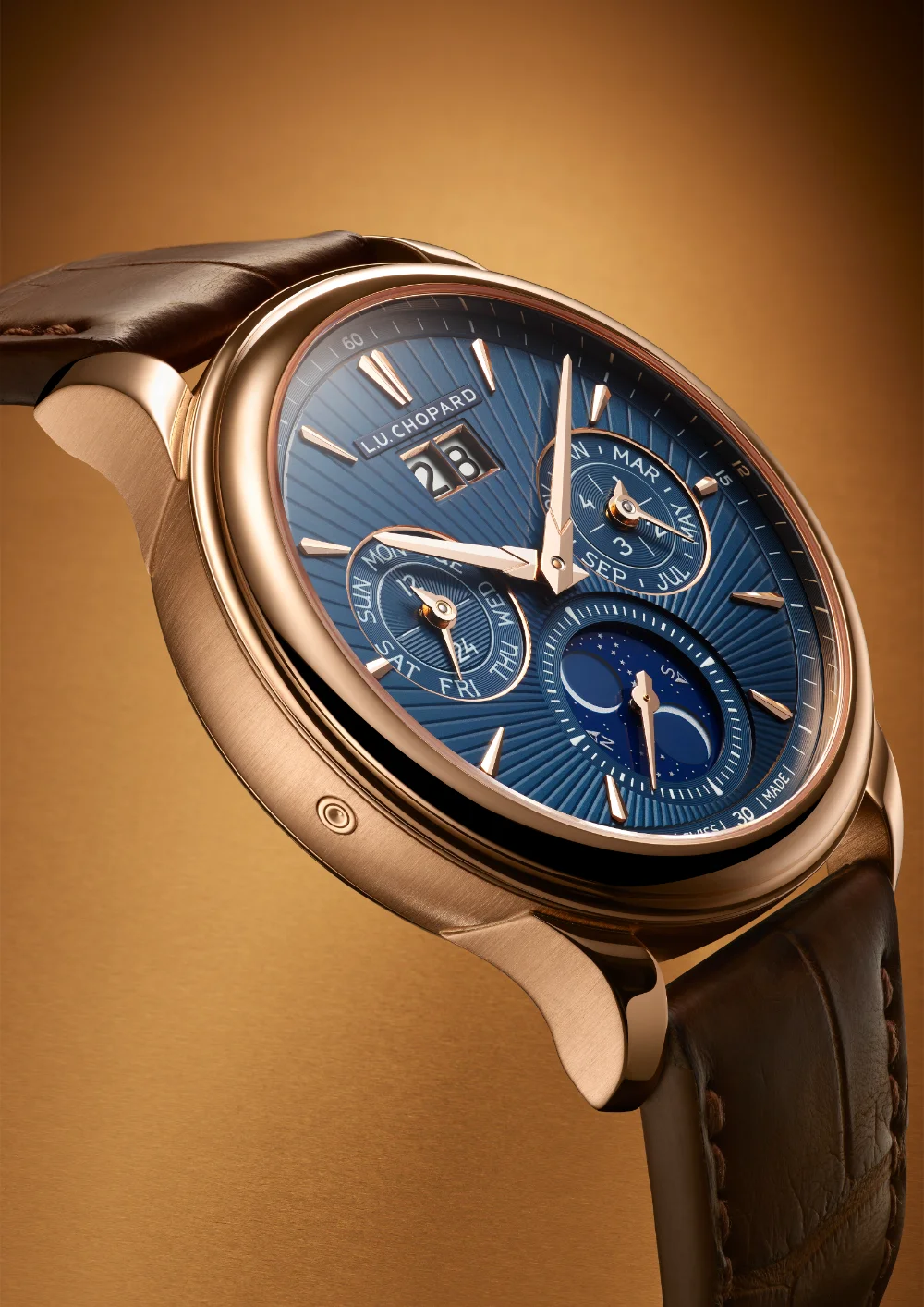
Image – ©Fédéral Studio – Chopard L.U.C Lunar One in Ethical 18-carat rose gold (Reference: 161951-5001)
Chopard L.U.C calibre 96.13-L – introduction
The Chopard L.U.C Lunar One is fitted with the L.U.C calibre 96.13-L, a movement that shares some of its genetic code with the brand’s inaugural in-house movement, the L.U.C calibre 96.01-L. Incidentally, the first two numerals reference 1996, the year Chopard started making the latter movement. Where a smartwatch silently churns its zeroes and ones, this movement does the job with physical levers, cams, springs and wheels; far more satisfying and, despite being a blizzard of baffling complications, much more accessible. In this case, a total of 355 components, all finished to within a ligne of their lives.
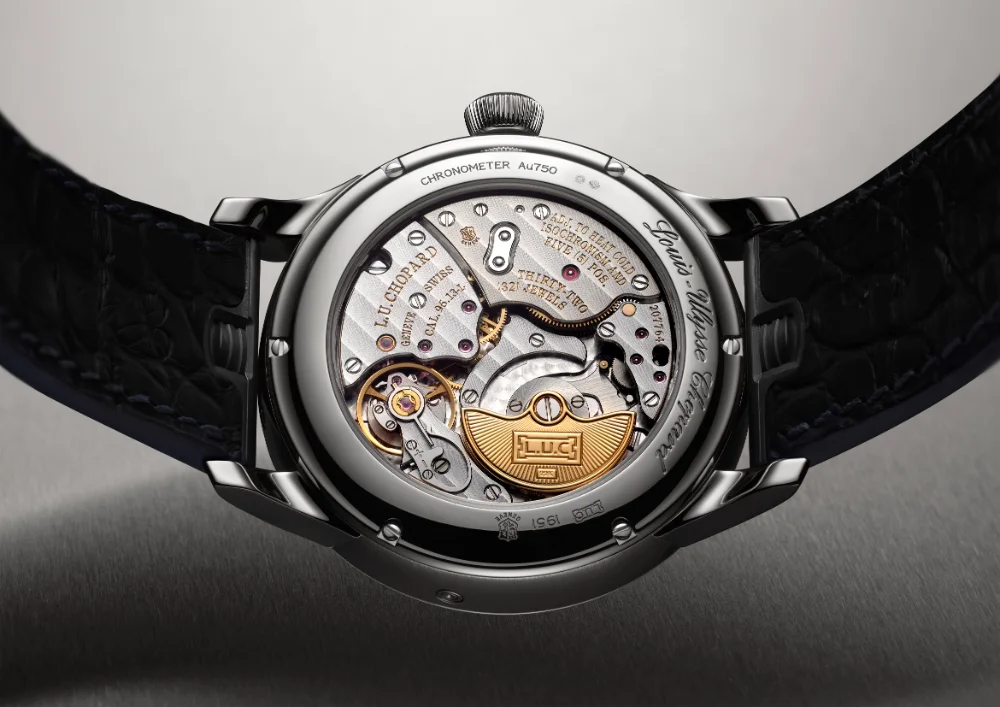
Image – ©Fédéral Studio
Chopard L.U.C Lunar One Salmon Dial – high-precision moon phases
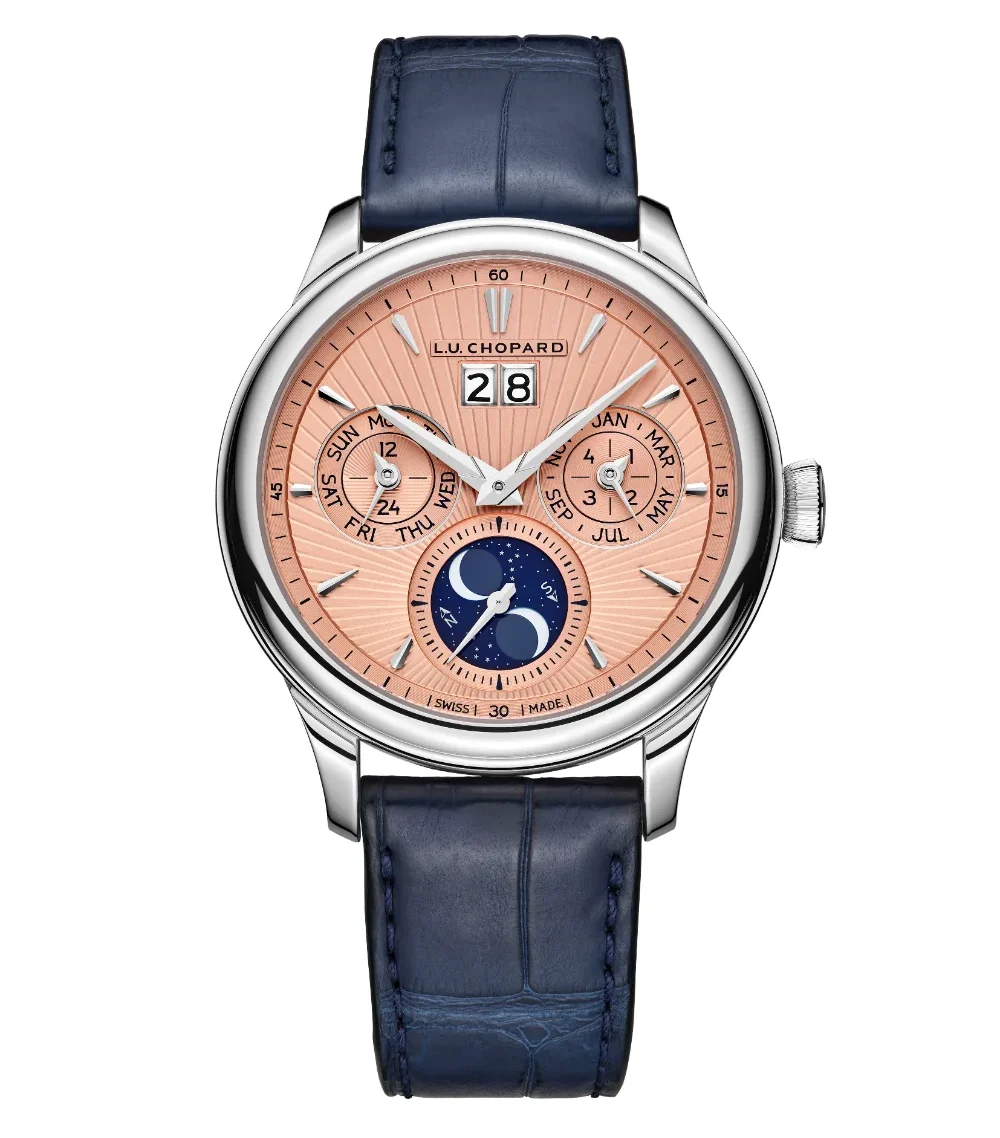
You get the usual hours, minutes and seconds plus a perpetual calendar that looks after the date (large, in this case), day, month and leap years. There’s even a 24 hour indicator, just in case you’ve been in the casino a little too long. But the star of the show is the high-precision moon phase display at 6 o’clock.
First up, this isn’t an everyday moon phase display. Most moon phase watches have a disc featuring a couple of moon images, both identical but with only one visible in the display window at any given time. As the disc turns, thanks to a 59 toothed gear, one ‘moon’ appears to wane as the other is revealed, slice by slice, by its twin in the display window.
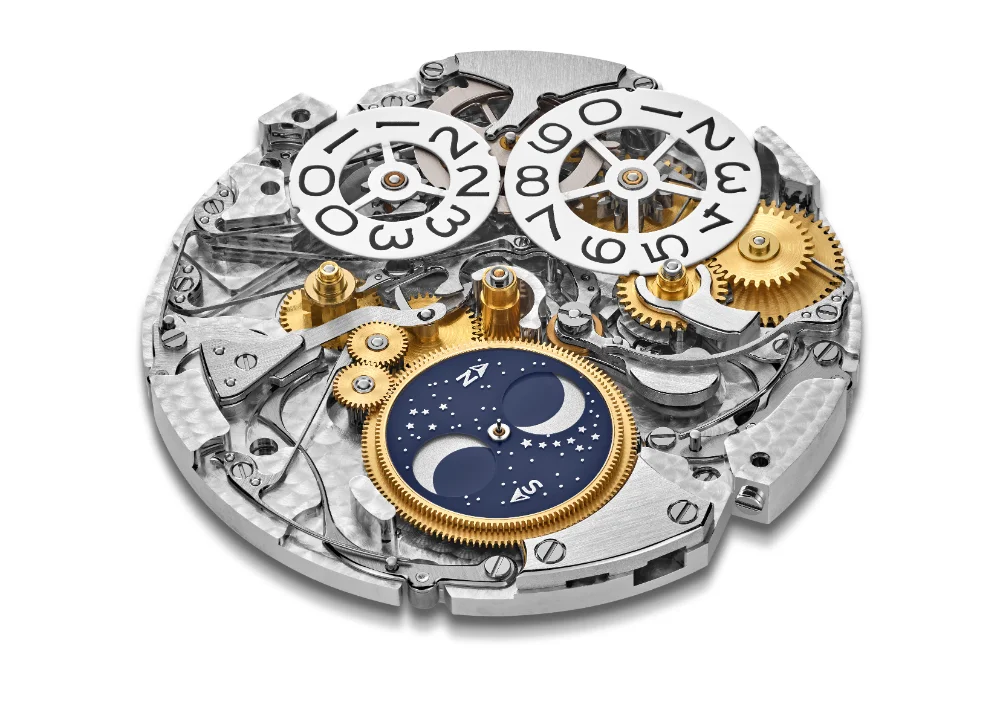
It’s widely known that the moon’s cycle is 29.53 days (near enough a month). With a standard 59 toothed moon wheel, this presents a problem. Over time, (every two years, seven months and 20 days) you’ll need to adjust your watch. This is the sort of failure in precision that causes a mass rush for strong coffee and the lunar tables in Fleurier. If you look at the dialside pictures of the Lunar One’s movement (please do, it’s worth it), you’ll see that there are rather more teeth on its moon wheel than a mere 59.
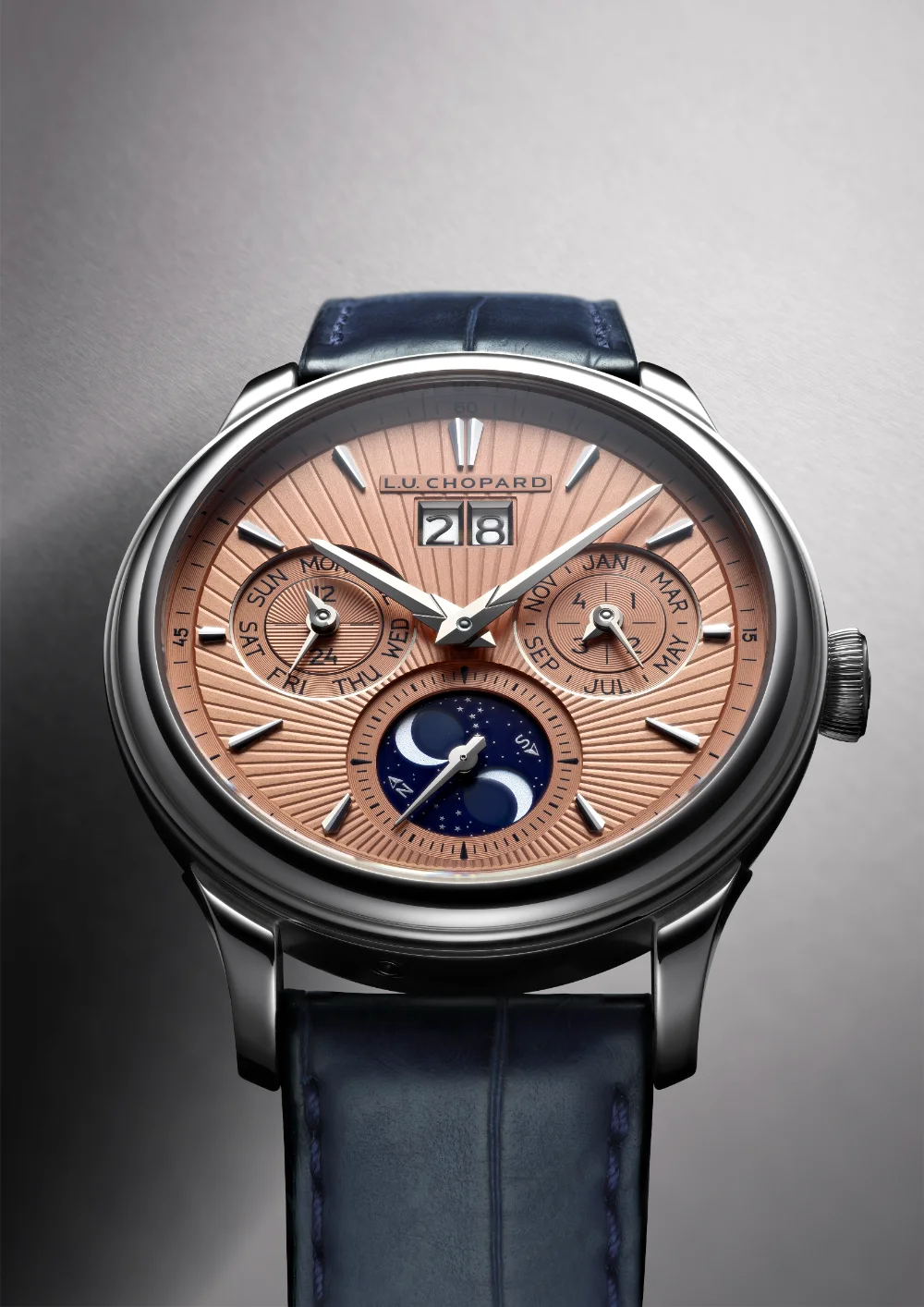
Image – ©Fédéral Studio
The 135 teeth on the Chopard’s wheel take a lot more horological nous to cut and finish, but they mean your Lunar One will only need adjusting (using that little recessed caseband corrector located between 6 and 7 o’clock, since you asked) by a single day every 122 years. This neatly passes on the problem of moon phase adjustment to your heirs, or possibly even theirs.
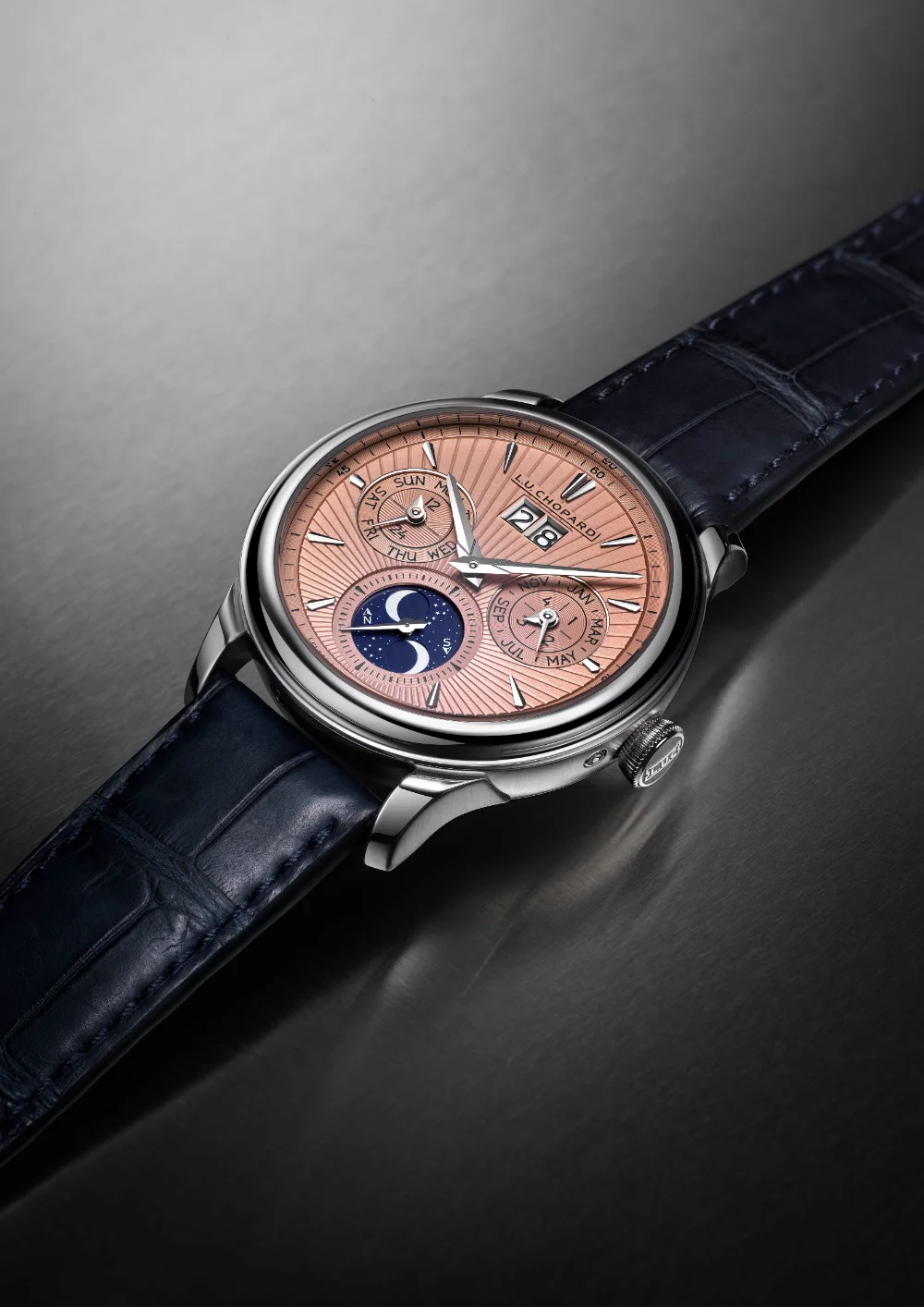
Image – ©Fédéral Studio
That little moon phase mechanism is a bit of a wonder in itself. First, it’s not one dial – it’s two. Look carefully and you can see there’s an upper wheel with two circular cutouts and a lower wheel with two moons running underneath. The two wheels turn at different rates, allowing the cutouts to reveal the moon waxing and waning over the month. This is all a great deal more complicated than the usual single disc partly obscured by a dial edge. It’s made more so by having the Southern Cross painted on one side of the upper disc with the Plough on the other, so you can feel at home wherever you are in the world.
Chopard L.U.C Lunar One Salmon Dial – hand-guilloché
As you’d expect from Chopard, the dial isn’t simply functional; that would be far too easy. That radiating pattern centred around the moon phase subdial wasn’t just stamped on, either. Below the minute track there’s concentric snailing – a design the two perpetual calendar counters pick up. Again, it would have been simple to just repeat the design for the 24 day/night indicator but no, that gets a radiating pattern (intended to evoke the Sun), with the lower half taking a horizontal motif for the stillness of night. To get an effect like that, termed ‘hand-guilloché, requires the use of a rose engine lathe.
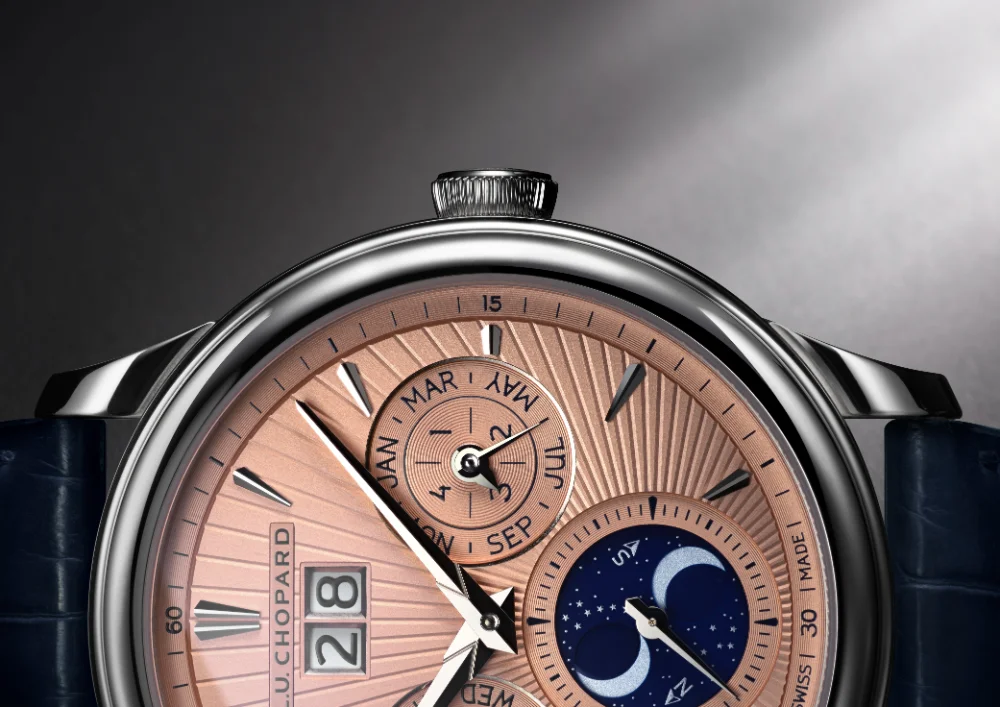
Image – ©Fédéral Studio
Hand-guilloché is an artisanal technique involving the use of said lathe and an inordinate amount of hand-eye coordination. Rose engine lathes are no longer made, hence it is not uncommon to see 100 year old examples still in use today. The dial blank is secured in a vertical position and the guillocher carefully introduces the cutting tool to the surface. The artisan then turns a handle (no electric motors here), causing the dial blank to rotate against the stationary cutter to remove fractional slivers of metal. The pattern comes from a selection of rosettes, each with a different profile, that cause the dial blank or workpiece to move in different ways.
In the time a skilled operator can decorate a single dial, a flat-stamping die machine will turn out a few hundred dials. You can probably guess which option imbues the dial with the most depth and character.
Chopard L.U.C Lunar One Salmon Dial – indications
Chopard hasn’t forgotten the hands or the hour markers either. The dauphine fusée hands and herringbone hour markers match the case material and wonderfully contrast with the salmon dial.
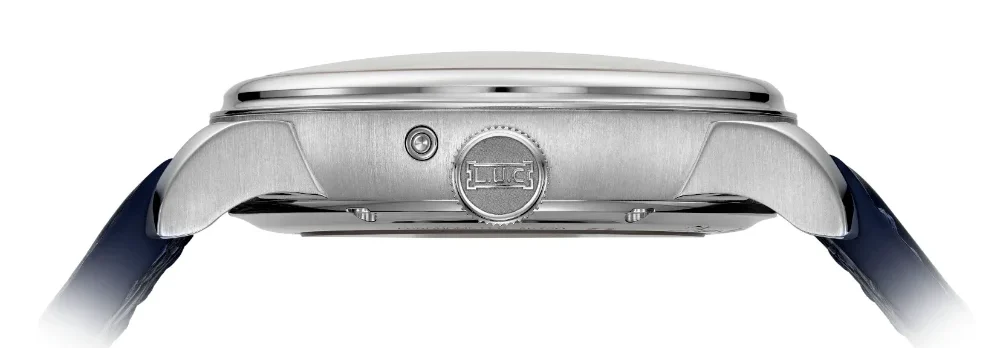
Despite all these complications that need at least occasional setting (once every 122 years, remember?) there are no oversized pushers to spoil the case outline. Instead, Chopard has endued the case with discreet correctors, recessed into the case sides and easily adjusted with a suitable stylus.
Chopard L.U.C Lunar One Salmon Dial – bassine-shaped case
The case measures a gnat’s whisker over 40 mm and just under 12 mm thick, so it’s no dinner plate or hockey puck. Chopardophiles will spot that the shape of this watch is a little different from its predecessors. It’s a little slimmer and bassine-shaped – so the base is narrower than the domed, polished bezel. The case sides are vertical satin-brushed and the sapphire crystal is slightly domed and curved into the bezel. Upholding high-watching etiquette, the lugs are not stamped with the case but made separately before being welded to the case sides. Again, more work equals more character.
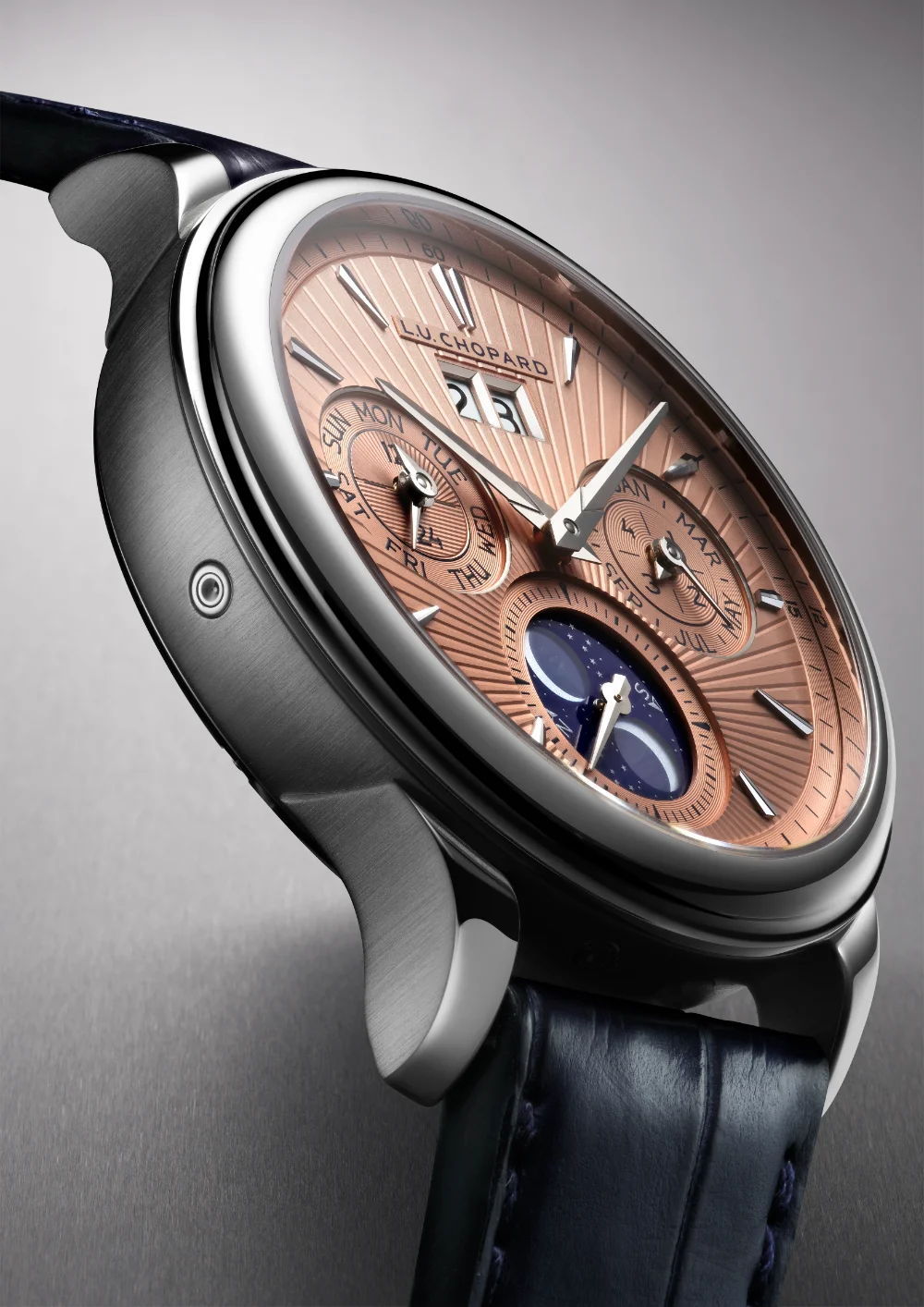
Image – ©Fédéral Studio
Chopard L.U.C calibre 96.13-L – micro-rotor
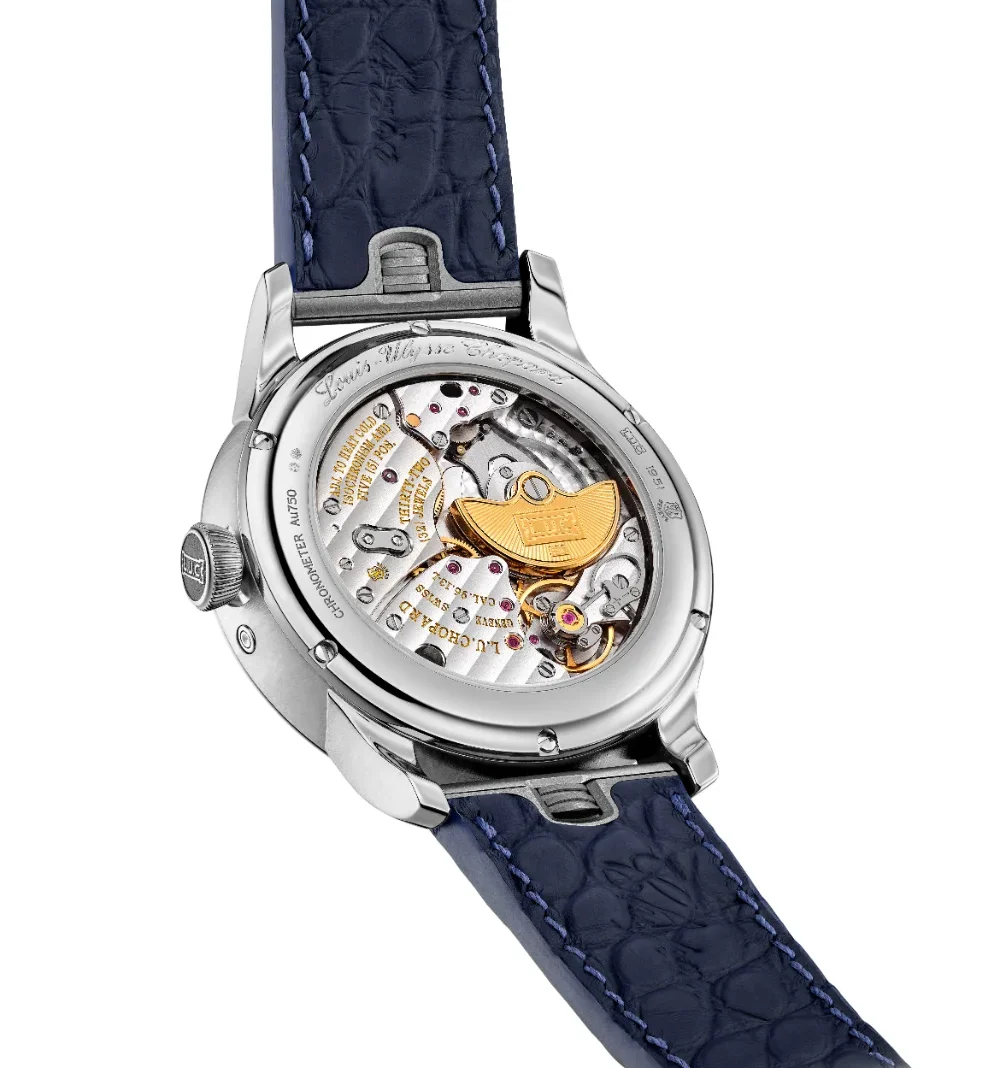
That said, there’s not much work for the Lunar One’s owner. There’s not even any need to exert yourself hand-winding your watch; the movement winds itself with a solid 22-carat gold micro-rotor. Gold, because, heck, why not, but also because its notable mass makes it a suitable alternative to a conventional full-size oscillating weight. It’s also recessed, so the movement doesn’t bulk up. More guilloché decoration here, too.
Chopard L.U.C calibre 96.13-L – finishing
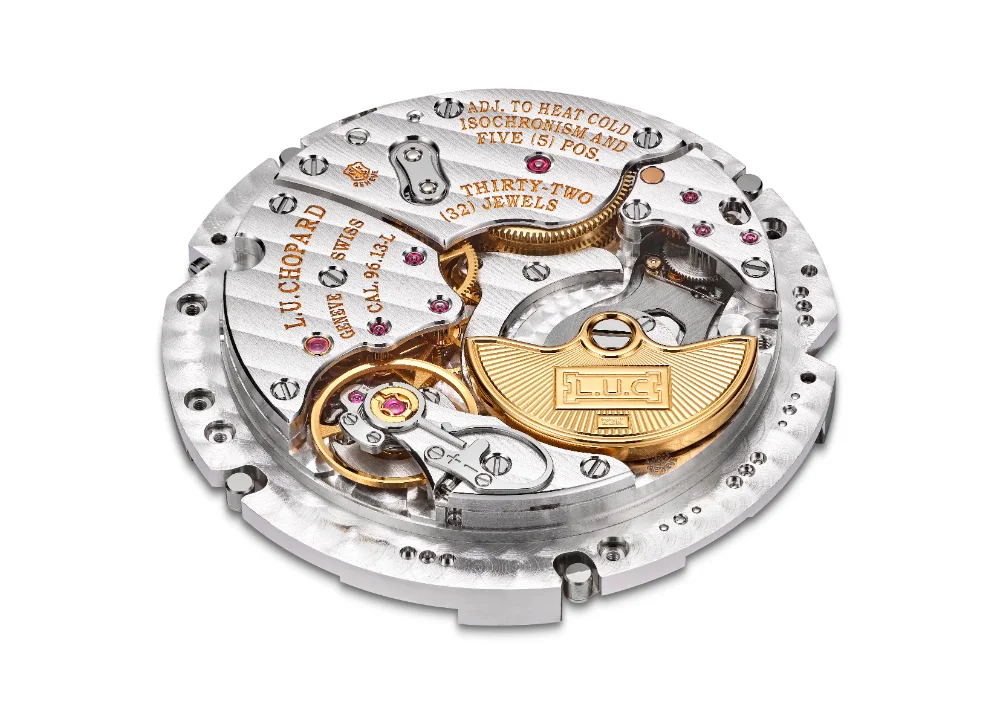
Look under the barrel bridge (just opposite the balance and the rotor – the one with the Poinçon de Genève engraved on it) and, if you can get the right angle, you can see there are two barrels stacked on top of each other, giving a thoroughly effective 65 hour power reserve. The calibre 96.13-L is COSC certified (the balance spring with a Phillips terminal curve and swan-neck regulator help).
While we’re talking about the Poinçon de Genève, just look at the finishing. Whether it moves or not, everything you look at has been hand-chamfered, polished, circular grained, satin brushed and probably given a final buff by an angel wielding a gold duster. Seriously though, the finishing here is exceptional even where you can’t even see the component because it’s buried underneath one of the bridges. The screwheads and sinks gleam wonderfully, while the sliding stud holder and swan neck are black polished. A solid back on a watch like this would be criminal.
Chopard L.U.C Lunar One Salmon Dial – closing remarks
All that said, we don’t actually need moon phase watches. Think about it – unless you have unnaturally hairy palms and a fear of silver bullets, when did you last look at your watch and say ‘Thank goodness! Now I know the moon is waxing gibbous!’ But this practical redundancy is all the more reason why timepieces like the Chopard L.U.C Lunar One are a wonder. They allow watchmakers to show off, to demonstrate what they can do and to make something beautifully engineered purely for its own sake – just because they can. The watchworld would be a poorer place without moon phase watches – and this one’s a beauty.
Further reading
Technical specification
- Model: Chopard L.U.C Lunar One Salmon Dial
- Reference: 161951-1002
- Case: Ethical 18-carat white gold, diameter 40.5 mm, height 11.63 mm, water resistance 3 ATM (30 metres) sapphire crystal to front, exhibition caseback.
- Functions: hours, minutes, perpetual calendar, moon phases appearing in a rotating aperture (orbital moon) for Northern and Southern hemispheres at 6 o’clock, 24-hour scale and day of the week at 9 o’clock. Semi-instantaneous twin-aperture large date
- Movement: Calibre L.U.C 96.13-L, self-winding movement, frequency 28,800 vph (4 Hz), 32 jewels, power reserve 65 hours, certified-chronometer (COSC)
- Strap: Hand-sewn navy blue alligator leather with tone-on-tone stitching, or blue grained calfskin with tone-on-one stitching paired with a pin buckle in Ethical 18-carat white gold
- Price: £77,300 (RRP as of 20.1.2025)