
Girard-Perregaux Laureato Three Gold Bridges Watch Review
Most watch brands seek to produce an iconic watch, albeit very few ever succeed. Remarkably, Girard-Perregaux has two iconic watches in its product portfolio – the Three Bridges (1867) and the Laureato (1975). Now, the Swiss Haute Horlogerie Manufacture has unveiled the Girard-Perregaux Laureato Three Gold Bridges, a timepiece that unites elements from both iconic models, delivering a contemporary aesthetic that’s rich in detail.
The first Three Bridges was unveiled in 1867
Once upon a time, watch movements were merely functional. Their role was to harness energy, serving the various indications, positioned front of house, with a linear supply of power. This was an era when beauty was restricted to cases and dials. However, in 1860, Constant Girard, an innovative watchmaker, began sketching ideas for a movement that would endow the mechanical workhorse behind the dial with a becoming aesthetic.
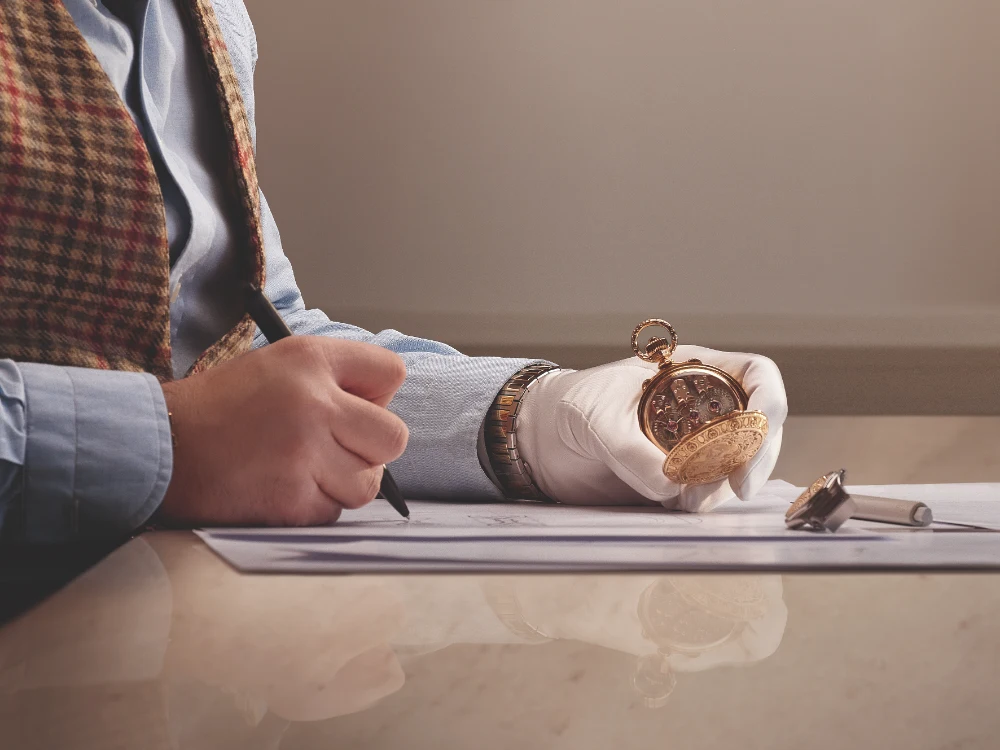
Constant Girard was always fascinated with the ‘tourbillon’, the ingenious mechanism patented by Abraham-Louis Breguet in 1801. Breguet recognised that gravity could adversely affect the behaviour of the balance spring, influencing the rate. His clever solution was to place the escapement and regulating organ within a rotating cage that revolved 360° every 60, 240 or 360 seconds, ameliorating gravity’s influence.
When designing his tourbillon movement, Constant Girard conceived an architectural style featuring three parallel bridges formed of nickel silver, supporting the barrel, gear train and tourbillon cage. The ends of each bridge were endowed with a pointed tip, imbuing the structural elements with a notable beauty. In 1867, the inaugural Three Bridges was unveiled, a pocket watch that made ‘the invisible, visible’.
Interestingly, up to this point, the decoration of movements was usually limited to visible surfaces; however, Constant Girard chose to finish areas of the movement that would never be seen by its owner. Today, this is the accepted norm for exemplars of Haute Horlogerie, but back in 1867, it was a radical, costlier approach.
The inaugural Three Bridges was presented at the Universal Exhibition in Paris to critical acclaim. Keen to preserve his unique architectural style, Constant sought to protect his design. However, with no patent office in Switzerland, he filed a patent in the US for his groundbreaking movement.
Like many perfectionists, Constant would revisit his movement design in his unwavering quest for continuous improvement. In 1889, nickel silver was supplanted by gold and the shape of the bridges became more intricate. The resultant watch, the legendary ‘Tourbillon with Three Gold Bridges’, also known as ‘La Esmeralda’, was presented at the Universal Exhibition in Paris, where it was awarded a gold medal.
Beyond its aesthetic charms and refined finishing, the Tourbillon with Three Gold Bridges was also known for its reliability, readability and extraordinary precision.
Almost 160 years have elapsed since Constant Girard began making preliminary sketches of the Three Bridges, but the aesthetic codes endure in various forms, some classical and others contemporary. The Three Bridges design has been adapted for the wristwatch and, in some instances, it has been executed in modern-day materials. Likewise, the profile of each bridge has gently evolved.
The Laureato 1975
In 1975, Girard-Perregaux unveiled the ‘Quartz Chronometer’, a watch that tapped into the horological zeitgeist of the 70s with its then cutting-edge quartz movement. Girard-Perregaux was at the forefront of quartz technology, setting the frequency of 32,768 Hz which other brands subsequently adopted.
Ultimately, the watch was renamed the ‘Laureato’ and while its in-house movement was very impressive, many horophiles, myself included, fell for the model’s distinctive appearance. Endowed with an octagonal bezel, sat atop a circular plinth, which in turn rests upon a tonneau case, the Laureato masterfully plays with shapes, volumes and finishes. With the advent of the Laureato, an icon was born.
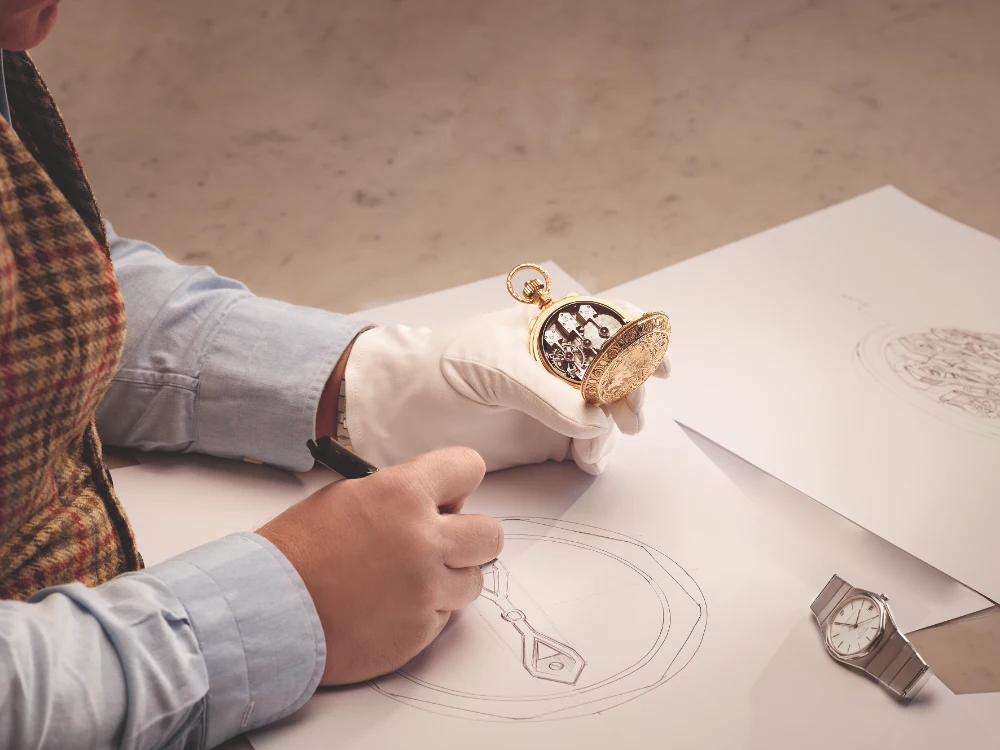
Over the years, Girard-Perregaux has continued to release new iterations of the Laureato, many equipped with mechanical, in-house Manufacture movements and some featuring complications. Moreover, the Maison has demonstrated boundless creativity, releasing various dial executions and cases formed from various materials.
Girard-Perregaux Laureato Three Gold Bridges – uniting two celebrated designs
The Three Bridges and Laureato were conceived in very different times, separated by more than 100 years. La Esmeralda of 1889 has a classical appearance, while the Laureato remains contemporary. Both watches have their own personality and yet they also share some characteristics in common. They were both conceived, designed, developed and crafted in-house. Likewise, each model is imbued with refined finishes worthy of the term, ‘Haute Horlogerie’. But most of all, both the Three Bridges and Laureato masterfully celebrate shapes, lines and curves while incorporating a myriad of subtle details.

Now, Girard-Perregaux has unveiled a new timepiece, uniting the aesthetic codes of the Three Bridges and the Laureato. However, when fusing two iconic models, there is an inherent risk that the notable allure of each model might be lost. Thankfully, I can attest the Girard-Perregaux Laureato Three Gold Bridges is an eminently handsome watch worthy of both iconic names. Allow me to elaborate.
Girard-Perregaux Laureato Three Gold Bridges – indications
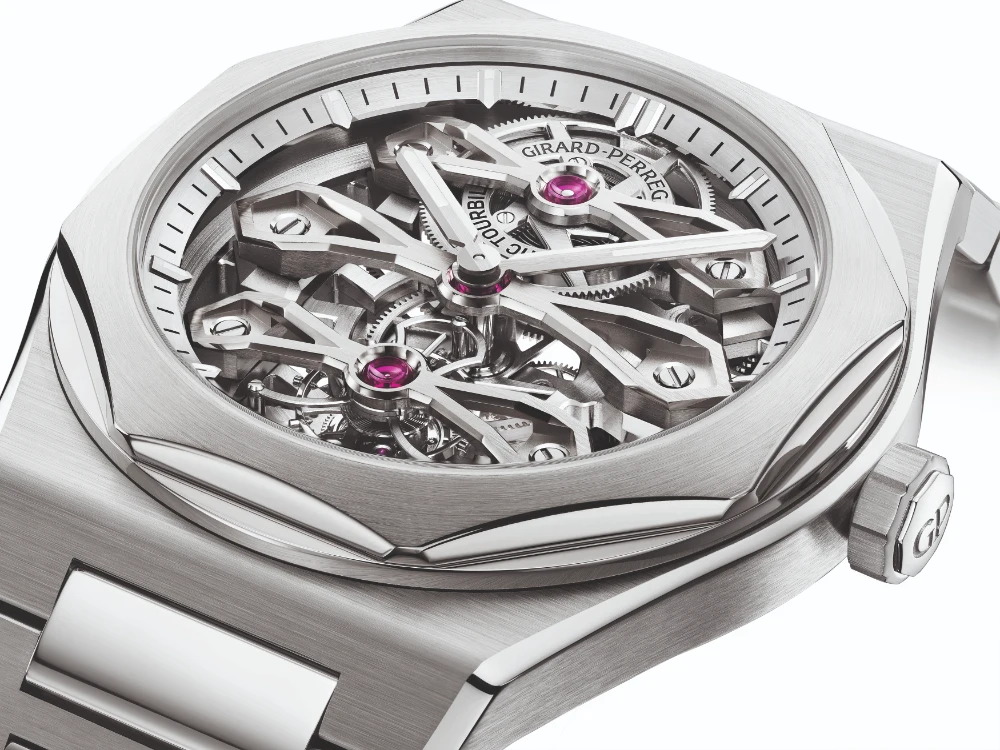
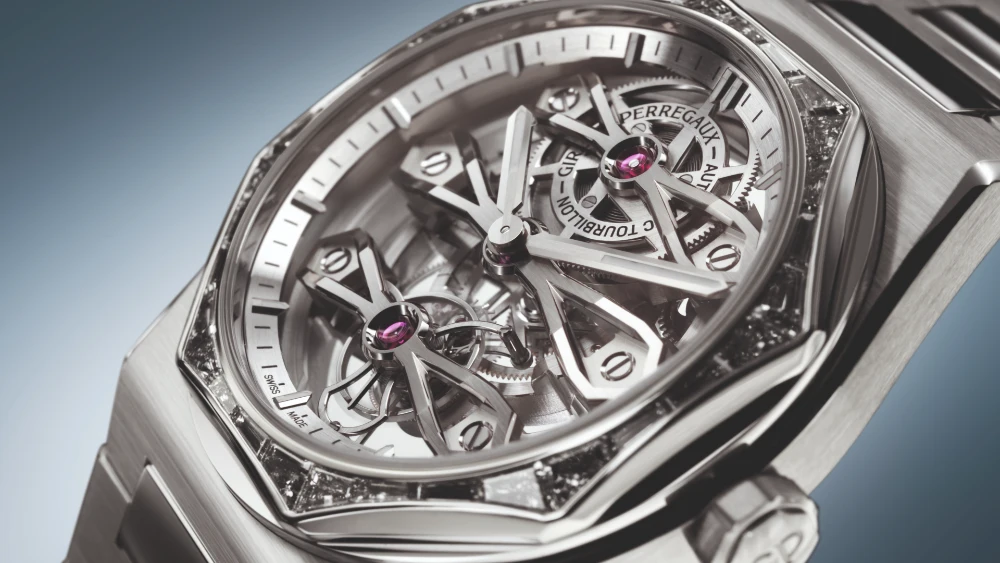
Baton-type hour and minute hands, formed of white gold and lined with Super-LumiNova, sit above a skeleton movement. These hands reach towards a chapter ring affixed to the interior of the case, seemingly floating in mid-air. The chapter ring is punctuated with white gold indexes lined with luminescent material that emits a blue glow in dim light. A small seconds hand sits atop the lyre-shaped tourbillon cage (see later).
Girard-Perregaux Laureato Three Gold Bridges – heightening transparency
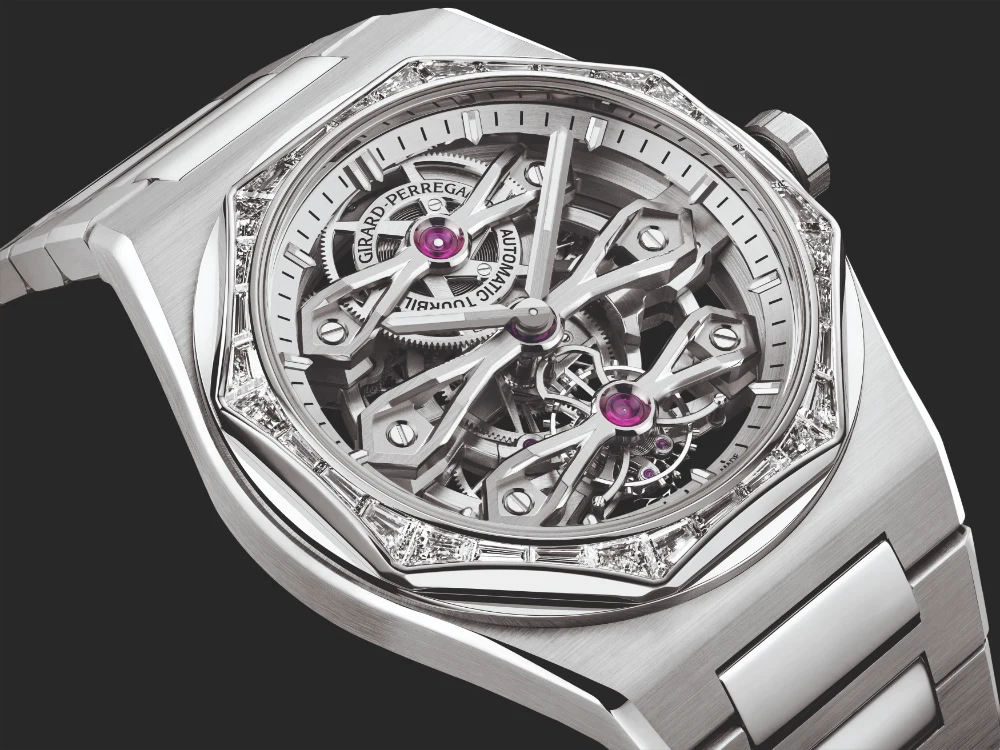
The skeleton movement, the in-house Manufacture Calibre GP9620, is the star of the show. The combination of two sapphire crystals, front and rear, allows light to flood the interior of the watch, highlighting the intricacies of this ultra-refined movement. Indeed, the Swiss Manufacture reports that the movement is endowed with 418 hand-polished angles, of which 362 are inward angles. Satin brushed and polished surfaces sit in close proximity, conferring a sumptuous appearance, heightening the perception of refinement.
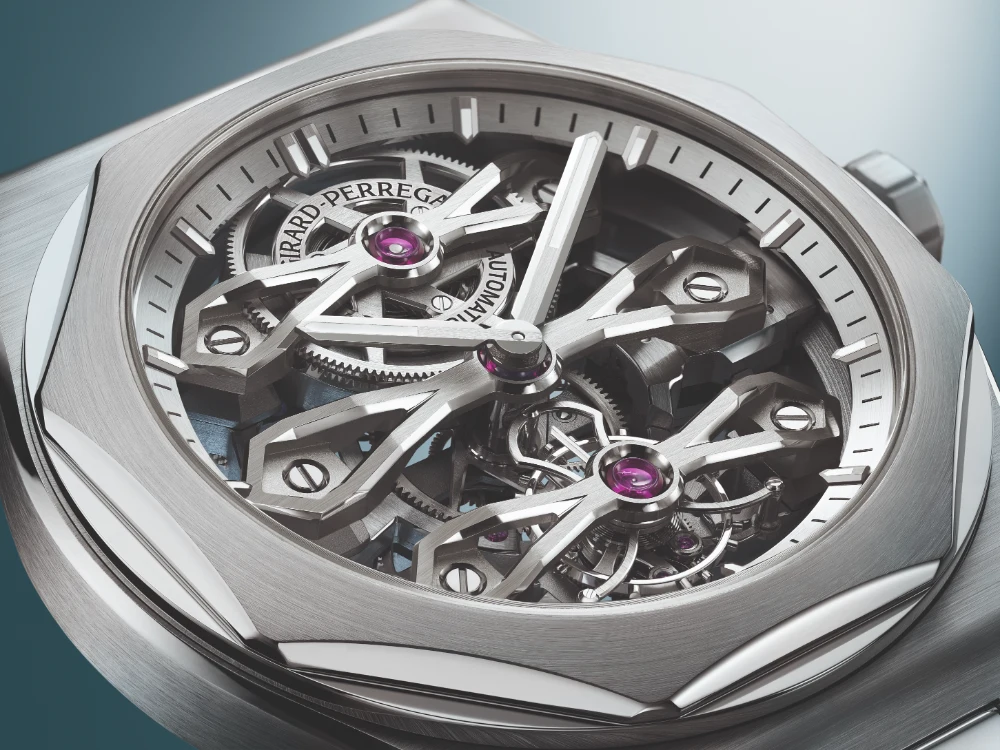
As its name suggests, the model features three bridges, arranged in parallel. The upper bridge supports the barrel, the gear train is held by the central bridge and the tourbillon cage is mounted on the lower bridge. In this instance, the tourbillon cage is lyre-shaped, a brand signature since the 19th century.
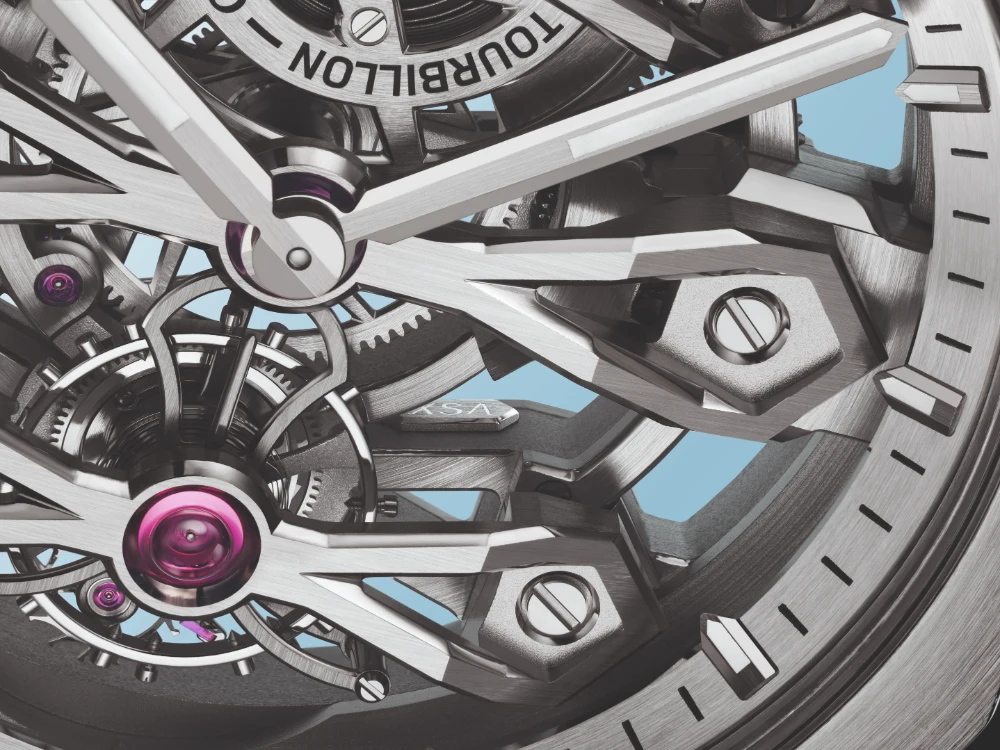
At first glance, one might assume the watch is hand-wound; however, a platinum micro-rotor sits behind the barrel, discreetly hidden from view, harvesting energy from the natural motion of the wearer’s wrist. This arrangement offers user convenience while simultaneously preserving the transparency of the watch.
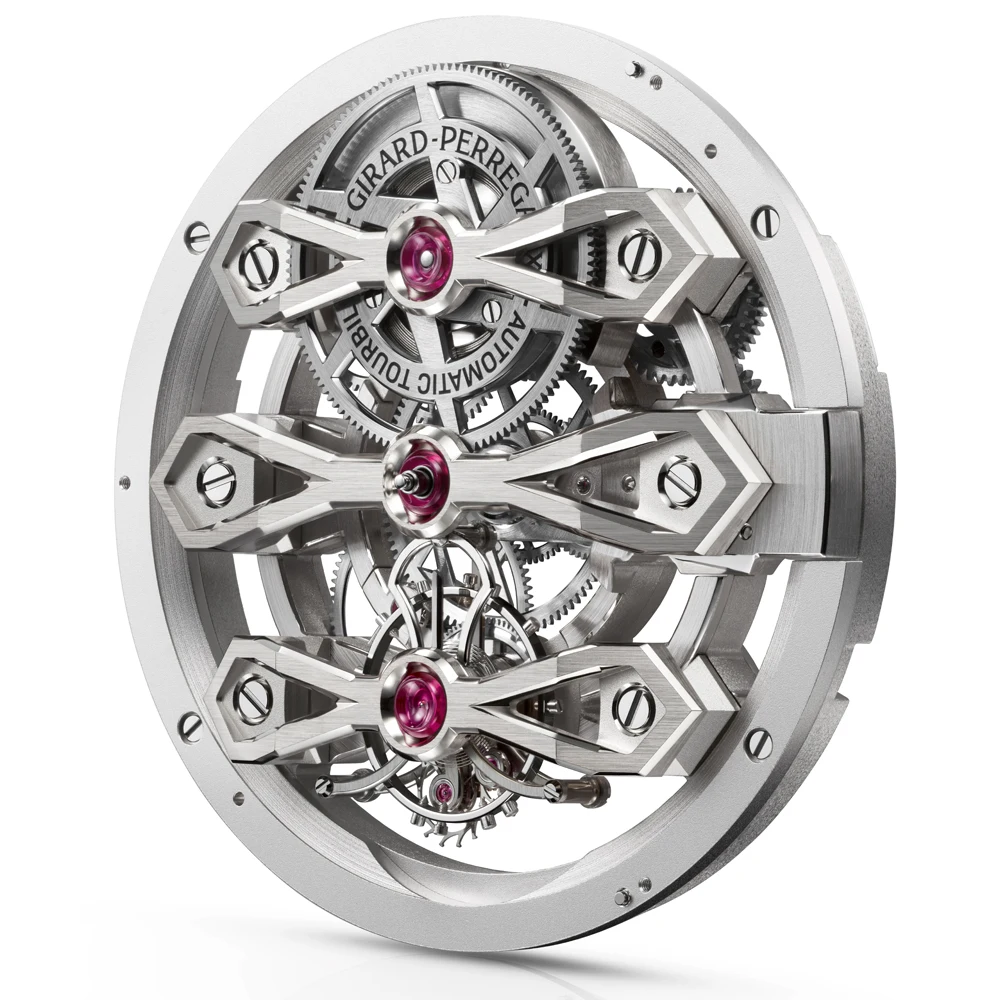
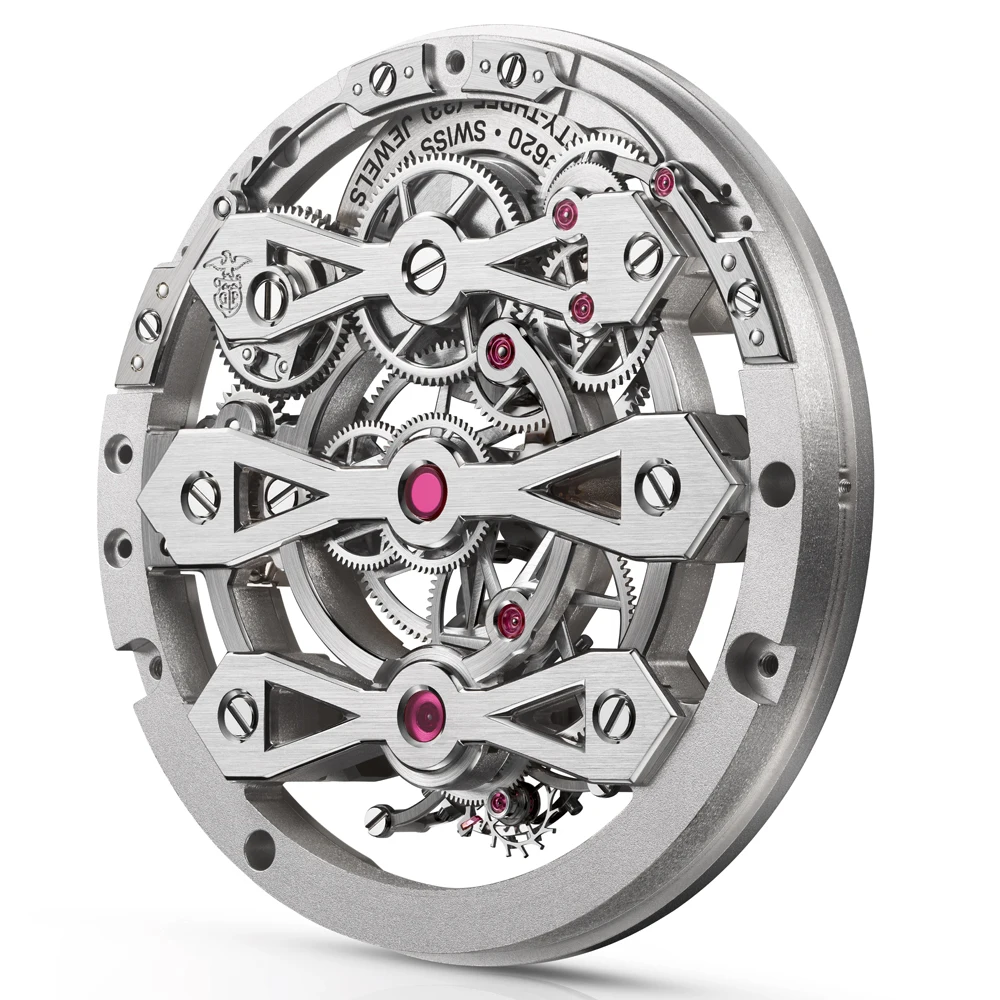
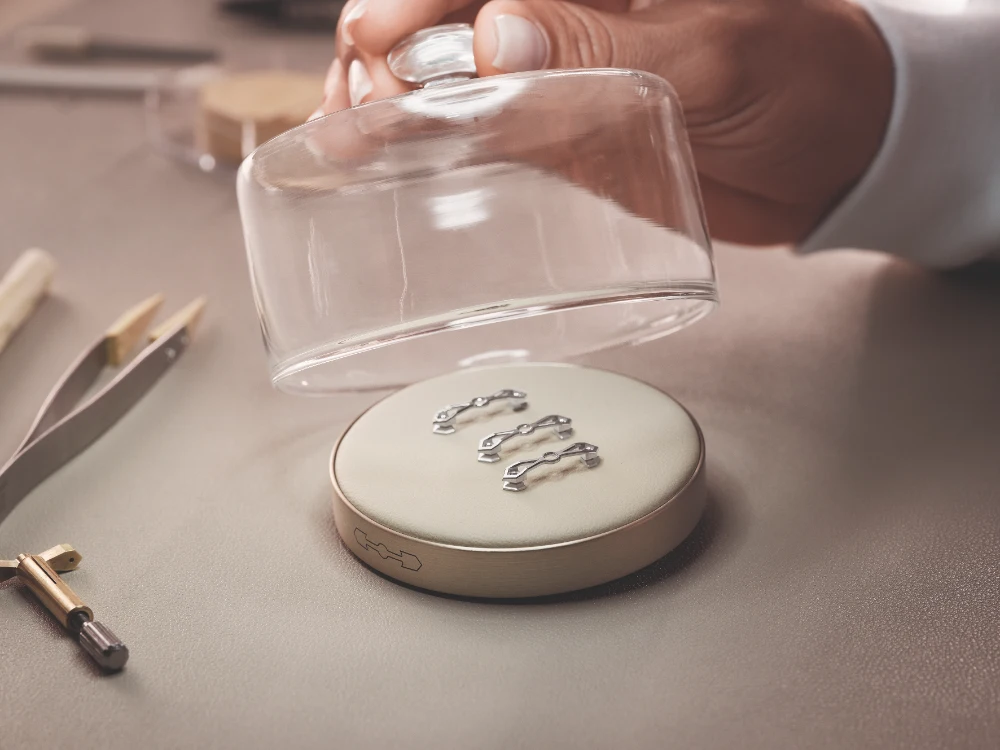
As stated earlier, the design of the Three Bridges has evolved over the years. For example, in 2014, the Manufacture unveiled the Neo-Tourbillon that was endowed with three bridges executed in a contemporary style. Now, with the advent of the Laureato Three Gold Bridges, the white gold bridges are partially openworked and more angular.
Girard-Perregaux Laureato Three Gold Bridges – case
The Laureato Three Gold Bridges is housed in a stainless steel case measuring 41 mm in diameter, with a thickness of 10.85 mm (the diamond-set model has a thickness of 11.25 mm). Although the case of the Laureato Three Gold Bridges is larger than the recently launched Laureato FIFTY, it shares the latter model’s pure lines. For example, the watch head elegantly merges into the bracelet with continuous flowing lines and neat, bevelled edges that gently taper.
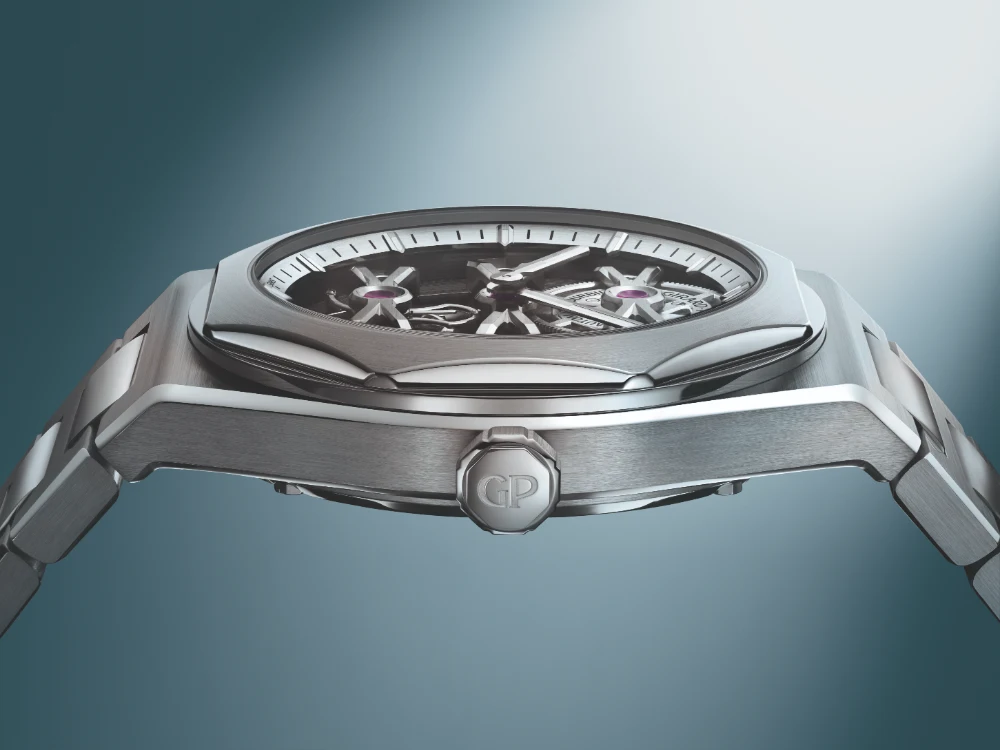
Interestingly, when viewing the watch from the side, it appears slimmer than its stated thickness might suggest. This is because the case middle is slender with the bezel resting on top, while the caseback gently nuzzles the fleshy part of the wrist. Indeed, once affixed to the arm, the Laureato Three Gold Bridges looks and feels slender.
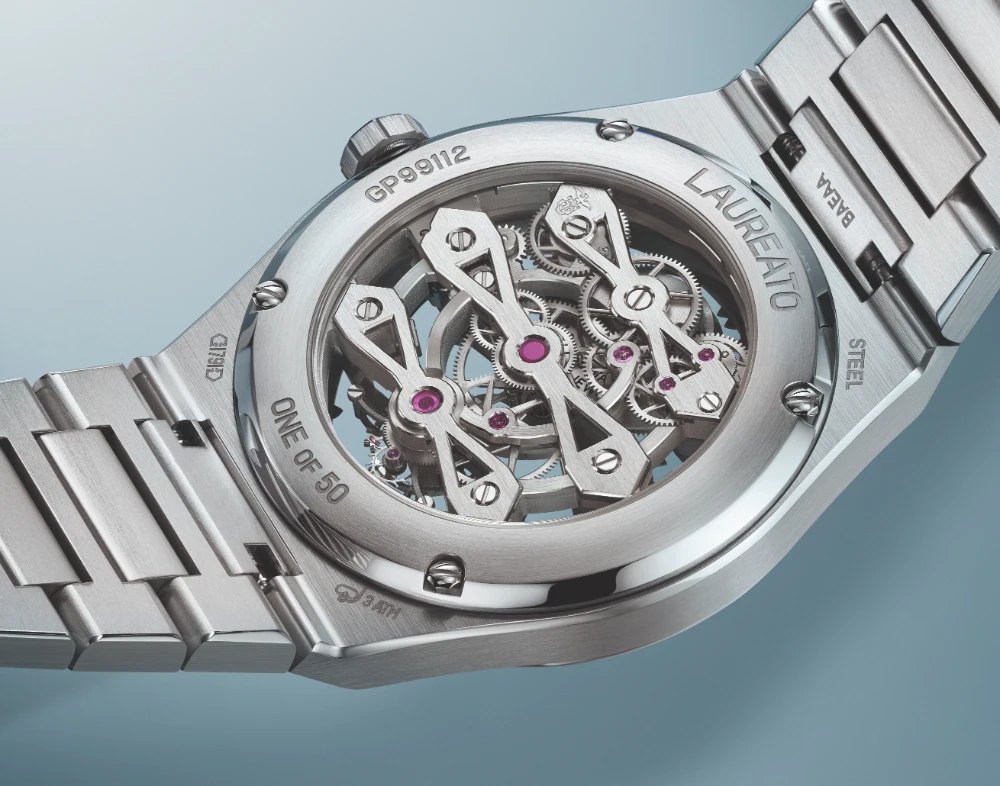
Girard-Perregaux has imbued the watch with subtle contrasts. For instance, the bezel is formed of white gold, delivering nuanced contrast with the stainless steel housing. The Manufacture has refined the bezel to incorporate larger bevels which beautifully engage with light. Moreover, the case has a more pronounced tonneau shape when contrasted with its antecedents.
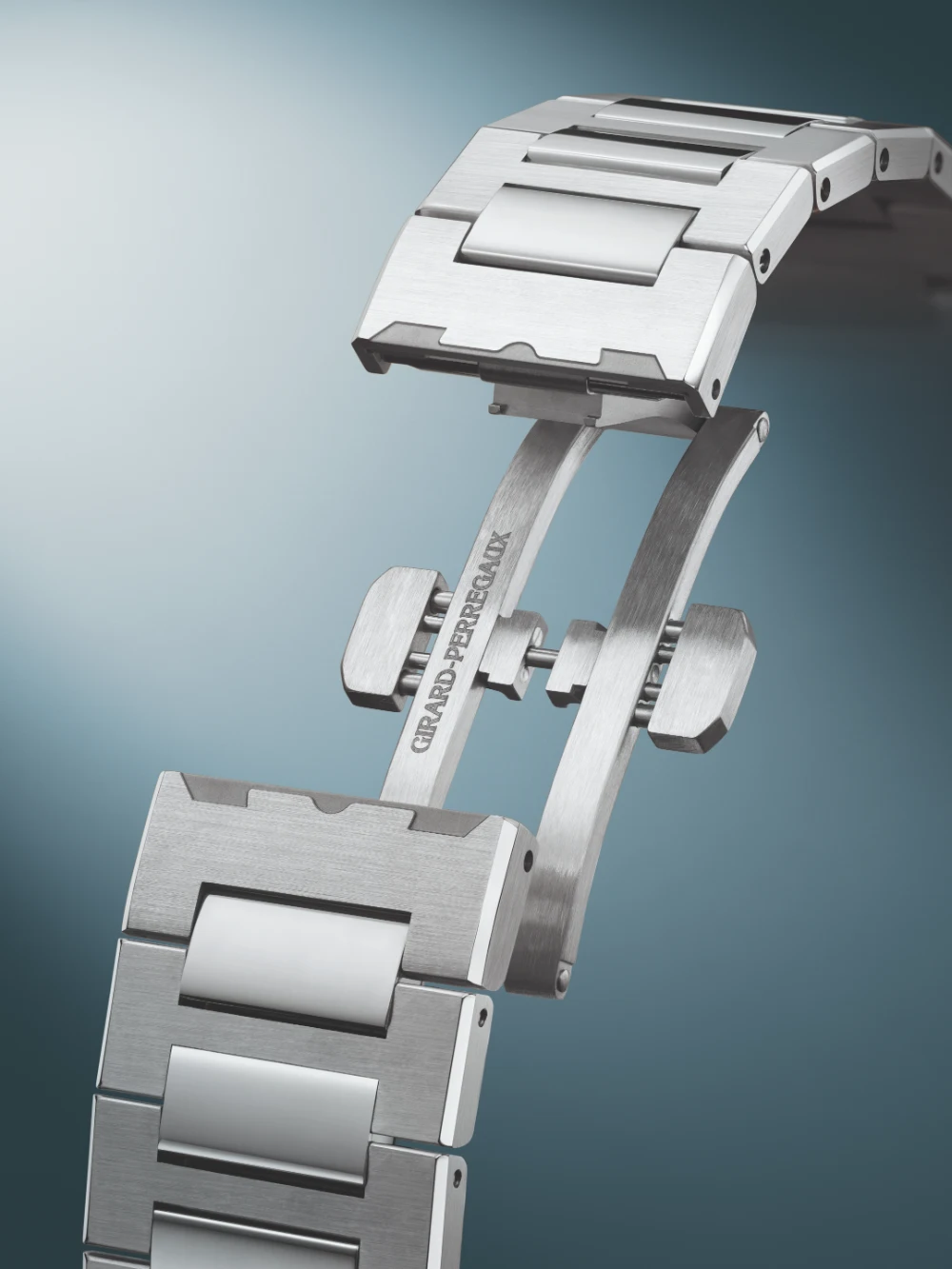
In common with the watch head, the bracelet juxtaposes brushed and polished surfaces, conferring a seemly aesthetic. Indeed, the central row of links is highly polished, heightening the bracelet’s aesthetic allure. Fitted with a triple folding clasp bearing the GP logo, the branding also extends to the inner blades. The clasp incorporates octagonal pushpieces that are clearly inspired by the bezel, located front of house.
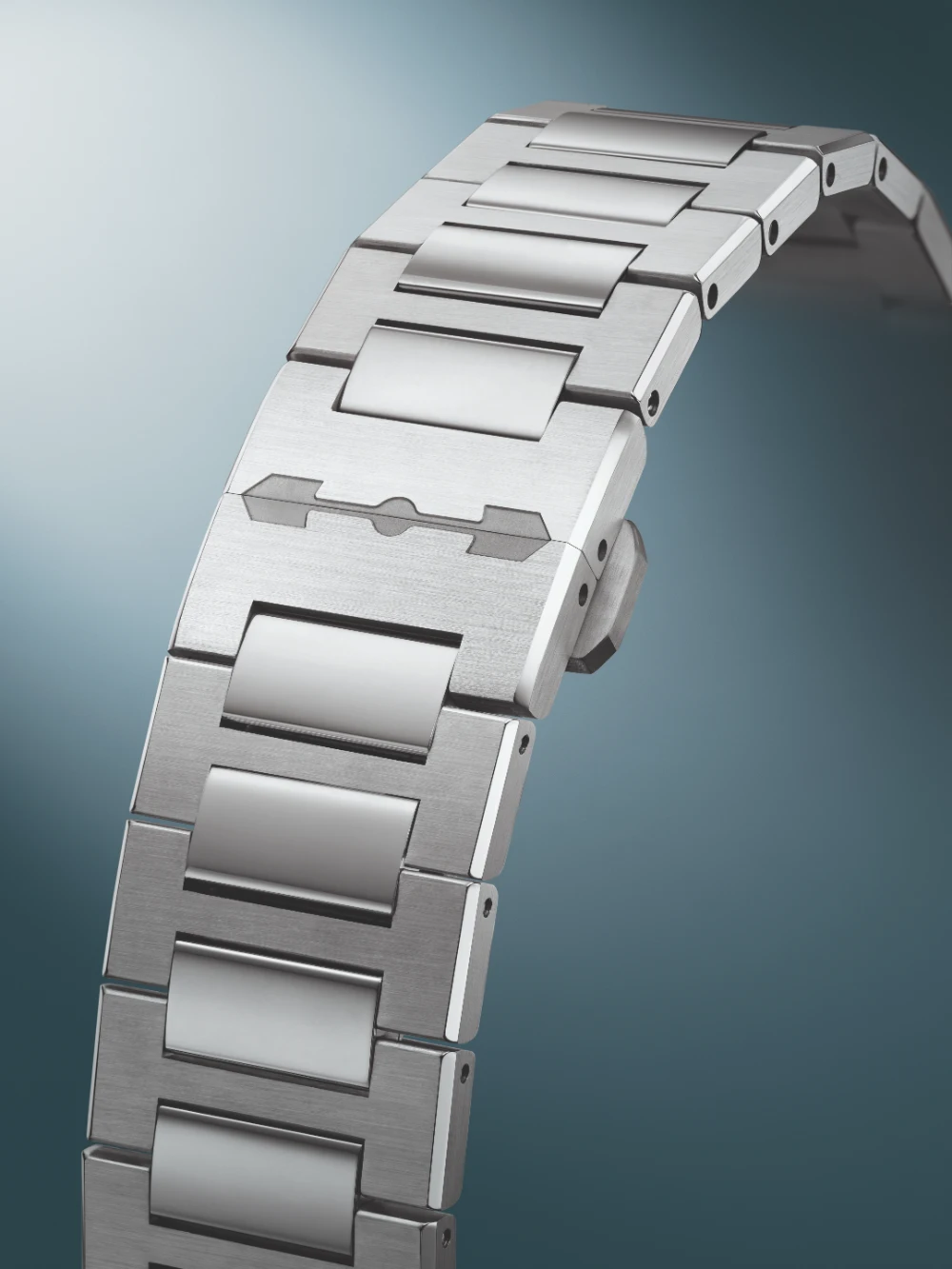
A notable characteristic of the Laureato Three Gold Bridges is that it is eminently comfortable to wear. The historic Manufacture has clearly expended many hours, refining the case and bracelet to enhance wearer comfort. In its quest for ergonomic excellence, Girard-Perregaux has equipped the bracelet with an ingenious fine adjustment system. This allows the wearer to extend the bracelet by 4 mm, highly useful on a warm day when the body can feel clammy and the wrist slightly swells.
Girard-Perregaux Laureato Three Gold Bridges – baguette-cut diamonds
The watch is an exemplar of Haute Horlogerie; however, in the esoteric world of luxury, there are some clients who crave even more indulgence. The Swiss marque sates this desire with a diamond-set version of the model. This reference features a white gold octagonal bezel that’s set with baguette-cut diamonds (~3.2 cts) using an invisible setting technique.
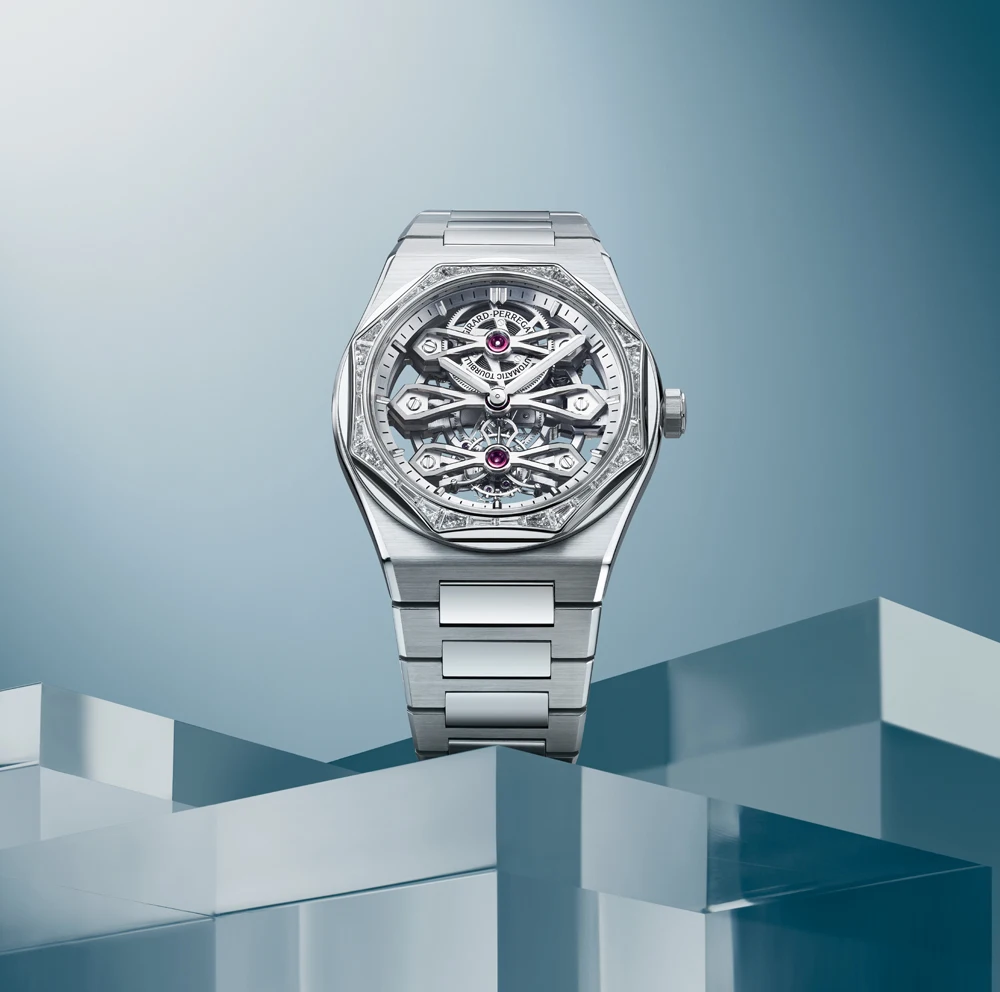
The bezel gracing the gem-set reference is slightly larger in order to accommodate a channel that hosts the various diamonds. The Master gem-setter carefully places the stones within this channel, making allowance for the subtle variations in size and shape. Ultimately, everything perfectly aligns, each stone sits in concert with its neighbour and the beauty of each diamond is optimised. Heightening the complexity of the artisan’s task, the diamonds increase in size as they near each corner of the octagonal bezel; a subtle evolution highly prized by discerning clients.
Closing remarks
The Laureato Three Bridges is a highly wearable creation. Indeed, unlike some skeleton watches, where the indications can become lost in a confusing sea of components, this timepiece remains a paragon of clarity. One reason the hours, minutes and seconds prove eminently simple to read is that the interior of the watch drinks in light, aiding readability.
Beyond the lucid expression of time, the watch proves comfortable to wear. Girard-Perregaux has clearly expended much effort optimising the relationship between the watch and its wearer. The tapering links smoothly encircle the arm, while the fine adjustment system contributes to the peerless wrist fit.
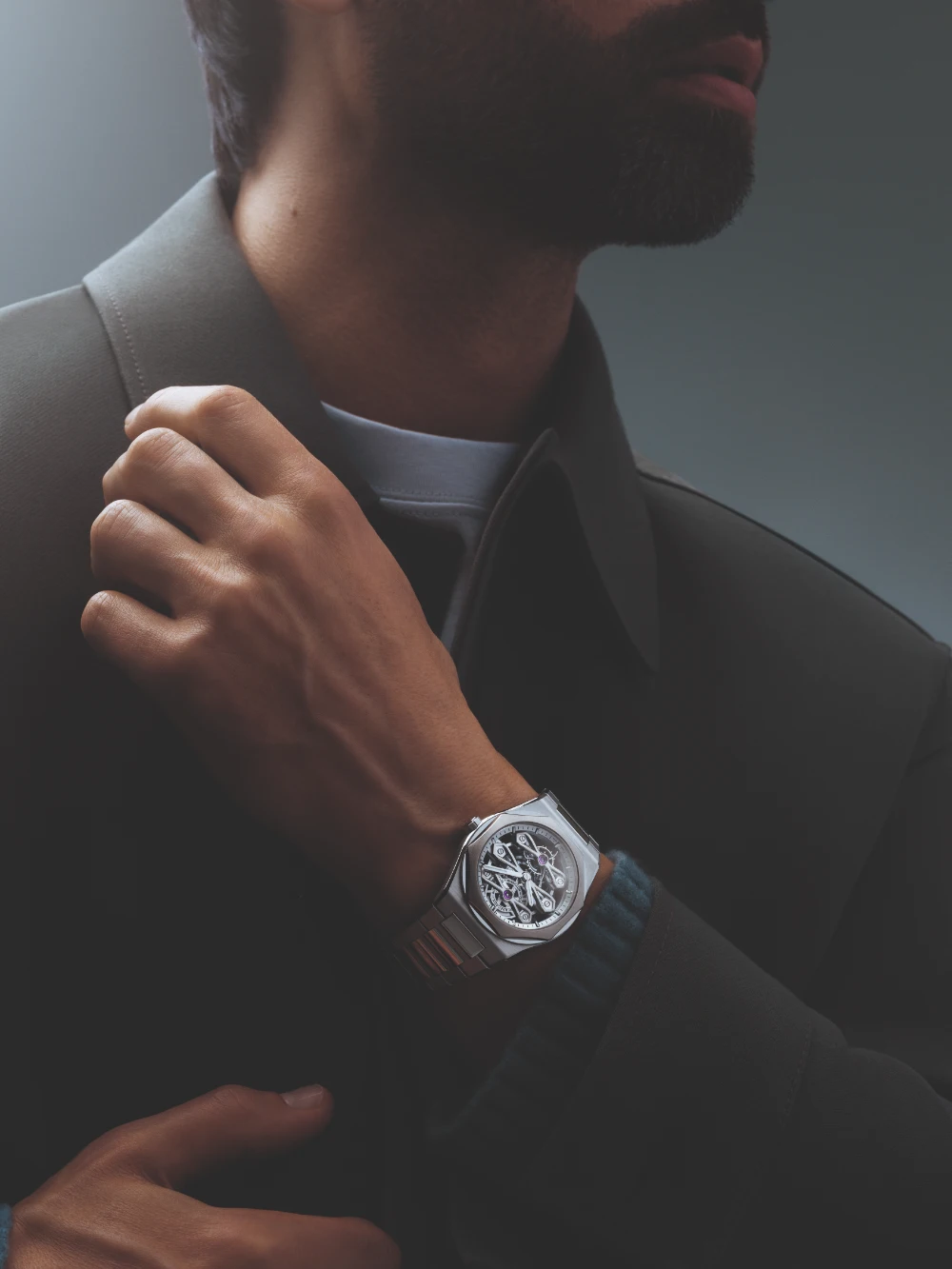
Unquestionably practical, the Laureato Three Bridges is blessed with a prepossessing appearance. Each facet of the bezel, case and bracelet has been sculpted to exhibit a jewel-like sparkle. Furthermore, for those collectors looking for an added quotient of brilliance, Girard-Perregaux offers a diamond-set expression of the watch.
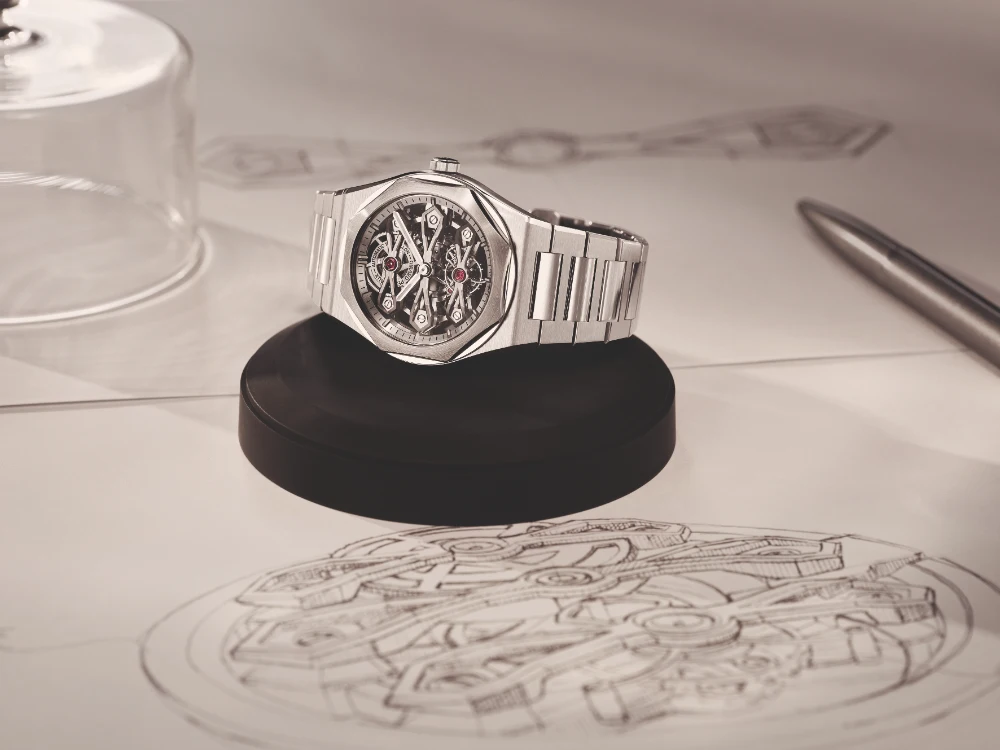
When describing this timepiece, I find myself repeatedly using the word, ‘refined’ and while there are synonyms which I could employ, ‘refined’ is the word that seems most apt. The model was designed, developed and crafted in-house. Consistent with the finest expressions of Haute Horlogerie, every watch is assembled and regulated by one watchmaker who expertly unites each component to form a piece of horological art. Indeed, just like a legendary landscape that bears its creator’s signature, the movement of this Girard-Perregaux, crafted from start to finish by one watchmaker, features a plaque engraved with their initials. By skilfully uniting two iconic models, the Swiss Manufacture has created a magnum opus worthy of your attention.
Further reading
https://www.girard-perregaux.com/
Technical specification
- Model: Girard-Perregaux Laureato Three Gold Bridges
- Reference: 99112-58-3576-1CM (no diamonds) – limited to 50 pieces
- Reference: 99112-58S3451-1CM (with 32 baguette-cut diamonds)
- Case: stainless steel with white gold octagonal bezel, diameter 41 mm, height 10.85 mm (the diamond-set model has a thickness of 11.25 mm), water resistance 3 ATM (30 metres), sapphire crystal to front, exhibition case back.
- Functions: hours, minutes, small seconds on the tourbillon
- Movement: Calibre GP 9620, self-winding movement, frequency 21,600 vph (3 Hz), 33 jewels, 303 components, power reserve min. 55 hours
- Strap: stainless steel bracelet fitted with a triple-folding clasp with up to 4 mm of fine adjustment
- Price: 99112-58-3576-1CM – CHF 162,000 (RRP as of 19.11.2025)
- Price: 99112-58-3576-1CM – CHF 219,000 (RRP as of 19.11.2025)