
L’Epee 1839 Belly Tank Racer Clock Review
Likely to resonate with petrolheads and horophiles alike, the L’Epee 1839 Belly Tank Racer is an expression of ‘Creative Art’ that imaginatively indicates time. Having visited many watch factories, Angus Davies recently travelled to Delémont, keen to witness clockmaking firsthand and see some of the Swiss marque’s car-themed products.
 L’Epee 1839 – mastering scale
During the formative years of childhood, the human brain develops at a remarkable rate as youngsters observe, explore and evaluate. Children begin to understand size in the first few months of life. With the onset of speech, they will compare objects, initially using simple words such as ‘bigger’ or ‘smaller’. Eventually, children connect visual features with actual physical size, albeit miscalculations have sometimes led to arms and legs becoming trapped, as many panicked parents will attest.
In adulthood, the brain, now a well-oiled machine, is capable of using physical reference points to determine size. It is less prone to error, albeit there will still be occasions when the scale of an object has the capacity to surprise the observer. For instance, should you stand in front of a skyscraper, its awe-inspiring vastness may well take your breath away.
L’Epee 1839 – Creative Art
Recently I travelled to L’Epée 1839, a Manufacture based in Delémont in the heart of the Swiss Jura Mountains. Founded in 1850, the company has amassed a remarkable talent for mastering scale, capturing detail and crafting mechanisms that depict time. While its origins lie in the creation of alarm clocks, table clocks and musical watches, L’Epée 1839 has attracted much attention in recent years for its ‘Creative Art’. The luxury marque uses this term to describe the three-dimensional objects it creates. Formed from a variety of materials, sometimes encompassing artistic crafts, these extraordinary creations replicate objects in miniature, precisely to scale, as well as indicate the prevailing time.
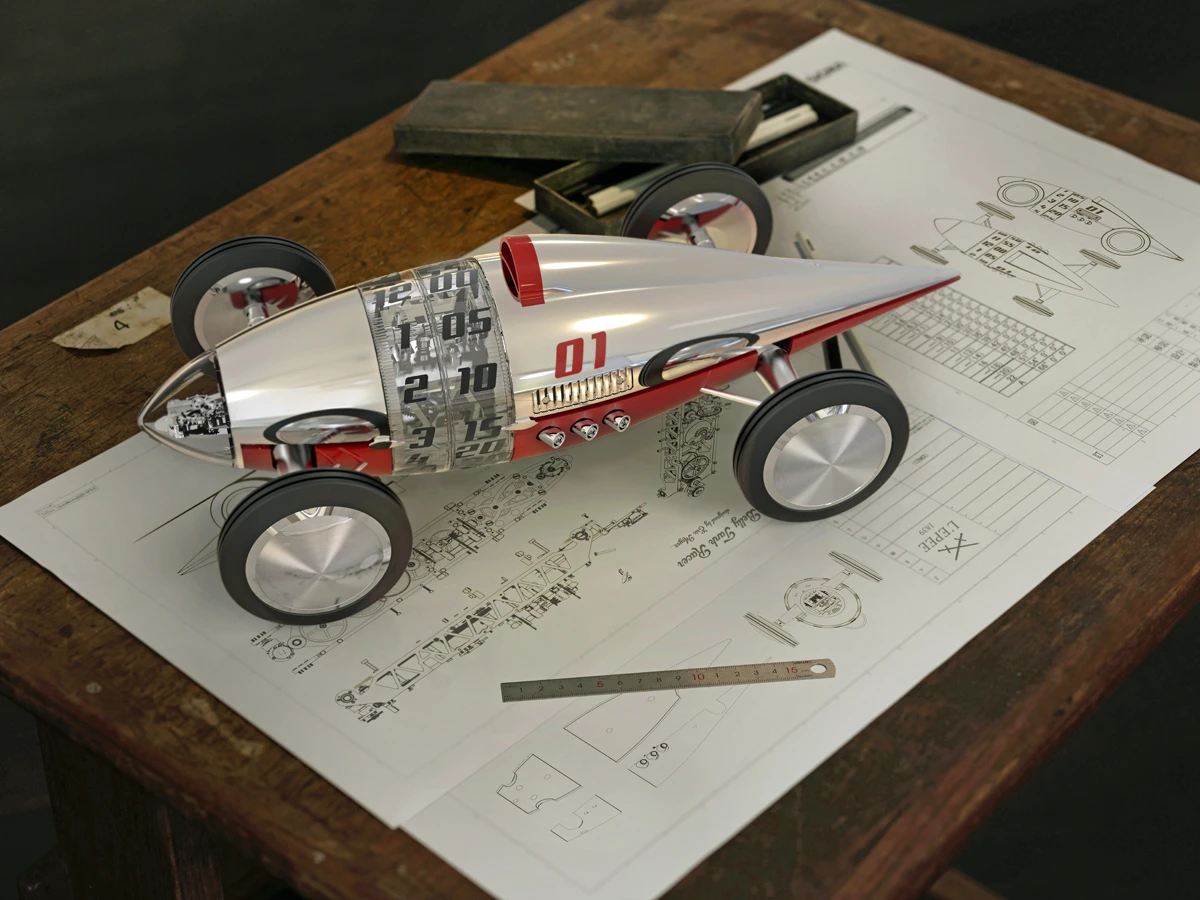
Image – L’Epee 1839 Belly Tank Racer
Over the years, I have visited numerous watch factories and grown accustomed to seeing CNC (Computer Numerical Control) and bar turning machines. These same machines were much in evidence at L’Epee 1839; however, the components produced are much larger. For example, the bar turning machines contained brass and steel rods with a far greater circumference than I’m accustomed to seeing within a watch factory.
L’Epee 1839 – Haute Horlogerie, just bigger
Despite the scale of components being different, the brand shares the same focus on mechanical excellence and artisanal craftsmanship as a prestigious watch maison. Indeed, the practices you would expect to encounter within Haute Horlogerie are much in evidence; it’s simply that everything is made to a different scale.
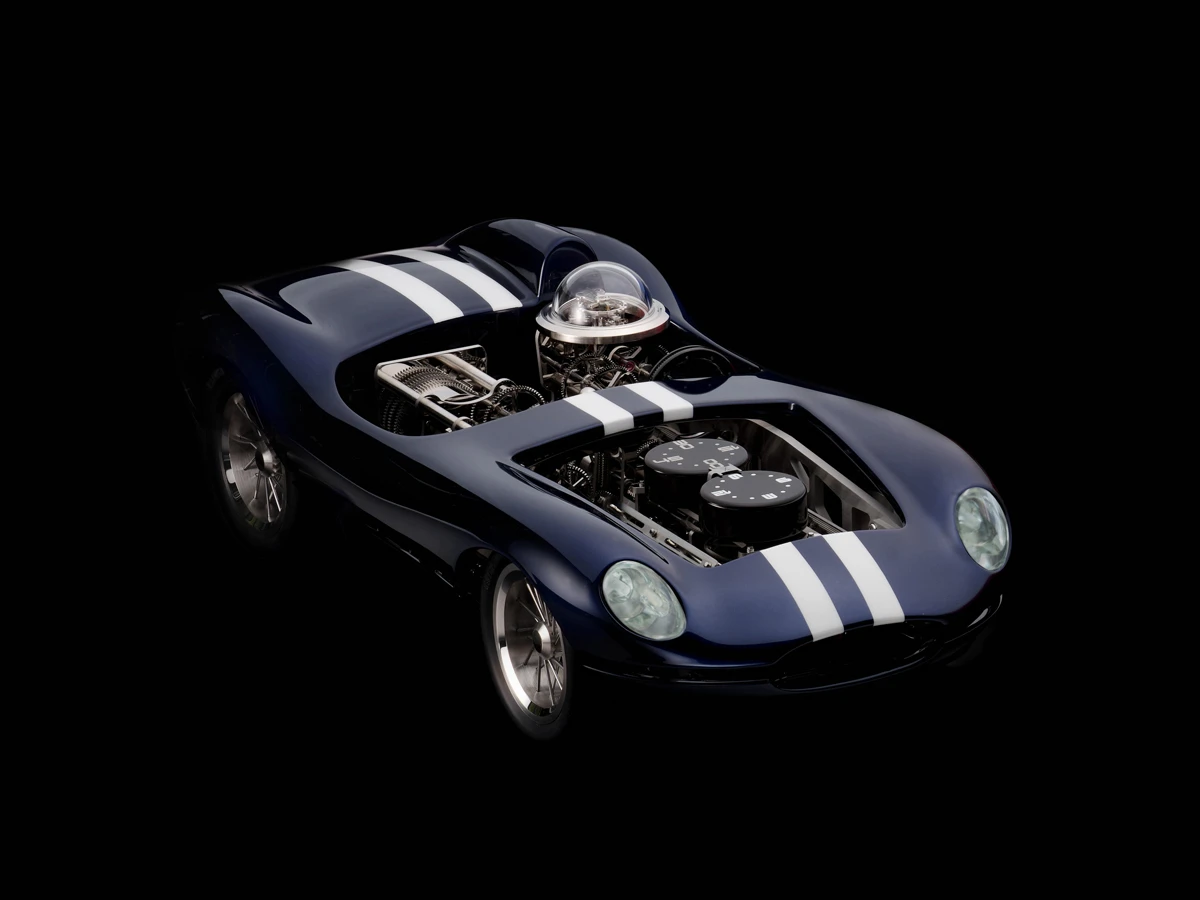
Image – L’Epee 1839 Time Fast 2
While touring the Manufacture, I walked past numerous ticking sculptures. It seems there are no limits to the brand’s creativity. I witnessed hot-air balloons, geckos, Memento Mori skulls and even grenades, all precisely indicating time, all beautifully crafted and worthy of comparison with wristworn expressions of Haute Horlogerie.
L’Epee 1839 car-themed clocks
A confessed horophile and petrolhead, I’ve always had a fondness for L’Epée’s car-themed clocks. Indeed, the Time Fast D8, the Time Fast II and the T35 race car evoke images of cars from a bygone age; thoughts of historic Jaguars, Ferraris and Bugattis readily come to mind.
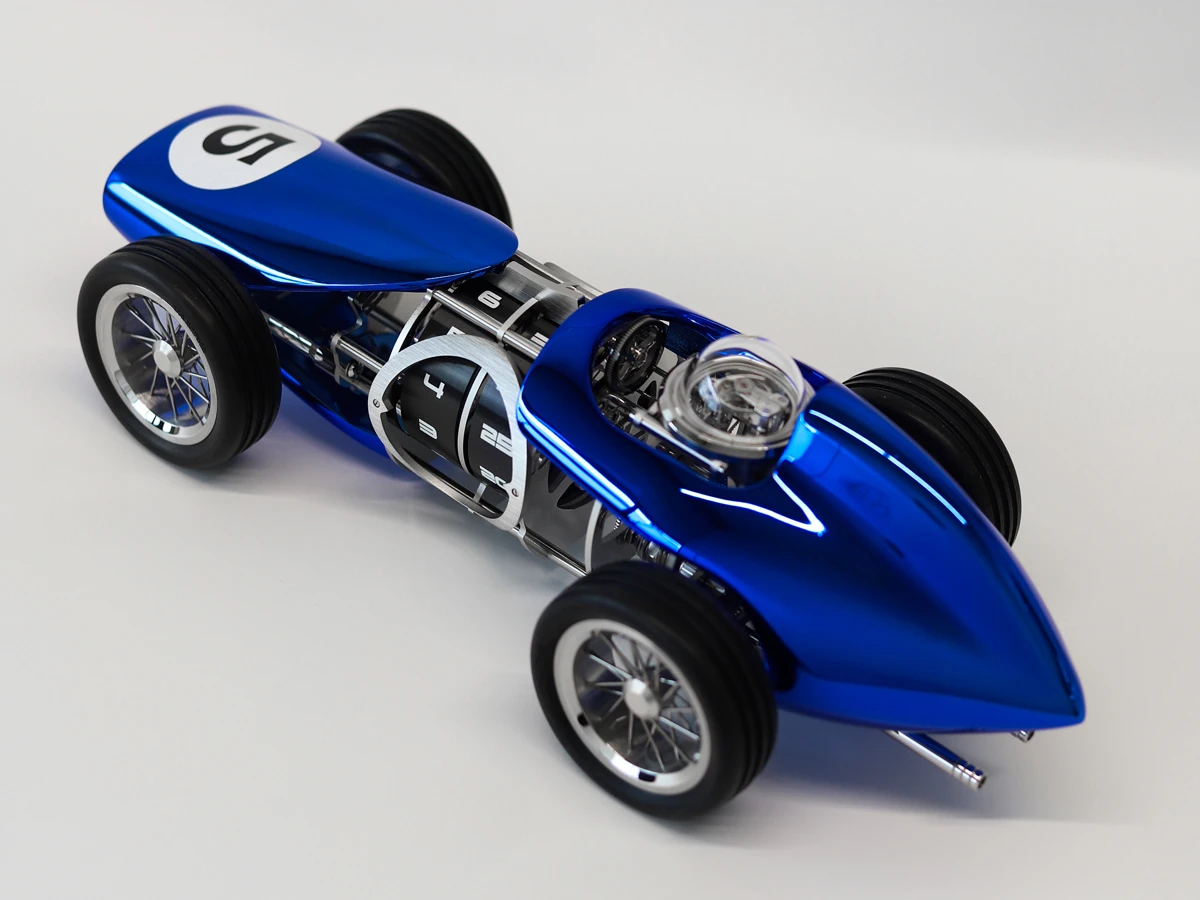
Image – L’Epee 1839 Time Fast
Earlier this year, L’Epee 1839 unveiled the Belly Tank Racer. Its name immediately piqued my interest, prompting me to explore the Googlesphere in a quest to discover the backstory that led to its formation.
L’Epee 1839 Belly Tank Racer – inspiration
During WWII, military planes, such as the Lockheed P-38 Lightning, would carry ‘drop tanks’, also known as ‘belly tanks’. These held additional fuel, allowing the plane to fly further. Once empty, the belly tanks were jettisoned. After the war, there was an abundance of surplus military equipment, including said belly tanks.
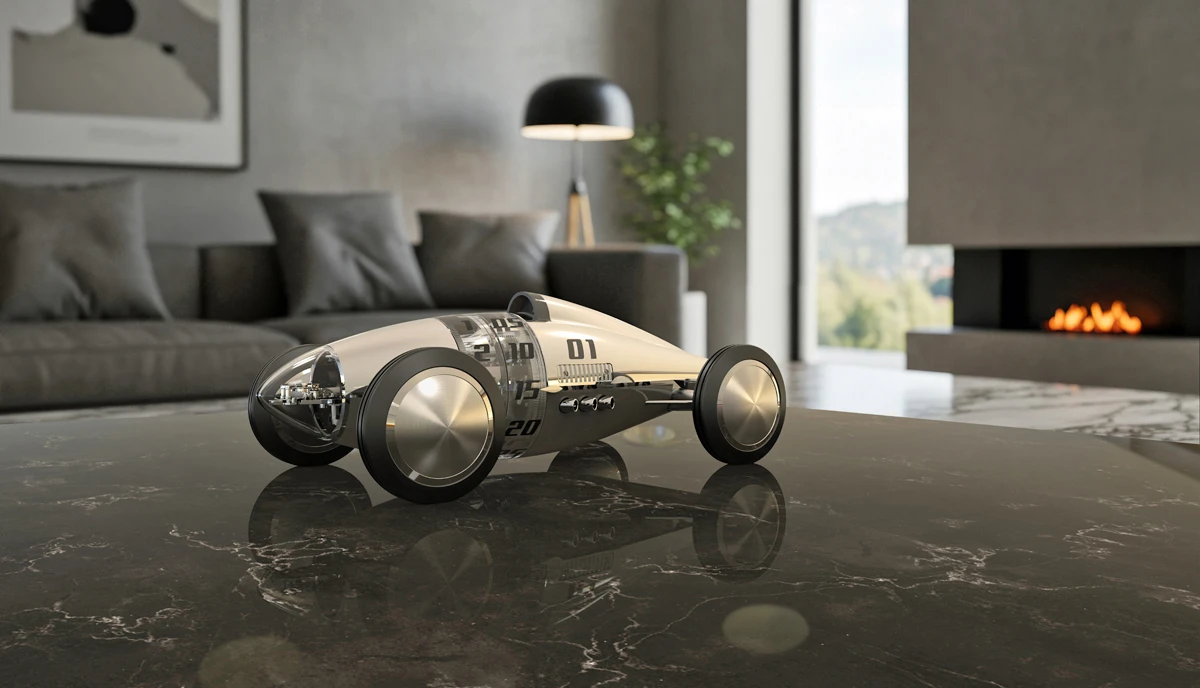
Designed to cause minimal drag when affixed to a plane, the belly tanks also made ideal racing machines, their aerodynamic shape efficiently scything through air. Four wheels and an engine squeezed into position, these racing machines were conceived with scant regard for safety or comfort. A small hole cut out of the belly tank provided the means for the driver to gain access. This inevitably meant contorting their torso to fit, leaving just the head peeping out, ready to be pummelled by quick-flowing air.
Often raced on dry lake beds, there was simply one overriding goal – cover a specific distance in the quickest time.
L’Epee 1839 Belly Tank Racer – Eric Meyer
The L’Epee 1839 Belly Tank Racer was conceived by Eric Meyer, a design veteran based in Switzerland. He has designed and developed a multitude of products over the years, including consumer goods and watches. His list of former clients, including MB&F, Swatch Group, Rolex and Nespresso, makes impressive reading.
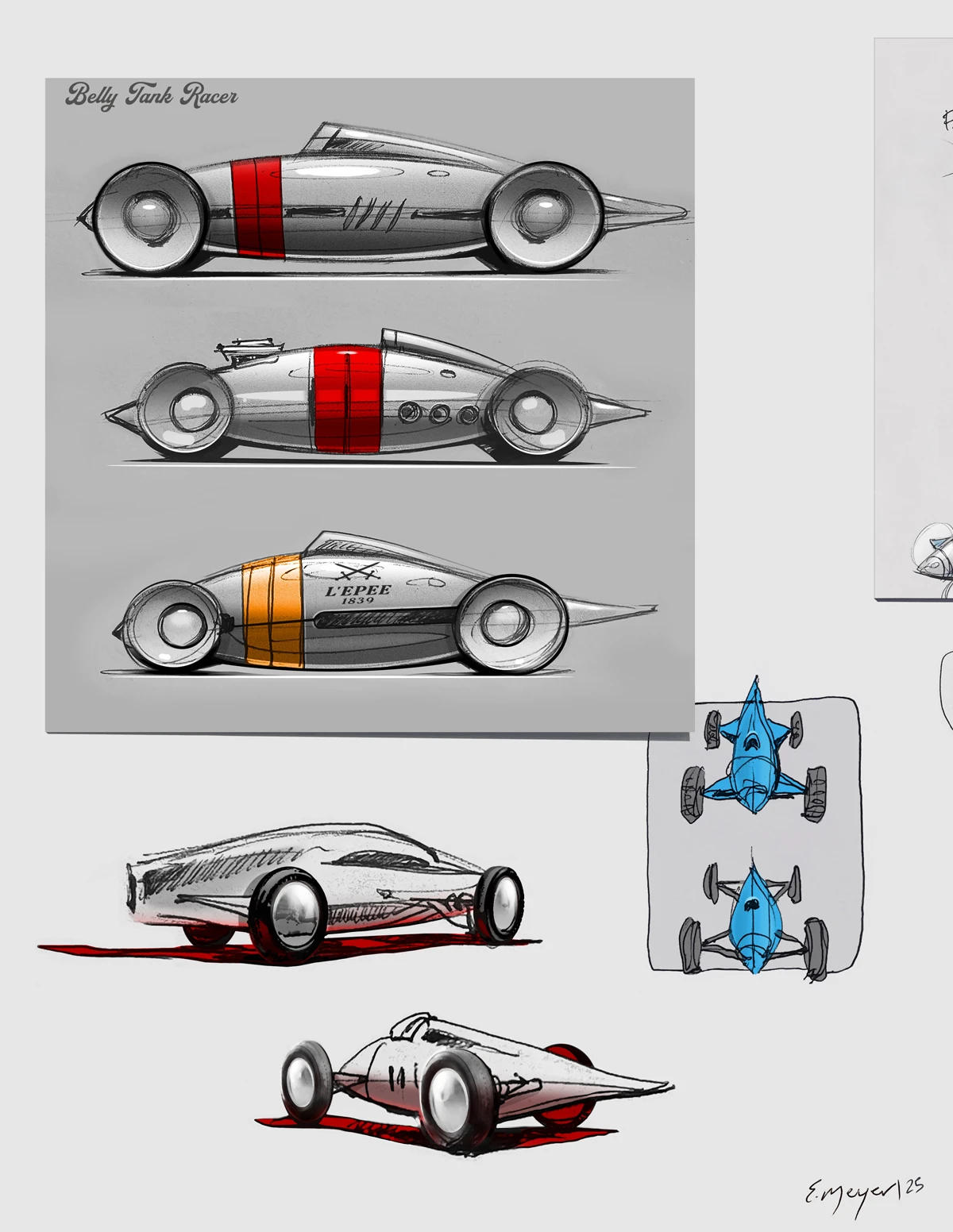
L’Epee 1839 Belly Tank Racer – in the metal
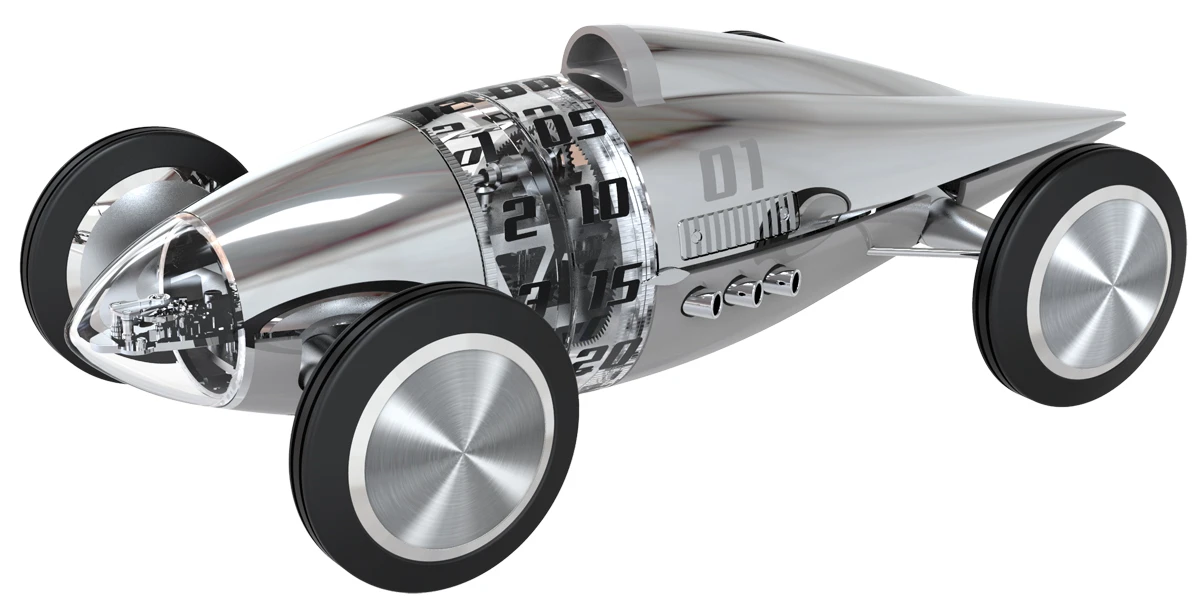
Blessed with a teardrop profile, the front of the L’Epee 1839 Belly Tank Racer resembles the tip of a bullet, poised to penetrate the air. It’s crafted in acrylic, thereby revealing the balance wheel oscillating to and fro with its Incabloc shock-protection system atop, ready for any rough terrain the car may encounter.
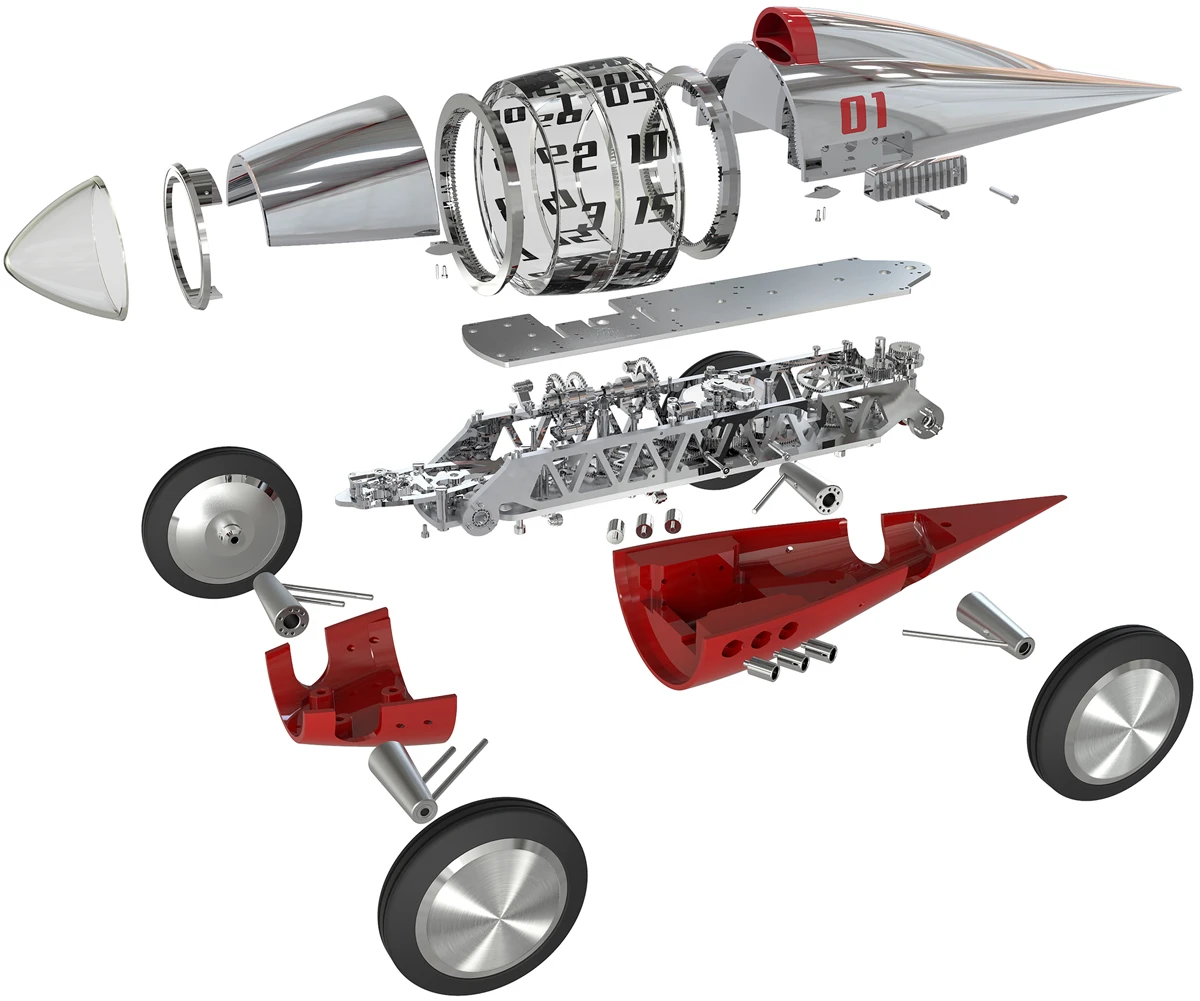
The upper and lower sections of bodywork are crafted from aluminium. The lower bodywork sections are presented in a selection of hues, including blue, green, metallic grey, red or black. Each colour is applied in-house within a dedicated paint studio, reminiscent of a car bodyshop, just a bit smaller.
Hours and minutes are shown on two transparent, rotating discs. The prevailing time is shown with a neat index, positioned adjacent to three stylised exhaust pipes. No keys or crown; the owner merely turns the minute disc clockwise to set the time. Look beyond the large Arabic numerals, executed in a contemporary font, and you will see part of the space frame construction and gear-train wheels belonging to the in-house movement.
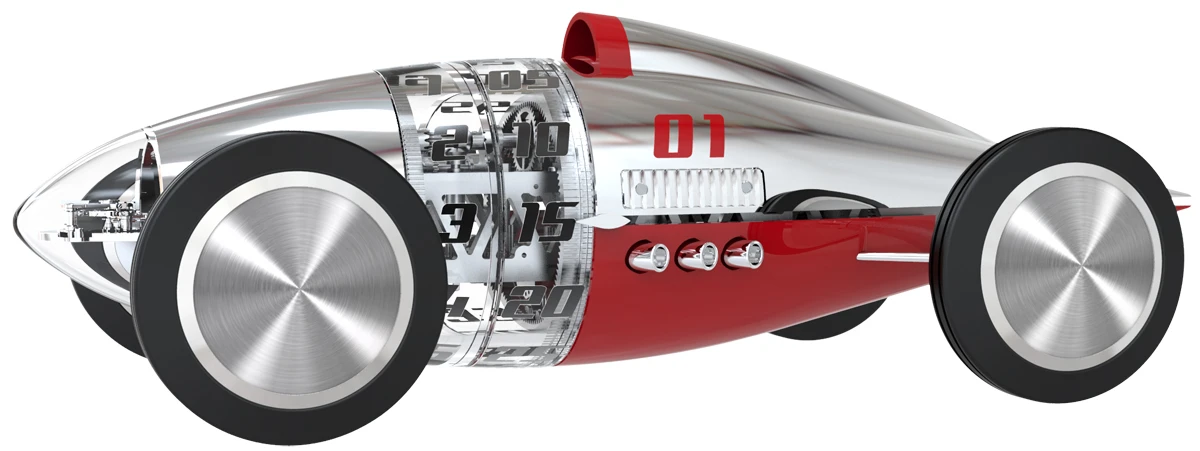
Four wheels with steel rims, shod with soft rubber tyres, connect the Belly Tank Racer with the road. Oversized and narrow, they reinforce the sense of speed and purpose. Place the car on a flat surface and simply pull it back to tension the mainspring. The 2.5 Hz movement incorporates 11 jewels and will run autonomously for 8 days.
Perusing the specification sheet for the L’Epee 1839 Belly Tank Racer reveals the brand has sculpted this ‘Creative Art’ from a multitude of materials and endowed it with several finishes. ‘Palladium-plated brass, polished stainless steel and acrylic glass together with polished, satin and sandblasted finishes, collectively capture the look of yesteryear.
Closing remarks
The L’Epee 1839 Belly Tank Racer encapsulates the zeitgeist of the post war-era, when optimism was omnipresent and individuals chose to pursue speed, often with scant consideration for safety, celebrating their freedom.
Every child has played with a toy car, pushing it along to the accompaniment of a human-generated ‘vroom’ sound. L’Epee taps into this nostalgia and yet, paradoxically, the company doesn’t create toys, but rather realistic representations of racing machines that indicate the time. The firm employs fine materials, imparts refined finishes, finesses minuscule details and includes beautifully engineered mechanisms – oh, and of course, everything is produced perfectly to scale.
Further reading
Technical specifications
- Dimensions: Length: 420 mm – Width: 212 mm – Height: 123 mm
- Weight: 5.4 kg
- Limited Edition: Available in a choice of blue, green, metallic grey, red and black – each limited to 99 pieces.
- Price on application