
Fleury Manufacture FXR-4 Openwork Watch Review
Having visited Fleury Manufacture in Choulex, Mark McArthur-Christie discusses Jean-Marc’s latest artisanal creation, the Fleury Manufacture FXR-4 Openwork – the very antithesis of mass production.
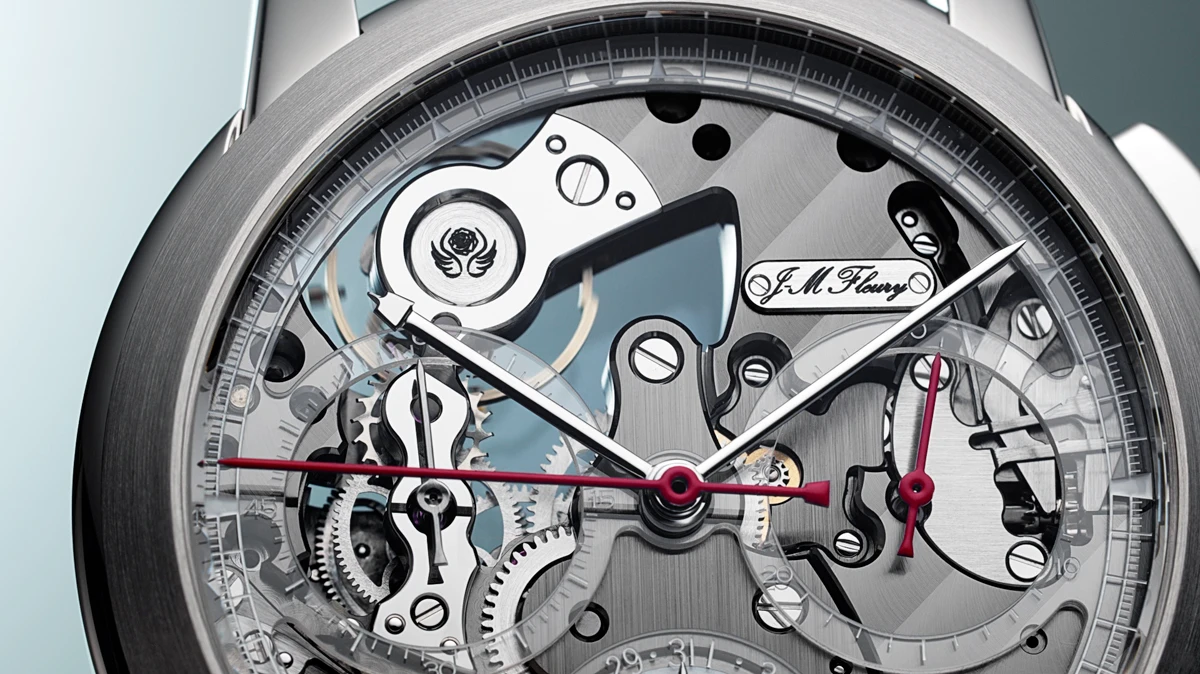
Nothing to hide
Pop the bonnet of almost any car built in the last twenty years and you’ll be greeted by a moulded, black plastic shroud. It’s there to muffle noise (frequently a good thing with modern sewing machine engines), to tidy the view and above all to keep you out and stop you looking at anything. Underneath it, the engine will be a decent piece of compliance engineering, but about as attractive as the motor in your washing machine.
Now think of a Colombo V12 in a 250 GT, with its crackle-black cam covers and its spider’s web of ribbed alloy. Or a Bugatti Type 35’s engine-turned block, machined in overlapping arcs by a bloke with dirt under his nails, an emery cylinder and more patience than most – a finish, incidentally, that watchmakers were applying to movement plates a century before Molsheim borrowed it.
Unlike the power unit in my Golf, so close to being a domestic appliance I refer to it as ‘The Fridge’, those engines were built knowing they’d be looked at.
Fleury Manufacture, Choulex
Which brings us, by way of a lake and a short drive uphill, to Choulex.
It’s worth paying attention on the drive, because Choulex is almost small enough to miss with a blink. On the eastern shore of Lake Geneva, it’s perhaps fifteen minutes from the city and several worlds away from the polished boardroom tables and egos of the Vallée de Joux. It is where Jean-Marc Fleury has his bench, makes a fine cup of coffee, and it’s where his FXR-4 Openwork is made.
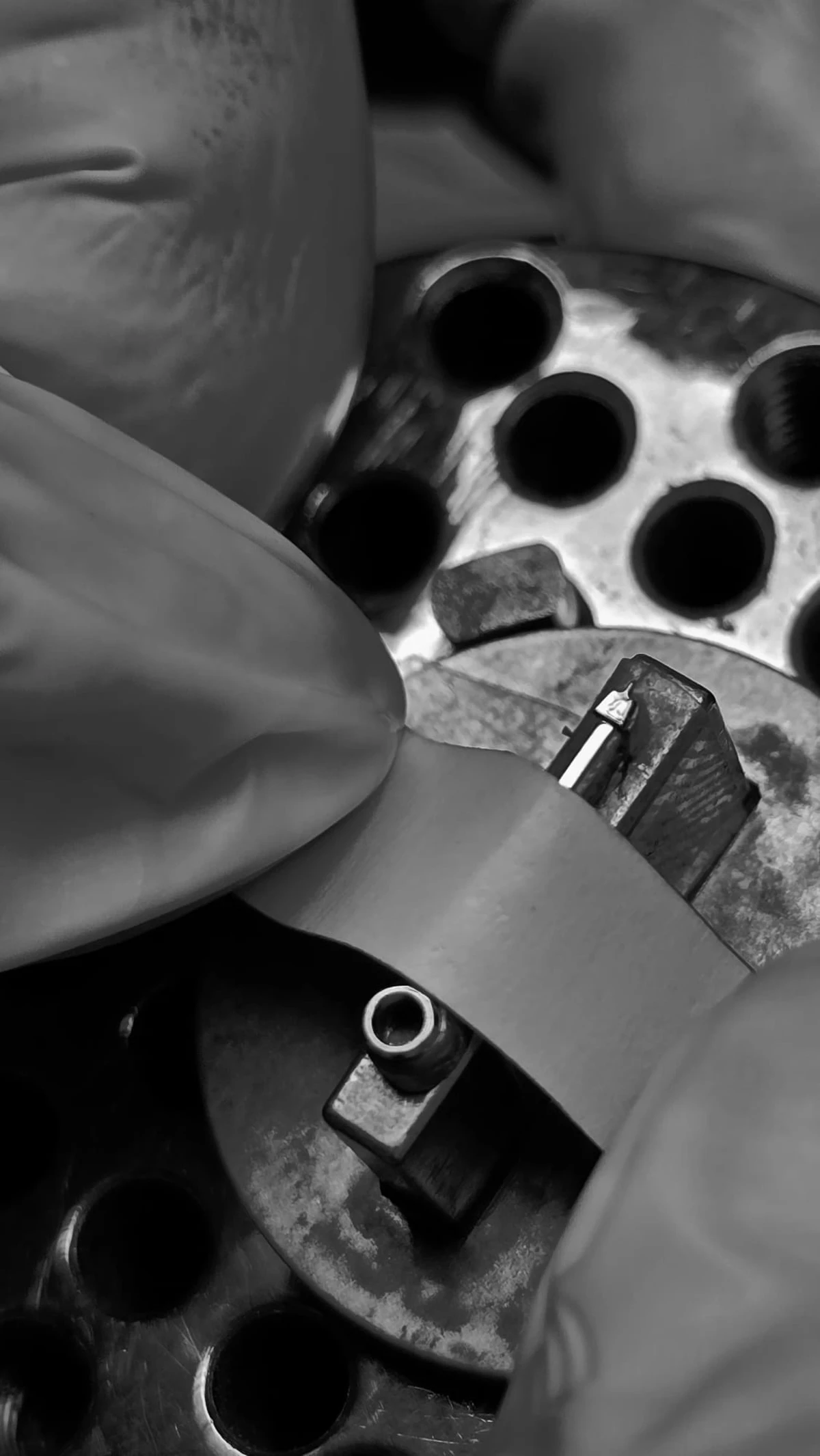
Image – hour hand polishing
Jean-Marc spent over a decade at Patek Philippe before setting up on his own in 2017. What he set up, though, wasn’t a watch brand. It was much more gritty than glitzy – Suisse Précision Composants – a component maker, making parts for other people’s watches with the sort of precision that gives normal people a headache. Many of his customers are independent watchmakers, several of which are GPHG winners.
This matters more than any amount of brand-polished copy because it answers the obvious question: how does a business this tiny produce something this good? The answer is that the watches came second. Fleury already owned the machines, already had the process controls and already knew how to make things with a function look beautiful. Making his own movement wasn’t a leap into manufacturing, it was a logical use of a workshop he’d already built. The first calibre, the FM01, arrived in 2020. The FXR-4 chronograph followed in 2024 – we looked at it and enjoyed every 1/5th of a second.
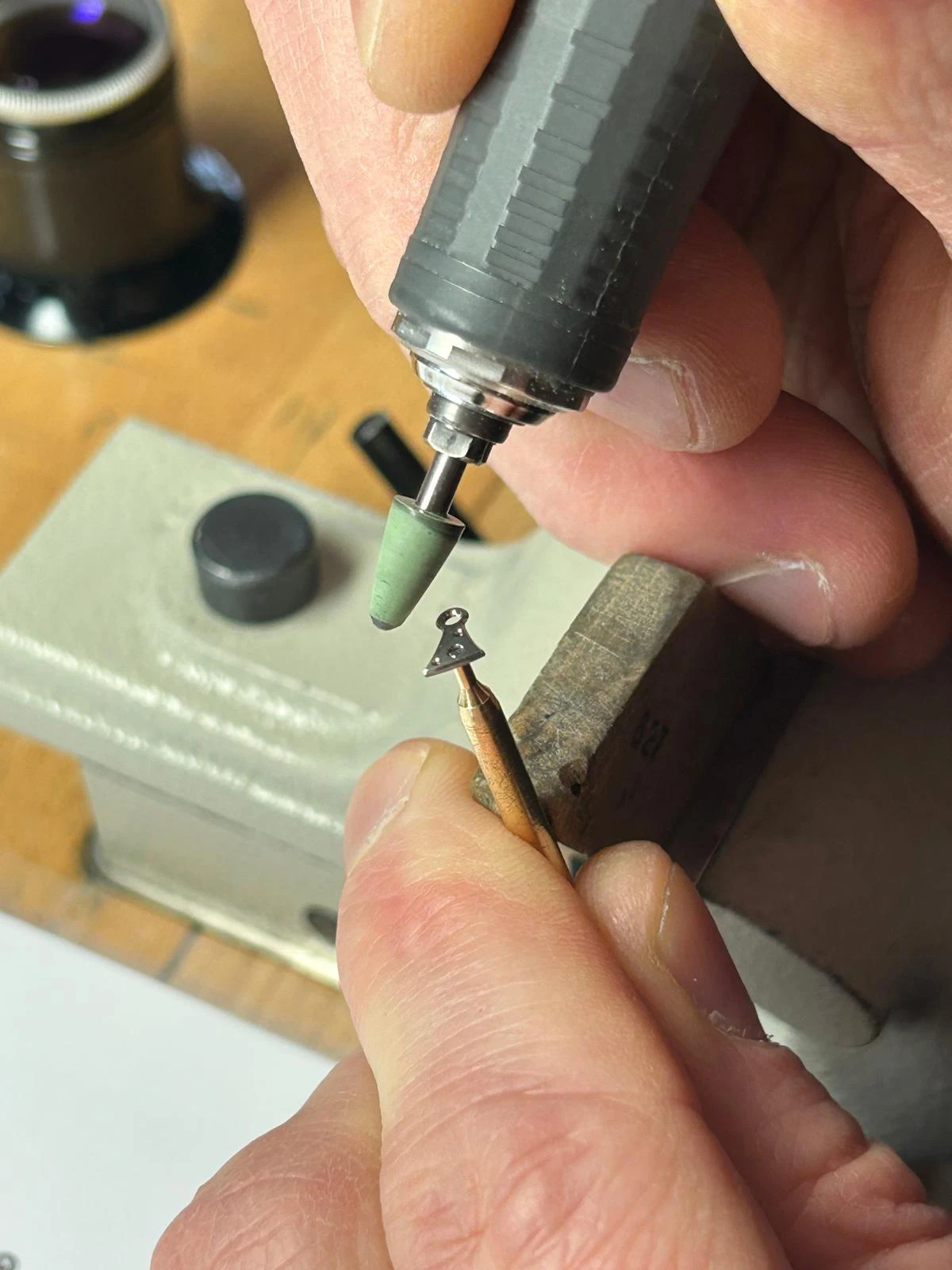
Image – polishing chamfer
Jean-Marc’s logic is the same logic that drove the best small-volume car makers. Bristol built aeroplanes before they built cars. Lotus was a man with a lock-up and a scary obsession with making things lighter. Capability first, product second – and the product is honest because it’s grounded in function, not marketing.
Fleury Manufacture FXR-4 Openwork – the movement
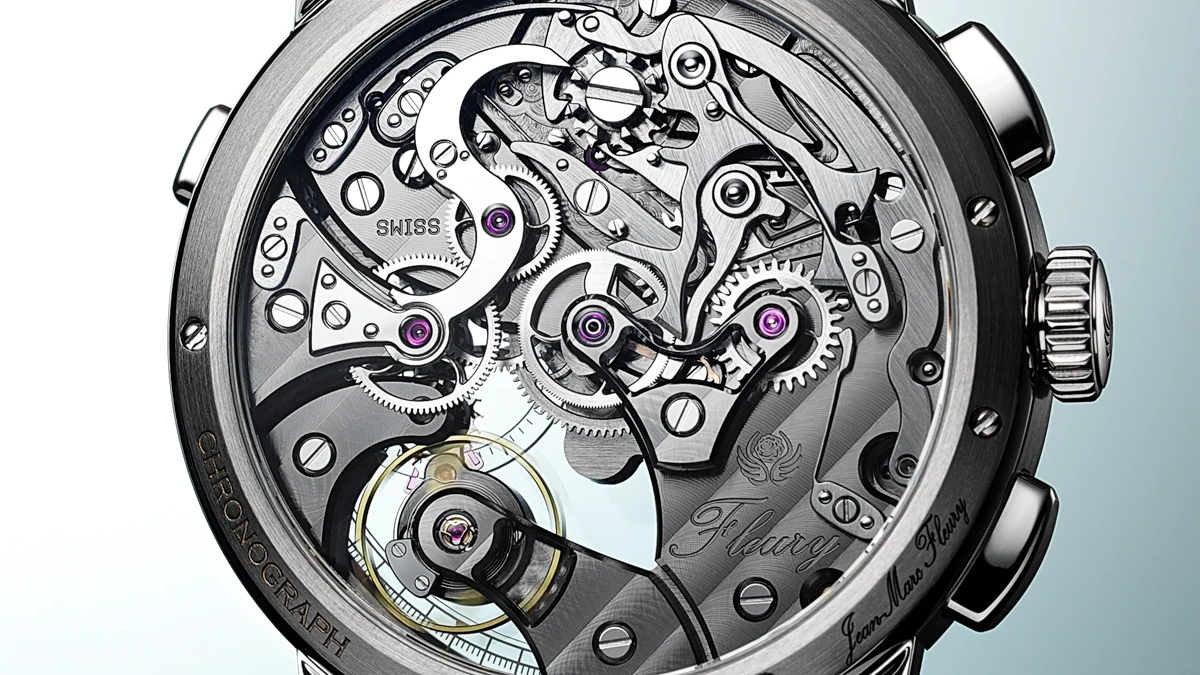
The FM04 inside the Fleury Manufacture FXR-4 Openwork is Fleury’s reinvention of the Lemania 2310. To carry our car analogy a little further, this is like someone sitting down and deciding the Bugatti Type 57S could use a bit of development work. Then turning the dials on his own lathe to do it.
Designed by Albert Piguet and Jacques Reymond in the early 1940s, the 2310 is pretty close to being the final boss chronograph movement. Omega used it as the calibre 321 – the movement on Buzz Aldrin’s wrist in the Speedmaster. Patek Philippe based its CH 27-70 on it, the movement powering the 3970 and 5970 perpetual calendar chronographs. Vacheron Constantin and Breguet used it too. A movement like the 2310 is not easy to improve. When people say a design is a classic, they usually mean it’s old and looks good. The 2310 is a classic in the proper sense: nobody has convincingly improved on it in eighty years.
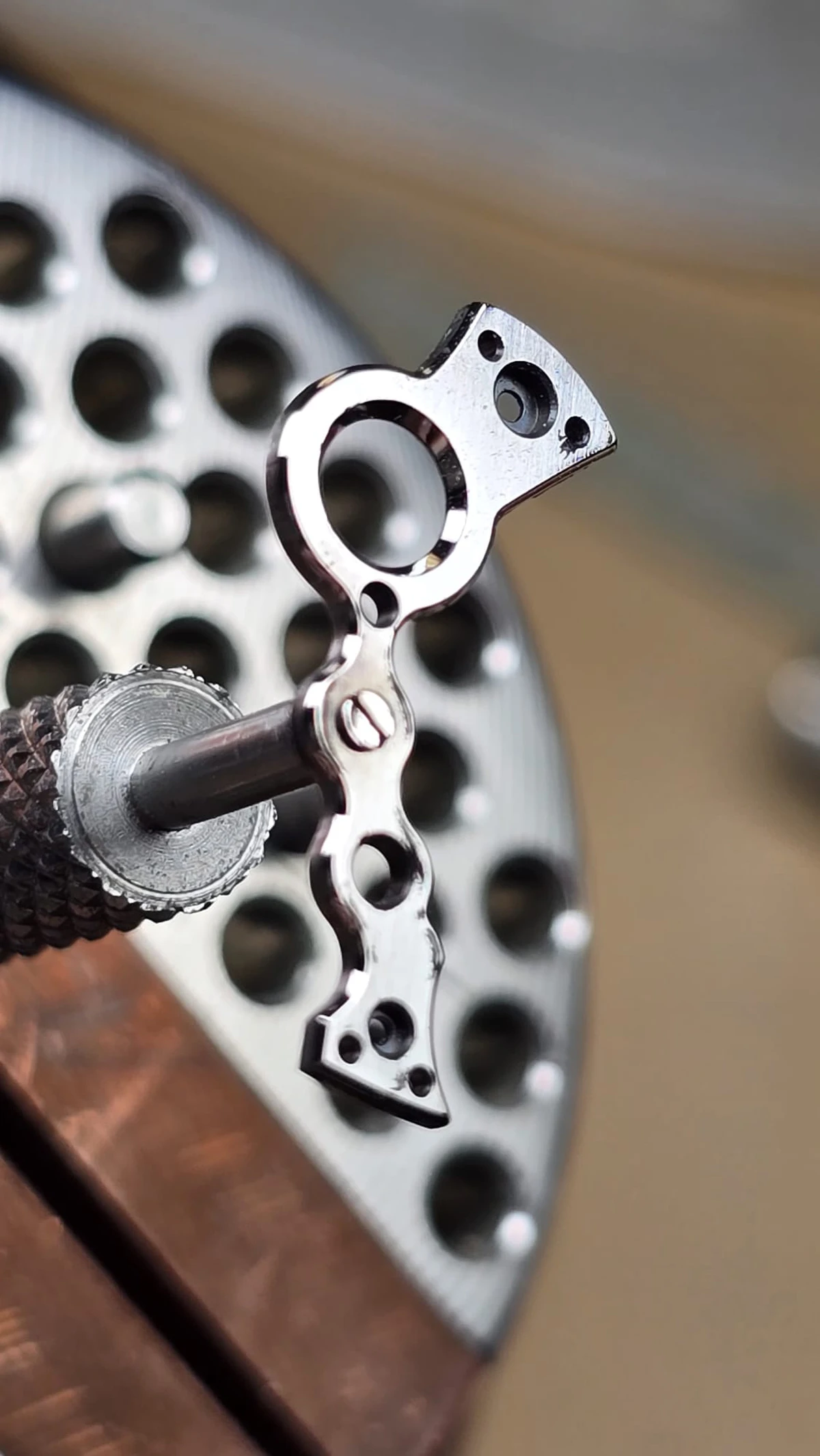
Image – column wheel plate
Under Fleury’s hand, the calibre has grown from the original 27 mm to 32.5 mm, so it actually fills a 40 mm case rather than rattling around like a ball bearing in a tin. The frequency is up from 18,000 to 21,600 vibrations per hour, yet the power reserve has gone the right way too, to sixty hours. Most interestingly, Fleury has integrated the chronograph driving wheel into the going train, siting it and the fourth wheel beneath a single bridge. That’s a structural refinement, not a cosmetic one, and it’s the sort of thing that takes a long time to think through, plan, prototype and machine, and wins you no marketing copy inches at all.
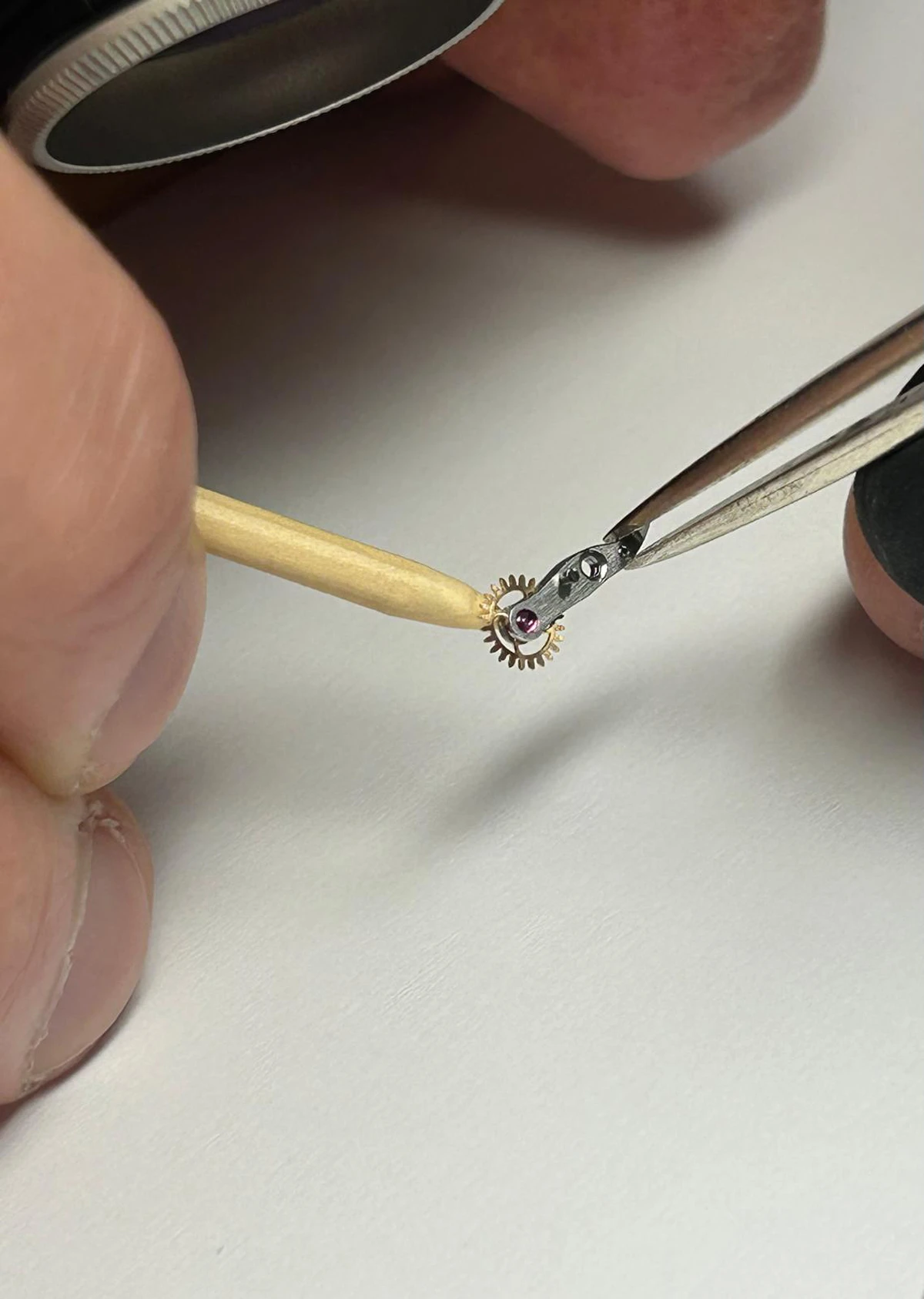
Image – hand polishing
Furthermore, Fleury has also retained the column wheel and the horizontal clutch. A vertical clutch would be more efficient and would eliminate the tiny jump of the seconds hand on starting. It is, on paper, the better answer, in roughly the way a turbocharger is the better answer to horsepower than increasing capacity. It’s just no fun to watch. The horizontal clutch is a spectacle – two wheels meeting, a lever swinging, a column wheel indexing round – and on a watch designed to be looked at, that’s the right call.
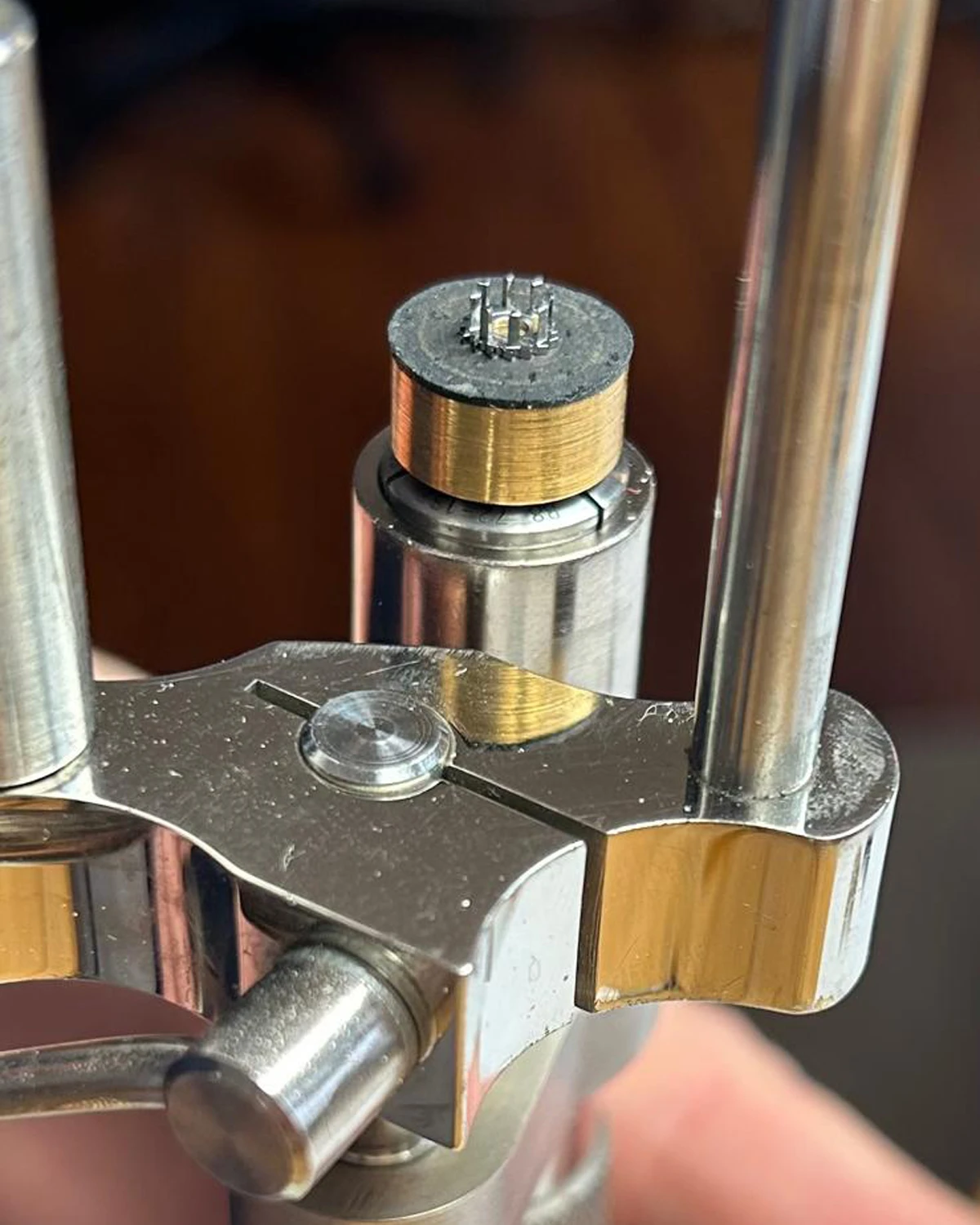
Image – preparation for column wheel polishing
Previously, this movement has been partly hidden behind a conventional dial. Now, the 279-component FM04 sits under a sapphire dial – itself skeletonised – with the bridges opened up and several components resculpted, so that light gets into the movement and you can see what’s going on.
Fleury Manufacture FXR-4 Openwork – nowhere to hide
Skeletonising is an old trick and, frankly, a much-abused one. The 1970s and 80s produced a stack of thin, gaudy skeleton movements best left buried in charity shop display cases. Done properly – the way André-Charles Caron did it in the 1760s – it’s brutal. Every surface is now on show and there is nowhere to hide a flaw. Each chamfer, each satin-brushed flank, each black-polished lever and every stripe of Côtes de Genève has to survive being looked at through sapphire. Fleury’s finishing is a mix of machine and hand work, with plenty of the latter to sit comfortably in the high-end category; the black-polished clutch lever in particular is the sort of detail that tells you where the hours and sweat went.
Legibility is where openworked chronographs often fall apart, and the layout here is a serious attempt to avoid that.
Fleury Manufacture FXR-4 Openwork – the display
The display is stripped down to what matters – hours, minutes and central chronograph seconds on the outer ring, running seconds and the thirty-minute counter at 9 o’clock and 3 o’clock, date and day/night indicator below, set by a pusher at eight.
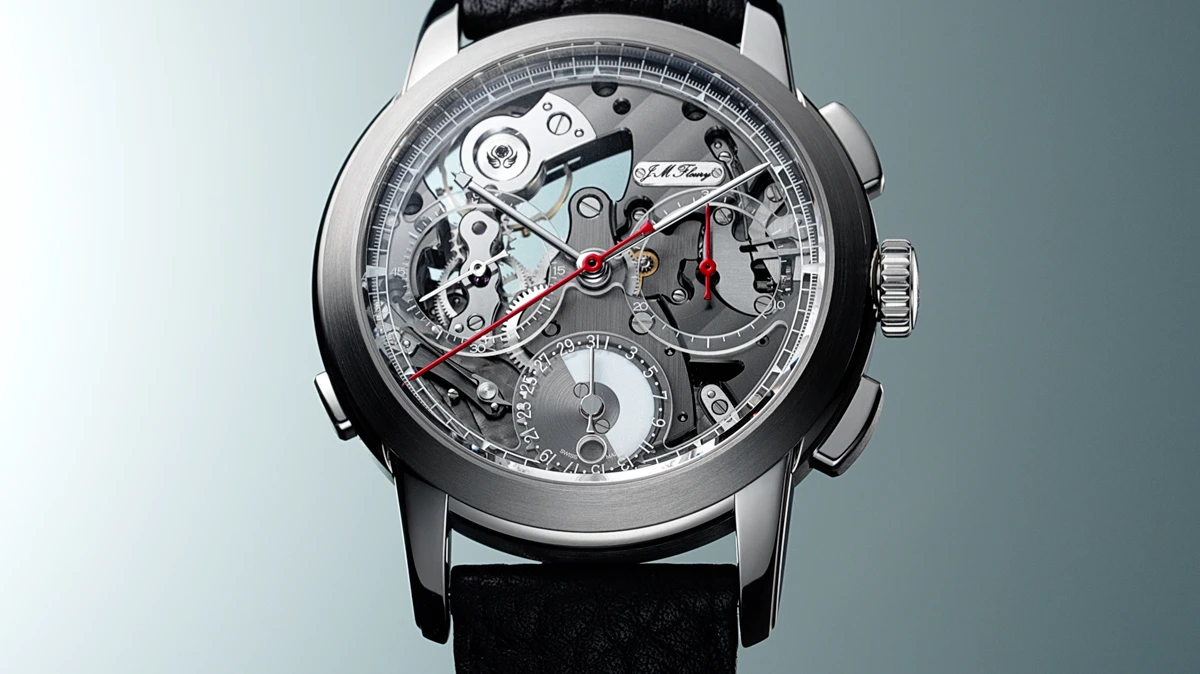
Numerals and indexes are engraved and white-inked rather than printed, so they have more depth and are easier to see. The hour and minute hands are hand-finished with domed bercé polishing, so they catch light from any angle; the chronograph hands are lacquered red. Red over a grey NAC-coated movement works a treat, and it’s the difference between a watch you can read at a glance and a watch you need your specs for. OK, some of us need our specs to find the door, but that’s by the by.
Fleury Manufacture FXR-4 Openwork – the case
The case is 40 mm by 12.8 mm in grade 23 titanium, with steel crown and pushers. Grade 23 is the stuff you use if you’re working in serious cryogenics or the scary bits of aviation. Watch cases are usually Grade 2 or Grade 5, so the FXR is splendidly over-specified.
Closing remarks
The price? CHF 54,500 before tax (around £50,000), against roughly CHF 39,500 (£36,250-ish) for the standard steel FXR-4 at the end of last year. That difference is the cost of having nowhere to hide and it feels far from unreasonable.
Is it a lot of money? Obviously – it won’t buy you a Bugatti, but would cover a very good Mk1 Lotus Elite or a concours Elan, if those took your fancy. But compared with the retail cost of a comparable in-house column-wheel chronograph from a maison with a marketing department and a posh office, it does something remarkable – it starts to look like one of the more rational buys in high-end watchmaking. That’s assuming any of us can be said to be even approaching rational when it comes to watches.
More to the point, it’s the antidote to that plastic engine cover. Jean-Marc Fleury made this knowing you’d look at it and then made it beautiful enough to survive the looking. There’s not much of that about. Here’s to more of it.
Further reading
https://www.fleurymanufacture.ch/
Technical specification
- Model: Fleury Manufacture FXR-4 Openwork
- Case: Grade 23 titanium, diameter 40 mm, height 12.8 mm, water resistance 3 ATM (30 metres), sapphire crystal to front, exhibition caseback.
- Functions: hours, minutes, small seconds, chronograph, date, day/night indicator
- Movement: calibre FM04 Openwork, hand-wound movement, frequency 21,600 vph (3 Hz), 26 jewels, power reserve 60 hours
- Strap: leather strap with stainless steel pin buckle
- Price: CHF 54,500 excluding VAT (RRP as of 7.8.2026)