
Lowenthal Villoresi Chronograph Watch Review
While the Lowenthal Villoresi Chronograph captures the glamour of 40s and 50s with its aged dial, modest case proportions and 2.5 Hz hand-wound movement, it does not languish in the past. On the contrary, the independent watch brand has created a ‘contemporary expression of Haute Horlogerie’, endowed with a gorgeous remastered column-wheel chronograph movement. Angus Davies recently chatted to Harry Guhl, Executive Chairman of Lowenthal, keen to discover more about the company’s inaugural creation.
Collecting vintage watches
Within the watch collecting community, some horophiles obsess over all things vintage. Drawn to period characteristics, including design, scale, materials and complications, this group of watch obsessives regularly frequent auction houses, willing to pay a king’s ransom for a coveted reference. Some opportunists visit flea markets, rummaging through horological detritus in their quest to find a sleeping beauty. Irrespective of the means of procurement, this band of like-minded souls places much value on originality.
The general advice for budding vintage fiends is: don’t polish a case; never relume hands and indexes; and always insist that original parts are not replaced with new ones. And then there is the matter of ‘patina’. For the avid vintage enthusiast, a dial that has been exposed to time, sunlight or humidity can prove even more appealing.
For instance, some sports watches were equipped with a ‘tropical dial’. Pristine at the time of sale and never intended to change, many tropical dials can assume shades of brown, coffee, honey or gold with the passage of time. As the Fondation Haute Horlogerie explains, ‘the transformation was never intentional. In the mid-20th century, dial lacquers and pigments weren’t always UV-resistant or perfectly stable’. Take an Audemars Piguet Royal Oak ‘A Series’ from around 1974; a once black dial can now appear bronze from certain angles and is catnip for vintage enthusiasts.
Harry Guhl – watch collector
Harry Guhl is a Swiss entrepreneur specialising in reviving heritage watch brands. He is the co-founder of Czapek & Cie and has spent two decades working across the luxury industry. Harry is also an avid collector of vintage watches, including period Lowenthal pieces.
Lowenthal was founded during the 1930s by Bovet Frères and gained recognition for its ‘precision chronometers and chronographs’. In 2016, Guhl registered the brand and, now, some ten years later, he has returned the Swiss marque to prominence with its inaugural model, the Villoresi Chronograph.
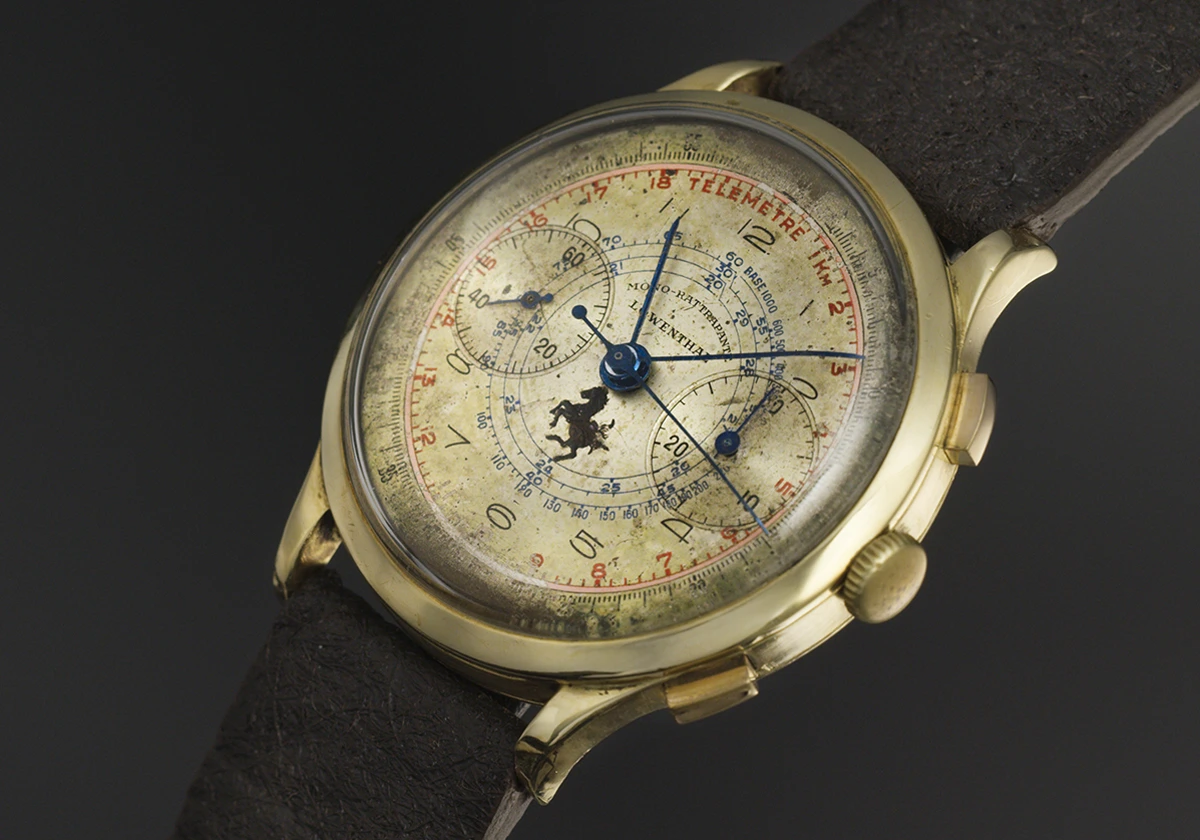
Image – the Lowenthal chronograph presented by Enzo Ferrari to Luigi ‘Gigi’ Villoresi
Lowenthal Villoresi Chronograph – inspiration
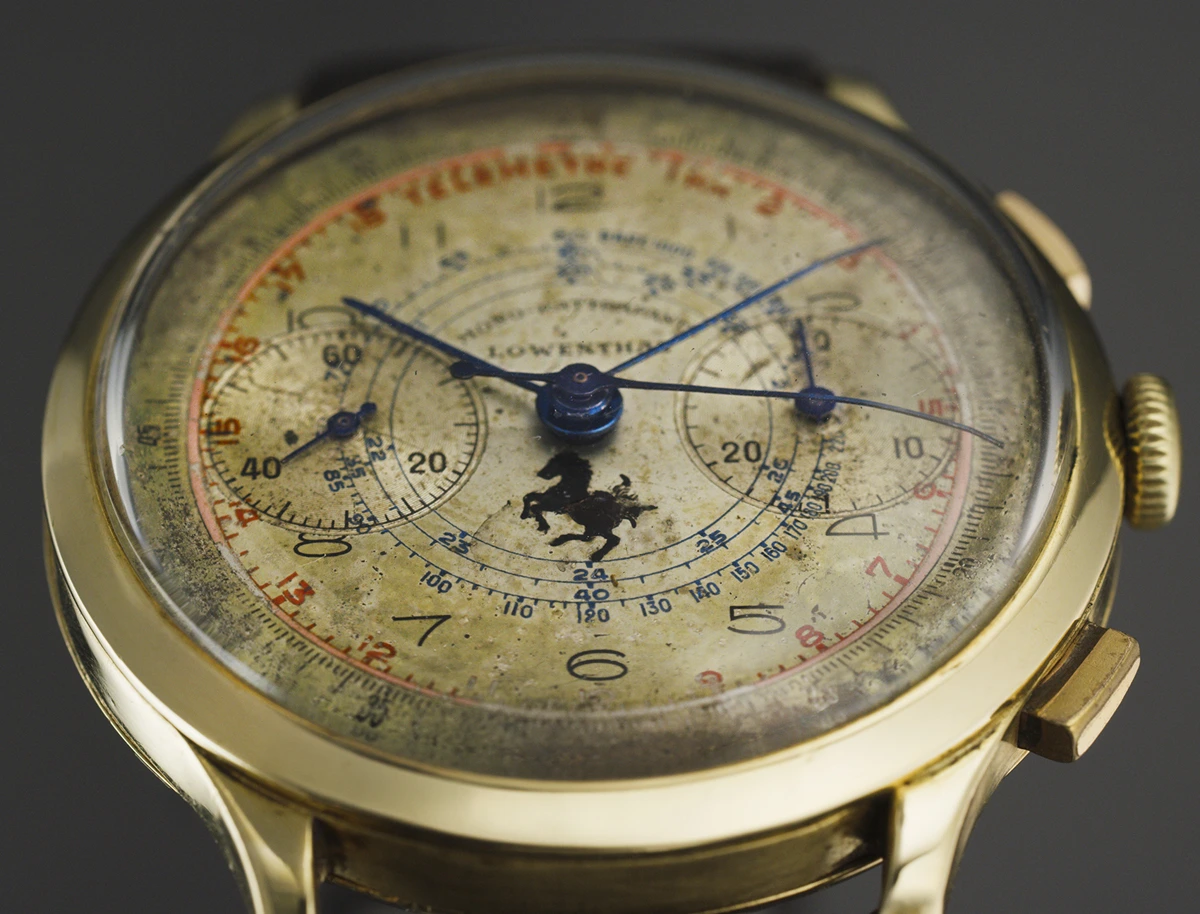
Famously, in 1951, ‘il Commendatore’, aka Enzo Ferrari, gave Luigi ‘Gigi’ Villoresi a Lowenthal chronograph after winning at the Syracuse Grand Prix. Considered large at the time, this watch measured 38.5 mm in diameter. The dial featured two registers, a telemeter scale and a depiction of the Cavallino Rampante (the Ferrari horse emblem). To the rear of the watch, the solid caseback bore an engraved inscription – a message from the owner of Scuderia Ferrari to the victorious driver.
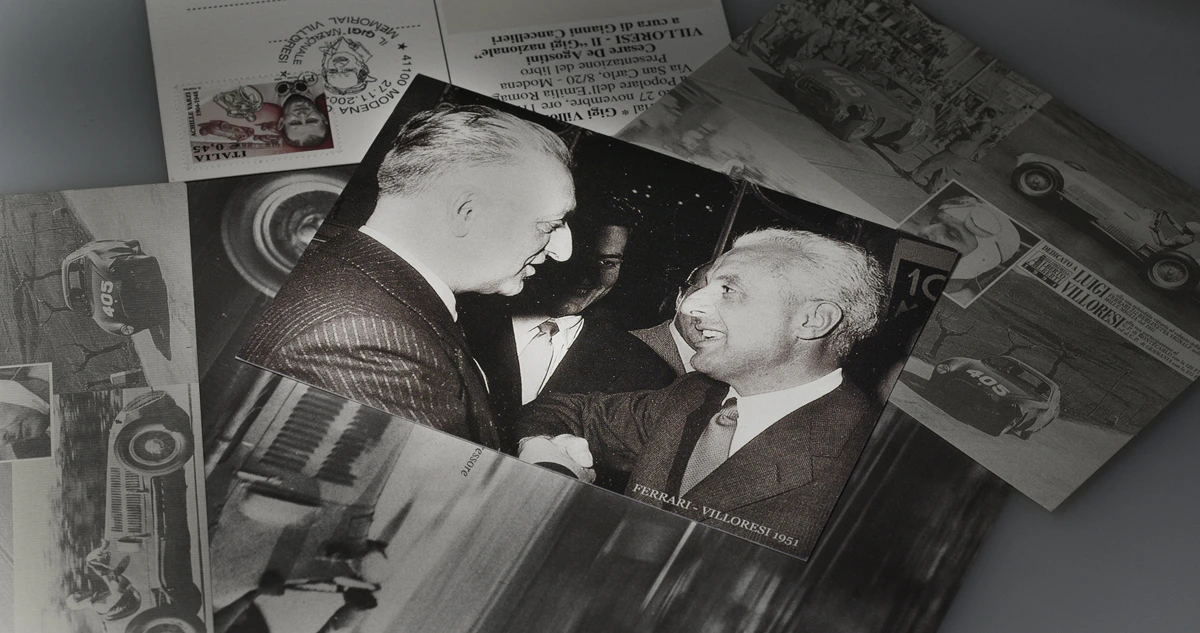
Image – Enzo Ferrari and Luigi ‘Gigi’ Villoresi in 1951
The aptly named Lowenthal Villoresi Chronograph captures the essence of the classic model of the 50s, but avoids replicating every detail. Indeed, Guhl and his team have reimagined the model, introducing some elements that are more aligned to present-day tastes, eg the watch is equipped with an exhibition caseback. Fundamentally, this approach is one of continuation rather than revival. That said, the vintage vibe is much in evidence.
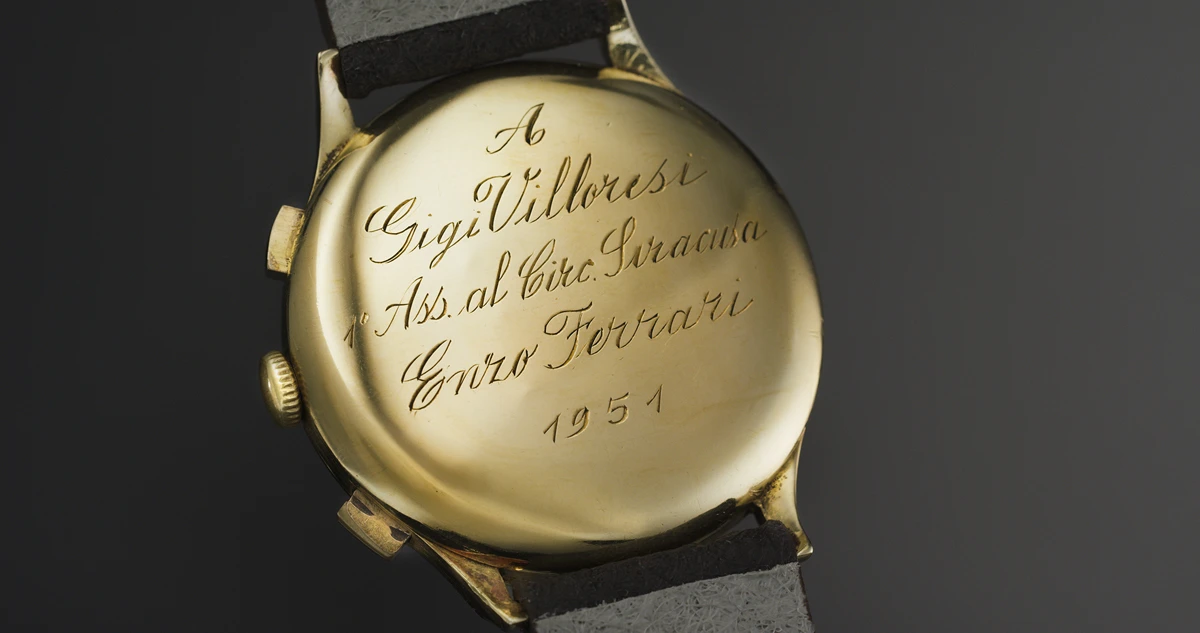
Image – the engraved caseback of Luigi ‘Gigi’ Villoresi’s watch
Lowenthal Villoresi Chronograph – dial
Guhl’s inaugural model is offered in four colourways, namely ‘Avorio Bianco over Grigio’, ‘Azzurro La Plata over Grigio’, ‘Palladio Verde over Grigio’ and ‘Oro Metallizzato over Grigio’. Each variant is limited to 12 pieces, making 48 pieces in total.
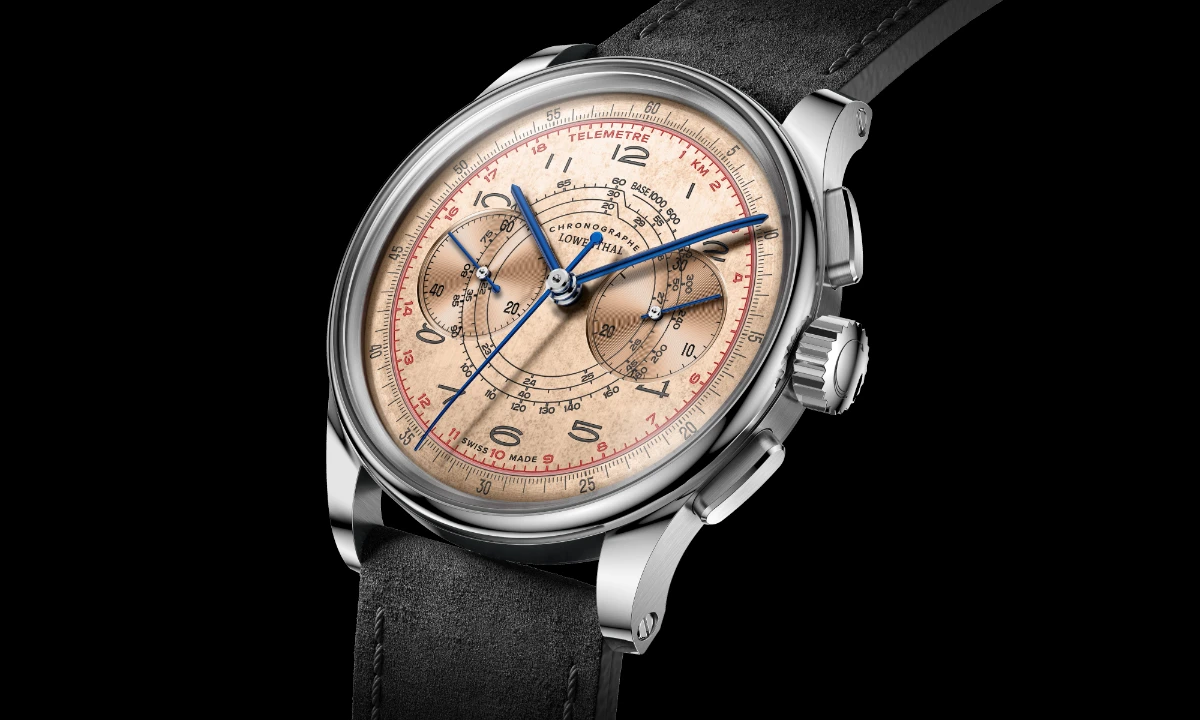
Time is presented on a bombé (domed) dial and sits beneath a box sapphire crystal with anti-reflective treatment on both sides. Lowenthal states it has used ‘period-correct materials and processes’, something that is very apparent when appraising the dials up close.
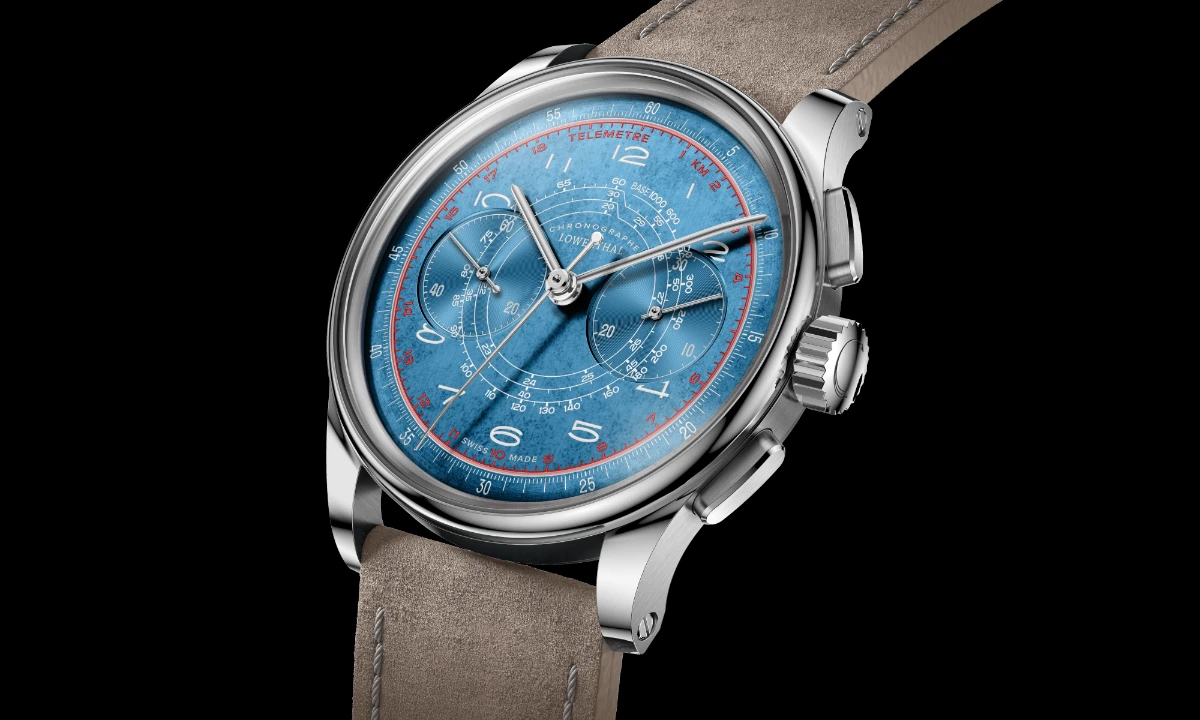
The fine, steel hour and minute hands are thermally blued, save for those fitted to the ‘Azzurro La Plata over Grigio’ variant, which are devoid of colour. The precise shade is unique to each piece and may resemble violet, light blue or mid blue depending on the amount of time the hands have been near the flame. The end of each hand is slightly bent, echoing the dial’s arcing profile. A central chronograph hand records elapsed seconds with two further hands, one positioned above each counter.
Each hour is denoted with Arabic numerals, executed in the same distinctive typeface as ‘Gigi’s’ watch. A spiral-type tachymeter graces the centre of the dial, allowing the wearer to determine the speed of an object over a known distance using the central chronograph seconds hand. A red telemetre scale encircles the central dial area, providing the means to calculate the distance of the watch from a visual event, eg a firework exploding. This function uses the difference between the speed of sound and the speed of light, again using the central chronograph seconds hand, to indicate the distance to the visual event. A track fringes the dial marked with a combination of Arabic numerals, at 5-second intervals, and ⅕-second markings that correspond to the movement’s 5-beat (2.5 Hz) frequency.
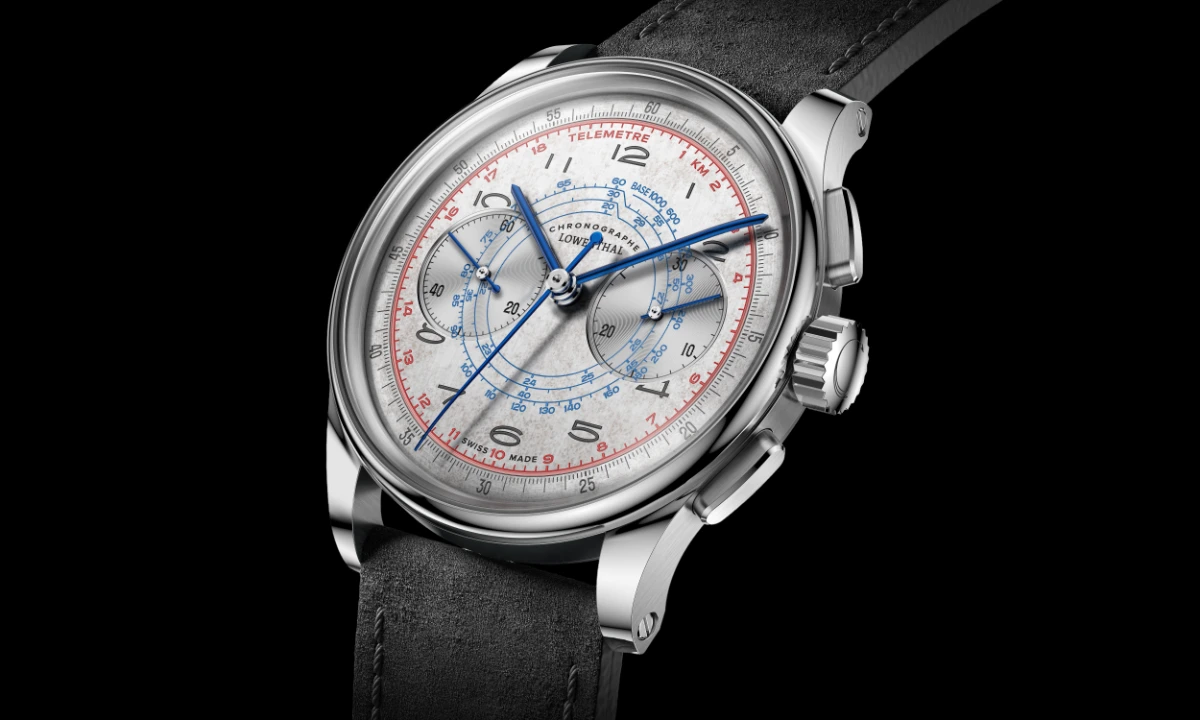
A 30-minute chronograph register is positioned at 3 o’clock, while a small seconds dial is located opposite. Both of these counters are enriched with azurage (aka snailing).
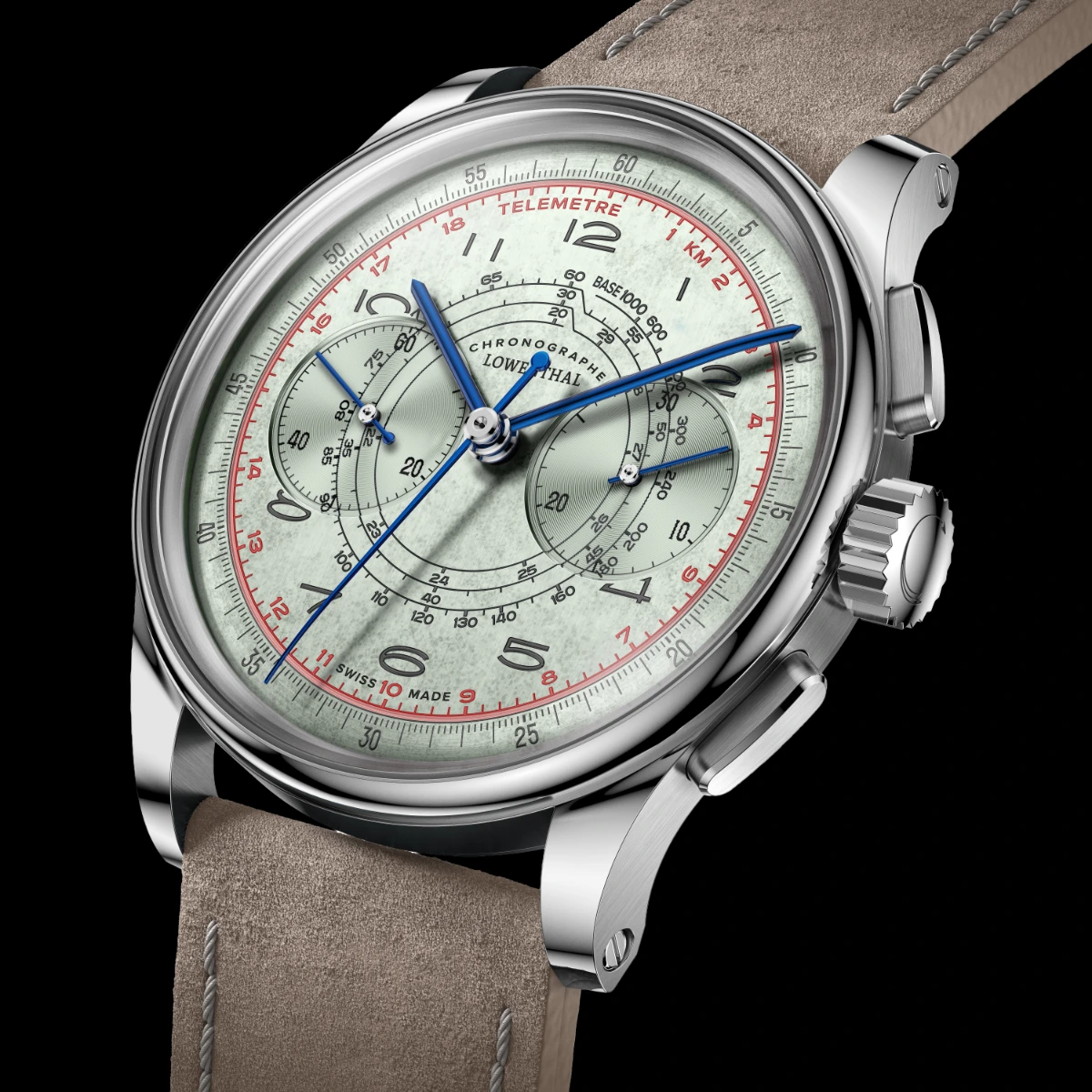
Unlike most new watches that exude a freshly made appearance, the Lowenthal Villoresi Chronograph has a slightly weather-worn look. The company states that each dial ‘undergoes a controlled ageing cycle, recreating decades of natural evolution before being permanently stabilised’. Lowenthal remains tight-lipped about the precise technique, but Guhl explained to me that by artificially aging period-correct details they can simulate 50-60 years of patination.
Lowenthal Villoresi Chronograph – case
Formed of 904L stainless steel, the case measures 40.5 mm in diameter with a thickness of 11.8 mm. This is slightly larger than the 1951 watch, but still modestly proportioned by today’s standards, making it suitable for most wrists.
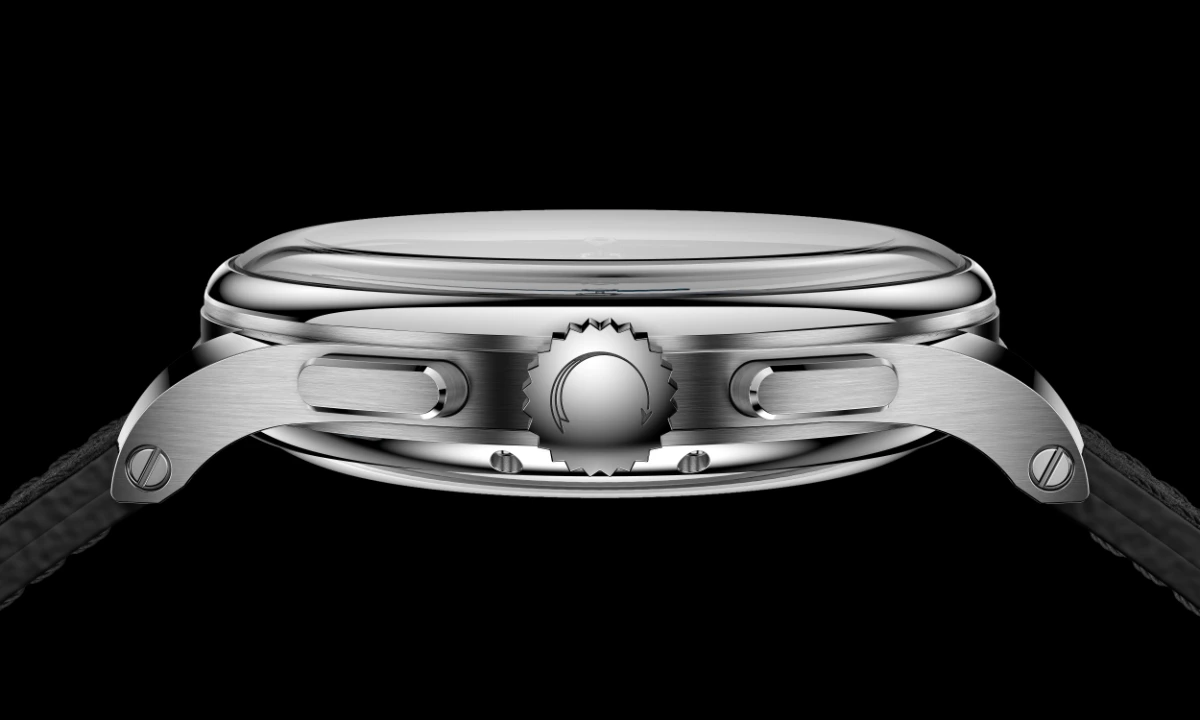
Two rectangular pushers grace the right flank of the case, consistent with the 1951 model, albeit their edges are faceted and slightly rounded. The crown fitted to the new Lowenthal Villoresi Chronograph is larger than that fitted to its antecedent, hence is easier to manipulate.
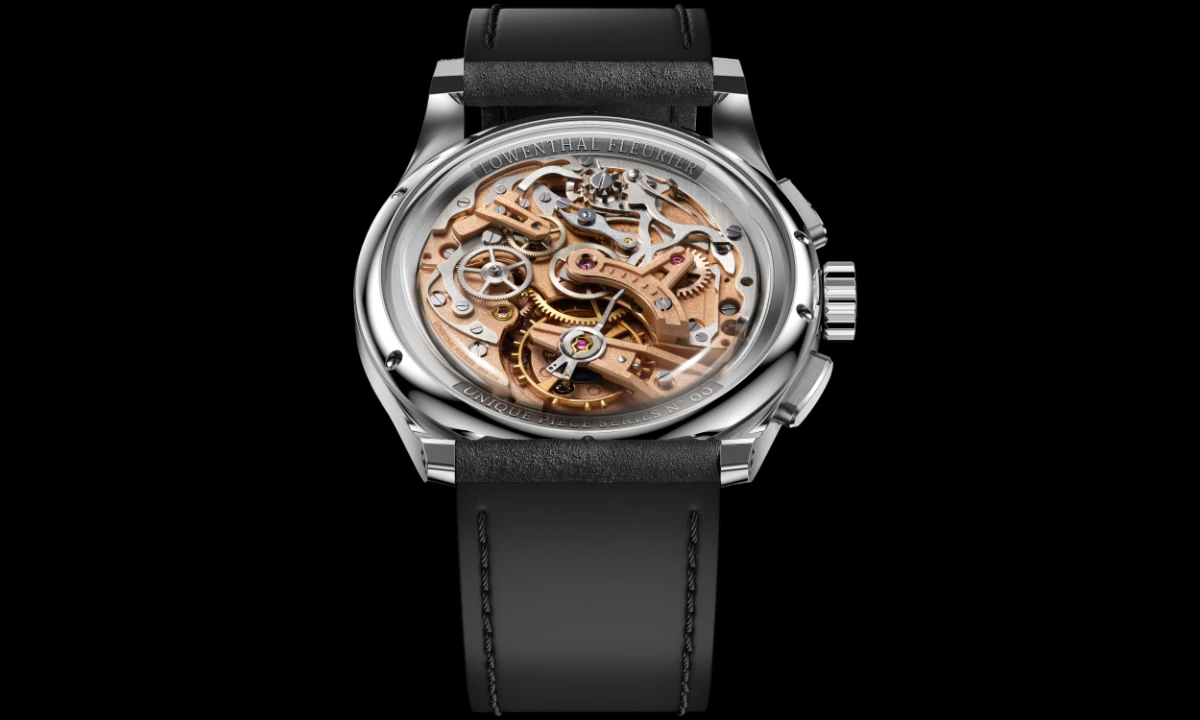
The lugs are another notable difference found on the modern-day watch – they are wider and more robust. Consistent with the front of the watch, the rear is also fitted with a box sapphire crystal, granting sight of the hand-wound movement, the Lowenthal Calibre 2518.
Lowenthal Calibre 2518
A heavily reworked Valjoux 23 forms the basis of the Lowenthal Calibre 2518. The Swiss Maison disassembled each period movement and then, working closely with Chronode, the esteemed movement specialist based in Le Locle, redesigned it, adding several new components of its own design. For instance, the chronograph bridge, lever bridge and balance bridge are all new.
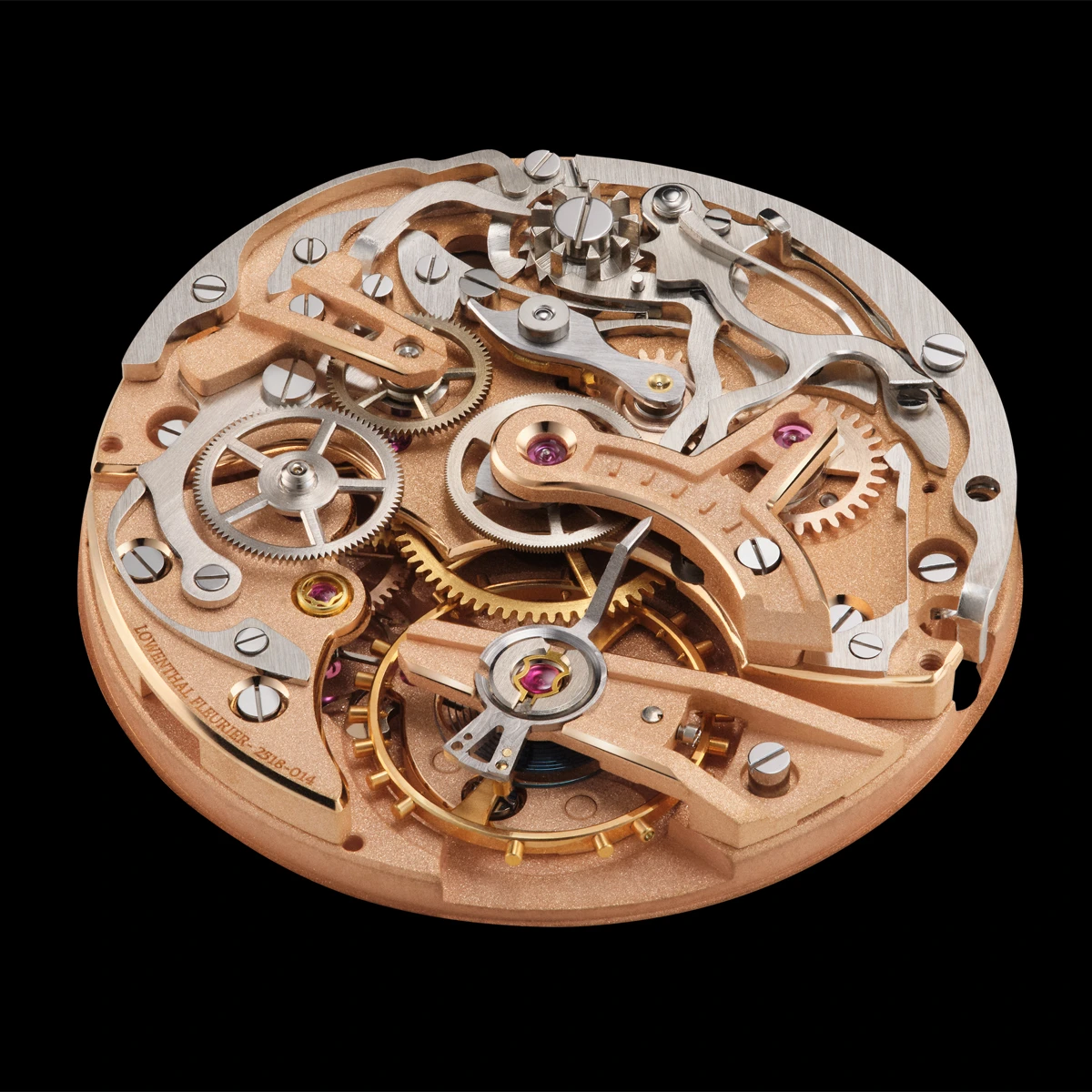
According to Lowenthal, ‘each movement requires just over 100 hours of hours of work to get the caliber done’. Individually executed anglage, black polishing, frosted graining and painstaking bridge refinements transform a historic chronograph architecture into a contemporary expression of haute horlogerie.’ Certainly, one look at the movement with its 5N rose-gold gilded finish and it is clear that the Lowenthal Calibre 2518 was a labour of love.
Take a moment to look at the balance bridge. It’s partially openworked, frosted and intricately formed. A gleaming screw retaining the bridge punctuates the frosted scene with its highly polished form.
Positioned atop the balance bridge, an elaborately shaped index adjuster, resembling a bird craning its neck, points to a scale gracing the upper surface of the adjacent chronograph bridge. Like the balance bridge, both the chronograph bridge and the lever bridge are openworked, frosted and endowed with gleaming bevels.
The frosted mainplate and bridges serve as a foil for the screws as well as the jewel and screw sinks, accentuating their beauty and notable brilliance. Likewise, the levers and springs are delightfully grained, while anglage abounds, painstakingly imparted for the delectation of purists.
Beyond the prepossessing beauty of the Lowenthal Calibre 2518 lies another significant detail – the cadence of the balance. While many contemporary watches favour high frequencies in their quest for precision, Harry Guhl and his colleagues sought a traditional cadence of 18,000 vph (2.5 Hz). By taking this approach, the central chronograph seconds hand advances in ⅕ of a second increments. Although a balance oscillating at a higher frequency proffers superior precision, the calmer rhythm of the Lowenthal Calibre 2518 delivers much charm.
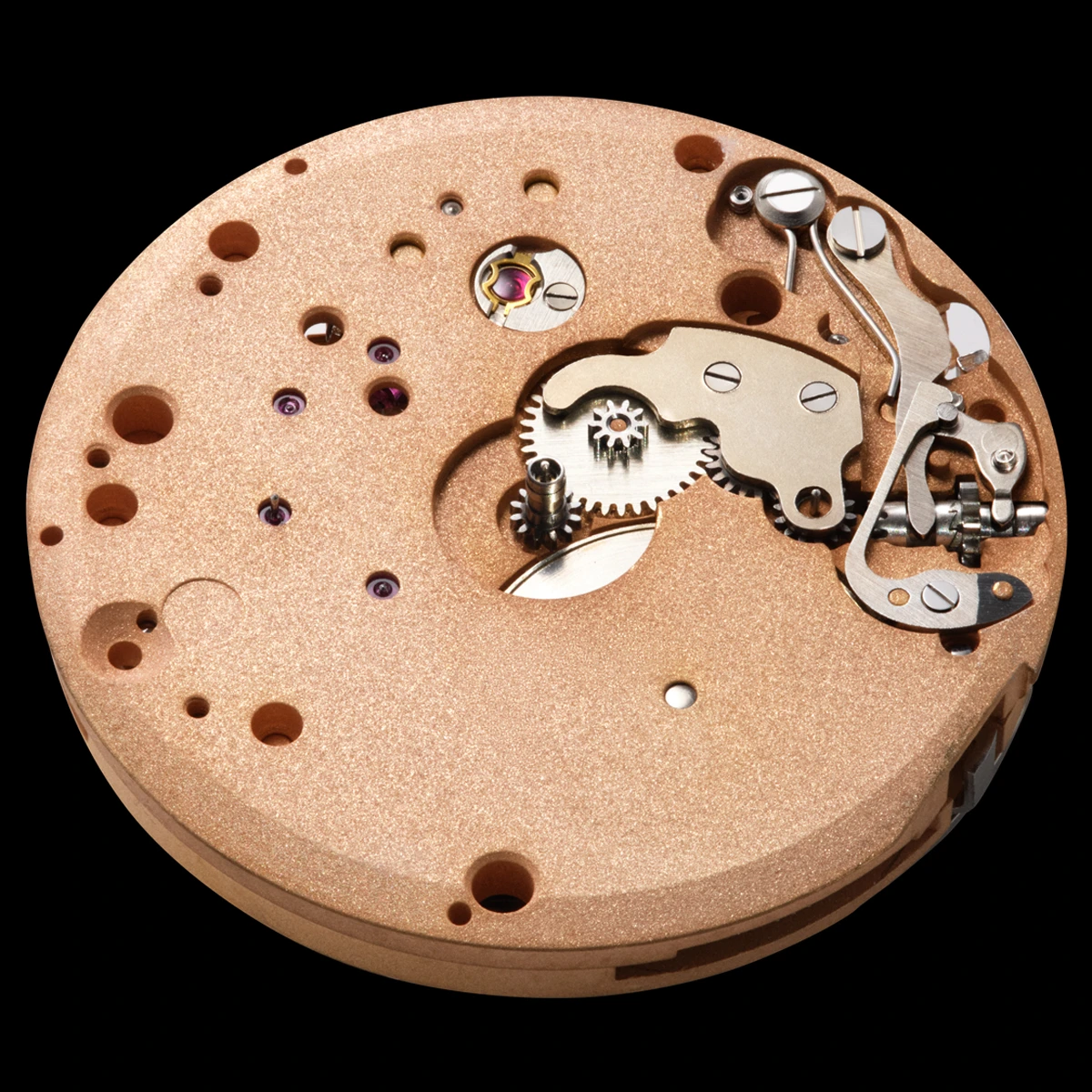
Consistent with a vintage watch, the Lowenthal Calibre 2518 is fitted with a column-wheel that collaborates with a horizontal clutch. While a chronograph with a vertical clutch may be less prone to stutter upon actuation, the traditional horizontal clutch does prove more interesting to look at. Indeed, with the Lowenthal Calibre 2518, the owner is indulged with sublime views of the chronograph engaging and disengaging.
Closing remarks
In recent years, having spoken to many watchmakers, the general consensus is that vintage movements are difficult to obtain and often command eye-watering prices. With this in mind, it is worth lavishing lots of love on these ticking gems as failure to do so would be nothing short of sacrilege. Lowenthal has respected the Valjoux 23, treated it with due reverence and, working with Chronode, created a beautiful rendition of the historic movement. Indeed, given a choice, I would always favour the Lowenthal Calibre 2518, appreciating its new bridges and highly-refined finishing.
Now, at this point, I must say that, unlike Mr Guhl, an avid collector of vintage references, I prefer my watches to be pristine. For instance, a case covered in dents and scratches has the propensity to trigger my OCD. Therefore, while I love the styling of some vintage watches, I’ve always given them a wide berth. With this in mind, it is easy to see why the Villoresi Chronograph’s pristine appearance piqued my interest.
Likewise, take the dial. Again, a distressed surface or excessive patination, whether intentional or not, unsettles me. I’m the type of person who likes his shoes to exhibit a mirror-like shine, hence the sight of weather-worn lace-ups prompts me to grab my worry beads. However, I appreciate the sensitive approach taken by Lowenthal. Using a ‘carefully controlled ageing process inspired by six decades of natural patina’, the resultant dials exhibit a period vibe but, unlike a vintage watch, the patination is arrested, frozen in time and destined never to change; an approach that again resonates with me.
With its many attributes, the Lowenthal Villoresi Chronograph makes a compelling case for acquisition. Quite simply, the reborn brand has created a stunning inaugural model and I look forward to discovering what Harry Guhl and his team are planning next.
Further reading
Technical specification
- Model: Lowenthal Villoresi Chronograph
- Case: 904L stainless steel, diameter 40.5 mm, height 11.8 mm, water resistance 5 ATM (50 metres), sapphire crystal to front, exhibition caseback.
- Functions: hours, minutes, small seconds, chronograph, tachymeter scale, telemeter scale
- Movement: Lowenthal Caliber 2518, hand-wound movement, frequency 18,800 vph (2.5 Hz), power reserve 48 hours
- Strap: cashmere leather with natural coutshock rubber inside paired with a steel pin buckle
- Price: CHF 36,000 before taxes (RRP as of 7.8.2026)