
Montblanc 1858 Manual Small Second Watch Review
The Montblanc 1858 Manual Small Second timepiece is endowed with an agreeable dose of vintage appeal. In particular, the hand-wound movement exhibits a traditional design and, in so doing, evinces a splendid honesty Angus Davies finds most becoming. However, with a number of model variants, choosing the ideal version of the watch becomes a time-consuming problem.
This detailed review of the Montblanc 1858 Manual Small Second includes live images, specification details and pricing.

Observe any child in a sweet shop, armed with a modest budget and presented with a bewildering choice of confectionary, they will undoubtedly be overwhelmed, scared of passing up on one sugary food in preference for another.
Likewise in adulthood, there are occasions when too much choice can almost feel like a burden. In addition, the prospect of post-purchase dissonance will be familiar to many serial shoppers.
Recently, I visited the Montblanc Boutique on London’s prestigious New Bond Street and happened upon an achingly gorgeous new model, the Montblanc 1858 Manual Small Second, sporting a handsome blue dial. During my visit, an attentive member of staff showed me the same watch with a handsome black dial and a brown leather strap. As I pondered which variant I preferred the most, a third version was shown to me, featuring the same black dial but paired with an arresting, retro-style Milanese bracelet. Very quickly I began to feel like the aforementioned child in a sweet shop.
The dial
The Montblanc 1858 Manual Small Second, as its name implies, features a hand-wound mechanical movement. Its inventory of functions is limited to hours, minutes and a small running seconds positioned on a subdial just above 6 o’clock.
Montblanc 1858 Manual Small Second – Ref. 112638 (black dial, brown calfskin strap. Price: £2445.00 (RRP as at 21.8.2016)
The black and blue dials behave differently to each other. The black dial has a soft-spoken, self-effacing matte surface, appearing to deferentially sit back and allow the other dial details to take the limelight. Conversely, the blue dial canvas exudes a more flamboyant character. It freely interacts with the light and, courtesy of its sunray motif, floods the dial surface with a multitude of shimmering lines, emanating from its centre.

Montblanc 1858 Manual Small Second – Ref. 113702 (blue dial, blue alligator strap. Price: £2690.00 (RRP as at 21.8.2016)
Generously sized ‘cathedral’ hour and minute hands impart time with a noteworthy mixture of functionality and style. The silver-toned, rhodium-plated hands are lined with luminescent fill, transcending the perfunctory with their elegant form to pronounce the time with a commendable degree of eloquence.
Arabic numerals denote the hours in white and, courtesy of their luminescent treatment, offer ease of read-off, day or night. The font employed, absent of serifs, delivers a no-nonsense approach to design, augmenting ease of interpretation.
The small seconds display is framed with a chemin de fer, providing a seemly means of delineation. Encircling the main dial-scape is a railway track, employing super-slender white lines and featuring Arabic numerals every 5-minute integer.
Reinforcing the 1930s vintage feel of the timepiece is a Montblanc period correct logo.
The case
While Montblanc has looked to the past for many of its styling cues, I consider the 44mm case diameter more befitting of the modern era. However, I do not see an issue with a watch of this scale and personally found the timepiece comfortable to wear.

Montblanc 1858 Manual Small Second – Ref. 112639 (black dial, Milanese bracelet. Price: £2695.00 (RRP as at 21.8.2016)
Highly polished stainless steel surfaces are ubiquitously employed, save for areas of the caseband. Contrary to what you may expect of this gregarious character trait, the 1858 Manual Small Second remain tasteful, deftly sidestepping ostentation.
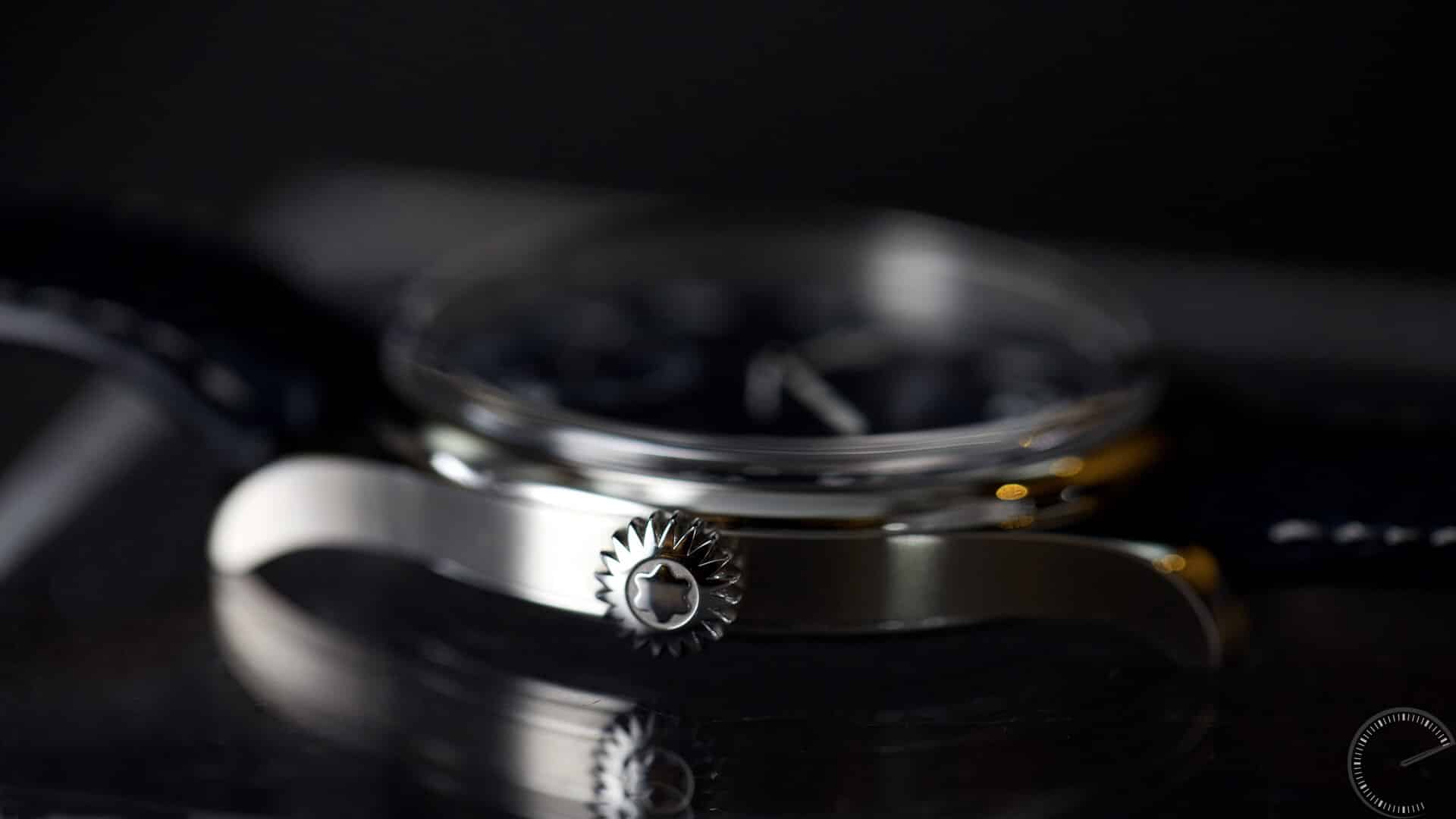
When viewed from the side, the lugs are curvaceous and show a tendency to trace the natural arcing form of the wrist and, in so doing, heightening wearer comfort.
Montblanc has repeatedly looked to its back catalogue for styling influences. The crown embraces the house style of the 1930s, featuring a fluted profile. Adorning the vertical plane of the crown, the Montblanc logo of today, with its snow-capped symbolism, is presented in relief.
Gracing the dorsal aspect of the timepiece is an exhibition caseback, allowing wearers to appraise the movement within.
The movement
The hand-wound Calibre MB 23.03 is beautiful and immediately grabbed my attention with its palpably honest design. Three movement bridges, sporting sharp, angular edges provide a clean, uncluttered appearance.
The bridges are adorned with Côte de Genève motif and polished jewel and screw sinks. The ratchet wheel is embellished with sunray-brush, while blued screws vie with ebullient rubies for the attention of the wearer.
This is a very attractive movement. I appreciate being able to see the balance wheel, the centre wheel, the third wheel, the click and the index adjuster. Unlike many modern watches, the mechanical magic is not hidden behind a sea of oversized bridges. This is a movement which has a retro-appearance and confers sight of the various movement components, indulging my desire to see the various parts at play.
The balance has a frequency of 21,600 vph (3Hz), the movement contains 17 jewels and the sole spring barrel delivers approximately 46 hours of autonomy.
Where I would have liked to have seen a little more added value is with the bridges. Ideally, a dose of prominent anglage, adding comely bevelled edges to each of the three bridges, would have made this already wonderful movement even better. However, in fairness to Montblanc, the costs incurred of introducing matchless gleaming chamfered edges would have undoubtedly had an impact on the incredibly competitive asking price of the watch.
Closing remarks
Montblanc has been releasing some fascinating timepieces in the last few years and the 1858 Manual Small Second proves to be no exception.
The story began in 1858, when Charles Yves-Robert established his watchmaking company in the St. Imier valley, crafting beautiful horological objects within the confines of the company’s workshops. In 1878, the company would register the ‘Minerva’ name, a nomen which continues to be held in the highest esteem by the cognoscenti.
Since acquiring Minerva in 2007, Montblanc has manufactured watches at the original site in Villeret and also in Le Locle. The most complicated timepieces continue to be crafted at the Villeret workshops and continue to dazzle the most discriminating collectors with a seductive blend of handsome aesthetics, technical ingenuity and peerless finissage.
The decision of Montblanc to offer both very modestly priced watches alongside extremely complicated, and justifiably expensive, models may not find favour with some purists, especially with those with one eye on future investment potential. However, by increasingly amalgamating the back catalogue of both locales, the maison is now delivering some exceptionally handsome watches.
The Montblanc 1858 Manual Small Second draws on the styling of the brand’s 1930s models. Whenever a watch company elects to embark on this course, it could potentially disenfranchise collectors of its historical timepieces. Moreover, when a watch company tries to reproduce a historical model for a new generation, the results can appear a tad contrived or kitsch. Kitsch may offer some ironic appeal with some products but not a serious watch.
Thankfully, I am pleased to report that, in my opinion, Montblanc has skilfully looked to the past and distilled the essence of what made their vintage models appealing into a highly practical ownership proposition for today’s wearer.
The case dimensions are bigger than some traditionalists may prefer, but I am very much a fan of the 44mm case diameter of this new watch.
Hand-wound watches always appeal to me. The daily ritual of imparting energy to the mainspring proves cathartic, granting just a few brief moments of escape from the mania of modern-day living. The Calibre MB 23.03 is a peach, candidly disclosing its mechanical thought processes for the delectation of die-hard watch obsessives. The movement finishing is no match for the elevated creations which leave the atelier in Villeret, however, the pricing proves more affordable, ranging from £2445 to £2770 (RRP as at 21.8.2016).
By offering the Montblanc 1858 Manual Small Second, the luxury watch brand has delivered an array of lofty virtues for very accessible money. However, as if it was not difficult enough choosing between the aforementioned variants of the 1858 Manual Small Second, I subsequently learned of a further limited model equipped with an alligator leather strap and then I established the brand also offers a self-winding derivative.
The Montblanc 1858 Manual Small Second is deserving of you attention, it is timepiece worthy of consideration but, be prepared to expend much time selecting your ideal variant.
Technical specification
- Model: Montblanc 1858 Manual Small Second
- Case: Stainless steel; diameter 44mm; height 10.95mm; water resistant to 3 bar (30 metres); sapphire crystal to front and caseback.
- Functions: Hours; minutes; small seconds.
- Movement: Calibre MB 23.03, hand-wound movement; frequency 21,600 vph (3 Hz); 17 jewels; power reserve circa 46 hours.
- Straps / Bracelets: Various
- Prices: Ranging from £2445 to £2770 (RRP as at 21.8.2016)