
A. Lange & Söhne Richard Lange Minute Repeater Watch Review
Unveiled at Watches & Wonders earlier this year, the A. Lange & Söhne Richard Lange Minute Repeater is equipped with one of the most desirable complications. Angus Davies explains why this is one of his favourite watches of 2022.

The minute repeater – the early years
Today, we are very accustomed to using the internet and owning mobile phones. An increasing number of motorists now reject fossil fuels, preferring to drive electric vehicles. It’s very easy to take technological advancement for granted, forgetting where we were, say, 25 years ago. However, looking back 150 or 200 years ago and society’s progress is even more noticeable.
For example, street lighting first appeared in the early part of the 19th century, albeit its use was limited to just a few places. Early street lights were powered by gas, while widespread electrical lighting came much later, circa 1870. In an era where nocturnal illumination was scarce, reading the dial of a pocket watch proved a challenge. The mechanical solution to this problem came in the form of a repeater mechanism.

English clockmaker, Daniel Quare is said to have invented his repeater mechanism in 1687. Several experts believe the first minute repeater was produced in Germany around 1720, albeit the identity of its maker is unknown. In the latter part of the 18th century, Abraham-Louis Breguet conceived a mechanism that sounded the hours, quarters and minutes using hammers and coiled gongs, supplanting the bells found on earlier repeater watches. In the latter part of the 19th century, the minute repeater mechanism was miniaturised and housed within a wristwatch.
What is a minute repeater?
A minute repeater indicates the prevailing time audibly on demand. By actuating the mechanism, often using a slide on the side of the case, the watch chimes the hours, quarters and minutes in sequence. However, such a description fails to convey the complexity of this complication.

Typically, a minute repeater features two gongs made from hardened steel wire. These metal loops don’t touch one another, remaining just a few millimetres apart. The gongs are secured with a ‘gong heel’ or ‘plot’ to the movement and they are struck by hammers which are optimally shaped. The chiming sequence comprises a combination of high and low notes.

Racks and snails
A series of snails, connected to the motion works, read the time. Once the chiming sequence is initiated, racks pivot against the snails. There are three racks in total, one for the hours, one for the quarters and, lastly, one for the minutes. The snails have ‘steps’. In the case of the hour snail, it has 12 steps, the quarter snail has 4 steps and the minute snail has 14 steps. The steps ensure the rack stops in the correct place. The rack bursts into life when the strike train is running and it continues to move until it engages with the corresponding snail. The racks have ‘beaks’ that match the maximum number of potential hammer strikes. The beaks trip the hammers as they pass causing them to strike the gongs.
Controlling the tempo of the chiming sequence
The duration of each strike is important. For the minute repeater to impart meaning in an intelligible form, the strikes must be of equal duration. In the past, an anchor governor was used to control the rhythm of the chiming sequence, however, these proved noisy, marring the minute repeater’s sonorous performance. An increasing number of modern-day minute repeaters are fitted with a centrifugal governor. This features two arms which extend outwards as a dedicated mainspring unwinds, creating air turbulence, thereby reducing the rotational speed of the repeater’s mainspring. The use of a centrifugal governor ensures the chiming sequence is not too fast or too slow.

A big sound from a modestly-sized case
Housing a minute repeater mechanism within a wristwatch is technically challenging due to the lack of space within the case. Much thought is needed regarding the design of the case in terms of the interior shape and the material it is made from.
Unusually, the A. Lange & Söhne Richard Lange Minute Repeater is housed in a modestly-sized case, measuring 39mm in diameter. The scale of this housing doesn’t afford much room for the sound to reverberate within. Moreover, the case is made of platinum, a noble metal that is very dense, a characteristic that has dissuaded many brands from using it. With this in mind, I expected the model’s chiming sequence to sound a tad muffled. However, this is not the case, the resultant sound is impressively audible, sweet-sounding and, courtesy of its centrifugal governor, evenly paced.

A. Lange & Söhne is known for crafting some of the world’s finest watches. This minute repeater proves no exception. Despite being housed in a 39mm platinum case, it sounds incredible.
Take a closer look at the case
In terms of aesthetics, one of the endearing characteristics of platinum is the metal evinces a whitish hue. Costlier than gold, platinum says luxury in a hushed voice. The bezel and upper lug surfaces are highly polished. Two slithers of highly polished platinum also grace the caseband, straddling a muted section of brushed metal. The caseback and underside of the lugs are, once again, brushed. This blend of contrasting finishes is attractive, understated and eminently tasteful.

Despite housing much complexity, the case measures just 9.7mm in height, readily slipping beneath a shirt cuff, seemly and unassuming. Indeed, save for the slide on the left flank of the case, there are few clues as to the mechanical intricacy housed within the case of this timepiece from Saxony.

A face so pure
Thermally blued, lancine-shaped hour and minute hands stretch outwards, floating above elongated Roman numerals and a chemin de fer, respectively. A small seconds display, positioned at 6 o’clock, is endowed with a blued hand and a crisp track marked with Arabic numerals. Both the central area of the dial and the small seconds display is located on a lower plane, while the hour track and chemin de fer sit on high. Although everything appears seemingly simple, this is actually not the case.

The brand from Glashütte has equipped the Richard Lange Minute Repeater with a grand feu enamel dial. This traditional artisanal technique requires much patience and expertise. In this instance, the dial blank, formed of 18-carat white gold, is dipped in alcohol and then dusted with enamel powder. Fired in an oven, operating around 800°C, the alcohol causes the powder to adhere to the dial blank before it melts and fuses with the base. Precise temperatures and baking times are closely guarded secrets. Once the baking process is complete, the dial blank is removed from the oven and allowed to cool before the process is repeated again and again. Indeed, a grand feu dial comprises numerous layers of fired enamel.

Some of the resultant dials feature imperfections eg air bubbles. The industry norm is that 30-40% of all dials don’t pass muster and are subsequently discarded. Those dials that make the grade are polished, filed and pad printed with the maker’s name, place of origin, etc. Thereafter, the dial is fired again, imbuing its surface with a notable permanence.
The resultant white dial seems chaste in temperament, unsullied and pure. However, like many aspects of this watch, the apparent simplicity belies the truth. For example, look at the fulcrum of the hands, the ‘centres’, they have been painstakingly polished to a mirror-like appearance. It’s just one of the tiny details which help to distinguish this watch as special.
Lange manufacture calibre L122.1
Beyond its functional role, the calibre L122.1 is a work of art. Typical of watches from this region, the movement features a three-quarter plate which delivers superior stability when contrasted with most movements that are endowed with numerous individual bridges.

Unlike most brands that favour rhodium-plated brass components, A. Lange & Söhne uses untreated German silver for its plates and bridges. This latter material is very strong and does not corrode, obviating the need for plating. Indeed, German silver promises to retain its showroom-fresh appearance for decades to come, save for a subtle ageing or patination that enriches its appearance, and for this reason, it is highly prized by watch collectors.
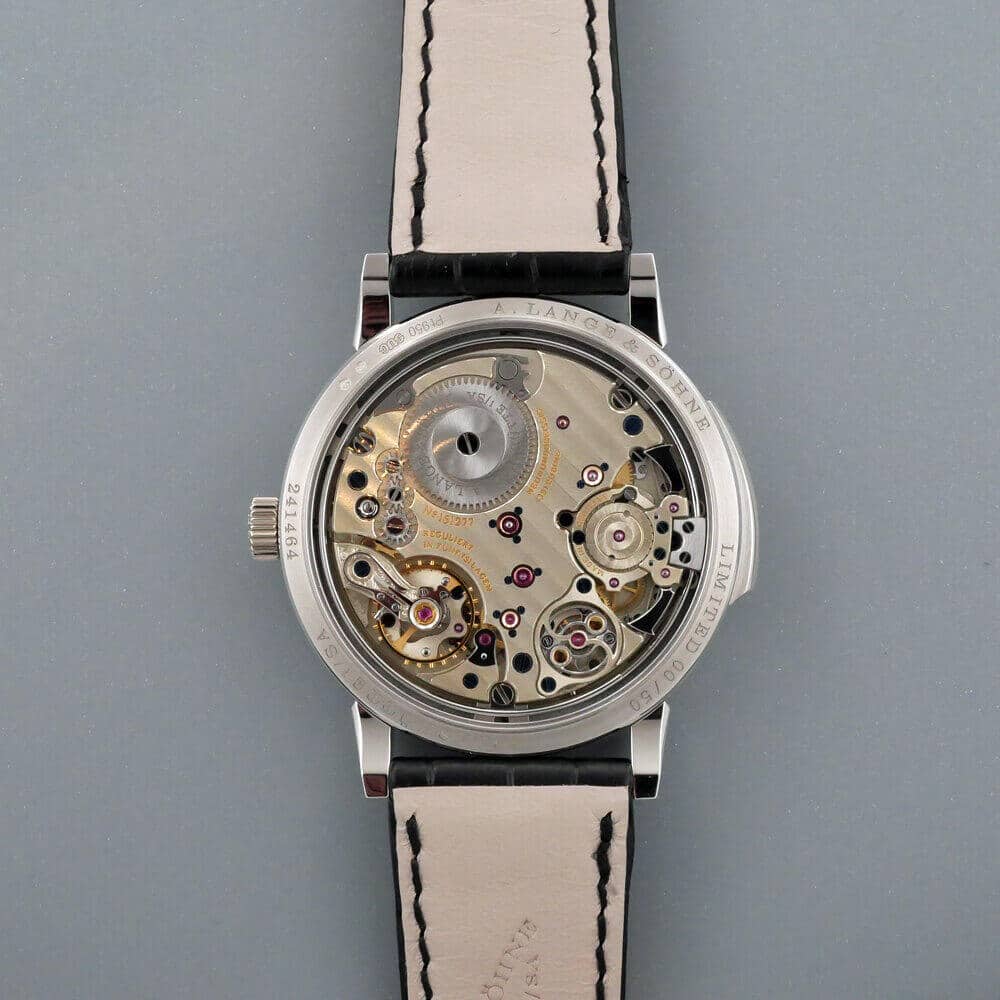
Sublime finishing is manifest throughout. On the recto side of the movement, positioned below the dial, the silver-toned levers, racks, snails and wheels are grained on their upper surfaces. Most of the said parts feature highly polished flanks and anglage. The silver-toned screws have chamfered rims and slots and are mirror-polished. The brass wheels are circular grained, while the upper sections of the mainplate are adorned with perlage.


Gold chatons
However, the verso side of the movement, visible via the exhibition caseback steals the show. The three-quarter plate is enlivened with Glashütte ribbing, pristine anglage and gilded, engraved text. Thermally blued screws abound. The brand has set several jewels within screwed gold chatons. In yesteryear, when genuine rubies were widely used, chatons provided an elegant means of mitigating breakages. Today, synthetic rubies obviate the need to use chatons, however, Lange upholds watchmaking traditions by continuing to use them. The resultant appearance proves spectacular to behold. The ratchet wheel features two snailed sections, one has a clockwise swirling pattern and the other incorporates the motif in counterclockwise form. Look at the click, the hammers and non-blued screws – all mirror-polished to a flawless conclusion.

The centrifugal governor incorporates two highly polished solid gold weights. A similar result could probably be achieved by using cheaper tungsten, but as should be obvious at this point, that wouldn’t be consistent with Lange’s obsession with horological rectitude.
The screwed balance doffs its hat to watchmaking tradition. The hairspring features an overcoil, a detail that causes the hairspring to breathe more concentrically, thereby enhancing isochronism. A mirror-polished (black polished) whiplash sits atop an intricately engraved balance cock. The whiplash allows a watchmaker to fine tune the anchor symmetry, providing a simple means of addressing any beat error. In reality, I suspect the watchmakers working within the brand’s Manufactory would have addressed any potential beat error at the regulation stage, however, I love the fact that they have included the beat adjustment anyway.

A. Lange & Söhne Richard Lange Minute Repeater – closing remarks
In an Instagram-obsessed era where the vulgarity of conspicuous consumption seems the order of the day, I applaud Lange and its seemly and appropriate approach to luxury. Tasteful design, pleasingly understated and notably timeless, means the appearance of each timepiece is underpinned with watchmaking virtue. The considered engineering inherent in this particular model is conjoined with peerless craftsmanship.

While we have amassed knowledge over the years, manifest with advances in technology, we should never forget traditions, abandon time-served skills or dumb-down watchmaking merely to make it easier or more profitable. A. Lange & Söhne clearly appreciates this, something that is evident with the Richard Lange Minute Repeater. However, this should come as no surprise to connoisseurs and the most informed horophiles. A. Lange & Söhne, a firm that brought watchmaking to Glashütte in 1845, is known around the world for watchmaking excellence and clearly doesn’t countenance the notion of making things simple, even if things may appear that way at first glance.
Further reading
https://www.alange-soehne.com/
Technical specification
- Model: A. Lange & Söhne Richard Lange Minute Repeater
- Reference: 606.079F
- Case: 950 platinum, diameter 39 mm, height 9.7 mm, sapphire crystal to the front and exhibition caseback
- Functions: hours and minutes, subsidiary seconds with stop seconds, chiming mechanism with minute repeater
- Movement: Lange manufacture calibre L122.1, hand-wound movement, frequency 21,600 vph (3 Hz), contains 39 jewels, power reserve 72 hours (when fully wound), 415 components
- Strap: black hand-stitched alligator leather with deployant in 950 platinum
- Price on application
- Limited edition 50 pieces (boutique exclusive)