
Angelus U30 Tourbillon Rattrapante Watch Review
The Angelus U30 Tourbillon Rattrapante, combines avant-garde design, a tourbillon and a rattrapante (double-split).

The chronograph
As regular readers of ESCAPEMENT will be able to attest, I often discuss chronographs on the pages of this website. Chronographs, on balance, are probably my favourite complication. This may surprise many readers, expecting me to wax lyrical about perpetual calendars, minute repeaters and tourbillons. Admittedly, I adore all of these latter über-complex complications, with their commensurately high pricing, but it is probably the chronograph that stands out as my favourite complication.
Chronographs, essentially wrist-worn stopwatches, are highly useful for daily wear. The capacity to measure elapsed intervals of time proves incredibly helpful, suiting a myriad of tasks from timing the period necessary to boil an egg, to honing a lap time on a running track.
Moreover, I appreciate the interactive relationship I can enjoy with a chronograph. The fact is that chronographs are ideally suited for meddlers, those annoying individuals who wish to touch objects that don’t belong to them. However, here is a horological device that allows said meddlers to fiddle with push-pieces without fear of rebuke.
There is, however, a problem with chronographs; they are too cheap! The industrialisation of chronograph movement manufacturing has seen the mass-produced iteration of this complication become widespread. Every major watch brand offers a chronograph at ridiculously affordable money. This may appear a strange comment for a cash-strapped watch collector to say but, in reality, the complexity of a chronograph usurps annual calendars and even some tourbillons. The numerous parts, including wheels and levers, the minuscule tolerances of components in motion and, lastly, the harsh forces meted out by jumping elements all make chronograph design and construction a daunting task for any watchmaker.
In very simplistic terms, the chronograph can be broken down into two forms, modular and integrated.
The modular chronograph consists of a base movement with a stop-watch module affixed. These chronographs are often priced at more accessible levels and prove simple for many watchmakers to service, a fact reflected with the on-going maintenance costs. There are many modular chronographs which I like and I freely comment about their comparative affordability.
However, the connoisseur’s choice is the integrated chronograph. This type of movement, designed from the ground up, is, from the outset, intended to be a chronograph. The benefits often include a superior pushpiece feel, frequently described by journalists, myself included, as exhibiting a ‘buttery smoothness’, free of any jarring action or clunkiness. When the central chronograph hand commences its journey it leaves its starting point with a notable wobble-free grace. The accuracy of the timekeeping function is not unduly affected by the chronograph operating, unlike some modular chronographs where the stopwatch function, once actuated, rapidly depletes the available energy within the mainspring, impairing accuracy. Also, the presence of a column wheel prevents damage to the gear train when the chronograph is reset mid-operation.
Another notable trait of many integrated chronographs is the superior movement vista they proffer. Quite simply, integrated chronographs often look prettier to a purist’s eyes.
Sébastien Chaulmontet – a fellow admirer of chronographs
I am not alone in my predilection for chronographs, some years ago I interviewed the charismatic ‘Head of Innovation’ of Arnold & Son, Sébastien Chaulmontet for an article in the printed magazine version of iwmagazine.com. Interestingly, the focal point of the article was not Arnold & Son’s watches, despite being deserving of many column inches, but instead, it focussed upon Chaulmontet’s incredible passion for chronographs. Indeed, at the time he stated that his collection of chronographs alone totalled in excess of 300 pieces. During the interview, I was shown many well-preserved vintage timepieces, including numerous examples of Angelus chronographs featuring the much revered patination, prized by many watch collectors.
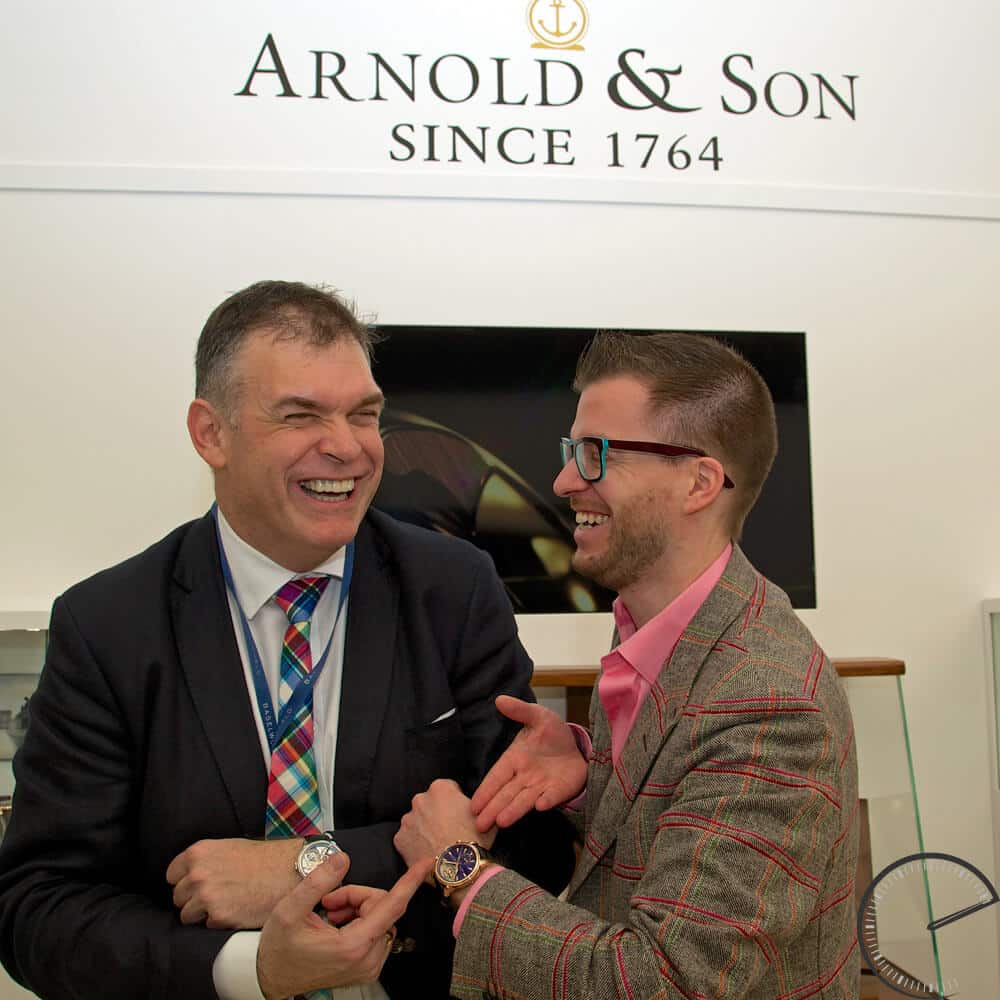
Angelus was reborn in 2015
In 2015, Angelus was reborn and placed adjacent to the traditionally styled Arnold & Son marque. Now, the two companies are siblings, crafting timepieces at the same atelier in La Chaux-de-Fonds. However, despite Sébastien Chaulmontet providing the technical lead for Angelus and Arnold & Son, each marque exhibits its own distinctive character.
To date, the resurrected Angelus brand has produced highly contemporary timepieces, suffused with innovative know-how but imbued with fine watchmaking craftsmanship. The first four models produced by the Swiss watch company belong to the ‘Urban Collection’ which may suggest that the brand will, in time, launch a classical or traditional range of watches, only time will tell (pun intended).

I chatted again to Sébastien Chaulmontet a few months ago and felt he could recognise that I was a fellow sufferer of the ‘chronograph bug’. He seemed to derive much pleasure from passing the Angelus U30 Tourbillon Rattrapante across his desk to me and observing my mouth break into a smile of appreciation. This is a chronograph made for chronograph enthusiasts, suffused with all the details you would want from a chronograph, as well as many you may never have imagined.
Without further ado, allow me to guide you through this chronograph technical fest par excellence.
Angelus U30 Tourbillon Rattrapante – openworked dial
Invariably, I commence watch reviews by discussing the dial of the watch, however, the Angelus U30 Tourbillon Rattrapante has no dial as such. Instead, black open-worked bridges are employed, immediately distinguishing this watch as something quite special. Holding the watch with its crown pointing downwards reveals that the bridges are arranged to form a letter ‘A’, acknowledging the first letter of the brand’s name.
This timepiece cordially invites the wearer to see much of the mechanical goings-on, typically hidden from prying eyes. This open-worked design approach, whilst occasionally seen elsewhere, is unusual because of the degree of mechanical frankness. There is a sea of silver-coloured wheels, luscious red rubies and open-worked hour and minute hands.
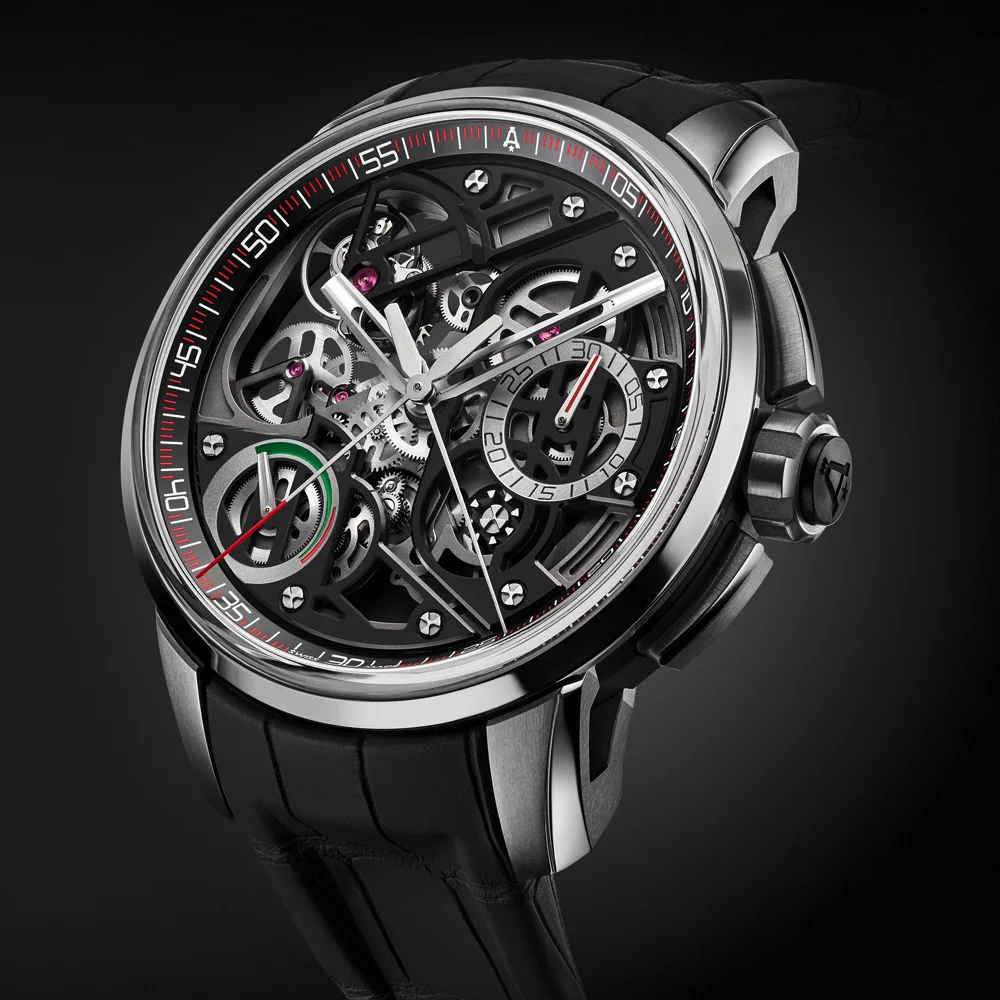
Adjacent to the crown at 3 o’clock, a 30-minute register appears to levitate above the movement. The register, presented on the upper chronograph bridge, is rhodium-treated and laser engraved with a combination of Arabic numerals and black markings. The hand on the register features a centrally positioned red line, delivering a touch of visual interest and aiding legibility.
Rattrapante or split second chronograph
Just below the 30-minute register is the first of two column wheels. The dial-side column wheel is used for the rattrapante or split second chronograph. Eight specular polished triangular pillars gleam against a black backdrop. A second column wheel is visible via the exhibition caseback and is used for the flyback chronograph.
A power reserve indicator is positioned between 7 and 8 ‘clock. This display is mounted directly upon the power reserve bridge, rhodium treated and filled with green and red lacquer. The incorporation of red and green hues adds a tasteful smattering of cheer without impairing readability.
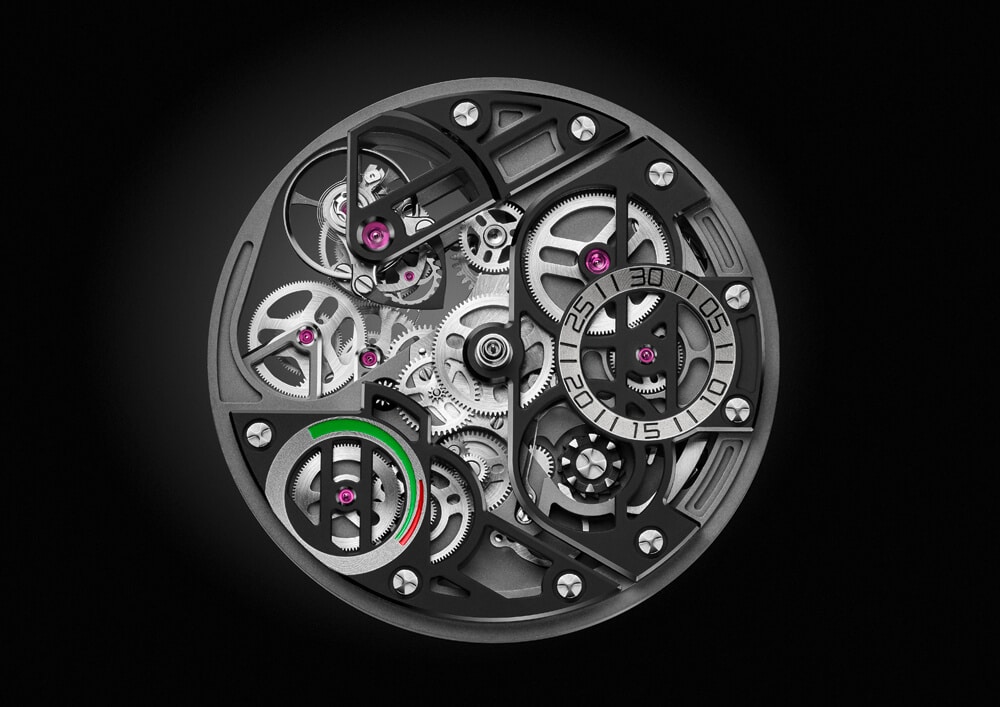
As previously stated, this Angelus timepiece is a split-second chronograph, equipped with two co-axially positioned central hands, affording the wearer the facility to measure two separate times. Typically, the wearer will only see the upper, central chronograph hand which features a fetching red shade on its tip. However, once the rattrapante (‘catch up’ in French) is actuated, the split-seconds chronograph hand, a second co-axially mounted hand, hidden beneath the aforementioned chronograph hand, comes out to play. In this instance, the rattrapante, or split-seconds, hand eschews colour, relying on its seemly sand-blasted finish to communicate with the wearer.
Encircling the dial is a black chapter ring, marked with Arabic numerals along with white and red strokes. Throughout the display, numerous ‘Angelus three-point design’ screws occupy the movement. These distinctive screws are not just attractive, but confer much technical virtue, allowing the watchmaker to tighten them to a pre-determined torque.
Residing between 10 and 11 o’clock, a one-minute tourbillon pulses with life, delivering an additional flourish of animation to the display. This watch delivers a spellbinding visual performance, inviting its audience to view the magical show of rotating wheels and traversing hands.
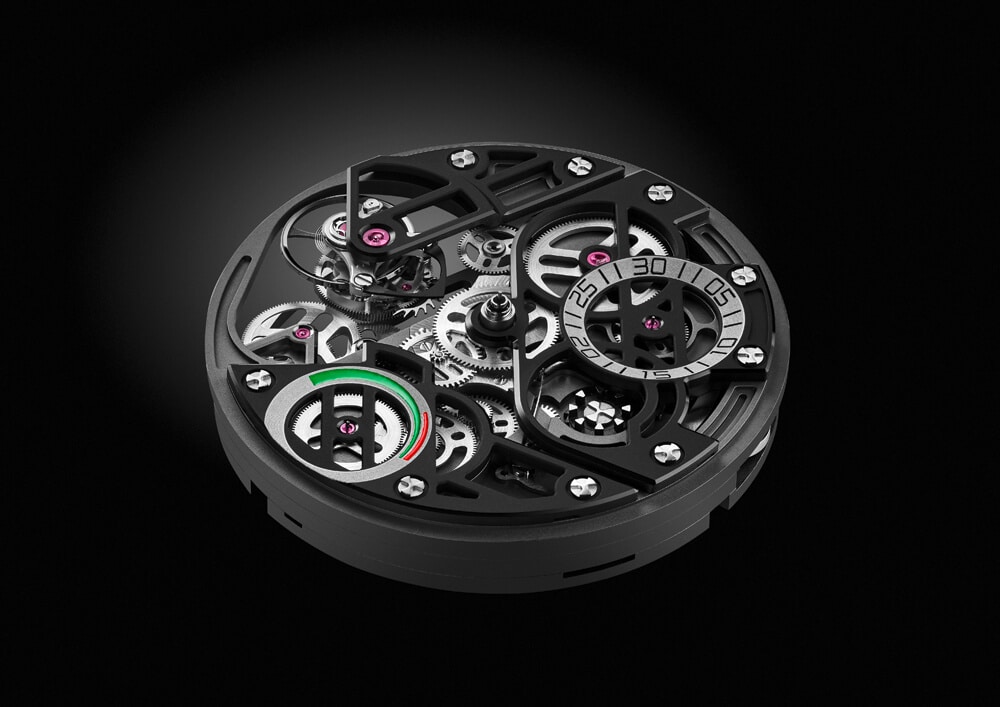
Despite the neoteric character of the Angelus U30 Tourbillon Rattrapante, this timepiece embraces a particular quality found with watches created in the 19th century, namely the capacity to be serviced and repaired in decades to come. There are numerous components present on this watch which have been conceived from the outset to be washed in ethanol, and other cleaning fluids favoured by watchmakers, without fear of removing text or coloured markings. There is a welcome integrity with this Angelus, sometimes lacking with some modern, contemporary-styled watches.
By revealing a profusion of mechanical parts, often hidden from view, there is much taking place front of house which some would-be wearers may not like. However, I personally did not struggle to read the dial and enjoyed witnessing the spectacle presented. The Angelus U30 Tourbillon Rattrapante delivers a wonderful visual performance which many lovers of haute horlogerie, myself included, will never tire of admiring.
Angelus U30 Tourbillon Rattrapante case
I always feel sorry for the designers of watch cases. Their role is tough and, like the younger sister at a family function, they have to sit back and allow their attention seeking older sisters, dial and movement, take all the glory. The case of the Angelus U30 Tourbillon Rattrapante could easily have assumed the role of younger sister, considering the propensity of the display to showboat and delight, however, look closely and there is much beauty and interest to be found with the case of this watch.
Measuring 47 mm in diameter, the grade 5 titanium case is generously proportioned but provides an agreeable union with the wrist. When worn, the case appears much smaller than its specification sheet would suggest. Furthermore, the case height of 15mm does not feel as significant when the timepiece is affixed to the arm, probably owing to some of the height being attributable to the airy sapphire crystal. The bezel is slender, prominently angled and highly polished. In contrast, the black caseband is unassuming, appearing to evince an almost covert character. Punctuating the muted surface of the caseband, the chronograph pushpieces add a soupçon of brushed detail, enhancing visual interest. Indeed, it is the profusion of design features which will delight prospective purchasers.
The lugs are graceful, sharply tapering down, inviting the strap to envelope the wearer’s wrist. They could almost appear classical in profile, if it were not for the open-worked vertical flanks which add a further dose of modernity.
Some of our most observant readers may ponder the whereabouts of the split-seconds chronograph push-piece. It is not located at the customary 10 o’clock position, but integrated into the crown, granting the watch a very neat appearance.
Angelus Calibre A150
The design of the movement within this Angelus creation is highly unusual. Firstly, there is an oscillating mass with its distinctive, twin-spoke, open-worked design. Again, the brand’s ingenious three-point design screws feature. The rotor is formed of 22-carat white gold, treated with black ADLC.
Ironically, most of the gear train is visible dial-side, albeit some wheels can be seen via the exhibition caseback. The gear train wheels feature a six-spoke design, again, a peculiarity of the maison, which brim with modernity and look stunning. Despite the cutting-edge feel of the Angelus U30 Tourbillon Rattrapante, the wheels featuring circular graining, subscribing to the traditional finissage found with classical paragons of haute horlogerie.
The caudal view accords sight of the one-minute tourbillon and, specifically, the black, gold treated copper-beryllium balance wheel.
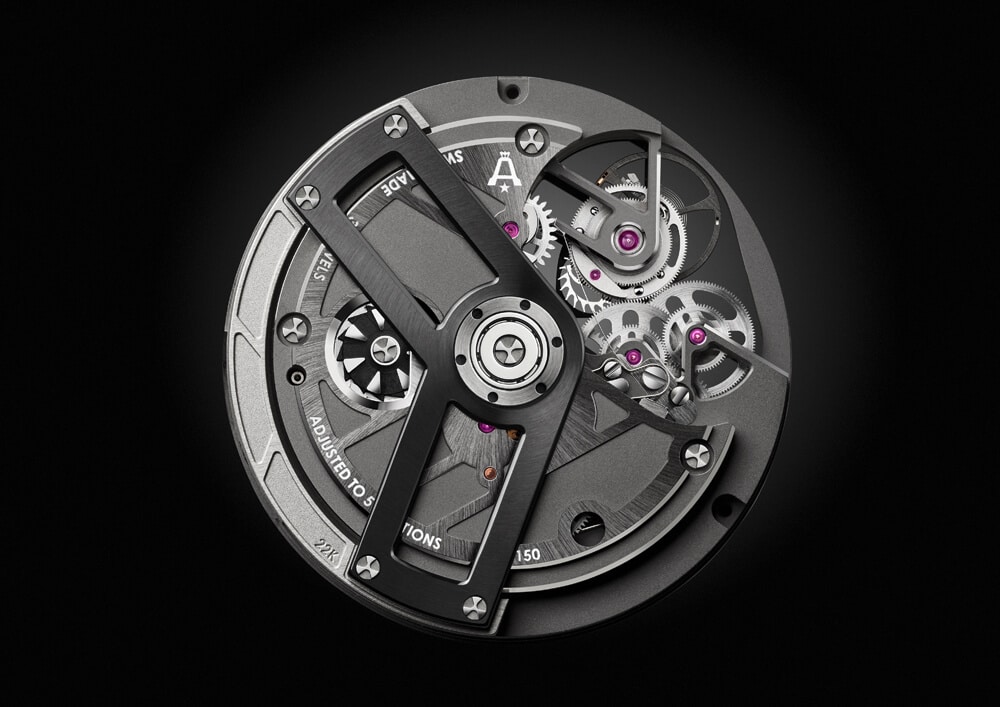
The rearmost column wheel is used for the flyback chronograph and is huge. This complication proves ideal for timing successive events, allowing the wearer to stop, reset and restart the stopwatch function in one process. The columns of the column wheel are mirror polished, shining resplendently against a black backdrop.
Angelus has coupled black ADLC-treated bridges with a grey NAC-treated main plate but then indulged the desires of the cognoscenti, incorporating chamfered and polished edges. Indeed, there is delightful mix of old and new which I personally find very endearing.
For me, the single most outstanding aspect of this watch, denoting the Angelus U30 Tourbillon Rattrapante as truly exceptional, is that it features both a split-seconds chronograph and flyback chronograph. Split-seconds chronographs are incredibly challenging to master. The two centrally positioned, co-axial hands, one superimposed above the other, are positioned incredibly close to each other, mitigating any parallax error. Moreover, they must rotate smoothly and not impair the performance of the neighbouring hand when working independently.
The forces at play within a ‘standard’ chronograph are immense. Often manufacturers of movements will use ultra-high speed cameras to photograph chronograph hands resetting in order to observe their behaviour. In some instances, the forces can be too great for the hands to bear and result in the hands subsequently bending.
By pairing both the rattrapante and the flyback together, the immense forces experienced during the start, stop and reset operations have to be managed. In the case of this watch it would seem that the creative minds at Angelus have beautifully handled the colossal power and delivered a wonderful marriage of complications for the delectation of watch lovers.
Despite being equipped with the power hungry complications of a tourbillon and chronograph, the Angelus U30 Tourbillon Rattrapante has an impressive power reserve of 45 hours. One reason for the movement’s parsimonious thirst for energy relates to the ‘non-magnetic’, black ADLC-treated tourbillon cage which is reputed by the brand to be of minimal mass, ‘optimising performance’ and consuming comparatively small quantities of energy.
Angelus U30 Tourbillon Rattrapante – closing thoughts
The Angelus U30 Tourbillon Rattrapante was conceived by a watch enthusiast for watch enthusiasts. It is a horological delicacy intended to sate the whims and desires of men who appreciate complications, particularly chronographs. It harnesses the highest standard of finishing typically found within traditional examples of Haute Horlogerie. However, this is not a traditional watch, it delivers an abundance of modernity and innovation, the latter trait earning Angelus huge respect in the 20th century.
The display is a little busy and I suspect some readers may consider it too congested for their tastes. Nevertheless, I appreciate the numerous pockets of mechanical intrigue conferred with this design and enjoyed discovering many smile-inducing details which proffer lasting joy. Furthermore, I found the readability to be fine.
While some readers may ponder whether such intricate mechanical complexity requires handling with kid gloves, rest assured that, courtesy of its various anti-shock provisions, this is a timepiece intended for daily wear.
In 2015, I freely proclaimed that my favourite watch was the Ferdinand Berthoud FB1. While 2016 has yet to be concluded, to date, the Angelus U30 Tourbillon Rattrapante is my stand out watch for this year, setting an altitudinously high bar which will prove very challenging for other brands to surpass.
Technical specification
- Model: Angelus U30 Tourbillon Rattrapante
- Reference: 0CRAC.B01A.C003U
- Case: Grade 5 titanium with black coating on caseband; diameter 47 mm; height 15 mm; water resistant to 3 bar (30 metres); sapphire crystal to front and caseback.
- Functions: Hours; minutes; tourbillon; fly-back chronograph, split-seconds; power-reserve indicator
- Movement: Calibre A150, self-winding movement; frequency 28,800 vph (4 Hz); 38 jewels; power reserve 45 hours.
- Strap: Black stealth alligator strap with titanium insert or rubber presented with a titanium folding clasp
- Price: CHF 55,600 (RRP as of 21.3.2016)
- Limited Edition: 25 pieces