
British watchmaking: the inventor, the mentor and the friend (F.P.Journe)
François-Paul Journe, founder of the eponymous firm F.P.Journe, was born in Marseille. He spent his early life working in Paris before establishing his own Manufacture in Geneva. Throughout his career, François-Paul has been inspired by the work of several British citizens, including Thomas Mudge, George Daniels and John Asprey. In 2023, the son of Marseille opened a boutique in London, further demonstrating his fondness for the home of the English lever escapement.
François-Paul Journe – a son of Marseille
In 1957, Jacqueline and Philippe Journe became the proud parents of a son, François-Paul. The new arrival was born in Marseille, the sun-kissed city in southern France. According to Jean-Pierre Grosz, in his tomb-like book, ‘F.P.Journe Invenit et Fecit’, François-Paul’s early life was good; however, he often didn’t conform to school rules while growing up.
With a reputation for being mischievous and seemingly disinterested in learning, his life may have turned out differently were it not for a pivotal moment in Journe’s early life. Concerned by her son’s behaviour, Jaqueline sent François-Paul to join his uncle, Michel Journe, a watch and clockmaker based in Paris. Apparently, Michel ‘had also been a rebel in his youth’.
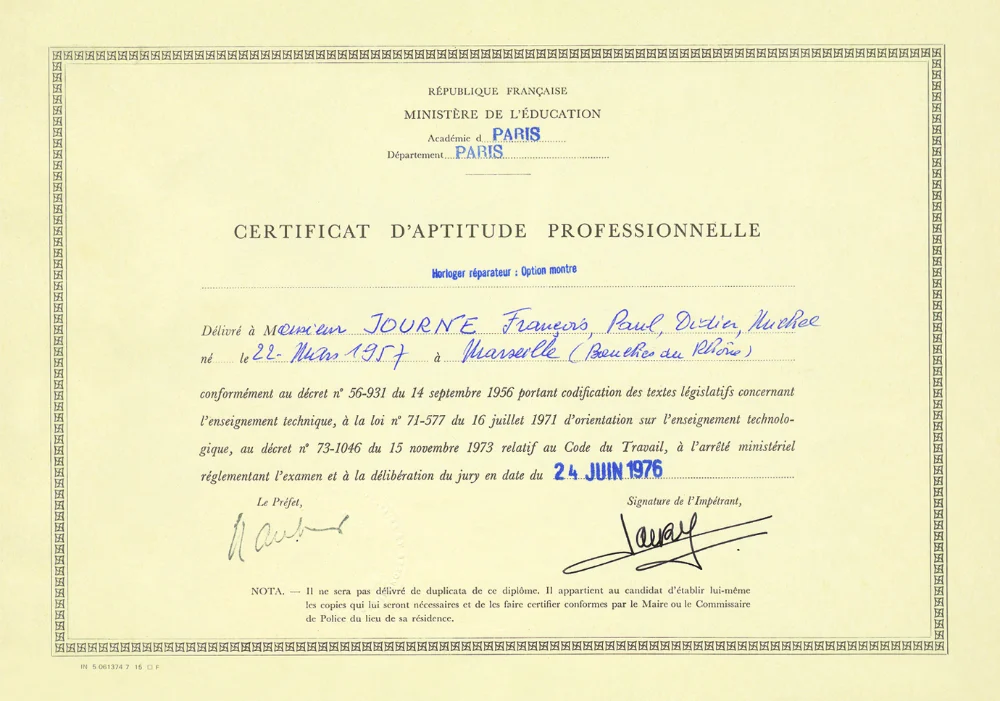
Image – certificate of professional competence (1976)
François-Paul, a teenager by this stage, was soon captivated by horology. He had found his vocation in life and a reason for learning. With the encouragement of his uncle, Journe Jnr enrolled at Marseilles technical college and a life of continuous learning ensued. Indeed, while regarded as one of the greatest watchmakers of his generation, the son of Marseille has never ceased in his quest to learn and understand. A trait that has served him well over the years, allowing him to invent and make objects of beauty; or as François-Paul prefers to say, ‘Invenit et Fecit’.
Key British figures who have shaped watchmaking
Having studied in Marseilles and subsequently graduating from watchmaking school in Paris, François-Paul had already amassed an impressive understanding of horology. However, a knowledge-hungry Journe would continue to devote many hours researching mechanisms from yesteryear, especially the work of the finest British and French clock and watchmakers of the 18th and 19th centuries.
During this period, Great Britain and France were at the vanguard of horological innovation. Great Britain was home to Arnold, Graham, Harrison, Mudge and Tompion. Similarly, on the other side of La Manche, France was home to Janvier, Lepaute, Le Roy, Robin, as well two adopted sons from Switzerland, Berthoud and Breguet, who spent most of their careers working in Paris.
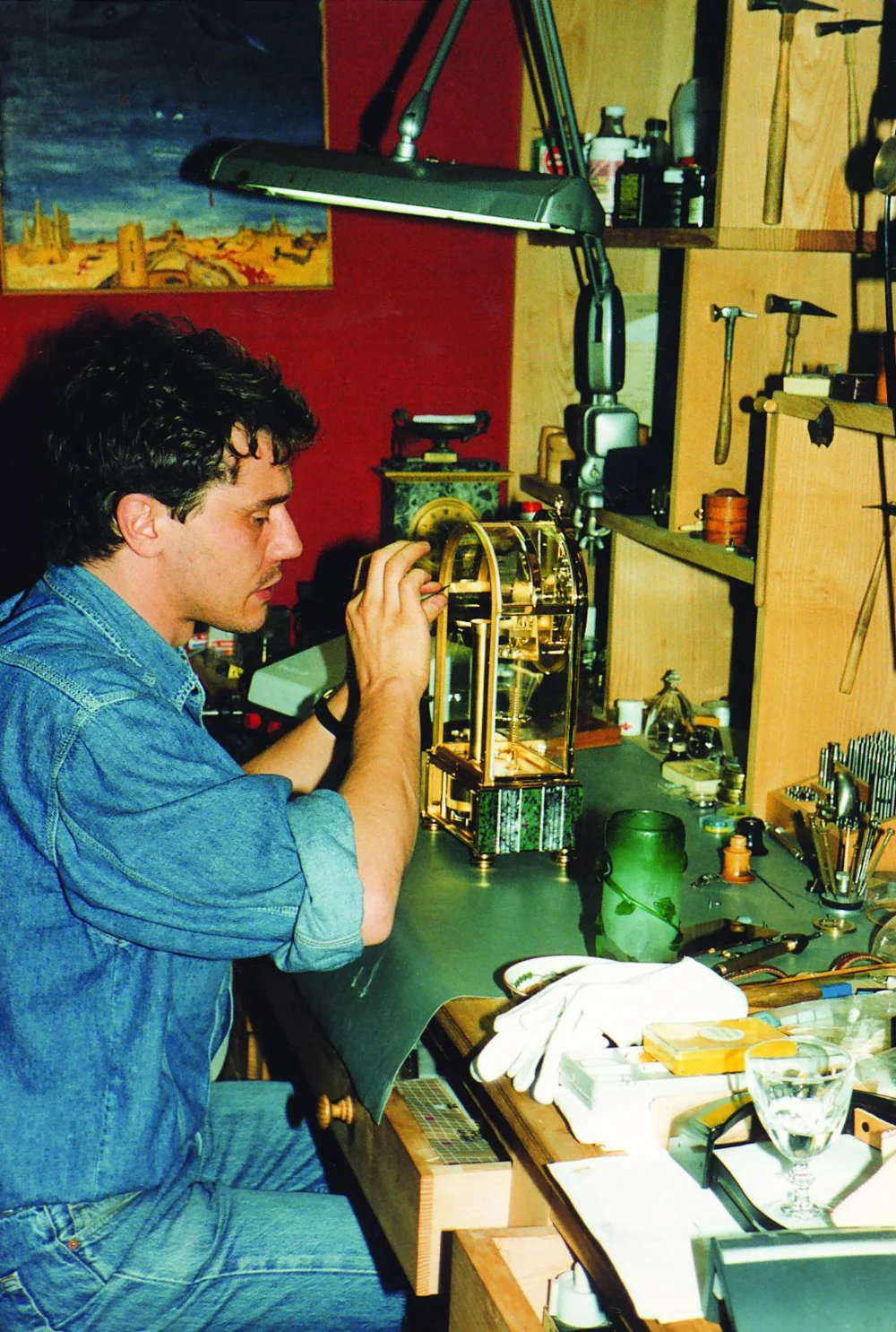
Image – François-Paul Journe working at his bench, aged 20
While studying Great Britain’s horological past, the young French watchmaker first learnt of Thomas Mudge’s English lever escapement, a precursor to the Swiss lever escapement. This latter mechanism is widely employed in the majority of today’s mechanical watches. But who was Thomas Mudge and, more pertinently, why did he become so important to François-Paul Journe? Allow me to elaborate.
Who was Thomas Mudge?
Thomas Mudge (1715-1794) was born in Exeter and apprenticed to George Graham (1673-1751), the illustrious clock and scientific instrument maker.
In 1754, Mudge invented the English lever escapement, a mechanism designed to ‘control the flow of time’. Referred to as a ‘detached escapement’, the balance is able to rotate freely throughout most of its oscillation except when the escape wheel is serving an impulse.
Contrasting the English lever escapement of the 18th century with the Swiss lever escapement of today, there are a few subtle differences. With Mudge’s original design, the lever is at right angles to the balance whereas on the Swiss lever escapement, the balance wheel, lever and escape wheel are inline. Over time, the evolution of Mudge’s original design has also led to other differences such as a revised profile for the escape wheel teeth and the way these interact with the pallet jewels.
There are several reasons why today’s lever escapement has been wholeheartedly embraced by the watch industry. In particular, it is reliable and comparatively simple to regulate and service. It’s also self-starting, more resistant to shocks than some other escapements and is considered relatively precise.
However, like many things in life, there are inherent weaknesses with the design of the lever escapement. As the escape wheel rotates, its teeth slide across the face of the pallet jewels which is not energy efficient and creates friction. This latter issue necessitates using lubricants which inevitably deteriorate with time, potentially altering the rate and necessitating renewal.
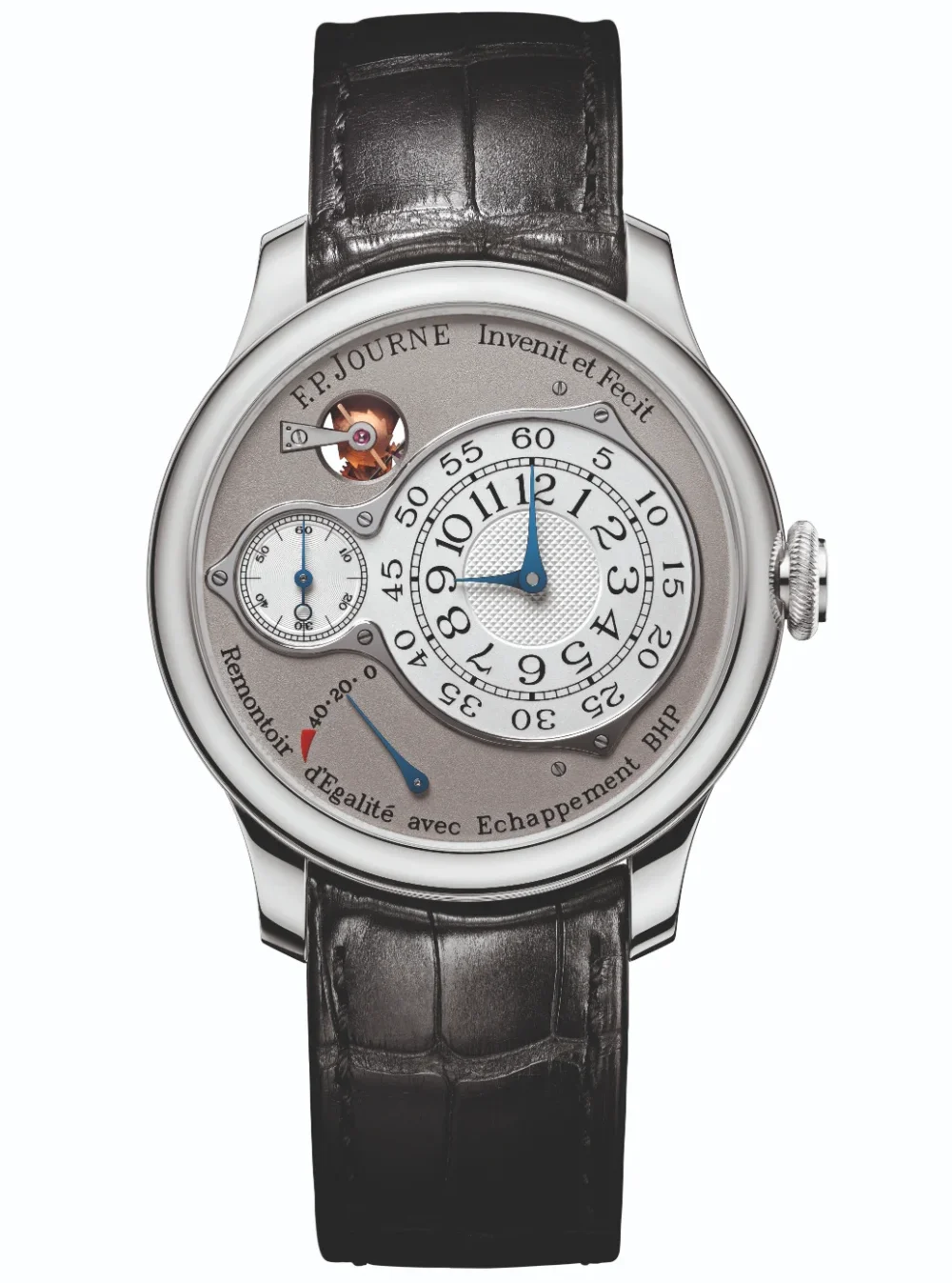
Image – F.P.Journe Chronomètre Optimum
Mindful of these drawbacks, François-Paul invented the ‘Echappement Bi-axial Haute Performance’, a fusion of the Swiss lever escapement and Breguet’s natural escapement. The Echappement Bi-Axial Haute Performance (EPHP system) employs two escape wheels that serve a direct impulse on the balance. Moreover, the EPHP system is self-starting and functions without the need for lubrication. This innovative EPHP system features within the F.P.Journe Chronomètre Optimum, a watch that is also endowed with a one-second Remontoir d’Égalité, augmenting rate stability.
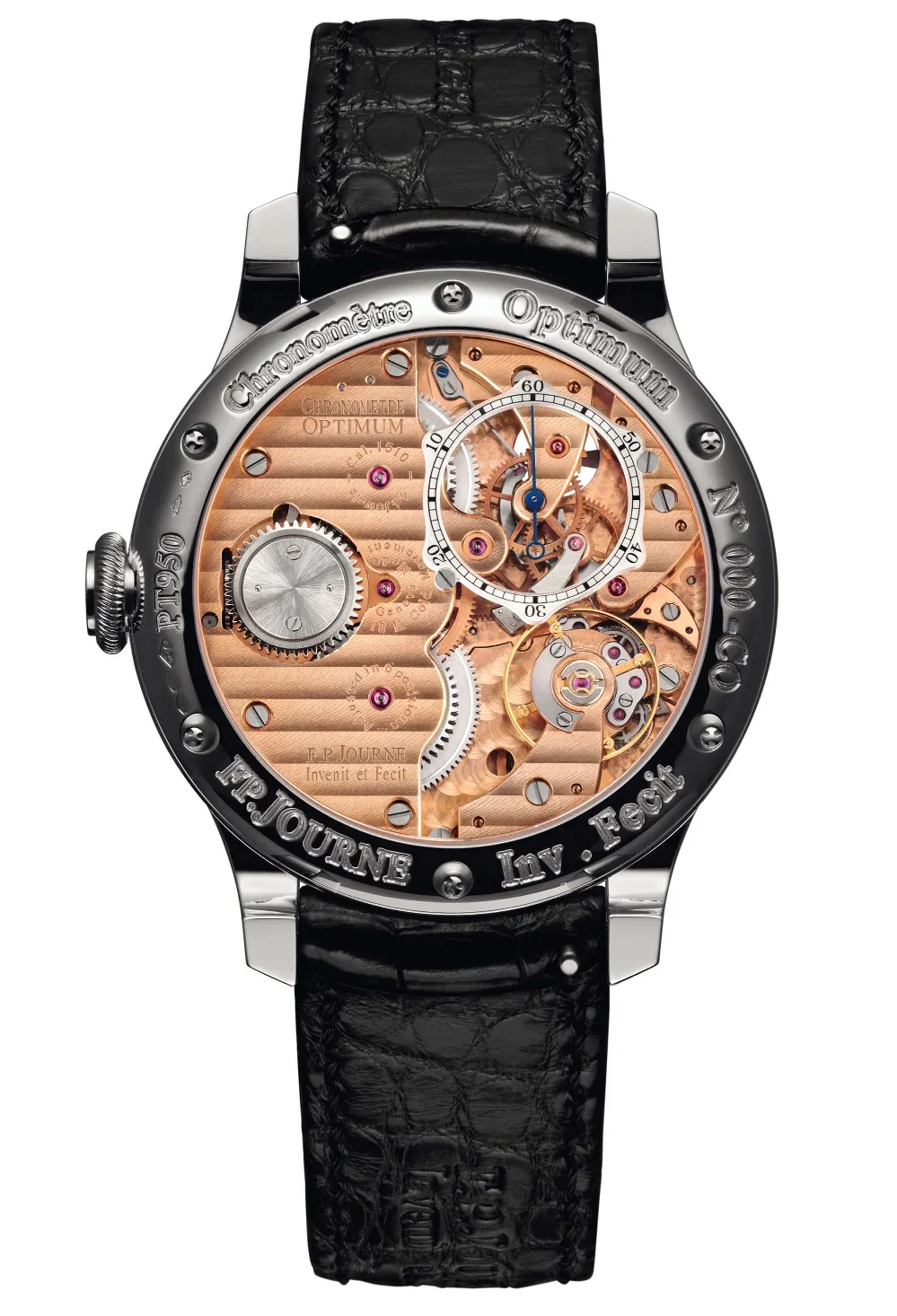
Image – F.P.Journe Chronomètre Optimum
Returning to Mudge, later in his life, he sought to develop marine chronometers, a highly precise means of determining longitude at sea. While John Harrison (1693-1776) was the first to receive financial payments from the Board of Longitude, Mudge was also rewarded for his designs (1770). In 1792, after a dispute between Mudge and the Board of Longitude, a Committee of the House of Commons ruled that Mudge be awarded £2500. Two years later, Mudge died.
Despite achieving much throughout his professional life, Mudge will forever be remembered for creating the detached lever escapement, a mechanism designed to control the flow of time that some 270 years later still remains in widespread use.
George Daniels – watchmaker, inspiration, mentor and friend
While working in his uncle’s workshop, François-Paul’s exposure to historical clocks and watches fuelled his imagination. Like many admirers of horology, he became fascinated by the work of Abraham-Louis Breguet (1747-1823). Once a reticent pupil, the son of Marseilles yearned to know more about the iconic watchmaker. Sat on a shelf within his uncle’s workshop was a copy of ‘The Art of Breguet’, a book penned by George Daniels (1926-2011). Daniels had an encyclopaedic knowledge of Breguet which no doubt helped him in his day-to-day life as a watchmaker.
Born in London, Daniels was an extraordinary figure. No stranger to poverty in his childhood, he ultimately crafted no-compromise watches for the great and the good. Unlike most watchmakers who procure parts from specialist suppliers, Daniels amassed the necessary expertise to make all components by hand within the confines of his workshop.
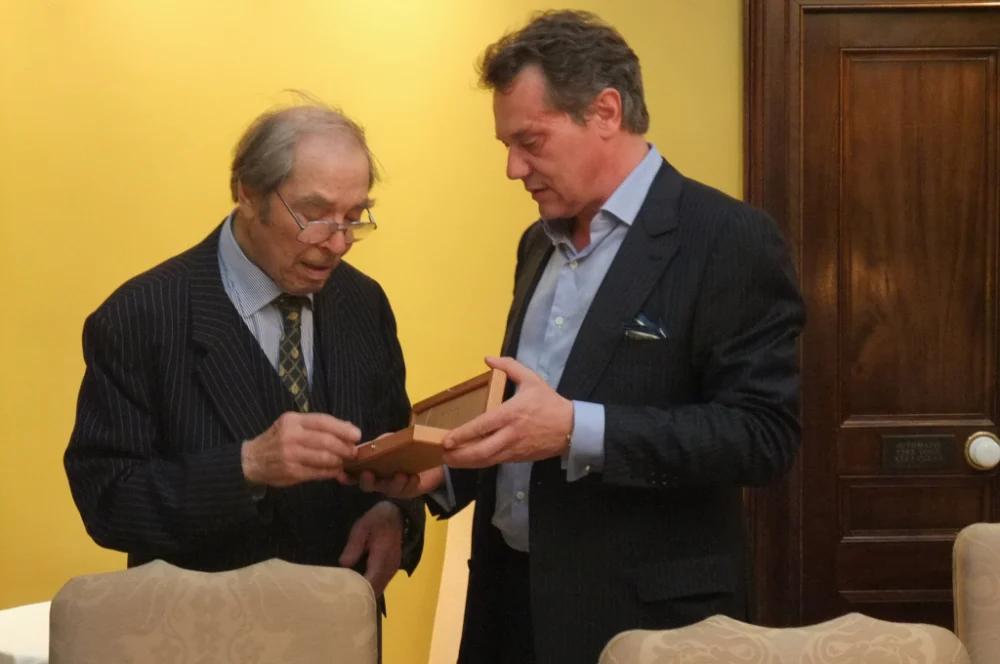
Image – George Daniels and François-Paul Journe
Around the same time, while working in Michel’s workshop, François-Paul met Sir Cecil (Sam) Clutton (1909-1991). A wealthy client of his uncle, Clutton often carried two watches upon his person, a Breguet and a Daniels. He was Daniels’ first client. The titled Englishman was a fascinating character with interests in motorsport, organ music and horology.
Appraising ‘The Clutton-George Daniels’, a pocket watch measuring 62 mm in diameter, François-Paul was said to have been astonished by its execution. Moreover, according to Jean-Pierre Grosz, in his book, ‘F.P.Journe Invenit et Fecit’, when Journe looked at the watch, he was ‘amazed by the tourbillon, which made a complete revolution in one minute.’

Image – First pocket watch by François-Paul Journe featuring a tourbillon and detent escapement
After reading Daniels’ book and seeing Sir Cecil Clutton’s watch, François-Paul embarked on a journey; discovering how to make his very own pocket watch. Inspired by George Daniels’ work, the son of Marseilles began work crafting a pocket watch by hand. It featured a tourbillon, double barrel and spring detent escapement. François-Paul began making the watch in 1978, when he was just 20 years of age. It would take him five years to complete. The watch remains in François-Paul’s private collection.

Image – First pocket watch by François-Paul Journe featuring a tourbillon and detent escapement
Returning to Daniels, he is probably best known for his groundbreaking co-axial escapement, an ingenious mechanism that addresses the issue of sliding friction and delivers a high degree of precision.
Journe met Daniels on several more occasions throughout the Englishman’s life and would often solicit his advice. In 2010, a dinner was organised by John and William Asprey in honour of George Daniels, ‘one of the foremost watchmakers of the 20th century’. At the event, François-Paul paid tribute to his mentor and friend and presented him with a Chronomètre Souverain engraved with the inscription ‘FP to George Daniels, My Mentor 2010’.
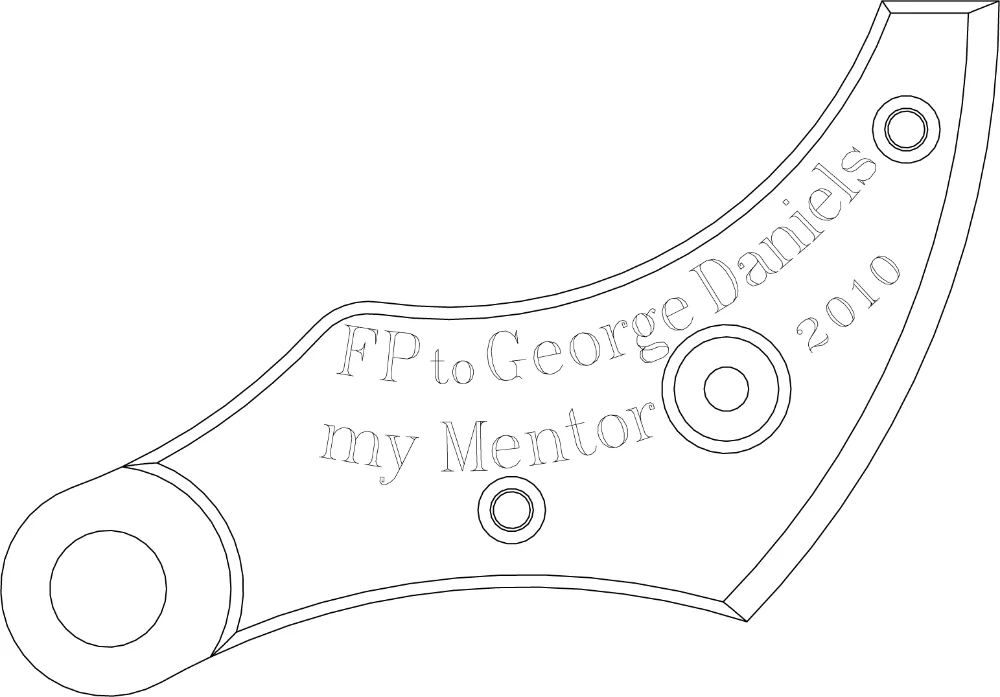
Image – engraved bridge fitted to the movement of the Chronomètre Souverain
John Asprey – client and friend
The name ‘Asprey’ will be familiar to many of my compatriots. Founded in 1781, the British institution is a purveyor of jewellery, leather, silver and other luxury goods. It has enjoyed the patronage of the great and the good, including royalty, aristocrats, the political elite and stars of the silver screen.
François-Paul, barely 22 years of age, was tasked by one of his uncle’s clients, P.G. Brun to construct a planetarium clock. The prestigious firm based in Paris specialised in Haute Joaillerie and fine clocks and had accepted a commission from John Asprey, a member of the eponymous retail dynasty. Etienne Brun ‘had already wasted precious time searching for a clockmaker, and only a few months remained before they had to deliver the piece. F-P agreed to take up the challenge and the Brun brothers took the risk of giving him the job’ (Grosz). The ‘Planetary clock with 12 sides’ was completed on time and presented at the Basel fair in 1979.
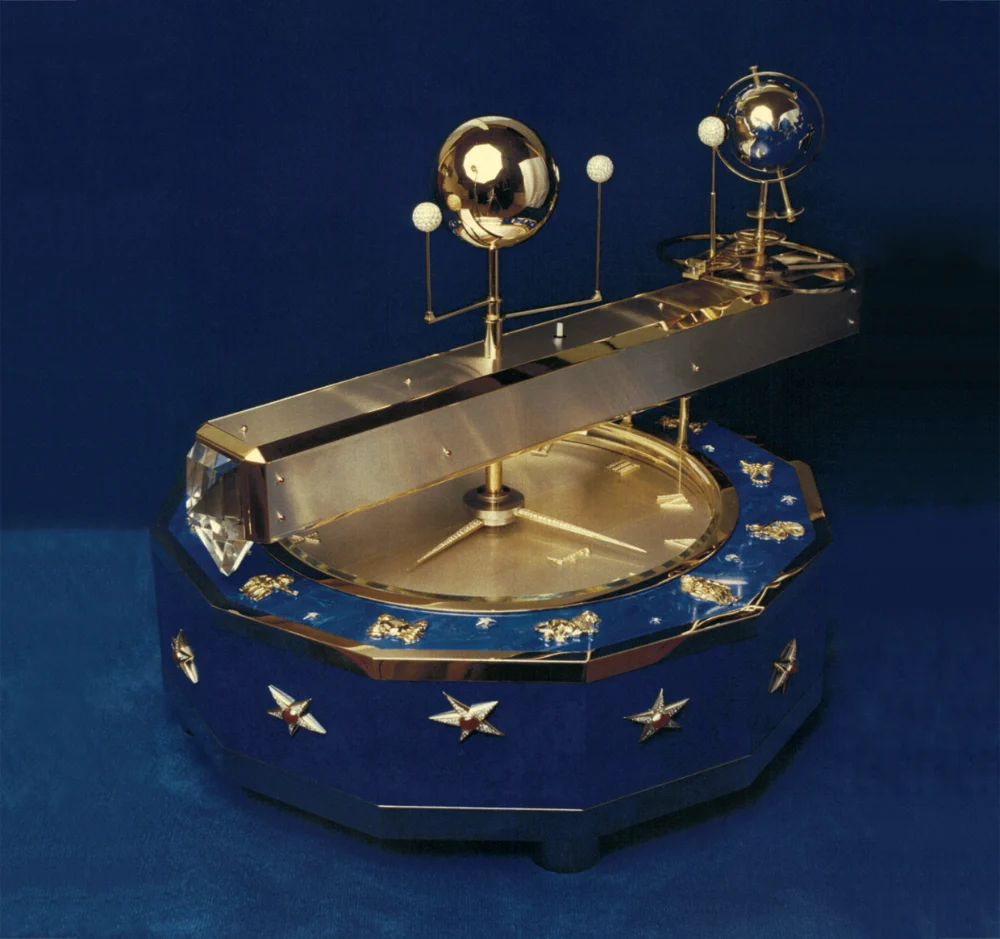
Image – Planetary clock with 12 sides
In 1987, John Asprey commissioned François-Paul to make two ‘sympathique clocks’. Originally conceived by Breguet (circa 1795), the sympathique clock, actually comprised of a clock and pocket watch. At the end of each day, the owner would place the pocket watch within a cradle set in the top of the clock. The clock wound the watch’s mainspring and also regulated its balance. The clock’s movement featured a constant-force chronometer escapement, conferring rate stability and precision. It was arguably one of Breguet’s most complex innovations and creating a similar clock-watch ensemble would have certainly challenged François-Paul at the time. Nevertheless, he persevered and fulfilled the order to the satisfaction of John Asprey. The two men would later become friends.
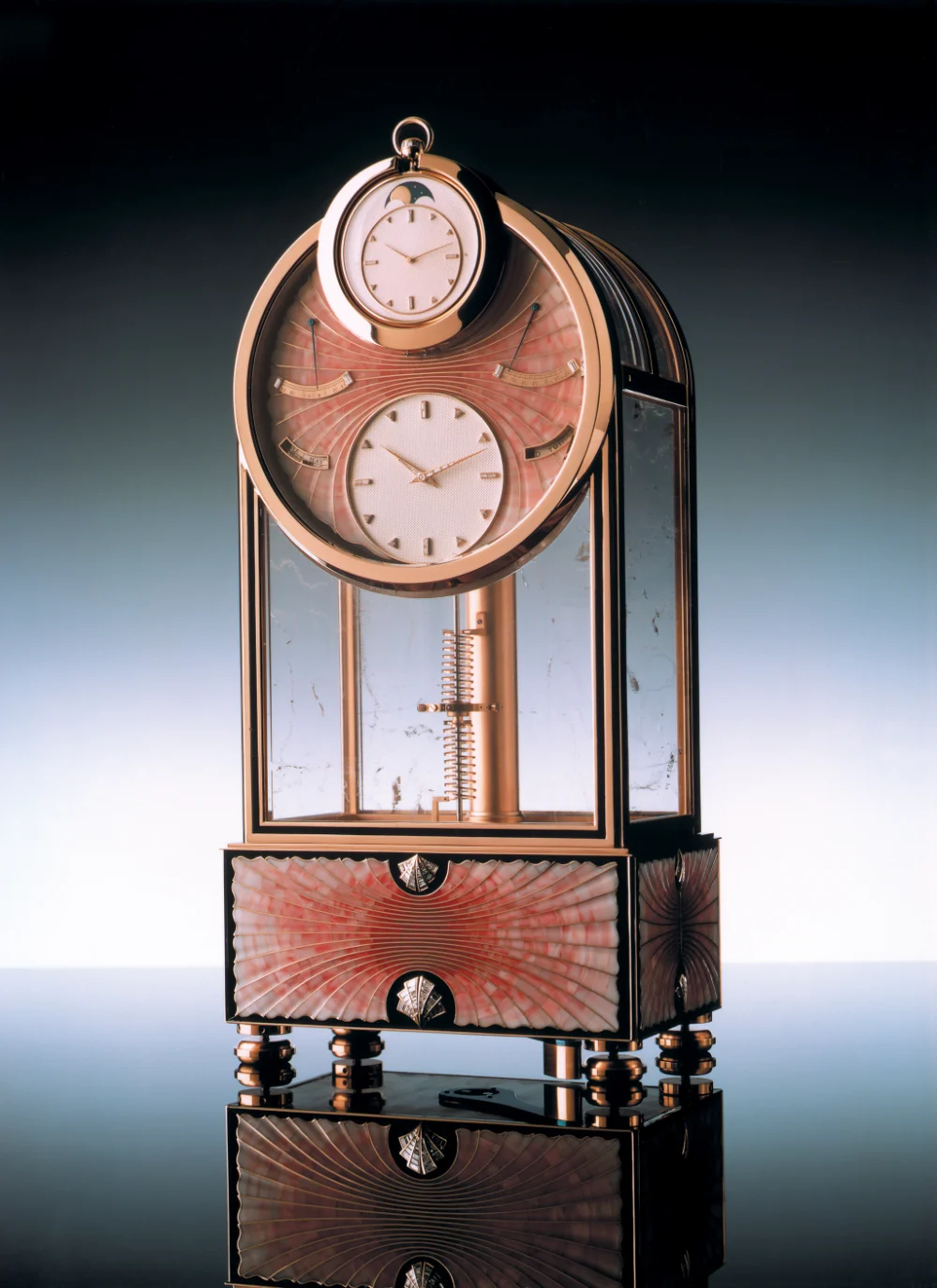
Image – Sympathique clock in gold – no.1 for Asprey
Coincidentally, in 1999, the same year François-Paul established his eponymous brand F.P.Journe, John Asprey’s son, William, opened William & Son. Initially, the firm began life as a gunroom, located on Mount Street in London’s prestigious Mayfair. Later, William & Son opened a second site, just two doors down from the first premises, selling various luxury goods, including watches. A strong advocate for independent watchmaking, it was perhaps inevitable that William would become an authorised retailer of F.P.Journe timepieces. Her Late Majesty Queen Elizabeth II awarded William & Son a Royal Warrant in 2009.
William & Son moved to new premises on nearby Bruton Street in 2016; however, in 2020, the company went into administration.
F.P.Journe London boutique
In December 2023, aware of local demand for the company’s products, F.P.Journe opened the doors to a new boutique in London. Located at 33 Bruton Street, the building was once home to Holland & Holland, the famous British gunmaker. With its Portland stone façade and doric columns, the building’s appearance has changed little since the 1930s, albeit its history dates back to the 18th century.
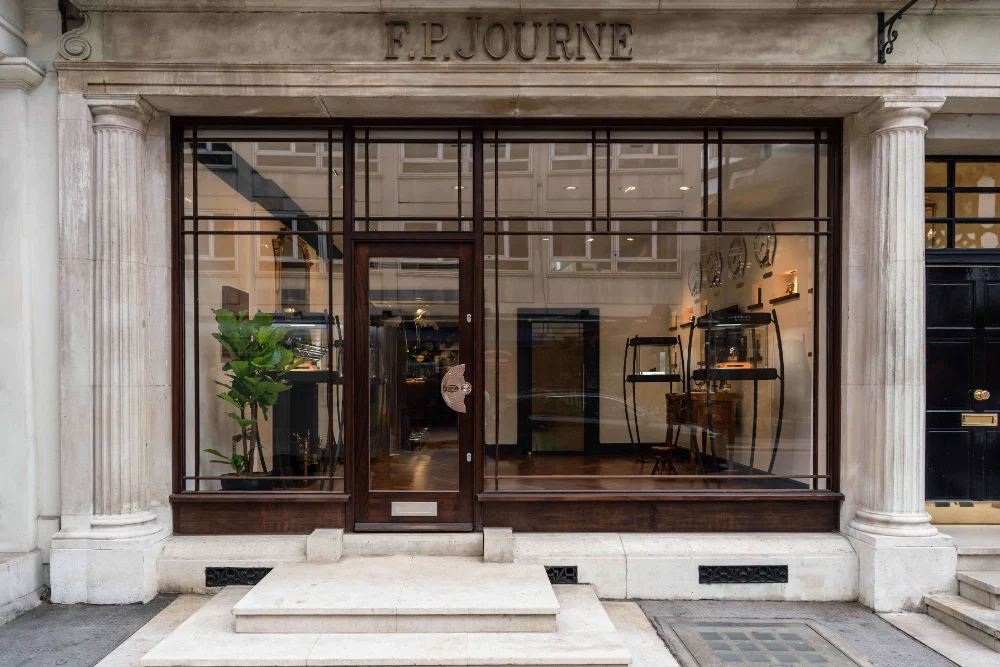
Image – F.P.Journe London boutique
Interestingly, Her Late Majesty Queen Elizabeth II was born at 17 Bruton Street on the 21 April 1926.
Another factoid is that F.P.Journe previously collaborated with Holland & Holland in 2017, creating a limited-edition timepiece endowed with a distinctive Damascus patterned dial formed from vintage gun barrels.
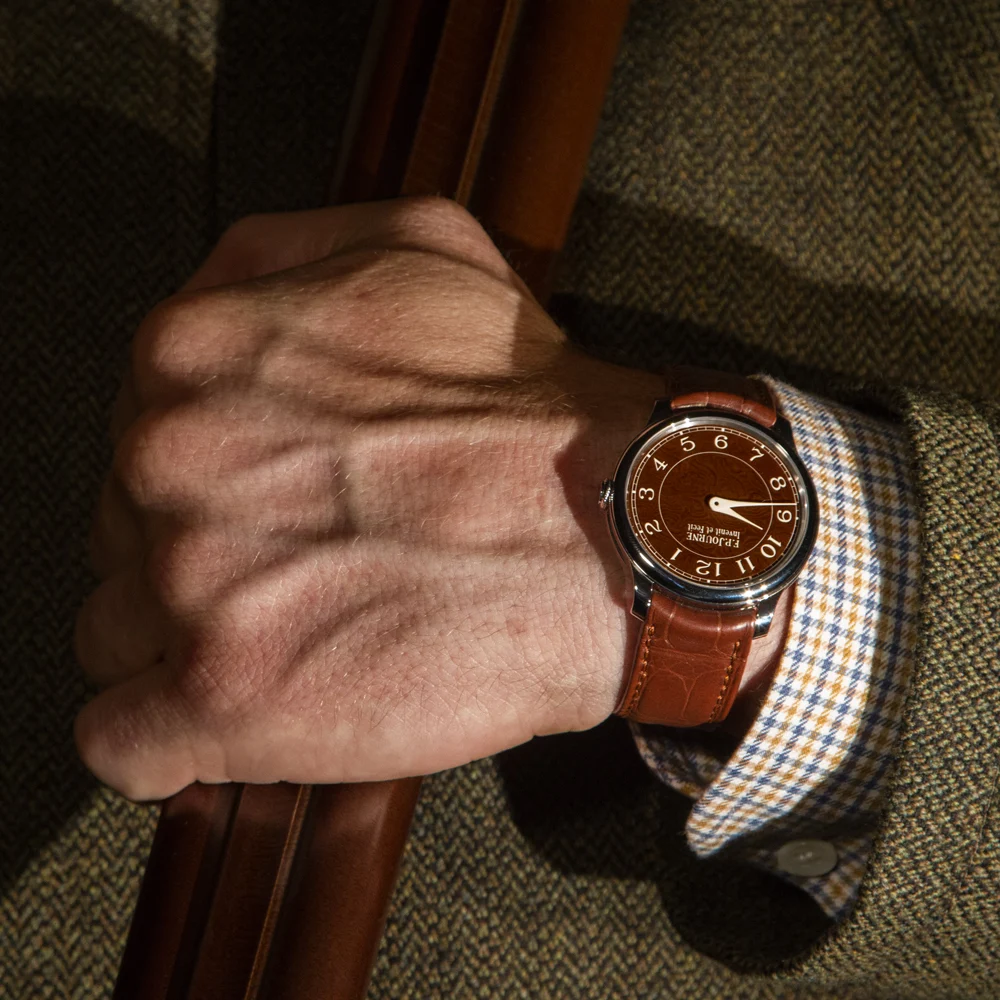
Image – F.P.Journe Chronomètre Holland & Holland (2017)
The advent of the London boutique has allowed François-Paul to remain close to his patrons and provides a haven for collectors and watch enthusiasts alike. It’s here, on the first Tuesday of every month, likeminded souls meet, enjoy an apéro and share their appreciation for F.P.Journe models. No doubt, conversations sometimes stray to other matters of horology, including Great Britain’s prominent role in the history of precision timekeeping.
British watchmaking; a source of inspiration and friendship
For over 50 years, François-Paul has displayed a keen interest in British watchmaking history. He has learnt from the some of the nation’s finest watchmakers, while forming enduring alliances along the way. In particular, Journe’s fondness for Great Britain was heightened by his friendships with John Asprey and George Daniels.

Image – François-Paul Journe appraising his first sympathique clock (1987)
The new F.P.Journe boutique promises to facilitate future encounters and perpetuate François-Paul’s love for a nation with a remarkable horological history. The son of Marseille remains unquestionably an Anglophile.