
Zeitwinkel watches – True Luxury Watch Review
Zeitwinkel watches are becoming increasingly popular among watch aficionados, attracted to the company’s blend of enduring aesthetics and mechanical integrity. In this feature, Angus Davies ventures behind the scenes, looking at the composition of a Zeitwinkel movement and pointing out the high quotient of horological goodness, often painstakingly imparted by time-served hands.
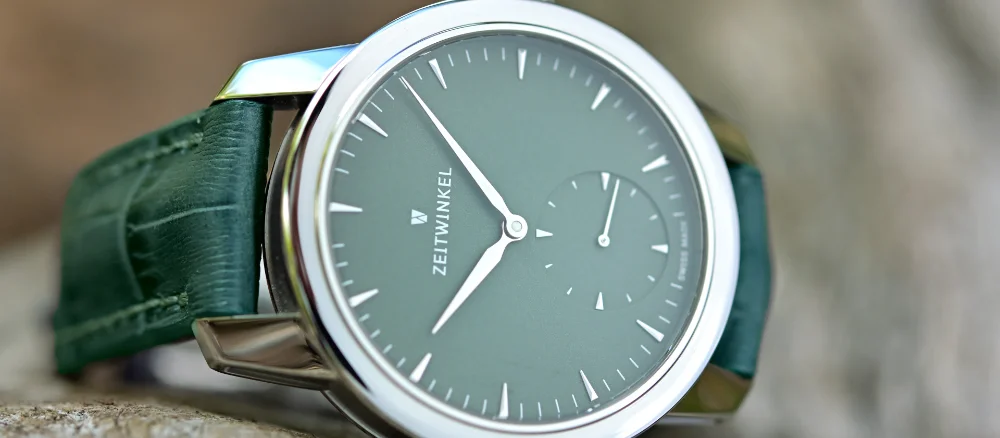
Image – Zeitwinkel 188° with galvanic frosted dial
Understanding excellence
“Five thousand pounds… but it’s a suit”, my friend cried as I revealed the cost of a bespoke suit from London’s Savile Row. I smiled and then proceeded to explain the difference between ‘ready to wear’, ‘made to measure’ and, the pinnacle of sartorial elegance, ‘bespoke’.
I pointed out that the skilled tailor appraises an individual’s stance and subtly disguises physical quirks such as one shoulder being marginally higher than the other. After taking innumerable measurements, a unique paper pattern is drafted by hand, incorporating minuscule details that confer wearer comfort and elegance. The chosen cloth is then cut by hand using traditional shears – not a machine in sight. Thereafter, three fittings hone the garment to a glorious conclusion.
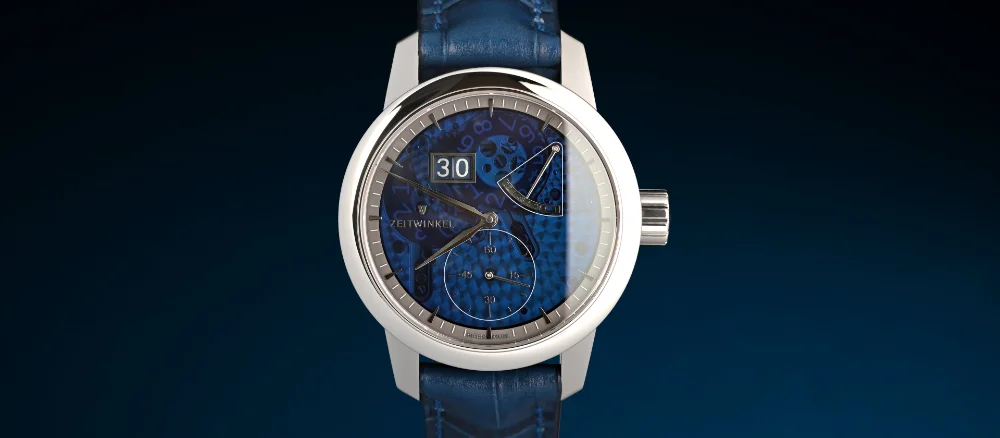
Image – Zeitwinkel 273° Saphir Bleu
Pause for a moment and consider the many refinements incorporated within a bespoke garment. The stitches are imparted with hand and needle, once again, no machine in sight. The bespoke canvasses (interlining) that provide structure to the suit are formed by hand, stitched in place and, unlike most mass-produced suits, no glue is used. The buttons are hand stitched. Wherever you choose to look, smile-inducing details abound.
At one time, when a suit was fitted with ‘working buttons’ (surgeon’s buttons), it indicated it was bespoke. Faux buttons were once only found on mass-produced suits. Sadly, the makers of these latter products now equip their suits with working buttons, passing off inferior garments as extraordinary. However, don’t be fooled, just look at the shape of the buttonholes and the way they have been stitched, you will soon see the difference between a genuine bespoke suit and a mere pretender.
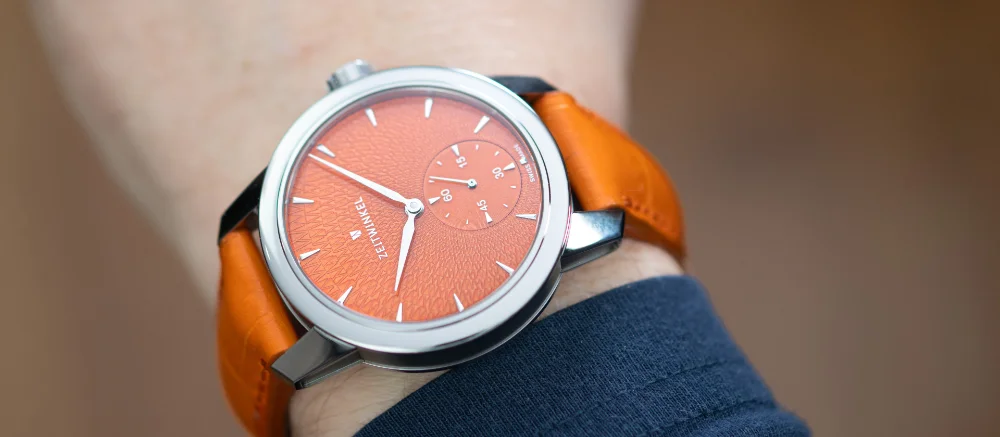
Image – Zeitwinkel 188° MAKS with structured dial
What is ‘true luxury’?
In the esoteric world of luxury, there are companies where their esteemed reputation is based on upholding time-served traditions, all practised in a no-compromise fashion, in an unwavering quest to deliver product excellence.
Unfortunately, the high prices charged by some firms is all too often a function of prominent branding and shrewd marketing. This is evident with some watches that purport to be ‘luxury’ but are simply devoid of virtue.
Zeitwinkel, an independent watch company based in Saint-Imier, crafts timepieces imbued with much horological integrity. I’ve visited the company’s atelier on a couple of occasions, and, in my opinion, the firm is an honest purveyor of ‘true luxury’, making watches where the notion of quality extends to many parts the wearer will never see.
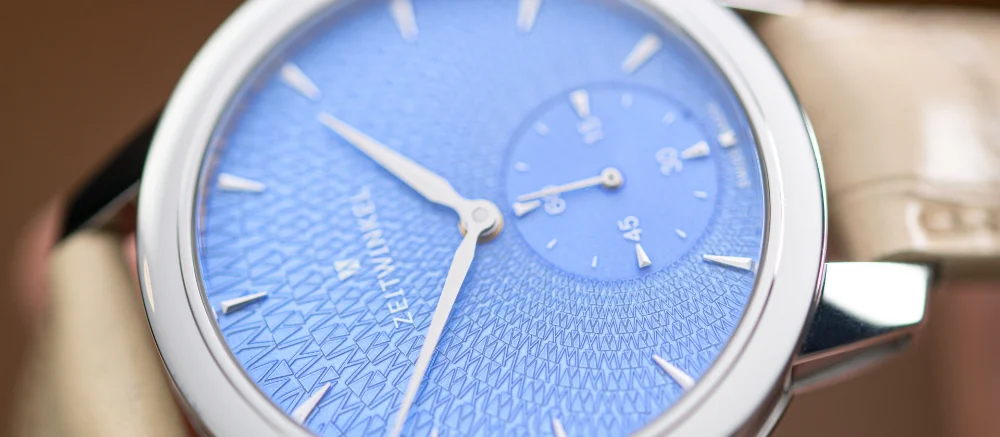
Image – Zeitwinkel 188° MAKS with structured dial
Understanding Zeitwinkel
Since it was founded in 2006, Zeitwinkel has become increasingly popular with horophiles. In a watchsphere dominated by large players, the Swiss marque is comparatively small. It doesn’t spend vast fortunes on grandiose exhibition stands, nor does it pay A-list celebrities to endorse its products. No, Zeitwinkel is a company that invests its resources into crafting sublime watches, packed with horological goodness.
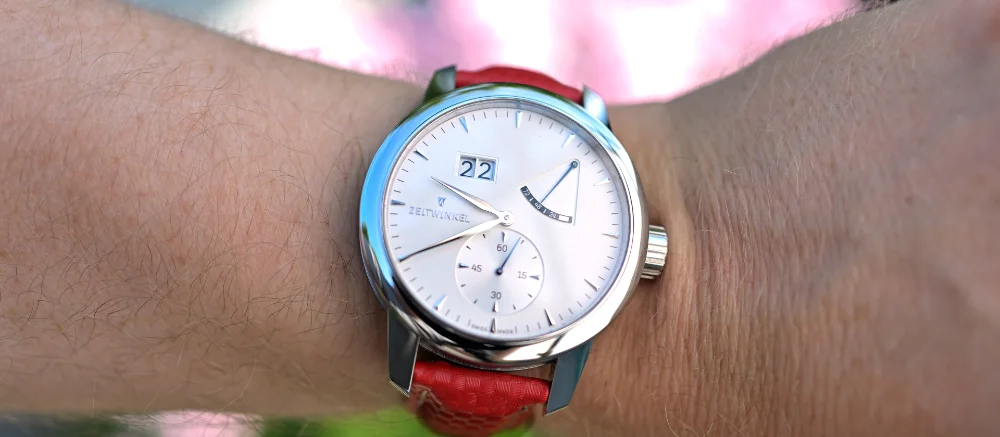
Image – Zeitwinkel 273°
Interestingly, Zeitwinkel continues to produce the same models it unveiled at the time of its inauguration. These watches have never shown any signs of ageing, but then as any Savile Row tailor will attest, ‘style never goes out of fashion’. Contrast this approach with those mainstream brands that release new models with great fanfare only to discontinue them three years later – is this true luxury?
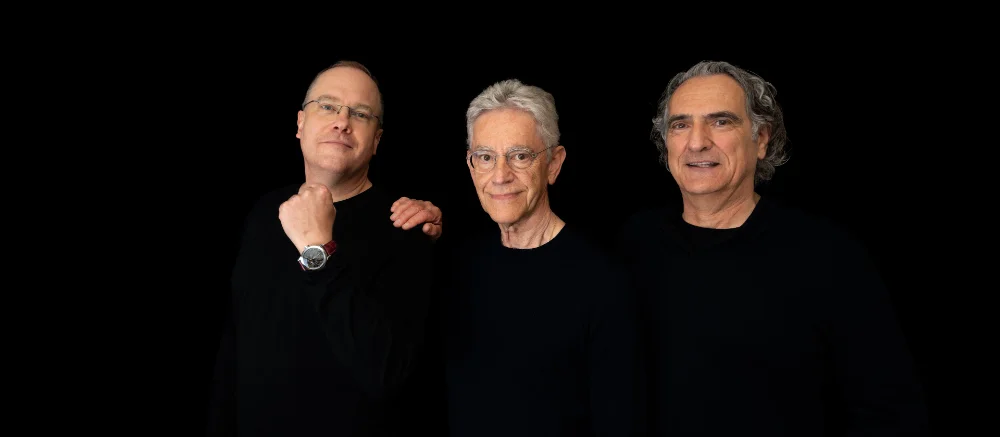
Image – Zeitwinkel’s founders – Albert, Maks and Peter (L to R)
Don’t misconstrue, Zeitwinkel has not sat on its hands for the last 18 years. On the contrary, by getting the design of its models spot on from the get-go, the brand has been able to add additional references while cleverly sidestepping obsolescence.
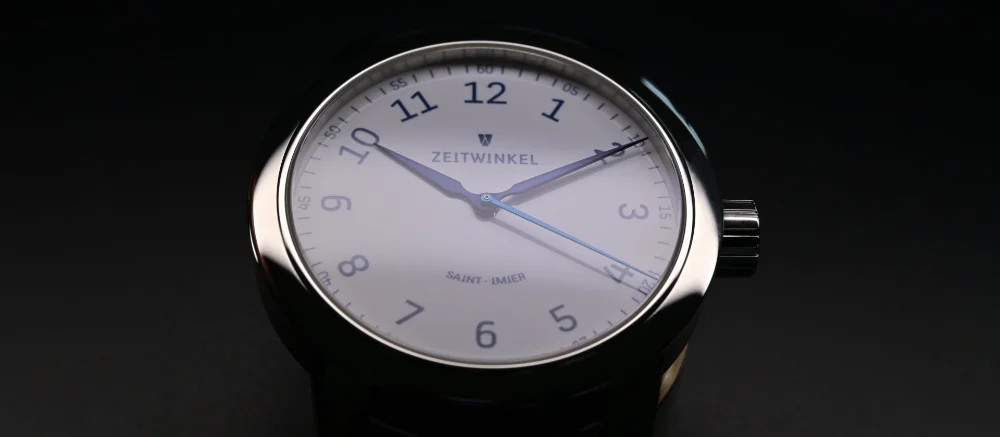
Image – Zeitwinkel 082° Email Grand Feu
Although enduring looks are important, there are other considerations which are equally valid. For instance, beyond the design of its models, the Swiss marque has given much consideration to the selection of materials, methods of construction and finishing. Allow me to elaborate.
Movement finishing (finissage)
There is a misconception that ‘finissage’ (finishing) is merely about making a movement look attractive. On the contrary, there are several reasons for finishing movement components using a variety of techniques, many of which are imparted with the deft use of hand and tool. For example, Zeitwinkel eradicates any signs of machining, even from those surfaces that will never be seen. Furthermore, in some cases, polishing components enhances corrosion resistance, imbuing parts with longevity. I will return to finissage shortly, but first let’s talk about German silver.
German silver – base plate and three-quarter plate
Most mechanical watch movements are predominantly formed of rhodium-plated brass. However, Zeitwinkel prefers to use untreated German silver (maillechort), an alloy of copper, nickel and zinc.
When the baseplate and three-quarter plate are machined, there may be some burrs left behind that could inhibit the motion of parts and heighten friction/wear. These burrs are removed by ‘drawing’ the surfaces with a graver, a Degussit ruby stone and diamond paper.
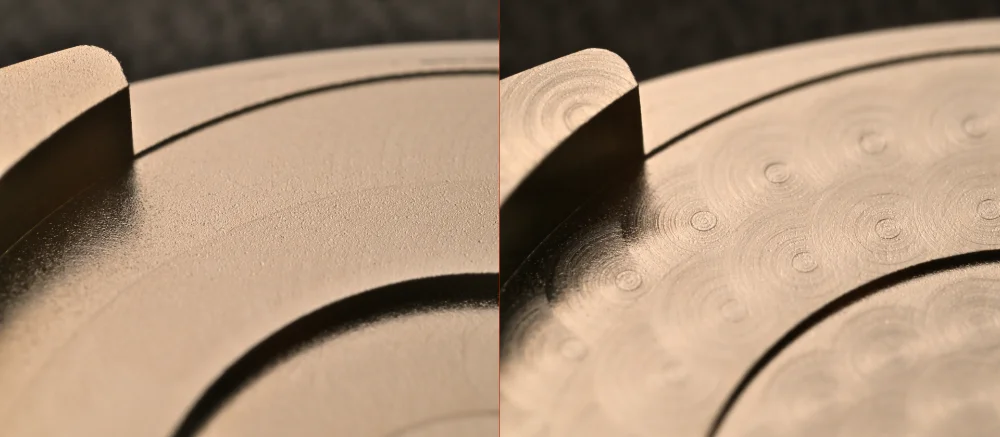
Image – German silver before and after decoration
German silver is strong, but more challenging to work with due to its hardness. Over time it develops a becoming patina, much loved by purists. Moreover, a watchmaker’s fingerprint or an absent-minded slip of a screwdriver can easily mar the pristine appearance of a surface necessitating time-consuming rework or replacement. But once the German silver components are viewed through the exhibition caseback, its beauty can be readily seen, justifying the Swiss marque’s protracted efforts and standing testament to great care practised during assembly.
Now let’s take a look at some of the finishes employed on a Zeitwinkel watch.
Types of finishing
Côtes de Genève
Some forms of finishing, such as Côtes de Genève, are traditional. Sometimes termed ‘Geneva stripes’, this striped motif is typically applied to the visible surfaces. Its role is purely decorative, and it is not applied to functional surfaces.
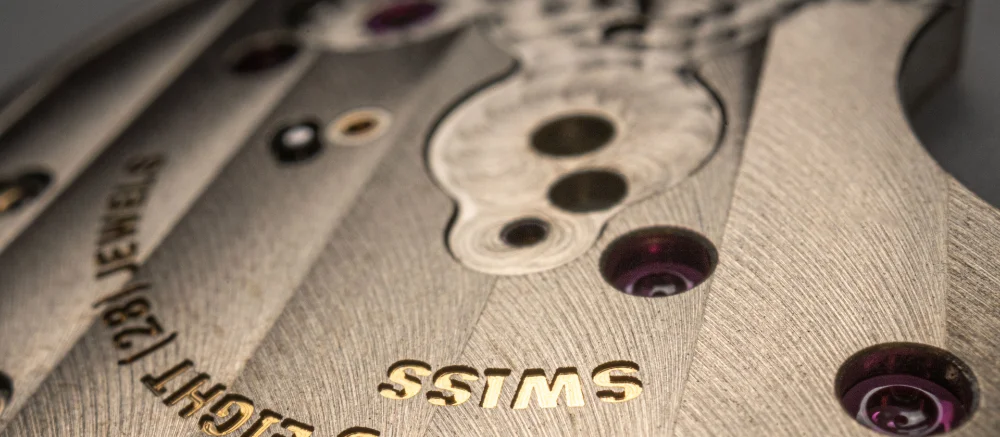
Image – Côtes de Genève
Côtes de Genève adorns the German silver three-quarter plate, bridges and/or cock. These components are collectively mounted on a plate and then fed into a type of lathe. This machine imparts lines using a rotating head endowed with an abrasive surface. Each resultant line is of uniform width and the parallel lines adorning the three-quarter plate, bridge and cock perfectly align with one another.
Perlage
‘Perlage’ (spotting) removes signs of machining, as previously discussed, upholding horological etiquette. In particular, it enhances the aesthetic appearance of components and is highly prized by purists.
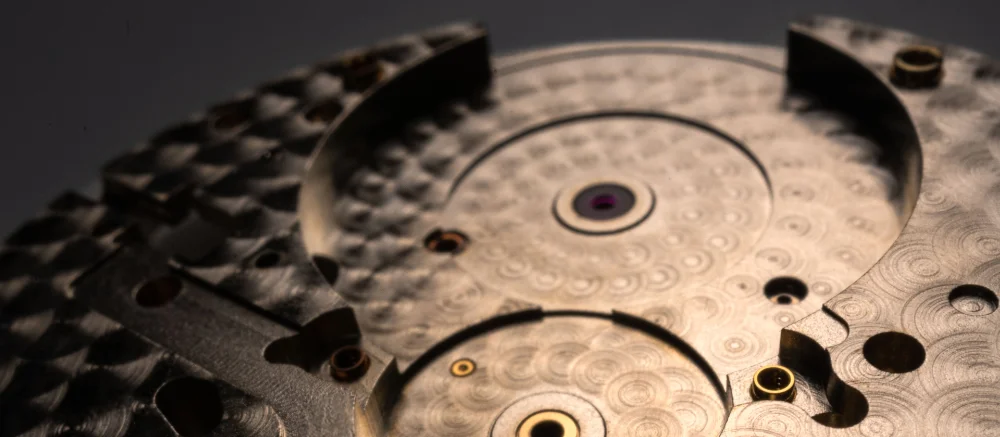
Image – perlage
The motif is executed using a stippling machine fitted with a vertical turning rod which has an abrasive tip. The finisseur presses a lever in a downward motion, causing the tip of the rod to form a small circle on the surface termed a ‘bead’. The objective is to press the lever downwards with uniform pressure and allow it to touch the baseplate (or other component) for the same amount of time. Moreover, each bead should overlap its neighbour by 50% and be spaced at regular intervals.
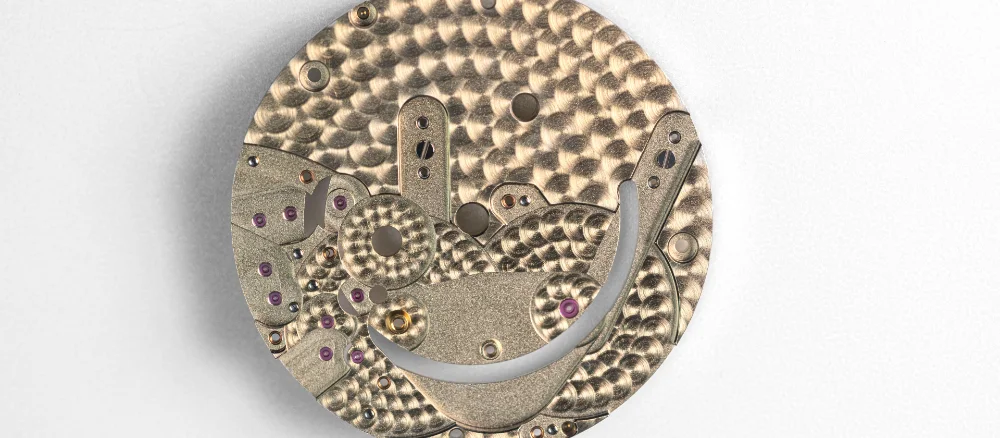
Image – perlage executed in different sizes
Perlage features upon several components within Zeitwinkel’s movements, but with two notable enhancements. Firstly, the size of the overlapping circles differs depending on their location. Secondly, Zeitwinkel does not restrict the application of perlage to the parts visible via the exhibition case back, but also to many parts that will only be seen by the watchmaker.
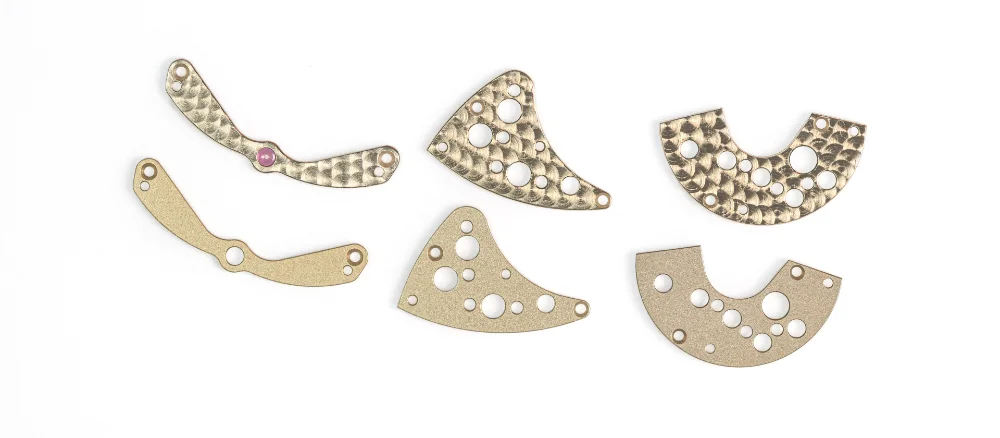
Image – before (below) and after (above)
Anglage (chamfering)
As well as featuring Côtes de Genève, the three-quarter plate, bridges and/or cock are chamfered. This process eliminates the sharp perpendicular edge between a surface and a flank by imbuing it with a 45° angle. Once again, the process removes any burrs caused by machining which would look unsightly or impair the smooth running of the movement.
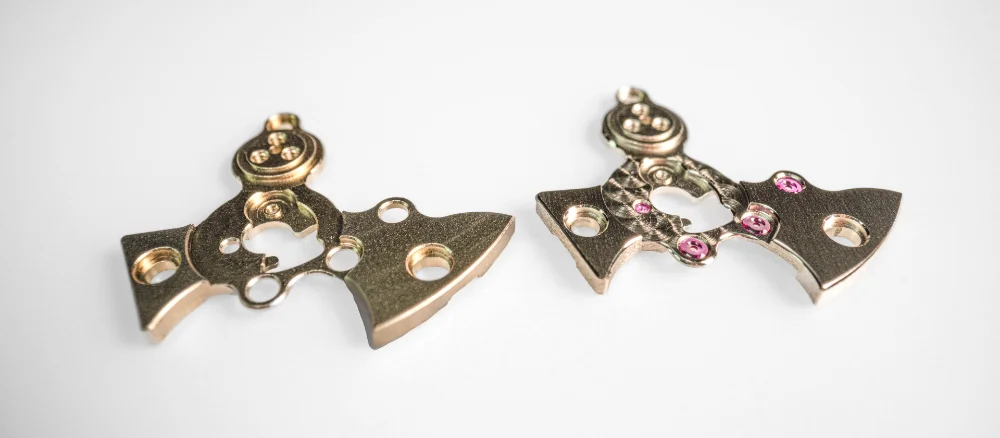
Image – before (L) and after (R)
While modern techniques such as CNC can be used to create a chamfered edge, Zeitwinkel, where possible, prefers to use more traditional techniques. Initially, the angles are formed using a file, ensuring that the bevelled edge remains of uniform width and doesn’t undulate. The surface is then refined, first with a degussit stone and then abrasive buffs before ultimately being polished with diamond paste and a pegwood.
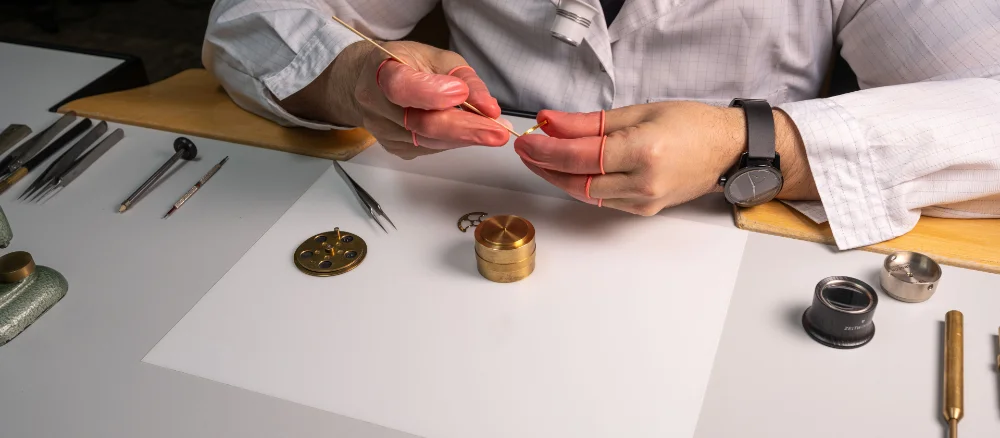
Although this handcrafted approach is more time-consuming, like a Savile Row suit the result justifies the protracted methods.
Circular grained wheels
If you look at the brass wheels within a Zeitwinkel movement, the ‘faces’ are circular grained and the ‘crossings’ are bevelled. These enhancements serve no functional purpose, but they do contribute to the wheels’ aesthetic allure.
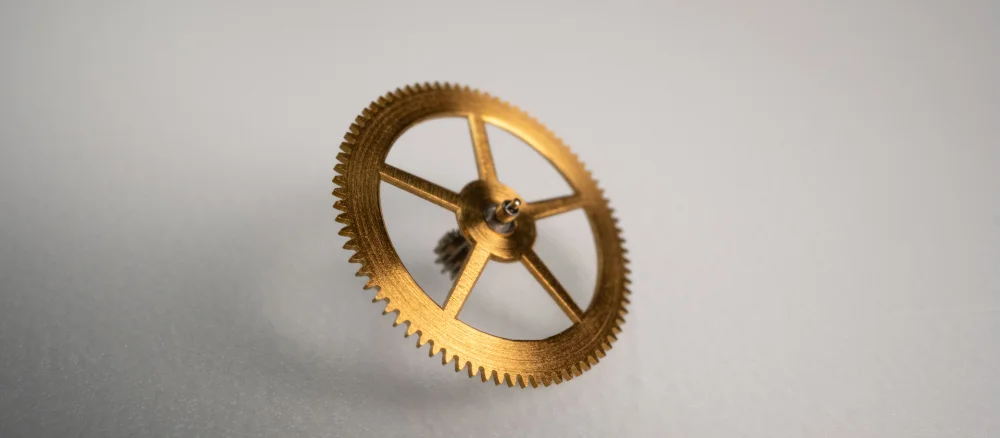
Image – circular grained wheel
Black Polish
Black polish (mirror polish) is the most challenging form of finishing technique to execute and is the preserve of high-end watchmaking. The process begins with smoothing the surface using an array of files, burnishers, buffs and abrasives. Eventually, parts are polished on a tinplate smeared with diamond paste, eliminating any imperfections, culminating in a perfectly flat smooth surface.
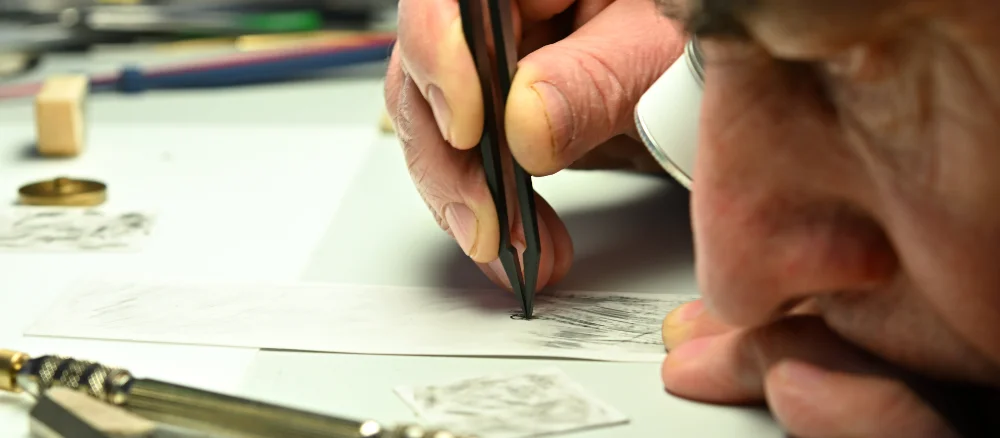
Image – raquette subjected to black polish
A component that has been black polished will bestow a notable brilliance and beautifully interacts with light, a characteristic appreciated by watch aficionados.
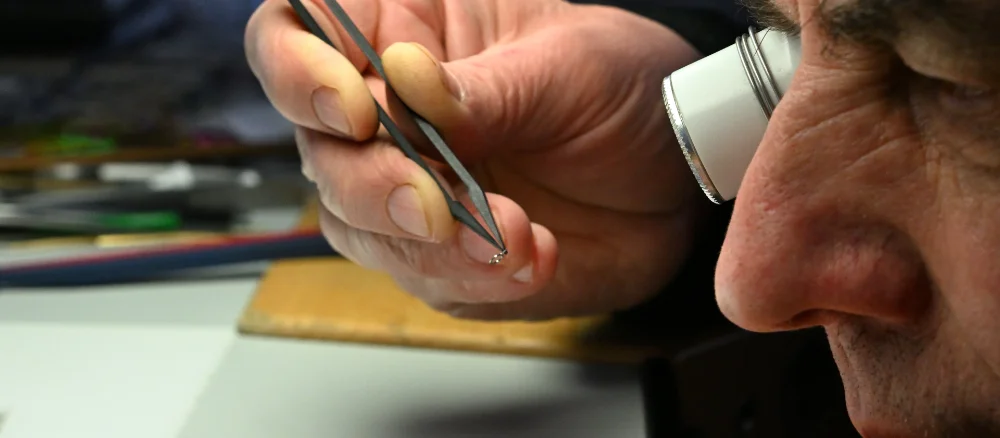
Image – raquette after black polish
Zeitwinkel black polish various components, including the ‘raquette’, a device used to alter the rate of the movement.
Other examples of hand craftsmanship
With Zeitwinkel, hand craftsmanship is not limited to ‘finissage’ but extends to many parts which other firms choose to make using mass-production techniques. For instance, the Zeitwinkel 273° Saphir Fumé is equipped with a patented large date display incorporating a large date ring. This latter component is set with 31 pins, each fitted by hand. This necessitates the deft use of hand and requires much skill on the part of the watchmaker.
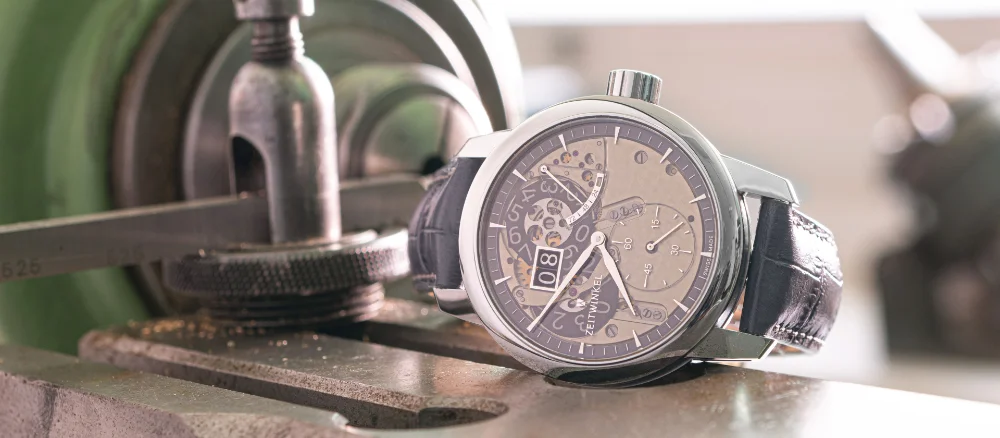
Image – Zeitwinkel 273° Saphir Fumé
There are easier and cheaper means of making a suitable date ring, but, quite simply, they’re not as good.
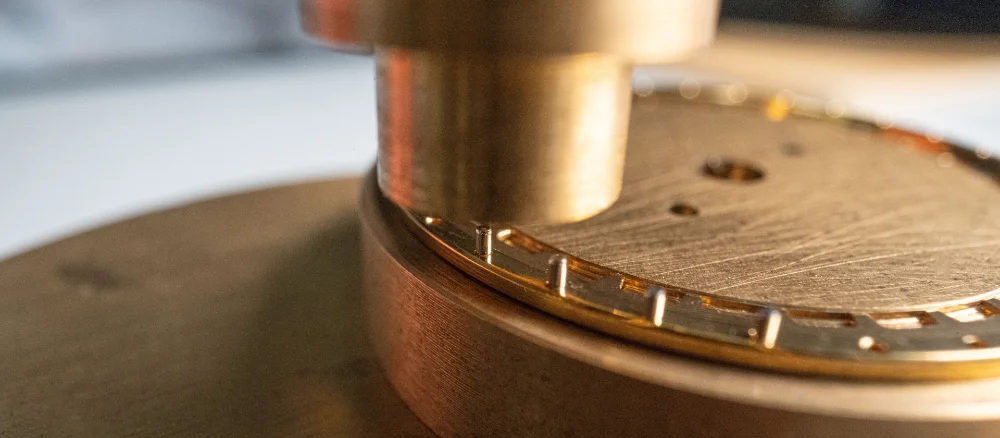
Image – setting pins on the date ring
Returning to the raquette, the oscillating rate is adjusted by altering the effective length of the balance spring. This is made possible by passing the balance spring between two curb pins affixed to the raquette and moving the raquette clockwise/anticlockwise (towards or away from the stud). Some companies use a one-size fits all curb pin; however, Zeitwinkel set the pins individually and precisely by hand, shortening the pins to the optimum length.
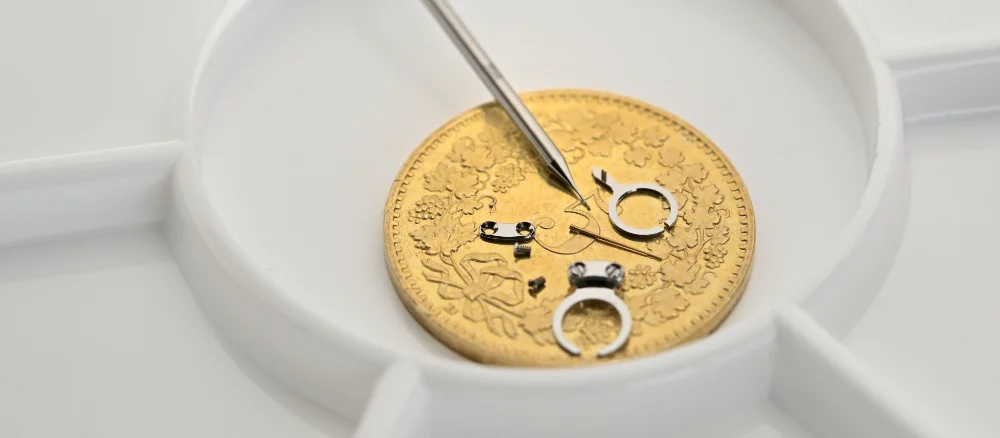
Image – raquette, peg carrier (porte piton), screws and pin
The virol is yet another example of Zeitwinkel’s fastidious approach to watchmaking. It unites the balance spring with the balance staff. On many mass-produced watches, this marriage is performed using a laser. However, Zeitwinkel subscribes to the traditional approach of manually pinning the virol. The balance spring is attached to the peg carrier (porte piton) with shellac, whereas the lid of the peg carrier is fixed with two extremely small screws.
It is only in the elevated world of Haute Horlogerie that this adherence to construction and manufacturing principles is adhered to. Recently, when I asked the brand about its approach, the firm remarked, “This approach requires much expertise and precision on the part of the watchmaker since by screwing the spring into the peg carrier as sloppy work cannot be easily remedied afterwards.”
These subtle nuances are the product of hand craftsmanship and serve to differentiate Zeitwinkel from many mainstream brands.
Zeitwinkel watches – closing remarks
Appraising a Zeitwinkel watch, there are a plethora of refinements that may go unnoticed by the wearer, but rest assured, they are there in abundance.
The parallels with Savile Row are many. The construction of both a bespoke suit and a Zeitwinkel watch take place without clock watching and draw upon the talents of time-served hands. Using automation would mitigate production costs and allow the firm to make greater volumes of product; however, such an approach is not compatible with the company’s founding principles, namely, to make no-compromise watches.
Some companies employ bean-counters to source cheaper materials and choose to restrict the finessing of components to purely what can be seen. However, like the finest tailors on Savile Row, Zeitwinkel has built an esteemed reputation by ignoring such examples of penny-pinching. It requires more time to make a Zeitwinkel watch but the many steps taken add virtue to the product, even if they are beyond the view of its owner.