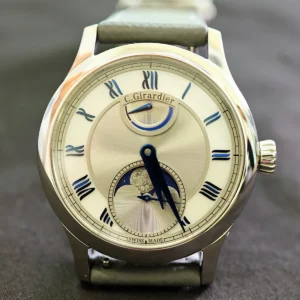
Charles Girardier Plénitude – in-depth watch review
This year, at Watches & Wonders 2026, Charles Girardier unveiled the Plénitude. The model is offered in two variants, the PL1 and PL2, and comes in a selection of colourways. Impressed by what he saw, Angus Davies recently visited the company’s atelier in Buchs, keen to learn more about Charles Girardier and its approach to fine watchmaking.
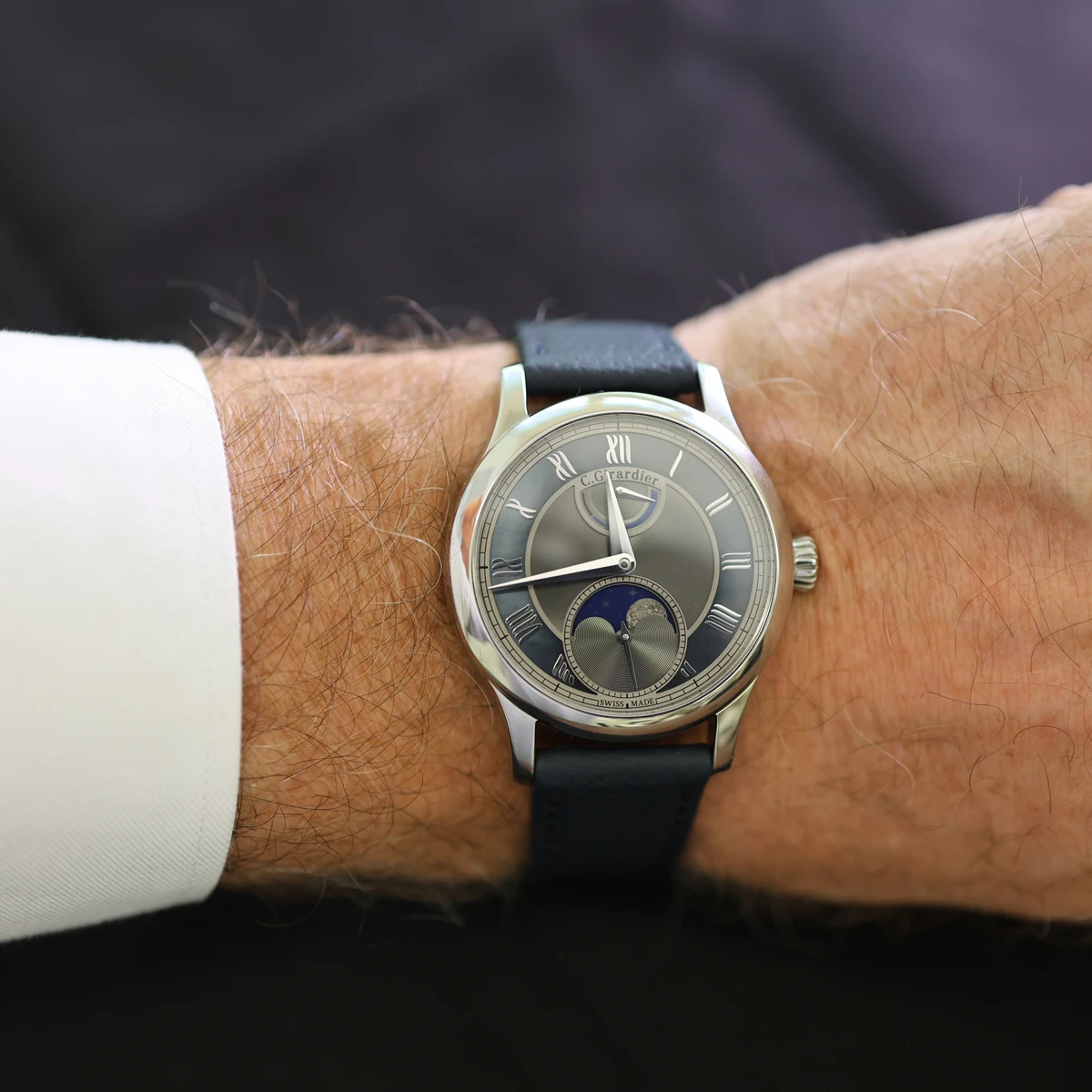
Image – Charles Girardier Plénitude Lunar Phase PL2 – Blue Ocean
Charles Girardier (1759-1839)
Geneva has a rich history of making watches dating back to the 16th century; however, it was later, during the 18th century, that the city assumed the status of watchmaking capital of the world. One reason for Geneva’s commercial success can be attributed to ‘La Fabrique’, a ‘decentralised’ method of making of watches. Tasks such as engraving, enamelling, guilloché, miniature painting and movement construction were performed by specialist independent workshops. By adopting this approach, production volumes increased significantly. According to the FHH (Fondation Haute Horologerie), over 5000 people, roughly a fifth of the city’s population at the time, were ‘producing hundreds of thousands of watches annually for global export’.
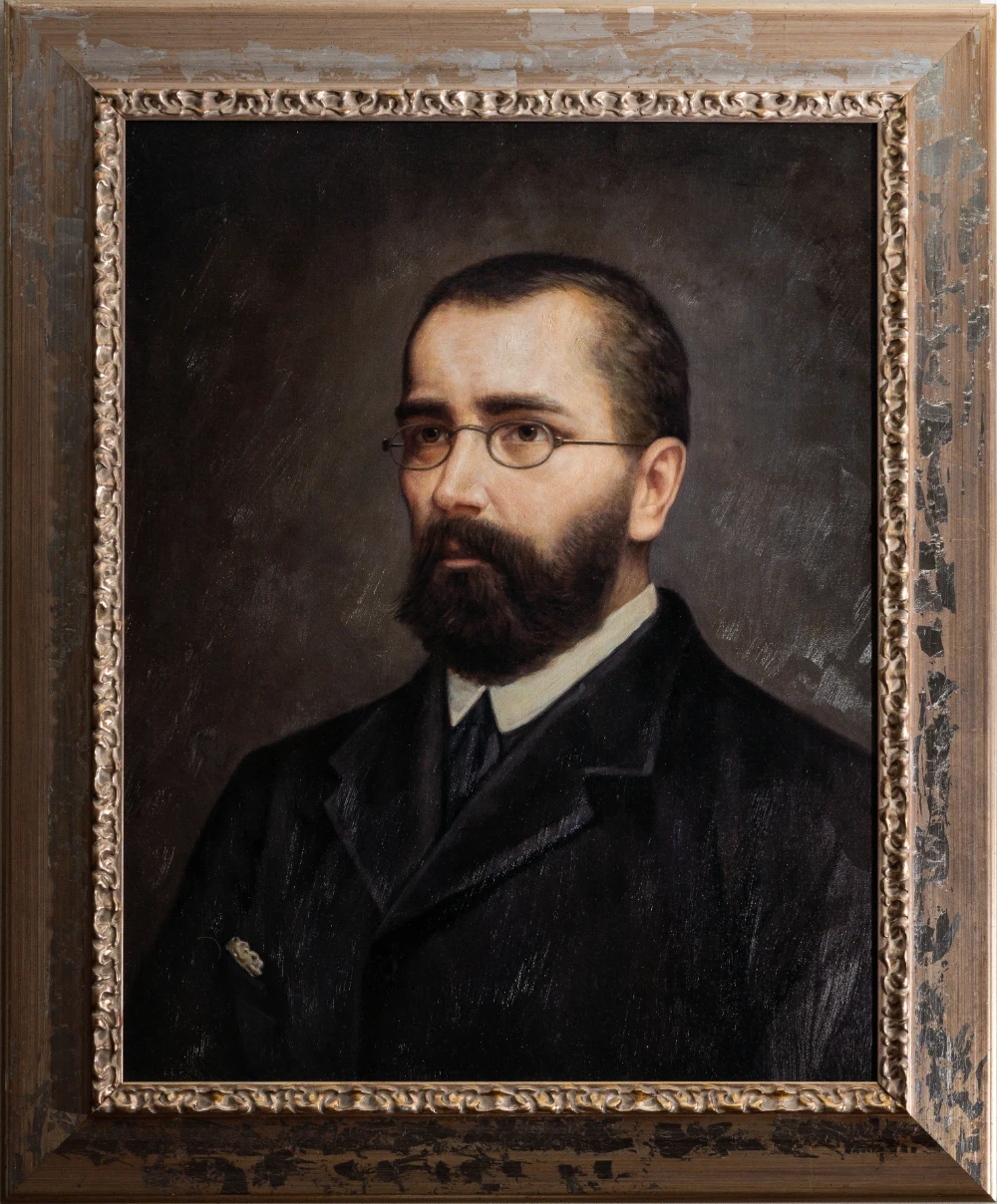
Image – Charles Girardier (1759-1839)
Born in Geneva, Charles Girardier (1759-1839) was ideally located to pursue a career in watchmaking. He was clearly a precocious talent, opening his own workshop at the tender age of 21. Interestingly, he signed his creations Girardier L’aîné (Girardier the Elder). Usually, the designation ‘Elder’ was used to distinguish between two family members who shared the same name, but Girardier died without descendants. Sometimes the designation ‘Elder’ was used by artists, politicians, literary figures, civic leaders or church officials. Why did Charles Girardier use the term ‘Elder’? There appears to be no definitive answer, although I should imagine it may have led some prospective clients to perceive Girardier as older than he really was.
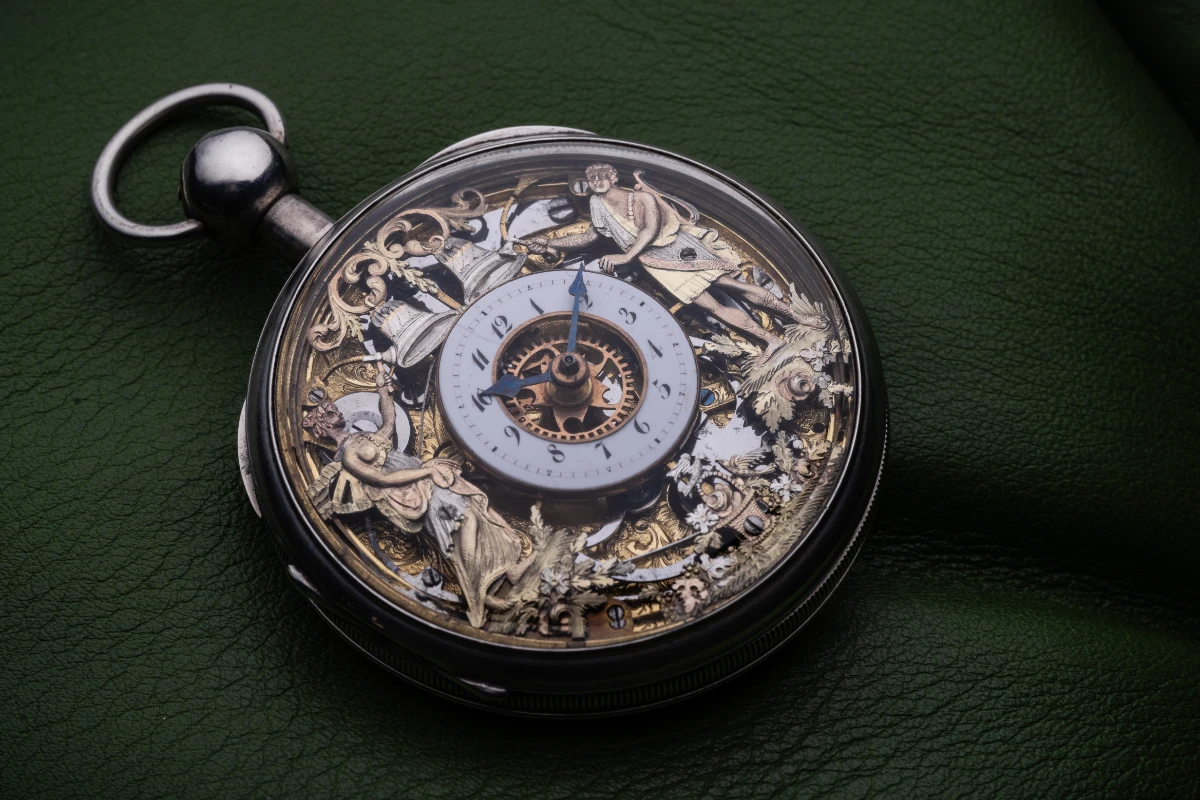
Image – ‘very rare quarter-repeating pocket watch with Jaquemart automata, Geneva (circa 1815)’
What is not in doubt is that Girardier had a remarkable prowess for enamelling and a fascination for automata. For instance, around 1815, he crafted a ‘quarter-repeater on spring-drive bells with 2 gongs, animated by a scene of two Jaquemart automata in chased gold’. Housed in a silver case, the pocket watch indicated the hours and minutes on a dial formed of white porcelain. Technically impressive and eminently beautiful, the timepiece showcases Monsieur Girardier’s notable talent.
Unfortunately, with no heirs, the story of Charles Girardier ended in 1839 with his passing; or at least that was the case until 2018!
Charles Girardier reborn in 2018
Patrick Ulm, an avid collector of pocket watches, happened upon a historic Charles Girardier timepiece. He was fascinated by the pocket watch and began to research the life and work of the Genevan watchmaker. Later, he chose to register a new company, ‘Charles Girardier‘, rekindling the historic name.
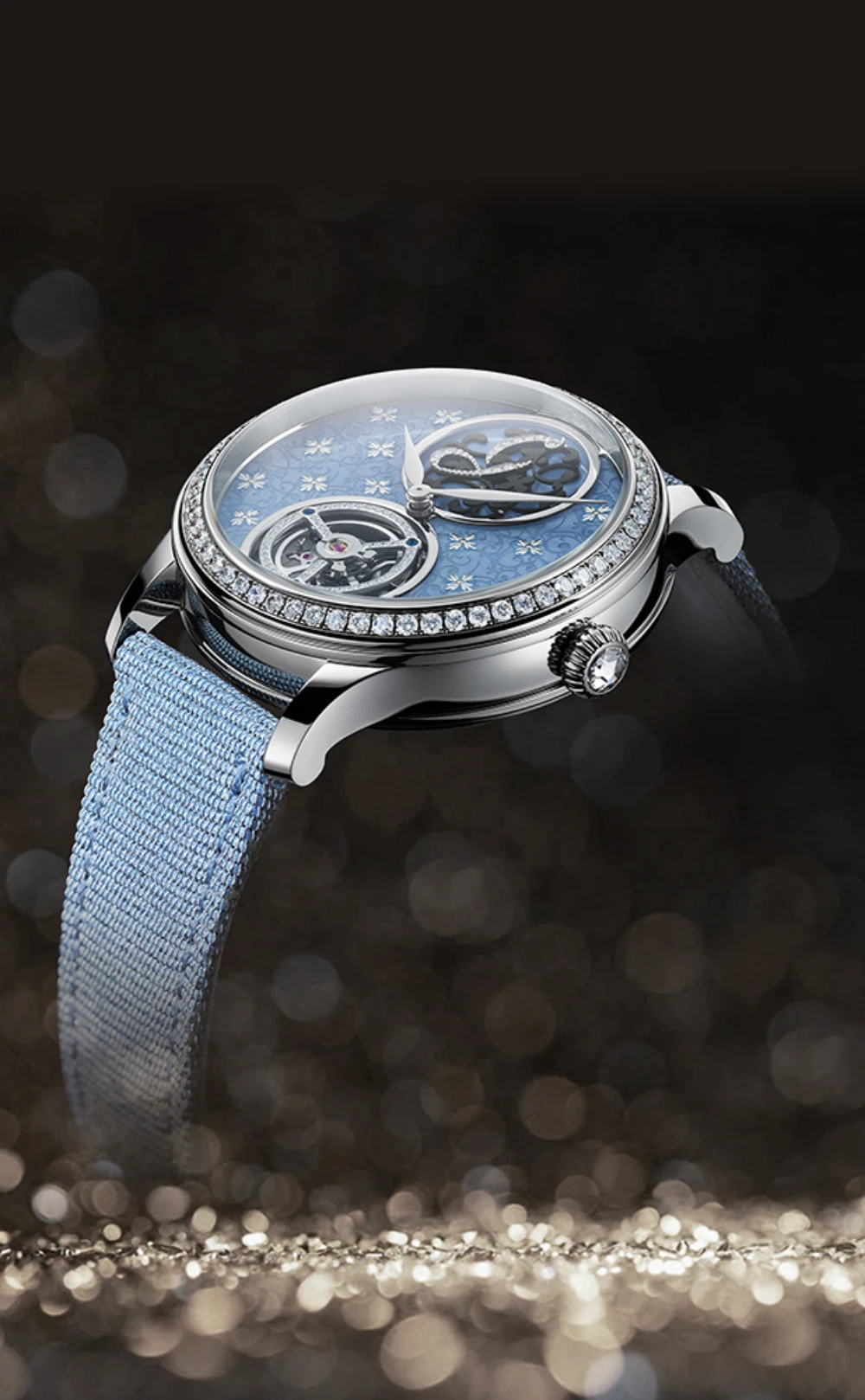
Image – Charles Girardier Signature Mystérieuse ‘Fleur de Sel’ – winner of the ‘Ladies’ Complication Watch Prize’ at the GPHG awards in 2020
Remarkably, just two years later, at the GPHG awards in 2020, Patrick Ulm stood on the stage in front of the great and the good of the watch industry and collected the ‘Ladies’ Complication Watch Prize’. The award-winning model, the Signature Mystérieuse ‘Fleur de Sel’, housed in a 37 mm case, features a Grand Feu dial with silver paillons, a 60-second flying tourbillon and a ‘mysterious signature’ at 12 o’clock. This latter feature, an automaton, comprises two letters ‘C’ and ‘G’, turning on the same axis, ultimately aligning to form the company’s logo. Highly original, wonderfully engineered and beautifully styled, the watch incorporates several influences from Girardier’s past, while remaining contemporary and suited to the present day.
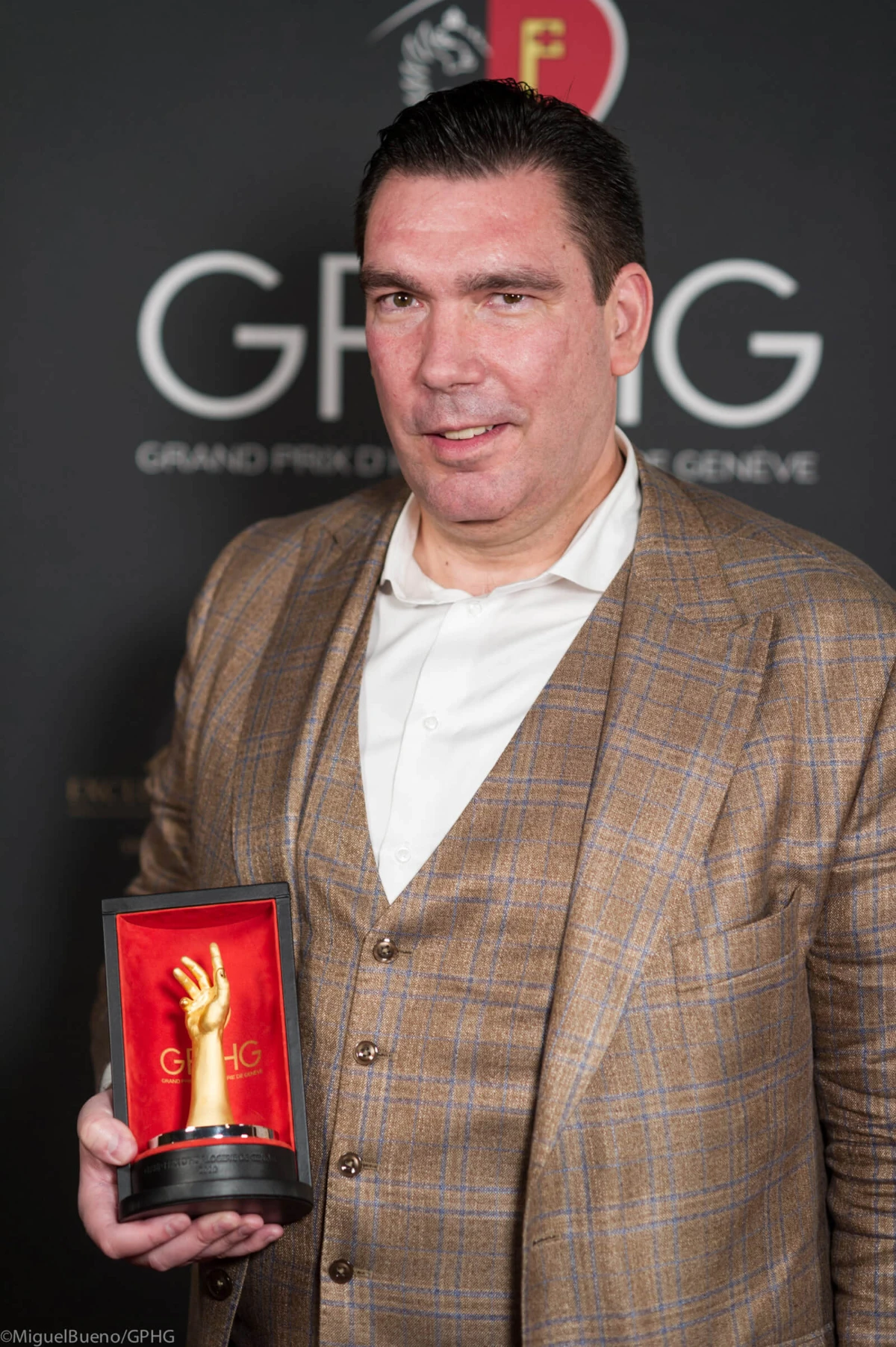
Image – Patrick Ulm holding the GPHG award
The following year (2021), building on the success of its prize-winning watch, Charles Girardier unveiled the Signature Mystérieuse 41 mm. Endowed with the same automaton complication at 12 o’clock and a flying tourbillon at 6 o’clock, the model, with its Grand Feu enamel dial adorned a ‘Chevrons’ motif, appears more masculine.
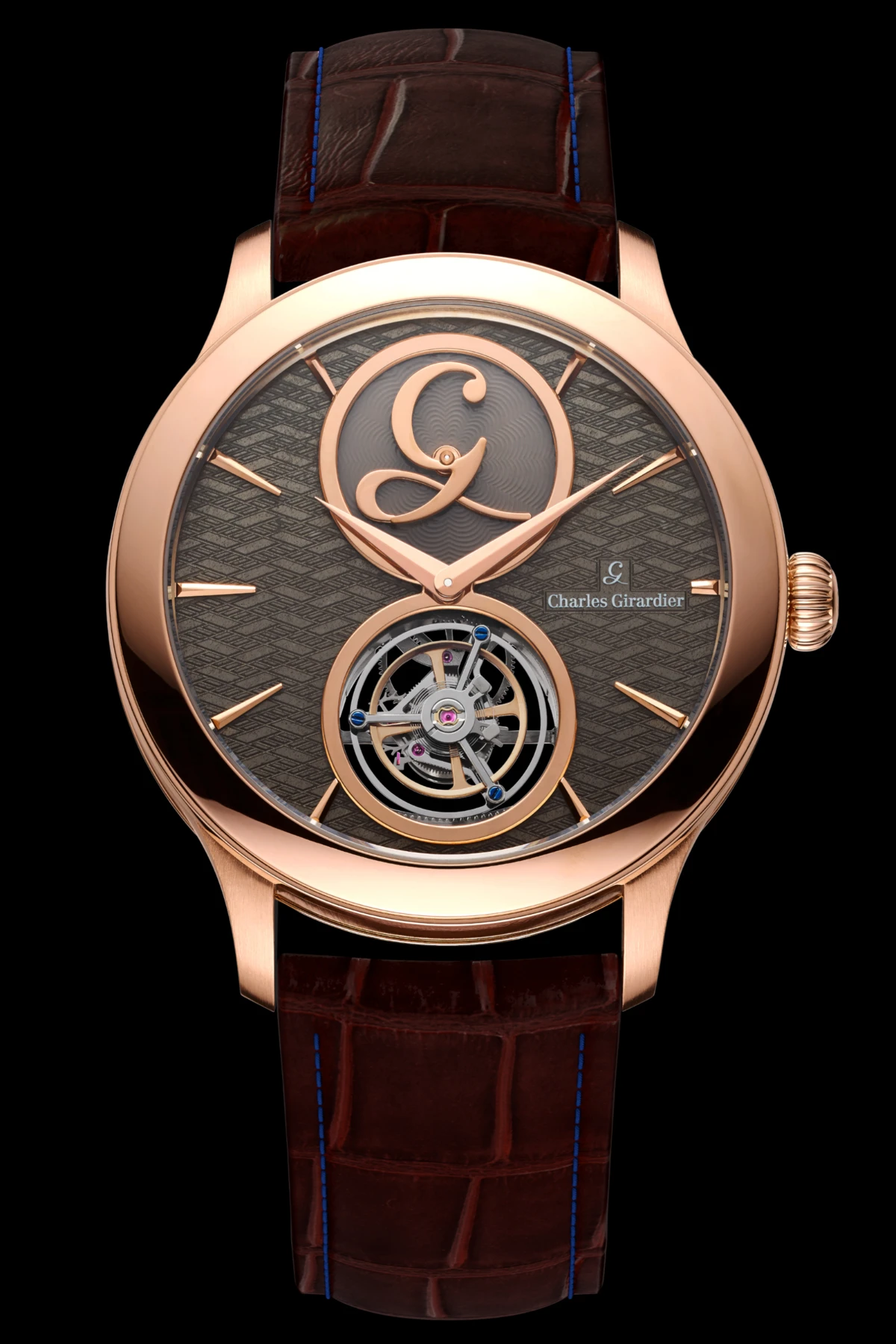
Image – Charles Girardier Tourbillon Signature Mysterieuse 41 mm
In 2024, Charles Girardier launched the Synchronaut GMT. Housed in a 39.5 mm case, the central area of the dial is presented in ‘the style of Ancient Guilloché Tapestry’, a distinctive motif that charmingly engages with light. Leaf-shaped hour and minute hands collaborate with crisp indexes, proclaiming time in clear tone. A prominent hand points to a 24-hour track, located on the flange, indicating the ‘home time’.
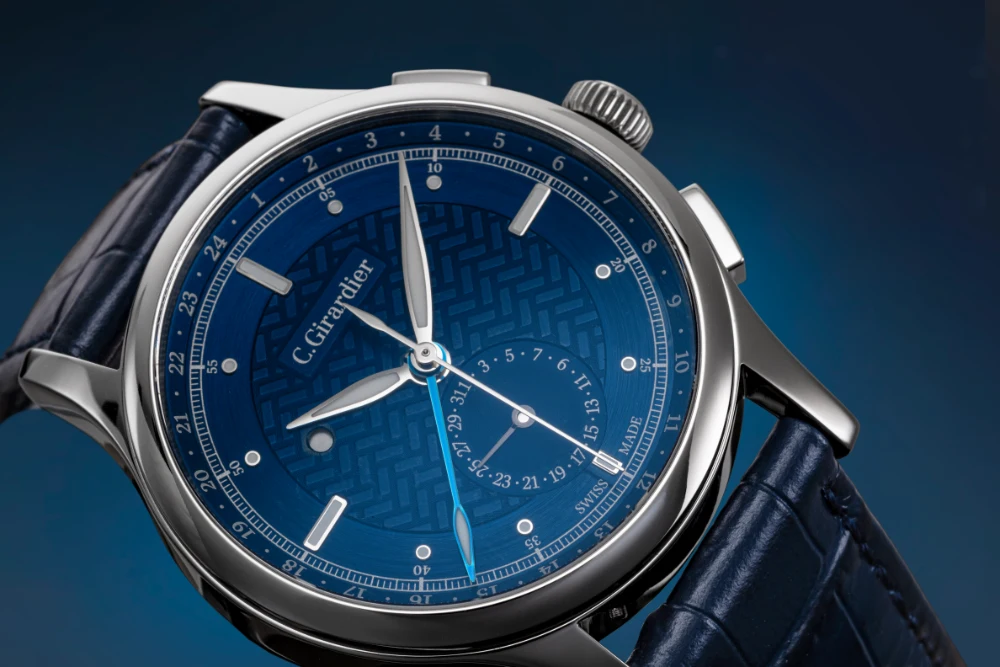
Image – Charles Girardier Synchronaut GMT
Unlike most GMT models, the wearer does not need to manipulate the crown to set the home time. Instead, adjusting the home time is simply a matter of using the pushpieces gracing the right flank of the case. While the watch is modern, it pays tribute to the eponymous watchmaker’s work. For example, the snailed counter residing at 6 o’clock indicates the date, a detail found on a pocket watch signed ‘Girardier L’aîné’ in yesteryear.
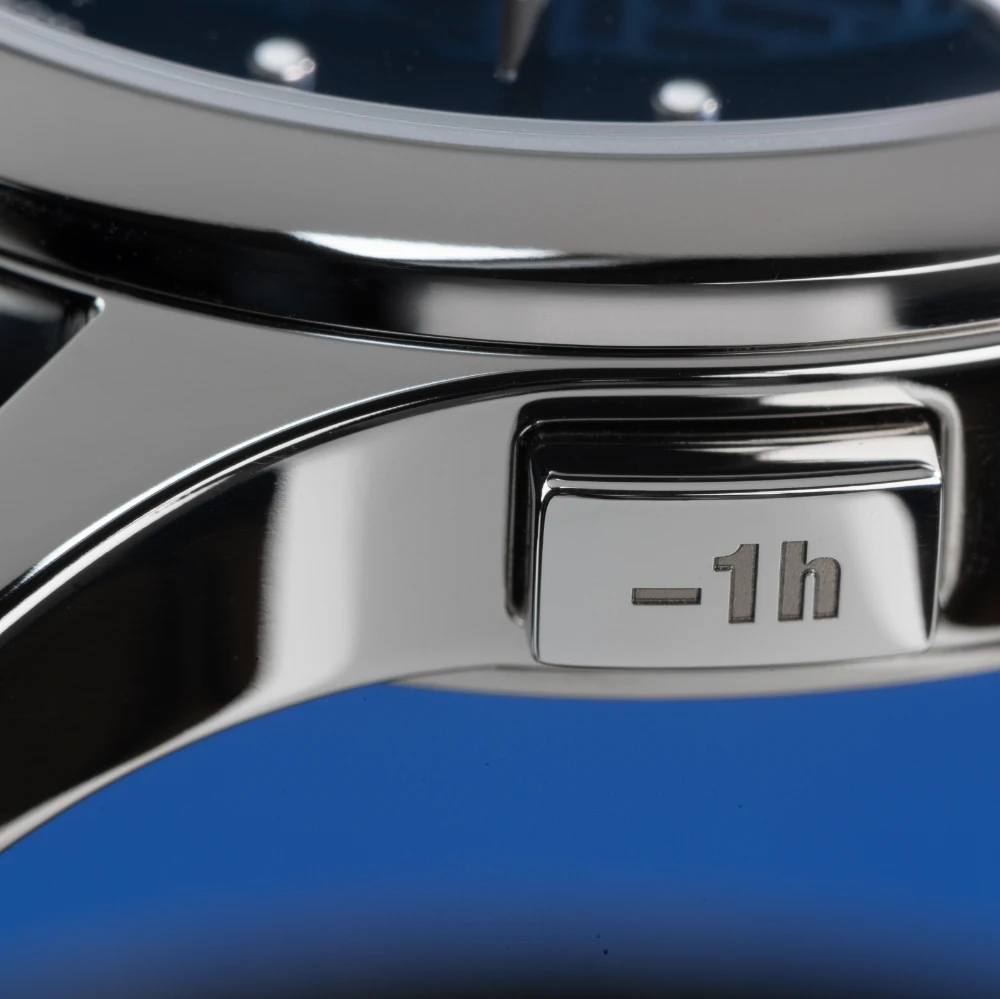
Image – Charles Girardier Synchronaut GMT
Throughout the creative process, Patrick Ulm has found inspiration from the work of Monsieur Girardier; however, he has not sought to create reproductions of what has gone before. Indeed, Patrick’s desire from the outset was to ‘create contemporary watches that Monsieur Girardier may have produced if he was alive today.’
Charles Girardier Plénitude – visiting Buchs
Keen to build on its success, Charles Girardier sought to create a new ‘fully in-house developed manufacture movement’. To achieve this aim, it relocated to Buchs, a small town in the canton of Aargau. The town is also home to the hugely talented Cyrano Devanthey and Dominique Büser of Oscillon. Collectively, they have formed a ‘watchmaking hub’ where each party works on their own projects but collaborate when needed, sharing their expertise.
Recently, I visited Charles Girardier’s facility in Buchs to learn more about its two latest models, the Plénitude Volcano Power Reserve and the Plénitude Lunar Phase.
Charles Girardier Plénitude Volcano Power Reserve – dial
The Plénitude Volcano Power Reserve is offered in three colourways, including ‘White Pearl’, ‘Champagne’ and ‘Majestic Purple’. Each dial subscribes to the same design, albeit the latter two options are embellished with a sunray motif, while the White Pearl eschews any surface treatment, allowing the natural beauty of the material to shine through. Faceted dauphine-style hands are teamed with trapezoidal applied indexes. The indexes rest upon a chemin de fer which enhances readability.
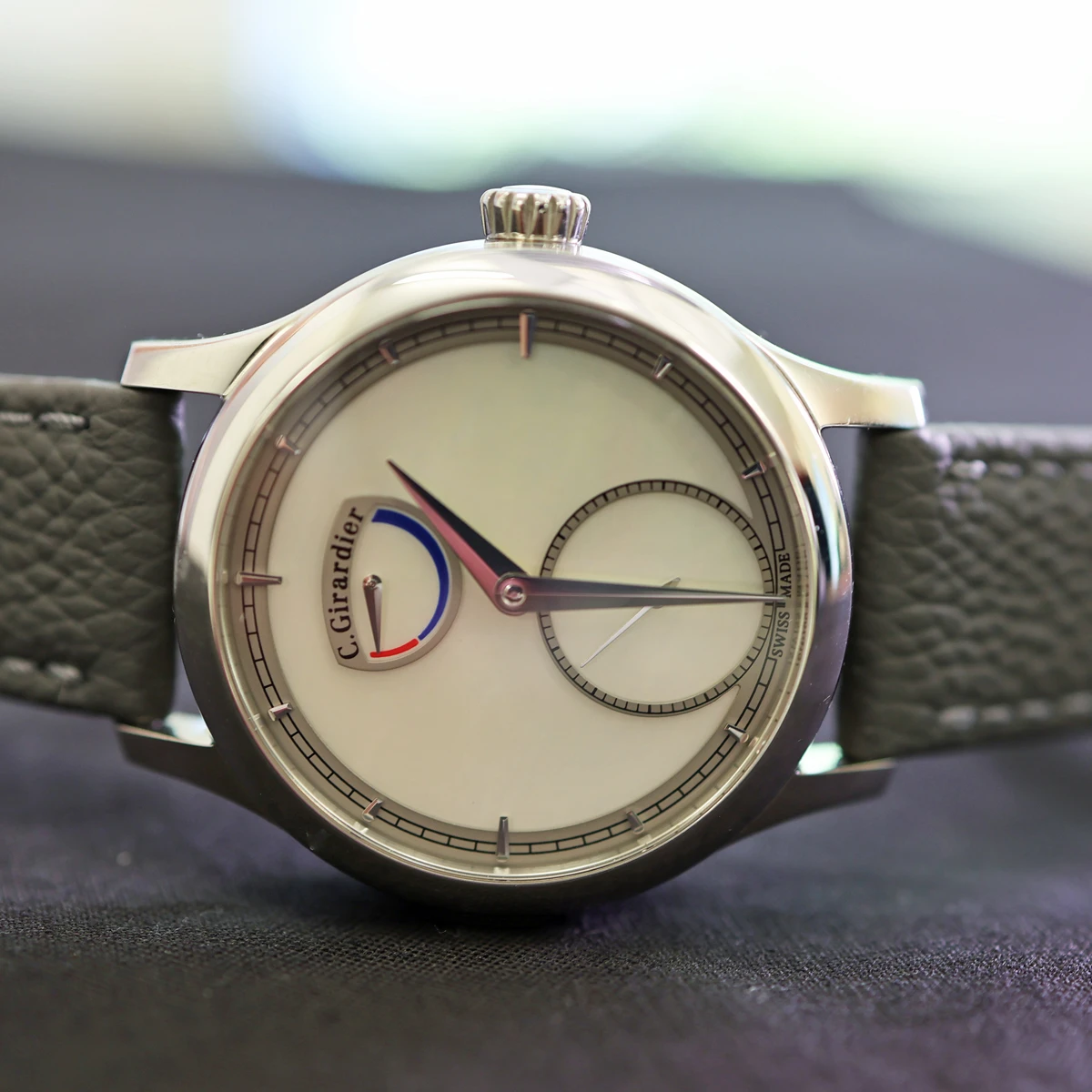
Image – Charles Girardier Plénitude Volcano Power Reserve PL1 – White Pearl
Charles Girardier has masterfully united different finishes and depths to comely effect. For example, the small seconds display, located at 6 o’clock, is adorned with snailing (aka azurage) and is framed with a crisp track that integrates into the hour track. The indexes at 3, 9 and 12 o’clock project from the hour track, appearing to float above the central dial area.
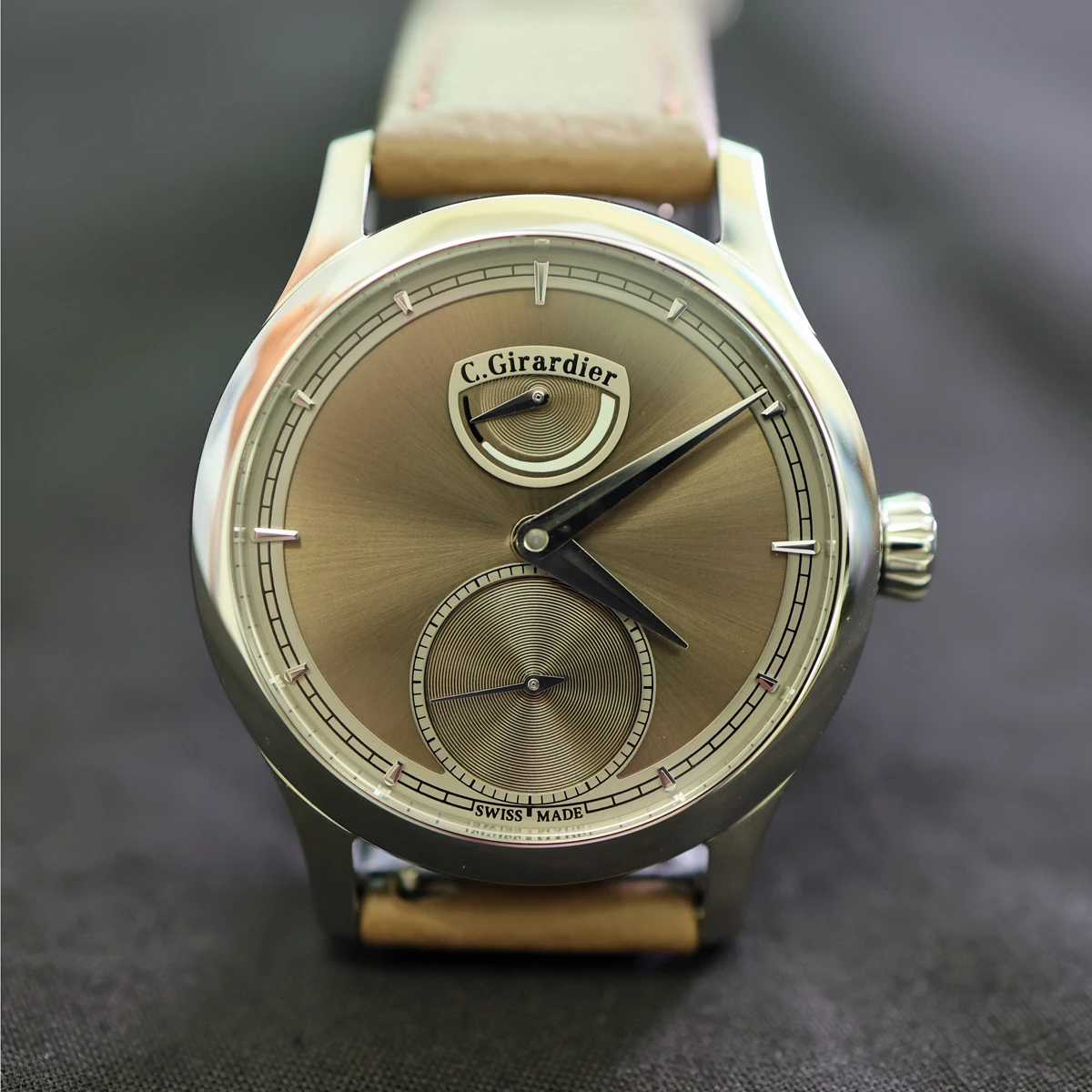
Image – Charles Girardier Plénitude Volcano Power Reserve PL1 – Champagne
However, the headline act is unquestionably the power reserve indication. Unlike watches featuring a regular gauge showing the available energy within the barrel, the highly accurate Plénitude Volcano Power Reserve is far superior. Firstly, the name ‘Volcano’ refers to the ‘cone and feeler’ mechanism beneath the dial which precisely indicates the available energy within the barrel (I will return to this later). Secondly, most power-reserve indications are squeezed into an available space on the movement, sometimes appearing as an afterthought. However, Charles Girardier has placed the Volcano Power Reserve along a north-south axis, running from 12 o’clock to 6 o’clock, imbuing the display with a delightful dose of symmetry.
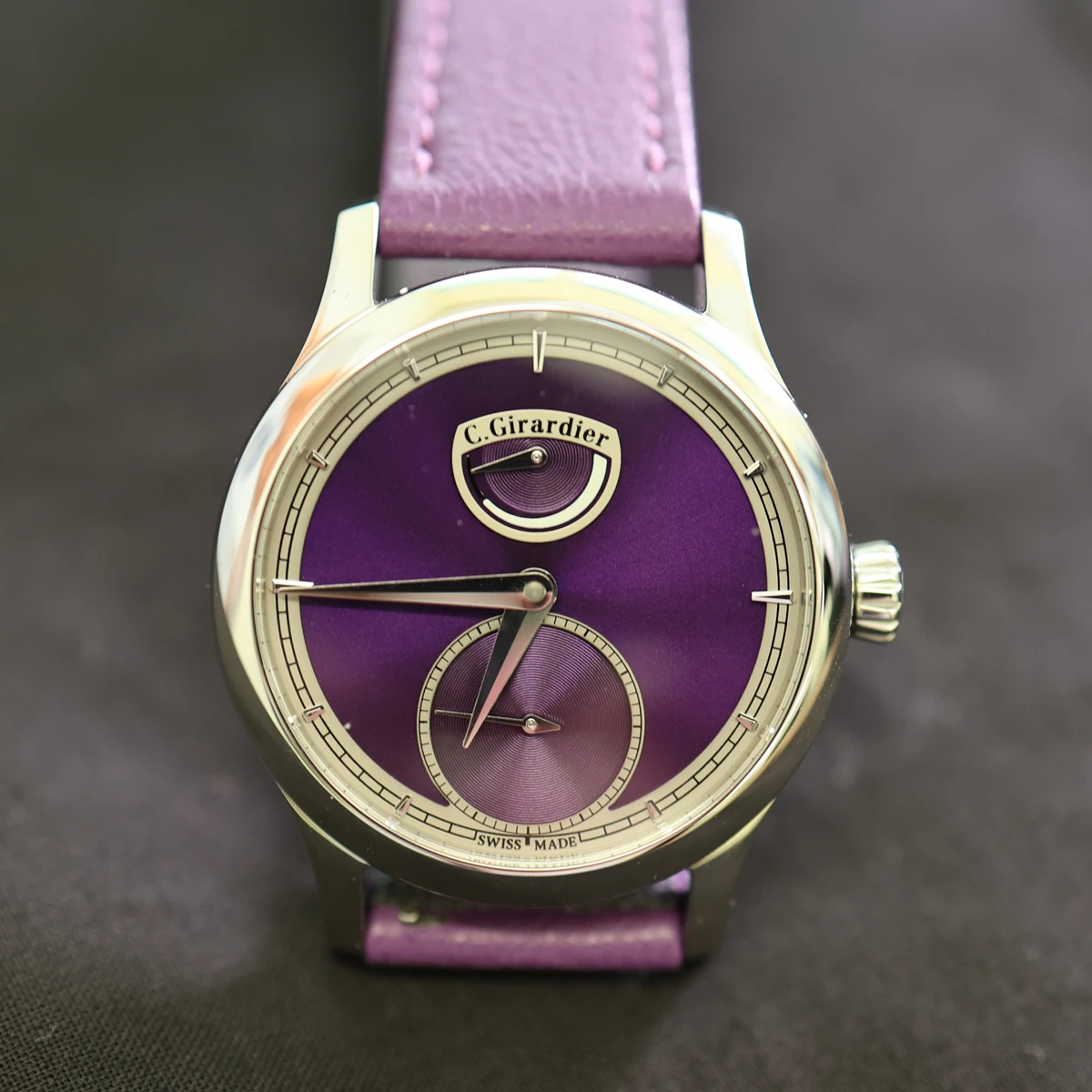
Image – Charles Girardier Plénitude Volcano Power Reserve PL1 – Majestic Purple
Charles Girardier Plénitude Lunar Phase – dial
When cradling the Plénitude Lunar Phase in my hands, I could readily see that it shares a familial likeness with the Volcano Power Reserve. The same dauphine-style hands, the same chemin-de-fer fringing the dial, the same snailed small seconds indication at 6 o’clock and an identical Volcano Power Reserve at 12 o’clock.
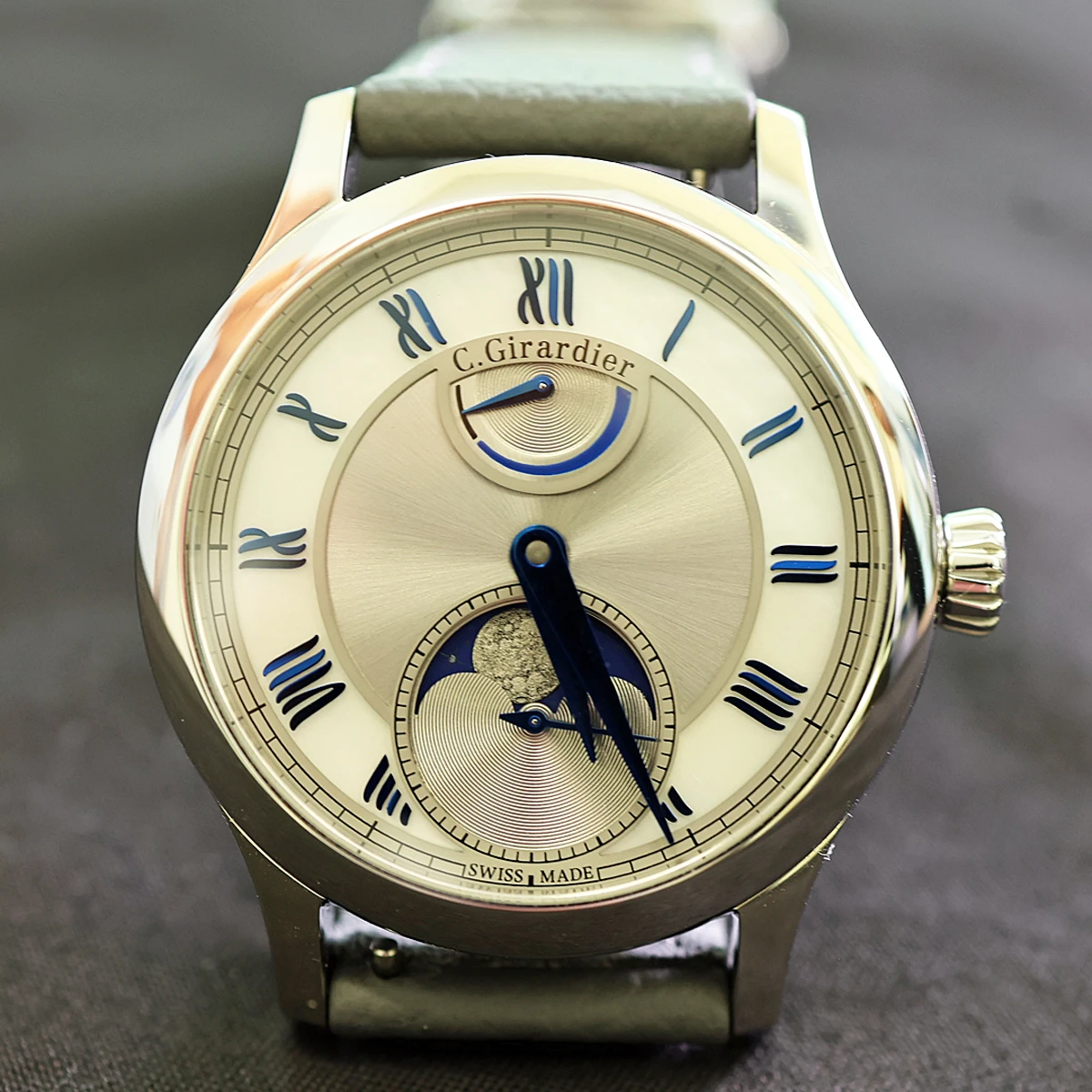
Image – Charles Girardier Plénitude Lunar Phase PL2 – Pearl White
However, Patrick Ulm and his colleagues have also endued the Plénitude Lunar Phase with its own unique characteristics. Each hour is denoted with Roman numerals, but executed in an unusual and highly attractive font. These numerals rest on a broad track, featuring a pearlescent finish, encircling the central dial area. This latter area, executed in a contrasting hue, is adorned with a sunray motif.
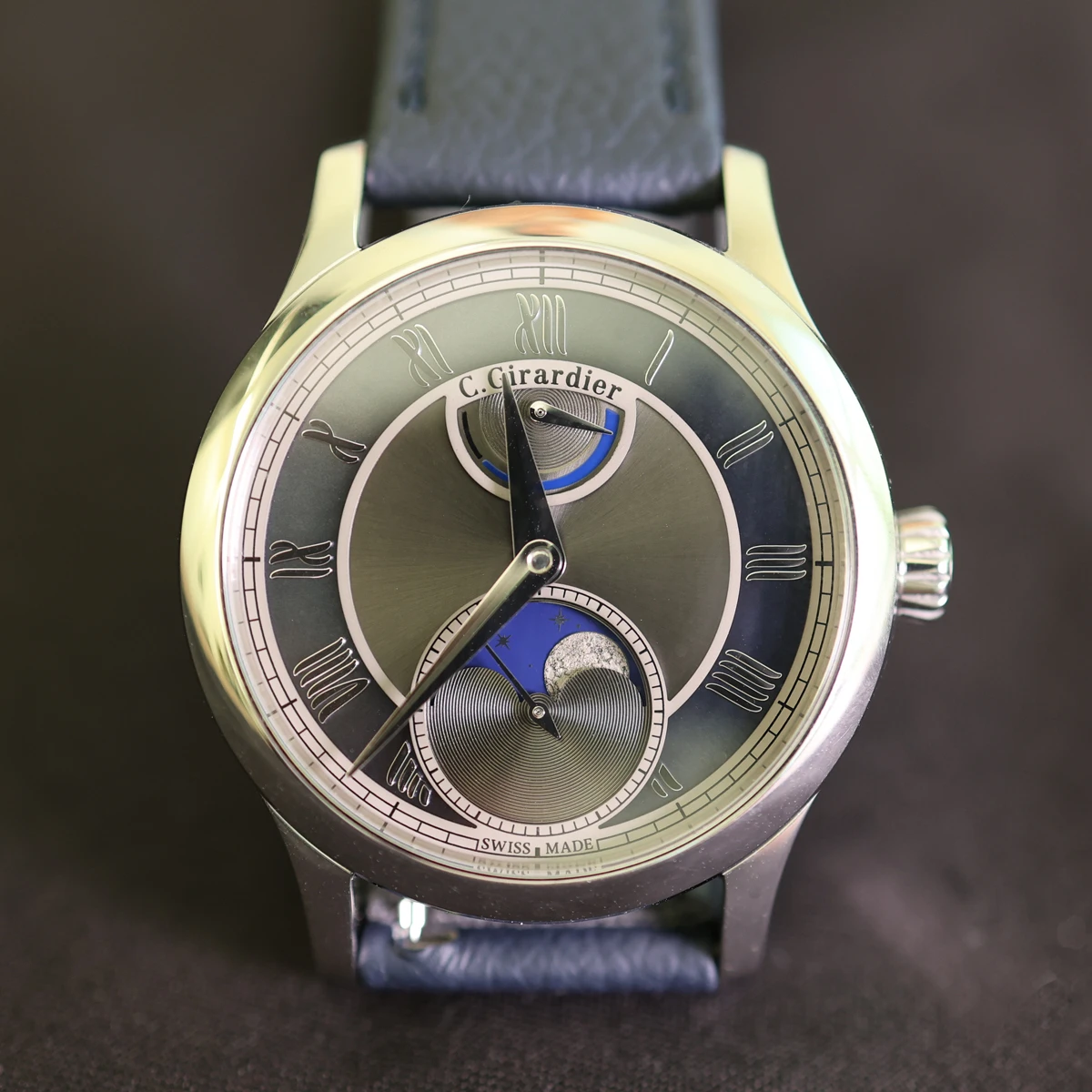
Image – Charles Girardier Plénitude Lunar Phase PL2 – Blue Ocean
A moon phase display is integrated within the small seconds indication. Beneath the dial’s epidermis sits a disc featuring two photorealistic depictions of the moon set amidst a nocturnal star-filled sky. Each moon is wonderfully detailed with craters and nuanced textures. Assuming the mainspring is always tensioned, the moon phase will remain accurate for 122 years, at which point it will only require adjustment by one day.
Charles Girardier Plénitude – case
Both the Plénitude Volcano Power Reserve and Plénitude Lunar Phase are housed in identical 3-part steel cases measuring 39.5 mm in diameter. The scale of this case makes it suitable for the majority of wrists, both male and female. Surprisingly, despite housing the complex Volcano Power Reserve mechanism, both models are just 10.95 mm thick, conferring a graceful, unobtrusive wrist presence.
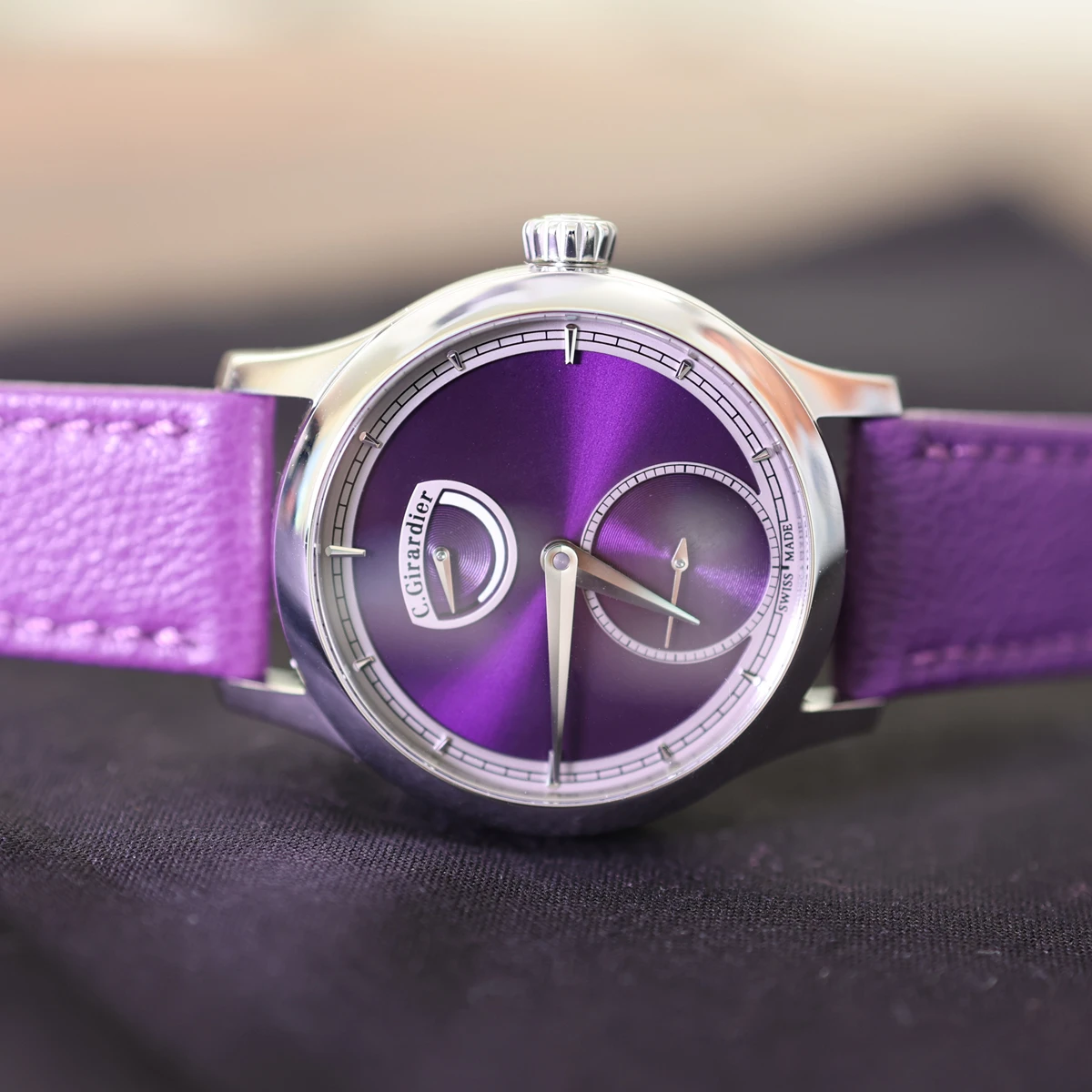
Image – Charles Girardier Plénitude Volcano Power Reserve PL1 – Majestic Purple
The bezel slopes down towards the case middle in a continuous line, granting a clean aesthetic. Gently arcing lugs emanate from the caseband, drawing the strap close to the watch head. To the rear of the watch, an exhibition caseback affords sight of the hand-wound movement within. Patrick Ulm explained that the design of the crown was inspired by the appearance of a winding key found on a historic Charles Girardier pocket watch. The Maison has chosen to execute all case surfaces in a high gleam polish. Sometimes this can appear excessive; however, the Swiss marque has judged everything to perfection, with the watch exuding elegance from every angle.
Each model is presented on a hand-stitched calfskin leather strap, fitted with a polished steel folding buckle.
Charles Girardier Plénitude PL1 & PL2 – movements
At the heart of each model is a hand-wound movement. The design and prototyping of each calibre has been done in-house. The architecture of each movement is near identical save for the PL2 calibre being equipped with a moon phase indication.
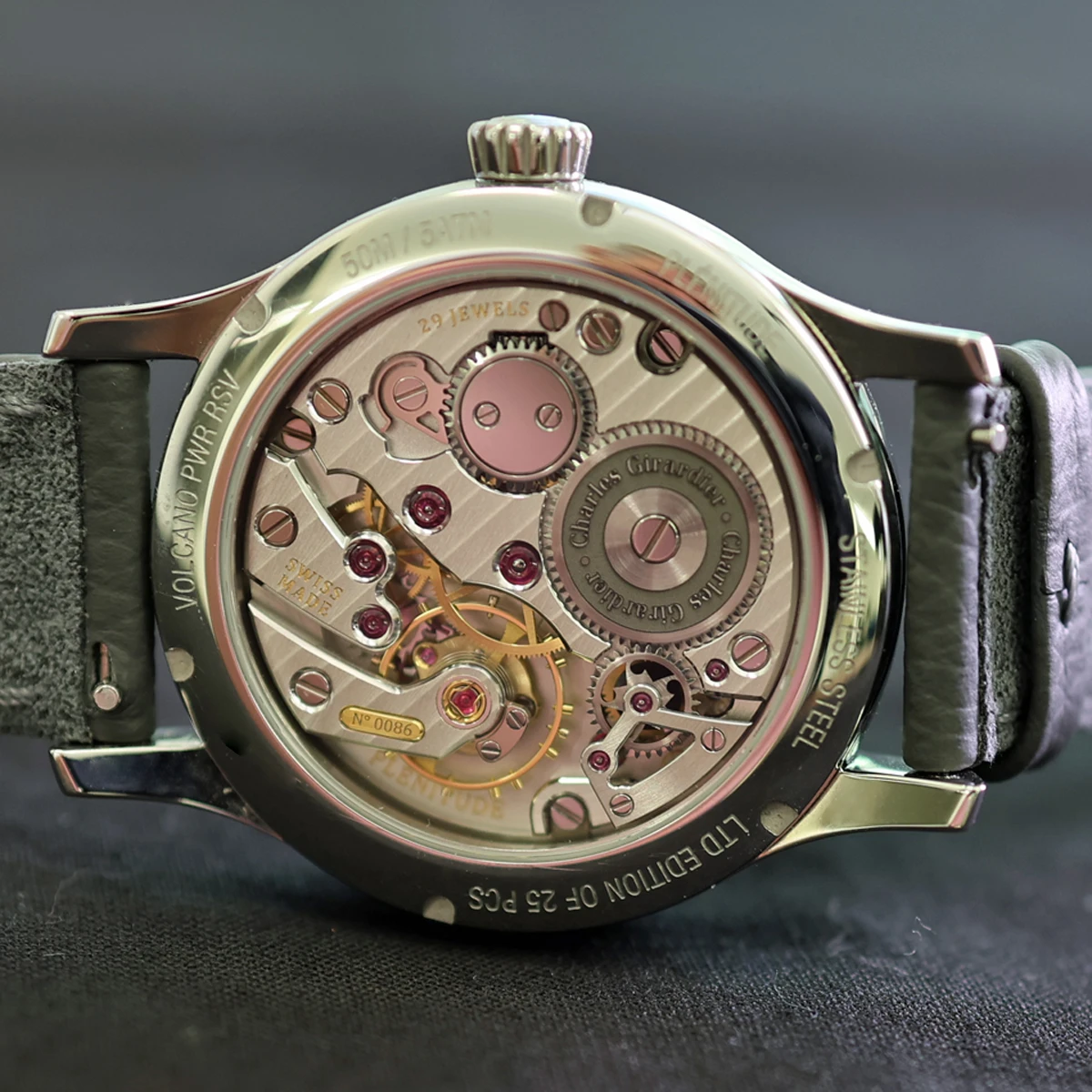
Image – Charles Girardier Plénitude Volcano Power Reserve PL1
Balance – 3 Hz frequency
The PL1 & PL2 movements have a classical appearance with generous gaps between the various bridges and cocks, delivering glorious views of the gear train and balance wheel. Patrick Ulm wanted the balance to have a traditional frequency of 3 Hz, keen for it to have a slow cadence, making it visually more appealing. Moreover, by using a large balance wheel in combination with a low frequency, the rotational inertia is increased, making the regulating organ less vulnerable to shocks, thereby augmenting precision.
Charles Girardier guarantees ‘a rate tolerance of between -1 and +2 seconds per day’ as part of its CG Seal (see later).
Variable-inertia balance
Most watches are fitted with an index-adjusted balance, where the effective length of the balance spring is increased/decreased to make the watch run faster/slower. However, the movements within the Plénitude models are equipped with a superior variable-inertia balance. With this latter means of regulation, the effective length of the balance spring remains fixed and the rate is adjusted by tightening/loosening four timing screws set within the rim of the balance wheel. It takes the watchmaker longer to regulate a variable-inertia balance, but the approach confers superior precision. Moreover, should the watch be subjected to a shock, it is less likely to require remedial regulation.
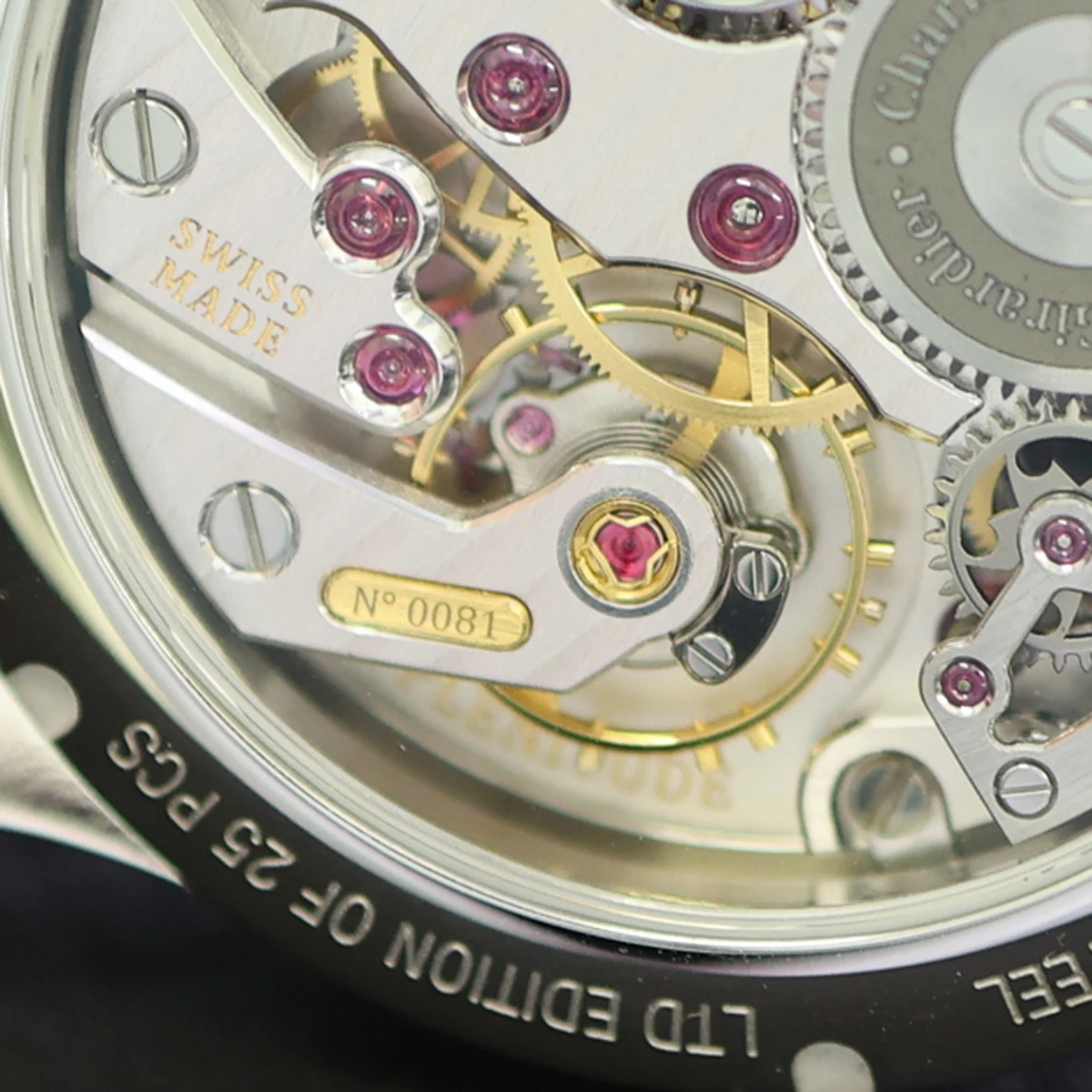
Image – variable inertia balance with 4 timing screws and 14 poising screws
At this juncture, you may notice that the balance wheel has more than 4 screws. Indeed, it has 14 additional screws for poising the balance (18 in total). The purpose of poising is to ensure the centre of gravity of the balance wheel is at the centre of the balance staff, making sure there are no ‘heavy spots’ and the balance wheel runs true. It is similar to a garage adding weights to a wheel rim after fitting new tyres. Many mass-produced watches use laser poising to ablate a tiny recess into the heavy part of the balance wheel. However, Charles Girardier has employed the traditional approach, using poising screws of differing weights to achieve the desired result. It takes a little longer, but is considered the artisanal approach and is indicative of high-end watchmaking.
Volcano Power Reserve
Patrick Ulm and his team wanted the Plénitude models to precisely indicate the available torque held within the barrel. Again, consistent with Charles Girardier’s exacting standards, the company did not seek to use a rudimentary system employing flat planetary gears. Instead, Charles Girardier created its own Volcano Power Reserve, a mechanism, sometimes termed a ‘cone and feeler mechanism’ or ‘differential screw mechanism’.
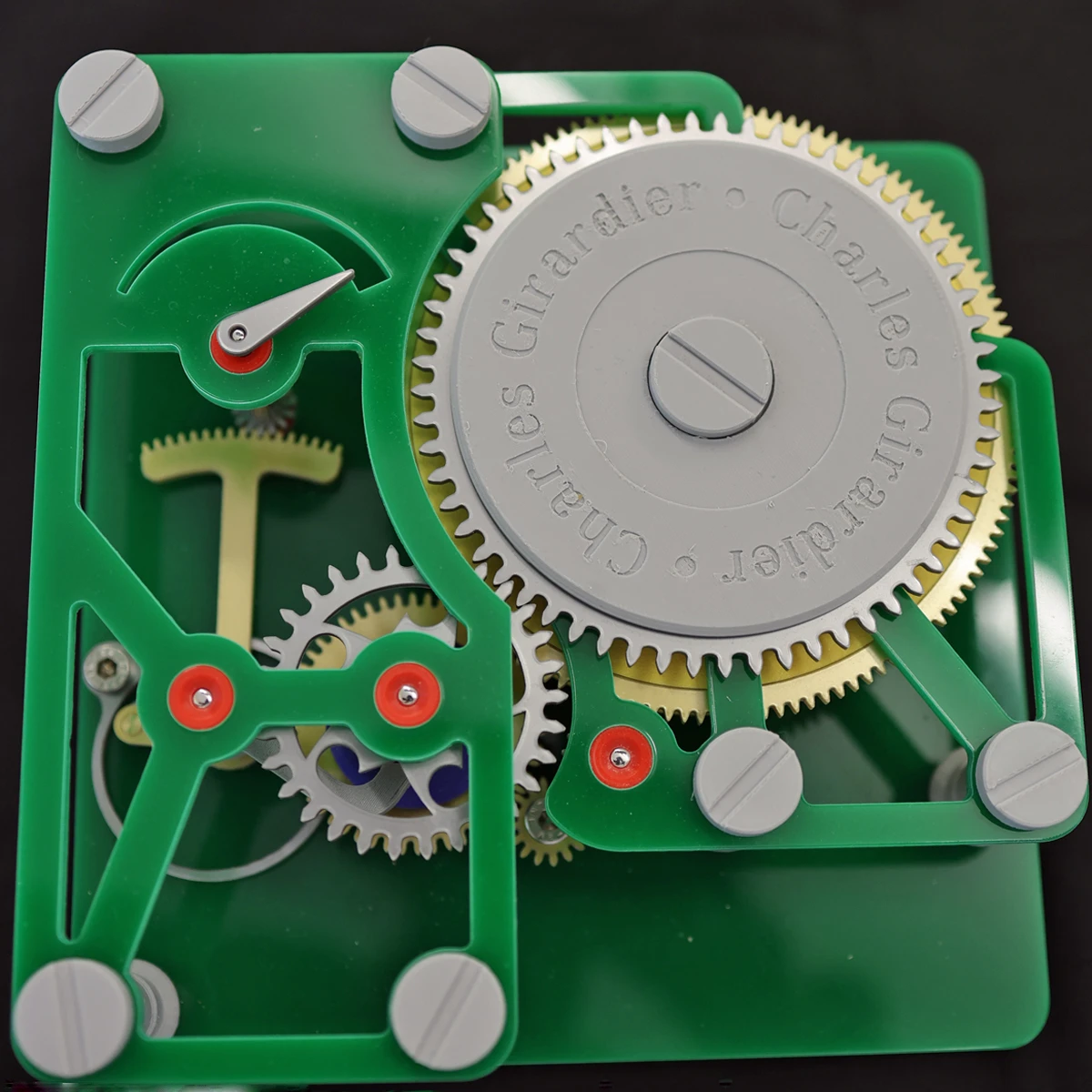
Image – a 3D printed model with the upper wheel (above the Volcano) in mesh with the ratchet wheel
An intricate wheel, in mesh with the ratchet wheel, turns a screw thread. A cone, minus its point, sits on the vertical screw thread and moves up when the mainspring is being tensioned and down as the mainspring tension decreases. A feeler arm tracks the position of the cone, causing a hand on the power-reserve indicator to move.

Image – a 3D printed model showing the feeler (in grey) in contact with the Volcano (in blue)
During my visit, Patrick showed me a 3D printed model of the Volcano Power Reserve (pictured). The mechanism sits within an elaborately formed bridge using a traditional pillar-type construction. Put simply, there is nothing perfunctory about the Volcano Power Reserve; its creation is beautifully engineered.
Finissage
The movements are formed of rhodium-plated brass and feature several refined finishes. For instance, the mainplate is circular satin-finished and the bridges are adorned with classical Côtes de Genève with hand-bevelled edges (aka anglage).
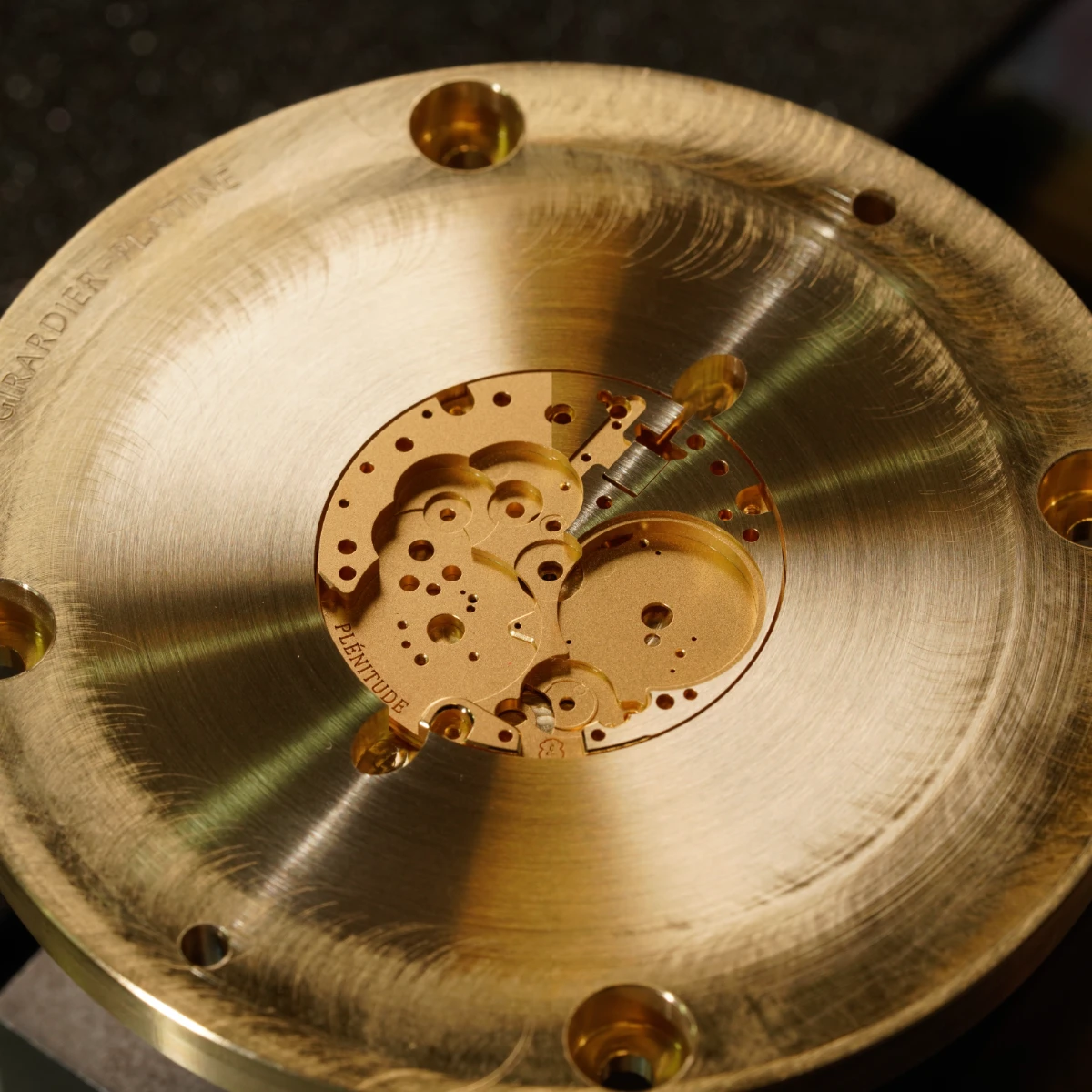
Image – the mainplate is adorned with hand-executed circular graining
Often companies talk about bevelling, but Charles Girardier employs traditional methods to create a 45° chamfer between the surface and the flank. Thereafter, a series of abrasive wooden tools, known as ‘cabrons’ are used in combination with diamantine paste to imbue the bevel with a smooth surface. The cabrons vary in coarseness, with the artisan progressively using finer grades as the bevelling process nears completion.
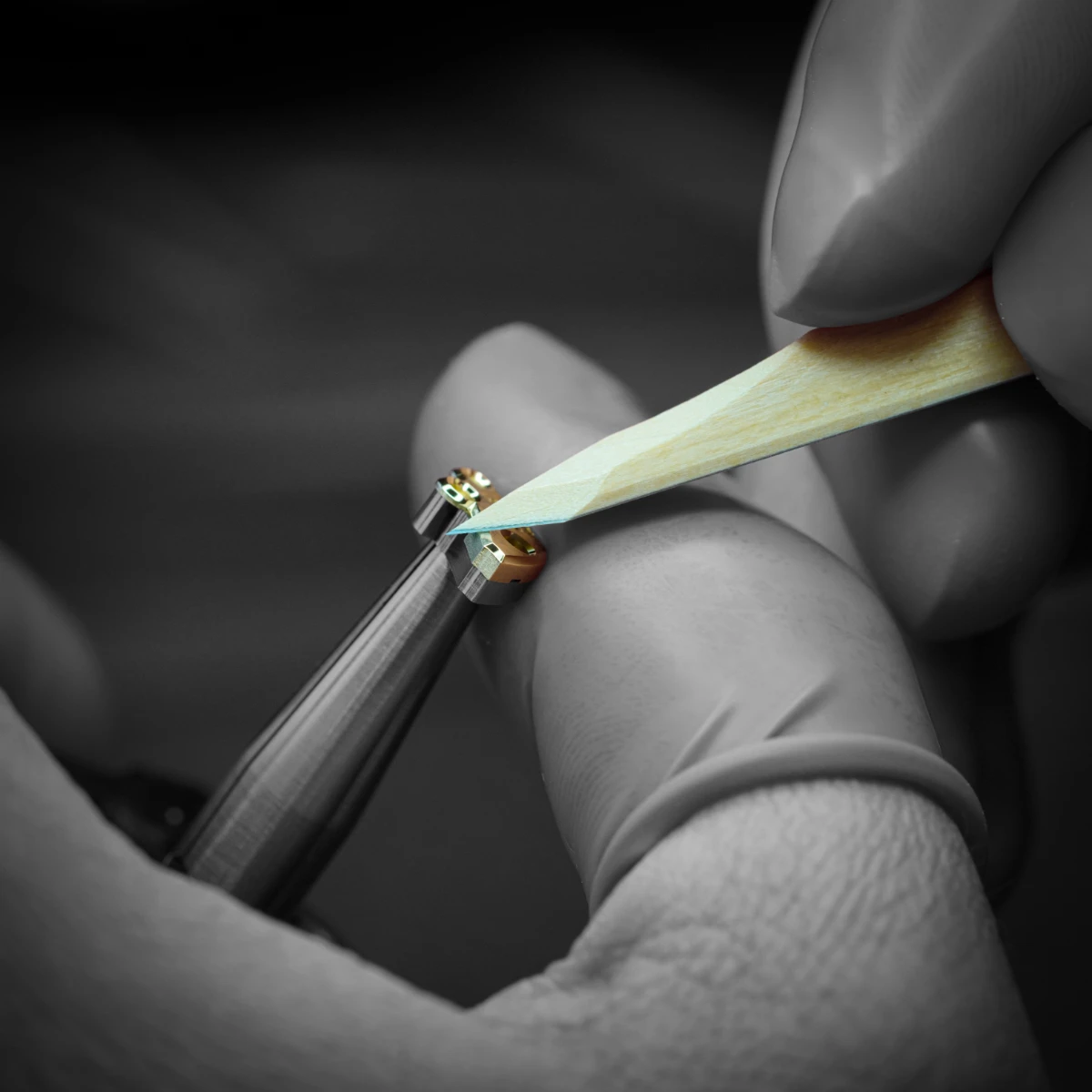
Image – inward angles meticulously hand-finished in black polish
The screw holes are manually moulded using a hand tool, both shaping and polishing the perimeter of each hole to create a ‘smooth and perfectly clean curve around the screw head’. Certainly, one thing that comes to the fore when examining the PL1 with a loupe is that each screw hole, as well as each polished jewel sink, exhibits a resplendent gleam.
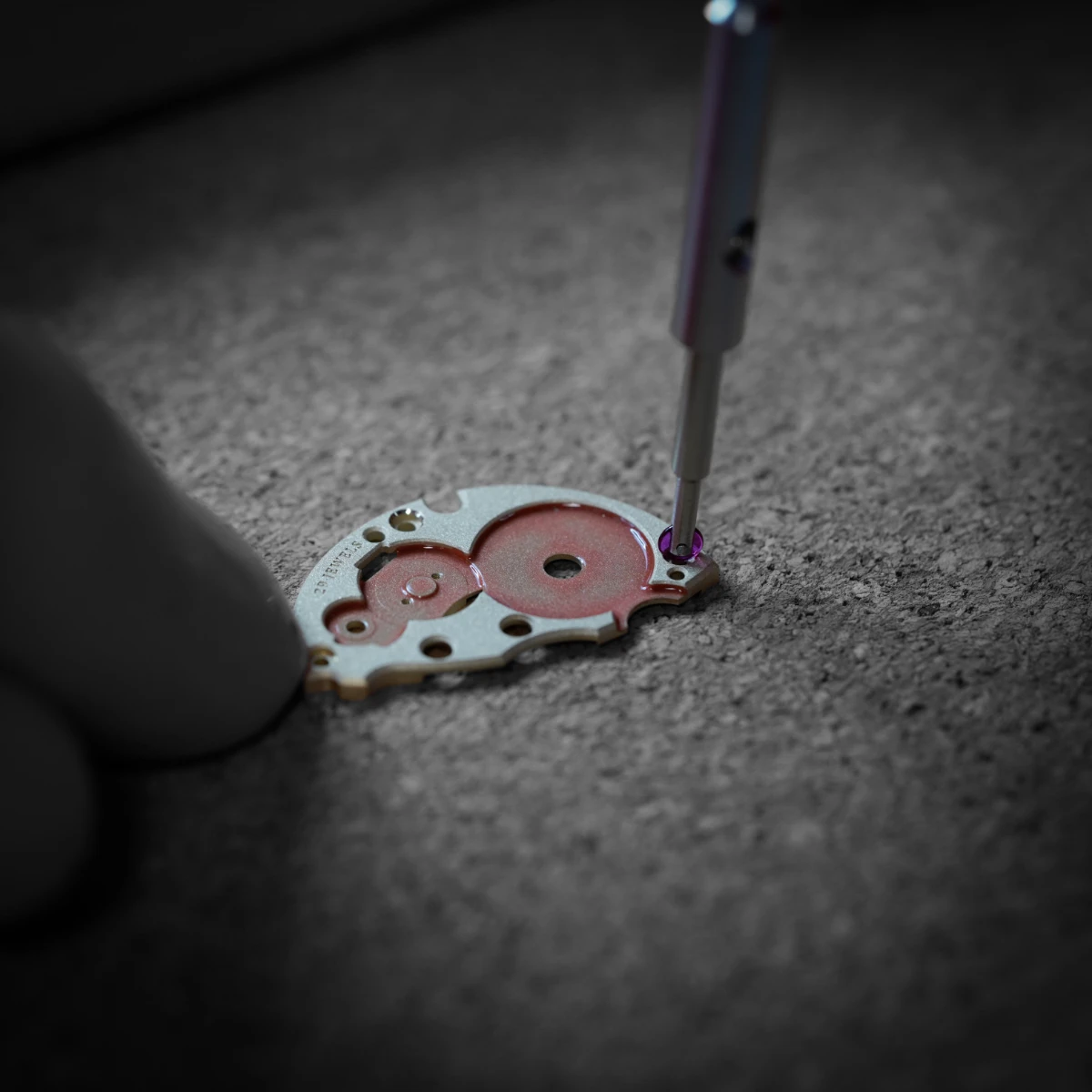
Image – hand-executed profiling of the screw holes
Charles Girardier has not doggedly rejected modern technology when it confers advancement. For instance, the ratchet wheel is adorned with the company’s name, presented in relief. This has been achieved using laser engraving. The balance cock is fitted with an engraved plate, marked with a unique reference number. Even the pallet fork is chamfered to a refined conclusion.
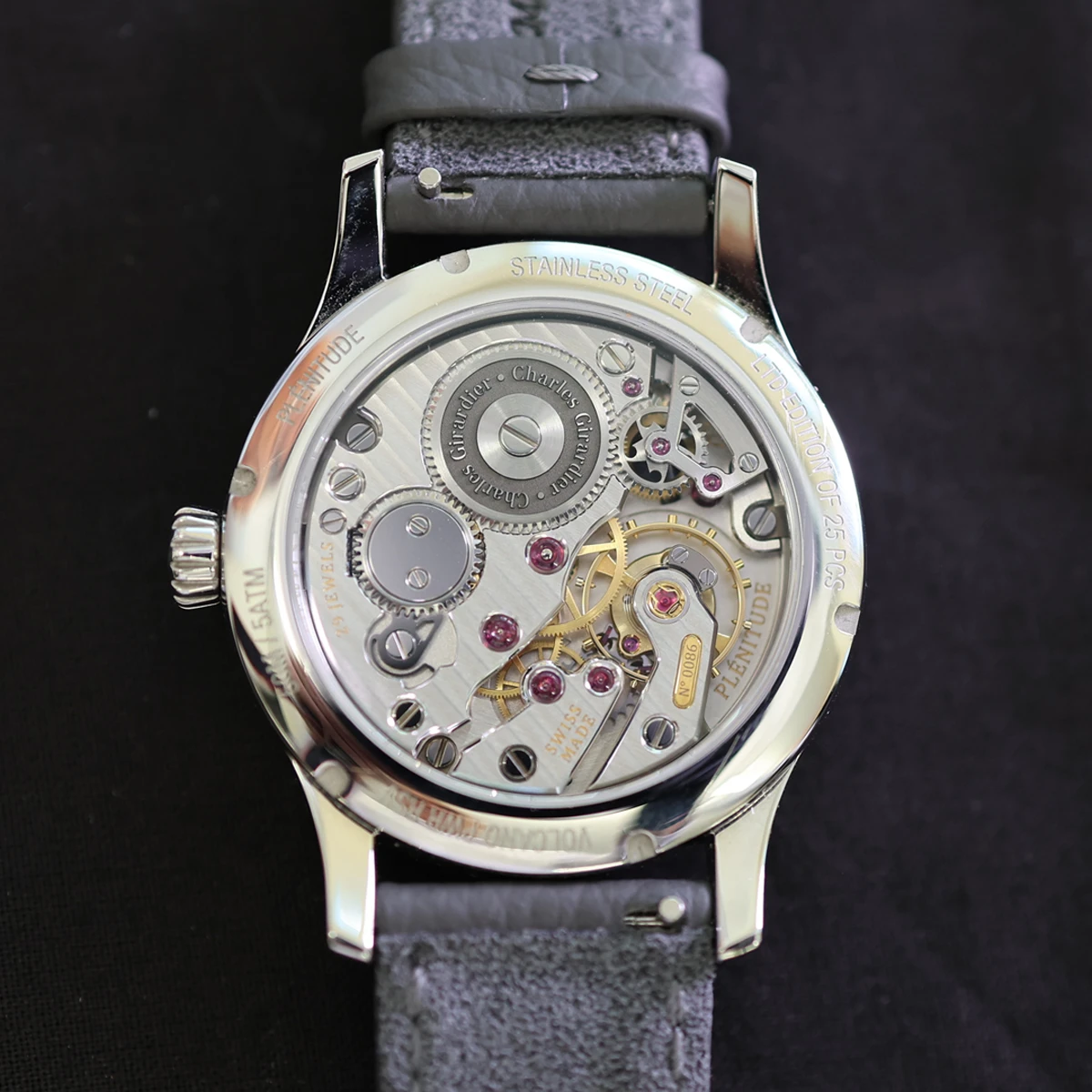
Personally, one of my favourite details is the mirror-polishing that has been used to enhance the appearance of the crown wheel, click and the sliding stud cap. The process, once again, involves using a cabron, smeared with a very fine diamond paste (different grains are used). The part is carefully rubbed in a circular motion to make it flatter. The process is then repeated using increasingly finer grains of diamond paste until eventually the surface evinces a lustrous gleam.
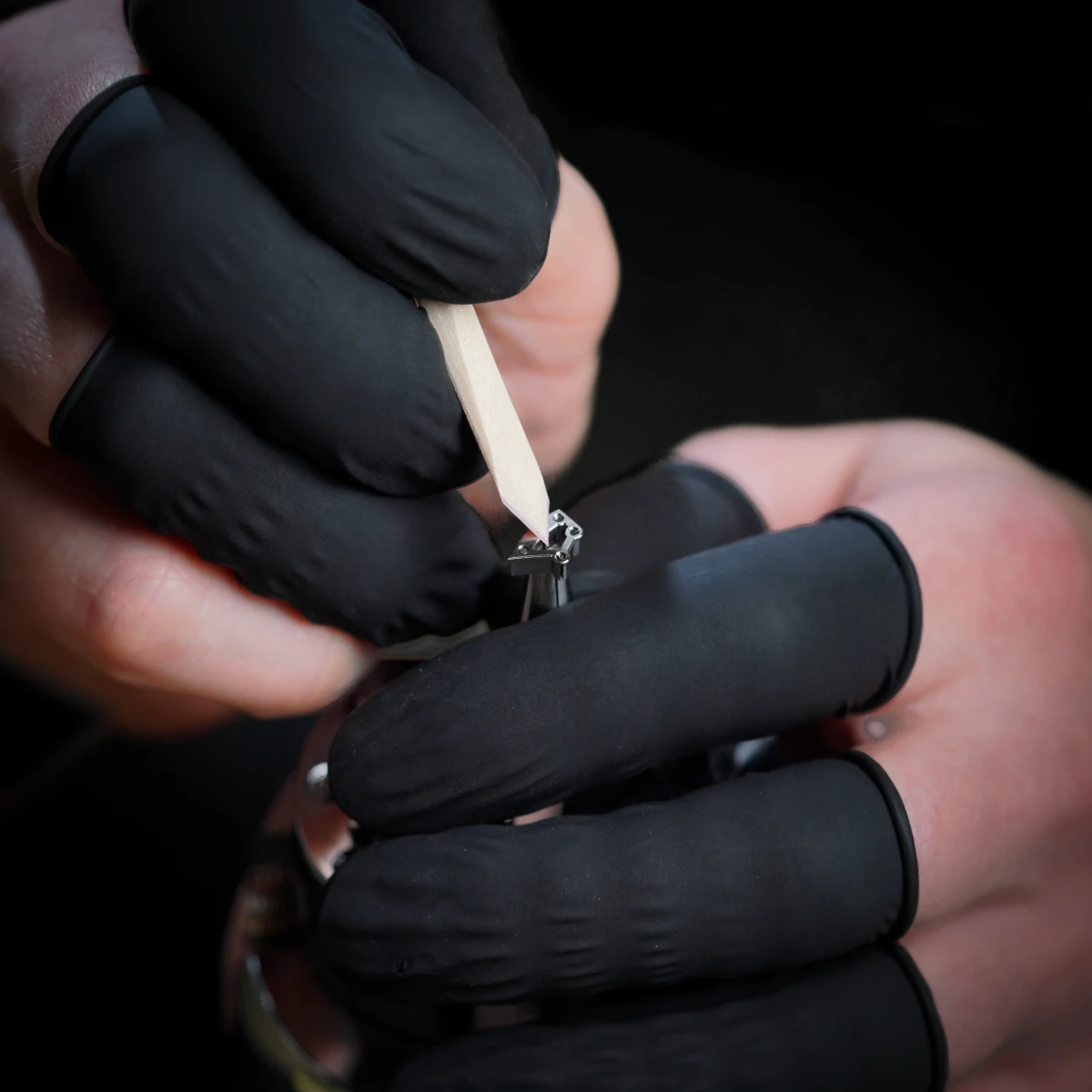
Image – the power reserve bridge features hand-executed satin finishing along its edges
The Plénitude PL1 & PL2 movements bear the brand’s own ‘CG Seal’ which ‘guarantees a high level of execution, combining precision, hand-finishing, and respect for watchmaking traditions’. Certainly, having examined the Plénitude models at close quarters, there is an overriding sense of excellence.
Closing remarks
After falling for the charms of a period Charles Girardier pocket watch, Patrick Ulm embarked on a journey. He sought to revive a historic name, working closely with industry experts. Having rekindled the company’s historic name in 2018, he stood on a stage, just two years later, holding a GPHG trophy aloft. It was a remarkable achievement by any measure and one that has evaded many longstanding brands.
However, it is perhaps the creation of the new Plénitude models that represents Charles Girardier’s greatest achievement to date. Designing and prototyping an in-house movement is no mean feat, but Patrick Ulm and his colleagues have done precisely that.
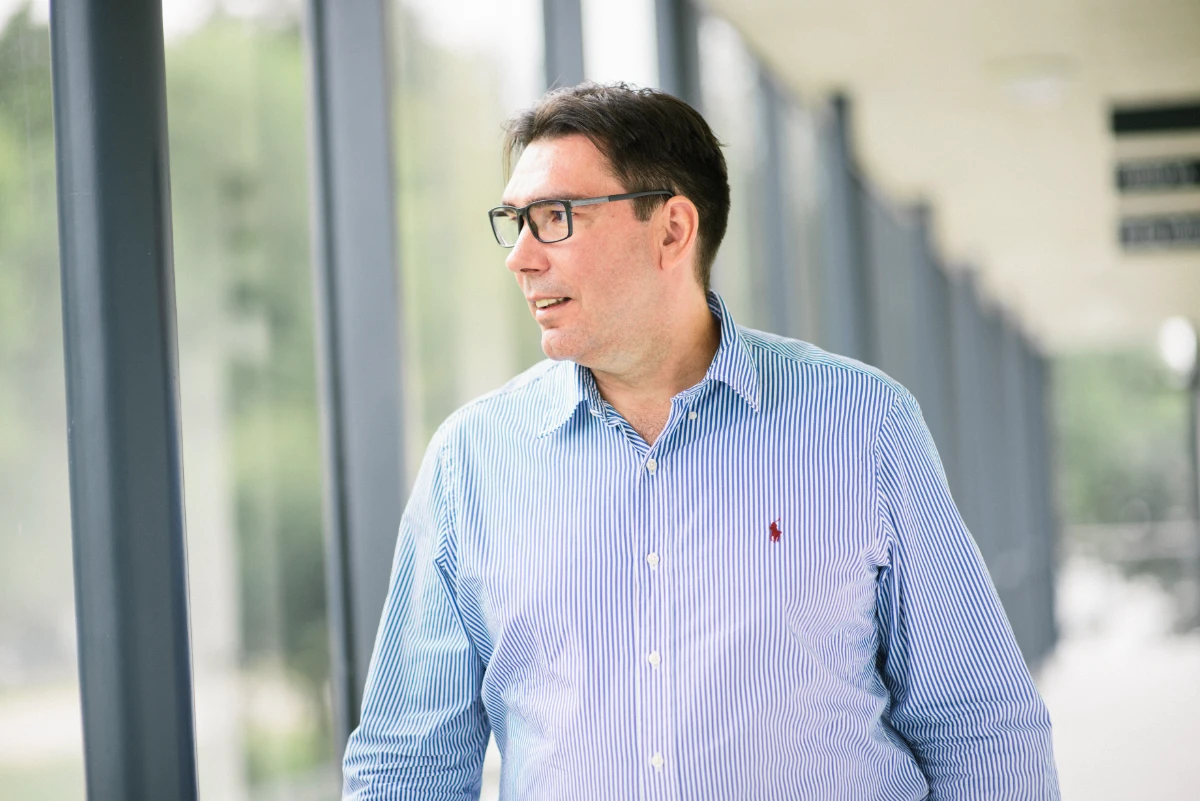
Image – Patrick Ulm
The Plénitude PL1 & PL2 movements are highly inventive. The power-reserve indicator is positioned front and centre, optimally located. Sadly, in contrast, the approach of so many rival firms appears like an afterthought by comparison, with scant consideration for scale and symmetry. Beneath the dial, the Volcano Power Reserve is beautifully engineered and provides a highly accurate indication of the available energy stored within the barrel. The addition of a variable-inertia balance and the presence of ultra-refined finishing also make compelling reasons for selecting a Charles Girardier Plénitude.
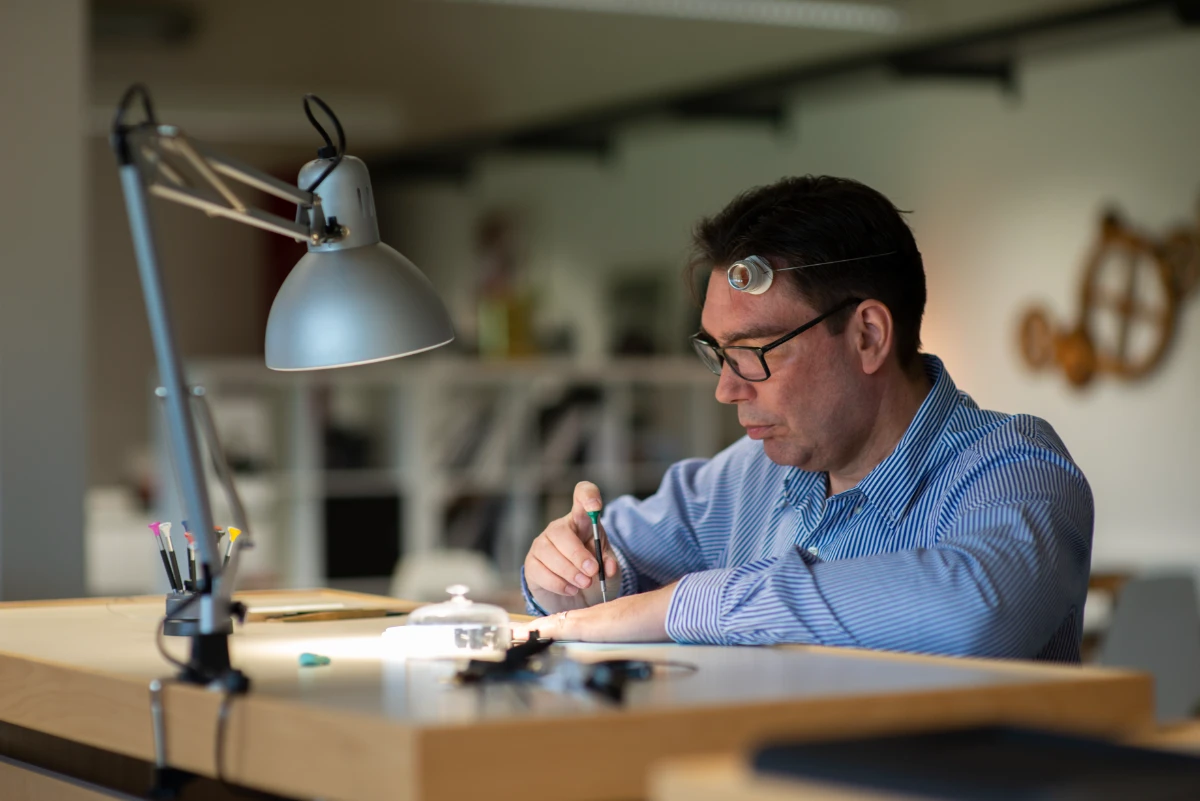
Patrick Ulm has been instrumental in creating an impressive body of work. Occasionally, there are small details on the company’s watches which are inspired by the past eg the style of the crown, mentioned earlier. However, Ulm has not sought to create a pastiche of Girardier L’aîné’s work, but rather craft ‘contemporary watches that Monsieur Girardier may have produced if he was alive today.’ In my opinion, he has successfully achieved this objective and it’s clear the company’s watches are destined to confer an enduring beauty that will never fade.
The only question that remains is, ‘What’s next for this highly creative independent Maison?’
Further reading
https://charles-girardier.com/
Technical specification
- Model: Charles Girardier Plénitude Volcano Power Reserve PL1
- Case: stainless steel, diameter 39.5 mm, height 10.95 mm, water resistance 5 ATM (50 metres), sapphire crystal to front, exhibition case back.
- Functions: hours, minutes, small seconds, Volcano Power Reserve
- Movement: Calibre CG PL1, hand-wound movement, frequency 21,600 Vph (3 Hz), 29 jewels, power reserve 60 hours
- Strap: hand-stitched calfskin leather, made in Geneva, and paired with a polished steel folding clasp.
- Price: CHF 17,800 including local taxes (RRP as of 8.7.2026)
- Model: Charles Girardier Plénitude Lunar Phase PL2
- Case: stainless steel, diameter 39.5 mm, height 10.95 mm, water resistance 5 ATM (50 metres), sapphire crystal to front, exhibition case back.
- Functions: hours, minutes, small seconds, Volcano Power Reserve, moon phase
- Movement: Calibre CG PL2, hand-wound movement, frequency 21,600 Vph (3 Hz), 29 jewels, power reserve 60 hours
- Strap: hand-stitched calfskin leather, made in Geneva, and paired with a polished steel folding clasp.
- Price: CHF 19,800 including local taxes (RRP as of 8.7.2026)