
David Candaux DC6 Titanium Watch Review
The David Candaux DC6 Titanium is the latest creation originating from the master watchmaker’s atelier. Angus Davies met Candaux for the first time in 2017 at the unveiling of his inaugural watch and recalls his thoughts at the time. Thereafter, Angus turns his attention to the DC6 Titanium, discussing its composition before expressing his opinion of the ultra high-end timepiece.
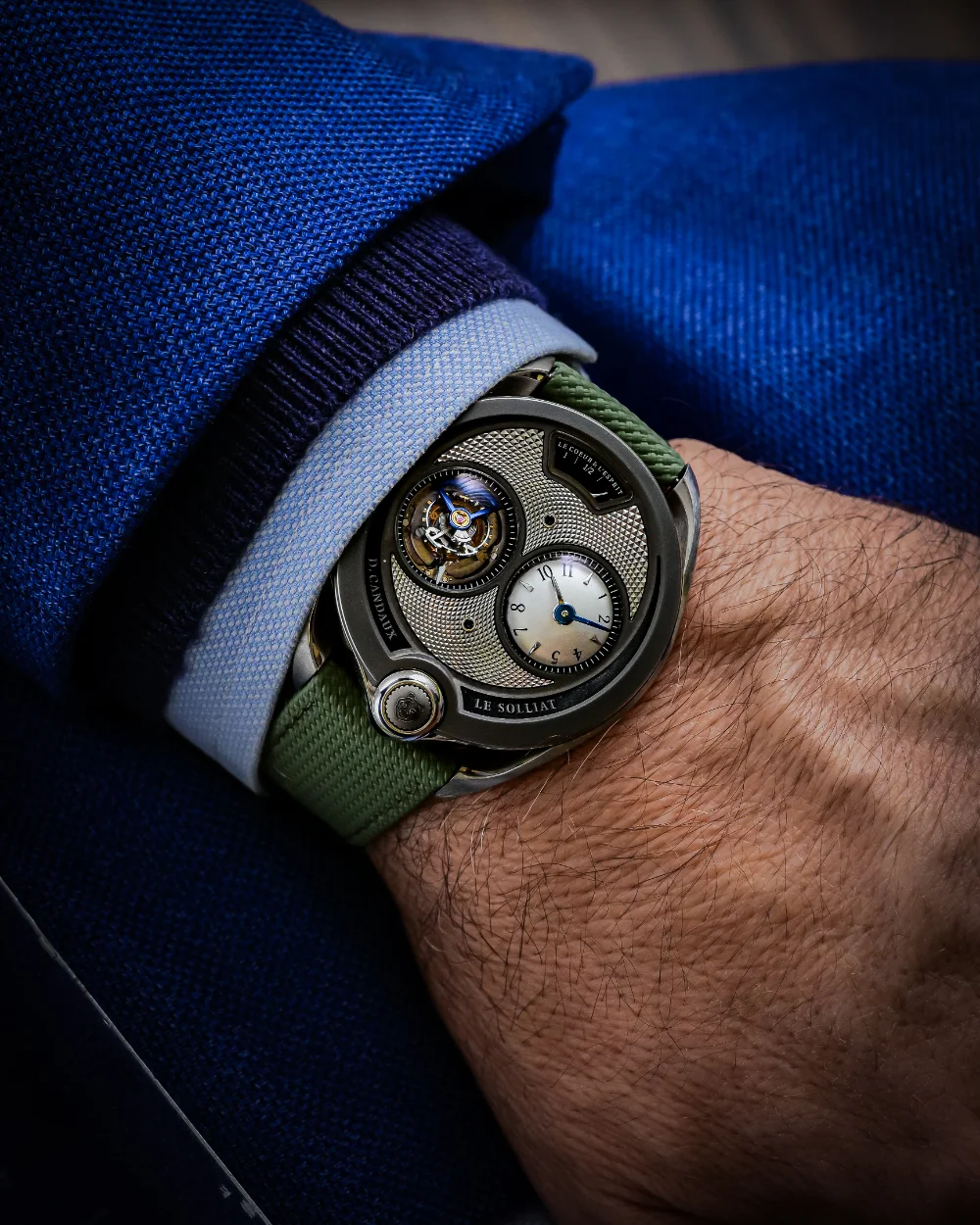
David Candaux depuis 2017
The birth of your first child changes everything. Suddenly, it’s bye-bye coupé, hello estate. Memories of lying in bed on a Saturday morning fade with the onset of sleepless colic-blighted nights. But perhaps more than anything, there’s the realisation that parenthood brings newfound responsibility, something that stays with you til the grave.
A consequence of being a father is that I sometimes feel paternal towards others, even people I barely know. Over the years, I’ve heard from wannabe watch entrepreneurs who have talked about remortgaging their homes, investing their life savings or turning their back on a well-paid job. In most cases, I usually counsel caution.
Even when you have the necessary watchmaking expertise, success isn’t guaranteed. Marketing ‘nous’, sufficient capital, tenacity and a degree of luck are also prerequisite requirements.

1740, Le Coueur & l’Espirit
In March 2017, during the Basel fair, I received an email from renowned journalist, Anders Modig, inviting me to a dinner hosted by David Candaux. Monsieur Candaux, a third generation watchmaker from the Vallée de Joux, was unveiling his first timepiece, the ‘1740, Le Coueur & l’Espirit’. Faced with the prospect of sitting in my hotel room alone, eating an overpriced plastic sandwich, I decided to accept Monsieur Candaux’s hospitality. Quite simply, a decent meal and the chance to meet fellow industry professionals sounded far more enticing.

The evening proved relaxed and convivial. Candaux, despite his youthful appearance, was a master watchmaker with an impressive CV. He had spent time at Jaeger-LeCoultre, working on Grand Sonneries and minute repeaters. His talents extended to engineering and design. His inaugural watch, the 1740, Le Coueur & l’Espirit’, was hugely impressive with some of the finest finishing I’ve seen anywhere.
However, in the corner of my eye, I saw a young lady pushing a pram around the restaurant. Nestling within pristine blankets, lay a newborn baby boy, Candaux’s son. My inner paternal streak came to the fore and, instinctively, I questioned the wisdom of Candaux turning his back on a salaried position. To my shame, I left the restaurant wondering whether, despite his obvious talent, David Candaux would succeed in a super competitive market.

David Candaux x Geneva Watch Days 2024
A few months ago, during Geneva Watch Days, I met up with David Candaux. His talent, business acumen and courage have since gained him recognition throughout the watch collecting community and he has clearly enjoyed the sweet taste of success. During our meeting, I was shown the latest creation from Candaux, the DC6 Titanium. While I am accustomed to seeing exceptional watches every day, this model sits on a higher plain and is the very antithesis of everyday. Indeed, the DC6 Titanium is an extraordinary timepiece worthy of your attention. Allow me to elaborate.
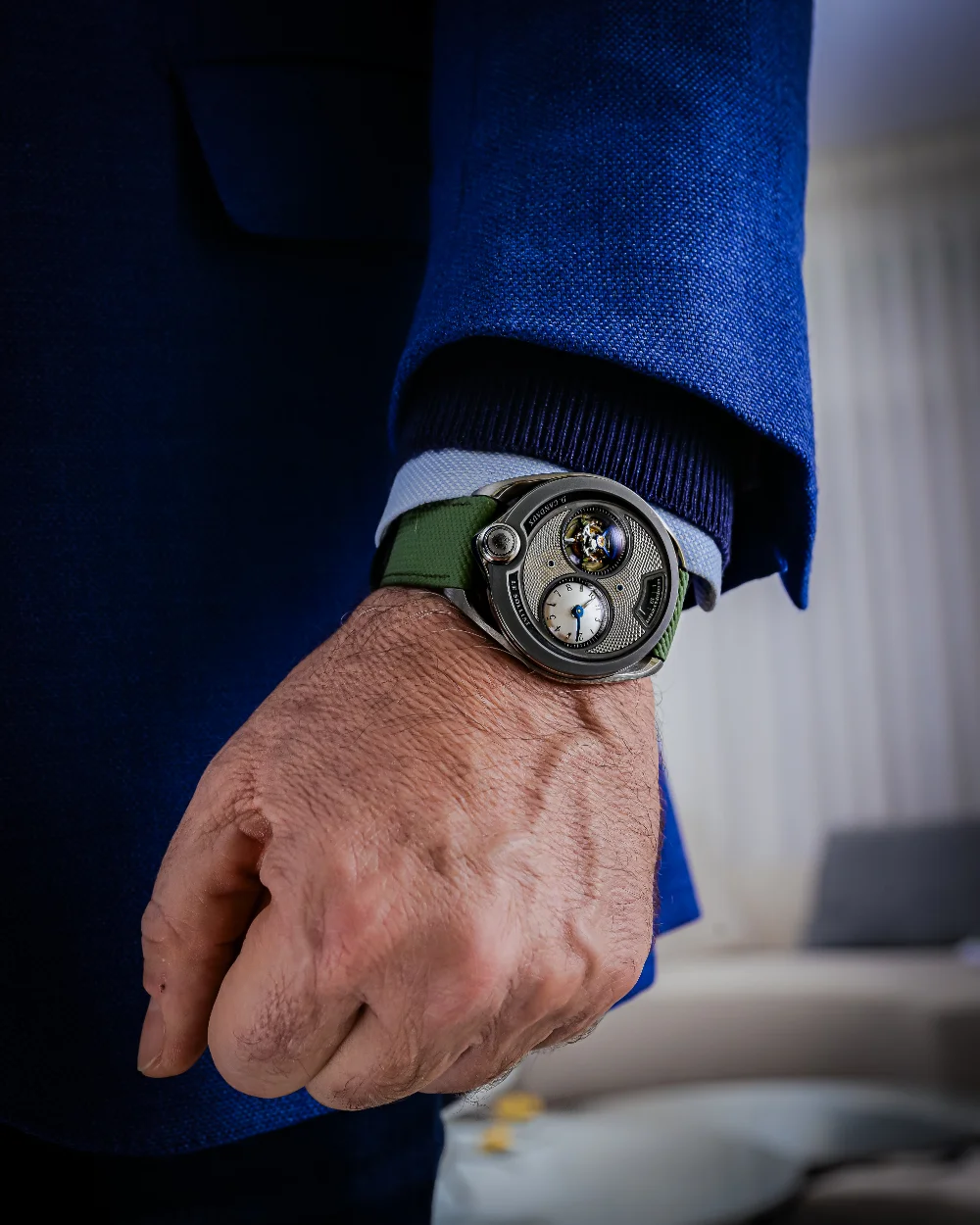
David Candaux DC6 Titanium – symmetry and asymmetry
Two sapphire domes reside at 3 and 9 o’clock, one indicating the hours and minutes, the other playing host to a flying tourbillon with an integrated small seconds display. A power-reserve indicator is located at 12 o’clock, while a ‘magic crown’ is positioned opposite at 6 o’clock. The arrangement of these elements is clearly the product of much thought.
Candaux was inspired by Leonardo da Vinci’s Vitruvian Man. The two sapphire domes, arranged along an east-west axis, confer symmetry. Conversely, the power-reserve indicator and magic crown subscribe to an asymmetric layout. Humankind is accustomed to viewing fellow mortals as a blend of symmetrical and asymmetrical forms, something da Vinci wonderfully conveyed in his iconic drawings. It is by combining these elements in his design, that Candaux has conceived a wonderfully harmonious mien.
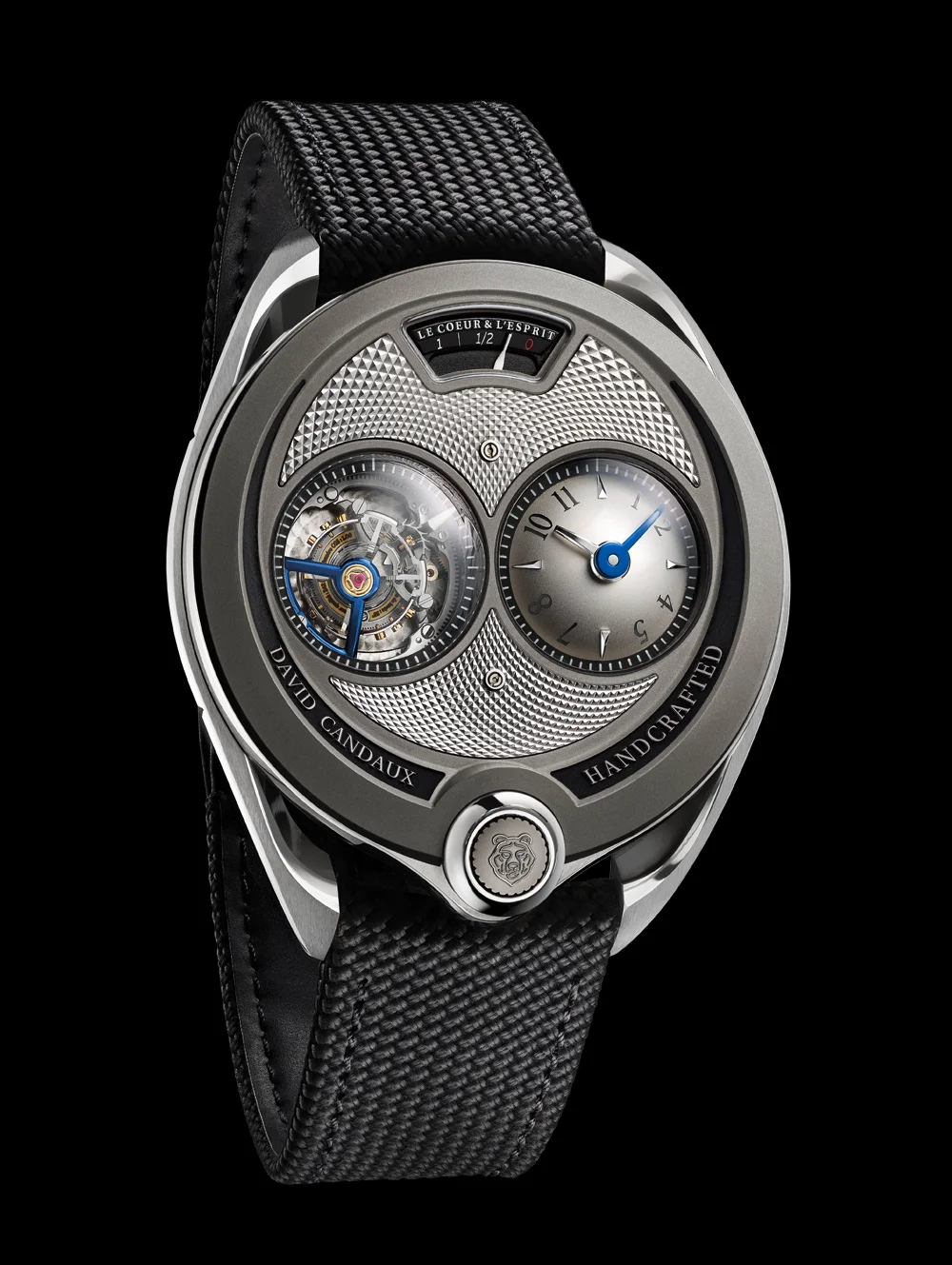
David Candaux DC6 Titanium – hand-guilloché
Two titanium plates, each retained with a stainless steel screw, sit above and below said sapphire domes. These plates are adorned with ‘Pointes du Risoux’, a guilloché motif expertly imparted to the titanium using a traditional rose engine lathe. Candaux’s decision to use Grade 5 titanium is extremely brave as the alloy is incredibly hard, making it far more challenging to work with. I will return to this point later.
David Candaux DC6 Titanium – hour and minutes display
The aforementioned hour and minutes display is executed in silvered titanium and incorporates curved, bevelled and hand-polished hands. The hour hand is executed in a silvery hue, while the minute hand is thermally blued, aiding interpretation. The hours are denoted with a combination of grey gold indices at the cardinal points with Arabic numerals in between.
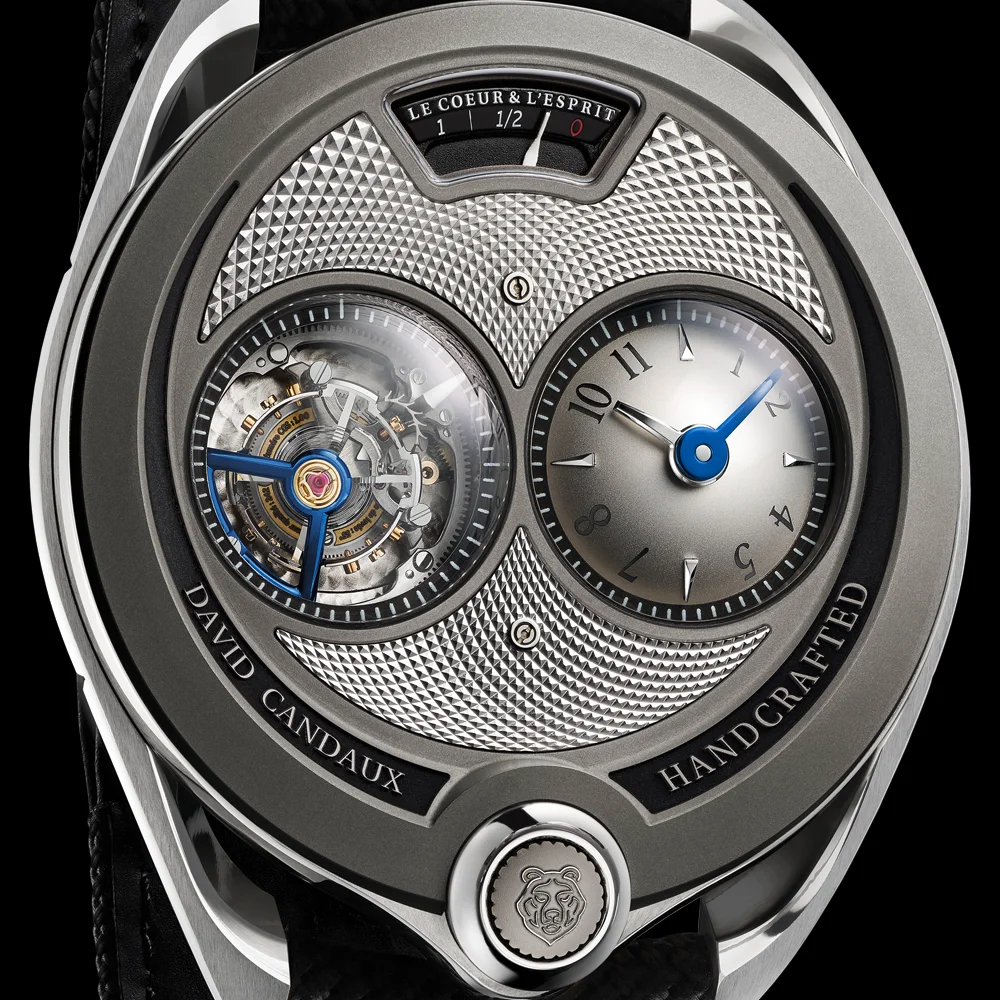
Flying tourbillon
The flying tourbillon, located under the dome at 9 o’clock, is inclined at 30° and rotates 360° every minute. But, what exactly is a flying tourbillon and what is the significance of it being inclined at 30°? Before, I answer this, we need to go back in history.
In the latter part of the 18th century, Abraham-Louis Breguet (1747-1823) recognised that gravity adversely affected the behaviour of the escapement and regulating organ within a pocket watch. His solution was to place these parts within a rotating cage, revolving 360° every 60, 240 or 360 seconds. Breguet named his invention the ‘tourbillon’ and it was subsequently patented in 1801. With Breguet’s tourbillon, the cage was supported by two bridges, one positioned above the cage and one located below.
In 1920, Alfred Helwig (1886-1974), a German watchmaker, conceived the ‘flying tourbillon’. It shared much in common with Breguet’s mechanism, save for one difference, it eschewed the upper bridge. When adopting this latter approach, the wearer is indulged with superior views of the cage in motion, the balance spring pulse with life and the pallet lever repeatedly engaging with the escape wheel.
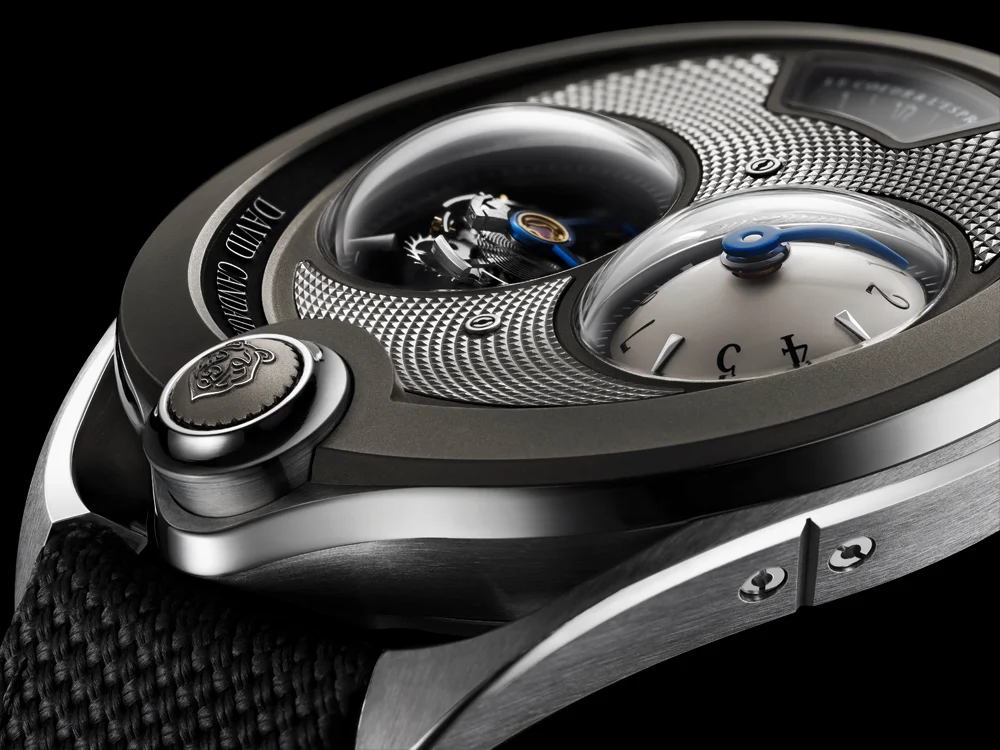
Returning to Breguet’s invention, it was originally designed for use in a pocket watch. At night, the pocket watch would be removed from the waistcoat and placed on a night stand, holding the watch in the optimal vertical position. A tourbillon within a wristwatch is equally valid; however, when removed from the wrist and left on a flat surface, the benefits of the mechanism will be compromised. In the case of the DC6 Titanium, the Swiss watchmaker has inclined the tourbillon at 30°, ensuring that its gravity-compensating qualities are optimised at all times.
Candaux has also crafted the tourbillon cage in titanium. Moreover, he thermally blued the alloy, a far more onerous undertaking than heat-bluing steel. A white lacquered hand affixed to the cage collaborates with a crisp track to indicate the running seconds.
David Candaux DC6 Titanium – ergonomics
Measuring 44 mm in diameter, the DC6 Titanium is generously proportioned and yet it remains incredibly wearable. The lugs are comparatively short and the strap sits close to the dial, characteristics that make the watch appear smaller than its stated dimensions.
Another factor that augments wearer comfort is the presence of the ‘magic crown’. The DC6 Titanium breaks with convention, shunning the customary crown at 3 o’clock. Instead, as mentioned earlier, Candaux has unusually positioned the crown at 6 o’clock. Neat and unobtrusive, it only makes its presence known when pressed. The magic crown energises the mainsprings (there are two) and also adjusts the time indications. Its design makes winding easier and its location avoids the 3 o’clock wrist chafing inflicted by some watches.
The case is intricately formed from Grade 5 titanium. It comprises a central section, angled slightly upwards towards the wearer, aiding readability, and arcing sides that are screwed to the central section. By adopting this design, Candaux has endued the watch with optimised ergonomics.
Grade 5 Titanium – a challenging material
Grade 5 titanium is an alloy composed of 90% titanium, 6% aluminium and 4% vanadium. It’s lightweight, strong, non-magnetic, corrosion-resistant and hypoallergenic; all attributes that make the alloy ideal for watchmaking. However, Grade 5 titanium does present a series of challenges.
Whereas steel watch cases are often stamped, especially on mid-range watches, Grade 5 titanium cases necessitate using a CNC machine, honing the alloy into the desired shape. This approach is more time-consuming than processing steel and, by default, more costly. For instance, when making Grade 5 titanium components, the milling speeds are much slower than those used for steel to prevent heat damage to the alloy or, worse still, a fire. Moreover, CNC tools wear out far more quickly when working with Grade 5 titanium, again heightening costs.

David Candaux is evidently not a man who seeks an easy life; however, Grade 5 titanium is a fabulous material and, as stated earlier, it proffers many attributes. Another benefit of the metal is that it can be polished to a brilliant gleam, albeit due to the hardness of the alloy, it’s more difficult. Despite said challenges, Candaux has not held back, endowing the case with a combination of satin-brushed, hand-polished and sandblasted surfaces.
Even more remarkably, the hand-wound movement at the heart of the DC6 features bridges and a mainplate made from Grade 5 titanium. Using the corrosion-resistant alloy obviates the need for plating. Once again, the difficulty of polishing Grade 5 titanium has not deterred Candaux from using the material. Indeed, in what seems slightly masochistic, he has embellished the bridges and mainplate with hand-polished angles and polished chamfers, mirror-polishing, straight graining and perlage under the barrels. The movement even has 18 hand bevelled interior angles, yet another highlight to seduce the cognoscenti. The bridges are embellished with ‘Côtes du Solliat’, Candaux’s own take on Côtes de Genève and the tourbillon cage is mirror-polished. All of these finishes would be considered exceptional if imparted to steel components, but on titanium, well that’s simply astonishing.
David Candaux hand-wound movement – other highlights
When discussing the movement, Candaux refers to a ‘chronometric power reserve’ of 55 hours. The presence of two fast rotating barrels helps deliver a more linear supply of energy to the escapement, conferring good rate stability and ultimately precision.
The movement features a free-sprung balance, granting superior precision to a common index-regulated balance. This means of regulation is also more stable and less susceptible to shocks. It takes longer to regulate a free-sprung balance; however, as you have no doubt ascertained by now, David Candaux is a very patient chap!
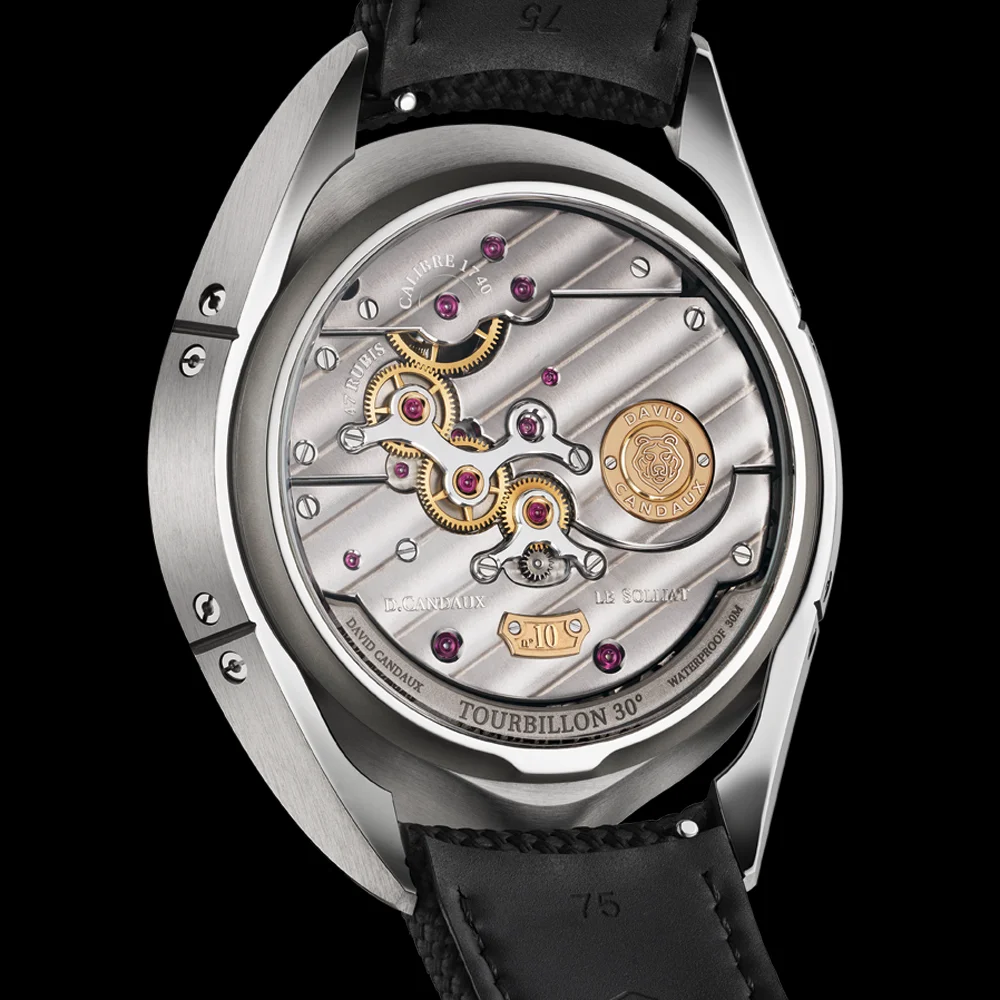
Returning to Breguet, he conceived his eponymous overcoil in 1795. His idea was to upraise the last coil of the balance spring and reduce its curvature. This improved the development of the balance spring, aiding isochronism. Edouard Phillips (1821-1889) refined the Breguet overcoil, further enhancing its ability to breathe concentrically, thereby heightening precision, leading to it being known as the ‘Philips terminal curve’. As you would expect with Candaux’s magnum opus, the balance spring within the DC6 Titanium features a Philips terminal curve.
David Candaux DC6 Titanium – closing remarks
At this juncture, it is probably superfluous to say that I adore the DC6 Titanium. Likewise, it is not necessary to exhaustively list every attribute of the DC6, you will recognise its excellence within seconds of making its acquaintance. Nevertheless, to provide some context, when benchmarking the DC6 Titanium, don’t look to the so-called ‘Holy Trinity of watchmaking’, Candaux’s work is far superior.
The protracted creation of each component within the company’s atelier in Le Solliat, sometimes using traditional machines and tools, precludes mass production, a characteristic conferring notable exclusivity. I have only seen comparable finishing on watches crafted by Greubel Forsey and Philippe Dufour; two esteemed names that serve to benchmark David Candaux’s work.

Back in 2017, I recognised Candaux was an immensely talented watchmaker. However, it is only in recent times that I became aware that his talents extend to micro-mechanical engineering and design. Furthermore, Candaux has an MBA in Management.

With the benefit of hindsight, Candaux’s decision to establish his own brand has been vindicated by his achievements, including the widespread critical acclaim he has since enjoyed. His suite of skills certainly enhanced his prospect of success, something sadly many wannabe watch entrepreneurs lack. The pessimism I felt back in 2017 was evidently misplaced, David Candaux has achieved greatness and his success is now well documented. And who knows, one day, Baby Candaux may become a fourth generation watchmaker and choose to establish his own successful horological enterprise.
Further reading
Technical specifications
- Model: David Candaux DC6 Titanium
- Case: Grade 5 titanium, diameter 44 mm, thickness 11.29 mm, water resistance 3 ATM (30m), sapphire does to the front, exhibition case back.
- Functions: hours, minutes, small seconds fitted to tourbillon cage, power-reserve indicator
- Movement: hand-wound movement, frequency 21,600 vph (3 Hz), 47 jewels, chronometric power reserve 55 hours.
- Strap: handmade rubber with a velcro clasp engraved with the David Candaux logo
- Price on application