
Delma 1924 Tourbillon (Part One) Watch Review
As its name implies, the Delma 1924 Tourbillon incorporates the famous gravity-defying mechanism, a high-complication that is widely associated with Haute Horlogerie. Celebrating its 100th anniversary, the Lengnau-based watch brand has created its most ambitious model to date equipped with a 100% Swiss-made movement. In this two-part feature, Angus begins by looking at the history of Delma, the purpose of the tourbillon as well as this new model’s dial and case.

Delma seit 1924
In 1924, recognising the widespread transition from pocket watches to wristwatches, two brothers, Adolf and Albert Gilomen, established their eponymous firm, A. & A. Gilomen. The company had four collections, each marketed under a unique name. These brands included Delma, Gil, Midland and Thuya. The Delma name assumed greater prominence in 1966 after the company was acquired by Ulrich Wüthrich (along with a partner) and was renamed Delma Watch Limited. Thirty years later, in 1996, Ulrich handed the reins to his son-in-law, Fred Leibundgut, the present-day Chairman and CEO. Delma remains a family-run business with Fred in charge, ably assisted by his son, Andreas Leibundgut, the brand’s Head of Marketing.
Over the years, the company has produced an impressive body of work, including an array of two-handers, chronographs, divers’ watches and calendar watches. Delma has always remained attentive to changing tastes, creating both classical and contemporary references, embracing different dials, case shapes and materials.
Delma has witnessed much change over the last 100 years with the advent of new technologies as well as the impact of political, economic and societal influences, both in its native Switzerland as well as internationally. However, despite these factors, some things have remained the same. For example, since the firm was founded in 1924, it has always remained in Lengnau, a German-speaking municipality just 3 km from Grenchen. Most pertinently, throughout its history, the name Delma has always been known for making watches that proffer an impressive mix of accomplished design, functionality, precision and reliability, coupled with an impressive high quality-price ratio.
Keen to mark its 100th anniversary, Delma has unveiled its most desirable watch to date, the aptly named Delma 1924 Tourbillon. In this two-part feature, I explore the composition of this watch in forensic detail, examining the execution of its dial, case and movement.

What is a tourbillon?
Renowned watchmaker, Abraham-Louis Breguet (1747-1823), established that gravity influenced the behaviour of the regulating organ within a wristwatch. His inspired solution was to place the escapement and regulating organ within a rotating cage that revolved 360° over a fixed period, typically once every 60, 240 or 360 seconds. As the cage turned it would negate any positional errors. Breguet patented the tourbillon in 1801.
While a tourbillon aids precision, these days it is often selected for the visual spectacle it bestows. Most watches equipped with a tourbillon escapement are endowed with a large dial aperture, revealing the cage, escapement and regulating organ in motion. The wearer is able to observe the cage rotate, the balance wheel oscillating to and fro, the hairspring pulse with life and the pallet lever engage in deep conversation with the escape wheel. There are very few complications that indulge the owner with such a mesmerising animated performance.
Due to the complexity of the tourbillon mechanism, it is necessary to engage a highly proficient watchmaker who is able to assemble and regulate a movement of such complexity. Needless to say, tourbillons are usually the preserve of Haute Horlogerie and priced commensurately. I will return to the matter of price later; albeit, I can already reveal that the Delma 1924 Tourbillon is competitively priced.

Delma 1924 Tourbillon – dial
The dial of the Delma 1924 Tourbillon is presented in sable black and adorned with a grained finish. The hour and minute hands are palladium, nickel-plated and lined with white Super-LumiNova (SLN BGW9) that emit a blue glow in dim light. Each hour is denoted with an applied lozenge-shaped marker, once again, lined with white Super-LumiNova. The indexes sit astride the dial’s grained epidermis and minute track. This track is snailed and features one-minute markings, aiding readability.

The base of the dial plays host to the tourbillon. A large aperture accommodates the coveted mechanism and includes an upper bridge, resembling an inverted V-shaped bar. The upper bridge is secured with two thermally blued screws. The head of each screw is mirror-polished and endued with a bevelled slot and chamfered rim.
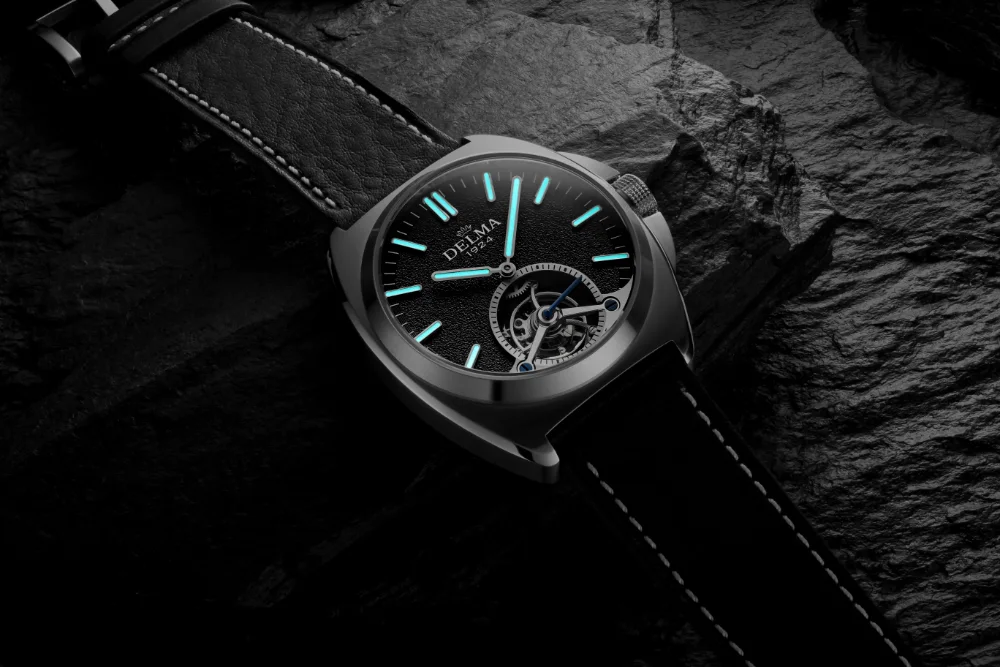
An intricately shaped metal plate features two dedicated circular holes, designed to accommodate said blued screws. In addition, this metal plate incorporates a polished circlet, endowed with crisp black markings, that serves as a highly legible track. Delma has fitted a hand atop the tourbillon cage which collaborates with the track, indicating the running seconds.
Despite the complexity housed within the case of the Delma 1924 Tourbillon, the display is refreshingly simple to understand. However, while the dial is highly intelligible, it does encompass numerous parcels of nuanced detail. Examples of this considered approach include the granular texture of the dial plane, the snailed minute track and the blend of polished and brushed metal surfaces encircling the tourbillon and its cage.

Delma 1924 Tourbillon – case
Delma has clearly sought to equip this model, its most prestigious to date, with a case worthy of housing the highly complicated movement. Measuring 41 mm in diameter, the case, made of 316L stainless steel, is intricately formed. The case is vertically brushed, save for the bevelled edge, positioned between the upper surfaces and the caseband, which is highly polished. The bezel is presented in a contrasting circular brushed finish. The resultant appearance is nuanced yet cohesive.

A circular bezel sits upon the tonneau-shaped case, heightening visual interest while remaining notably harmonious. The sides of the bezel slope downwards at approximately 45° where they ultimately meet the upper surface of the case, imbuing the display with much depth.
A chamfered edge connects the upper case surfaces with the arcing caseband. It is a subtle detail that plays with light, bestowing pockets of brilliance and shade. The crown sits between the sturdy shoulders of a crown protector and is appointed with an intricate knurled motif that confers a wonderful tactility.
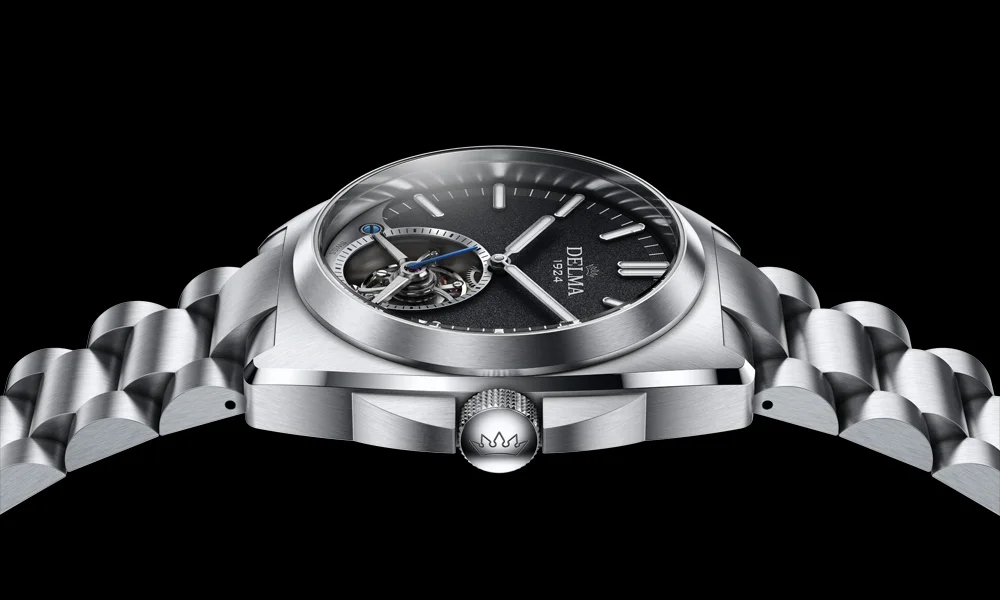
The case of the Delma 1924 Tourbillon is rich in detail, but nothing detracts from the headline act, the tourbillon pirouetting centre stage. Delma has skilfully steered a course between flamboyance and restraint by juxtaposing polished and brushed surfaces.
Short horns draw the bracelet/strap (see later) close to the watch head, mitigating the lug-to-lug distance. This characteristic ensures the timepiece will fit a broad range of different wrist sizes.

The Delma 1924 Tourbillon is supplied with both a steel bracelet and a black hand-crafted, Italian calf leather strap with contrasting white stitching. The watch is presented in a luxurious presentation box, created exclusively for this model. Indeed, the Maison has not skimped on any detail, making sure this limited-edition model serves as a worthy memento of the company’s centenary.

Coming next
The next instalment of this two-part feature will look at the movement at the heart of the Delma 1924 Tourbillon, the Swiss-made Cal DT100.01, produced in collaboration with Olivier Mory of BCP Tourbillons.
Further reading
https://www.delmawatches.com/en-gb/collections/1924-tourbillon