
Ferdinand Berthoud Chronomètre FB 3SPC Watch Review
Unusually, the Ferdinand Berthoud Chronomètre FB 3SPC is equipped with a cylindrical hairspring and yet it is also a COSC certified chronometer, a technical obstacle that would flummox many brands. However, as this model perfectly illustrates, this prestigious Maison does not shy away from challenges when it delivers betterment. Angus Davies appraises Ferdinand Berthoud’s most accessible timepiece.

Who was Ferdinand Berthoud?
The illustrious name, Ferdinand Berthoud, was revived in 2015 by Karl-Friedrich Scheufele, a man with a passion for horology. Ferdinand Berthoud (1727-1807), a son of Val-de-Travers in Switzerland, spent most of his life in France, a nation that repeatedly recognised his immense talents. In 1753, aged just 26 years of age, Ferdinand was awarded the title of Master Watchmaker by King Louis XV’s council. In 1770, he was appointed ‘Horologist Mechanic to the King and Navy’ and later, in 1804, received the Légion d’honneur from Napoleon.
Ferdinand Berthoud began developing marine chronometers around 1760, initially producing two marine clocks in 1765. Thereafter, Ferdinand Berthoud was forever associated with calculating longitude and creating marine chronometers.
Ferdinand Berthoud Chronomètre FB1
In 2015, Ferdinand Berthoud, the newly revived brand, unveiled its inaugural model, the Chronomètre FB1. This highly precise wristwatch, housed in a distinctive octagonal case, was unveiled to the assembled watch press in Paris, a city Monsieur Berthoud knew well. Designed to replicate the appearance of a gimbal-mounted marine chronometer, the watch featured a tourbillon with a direct-drive centre seconds, fusee-and-chain transmission and Geneva stop works. The watch was certified as a chronometer by COSC, a characteristic that is now a pre-requisite for all modern-day Ferdinand Berthoud timepieces.
Grand Prix d’Horlogerie de Genève (GPHG)
In 2016, The greatness of the Chronomètre FB1 was recognised by the GPHG with the award of the coveted ‘Aiguille D’Or’. Thereafter, the Maison released further models, including the Chronomètre FB 1L, the Chronomètre FB 2RE (winner of the GPHG Chronometry Watch Prize in 2020) and the Chronomètre FB 2RSM. While all of these models had their own distinct characteristics they all featured a fusee-and-chain transmission and tourbillon.
Ferdinand Berthoud Chronomètre FB3 collection
With the advent of the Ferdinand Berthoud Chronomètre FB 3SPC in 2022, the Maison reminded horophiles that Ferdinand Berthoud was not the only member of the Berthoud clan with a talent for making clocks and watches. Indeed, Henry Berthoud and Pierre-Louis (Louis) Berthoud followed their uncle into the field of horology. In turn, Charles-Auguste Berthoud, Pierre-Louis’s son, also entered the profession.

It was Louis Berthoud’s decimal watch No. 26, that provided the inspiration for the FB3 collection. Decimal watches first appeared in France, against the backdrop of the French Revolution (1787-1799), however, the decimal system failed to usurp the sexagesimal system that we continue to use today. It was not the decimal system that piqued the interest of the modern-day brand when creating the FB3, but the cylindrical hairspring housed within the historical pocket watch.
Cylindrical hairspring
The cylindrical hairspring (sometimes termed a cylindrical balance spring) was invented by English watchmaker John Arnold in 1776. However, Ferdinand Berthoud was also known to have worked on this type of hairspring as it was frequently employed on marine chronometers in the latter part of the 18th century. One of the benefits of the cylindrical hairspring is that it breathes more concentrically than a flat hairspring, thereby enhancing isochronism. Notoriously difficult to house within a wristwatch, partly due to its size, the modern-day brand rose to the challenge of making a timepiece that’s equipped with a cylindrical hairspring while achieving chronometric certification (COSC).

Two hand-crafted curves
Perhaps what makes the brand’s achievement even more remarkable is that it hasn’t employed a tourbillon to compensate for positional errors. Instead, it endows the hairspring with two hand-crafted curves, one connecting the hairspring to the balance wheel and the other attached to the stud.
Using a blueprint and a profile projector showing an enlarged view of the curve, the watchmaker has to carefully tease the hairspring into the desired shape. The geometry of the curves is critical to chronometric performance.
An entry-level model?
Intended to be Ferdinand Berthoud’s entry-level model, the Chronomètre FB 3SPC lacks the fusee and chain transmission and tourbillon found on its older siblings. However, before you get too carried away, the term ‘entry-level’ is relative, with the Ferdinand Berthoud Chronomètre FB 3SPC priced at circa CHF 140,000 at the time it was launched in October 2022. Nevertheless, as I hope to elucidate, the price actually represents value for money.
The Calibre FB-SPC architecture
Most watch movements comprise a mainplate, positioned beneath the dial, with bridges affixed on top, often visible to the rear. The Calibre FB-SPC, a hand-wound movement, is different. With this movement the mainplate is positioned at the centre of the movement and the bridges are positioned both above and below in a sandwich-type construction. By adopting this approach, Ferdinand Berthoud has endued the Calibre FB-SPC with three-dimensional architecture. While it would have been simpler to have made large bridges or plates, the Swiss Maison has chosen to fit six bridges on the dial side of the movement with a further ten bridges positioned just beneath the exhibition caseback. This approach is clearly time-intensive, however, the high-end firm has never sought to make life easy for itself, preferring to focus solely on excellence.
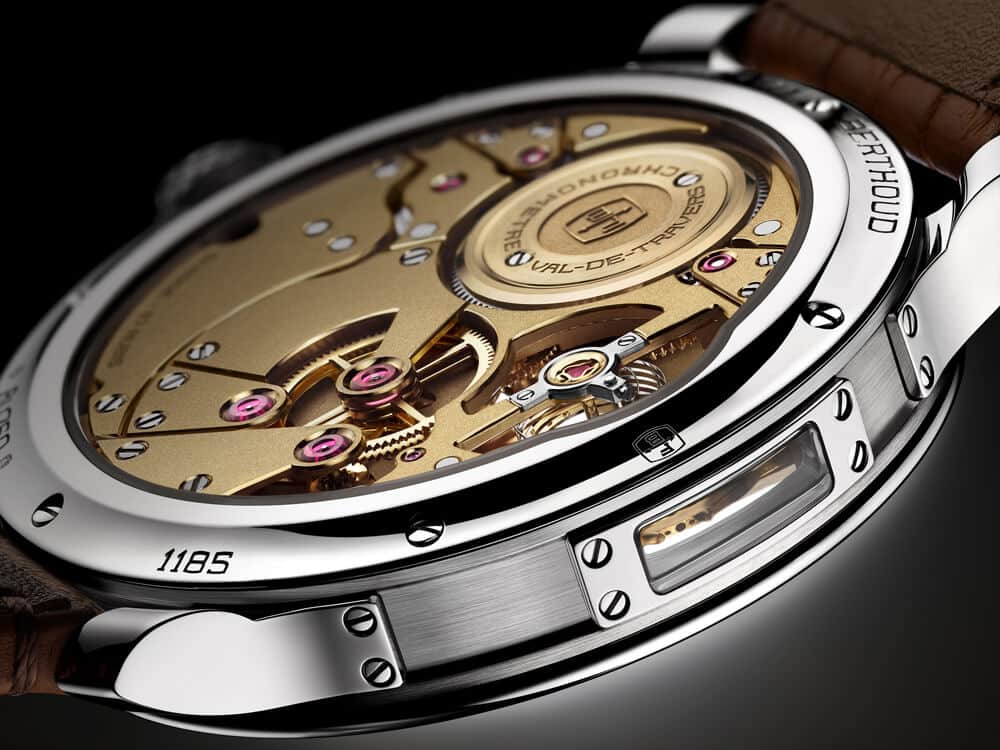
A large opening at 9 o’clock serves to accommodate the cylindrical hairspring, proffering views through the case, from front to back, which affords sight of the hairspring pulsing with life. The finger-like balance bridge (or cock) is stepped, grained and features gleaming bevels. Beneath the balance bridge, sit a pallet lever bridge and a bridge for the escape wheel. This arrangement wonderfully showcases the Swiss lever escapement performing its metronomic dance.
In the upper reaches of the dial, an arcing bridge holds a lone barrel in place. Termed a slip-spring barrel, it features automatic uncoupling when the maximum power is reached, serving to protect the watch. The power-reserve is stated as three days.
The Ferdinand Berthoud Chronomètre FB 3SPC – functions
The hour and minute hands are partly openworked and were inspired by the hands found on a historic Ferdinand Berthoud marine chronometer. They are made of 18-carat gold and are suffused with blue CVD.
A discrete seconds track is positioned at 6 o’clock, seemingly floating above the bridges. Meaning is expressed with a blue-toned hand featuring a counterweight. A power-reserve sits adjacent to 6 o’ clock, imparting information with a lone hand.

The Maison has equipped the FB3 with a stop seconds function. While this is not an uncommon feature, it would have presented a challenge on this occasion due to the presence of a cylindrical hairspring. By having a stop seconds function the wearer is able to synchronise the watch with a reference clock.
The Ferdinand Chronomètre FB 3SPC – case
When contrasted with the FB1 and FB2, the FB 3SPC appears modestly sized, measuring 42.3 mm in diameter with a height of 9.43 mm. Whilst the model could not be described as ‘ultra-thin’, it is surprisingly slender for a watch housing such complexity.
The Ferdinand Berthoud Chronomètre FB 3SPC is offered in a choice of 18-carat rose gold or 18-carat white gold. Personally, I prefer the latter option as it is paired with a 2N pale yellow gold calibre that resembles an 18th century pocket watch movement. The 18-carat rose gold case is presented with a black-rhodium treated movement, appearing slightly more contemporary (with the emphasis being on the word ‘slightly’).

The sapphire crystal located front of house is bombé-shaped (domed), a tasteful nod to the pocket watches of the late 18th century and early 19th century. However, Ferdinand Berthoud has not created a facsimile of a watch from yesteryear. For example, the FB 3SPC includes a distinctive, slightly modern bezel, that sits below the sapphire crystal and is mounted on the movement. While the bezel is very functional, allowing the wearer to easily read-off the prevailing minutes, it serves to enrich the appearance of the watch.
Throughout the composition of this timepiece, Ferdinand Berthoud has enriched this model with exquisite soupçons of delight. For instance, each lug is affixed to the caseband with screws. Consistent with the FB1 and FB2, this reference features a porthole on its left flank, granting sight of the cylindrical balance spring at work. Even the crown with its hatched knurling feels wonderful between forefinger and thumb.
Closing remarks
To fully appreciate the greatness of this watch, one has to consider the amount of time it must have taken to conceive the model. The numerous hours of research and development along with experimentation with materials and finishes will have undoubtedly been colossal.
Likewise, it takes six days to regulate the movement before it is submitted to COSC for evaluation. That’s after the protracted creation of the hairspring, the 90 hours spent hand-finishing the movement parts and the many hours uniting the 230 components to form a complete Calibre FB-SPC. Thereafter, the watch has to be assembled, once again, another protracted task.
It’s fair to say, therefore, that when viewed in its entirety, this sublime example of Haute Horlogerie, with its peerless finishing, seems incredible value for money when contrasted with some of its mainstream, industrially produced rivals. Alas, I write for a living, hence such value remains firmly beyond my grasp, but a man can still dream….
Further reading
https://www.ferdinandberthoud.ch/
Technical specifications
- Model: Ferdinand Berthoud Chronomètre FB 3SPC
- Case: 18-carat white gold or 18-carat rose gold (two variants), fitted with a transparent sapphire porthole at 9 o’clock, diameter 42.3 mm height 9.43 mm; water resistance 3 ATM (30 m); sapphire crystal to the front and exhibition case back.
- Functions: hours, minutes, small seconds, power reserve
- Movement: Calibre FB-SPC, hand-wound movement, frequency 21,600 vph (3Hz), 47 jewels, power reserve 72 hours, 230 components
- Strap: alligator leather (125 x 70 mm) paired with a matching gold pin buckle
- Price: on application