
Ferdinand Berthoud FB 1.6-3 pièce unique Watch Review
The Ferdinand Berthoud FB 1.6-3 pièce unique encompasses many of the groundbreaking details found on the inaugural FB1 of 2015. However, this latest version looks radically different, courtesy of the sporty colourway and ingenious use of sapphire crystal. This one-of-a-kind creation is available exclusively at the prestigious ART IN TIME boutique, Monaco.

John Harrison and the longitude problem
During the early part of the 18th century, navigating the seven seas was fraught with risk. Beyond the inherent dangers of negotiating treacherous waters, there was the ever-present risk of striking obstacles such as rocks.
At the time, the fundamental problem facing mariners was knowing their relative position at sea. Latitude could easily be determined by studying the relative position of the sun or the North Star. However, determining longitude proved far more difficult. Various clockmakers and scientists sought a precise means of solving the ‘longitude problem’, incentivised by the significant financial rewards on offer. The English clockmaker, John Harrison (1693-1776) invented the marine chronometer in 1735. Thereafter, he spent the remainder of his life, continuously refining his concept, eager to deliver superior chronometry.
Ferdinand Berthoud (1727-1807)
Meanwhile, on the other side of the English Channel, Ferdinand Berthoud (1727-1807), a master watchmaker based in Paris, was actively developing his own marine chronometer, again incentivised by the financial rewards on offer. Berthoud’s first marine chronometer, ‘Marine Clock no.1’ was completed in 1761.
When making marine chronometers, accuracy, or chronometry, was of fundamental importance. Precision of 0.1 second per day would allow a naval officer to locate his position within 1-2 miles after a one-month voyage.
The rebirth of Chronométre Ferdinand Berthoud (2015)
In 2015, the name Chronométre Ferdinand Berthoud returned to the horological landscape after Karl-Friedrich Scheufele revived the prestigious name. The inaugural model, the FB1 (now termed the FB1.1), resembled an 18th-century marine chronometer with its distinctive octagonal-shaped case. However, this watch was not a pastiche of 18th century design, but a highly original, modern take on high-end watchmaking.
The FB1 is festooned with details designed to augment chronometry, including a fusée and chain, a stopworks and a tourbillon. Moreover, the watch brims with ingenuity. Indeed, at the time of launch, several patents were pending. The power-reserve features a clever feeler and spindle system and the central seconds hand (positioned above the seconds wheel and pinion) is in mesh with the driving wheel of the tourbillon cage. The movement features a pillar-type construction, doffing its hat to the past.
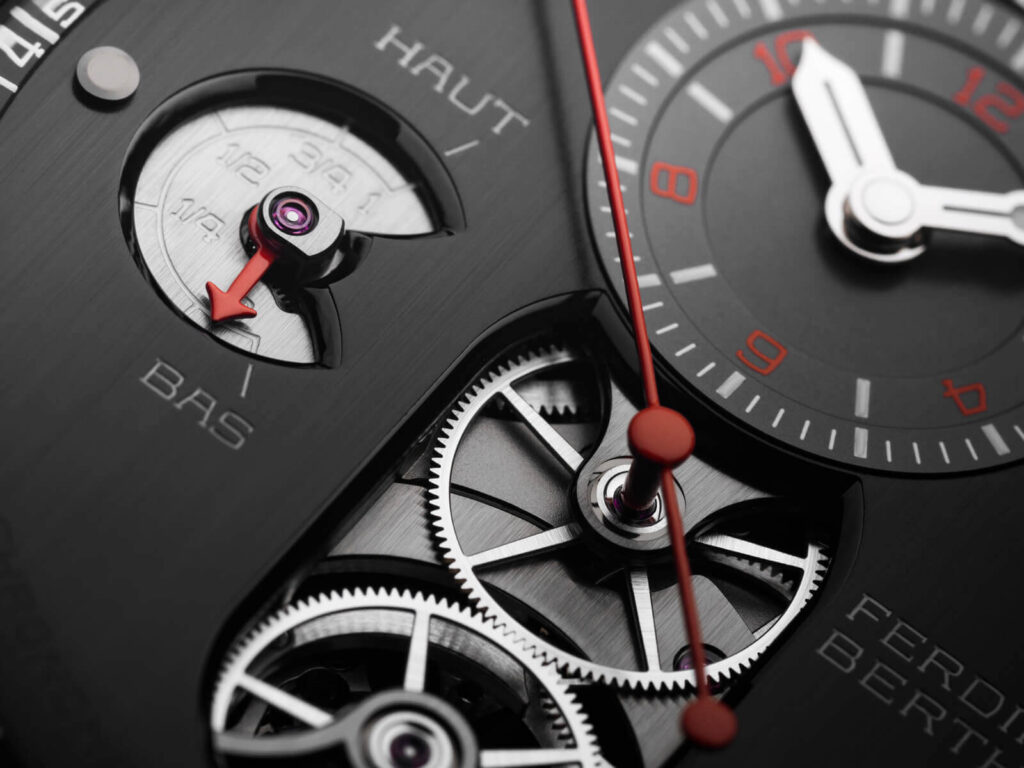
Ferdinand Berthoud FB 1.6-3 pièce unique – dedicated to chronometry
Since the FB1 was released, the Maison has enjoyed much success, spurring it on to release further models. While each of these watches is very different, they all share the same overriding fixation with chronometry. Furthermore, Chronométre Ferdinand Berthoud has gained a reputation for a high quotient of hand-craftsmanship and peerless finishing.
Ferdinand Berthoud FB 1.6-3 pièce unique
Recently, the venerable watch marque unveiled a further edition of the FB1, the Ferdinand Berthoud FB 1.6-3, a pièce unique sharing much in common with the inaugural model of 2015. However, this creation looks very different from its forebears. The stainless steel case is dressed in a natty coat of black DLC. This brooding hue extends to the stainless steel crown and the screw-in caseback.
The dial of the Ferdinand Berthoud FB 1.6-3 is presented in a satin-brush finish and encompasses semi-matte black galvanised treatment. Various bevels are delivered in black and the hands are presented in a sporty shade of red. The Swiss firm has not been afraid to embrace a new palette and, in so doing, heighten the overall sense of modernity. This trait is reinforced with the installation of three angled transparent sapphire bridges, each bestowing enhanced views of components below.

Ferdinand Berthoud FB 1.6-3 pièce unique – available exclusively at ART IN TIME
Since 2015, Chronométre Ferdinand Berthoud has repeatedly shown it respects the patrimony of the 18th century master watchmaker while at the same time conceiving new ways to engage with today’s horophiles. With the advent of this unique creation, the Ferdinand Berthoud FB 1.6-3, the venerable company has infused the FB1 with a sizeable dose of sportiness and, in my opinion, it looks fabulous.
This timepiece is available exclusively at ART IN TIME, a specialist boutique located in Monaco, dedicated to the sale of unique pieces. Part of the sale proceeds will be passed to the Prince Albert II of Monaco Foundation.
The brand’s press release
With its black DLC-treated steel case, rubber strap, and vertical satin-finish black dial, the Chronomètre FB 1.6-3 exudes a sports feel at first sight. Its movement boasts angled sapphire half bridges, echoing the modernity of its housing.
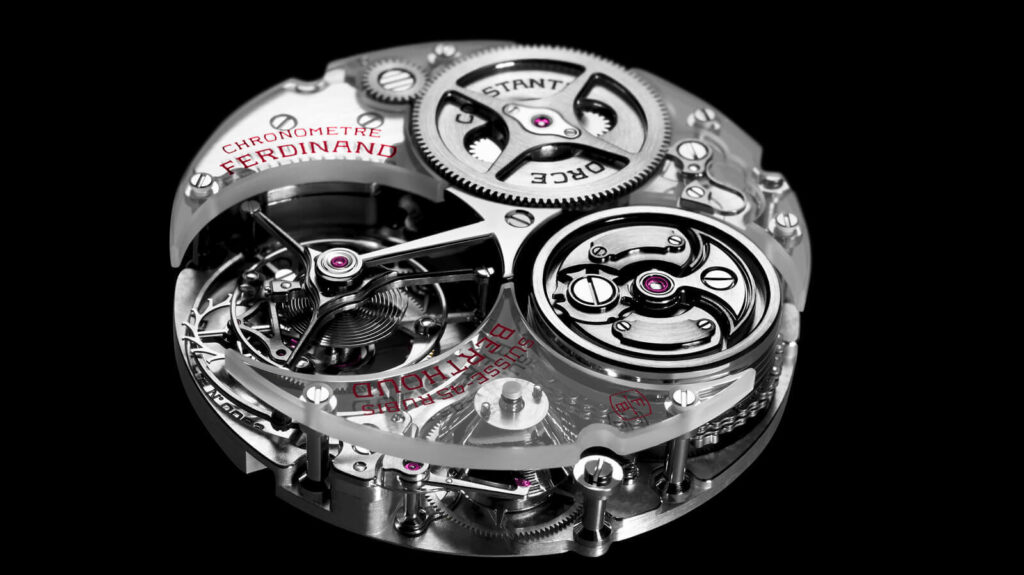
Image – Ferdinand Berthoud FB 1.6-3 pièce unique
Among the output of Fine Watchmaking manufactures, creations in steel are often the most sought-after, being much rarer than their gold and platinum counterparts. The new Chronomètre FB 1.6-3 is all the more remarkable in that it is the first all-black creation by Chronométrie Ferdinand Berthoud. The unique piece has been exclusively designed for the ART IN TIME watch gallery in Monaco, with part of the proceeds from its sale passed on to charity.
Unique and historic
The singular nature of this timepiece is clear at first glance. For the first time, Chronométrie Ferdinand Berthoud has decked out one of its models in black DLC. This bold move is nevertheless consistent with developments to date: right from its inception, in addition to technical performance inspired by the values of Fine Watchmaking, the manufacture has sought to endow its timepieces with an unashamedly contemporary look.
The FB 1.6-3 explores this modern ethos – and pushes back its boundaries. It’s both sporty and daring, with the case, bezel, flange, dial, crown, and strap clad entirely in black. It’s also the first ever steel case in the FB 1 collection, making this model very much one of a kind.
The Monaco connection
In a first for the manufacture, Chronométrie Ferdinand Berthoud has applied an all-black DLC treatment to the fine sand-blasted steel. The crown is fitted with a ceramic insert; the screws fastening the case are in titanium.
The vertical satin-finish dial benefits from a semi-matte black galvanised treatment. The even-numbered hours, seconds hand, and power reserve are coloured red, standing out eloquently. The combination of dark black and bright red contributes to the sports feel of the piece, as well as making its indications effortless to read.
To complete the nod to ART IN TIME’s Monaco identity, the Chronomètre FB 1.6-3 features a white seconds scale and minute circle, thus echoing the House of Grimaldi’s two heraldic colours, red and white. In line with ART IN TIME’s tradition of unique pieces, part of the proceeds from the sale of the watch will be passed on to the Prince Albert II of Monaco Foundation, dedicated to building a sustainable future.
Full transparency
Front and back, the timepiece exemplifies the manufacture’s demanding standards in finishing. The hour and minute counter is finely sand-blasted and treated with matte BlackOr; hour markers have been coated with Super-LumiNova. The hours and minutes hands and power reserve indicator are in gold, while the seconds hand is made of polished bronze.
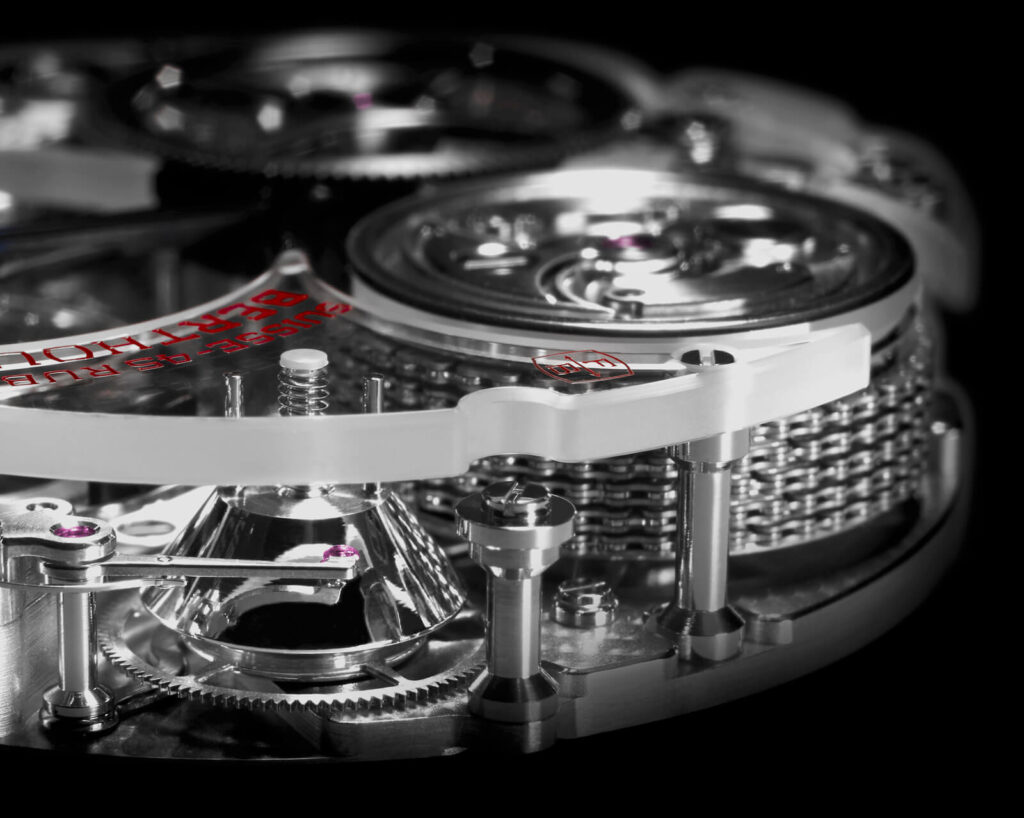
Image – Ferdinand Berthoud FB 1.6-3 pièce unique
All that aside, the main feature is not immediately apparent: sapphire. With the FB 1.6-3, it takes pride of place, both on the dial, for the flange, and also on the back, for the half bridges. The latter are finely angled, engraved, and coloured red, enclosing the tourbillon carriage and its central seconds hand. Equipped with a fusee-and-chain transmission – the oldest and most complex solution for providing an escapement with constant force – the FB 1.6-3 guarantees Chronometer certified accuracy.
A tried and tested movement
The manufacture movement can be admired through one of the side portholes in the octagonal case that has now become the style signature of this Ferdinand Berthoud collection. The case houses the FB-T.FC-2 calibre, the construction of which is unique in contemporary watchmaking. With 15 bridges and 3 half bridges connected by vertical pillars, Chronométrie Ferdinand Berthoud has designed a movement that brings to mind eighteenth-century marine chronometers, with barrel and fusee suspended, as is the cone – on which a feeler rises and falls, indicating the power reserve.
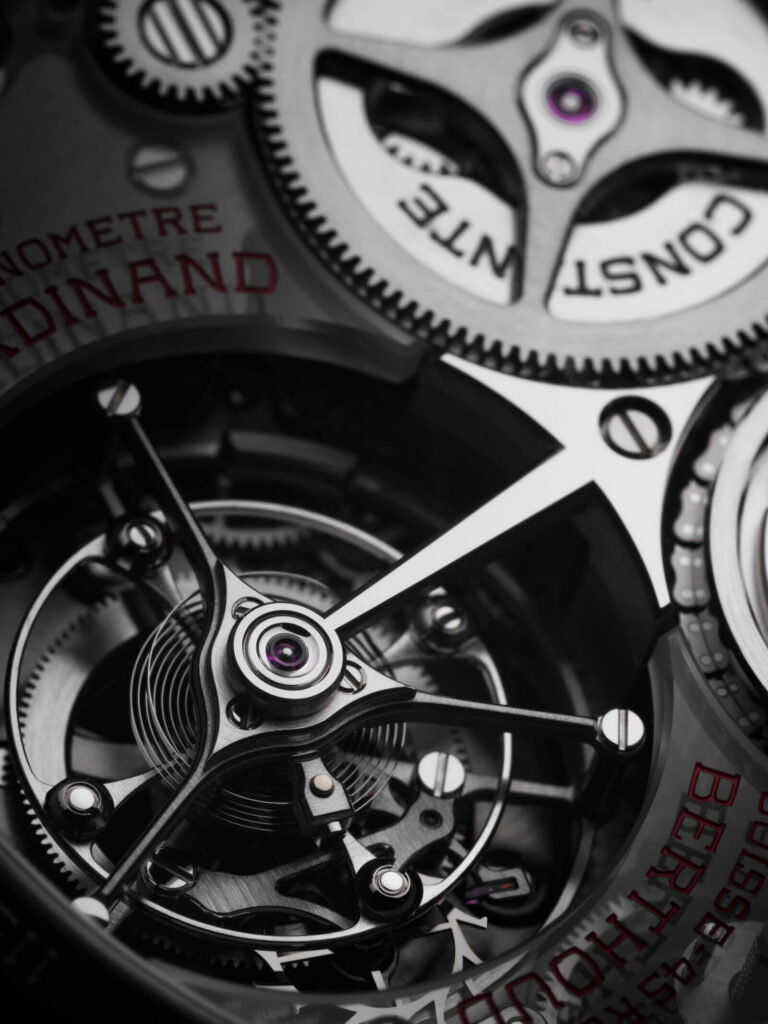
Image – Ferdinand Berthoud FB 1.6-3 pièce unique
“Each of our creations has its own identity. This one is no exception, communicating a decidedly sporty feel,” concludes Karl-Friedrich Scheufele, President of Chronométrie Ferdinand Berthoud. “Over the past few years, the FB 1 collection has demonstrated its capacity to embody a range of different styles. There can be no doubt that this unique watch marks a major milestone in our history – and a significant step towards the ultimate customisation possibilities opened up by the collection.”
About the Prince Albert II of Monaco Foundation
For the best part of 15 years now, through his Foundation, HSH Prince Albert ll of Monaco has been actively involved in protecting the environment and promoting sustainable development to counter threats to the planet. Committed to research, technological innovation, and tackling major social challenges, the Foundation funds projects in the Mediterranean basin, the polar regions, and the world’s least socially and economically developed countries. Its goals are to mitigate the effects of climate change, promote renewable energy, preserve biodiversity, manage water resources, and fight against desertification.