
Girard-Perregaux 1966 Tourbillon with Gold Bridge
Angus Davies reviews the Girard-Perregaux 1966 Tourbillon with Gold Bridge, a quiet beauty, featuring classical aesthetics.
This detailed review of the Girard-Perregaux 1966 Tourbillon with Gold Bridge includes live images and specification details.

When Simon & Garfunkel sang, “Bridge Over Troubled Water”, it drew on the notion of providing a safe passage. A bridge often grants a safe means for pedestrians to traverse hazards.
By way of contrast, I look at the single gold bridge that spans the tourbillon carriage on the Girard-Perregaux 1966 Tourbillon with Gold Bridge and see only beauty below. The spherical shaped chasm provides a sanctuary for exceptional watchmaking craft, encouraging the eyes to view the visible elements of the tourbillon within.
Despite the word tourbillon meaning “whirlwind”, there is much serenity and calm with this timepiece, as the tourbillon makes one revolution per minute with a small seconds hand attached to its form. The filigreed profile of the tourbillon cage is elegant and advances with graceful progress.

The balance wheel, features gold screws, enhancing ease of poising. The Philips terminal curve is visible on the balance spring and circular graining is evident on the mainplate below.
The hand craftsmanship, with chamfered and polished surfaces, the product of patient endeavour is clearly evident as admiring the carriage. Indeed, the rationale for purchasing such as timepiece is the elevated skill necessary to bring it to fruition rather than any enhanced rate keeping.
A quiet beauty
All eyes of the watchmaking world have recently focussed upon the Girard-Perregaux Constant Escapement L.M., as it recently won the highly prestigious GPHG “Aiguille d”Or” prize. The uniformity of the amplitude, arguably confers greater relevance to rate keeping than a tourbillon. It is an exceptional timepiece and, like many, I am in awe of its breathtaking ingenuity.


Girard-Perregaux Constant Escapement L.M.
However, the Girard-Perregaux 1966 Tourbillon with Gold Bridgeshould not be overlooked. This watch is a quiet beauty and has many charming qualities.
A classical aesthetic
“Beauty” is a word I find myself wanting to repeatedly apply to this watch. The restraint of its style is a notable virtue. The case diameter of 40mm is tasteful and discreet. There is a classical aesthetic to this watch.
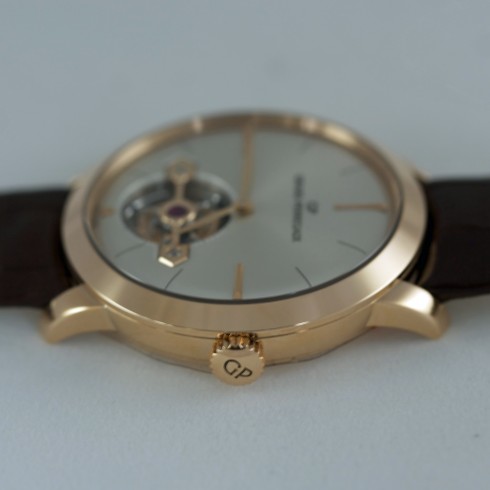

The silvered dial features a sunburst-motif that pleasingly interfaces with available light.
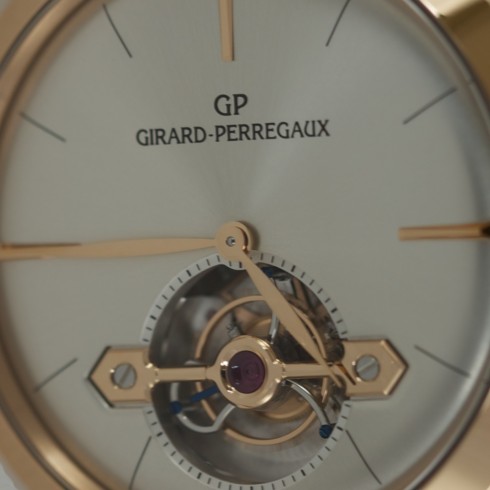
The absence of the Arabic or Roman numerals is perfectly attuned to the persona of the timepiece, with its simple gold applied hour markers at 3 o’clock, 6 o’clock, 9 o’clock and noon. The intervening hours are marked with fine, grey coloured strokes.
Swallow shaped hour and minute hands communicate time with seemly breeding. There is nothing excessive or vulgar about this timepiece.
The focal point of the 1966 Tourbillon with Gold Bridge, as the name implies, has to be the solitary gold bridge spanning the lower portion of the dial. It is presented in a shape the brand describes as “bassiné”.
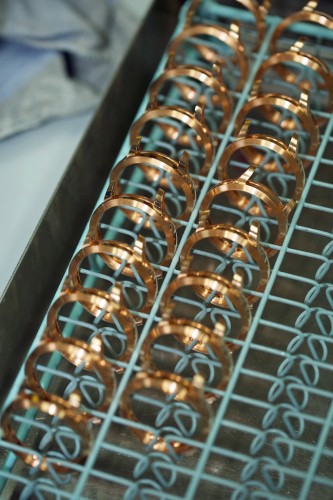
The term was unfamiliar to me beforehand and refers to the rounded off edges of the two arms of the bridge. However, I readily became aware of the immense time necessary to execute the bridge whilst visiting the Manufacture in La Chaux-de-Fonds. A dedicated team within the Haute Horlogerie Department expend much effort finely finishing components with deft use of skilful hands.

Admiring the bridge, you note the uniform rounded profile to its arms. I recall seeing an artisan diligently apply a boxwood stick to the surface of a bridge, polishing it to a blemish free result.
Beauty within
The caseback of this watch is engraved with the name of the model in French, the nomen of the Manufacture, place of origin and individual case number. Whilst this is charmingly executed, it is the only area of the watch I would wish to change.

I have witnessed the prowess of the watchmakers at the atelier, first hand. I have seen beautiful movements refined to a matchless standard. I have been amazed at the inordinate amounts of effort devoted to seemingly minuscule details. Sadly though, in this instance, the wearer is denied a view of the inner beauty within. This is a shame as the self winding movement, GP09600-014, incorporates much merit with all the fastidious details that any discerning purchaser could crave.
Conclusion
When I placed the Girard-Perregaux 1966 Tourbillon with Gold Bridge on my wrist, I smiled as I admired its handsome form. It would be a philistine who did not succumb to its alluring charms.
Girard-Perregaux is known for its iconic Three Bridges and, more recently, its magnificently ingenious Constant Escapement L.M. However, to focus merely on these two watches may cause some to miss this quietly spoken horological gem.
The absence of an exhibition caseback is insufficient reason to avoid the charms of this timepiece. Its clean appearance and classic lines are delightful. Most of all, there is enchantment to be found under the bridge.
Technical Specification
- Model: Girard-Perregaux 1966 Tourbillon with Gold Bridge
- Ref: 99535-52-131-BKBA
- Case: 18-carat pink gold; diameter 40mm; height 10.90mm; water resistant to 3 bar (30 metres); sapphire crystal to front and solid caseback.
- Functions: Hours; minutes; small seconds on the tourbillon
- Movement: GP09600-014, Self-winding movement; frequency 21,600 vph (3Hz), 31 jewels; power reserve 48 hours
- Strap: Brown alligator leather strap presented on a 18-carat pink gold pin buckle
- Limited Edition: 25 pieces
Related Links