
Girard-Perregaux Minute Repeater Flying Bridges Watch Review
The contemporary Girard-Perregaux Minute Repeater Flying Bridges features two high complications – a minute repeater and a tourbillon. Endued with sinuous gold bridges, inspired by the brand’s rich history, this timepiece draws on the extraordinary talents of the artisans and watchmakers based at the Swiss Manufacture. Angus Davies takes a close look at this new model, providing an insight into the rarefied world of Haute Horlogerie where only a few companies are able to flourish.
Watch complications
There are several factors that determine the price of a new mechanical watch. These include the case material, the presence of precious stones, whether the watch has been enriched with artisanal crafts and, to some extent, the cachet of the brand. However, there is also another important factor that has the capacity to influence price, namely ‘complications’.
According to the Fondation de la Haute Horlogerie (FHH), ‘a complication is any feature other than the display of hours, minutes and seconds’. Complications take several forms, from the comparatively simple to the mind-bogglingly complex.
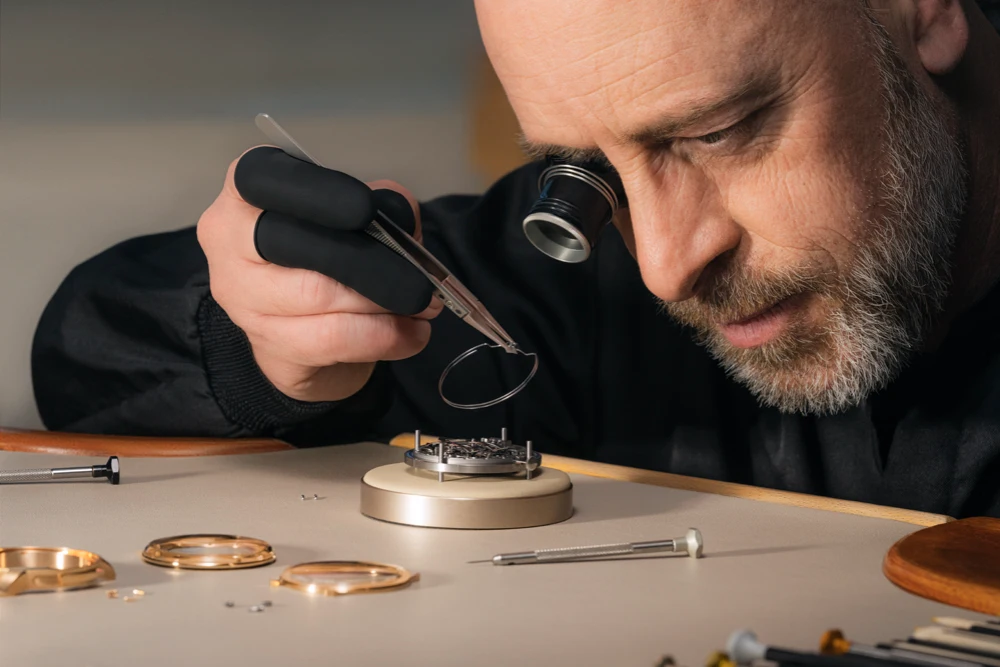
Image – watchmaker fitting gongs
In the lowlands, complications may include a GMT function or a power-reserve indicator. Ascend to base camp and you may encounter flyback chronographs and complete calendar watches. At this altitude, the air is a bit thinner and fewer brands are able to operate.
Ascend higher, nearing the summit of the mountain and you will discover ‘high complications’, including the perpetual calendar, split-second chronograph, tourbillon and minute repeater. Hardly any watch brands are able to function at this altitude, especially without supplementary oxygen.
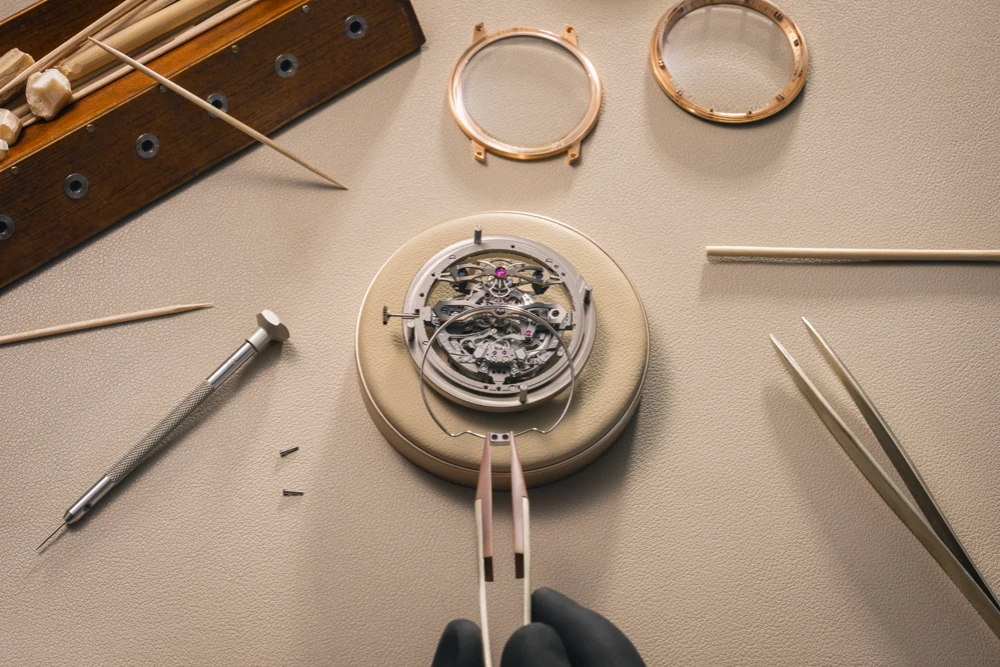
Image – watchmaker fitting gongs
Lastly, there are only a handful of companies with the necessary technical ability to combine two or more high complications. These timepieces feature intricate movements comprising hundreds of components. Such sophisticated mechanisms require extraordinary expertise to conceptualise and an inordinate amount of skill to assemble, fine-tune and regulate. Girard-Perregaux, a company with a history dating back to 1791, is one of the few brands capable of operating in this rarefied atmosphere, a Manufacture par excellence.
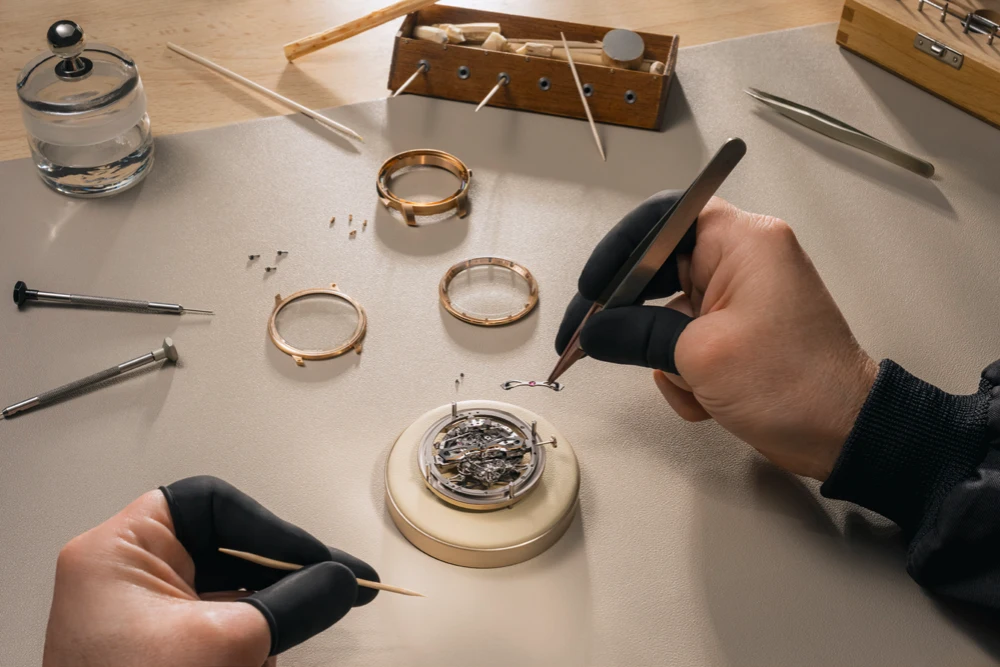
Image – watchmaker fitting a bridge
A Manufacture par excellence
Peruse the glossy pages of a watch magazine and you could be forgiven for thinking that all timepieces feature a ‘Manufacture’ movement. However, not everything is quite what it seems.
For many years, most watch companies were ‘établisseurs’, purchasing ébauches (a movement blank) from a Manufacture. The movement blanks would usually comprise of the mainplate, bridges and wheels. Normally, the établisseurs would be responsible for adding the regulating organ, mainspring, dial and hands.
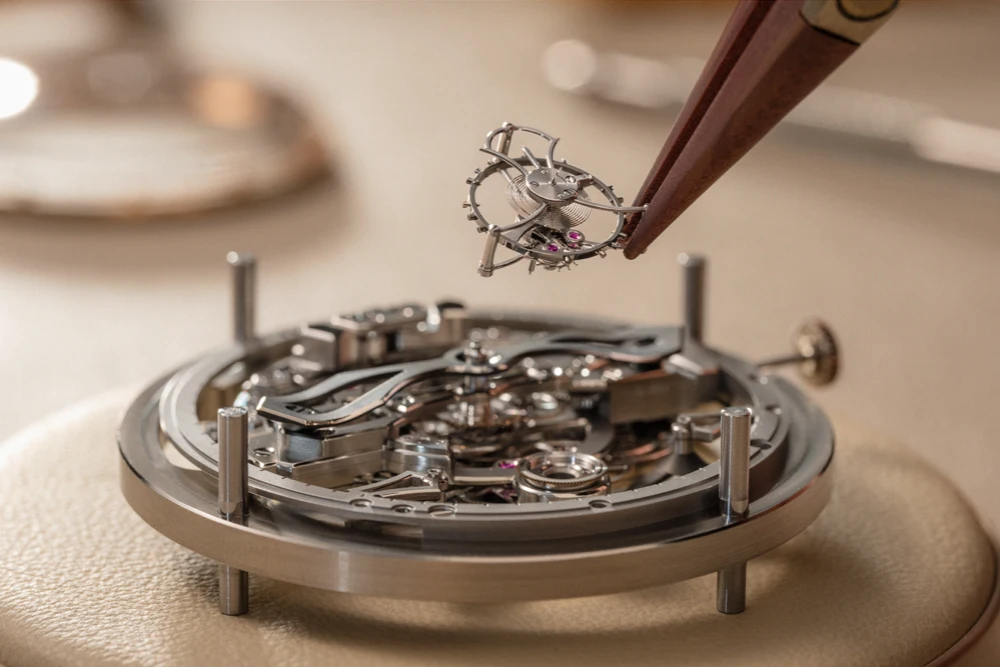
Image – lyre-shaped cage
When explaining the meaning of the term ‘Manufacture’, the FHH states, ‘The Swiss watch industry uses this term to differentiate between a company that manufactures a watch almost in its entirety as opposed to finishing shops which only assemble and time the watch’.
As recently as 20 years ago, a significant number of brands within the watch industry were purchasing off-the-peg movements from ETA, a subsidiary of the Swatch Group. However, the Swiss conglomerate began to reduce the number of movements it supplied to third parties, eventually stopping in 2019. As a result, some watch brands turned to alternative movement suppliers, while other companies began making their own Manufacture movements with varying degrees of success.
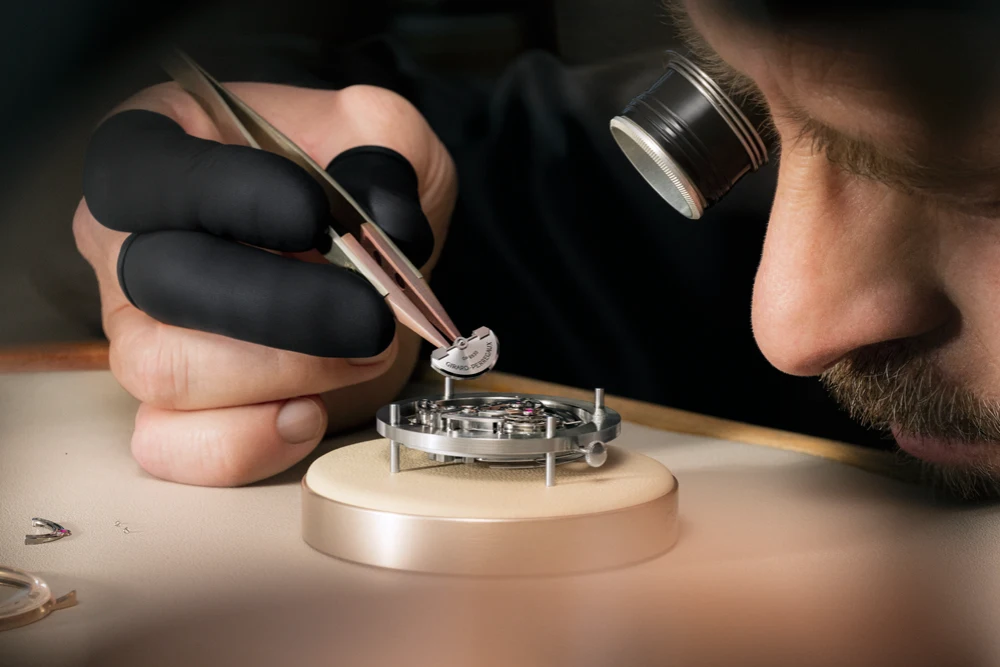
Image – watchmaker fitting white gold micro-rotor
Girard-Perregaux is a Manufacture in the truest sense and has been for more than 230 years. Not only does it make watches bearing its own name, it also crafts in-house movements for several établisseurs, including some of the most prestigious marques in existence. Over the years, Girard-Perregaux has constantly been at the vanguard of innovation, creating groundbreaking movements, including the first-ever high-frequency movement with a cadence of 5 Hz back in 1966 and the groundbreaking ‘Constant Escapement L.M.’, winner of the GPHG Aiguille d’Or in 2013. Indeed, throughout its history, this Manufacture has consistently produced highly precise watches, termed ‘chronometers’.
Girard-Perregaux Minute Repeater Flying Bridges – introduction
Recently, Girard-Perregaux has been on a roll. In less than six months, the company has been nothing short of prolific, releasing the Laureato FIFTY, the Laureato Three Gold Bridges and now, the Minute Repeater Flying Bridges.
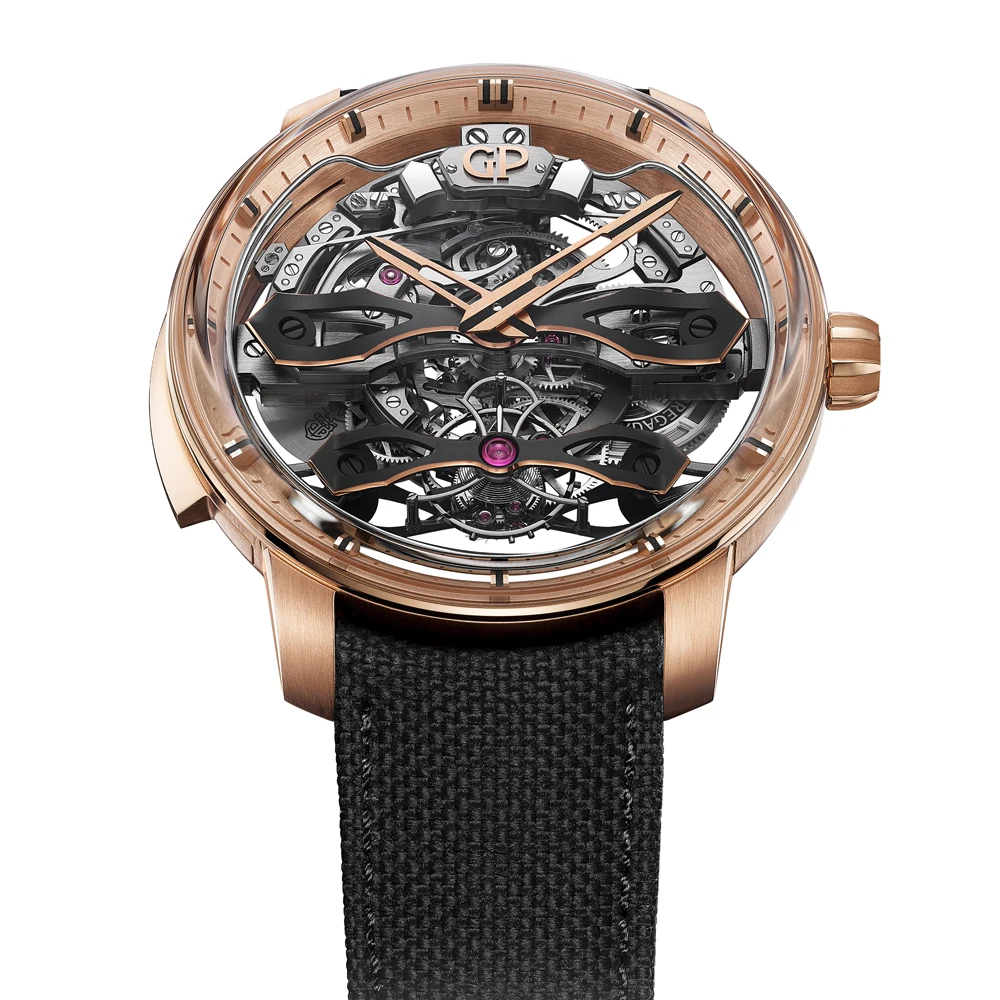
Although unquestionably modern, the new Minute Repeater Flying Bridges incorporates some traditional elements, inspired by the Maison’s rich heritage, immediately identifying the model as a Girard-Perregaux timepiece. For instance, this new reference features ‘three stylised Flying Bridges (the third is at the rear of the movement)’, a feature inspired by Constant Girard’s iconic bridges first introduced in 1867 (see later). Likewise, the new watch is endowed with a lyre-shaped tourbillon cage, again a brand signature dating back to the 19th century. At this juncture, it is worth looking back at the brand’s history and how it has shaped its timepieces over the years.
Girard-Perregaux DNA – bridges
In 1884, having refined the design of his three bridges, Constant Girard (1825-1903) sought to protect his intellectual property. However, with no patent office in Switzerland at the time, he turned to the US Patent Office and registered his design for a movement with three arrow-shaped bridges. Five years later, in 1889, the Tourbillon with Three Gold Bridges (aka ‘La Esmeralda’) won a gold medal at the Paris Universal Exhibition. These three prominent bridges, which are both functional and aesthetically beautiful, have become an integral part of the brand’s DNA and have even influenced the design of the company’s arrow-shaped logo.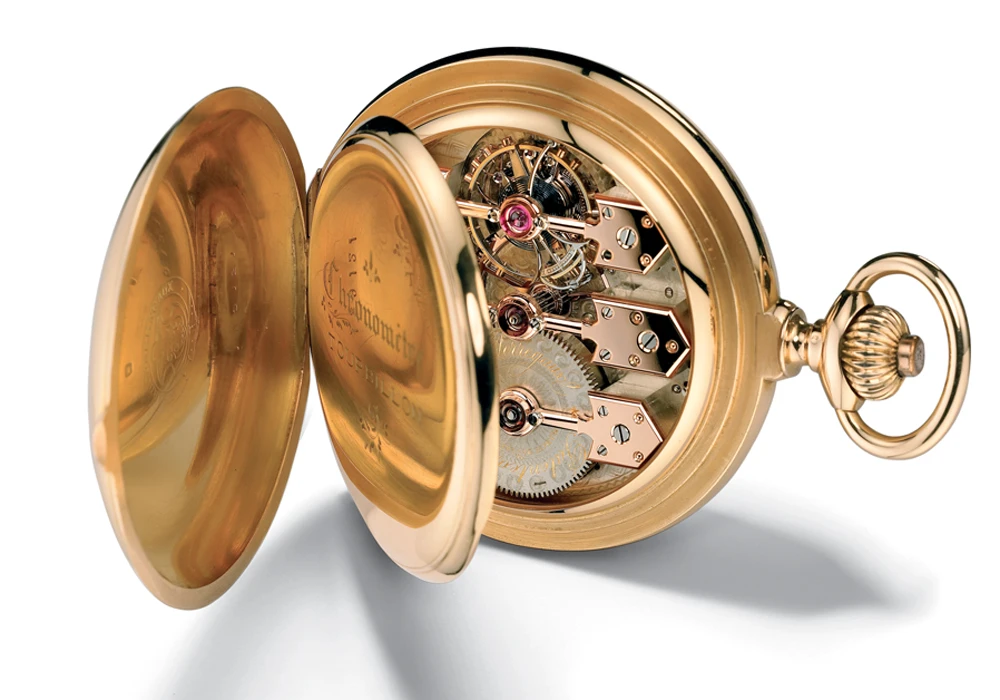
Image – Tourbillon pocket watch with three gold bridges
Girard-Perregaux tourbillons
The history of Girard-Perregaux has been closely linked with the tourbillon since the 1800s. Patented by Abraham-Louis Breguet in 1801, the mechanism ameliorates the adverse effect of gravity on the rate of the movement. By placing the escapement and regulating organ in a rotating cage, revolving 360° every 60 seconds, positional errors are mitigated, thereby improving chronometric performance. Constant Girard was fascinated by escapements, especially the tourbillon. Moreover, throughout his career, he was driven to create ever more precise pocket watches and entered several competitions, including Universal Expositions. In 1867, Constant presented a pocket watch endowed with three parallel nickel silver bridges and a tourbillon at the Paris Universal Exhibition. The brilliance of the watch was recognised with the award of a prize.
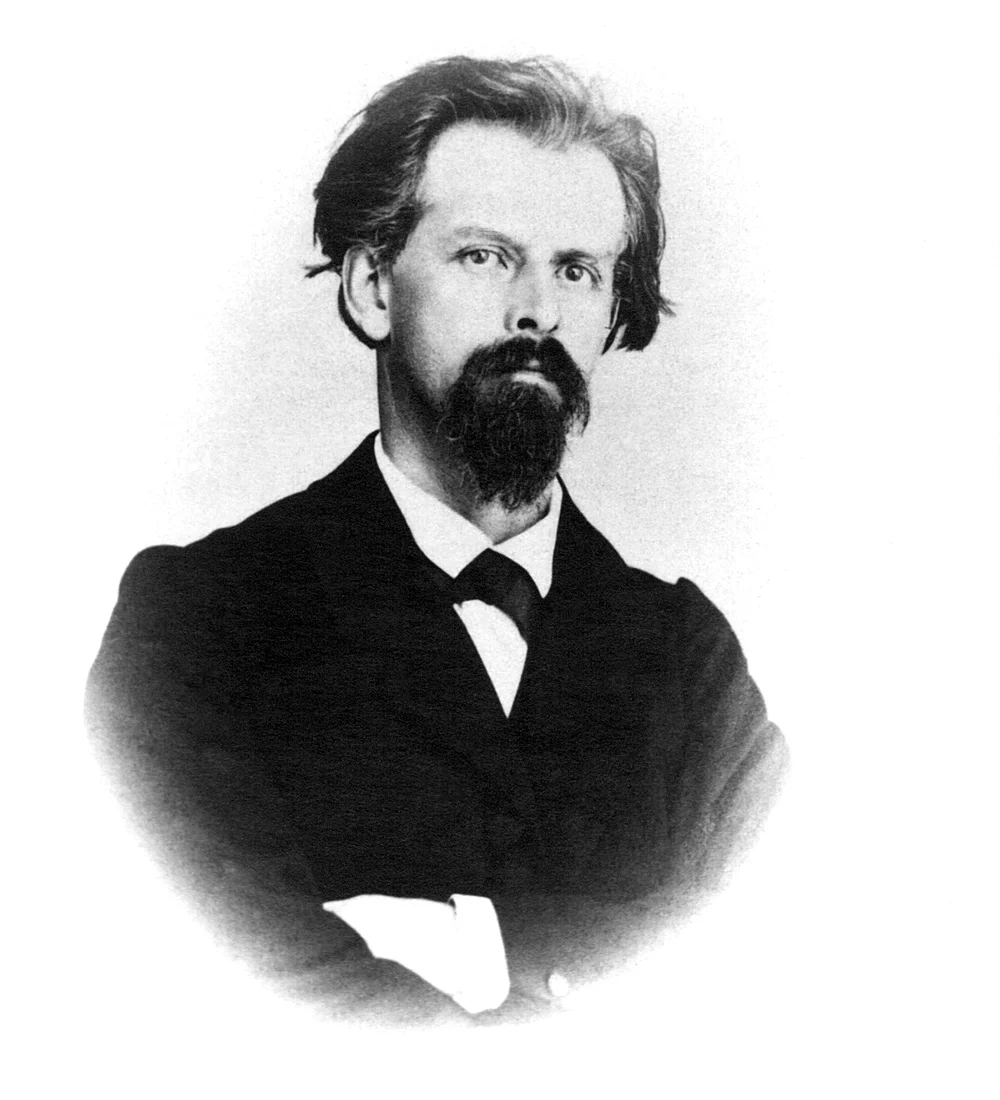
Image – Constant Girard (1825-1903)
Girard-Perregaux minute repeaters
While chiming watches already existed in the 17th century, most historians believe that the first minute repeaters originated in Germany at some point during the first half of the 18th century. During this period, street lighting was virtually non-existent, hence reading the time was nigh on impossible. However, with the advent of the minute repeater, the wearer could actuate the chiming sequence, usually by sliding a lever on the side of the case, and their watch would chime the hours, quarters and minutes. Over the years, Girard-Perregaux has crafted minute repeaters both in pocket watch and wristwatch formats and has even produced ultra-complex carillon minute repeaters.
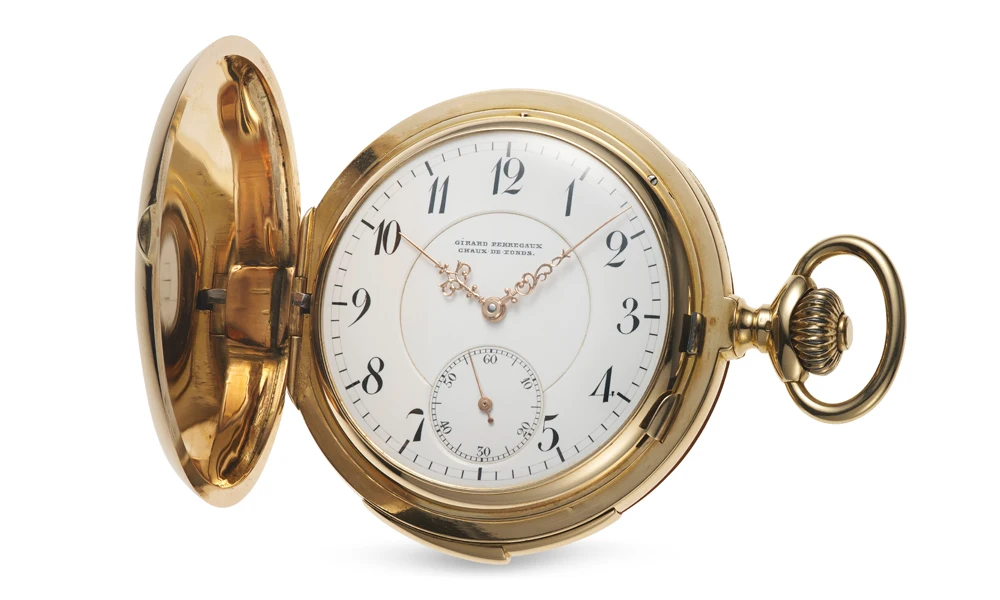
Image – historic pocket watch – ‘Répétition Minute Carillon’
Minute repeaters are usually equipped with two gongs formed of steel. These gongs begin life as high-quality steel wire, which is shaped by expert hands, coiled to hug the interior of the case, but without touching it. This wire is repeatedly heated and quenched, thereby hardening the material. The precise details of gong making is often shrouded in secrecy, a rare expertise known to only a few.
Once formed, the sound of each gong is finely tuned by ear with the skilful use of a file, removing minuscule amounts of steel to achieve the desired note. The two gongs are then arranged such that one sits above the other, ensuring they don’t touch one another, and secured to the mainplate with a ‘heel’.
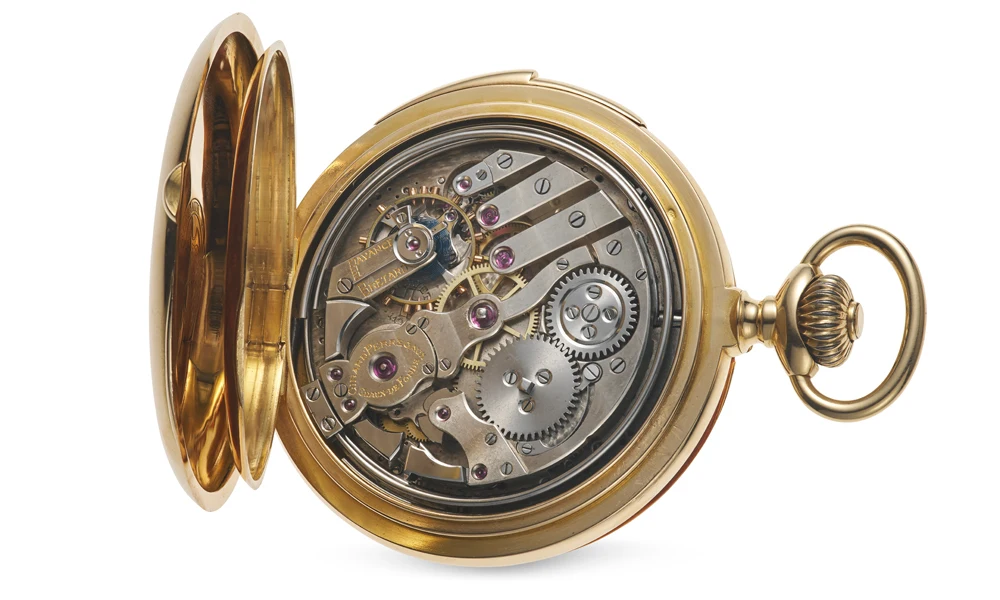
Image – historic pocket watch – ‘Répétition Minute Carillon’
Three ‘snails’, one for hours, a second for quarters and a third for minutes connect to the motion works. As the hour and minute hands advance, the snails continuously read the time. When the minute repeater is actuated, often using a ‘slide’ on the side of the case, a second mainspring is tensioned, powering the chiming sequence. This comprises low notes (hours), low-high notes (quarters) and high notes (minutes).
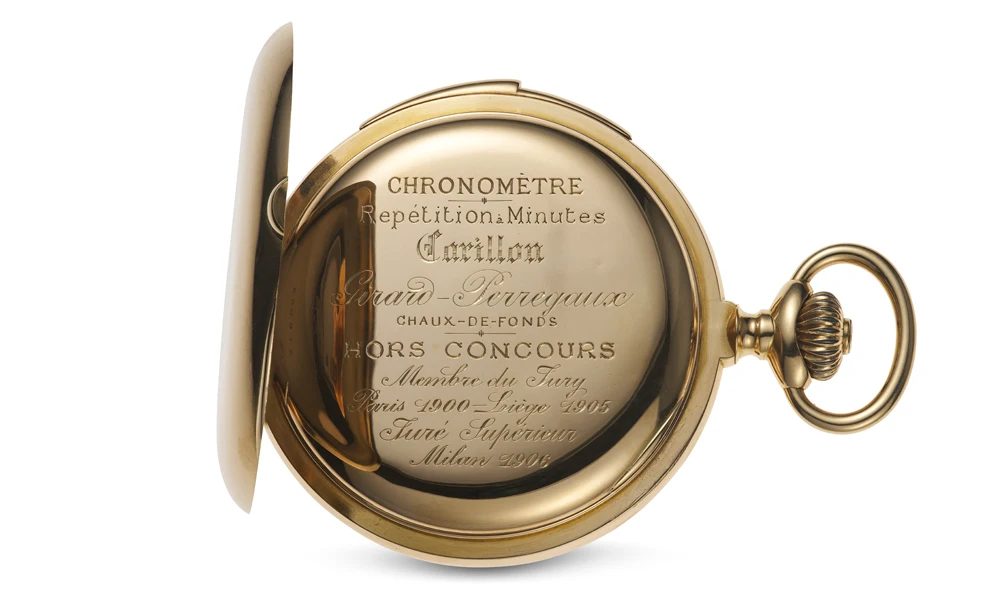
Image – historic pocket watch – ‘Répétition Minute Carillon’
Three racks (hours, quarters and minutes) each fall onto the corresponding snail, effectively feeling the time with a ‘beak’. As the beak catches the teeth on the rack, it connects with the corresponding ‘hammer trip’, pulling back the hammer, which in turn strikes the gong.
As the above description shows, the complexity of a minute repeater cannot be overstated! It is this overwhelming complexity that makes minute repeaters the preserve of Haute Horlogerie, drawing on the talents of the most experienced master watchmakers.
With a brief understanding of tourbillons and minute repeaters, as well as an awareness of Girard-Perregaux’s elevated standing within the watchsphere, let’s take a closer look at the composition of the new Minute Repeater Flying Bridges.
Girard-Perregaux Minute Repeater Flying Bridges – front of house
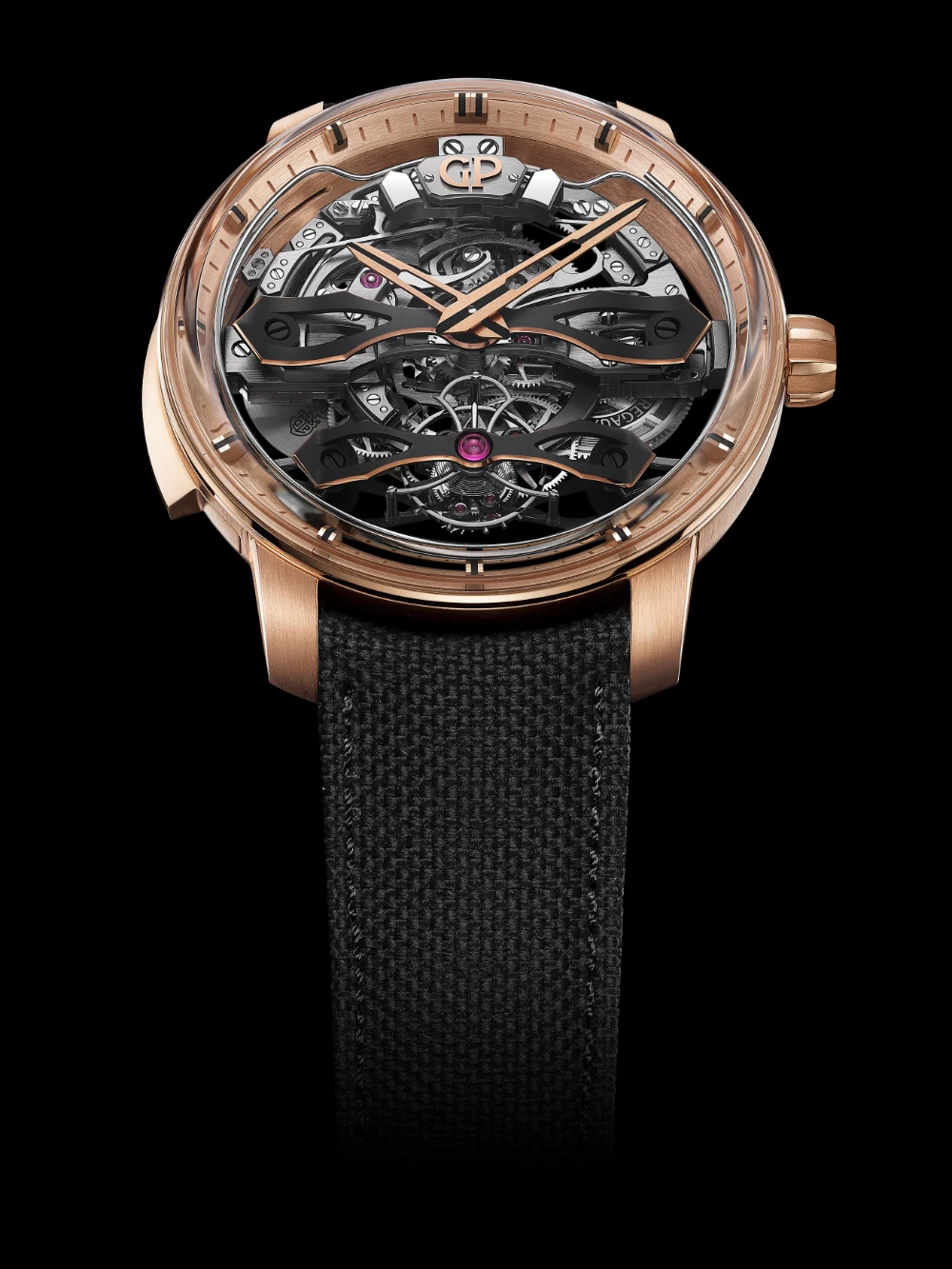
This model eschews a conventional dial, affording unhindered views of the skeletonised movement, the GP9530 calibre. Pink gold openworked hour and minute hands float above a mechanical vista that’s rich in detail. The hands are lined with luminescent material and evince a blue hue in dim light. Fringing the display, a pink gold inner bezel, or flange, plays host to a minute track and applied hour markers, again lined with SLN.
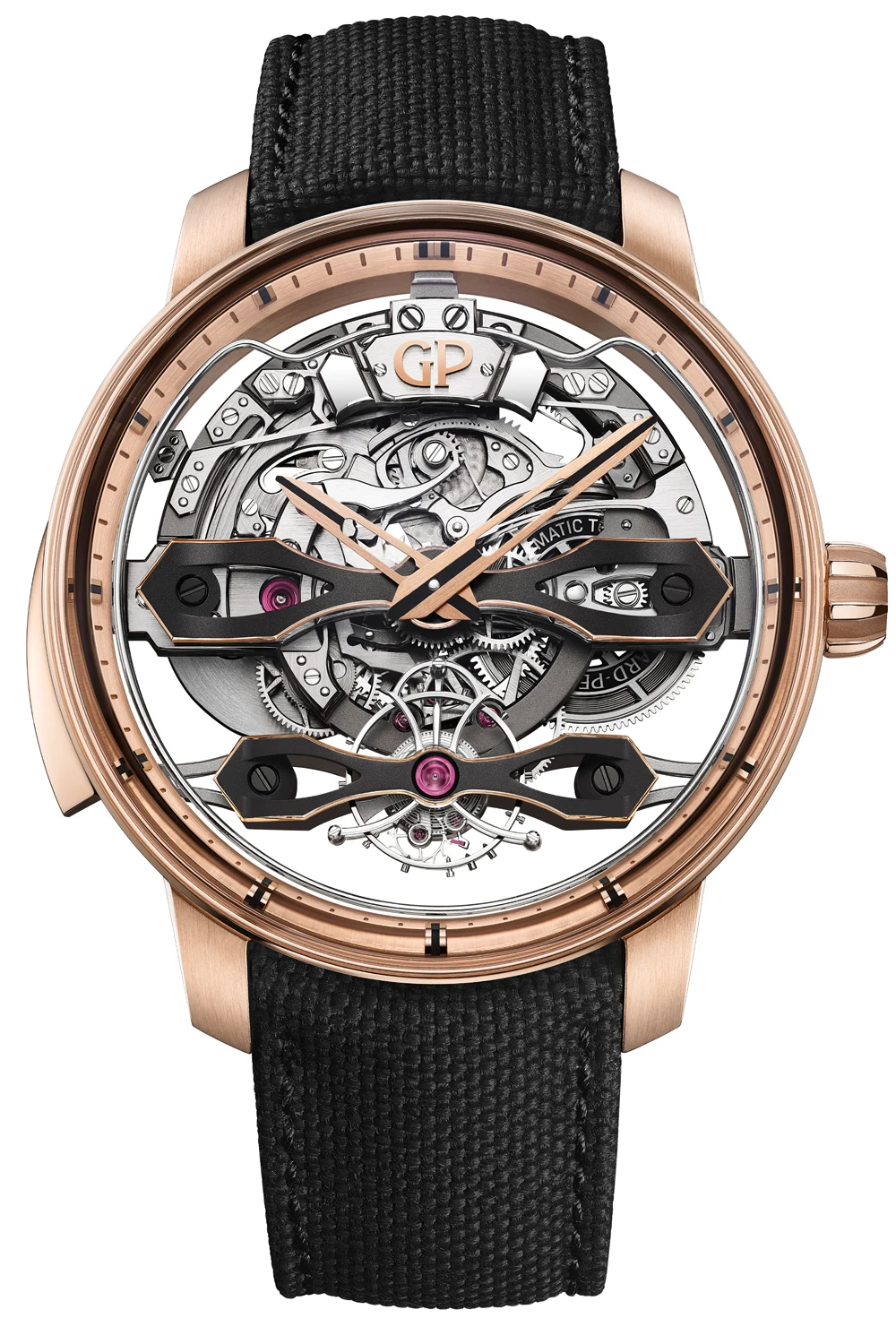
Everything sits beneath an expansive box-type sapphire crystal that drinks in light, aiding readability and showcasing the movement’s intricate architecture.
Located beneath the hands are two prominent ‘Flying Bridges’, straddling the dialscape. The bridges are neoteric in character and share a close resemblance with the aptly named ‘Neo bridges’, first introduced in 2014. On this occasion, the Flying Bridges are formed of rose gold, although they are dressed in black with only the chamfered edges revealing their noble composition. As stated previously, the third bridge is located to the rear of the movement.
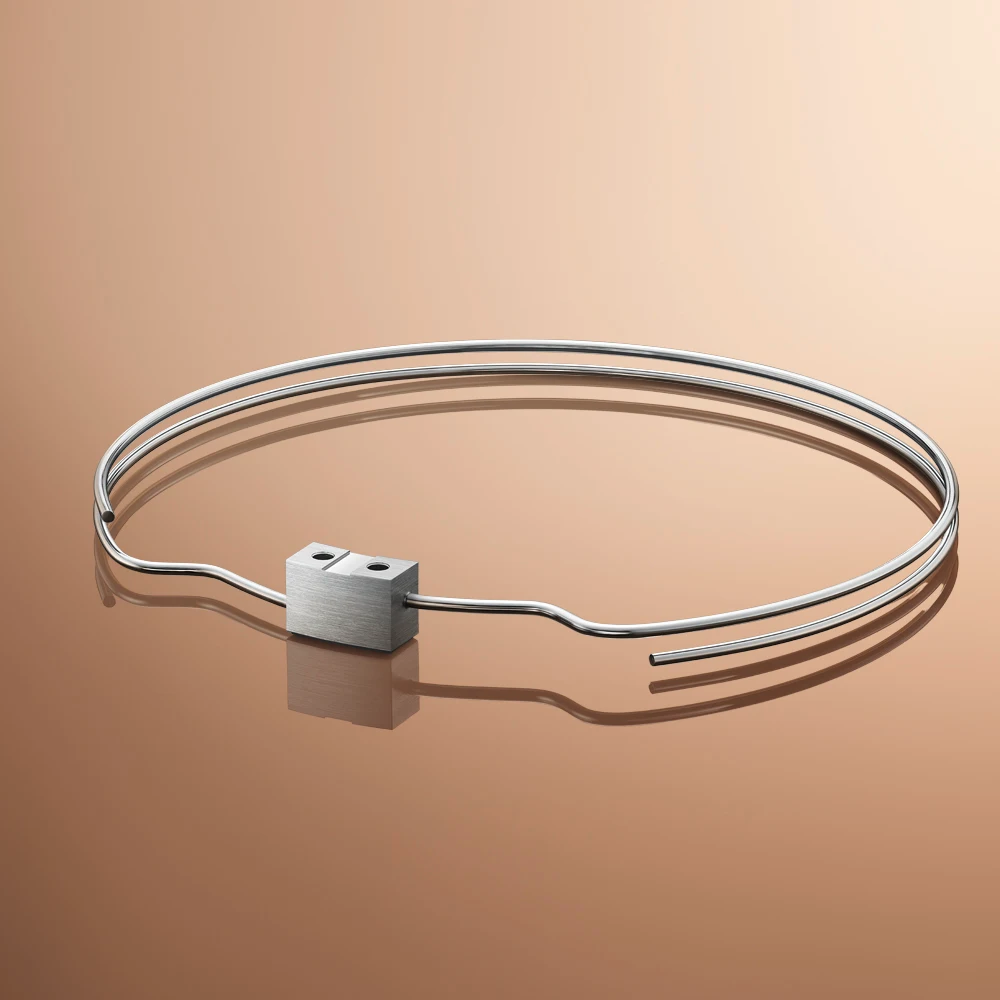
Image – gongs with heel fitted
Save for the Flying Bridges, the plate and remaining bridges are formed of titanium. This lightweight material is strong and wonderfully propagates sound, making it ideal for a chiming watch.
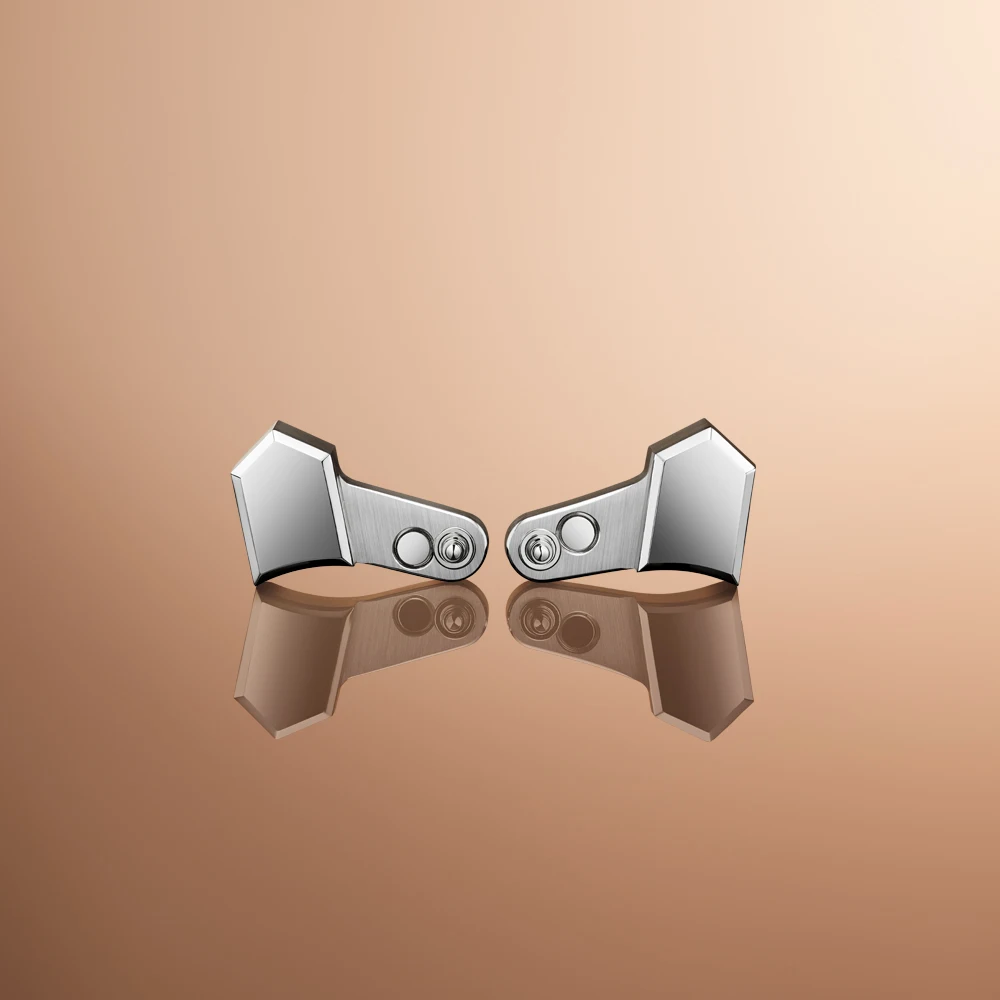
Image – arrow-shaped gongs with mirror-polished upper surface (aka ‘black polish’)
The tourbillon is located at the base of the dial, just above 6 o’clock, serving to enhance the watch’s chronometric performance. Its lyre-shaped cage doffs its hat to Girard-Perregaux’s historic watches and is fitted with a small hand that indicates the running seconds.
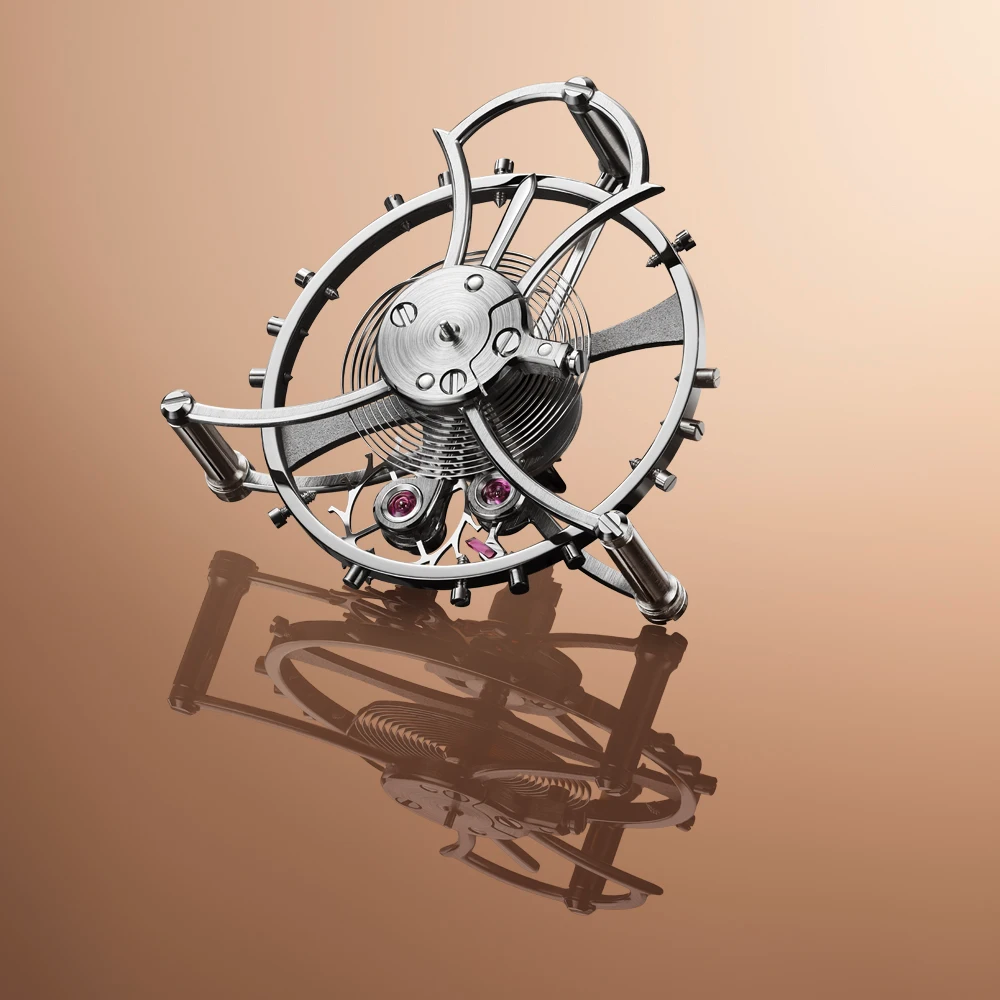
Image – a modern-day lyre-shaped tourbillon cage
Girard-Perregaux has positioned the gongs to the front of the watch, allowing the wearer to see the hammers chiming the hours, quarters and minutes in sequence. Look closely and you will see the rack teeth, GP’s initials executed in gold residing at noon, as well as a myriad of levers and wheels reminding you that this movement is a technical tour de force. Beyond the gold bridges, the Swiss marque reminds us again of its rich heritage by endowing each hammer with an arrow-shaped tip. Some watch brands make one hammer larger than the other, accentuating the difference in pitch. However, on this occasion, both hammers appear identical, granting symmetry, a characteristic found on many GP models and beloved by the brand.
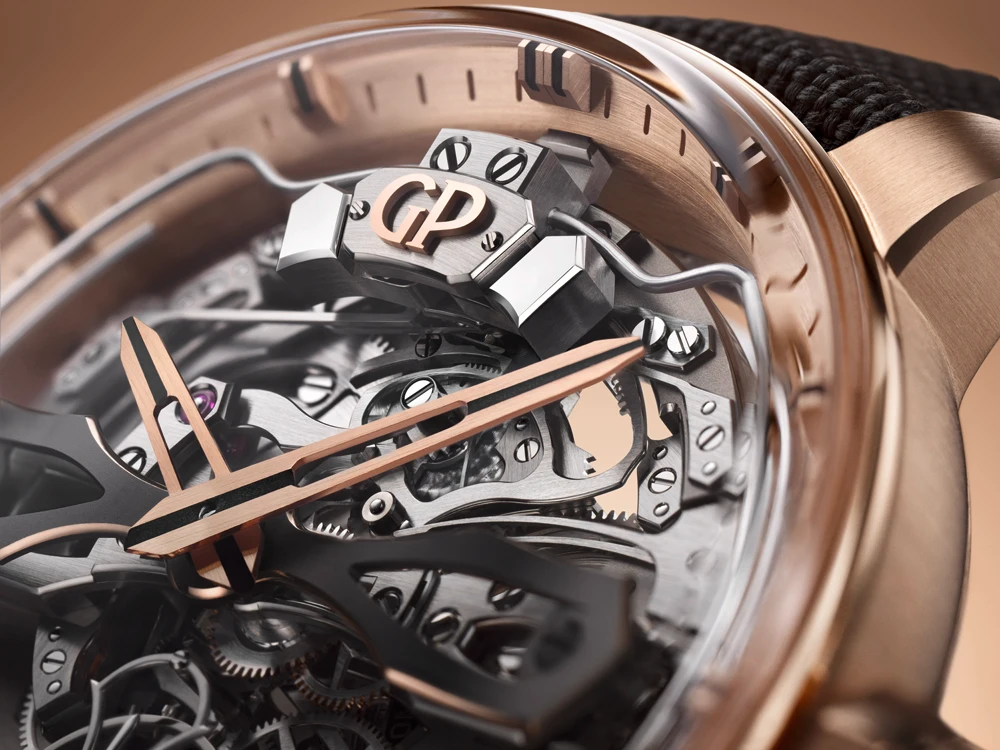
Image – gongs and hammers with racks also visible
The hammers have been mirror-polished, a finishing technique that is widely regarded as the most challenging to undertake. The flat surface of the steel part is polished on a tin plate smeared with diamond paste. This process requires much expertise and an inordinate amount of patience. Each facet of the movement has been refined using traditional artisanal techniques worthy of the term ‘Haute Horlogerie’. Indeed, the Manufacture states that ‘over 440 hours of decoration and assembly have been lavished on the 475 component calibre’. Moreover, the company also states there are ‘no less than 1,340 hand-polished chamfers (including 295 interior angles)’.
Girard-Perregaux Minute Repeater Flying Bridges – rear of the watch
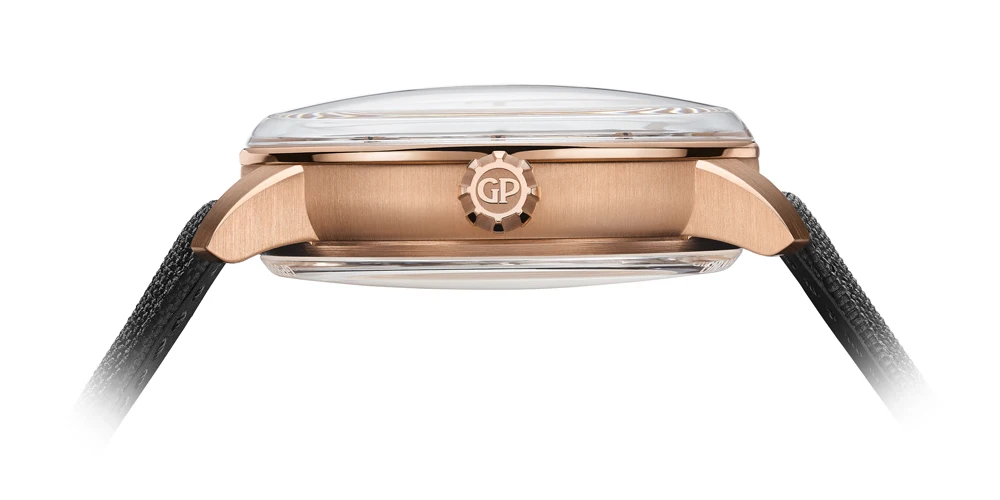
Turn over the 46 mm pink gold case and you will find even more exquisite finishing. At the base of the movement, the lower tourbillon bridge emulates the appearance of its counterparts, positioned front of house.
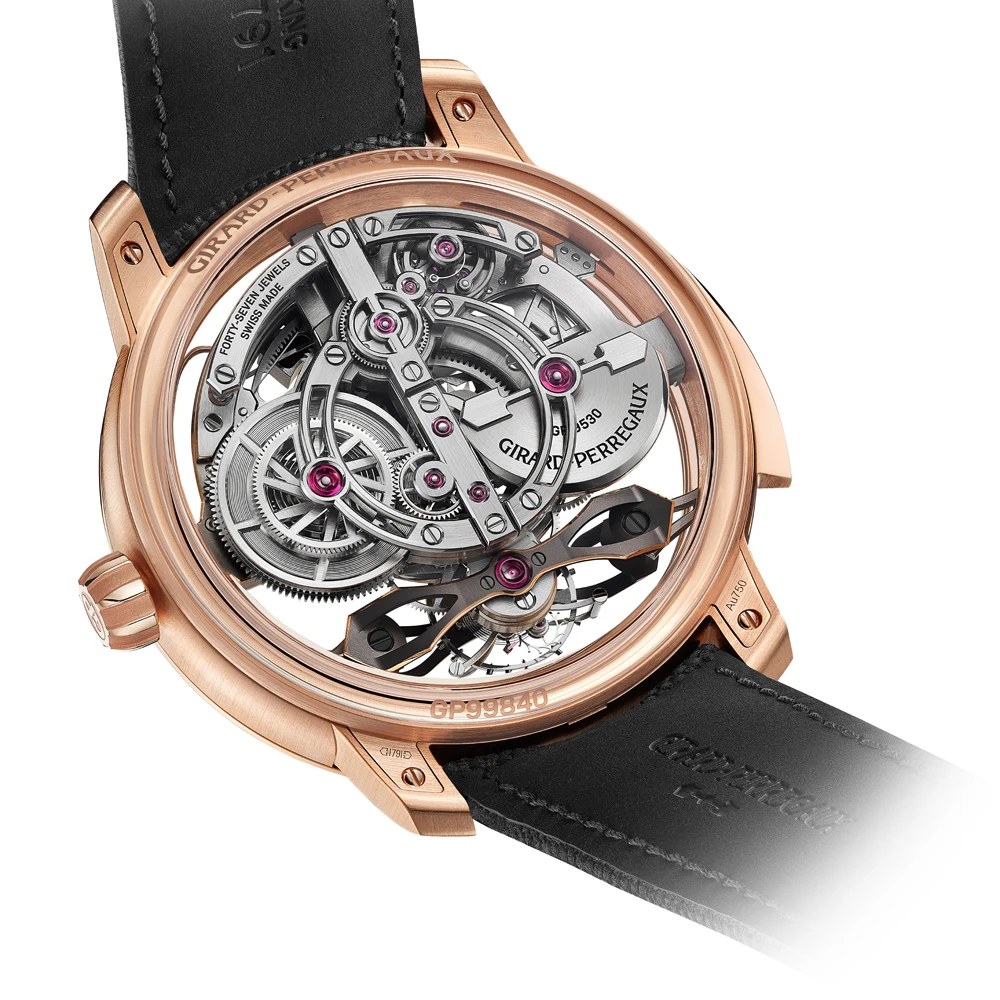
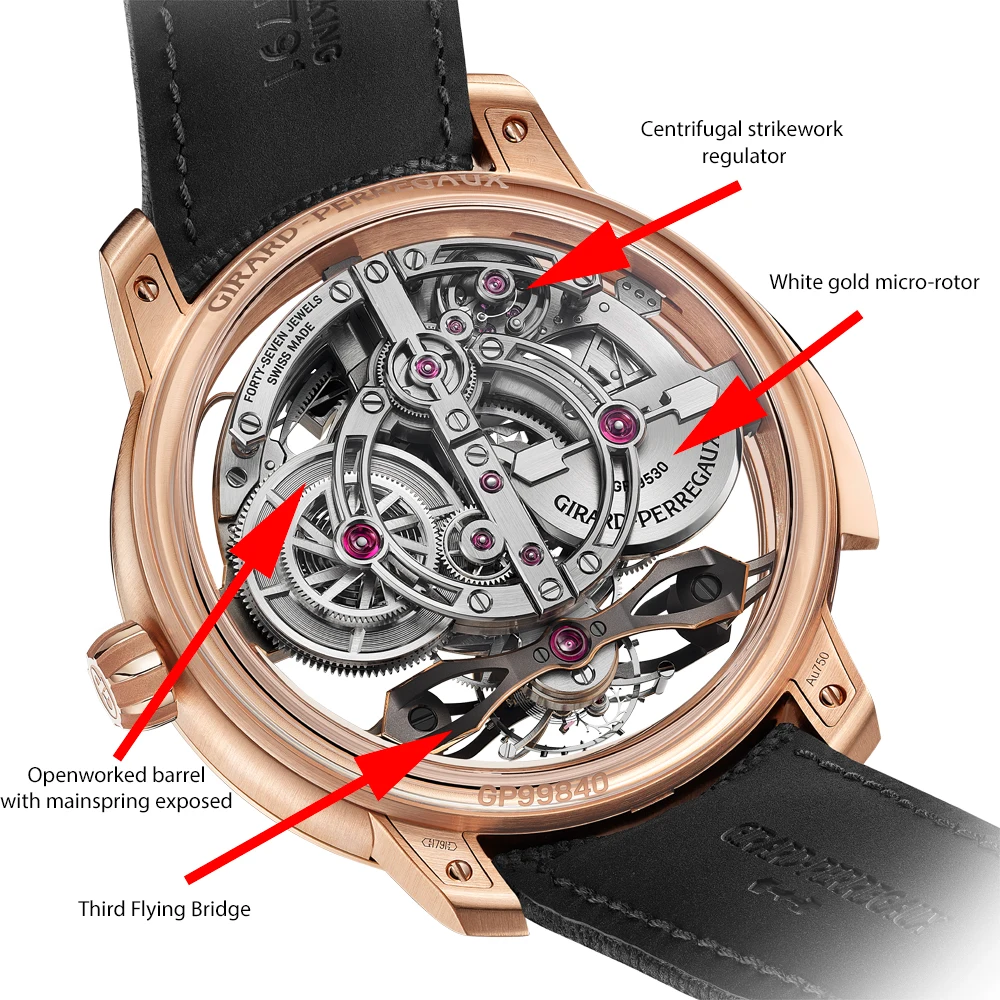
An openworked circular bridge supports the spring barrel on one side and the micro-rotor opposite. Again, GP’s penchant for symmetry is clear to see with the dorsal architecture exhibiting a notable sense of harmony.
Interestingly, the Maison has chosen to equip this watch with a micro-rotor, a means of harnessing energy from the natural motion of the wearer’s wrist. By employing a micro-rotor, the transparency of the design is optimised, indulging the wearer with front to rear views while offering the convenience of automatic winding.
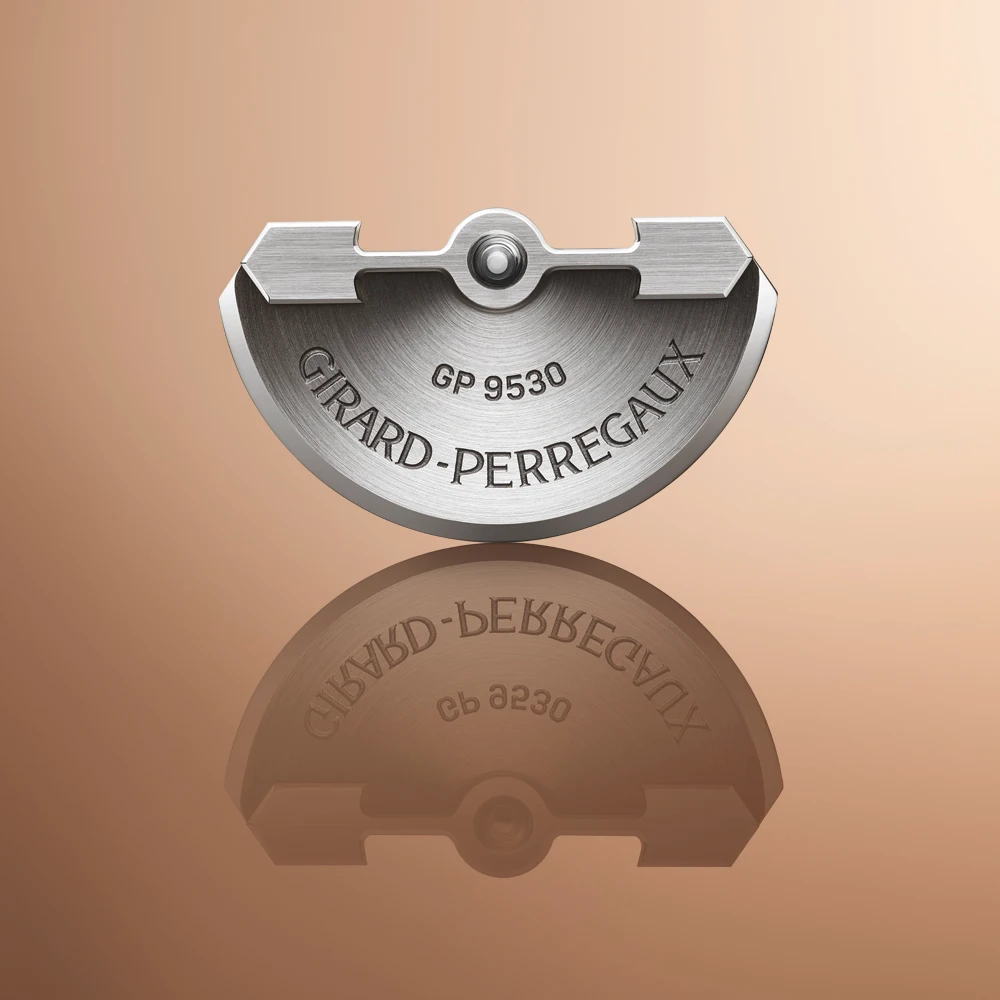
Image – white gold micro-rotor
Compared with a full-size oscillating weight, a micro-rotor is technically more challenging. The diminutive oscillating mass needs to create sufficient inertia to energise the mainspring, a technical challenge that has thwarted the ambitions of many watch companies. However, GP has much expertise in this area with a long history of making watches equipped with a micro-rotor.
When viewed from the rear, the wearer is able to see the centrifugal strikework which bursts into life when the slide on the side of the case is activated. The purpose of the centrifugal strikework is to set the rhythm of the strikes, ensuring everything is evenly spaced, assisting aural interpretation.
Most minute repeaters have a strong aversion to moisture; however, the Girard-Perregaux Minute Repeater Flying Bridges proves the exception. The brand explains that the ‘case has been equipped with an innovative arrow-shaped slide-piece system seamlessly integrated into the new monobloc case-middle. This results in enhanced reliability and unique water resistance to 30 metres.’
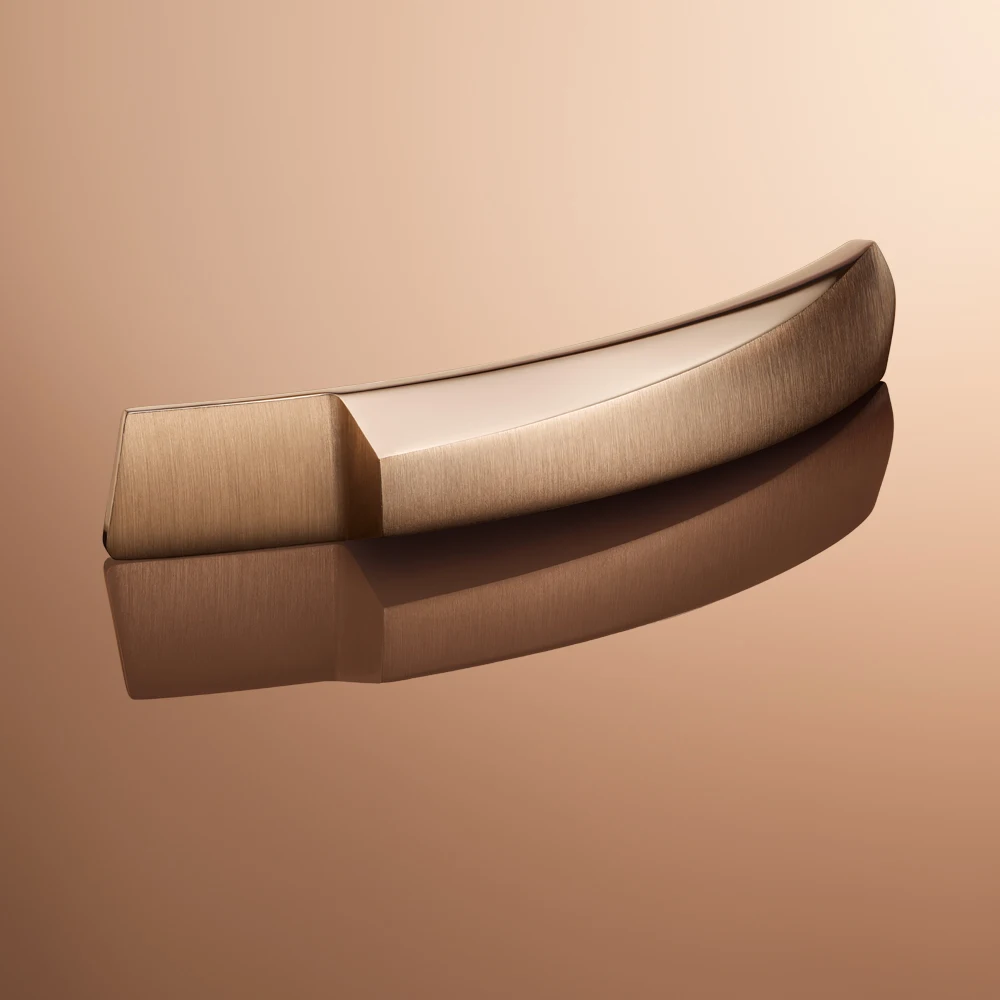
Image – arrow-shaped slide-piece system
Lastly, look beyond the polished screws, the gleaming sinks for the jewels and screws and the expertly grained surfaces, and you will eventually discover a discreet plate bearing the initials of the artisan who brought the watch into the world, reminiscent of a great master signing their work.
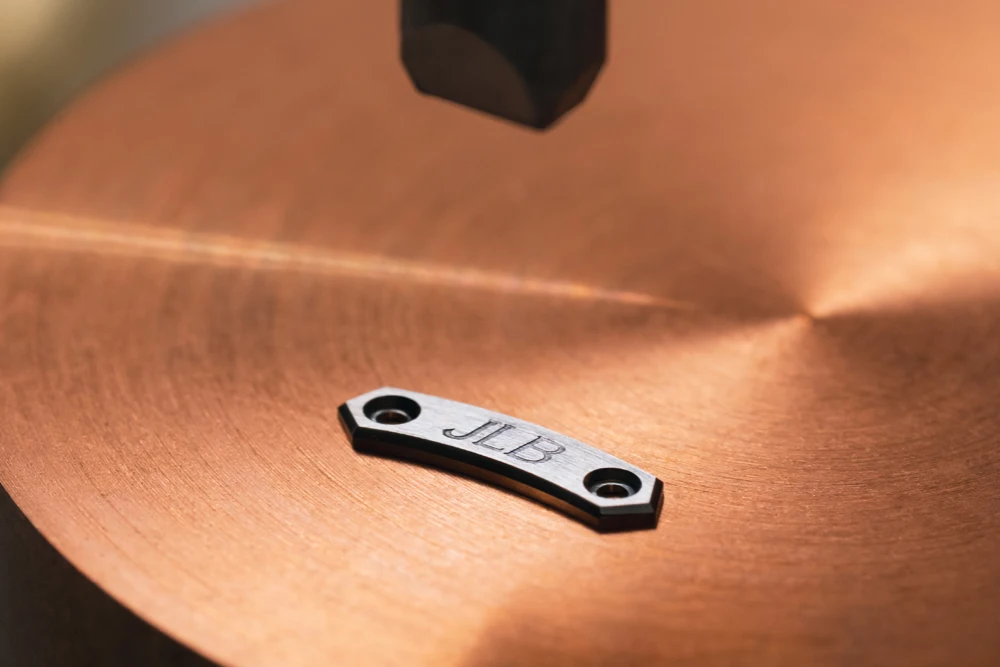
Image – plate bearing the name of the watchmaker
Closing remarks
The skills required to bring the Girard-Perregaux Minute Repeater Flying Bridges into the world are highly prized and incredibly rare, just like those rare individuals who have conquered Everest, K2 or the Eiger. Hopefully, such comparisons will adequately convey the magnitude of Girard-Perregaux’s latest achievement; a brand that operates in a rarefied atmosphere where only a few can breathe.
Video
Further reading
https://www.girard-perregaux.com/
Technical specification
- Model: Girard-Perregaux Minute Repeater Flying Bridges
- Reference: 99840-52-2013-5CC
- Case: pink gold, diameter 46 mm, height 17.90, water resistance 3 ATM (30 metres), box-type sapphire crystals to the front and rear
- Functions: hours, minutes, small seconds on the tourbillon, minute repeater
- Movement: Calibre GP 9530, self-winding movement, frequency 21,600 vph (3 Hz), 47 jewels, 475 components, power reserve min. 60 hours
- Strap: black rubber strap with a fabric effect, fitted with a triple-folding clasp
- Price upon request