
Girard-Perregaux Neo Constant Escapement (Part Three) – in-depth review
The Girard-Perregaux Neo Constant Escapement is the latest expression of Haute Horlogerie to emanate from the prestigious Manufacture based in La Chaux-de-Fonds. In a series of three articles, Angus Davies looks at constant force and how it confers rate stability. In addition, he provides an insight into this latest creation from the Swiss marque, pointing out the model’s numerous details and the various benefits these provide.
In this final part, Angus looks at the Neo Constant Escapement, appraising the dial of the watch as well as other components shown front of house, the model’s case, the Calibre GP09200 and reflects on the overall composition of the watch.

The Neo Constant Escapement – a new era
Throughout its history, Girard-Perregaux has explored the extremes of horological performance, constantly seeking new ways to deliver rate stability and precision. Indeed, rather than simply basking in the glory of its GPHG success, the Manufacture has continued to create new versions of its prize-winning watch, embracing new case materials as well as reducing the diameter of the housing.
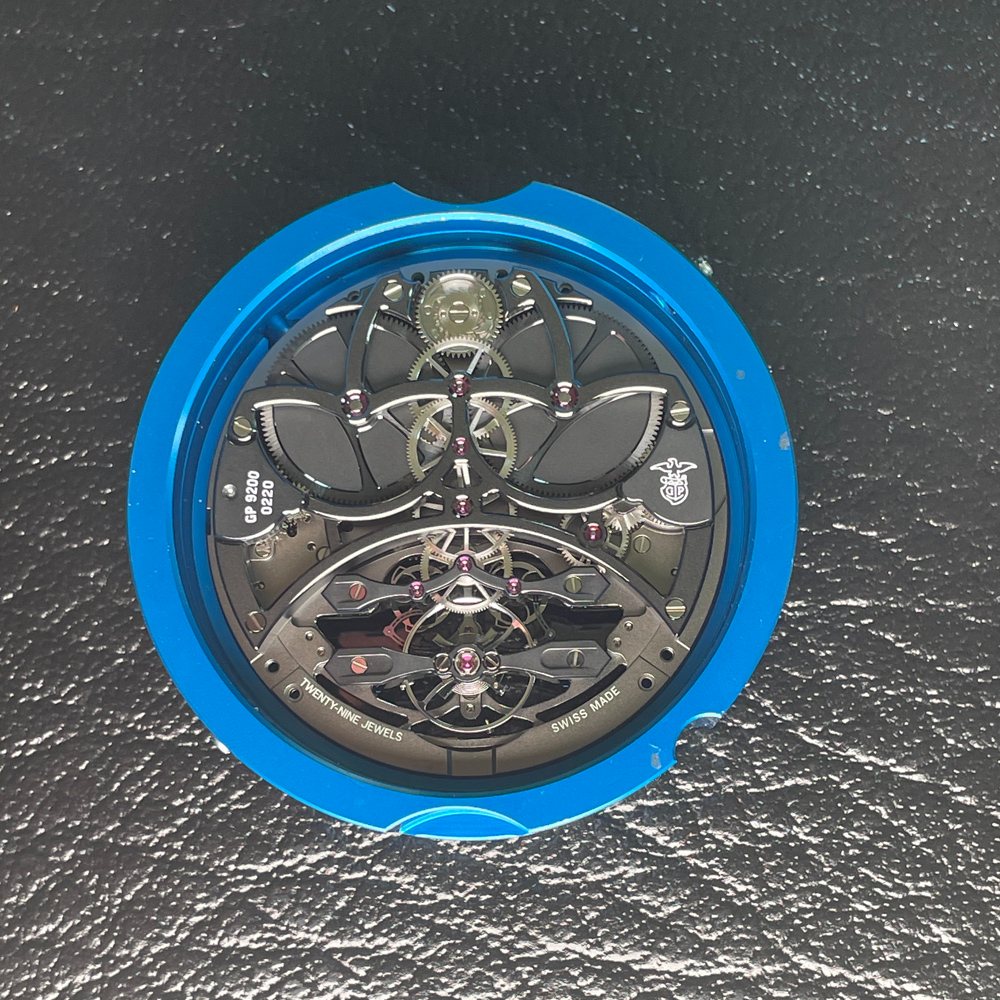
The Constant Escapement L.M. was sold between 2013 and 2019 after which the Manufacture ceased production. However, beyond the public’s gaze, Girard-Perregaux has never stopped developing the Constant Escapement. Ten years after the release of the original Constant Escapement (2013), the Manufacture has unveiled a new, redesigned mechanism, the aptly named Neo Constant Escapement (2023). This evolution encompasses a number of aesthetic and technical improvements as well as incorporating several new technologies. According to the Swiss watch company, ‘30% of the patents employed on this latest model, 13 in total, are new’. Furthermore, the brand has reduced the number of movement components (266 compared with 280 previously), stating the approach is a ‘clear example of optimisation over complexity’.
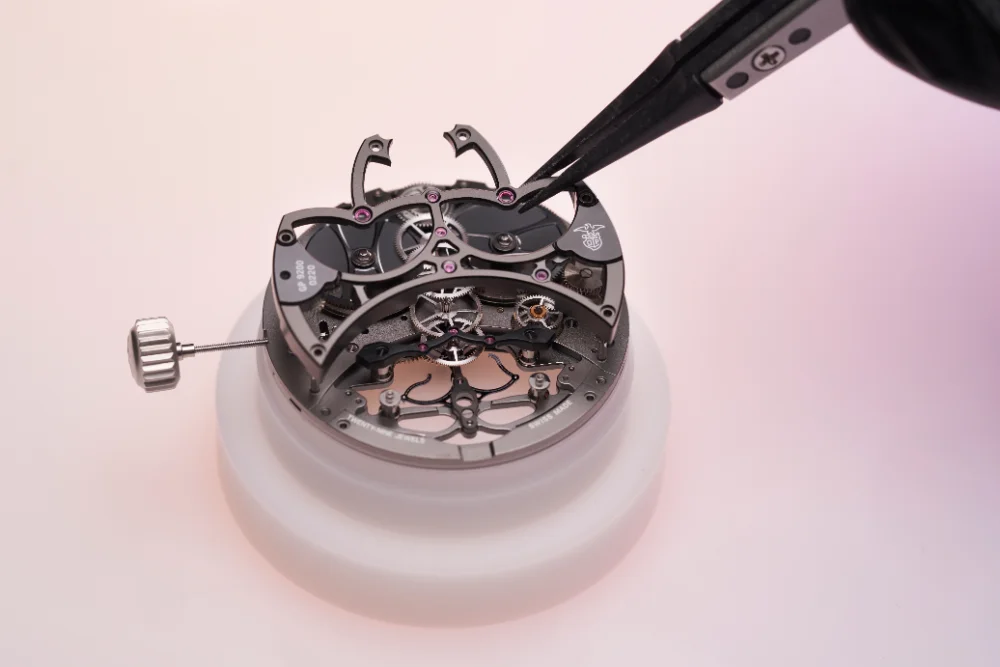
Girard-Perregaux has invested vast sums into the research and development underpinning the Neo Constant Escapement and, as you would expect, is slightly guarded about revealing all of its inventive ideas. However, it does declare some of the patents employed stating they improve ‘.. the power reserve and efficiency of the escapement’, ‘the chronometry and the efficiency of the balance wheel’, as well as the ‘complete angular locking of all sequences of the escapement’. Furthermore, the Maison has stated that it ‘will be filing further patents covering an array of additional innovations. These relate to the geometry of components that facilitate the automatic starting of the movement as well as the shape of further parts that enhance the efficiency of the escape wheel.’
Girard-Perregaux Neo Constant Escapement – a different look
In July 2023, the Manufacture unveiled the Girard-Perregaux Neo Constant Escapement Only Watch Edition, a vision in golden hues. While it shared a family likeness with the 2013 prize-winning model, the charity watch was unequivocally new, incorporating much innovation including several examples of patented know-how. This is consistent with Only Watch, which has become an incubator for creativity, where brands gauge opinion, often before releasing a serially produced timepiece thereafter.
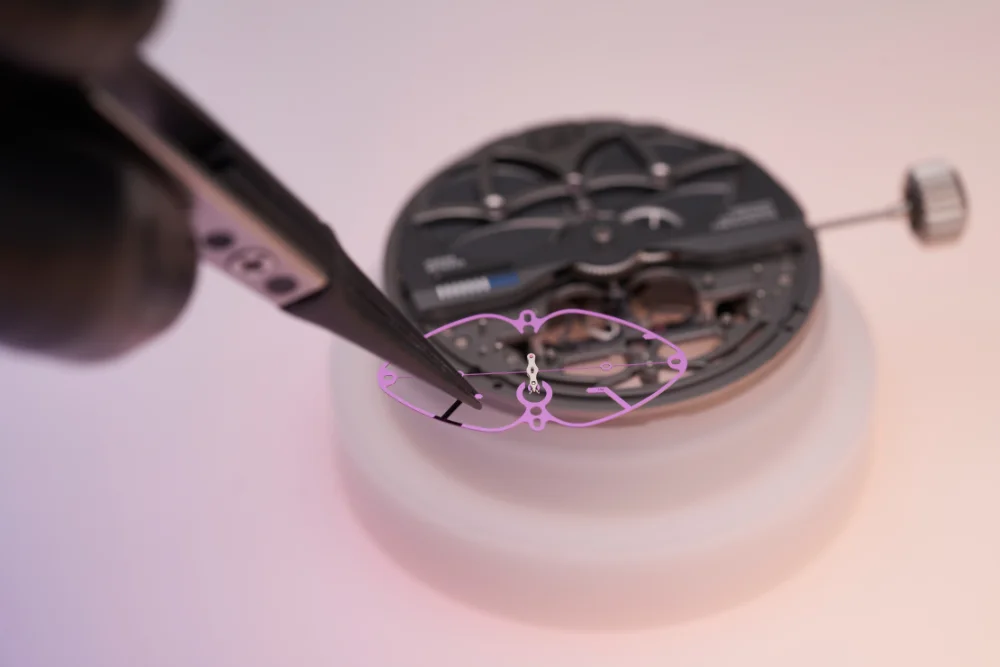
Having expended much time and money developing the Neo Constant Escapement, the reception for the Only Watch version has proved to be very favourable, effectively giving the Manufacture the green light for its ‘regular’ model. I use the term ‘regular’ to denote the watch is not limited; however, on reflection probably the only other thing that can be described as ‘regular’ about this timepiece is the supply of force to the regulating organ.
Girard-Perregaux Neo Constant Escapement – front of house
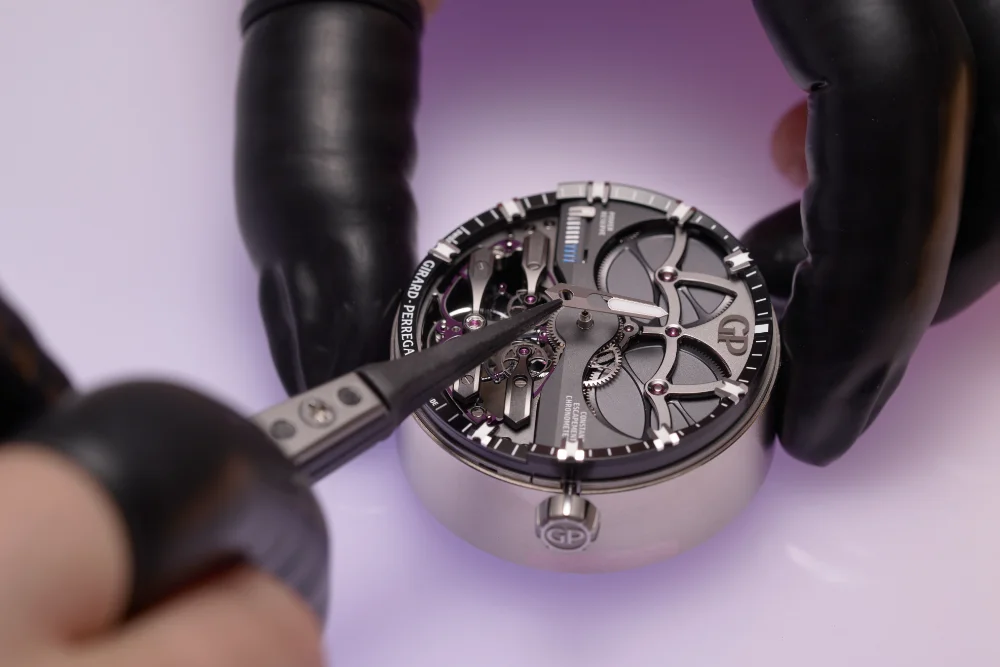
Contrasting the 2023 model with its forebear of 2013, the hours and minute hands are now centred whereas before they were shown on an off-centre display, positioned at 12 o’clock. The watch still features a centre seconds hand, but the tip of the hand is now cyan-coloured. Similar to the 2013 timepiece, a power reserve indicator is positioned at 9 o’clock, albeit the scale does not slope downwards as the mainsprings relax instead it is linear with cyan hues denoting the fuel tank is approaching empty.

The blue-toned silicium escapement spring, with its buckling blade positioned centre-stage, occupies the lower portion of the dial. Similar in concept but totally reworked, the geometry of the mechanism as well as the greater use of silicium confer a different look. Most notably, the watch features twin ‘Neo bridges’ that straddle the escapement and regulating organ, serving as a visual reminder of Constant Girard’s famous three-bridge design.

Beyond its bewitching appearance, silicium is a friction-free material that is especially light. In this instance, by using silicium, Girard-Perregaux has mitigated both friction and mass, increasing the power-reserve to 7 days (formerly 6 days).
Returning to the dial indications, the hour and minute hands are now dauphine style, plump in form, aiding readability, skeletonised near the fulcrum of the dial and lined with luminescent material that emits a vivid blue hue in dim light. The indexes, feature matching luminescent treatment and project from the minute track, bestowing a delightful play with depths. Despite this watch making huge strides in terms of chronometry, the Manufacture has not been illiberal with the notion of style.
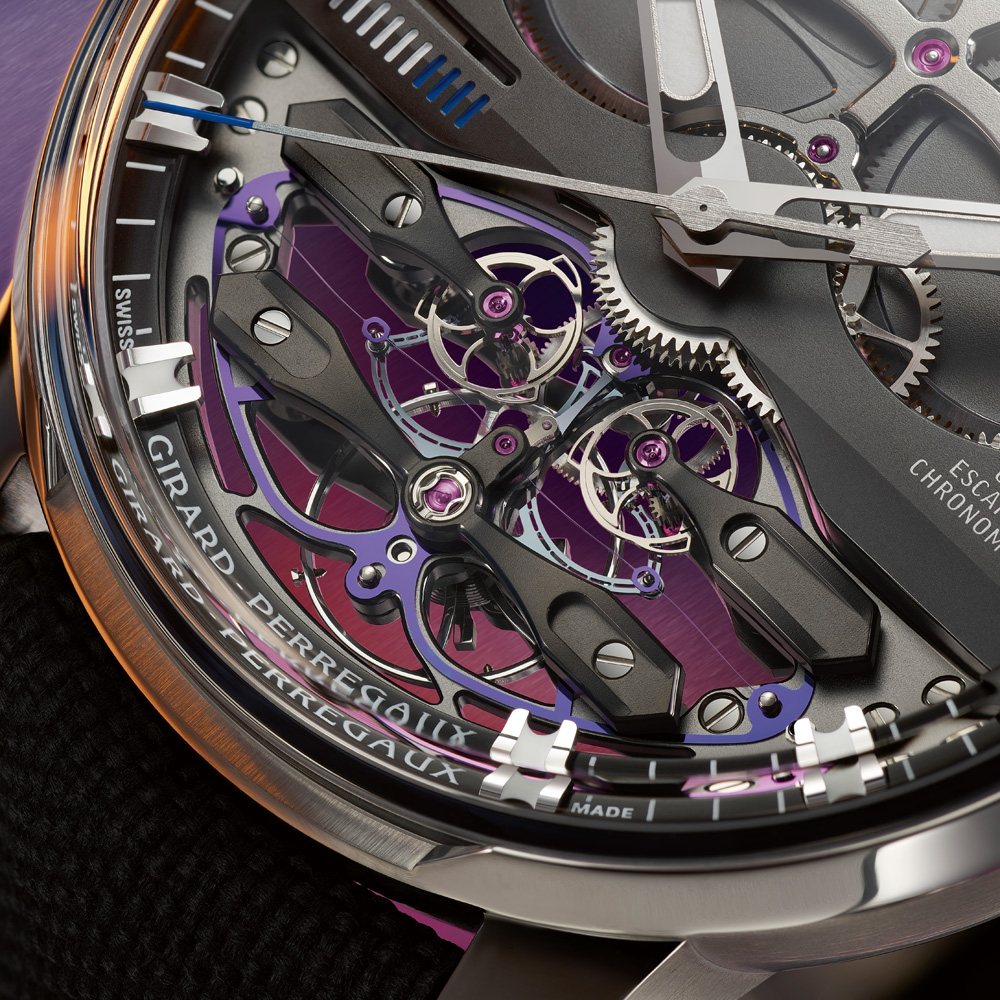
Indeed, a defining characteristic of Constant Girard’s aforesaid pocket watch of 1867 was that the dial masterfully used symmetry to deliver an abundance of eye-appeal. In the case of the Neo Constant Escapement, this aesthetic balance is provided by the previously mentioned twin Neo bridges and two large barrels, located at 2 and 10 o’clock, respectively. The resultant design is packed with intriguing detail, yet remains harmonious, easy on the eye and, most pertinently, simple to read.
Girard-Perregaux Neo Constant Escapement – the case
Measuring 45 mm in diameter with a height of 14.80 mm, the diameter of this latest watch is smaller than the 2013 release with the height just a smidgen greater (0.4 mm) due to the relocation of the hour and minute hands. The lugs gently arc downwards and are modest in length, two characteristics which make the watch appear smaller when affixed to the wrist.
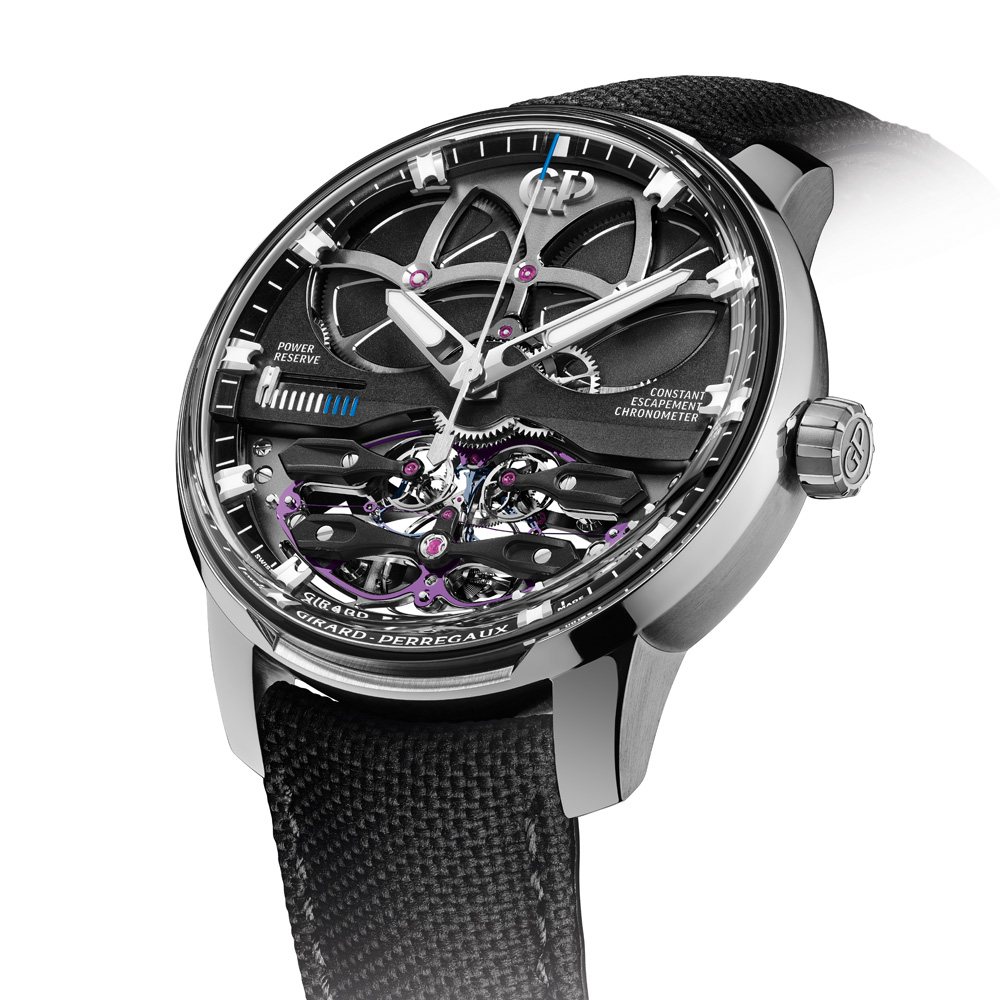
Made from Grade 5 titanium, the Neo Constant Escapement is light, augmenting wearer comfort. This metal, an alloy comprising 90% titanium, 6% aluminium, 4% vanadium with minuscule traces of iron and oxygen, proffers additional benefits. It is strong, corrosion-resistant and hypoallergenic. However, Grade 5 titanium is difficult and costly to machine due to its hardness, a factor that has led some watch brands to treat it with the same reverence as noble metals.
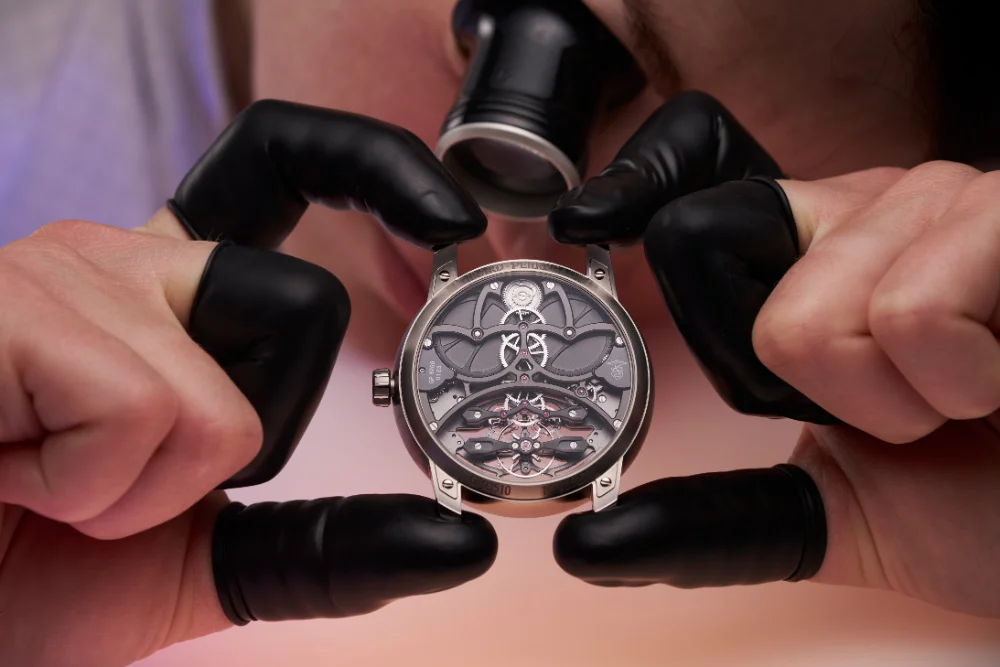
Considering the technical challenges involved in machining Grade 5 titanium, one would have expected Girard-Perregaux to elect for a simple, straight-sided case design. In fact, it has done the exact opposite. Those surfaces positioned above the crown angle inwards appearing to seamlessly flow into the box-style sapphire crystal. This voluminous glazing invites light to illuminate the dial plane, aiding legibility and delightfully introducing depths to the vista presented. The sides of the case positioned below the crown taper inwards as they approach the caseback. The diameter of the sapphire caseback is even smaller, measuring just 42.5 mm, causing it to nuzzle the fleshy part of the wrist, allowing greater flexibility. It is for the aforementioned reasons that this timepiece bestows an impressive ergonomic relationship with the wearer.
The agreeable union between the watch and the wrist is heightened with an ingenious strap and buckle arrangement. At first glance, the strap appears to be fabric but it’s actually black rubber with a fabric effect, providing a pleasing tactility coupled with robustness. In addition, the strap is paired with a triple folding buckle made of Grade 5 titanium, equipped with a micro-adjustment system. This latter feature allows the wearer to fine-tune the length of the strap, providing the optimal wrist fit.
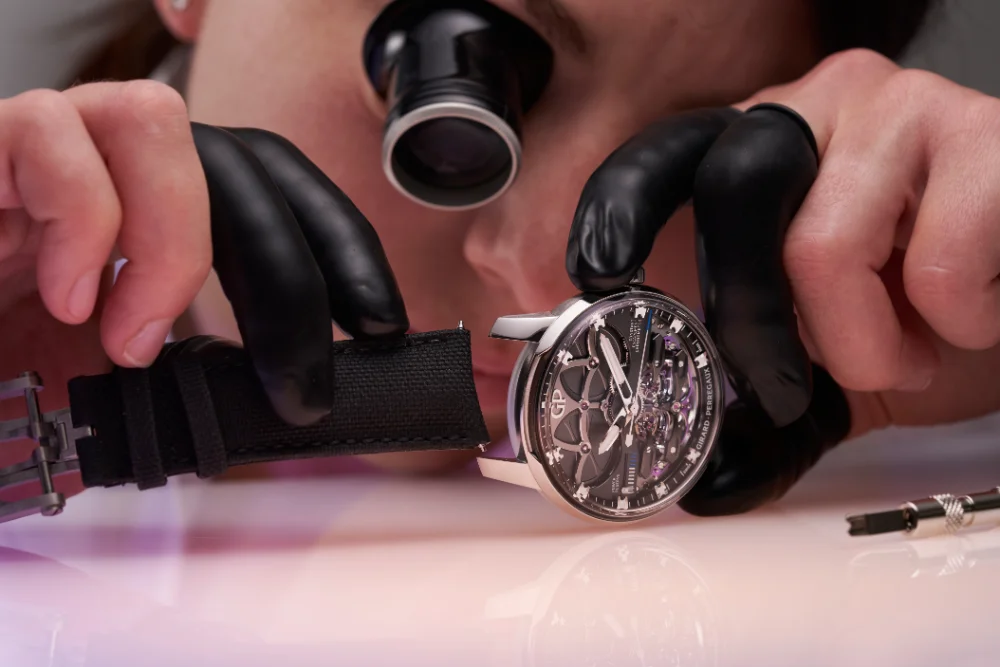
Another detail which demonstrates the Manufacture’s obsessive attention to detail is the polishing of the case. Grade 5 titanium is a challenging material to polish due to its relative hardness; however, that has not stopped the Manufacture from endowing the case with a mix of polished and satin finishes (both straight and circular). The fluted crown has not been neglected either, with its tactile surfaces featuring polished and sandblasted surfaces.
Girard-Perregaux Neo Constant Escapement – Calibre GP09200
The new model features a patented double-barrel construction with each barrel containing two mainsprings. The arsenal of mainsprings, four in total, endows the Calibre GP09200 with an impressive power reserve of at least 7 days (chronometric operation).
Similar to a detent escapement or Breguet’s natural escapement of 1802, the original Constant Escapement of 2013 was not self-starting. However, the Neo Constant Escapement is a self-starting movement, making it more suitable for regular wear.
Like the Constant Escapement L.M. of 2013, the new watch is fitted with a variable inertia balance. This feature promises greater precision than an index-regulated balance (raquette). Furthermore, should the watch be subject to a shock, it is less likely to need remedial regulation. With the newer watch, the balance wheel is slightly larger, aiding precision and the inertia is greater, improving shock resistance.

I have made many references to rate stability. This is not the same as accuracy. By way of illustration, if a watch fitted with a constant force mechanism was regulated to operate with a daily rate variation of +30 seconds per day, its rate would not change, but it would not be considered very accurate.
However, if a watch was regulated to have an ‘average daily rate’ of -4 to + 6 seconds per day (the minimum requirement of COSC) and the rate stability was very good, the watch would consistently operate at this rate, irrespective of the energy held within the barrels and deliver a high degree of precision.
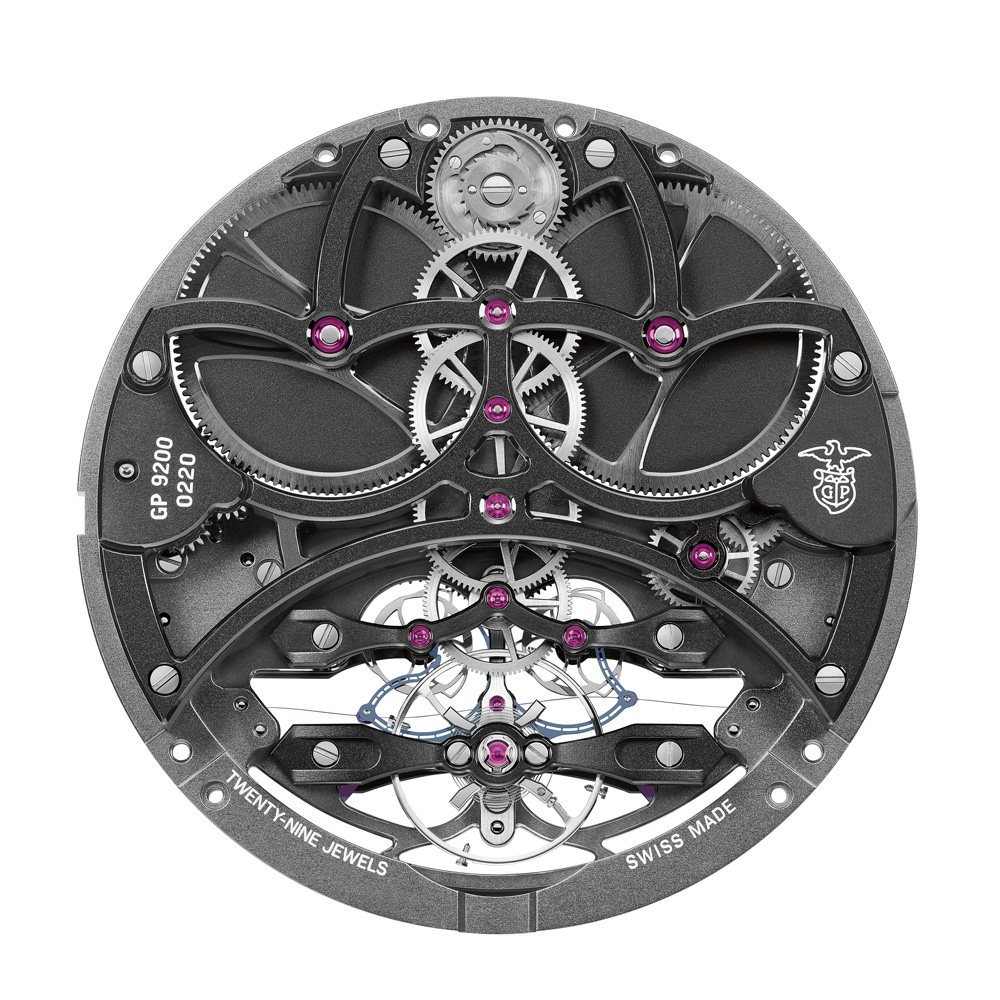
In this instance, the Girard-Perregaux Neo Constant Escapement is a COSC-certified chronometer. The independent certification body tests the watch in a variety of conditions such as different positions and at two different temperatures ie 8°C and 38°C.
While this timepiece is ultra-modern, it does not eschew the traditional craftsmanship synonymous with Haute Horlogerie. Everything has been distilled to the highest order, something that can be readily seen via the box-style sapphire crystal to the front and the exhibition caseback to the rear.

Closing thoughts
Throughout its history, Girard-Perregaux has never wavered from its pursuit of chronometric excellence. When it released the Constant Escapement L.M. in 2013, the Manufacture showed the world that it has continued the journey that Constant Girard began back in the 18th century.
Since 2013, the prestigious Maison has made great strides in enhancing the design and specification of its groundbreaking escapement. Moreover, like the famous pocket watch of 1867 with its three prominent bridges, the Neo Constant Escapement showcases its functional parts as well as making them an artistic feature of the timepiece.

With the advent of this new timepiece, Girard-Perregaux has shown that it has embraced modern techniques and materials when this proffers advancement. However, it also serves to reaffirm that the Manufacture has never ceased in its quest for continuous improvement, a strategy it has employed since it was founded in 1791.
Further reading
https://www.girard-perregaux.com/
Technical specification
- Model: Girard-Perregaux Neo Constant Escapement
- Reference: 93510-21-1930-5CX
- Case: titanium, diameter 45 mm, height 14.80 mm, water resistance 3 ATM (30 metres), sapphire crystal to front, exhibition case back.
- Functions: hours, minutes, central seconds, power-reserve indicator
- Movement: GP09200-1153, hand-wound movement, frequency 21,600 vph (3Hz), 29 jewels, power reserve (minimum) 7 days, 266 components.
- Strap: black rubber with a fabric effect
- Buckle: titanium triple folding with micro-adjustment system
- Price: CHF 95,000 (RRP as of 11.10.2023)