
Girard-Perregaux Tourbillon with Three Flying Bridges – Aston Martin Edition
The Girard-Perregaux Tourbillon with Three Flying Bridges – Aston Martin Edition is a spectacular creation, jointly produced by two exceptional companies. Consistent with several former designs, created by both companies, this new model employs functional elements and uses them to deliver an abundance of eye appeal.

In February 2021, Girard-Perregaux, the prestigious Swiss Manufacture, announced it had become the Official Watch Partner of Aston Martin Lagonda and the Aston Martin Cognizant Formula One™ Team. While one firm is quintessentially British and the other is clearly Swiss, both brands share much in common. For example, Aston Martin was founded in 1913 by Lionel Martin and Robert Bamford, two entrepreneurs, each blessed with a visionary outlook. Meanwhile, Girard-Perregaux can trace its origins to Jean-François Butte, a driven man, eager to succeed, who produced his first watch in 1791. It is this shared ‘ambition’ that led to both companies achieving greatness.
Moreover, the two marques appeal to a similar audience, namely, discerning individuals who appreciate substance rather than overt branding and marketing-fuelled hyperbole. Indeed, Aston Martin and Girard-Perregaux attract aficionados, enthusiasts and those in the know.
Lastly, there is another trait both companies share in common. In 1867, Constant Girard, a man who was particularly interested in the tourbillon (a mechanism patented by Breguet in 1801), created a movement that featured three prominent parallel bridges. He presented the timepiece at the Universal Exposition in Paris where it enjoyed prize-winning glory. Most pertinently, the eponymous three bridges were no longer purely technical features, with the advent of this pocket watch, they also became a design element. Likewise, when appraising former Aston Martin models, the grille, bonnet scoop and side strakes, originally intended to aid cooling, also became part of the brand’s much-admired design language. Put simply, the functional elements of both marque’s models have increasingly influenced the appearance of their über-desirable products.

Aston Martin and the Swiss Manufacture have recently unveiled the ‘first timepiece borne of the recently announced partnership..’, the Girard-Perregaux Tourbillon with Three Flying Bridges – Aston Martin Edition.
When looking at the watch, three Neo bridges come to the fore. Presented in a stealthy shade of black, their sinuous appearance contributes to the model’s distinctive look. However, the bridges are not merely for show, they support the barrel, geartrain and bridge. While the pocket watch of 1867 has clearly inspired the new Girard-Perregaux Tourbillon with Three Flying Bridges – Aston Martin Edition, the new model is unequivocally neoteric.

The latest watch shuns a conventional bezel, instead favouring a sapphire crystal box. The sides of the box are angled, stretching outwards as they approach the caseband. Interestingly, the sapphire caseback is a facsimile of the upper box, delivering a delightful sense of symmetry and bathing the interior components with an abundance of light. To create each sapphire crystal box, the brand uses approximately 4 – 5 times more material than normal. Moreover, the crystals have to be painstakingly polished to achieve a distortion-free conclusion. Once again, Girard-Perregaux demonstrates that excellence is seldom achieved expeditiously.
When looking at this model closely, you soon become lost in a world of architectural forms, where lines give way to curves and flat surfaces transition into three-dimensional structures. This watch delivers a fascinating world that invites the wearer to explore, again and again.
Contrary to first impressions, the Girard-Perregaux Tourbillon with Three Flying Bridges – Aston Martin Edition incorporates an automatic movement. It is equipped with a gold micro-rotor which nestles beneath the spring barrel, granting the wearer the convenience of a self-winding movement while bestowing unhindered views of various parts, often hidden from view.
Although this paragon of fine watchmaking is undeniably contemporary, it features some delightful nods to the past, including the lyre-shaped tourbillon cage, a detail that harks back to the Maison’s models of the 19th century. But perhaps most of all, this model upholds Girard-Perregaux’s longstanding ethos of making ‘the invisible, visible’.
If this is a foretaste of what’s to come, this union between these two prestigious companies promises more delights in the future.
The brand’s press release
The first timepiece borne of the recently announced partnership between Girard-Perregaux and Aston Martin has been revealed. The Tourbillon with Three Flying Bridges – Aston Martin Edition unites the watchmaking expertise of Girard-Perregaux with Aston Martin’s unique knowledge of luxury and performance.
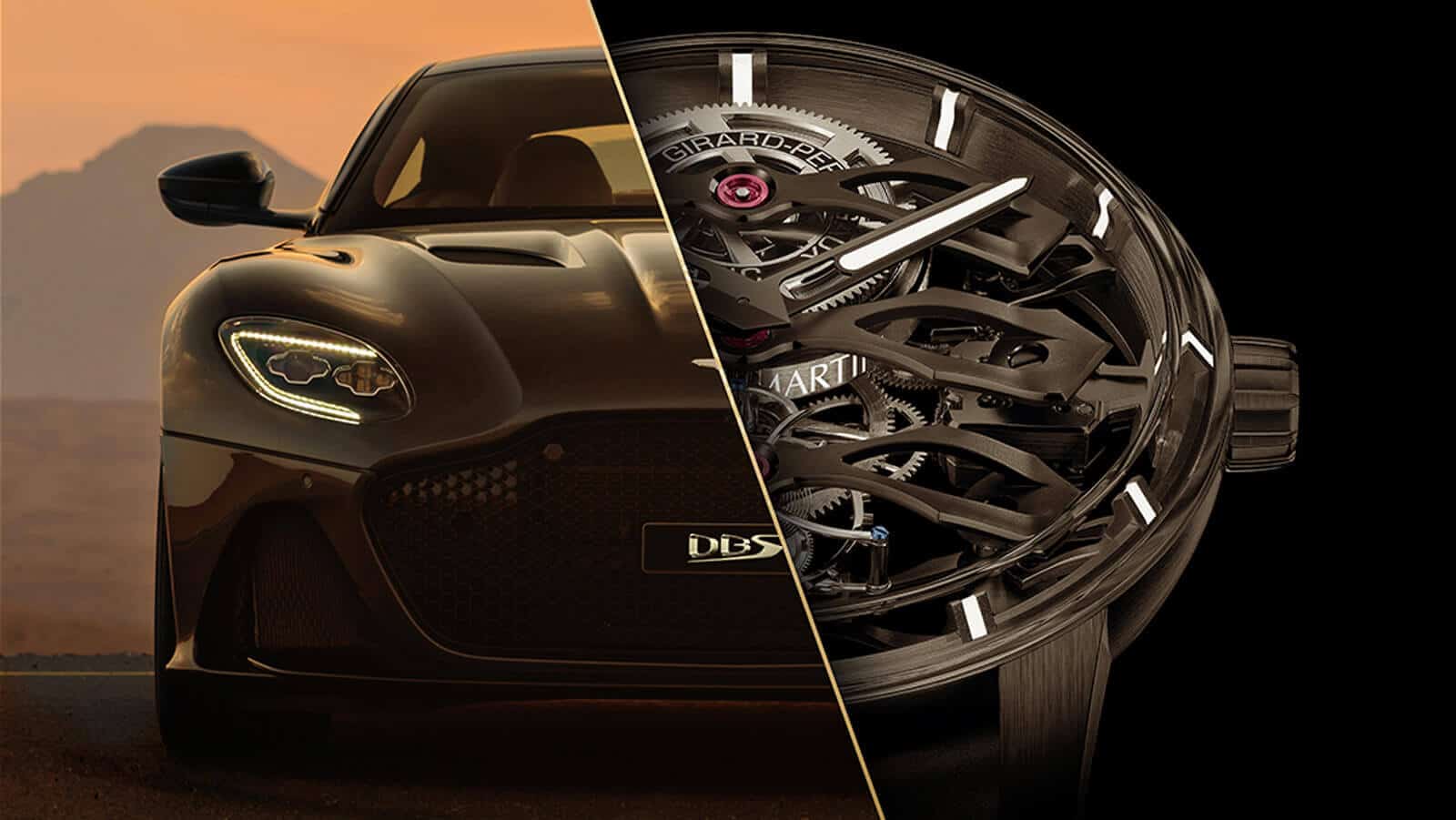
Both brands demonstrate a passion for refined craftsmanship and have been working together, sharing their understanding of design, materials and technology. This latest model celebrates the iconic Three Bridges pocket watch from the 19th century in a decidedly contemporary way, down to the smallest details, including the strap. The latter is a world premiere, presented in black calf leather and featuring Girard-Perregaux Rubber Alloy, an innovative rubber insert injected with white gold. The design of the strap is intended to evoke thoughts of Aston Martin racing cars of the past.

Upholding Girard-Perregaux tradition, this model skilfully plays with proportions and shapes much to the delight of aesthetes.

The 44 millimetre case of the Tourbillon with Three Flying Bridges – Aston Martin Edition is formed of Grade 5 titanium, a strong, hypoallergenic alloy selected by Aston Martin for its lightweight properties. It is suffused with black DLC (Diamond-Like Carbon), bestowing the watch with a stealthy appearance. Interestingly, titanium ore was discovered in Great Britain, the home of Aston Martin, back in 1791 by an English clergyman, William Gregor, in the same year Girard-Perregaux was founded.

A sapphire crystal ‘box’ is positioned front of house, as well as to the rear, coaxing light to illuminate the case interior, thereby augmenting readability. The movement eschews a mainplate, sitting between both panes of sapphire crystal and seemingly floating in mid-air. Three bridges, an iconic signature of Girard-Perregaux, span the dial and are formed of titanium with black PVD treatment and polished angles. The design endows the timepiece with an airy appearance, affording breathtaking views of movement components ordinarily hidden from view. While Girard-Perregaux has a long history of making the invisible visible, in this instance it has ventured off-piste, creating a watch whose movement appears to levitate within the case. This is achieved by paring back the movement, causing the mainplate to seemingly disappear within the case, thereby creating the illusion of the movement flying within the case. It was this particular characteristic that led to the term ‘Flying Bridges’.

The cage of the tourbillon, positioned in the lower portion of the dial, is ‘lyre-shaped’, a characteristic found on all the company’s tourbillons dating back to the 19th century. A blued hand affixed to the cage imparts the running seconds. The tourbillon cage, measuring a mere 10mm in diameter, is composed of 79 components which collectively weigh only 0.25 grams. This remarkably low figure helps mitigate energy consumption.
The barrel, positioned at 12 o’clock, is openworked, affording partial views of the mainspring. A white gold micro-rotor, positioned beneath the barrel, energises the mainspring and, unlike most automatic watches, it grants unobstructed views of the movement. The car company’s name is engraved on the vertical flank of the micro-rotor and is filled with white luminescent treatment which appears blue in restricted light. Likewise, the indexes and hands are also treated with white luminescent treatment and, once again, emit a blue glow in dim light.

Image – Patrick Pruniaux
Patrick Pruniaux, CEO of Girard-Perregaux, said:
“We are delighted to partner with Aston Martin, entrusting their team with arguably our most iconic timepiece, delivering a fresh perspective on Haute Horlogerie. Rarely do we work with others to reinterpret the Three Bridges, however, on this occasion, we have made an exception, mindful of Aston Martin’s prowess for design.
“When viewing the design of an Aston Martin, you will note the firm’s distinctive front grille, first seen on the DB Mark III of the late 50s. Likewise, the scoops and side strakes found on the company’s modern-day models are functional elements, intended to improve airflow while enriching the overall appearance of each car.
“At Girard-Perregaux we share a similar philosophy. For example, when the Maison released the now-legendary Tourbillon with Three Gold Bridges in 1867, it transformed three functional elements into attractive aesthetic features and demonstrated an approach that we continue to employ today. Finally, this latest partnership provides a fascinating chapter in Girard-Perregaux’s 230-year history.”

Image – Marek Reichman
Marek Reichman, Aston Martin Executive Vice President and Chief Creative Officer, adds:
“The greatest of the challenges we faced with the design of this new timepiece was that of scale, as one can imagine. We had to consider lines and proportion on a far smaller measure than we are used to in the realm of automotive design. That said, good design is good design, so whether it is a watch or a car, the principles remain the same. I’m delighted with the finished watch and congratulate everyone who worked on this project as this collaboration has produced a timepiece of great beauty.”
The Tourbillon with Three Flying Bridges, a limited edition of 18 pieces, is immediately available worldwide in all authorised Girard-Perregaux retailers.
Further reading