
Grand Seiko 62GS SBGR094
Angus Davies reviews the Grand Seiko 62GS SBGR094, a much sought after timepiece presented in luxurious 18-carat rose gold.
This detailed review of the Grand Seiko 62GS SBGR094 includes live images, specification details and price.

Apparently when it comes to Bordeaux, 1967 was not considered a great year. Conversely, my mother would attest that it was a fabulous year, she gave birth to her only child, a beautiful boy, albeit my long suffering wife may well dispute this point of view.
At Baselworld 2013, the Japanese watch company released a re-issue of its iconic ‘Self Dater’ of 1964, the 44GS. The response among Grand Seiko’s loyal clientele was phenomenal and the watches sold like proverbial hot cakes.
Now, Grand Seiko is celebrating its 55th anniversary and has once again looked to its back catalogue for inspiration. It has masterfully played the nostalgia card, releasing a faithful re-creation of its first ever self-winding watch, the 62GS.
The original 62GS was released in 1967 and exhibited a fascinating fusion of sharp and rounded surfaces. At Baselworld 2015, Grand Seiko released four versions, each replicating the appearance of the original 62GS and equipped with 4 Hz movements. One version is delivered in stainless steel, while three further models are offered in luxurious shades of 18-carat gold.
Grand Seiko has also released four contemporary ‘re-interpretations’ of the 1967. Two of these watches are equipped with Seiko’s Hi-Beat 36000 movement (Calibre 9S85) and two models contain the company’s supremely accurate Spring Drive movement (Calibre 9R65). Over the coming months, I hope to be able to get on personal terms with these watches and report my findings in minute detail. However, on this occasion, the focal point of my attention is the ‘re-creation’ of the 1967 original, limited to 100 pieces and presented in an 18-carat rose gold.
The dial
The appearance of the dial changes depending on the prevailing light. Sometimes it seems cream, whereas, other times it appears almost ashen. By contrast, the baton-like hour markers stand proud of the dial surface, resplendently pushing forward their chests with golden-hued pride. The visual contradistinction is spectacular and the warmth of the hour markers and hands is very appealing.

Beyond the attractiveness of the dial detail, functionality is not overlooked and everything appears supremely legible. This is a welcome trait, with all of Grand Seiko watches known for their eminent readability. The tips of all three hands point with laser-like accuracy to the relevant hour markers and neat markings adorning the periphery of the dial. This latter aspect, the chapter ring, sits lower than the adjacent dial surface, further sweetening the delicious taste of the dial presented.

The finest watch designs always exploit depths to sublime effect. Depth is a key means of imbuing a dial with a sense of luxury. This fact is not lost on Grand Seiko and has been masterfully utilised with the date aperture. Moreover, the date aperture, together with the hour markers, feature chamfered facets which grab parcels of light and refract small sparkling flourishes to proceedings. It is this attention to detail which has led to legions of fans, myself included, to excitedly await each new model released bearing the ‘GS’ moniker.
The case
The diameter of the Grand Seiko 62GS SBGR094 is sympathetic to the 1960s, but is marginally larger at 37.6mm than the original 1967 model. Furthermore, the depth of the watch has also increased a tad to 12.9mm (formerly 11.4mm), but still appears slender when placed upon the arm. However, by today’s standards, the scale of this watch remains comparitively restrained, eschewing the portly appearance of some contemporary watches.
Regular readers of ESCAPEMENT will know that I favour larger case sizes due to my own genetic make-up, but surprisingly this watch appeared larger on the wrist than I would have anticipated. Ideally, I would have preferred for the watch to measure 40mm in order to sate my own personal needs, but feel compelled to defer to traditionalists who I suspect will seek the character of the original 62GS.
Admiring the case of the Grand Seiko 62GS SBGR094, I note a myriad of period details which have been lovingly recreated. The crown of the original watch was located at 4 o’clock to denote that the timepiece was self-winding, obviating the need for regular hand-to-crown interaction. This has been adopted for this latest watch.

The intricately formed case features numerous facets and evinces a lustrous shine from a myriad of surfaces. It is incredibly complex and will no-doubt have presented numerous challenges to the case-making team. The feel of the case delivers a silk-like smoothness and is the result of the brand’s legendary ‘Zaratsu’ polishing, practised by skilled artisans.


I normally crave the inclusion of an exhibition caseback, especially when I know that the watch contains a magnificently finished movement. In this instance, I accept Grand Seiko’s decision to feature a solid caseback sporting the brand’s nomen, together with a lion motif presented in relief. This is to sate the desires of traditionalists and looks glorious. Nevertheless, as I will come to later, there is a slight pang of sadness that the gloriously finished movement within cannot be seen.
The movement
The Caliber 9S65 is a self-winding movement of which I am familiar. I reviewed the SBGR061 some time ago and recall seeing the movement of this watch via its exhibition caseback. It is beautiful.
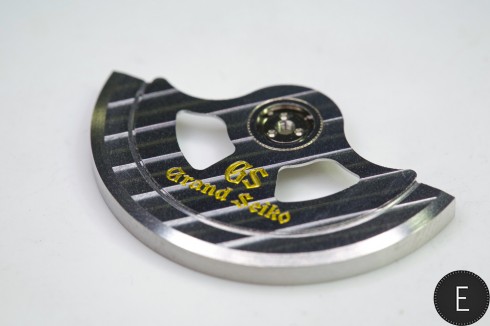

Last year, while visiting the various production facilities of Grand Seiko in Japan, I was enchanted by the sight of the Caliber 9S65 and the Hi-Beat Caliber 9S85. These movements feature open-worked oscillating masses and blemish free, bevelled bridges, proving magnificent to behold.

Grand Seiko Caliber 9S85
Despite my earlier comment that I like the solid caseback, there is still a part of me which feels a sense of melancholy at the prospect of being denied the splendiferous view of the naked Caliber 9S65.
The frequency of the 9S65 is 28,800 vph (4 Hertz) or, as Grand Seiko prefers to say, 8 beats per second. Theoretically, this does not confer the same degree of stability as the Hi-Beat movements but with a stated daily variation of +5 to -3 seconds, it remains a very accurate watch.
Closing remarks
My 16 year-old son has discovered ‘The Beatles’ and plays old vinyl records in his bedroom with the volume set at ear-splitting levels. He is fascinated by the notion of the ‘Swinging Sixties’.
My mother’s generation talk about the period with a sense of fondness. The British Prime Minister, Harold McMillan may have famously said in 1957 that ‘most of our people have never had it so good’, but on reflection the same statement could well have been applied to the lives of many living in the 1960s.
I accept that nostalgia can lead us to look at the past with rose-tinted glasses and concede that clearly some events have blemished periods in our history. However, based on the absolute beauty of the 1967 62GS, it is clear that the swinging motion of its balance wheel oscillating to a frequency of 8 beats a second is a wonderful metaphor for the upbeat mood of the period.
Where Grand Seiko has, in my opinion, usurped the original 62GS is by introducing the Grand Seiko 62GS SBGR094 with its noble case. Indeed, the choice of rose gold seems more befitting for this regal timepiece. It exudes luxury but always exhibits seemly behaviour and notable decorum. Indeed, based on this evidence, 2015 may well be another vintage year for Grand Seiko.
Technical Specification
- Model: Grand Seiko 62GS SBGR094
- Ref: SBGR094
- Case: 18-carat rose gold; diameter 37.6mm; height 12.9mm; water resistant to 10 bar (100 metres) sapphire crystal to front and caseback.
- Functions: Hours; minutes; central sweep seconds; date.
- Movement: Calibre 9S65, Self-winding movement; frequency 28,800 vph (4Hz); 35 jewels; power reserve 72 hours
- Strap: Brown crocodile leather strap supplied on an 18-carat rose gold pin buckle
- Price: €16,050 (RRP as at 13.8.2015)
- Limited Edition: 100 pieces
Related Links