
Grand Seiko Tentagraph SLGC001 Watch Review
The Grand Seiko Tentagraph SLGC001, a chronograph featuring the Caliber 9SC5, was launched at Watches & Wonders 2023 and features an array of attributes designed to wow purists. Once again, the Japanese firm’s vast watchmaking expertise is much in evidence. Angus Davies looks closely at the composition of this latest model and, in particular, its exceptional movement.

Quartz, mechanical and Spring Drive movements
Grand Seiko, the Japanese marque, has gained an enviable reputation for crafting some of the most interesting movements on the market. Whether it’s the Caliber 9F, widely regarded as the ultimate quartz movement, or the Caliber 9S85, a high-beat automatic watch equipped with a Swiss-lever escapement, Grand Seiko is always at the forefront of precision timekeeping.
Spring Drive
Take Spring Drive, a proprietary technology that took 28 years to develop. This exemplar of fine watchmaking, offered in manual and self-winding formats, synergistically unites a mechanical movement with an electronic regulator to deliver exceptional precision. With the advent of Spring Drive, Grand Seiko showed the world it doesn’t doggedly stick to convention, but continuously delivers advancement by exploring new expressions of horology.
Haute Horlogerie
Despite producing some amazing watches over the years, often laden with cutting-edge know-how, Grand Seiko stunned watch aficionados in 2020 with the release of two exceptional movements. Suddenly, the brand’s ambitions seemed to extend beyond making fine watches to crafting remarkable expressions of Haute Horlogerie.
Grand Seiko T0 Constant-Force Tourbillon
The Grand Seiko T0 Constant-Force Tourbillon was a concept movement combining Breguet’s gravity-defying invention with a constant force system. This latter feature ensures the power from the twin barrels, transferred via the gear train to the escapement, remains consistent, enhancing rate stability and precision. In 2022, the Japanese firm released a piece-unique incorporating this know-how, the Grand Seiko Kodo Constant-Force Tourbillon SLGT001.

Caliber 9SA5
The second movement released in 2020, the Caliber 9SA5, first appeared within the Grand Seiko 60th Anniversary Limited Edition SLGH002. The Caliber 9SA5 is packed with a plethora of refinements, delivering exceptional performance. The inventory of horological attributes, includes a dual impulse escapement, a free-sprung balance, an overcoil, twin barrels, a horizontal gear train (mitigating movement thickness), an instant date change, attractive finishing and a frequency of 5Hz.
Assuming both mainsprings are fully tensioned, the Caliber 9SA5 will run autonomously for 80 hours. Lastly, upholding Grand Seiko’s reputation for making highly accurate movements, the Caliber 9SA5 proffers incredible levels of chronometric performance with a stated mean daily rate of +5 to -3 seconds per day (tested in six positions). Perhaps even more impressive are the stated figures for ‘normal usage accuracy’ of +8 to -1 seconds per day. These latter figures can be partly attributed to the 5Hz frequency of the balance, a cadence that ameliorates the effects of positional influence.
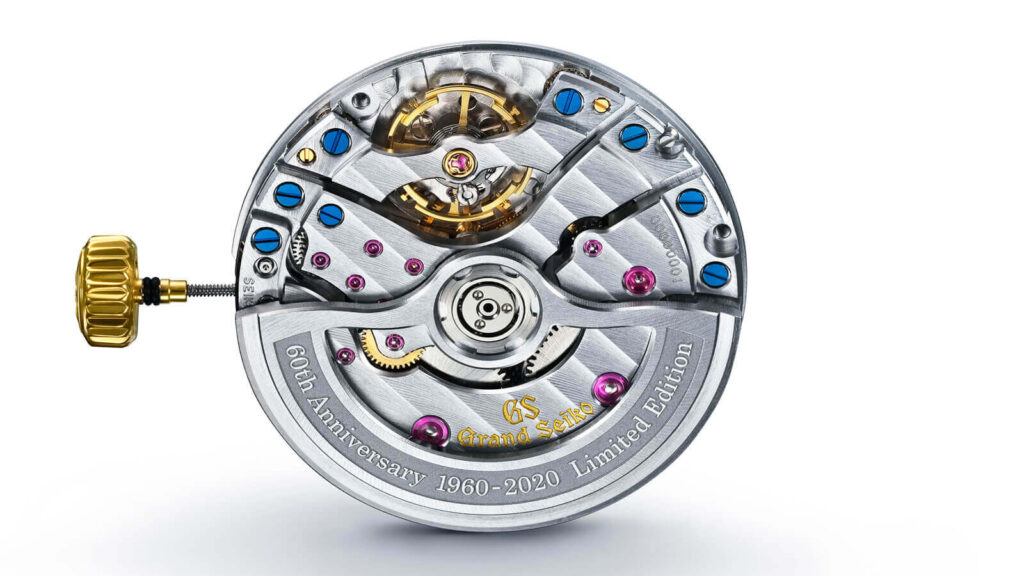
Image – Caliber 9SA5
Grand Seiko Tentagraph – Caliber 9SC5
Now, at Watches & Wonders 2023, Grand Seiko has unveiled a new chronograph, this time equipped with the brand’s new Caliber 9SC5, a movement incorporating many of the highly desirable features found on the aforementioned Caliber 9SA5. Allow me to guide you through the various attributes of this movement.

Dual impulse escapement
The self-winding Caliber 9SC5 is endued with a dual impulse escapement and has a frequency of 36,000 vph (5Hz). Most mechanical movements feature a Swiss lever escapement where an impulse from the escape wheel is sent indirectly via a pallet lever to the balance. Unfortunately, this system is not very efficient with some inevitable loss of energy.
The Caliber 9SC5 is different. In one direction, the balance receives an indirect impulse from a pallet lever, just like a Swiss lever escapement. However, when the balance wheel rotates in the opposite direction it receives a direct impulse. This latter phase is made possible by equipping the balance with a pallet that engages directly with the escape wheel on each alternate beat. By adopting this approach, the escapement is more efficient, consuming less energy, thereby increasing the power-reserve.
Hi-Beat movement
Most mechanical watch movements include a balance with a cadence of 2.5Hz, 3Hz or 4Hz. Grand Seiko, along with a handful of other brands, has been making 5Hz movements for some time. The benefit of having a 5Hz frequency (36,000 vph or 10 beats per second) is that the movement is more precise, especially when housed in a watch affixed to the wrist. As previously stated, this is because the higher frequency of the movement makes it less prone to positional influence. Moreover, a high-frequency movement proffers superior shock resistance.

Grand Seiko released its first ‘Hi-Beat’ movement back in 1968, the Caliber 61GS. Thereafter, the company continuously refined the 10-beat movement. In 2009, the watch brand released the Caliber 9S85, a 5Hz movement that has consistently delivered precision and reliability.
Inevitably, this prompts the question why haven’t all companies chosen to produce 5Hz movements, or calibres with even higher frequencies? Well, there are several reasons. Firstly, high-frequency movements quaff energy, a trait that can lead to a pitiful degree of autonomy. Secondly, the consumption of lubricants is often greater, culminating in greater wear.
MEMS (Micro Electro Mechanical System)
Several years ago, Grand Seiko chose to use an ingenious technology termed MEMS (Micro Electro Mechanical System) to create parts that were hitherto impossible to produce. Widely used in the making of semiconductors, MEMS has been employed for a variety of uses. In the case of Grand Seiko, the firm uses a form of MEMS termed LIGA. This lithographic process is used to create the pallet lever and escape wheel. Both parts are openworked, feature optimal geometry and are very light. The absence of mass results in reduced energy consumption. In terms of the escape wheel, the teeth feature reservoirs that retain lubricant, helping to mitigate wear. Once again, Grand Seiko has exploited the benefits of MEMS technology for its new Caliber 9SC5 movement.
Free-sprung balance
Most mechanical movements use a ‘raquette’ or ‘index regulator’ as a means of regulation. The hairspring passes in between two ‘curb pins’ on the ‘curb regulator’. When the curb regulator is moved towards or away from the ‘stud’, the effective length of the hairspring is decreased or increased, making the movement run faster or slower.

With a free-sprung balance, the effective length of the hairspring remains constant. The rate is altered by adjusting weights positioned on the rim of the balance wheel which alter the moment of inertia. A free sprung balance is less susceptible to shocks, hence by default it confers superior precision. In the case of the new Caliber 9SC5, the weights (screws) are recessed within the rim of the balance wheel creating less air perturbation, further heightening precision.
Column wheel and vertical coupling
With a chronograph, there are effectively two trains, a full-time train (gear train) and a second train that operates on demand (chronograph). This latter train works by drawing power from the gear train using a coupling. The coupling can be either horizontal or vertical. Most watch aficionados favour the vertical coupling for two reasons. Firstly, when the chronograph is actuated, there is a welcome absence of stutter or hesitation. Indeed, the central chronograph seconds hand leaves the starting blocks crisply, a trait sadly lacking on cheaper chronographs. Secondly, pressing the pushpieces indulges the index finger with a smooth, buttery action.
The column wheel acts like a control centre for the chronograph, rotating on the wearer’s command, whenever the pushpieces are pressed. While it does little more than a cheaper stamped cam, its costlier, more protracted creation often appeals to purists.
Grand Seiko states the Caliber 9SC5 ‘movement incorporates a three-pointed hammer, which ensures that, when the reset pusher is pressed, the hands return to zero instantly and in perfect synchronisation’.
Twin barrels
The Caliber 9SC5 features two barrels. Assuming both mainsprings are fully tensioned, the Grand Seiko Tentagraph will run autonomously for 72 hours. An additional benefit of using two barrels, when contrasted with one barrel, is that the energy supply to the escapement is often more consistent, delivering superior rate stability.
Validating the precision of the movement
The Grand Seiko Tentagraph ‘time-of-day accuracy’ (ie not the chronograph) is assessed in six positions, at three temperatures over 17 days. This compares very favourably with COSC chronometer testing, a regime that involves assessment in five positions, at three temperatures over 15 days. Likewise, the average daily rate for the Caliber 9SC5 is +5 to -3 seconds per day, compared with the criteria for COSC which is +6 to -4 seconds per day.
Grand Seiko also tests the watch over an additional three days in three positions while the chronograph is running. Some chronograph movements suffer ‘drag’ where the stopwatch function when operational impairs the precision of the hour and minutes display. However, with the Grand Seiko Tentagraph, the performance is not blighted by drag and, even when the chronograph is running, it still meets the ‘Grand Seiko standard of +5 to -3 seconds per day’.
Grand Seiko Tentagraph – Habillage

Mount Iwate pattern dial
In 2006, Grand Seiko released the SBGL001 equipped with a distinctive Mount Iwate pattern dial. Composed of ridges, the dial’s surface was designed to emulate the appearance of Mount Iwate, a mountain visible from the windows of Grand Seiko Studio Shizukuishi. A few years later, Grand Seiko won the ‘Petite Aiguille’ watch prize at GPHG 2014 with its gorgeous SBGJ005 model, equipped with a green Mount Iwate dial. The resultant media coverage served to heighten awareness of the exquisitely textured horological vista and, like the iconic ‘Snowflake’ dial, it has become synonymous with GS.
In this instance, the Tentagraph SLGC001 is appointed with a blue Mount Iwate pattern dial featuring three recessed and snailed counters. This arrangement comprises a small seconds display at 3 o’clock, a 12-hour chronograph register at 6 o’clock and a 30-minute chronograph register at 9 o’clock.
Lumibrite
The hour and minute hands are lined with Lumibrite, the brand’s proprietary luminescent treatment, aiding readability in dim light conditions. The indexes are applied, faceted and ridged on their upper surface and, once again, lined with Lumibrite. Grand Seiko has gained a reputation for making highly legible dials and the new Tentagraph SLGC001 proves no exception.
The date is shown at 4:30 and features a blue disc that matches the hue of the main dial as horological etiquette dictates. A track, located on the flange, is marked with white strokes, positioned at 0.2-second intervals, perfectly matching the 5Hz frequency of the movement.
Light and shadow
Grand Seiko is famous for its ‘zaratsu’ polished cases. Early GS models were polished using a machine produced by a Swiss firm, the Sallaz Brothers. In Japan, this latter firm’s nomen was mispronounced as ‘zaratsu’, a term that has since become known to legions of GS devotees. The resultant finish gleams resplendently and confers a baby-soft smooth tactility.
In more recent times, Grand Seiko has juxtaposed shiny zaratsu polished surfaces with straight-brushed facets, termed ‘hairline finished surfaces’. The resultant appearance plays with light, suffusing the surfaces of the Tentagraph with contrasting pockets of brilliance and shade. Consistent with Grand Seiko’s fastidious attention to detail, the contrasting finishes are located very close to one another and yet are precisely delineated, a feat that many companies struggle to achieve.

Ceramic bezel
Measuring 43.2mm in diameter, the Grand Seiko Tentagraph is smaller than some of its GS chrono antecedents, therefore the model’s dimensions should suit a broad array of wrist sizes. The model is fitted with a black ceramic bezel marked with a tachymeter scale, a useful detail allowing the wearer to determine the speed of an object over a known distance. An increasing number of watch companies are moving away from aluminium bezels to ceramic alternatives as this latter material is scratch-resistant and less prone to fading when exposed to light or seawater.

High-intensity titanium
The case and bracelet are made from ‘high-intensity titanium’. This lightweight alloy should not be confused with cheaper Grade 2 titanium. High-intensity titanium is much stronger and can be polished to a resplendent gleam which would not be possible with Grade 2 titanium. Moreover, the case and bracelet are not liable to corrosion and the alloy is hypoallergenic.
However, high-intensity titanium has a low ductility making it unsuitable for stamping operations. This means that it has to be milled using a CNC machine, a costlier process. Due to the relative hardness of the alloy, it wears out CNC tools more readily and the milling speeds have to be reduced to avoid heat damage. Such technical factors heighten the cost of making a case or bracelet from this lightweight material, a fact usually reflected in the retail price of the completed watch (see later).

Grand Seiko Tentagraph SLGC001 – closing remarks
I began this article by focussing on Grand Seiko’s movements. I’m a long-standing admirer of the brand, appreciating its innovative spirit. When the company unveiled the Caliber 9SA5, it ascended to a new strata of watchmaking, Haute Horlogerie. Encompassing several technical refinements and impressive finishing, this movement stands comparison with some of Switzerland’s best. The new Caliber 9SC5 perpetuates this gentrification process with the added functionality of a chronograph. It delivers precision and proffers a decent power reserve of 72 hours, a figure that is especially impressive for a high-beat movement.
But, the Tentagraph’s talents are not restricted to its movement alone. The blue dial with its Mount Iwate pattern, along with the hands, counter and date display prove attractive and functional. Indeed, the readability is particularly worthy of note.
Likewise, the case and bracelet are exceptional. Life would have been simpler for GS personnel if the Tentagraph had been housed in steel. Quite simply, high-intensity titanium is more challenging to mill. Nevertheless, it’s clear this brand doesn’t always follow the easiest route when there are potential benefits up for grabs. Indeed, the numerous benefits of using the lightweight alloy for the case and bracelet serve as another reason for recommending this model.
This brings me to my final thought: price. The recommended retail price for the Grand Seiko Tentagraph SLGC001 is £12,500 (as of 27.3.2023). This is not an inconsequential sum, however, for an automatic chronograph with a column wheel and vertical coupling, a free-sprung balance, a 5Hz frequency, refined finishing, a pulchritudinous dial and a high-intensity titanium case and bracelet….. it’s a bargain!
Further reading
https://www.grandseikoboutique.uk/
Technical specifications
- Model: Grand Seiko Tentagraph SLGC001
- Case: high-intensity titanium case, diameter 43.2mm, height 15.3mm, water resistance 10ATM (100 metres), box-shaped sapphire crystal to front, sapphire caseback.
- Functions: hours, minutes, small seconds, chronograph
- Movement: Caliber 9SC5, Self-winding movement, frequency 36,000vph (5Hz), 60 jewels, power reserve 72 hours.
- Bracelet: high-intensity titanium bracelet with 3-fold clasp with push button release.
- Price: £12,500 (RRP as of 27.3.2022)