
La Vallée M30TP
La Vallée M30TP is a supremely refined clock, crafted in Italy within the picturesque region of Lake Como. This sleek, symmetrical timepiece is endowed with several complications and incorporates peerless craftsmanship.

Throughout my adult life, I have been passionate about wristwatches. Craftsmanship, design, materials and mechanisms all have a tendency to elicit affection. A cynic may say that an iPhone can deliver the same functionality for significantly less, but they would be missing the point. A no-compromise expression of watchmaking does not merely focus upon reaching a destination it also imparts much joy along the journey.
Wearing an exemplar of Haute Horlogerie is an indulgence. Indeed, whenever I have affixed an exquisite creation to my wrist, I have known that I’m committing a selfish act. The money I have splurged on such acquisitions could have been spent on my wife, children or friends, however, for that brief moment, sat in a retailer, quaffing a glass of Champagne, all such thoughts are forgotten.
A watch is self-indulgent for other reasons. A timepiece can be endowed with a myriad of complications, but save for a chiming watch, its indications are shared with the wearer alone. Few onlookers will see the dial from afar, the craftsmanship manifest or feel its tactile delights.
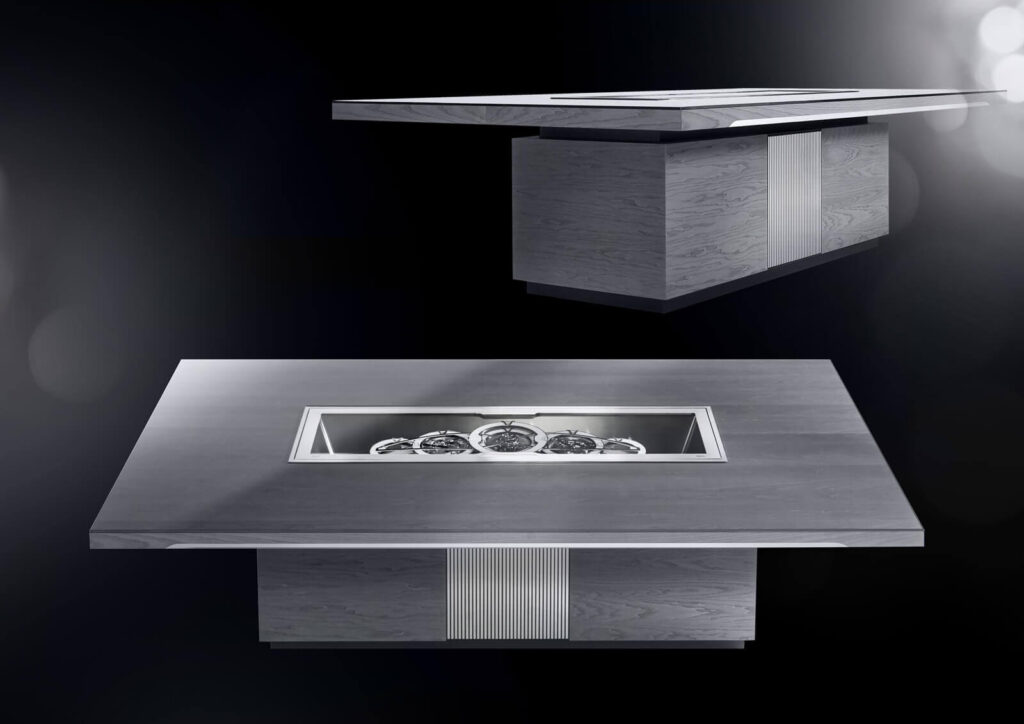
Now, I have discovered an alternative expression of horology which has the capacity to share its thoughts with two onlookers at the same time. La Vallée M30TP is a ‘timepiece’ but in a very unique sense of the word. Crafted in Italy, in the picturesque region of Lake Como, this intricate mechanical clock sits within a tailor-made table. Its design allows a couple of people to read the various indications simultaneously. Furthermore, its technical virtuosity extends to several complications.
Design
Set aside any thoughts of a grandfather clock, La Vallée M30TP is an avant-garde creation resembling a space ship depicted in a sci-fi movie. From the side, the clock has an arc-shaped profile, while a series of rings, positioned above, overlap one another with the centre ring sitting on the highest plane. When viewed from above and from the side, various components can be seen, several of which are in motion.

Indicating the hours and minutes
On the rim of the central ring, two apertures, set 180° apart from each other, display the prevailing hour, allowing the observers at each side of the table to view the time simultaneously.

Located below the central ring is a second ring, positioned on a lower plane, which is endowed with two additional apertures revealing the prevailing minutes. The movement features a five-minute remontoir which accumulates energy from the barrel and then releases it as a pulse. A red-tipped hand is driven by the remontoir spring, ‘using an elastic proportionality principle’, and moves against a track adjacent the minute windows. When the remontoir releases its energy every 5 minutes, the red minute hand returns to its point of origin and the primary minute display advances accordingly.
Beyond its capacity to advance the minute hand in discrete steps, the remontoir spring augments chronometry. By delivering a precise dose of energy to the escapement every 5 minutes, the amplitude of the balance is less susceptible to variation, thereby aiding precision.
A 5-minute tourbillon
In 1801, Abraham-Louis Breguet patented the tourbillon. His invention consisted of placing the escapement and regulating organ within a rotating cage as a means of countering the adverse effects of gravity on the balance. Breguet conceived the tourbillon for use in a pocket watch, however, today it is predominantly employed in wristwatches.

Most of the tourbillons I come across in my professional role rotate 360° every 60 seconds. However, La Vallée M30TP is different, it rotates 360° every 5 minutes, albeit the reason for its use remains exactly the same.
Furthermore, this tourbillon also differs in that it has no cage and no bridge. Indeed, it is equipped with magnetic suspension. The balance wheel measures 72mm in diameter, an extraordinarily large figure. Clearly, this scale would preclude its use in a wristwatch but in a clock of this size it is viable. The large diameter of the balance wheel aids precision.
A perpetual calendar
A complete calendar displays the date, day, month and, more often than not, the moon phase. However, unless the preceding month has 31 days, it will require the wearer to adjust the date on the first day of the month.

An annual calendar can distinguish between those months containing 30 or 31 days. Nevertheless, it still requires the wearer to manually adjust the date on the 1st of March. The ultimate calendar complication is the perpetual calendar which automatically adjusts the date on the 1st of March and even makes an allowance for leap years.
La Vallée M30TP is equipped with a perpetual calendar. Assuming it is kept wound, the date will not require manual adjustment until 2100.
The four white rings, positioned adjacent to the central hour and minutes display indicate the following: the week, the date, the month and the year. Once again, two apertures per indication serve the requirements of two observers.
Unfortunately, perpetual calendars are not known for their reliability. Indeed, some watchmakers term them ‘boomerang watches’ as they invariably keep coming back for repair. La Vallée has been very clever with the design of its perpetual calendar. They have recognised that by using fewer components the risk of mechanical malfunctions is mitigated. As a result, the brand’s mechanism features only seven moving elements, including four gears. The limited parts inventory also reduces energy consumption, thereby increasing autonomy.
A power-reserve indicator
The barrel sits beneath the tourbillon and is endowed with an integrated power-reserve indicator. Three windows are positioned on the barrel. As the barrel rotates at least one of the windows is visible, revealing the status of the mainspring. Again, this mechanism consists of just a few parts, in this instance just two components. The rationale for the limited inventory of parts remains the same as the aforementioned perpetual calendar.
Closing remarks
Measuring 1.5 metres long, La Vallée M30TP is an imposing structure, but it’s unequivocally an object of beauty. Its sleek, symmetrical appearance looks like it has been honed in a wind tunnel, while its three-dimensional form invites inquisitive eyes to explore.
The specification of this timepiece is lengthy and incorporates many complications that will engender lust among the cognoscenti. La Vallée M30TP comprises 1280 ‘custom-made’ components. However, this high part count doesn’t tell the full story. The brand has kept the number of components to a minimum where this confers benefits. For example, the perpetual calendar employs only seven moving elements, thereby ensuring reduced energy consumption and enhanced reliability.
In the world of Haute Horlogerie, watch aficionados place much value on flawless finissage. Readers can be rest assured, this exceptional timepiece is beautifully crafted by time-served hands.
Like many horophiles, I will always retain my selfish streak. Indeed, I can’t resist a wristwatch and I feel no shame keeping its beauty and functions all to myself. However, La Vallée M30TP is a kinder form of timepiece, it’s rich in virtue and designed to share.
Further reading