
Laurent Ferrier hand finishing Watch Review
Laurent Ferrier, the Geneva-based independent watch company, dwells in the highest echelons of watchmaking. It is known for crafting beautiful timepieces, some featuring remarkably intricate mechanisms, all imbued with peerless finishing. In this article, Angus Davies explores the reasons for finishing and looks closely at six techniques practised within the confines of the brand’s atelier.
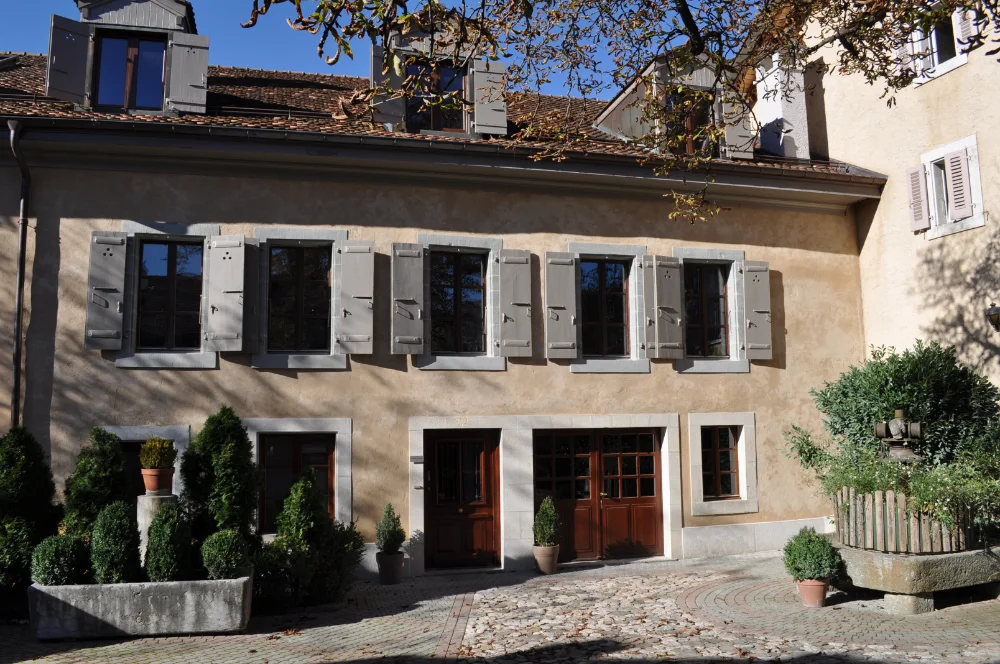
Image – Laurent Ferrier atelier
Haute Horlogerie
A movement found within a watch is composed of numerous parts made of brass, gold, steel, untreated German silver or a combination of these metals. Some mass-produced watches are devoid of even the most basic embellishment, especially where price is the overriding concern. Other watches may receive a degree of industrial finishing, applied to visible surfaces and even some areas that remain hidden, but the overall execution indicates their mass-produced nature.
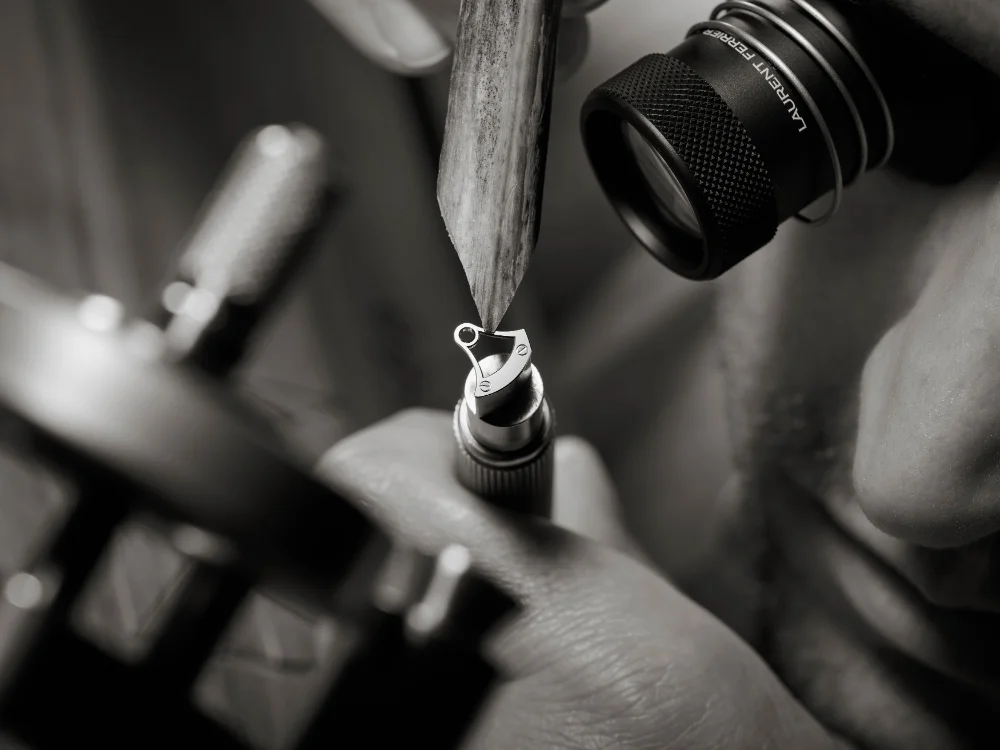
Image – working on a micro-rotor cock
In the elevated world of ‘Haute Horlogerie’, where the pursuit of excellence reigns supreme, finishing assumes far greater importance with the finest examples of Haute Horlogerie finished and decorated by hand.
Since its inception, Laurent Ferrier has always operated within the rarefied heights of ‘Haute Horlogerie’. Indeed, the marque is known for crafting beautiful timepieces with intricate movements that are imbued with exemplary finishing. In this article I look closely at the rationale for finishing and cite some examples typically found on Laurent Ferrier creations.
The purpose of finishing
With Haute Horlogerie creations, movement parts are formed from metal bars and plates that are cut or milled (stamping is more commonly used for industrially produced watches). Even the most traditional practitioners of Haute Horlogerie use modern techniques to make components. CNC, bar turning and wire erosion machines can produce parts to infinitesimal tolerances, sometimes measured in microns. The advent of this technology delivers product consistency and makes the once impossible, possible.
After a part has been produced, all burrs and signs of machining must be removed. Failure to remove extraneous material can impair the operation of a movement. Indeed, burrs can increase friction, lead to wear and compromise reliability. Various types of finishing techniques are employed to remove burrs and signs of machining. Allow me to elaborate.
In bygone times, watch cases were often susceptible to dust ingress, a form of contamination that could impair the smooth running of the movement and adversely affect reliability. The solution came in the form of ‘perlage’, a series of overlapping circles applied to the mainplate which retained dust, preventing it from impeding the motion of moving parts. These days, watch cases are less susceptible to ingress, but perlage continues to feature on fine watches as a means of removing signs of machining, enhancing the visual appearance of the mainplate and upholding watchmaking tradition.

Image – perlage on mainplate (Calibre LF270.01)
In a similar vein, Côtes de Genève was originally intended to capture dust. The motif is composed of straight-line engravings applied to the upper surface of bridges or cocks. Rooted in tradition, Côtes de Genève or ‘Geneva waves’ is now viewed as purely decorative and is not applied to functional surfaces as this could potentially impair precision.
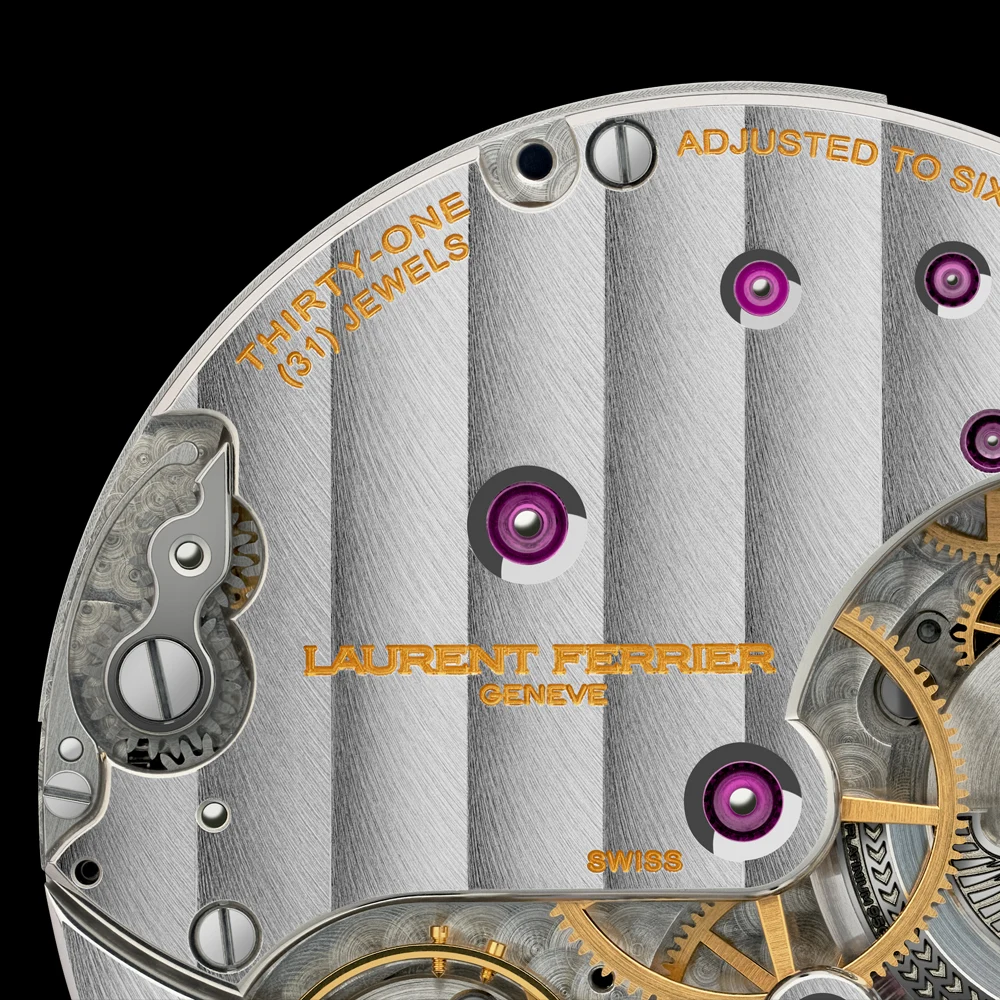
Image – Côtes de Genève on mainplate (Calibre LF270.01)
Furthermore, the process of ‘drawing’ surfaces with a file and polishing components also enhances the corrosion resistance of metals.
Beyond the functional benefits of finishing, various techniques also serve to enhance the visual allure of parts. A watchmaker or ‘finisseur’ will expend many hours, filing and polishing to imbue various movement parts with life, transforming dull metal into eye-catching surfaces that play with light and shade.
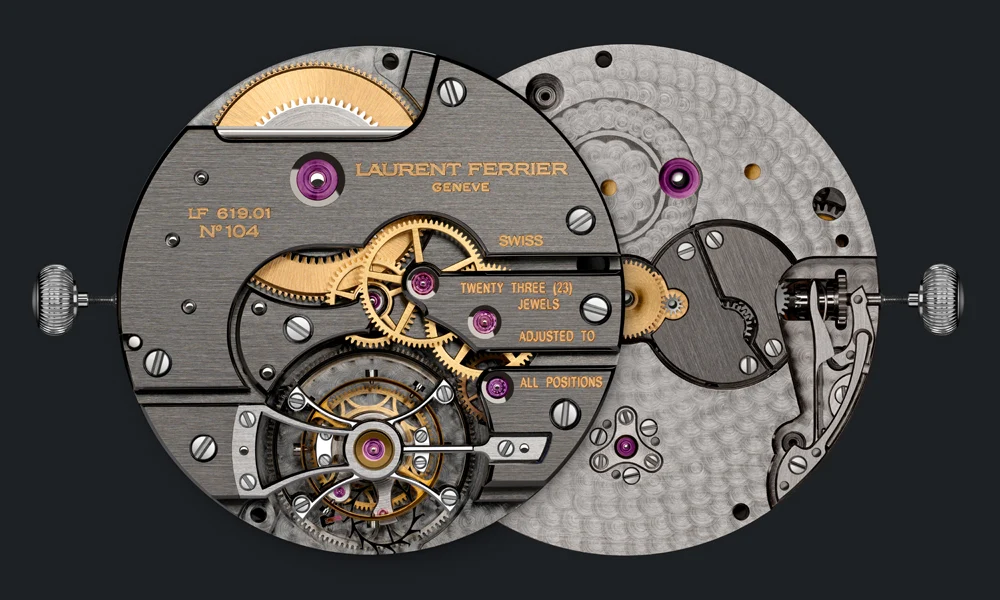
Image – various techniques applied to movement (Calibre FBN 619.01 No 104)
Laurent Ferrier has gained a reputation for its mastery of finishing techniques. So, without further ado, let’s take a look at some examples of the hand finishing expertly practised by the Maison.
Laurent Ferrier hand finishing – perlage
Returning to perlage, sometimes termed ‘circular graining’, the handcrafted approach is to use a stippling machine. However, don’t misconstrue, the word ‘machine’ doesn’t accurately convey the inordinate amount of skill needed to master this technique.

Image – perlage being applied to a mainplate with a stippling machine
A vertical rotating pegwood fitted with an abrasive pad on one end is introduced to the metal surface by pulling a lever in a downward motion. As the tip of the peg kisses the metal, positioned at a right angle, it forms a ‘pearl’. The operator must apply uniform pressure when imparting this motif. In addition, the pearls must be arranged in concentric lines and each one must overlap its neighbour by 50%. Typically, perlage is applied to mainplates but there are other areas where the technique may be used. Laurent Ferrier usually embellishes the mainplate (and other components such as barrel bridges) with pearls in three sizes. Smaller pearls are applied to the area below the balance and beneath the spring barrel.
Laurent Ferrier hand finishing – Côtes de Genève
As previously mentioned, Côtes de Genève is now considered purely a decorative technique. A semi-automated machine featuring a steel cylinder fitted with an abrasive pad or paper is the preferred method of applying this motif. Using a steady to and fro motion, the cylinder (with the abrasive fitted) is dragged across the bridges to create a straight line. Unlike perlage, the pressure of the cylinder is imparted by the machine not the operator. The process is repeated until the whole surface is adorned with a series of lines. The lines should be of uniform width, albeit for many purists the slightest imperfection is a welcome sign that the component has been hand finished.
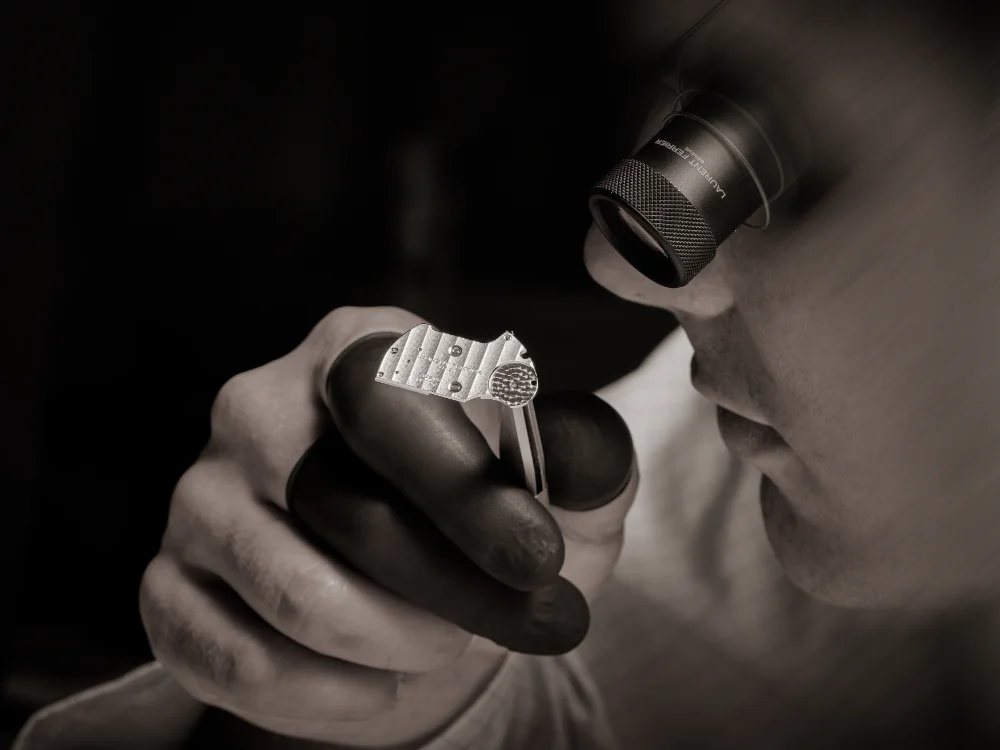
Image – Côtes de Genève on barrel bridge for Classic Moon (Calibre LF126.02)
Laurent Ferrier hand finishing – anglage
‘Anglage’ or hand-bevelling is often employed on bridges and cocks and involves creating a 45° chamfer between the surface and the flank. Once again, it is a means of removing burrs that could restrict the motion of moving components, albeit these days it is primarily used to enrich the appearance of a movement.
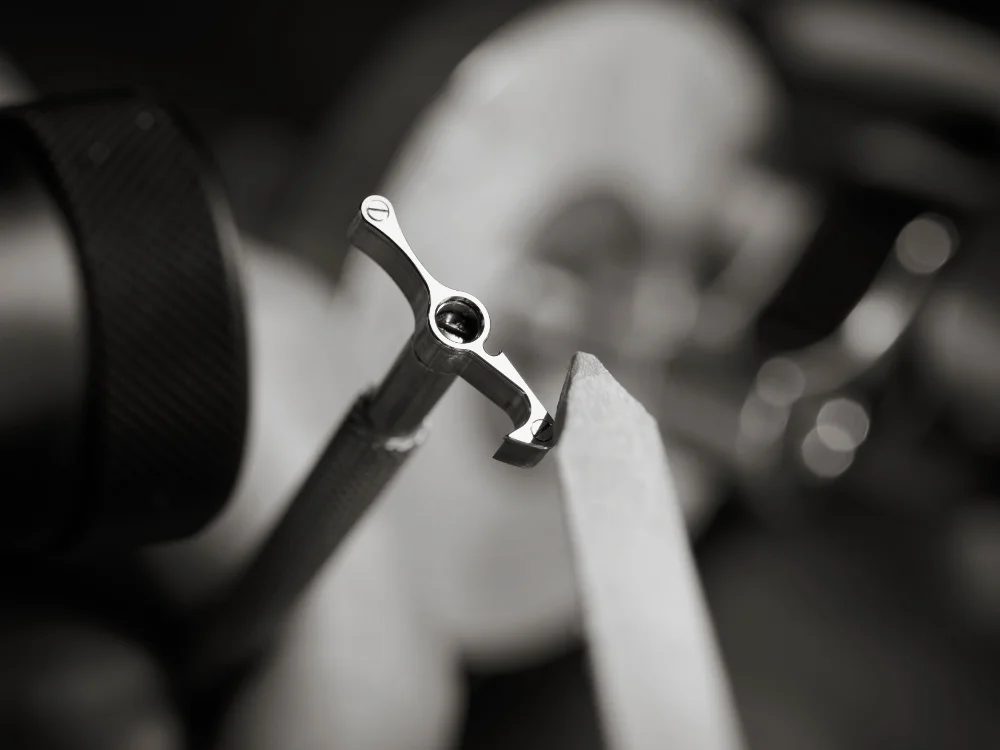
Image – anglage on bridge (Calibre LF270.01)
The bevel should be the same width throughout, it must not undulate or twist and it should be presented at 45° along the entirety of its length. Where two bevels meet, they should precisely dovetail.

Image – Anchor bridge
There are three places that anglage can be found: exterior angles, interior angles and rounded angles. ‘Exterior angles’ are formed of two chamfers meeting on the outside edge of a part. ‘Interior angles’ are where two bevels meet on an inside corner and form a continuous line. Lastly, ‘rounded angles’ are formed where two arcing chamfers come together on an outside edge.
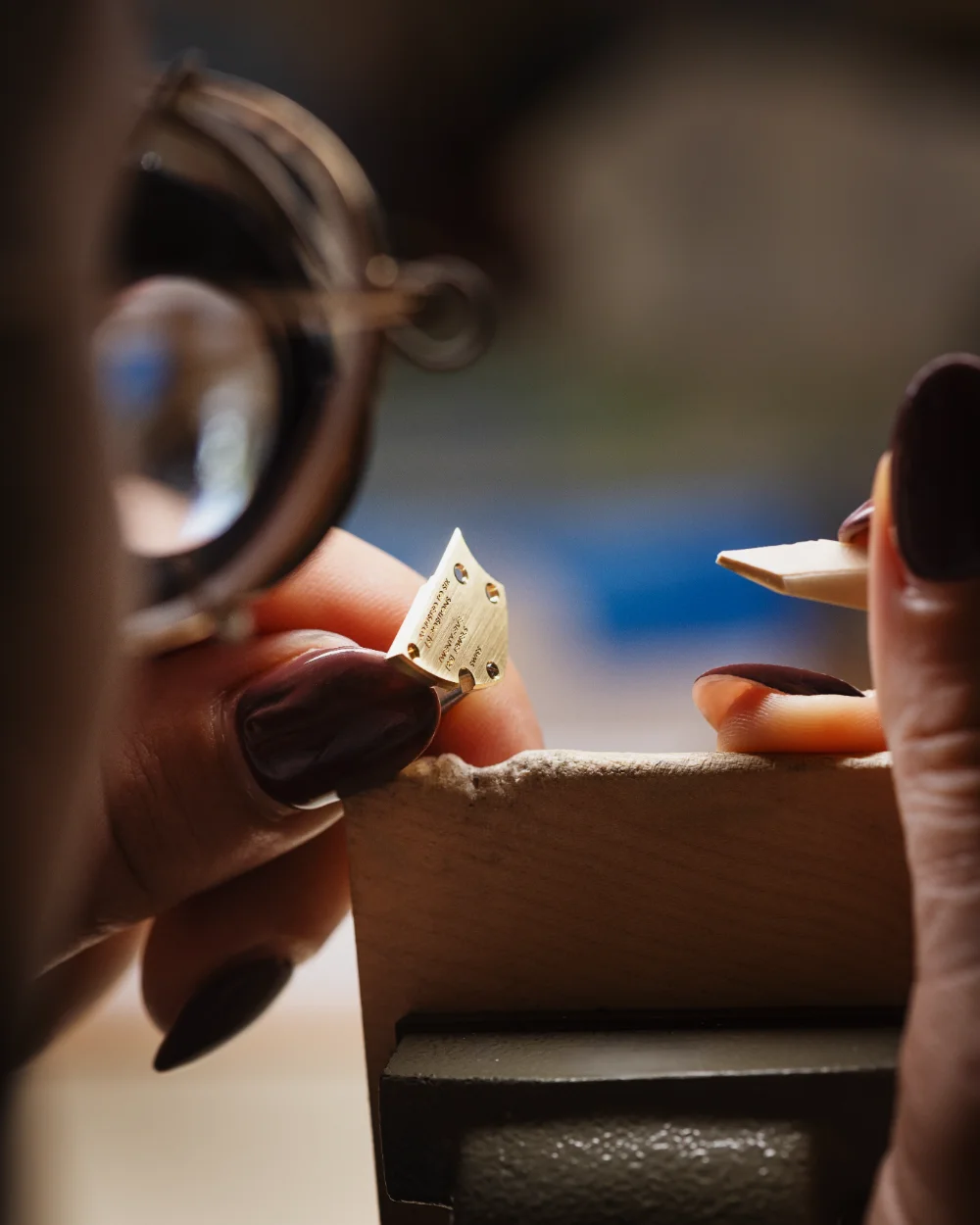
Image – anglage on middle bridge of Classic Moon movement (Calibre LF126.02)
In the esoteric world of Haute Horlogerie, exterior and rounded angles are realised using a grinding wheel smeared with abrasive paste. Ultimately, the surface is polished using a file, pin or gentian wood.

Image – anglage on ‘guitar’ (Calibre LF619.01)
Interior angles are far more challenging to execute and can only be done by hand. Files are selected based on the part to be bevelled with due consideration given to their shape, size and coarseness. Moreover, abrasive pastes of various grains are used based on the task to be undertaken.
At Laurent Ferrier, interior angles are a speciality that need to be seen in order to be fully appreciated. In its comprehensive hardback catalogue, the Maison states, ‘After finishing the sides, the interior angles are shaped with a file, then the surface is smoothed with an abrasive tool called a cabron. Lastly, the part is polished with diamond paste and gentian wood.’
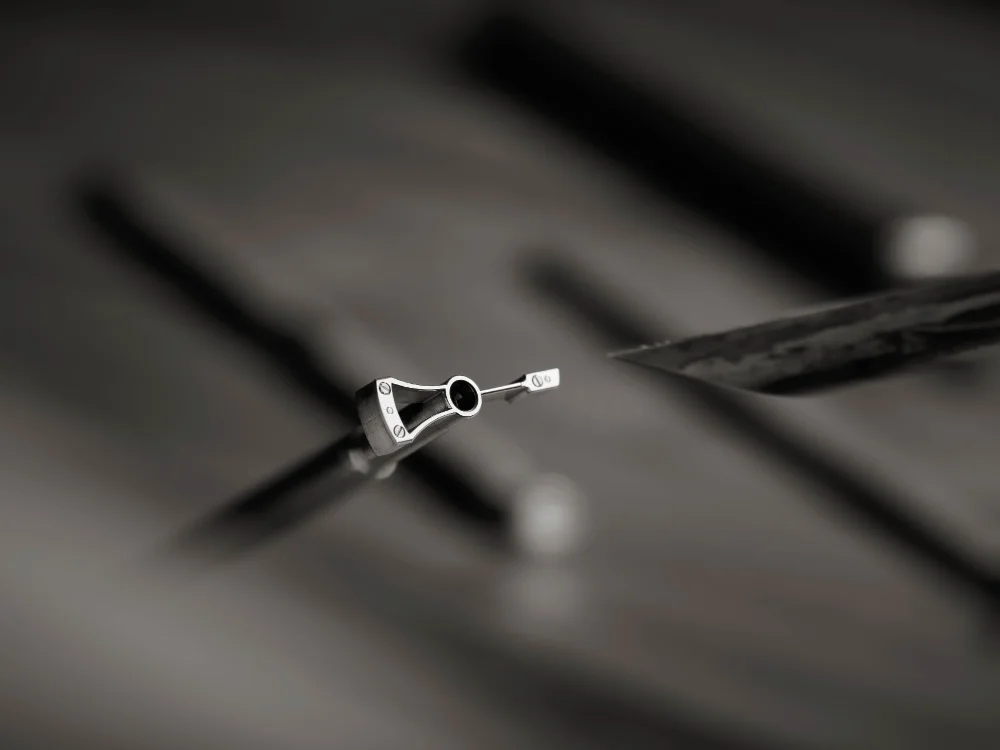
Image – anglage on ‘guitar’ (Calibre LF619.01)
Among the watch collecting fraternity, interior angles are highly prized and are often the subject of prolonged loupe-equipped inspection. This level of finishing, which is both challenging and time-consuming to undertake, is the preserve of Haute Horlogerie.
Laurent Ferrier hand finishing – mirror polishing
‘Mirror polishing’, also known as ‘black polish’ or ‘poli noir’ is, once again, much appreciated by the cognoscenti and purists. The technique is only employed on steel parts.
To mirror polish a component, it must be made perfectly flat. It is placed upon a zinc plate smeared with diamond paste of different grains, starting with a coarse grain and moving to increasingly finer grains. The part is moved against the plate in a circular motion.
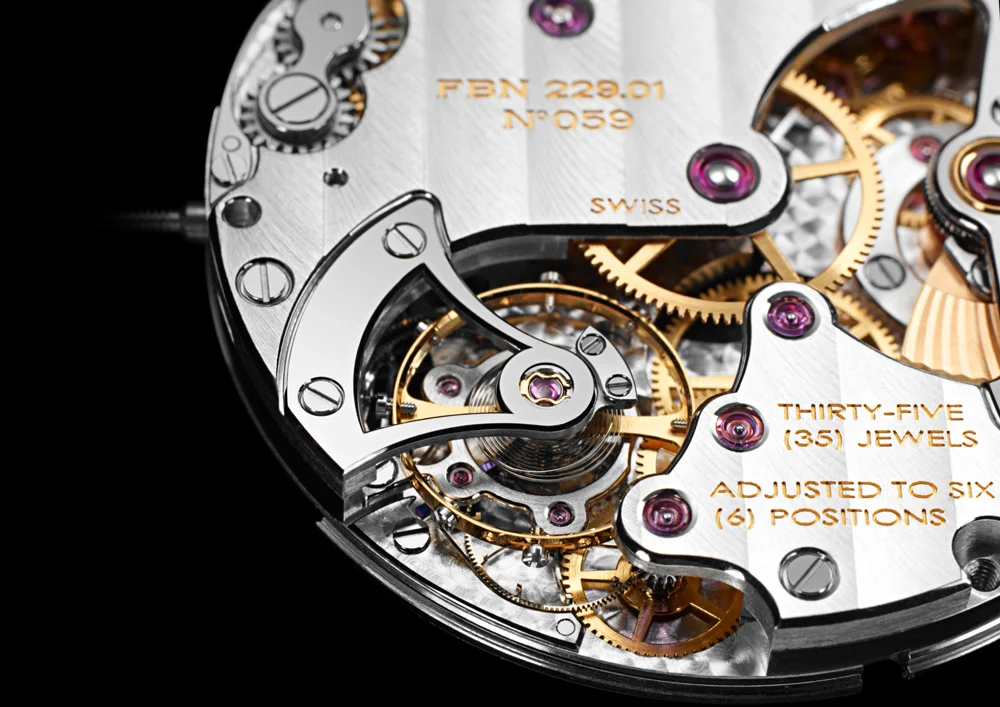
Image – mirror polishing on balance bridge and sliding stud holder (Calibre FBN 229.01)
By mirror polishing a component, the light will only be reflected in one direction. Its shade will appear to change depending on the angle it is viewed from. It may look black from one angle only to appear white from another perspective.
Laurent Ferrier endues a variety of parts with a mirror polished finish ranging from gleaming screw heads to intricately shaped parts such as the automatic device bridge. It can take several hours to mirror-polish a component, hence the approach is exclusive to Haute Horlogerie and, specifically, those Maisons that practise low-scale production methods.
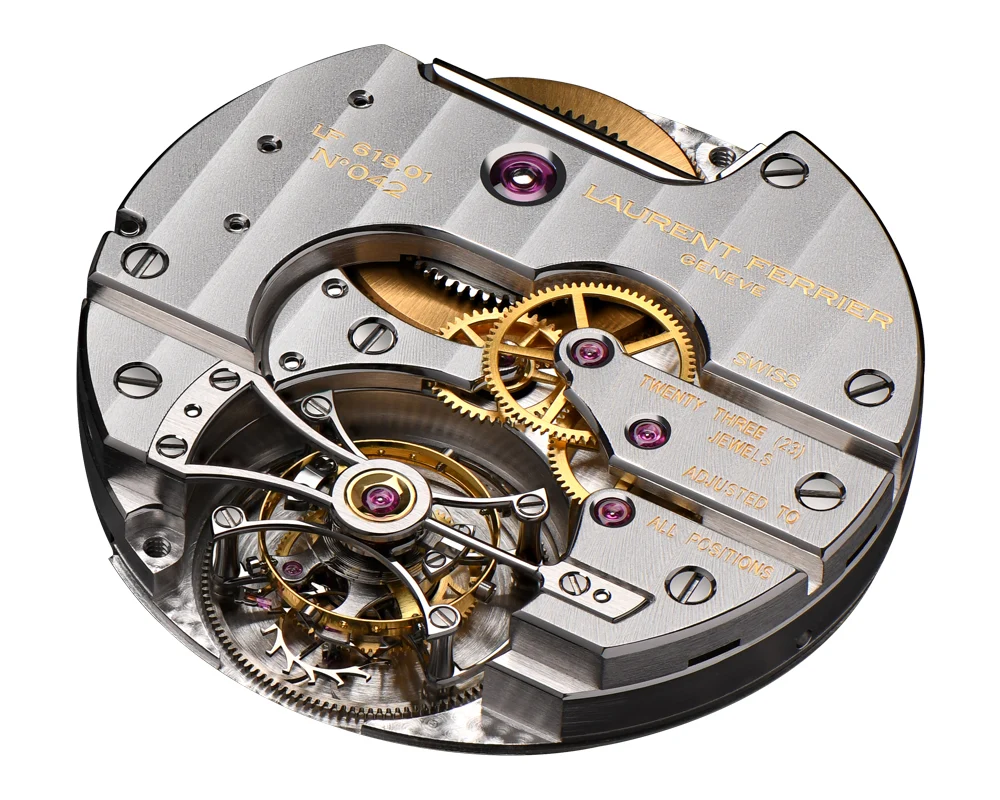
Image – mirror polishing on ‘guitar’ (Calibre FBN 619.01)
Laurent Ferrier hand finishing – satin-brushed finishing and brouillage
‘Satin finishing’ or ‘dressage’ involves dragging a movement part across a sheet of abrasive paper in one direction. This process imbues the surface with a series of fine, parallel lines that readily engage with light.
Similar to satin finishing, ‘brouillage’ involves rubbing a movement part across a sheet of abrasive paper. However, rather than restricting the motion to one direction, the part is rubbed against the abrasive paper in multiple directions. Meaning ‘interference’, brouillage imbues the surface with a matt appearance.
Laurent Ferrier hand finishing – closing remarks
In this article I have explored six forms of hand finishing, all of which are detailed within the Laurent Ferrier catalogue. However, there are many more product refinements to be found on Laurent Ferrier models. For instance, the jewels and screws sit within polished sinks. Moreover, the screws feature chamfered rims and slots. The gear train wheels are embellished with a stain finish termed ‘cerclage’ and in the case of the recent GPHG prize-winning Classic Moon Silver, the power-reserve indicator to the rear is embellished with sunray brushing.
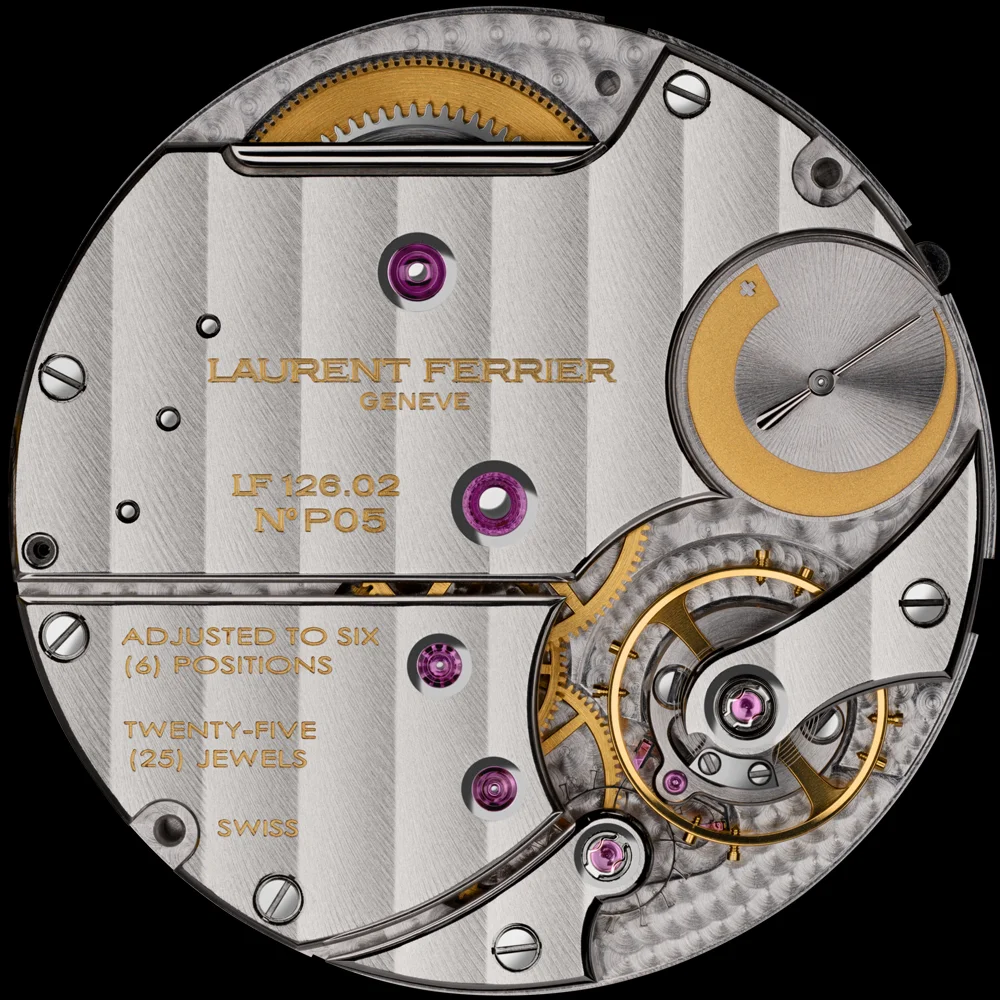
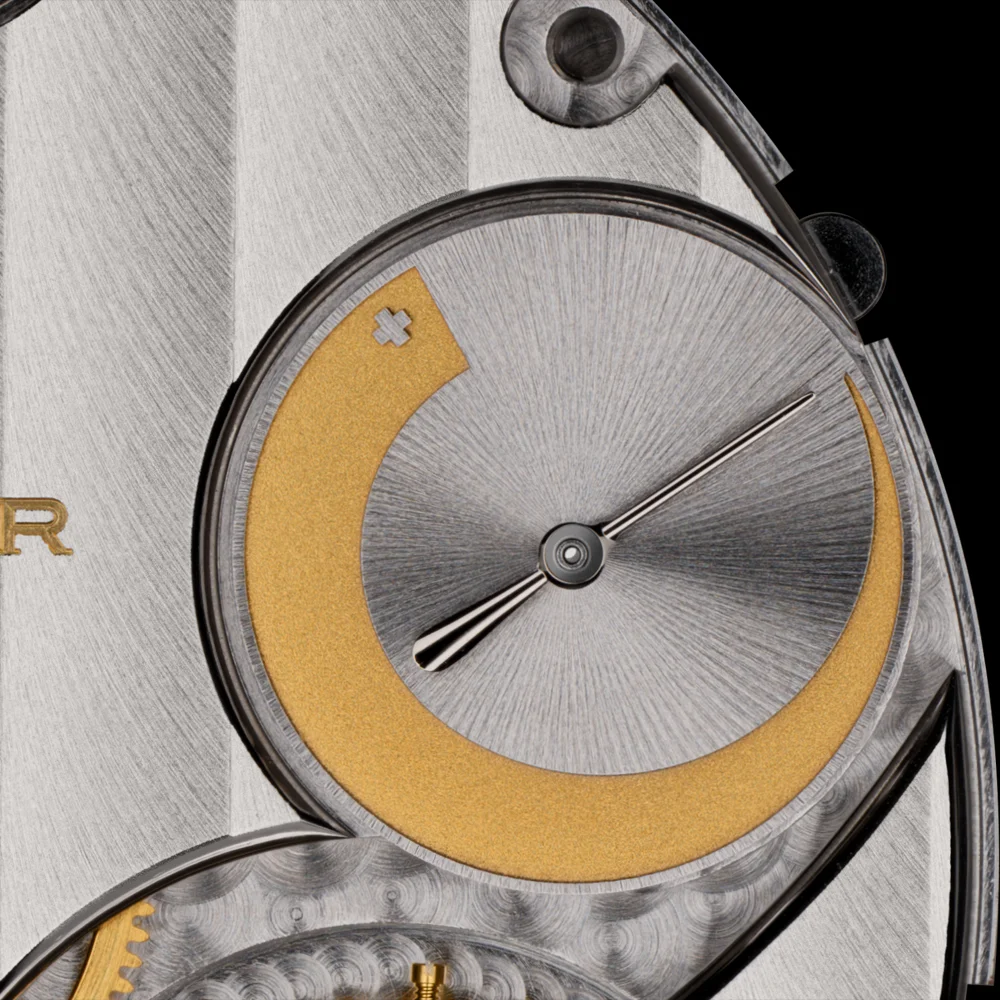
The Maison is regarded as one of the finest practitioners of hand finishing with the company’s artisans and watchmakers employing incredible expertise in the pursuit of perfection. Not only do the Maison’s artisans and watchmakers know how to apply a variety of different hand finishes to a movement, they are also adept at selecting those which are the most appropriate. It is this horological wisdom that makes every LF calibre extraordinary and the brand’s timepieces highly prized by discerning watch collectors around the globe.
Further reading