
Laurent Ferrier Natural Escapement (Calibre FBN229.01) in-depth feature
The Laurent Ferrier Natural Escapement is a modern-day take on Breguet’s échappement naturel (natural escapement). The Geneva-based Maison was able to make the system a reality by combining modern-day materials and technology with its legendary low-volume production methods and extraordinary watchmaking expertise. The resultant escapement is highly efficient and is found within the Calibre FBN229.01, an automatic movement equipped with a micro-rotor.
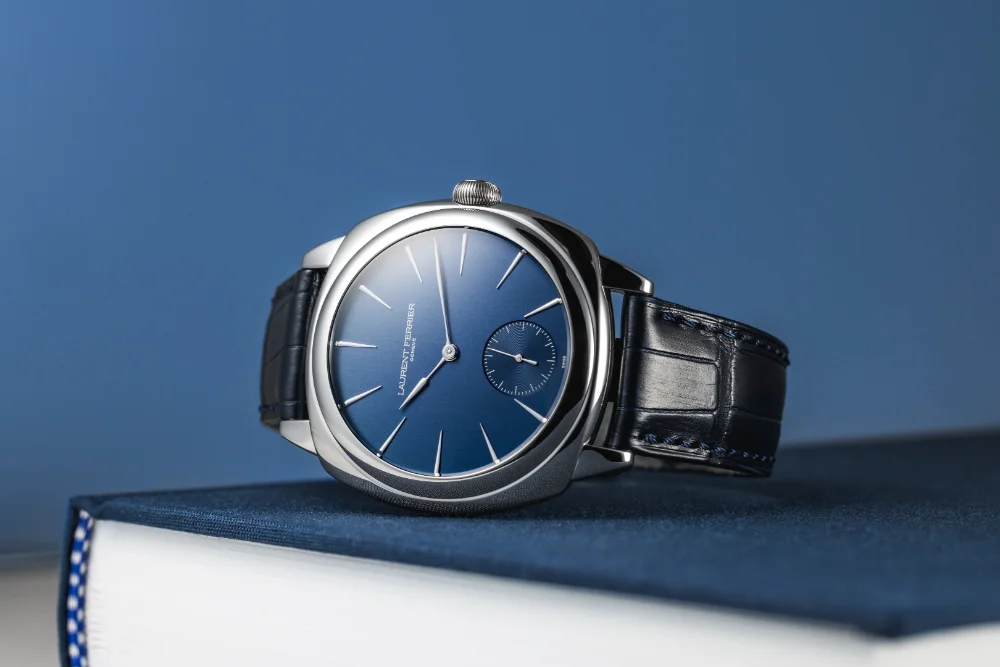
Image – Laurent Ferrier Square Micro-Rotor Blue
Laurent Ferrier Calibre LF619.01 – Classic Tourbillon Double Hairspring
In 2010, Laurent Ferrier unveiled its inaugural watch, the Classic Tourbillon Double Hairspring, a model that remains a member of the present-day collection.
Equipped with a Swiss-lever escapement, the Calibre FBN916.01, the forerunner to the Calibre L619.01, featured Breguet’s coveted gravity-compensating complication, the tourbillon. This latter mechanism involves placing the escapement and regulating organ within a revolving cage that rotates 360° every 60 seconds, ameliorating positional errors.
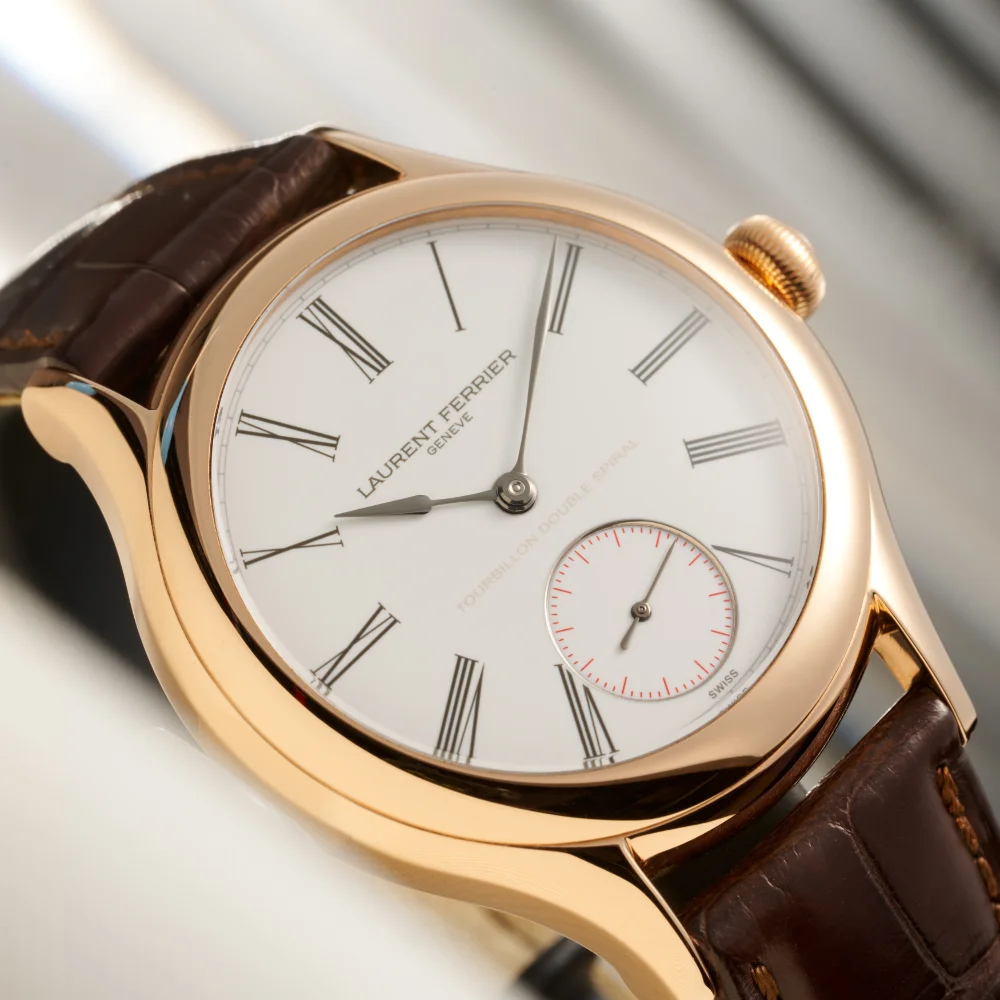
Image – Laurent Ferrier Classic Tourbillon
Moreover, as its name suggests, the Classic Tourbillon Double Hairspring also features two flat hairsprings positioned opposite one another, 180° apart. As the hairsprings develop or breathe in synchronous fashion, they effectively cancel out any lateral displacement of the balance axis, further mitigating positional influence and thereby augmenting precision.
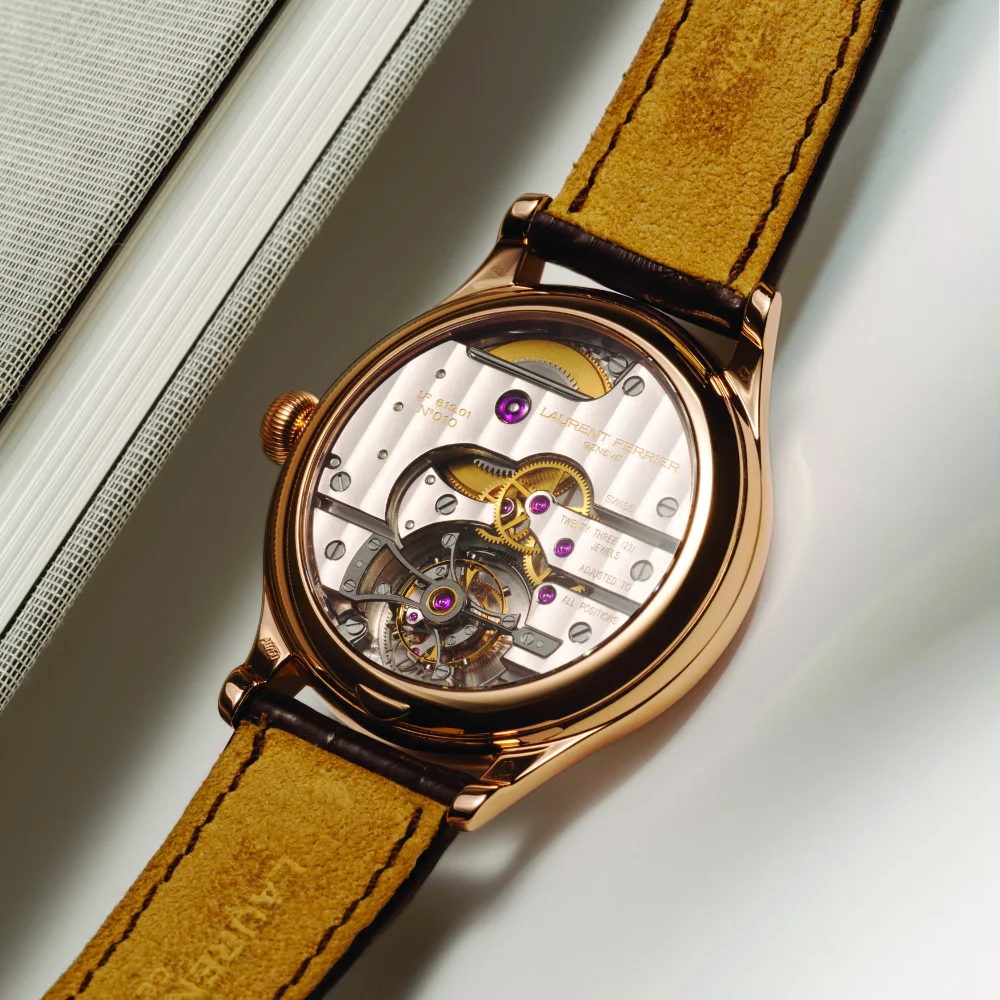
Image – Laurent Ferrier Classic Tourbillon featuring the Calibre LF619.01
The extraordinary complexity of the Calibre LF619.01 appears to be in stark contrast to the overall clean, uncluttered design of the case and dial of the Classic Tourbillon Double Hairspring. However, a closer look at the dial reveals the Assegai-shaped hour and minute hands and Grand Feu enamel along with a pebble-like case. These elements may appear simple, elegant and understated but they are the product of much time and effort. Indeed, they stand testament to the Maison’s exacting standards. This fastidious approach to product creation also extends to the finishing, widely considered some of the finest within the watch industry, distinguishing this model as truly exceptional.

Image – Laurent Ferrier Calibre LF619.01
Back in 2010, the brilliance of the Laurent Ferrier Classic Tourbillon Double Hairspring was recognised by several esteemed watch experts, culminating in the award of the ‘Mens watch prize’ at the Grand Prix d’Horlogerie Genève (GPHG).
Laurent Ferrier Natural Escapement (Calibre FBN229.01)
It was an auspicious start for the Geneva-based Maison; however, it soon became apparent there was much interest among watch collectors for a more accessible model. This led to Laurent and his son Christian creating a new timepiece, again featuring a highly technical movement, the Calibre FBN229.01. This automatic movement is endowed with a micro-rotor and a natural escapement, two features that remain a comparatively rare sight in the watchsphere.
Before I talk about the Calibre FBN229.01 and discuss its unusual composition, I think it is helpful to explain how a mechanical watch works and the role of the escapement.
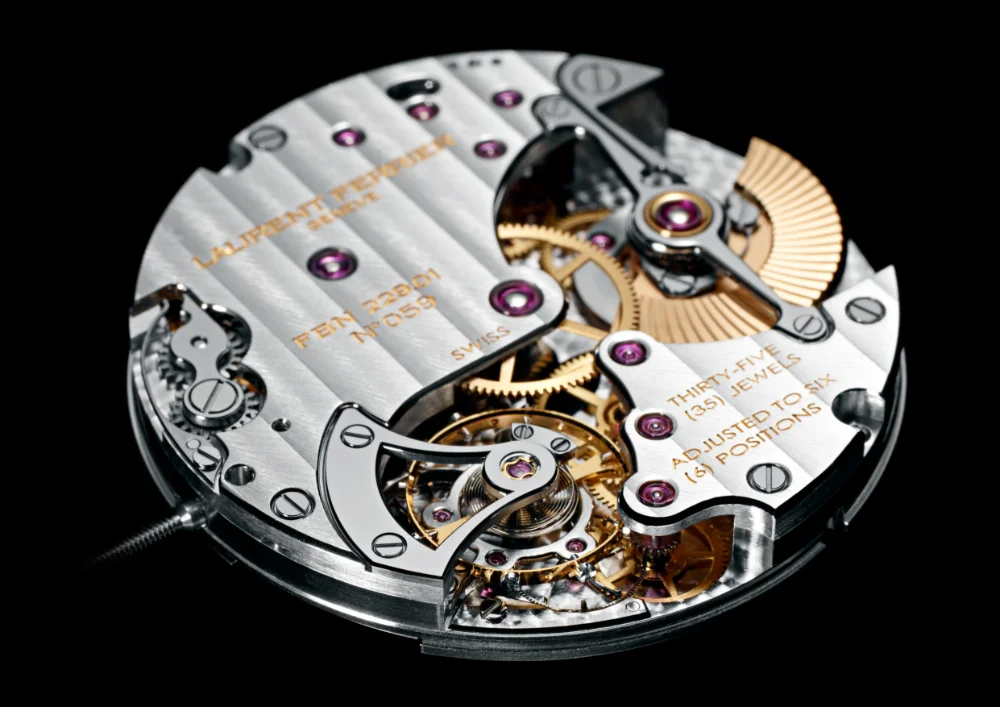
Image – Laurent Ferrier Calibre FBN229.01
How a mechanical watch works and the role of the escapement
With a mechanical watch, the action of winding the crown tensions the mainspring held within the barrel, effectively the fuel tank of the watch. Once fully tensioned, the mainspring wants to unfurl and return to a relaxed state. However, if it was allowed to unfurl without any control, the stored power would soon dissipate, small components could easily be damaged, and the watch would cease to operate within a short period of time.
For a timepiece to be of use, the power from the barrel must be controlled. For this reason, power is transmitted through the gear train. Comprising a set of four wheels arranged in sequence, the gear train is a bit like an electrical transformer, stepping-down the power to a manageable level. The fourth wheel in the gear train is connected to the escape wheel causing it turn clockwise.
Most mechanical watches on the market today incorporate a Swiss lever escapement (see later). This mechanism comprises an escape wheel which engages with a pallet lever which in turn serves an impulse to the balance (balance wheel and balance spring).
Similar to a pendulum, the balance oscillates to and fro with the frequency of each oscillation determined by the balance spring. The balance requires an impulse to perform each oscillation. This to and fro motion causes the escape wheel to lock and unlock, allowing the gear train to advance in small, precise increments. During this locking/unlocking process, the centre wheel (the second wheel in the gear train) rotates, ultimately causing the hands to turn a set amount.
Incidentally, an automatic movement is equipped with an oscillating weight which rotates with the natural motion of the wrist, tensioning the mainspring, albeit it can be manually wound if necessary eg after a long period of inactivity. However, irrespective of whether a movement is manual or automatic, it will always feature a barrel, a gear train, an escapement and a balance.
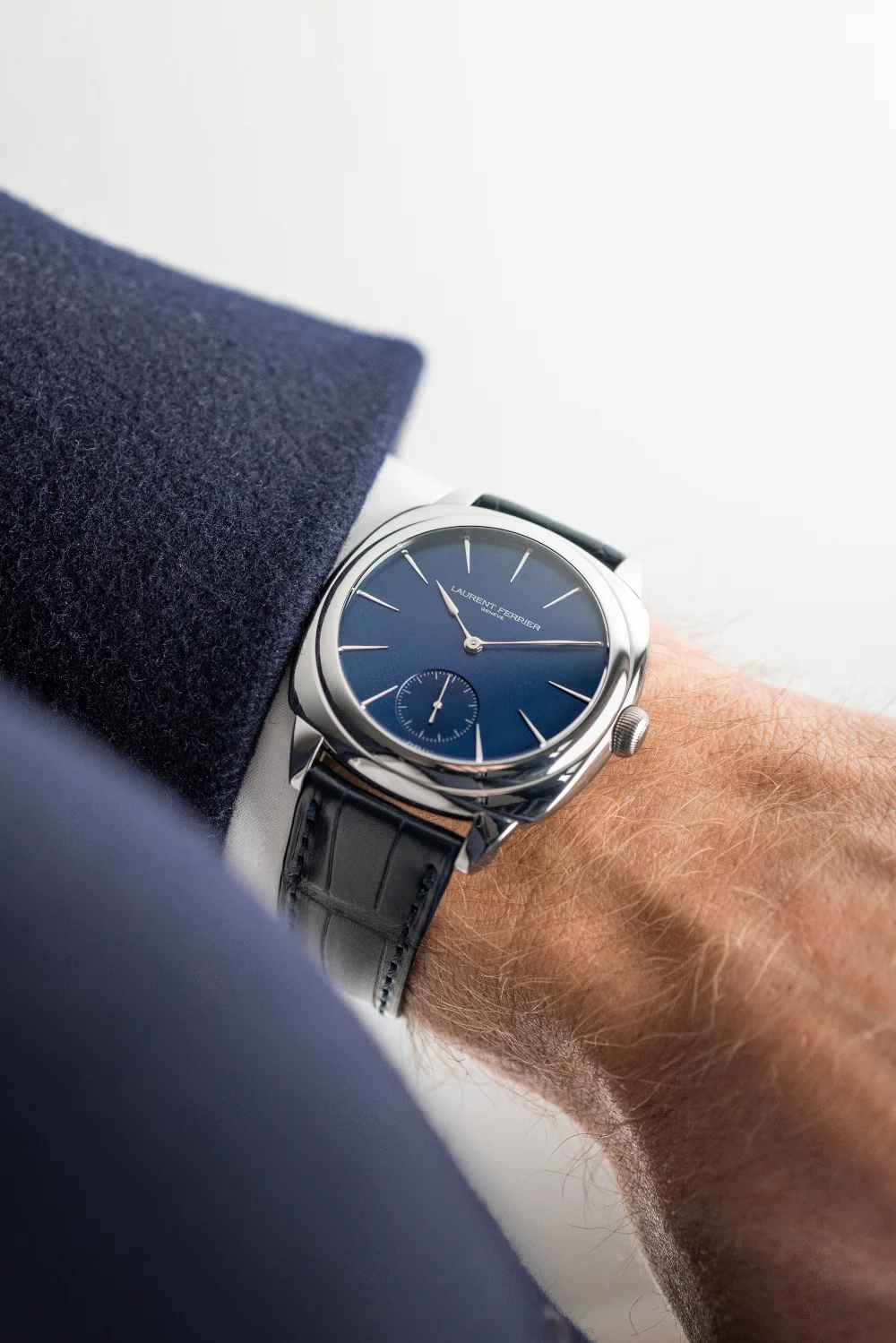
Image – Laurent Ferrier Square Micro-Rotor Blue
The Swiss lever escapement
As previously mentioned, the Swiss lever escapement is the most popular method of ‘controlling the flow of time’. It can trace its origins to an English watchmaker, Thomas Mudge (1715 – 1794) who created the English lever escapement in 1754. This escapement was the forerunner of what is now commonly termed the Swiss lever escapement, albeit there are some differences between the two.
Most obvious is that the lever on Mudge’s mechanism sits perpendicular to the balance wheel, while on modern-day Swiss lever escapements, the balance wheel, lever and escape wheel are arranged in a straight line. Other differences include the shape of the teeth on the escape wheel and the way these teeth interact with the pallet lever jewels.
Termed a ‘detached’ escapement, the Swiss lever escapement allows the balance to swing freely throughout most of its oscillation except when the escape wheel is serving an impulse.
Comparatively reliable, simple to service and relatively straightforward to regulate, the Swiss lever escapement is the preferred approach for most mass-produced watches. So far, so good.
However, if you look closely at the behaviour of the Swiss lever escapement, a fundamental weakness comes to light. As the escape wheel rotates clockwise, its teeth, termed club teeth, engage with two ruby pallets (the entry pallet and the exit pallet). The teeth slide along the face of the entry pallet, which ultimately provides the impulse, effectively pushing the pallet lever upwards. This action causes the lever to pivot and provides momentum to the balance. Unfortunately, this sliding action creates friction, reducing the efficiency of the mechanism.
An analogy often used to describe the action of the escape wheel teeth moving along the face of the entry pallet is to think of it like a door. Imagine standing in front of the door and pushing it with the hand effectively perpendicular to the door. The door will usually move with minimal force. However, if you stand almost parallel to the door and slide your hand across the front of it, more effort is needed to open it and your hand may feel a tad warm from the friction created. This latter scenario is effectively what is taking place with a Swiss lever escapement. It’s a less than ideal situation which the watch world has come to accept due to the aforementioned benefits of this type of mechanism.
To mitigate friction, a lubricant is needed, but as any watchmaker will attest, lubricants deteriorate over time, meaning the behaviour of the escapement and regulator organ will change. Abraham-Louis Breguet (1747-1823) famously said to Louis XVI, “Find me the perfect oil, Majesty, and I will make you the perfect watch!”. While modern-day lubricants are far superior to those that were available to Breguet, they still have their limitations.
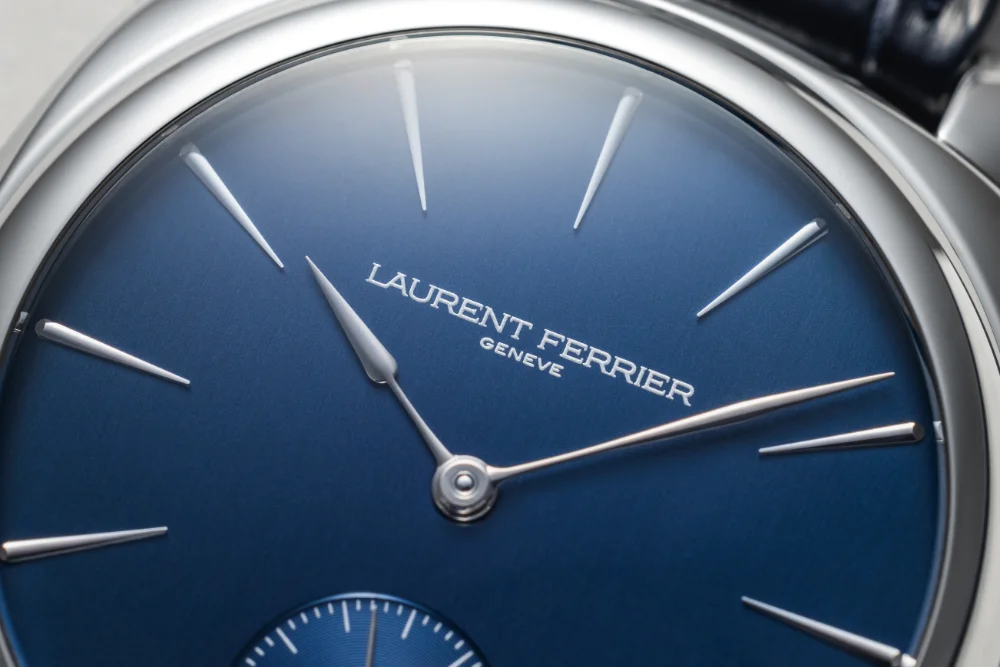
Image – Laurent Ferrier Square Micro-Rotor Blue
The natural escapement
Abraham-Louis Breguet, recognising the problem with friction and lubricants, created a watch equipped with an ultra-efficient escapement, the échappement naturel (natural escapement).
The most efficient means of imparting momentum to the regulating organ is by serving the impulse directly from the escape wheel to the balance axis. However, the problem is that the escape wheel only rotates clockwise, hence it can only serve an impulse in one direction. Clearly, for the balance to oscillate it needs an impulse in both directions. The natural escapement addresses this issue by having two escape wheels.
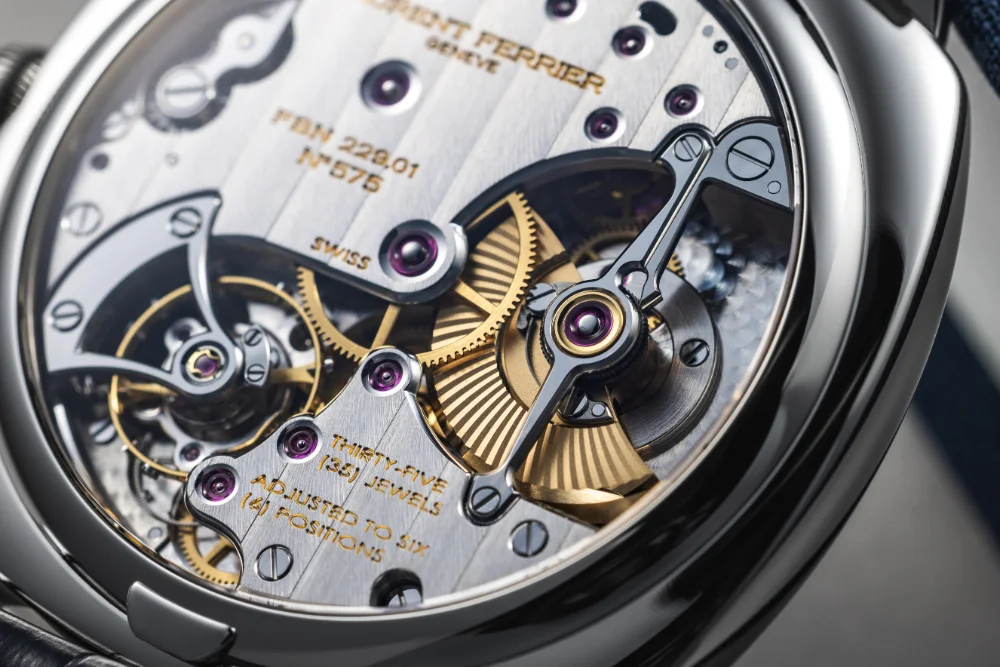
Image – Laurent Ferrier Calibre FBN229.01
One wheel (let’s call it wheel A) is powered by the mainspring via the gear train and turns clockwise. Wheel A (the driving escape wheel) turns the second wheel, Wheel B (the driven escape wheel) which rotates in a counterclockwise direction.
Each escape wheel has small columns on its upper surface. These columns serve a direct impulse to the double table roller which is part of the balance. The lever located between the escape wheels provides a resting point for the columns in a similar way to the pallets found on a Swiss lever escapement.
A problem Breguet encountered was the play between the escape wheels caused ‘backlash’. Too much play could result in a variable impulse to the balance or cause the escapement to stop. Conversely, too little play would create excessive friction.
Laurent Ferrier Natural Escapement (Calibre FBN229.01)
Laurent Ferrier addressed the ‘backlash’ issue by positioning the driving wheel (A) asymmetrically against the driven wheel (B) and optimising the geometry and gearing to minimise the amount of play between the escape wheels while at the same time still leaving just enough play.
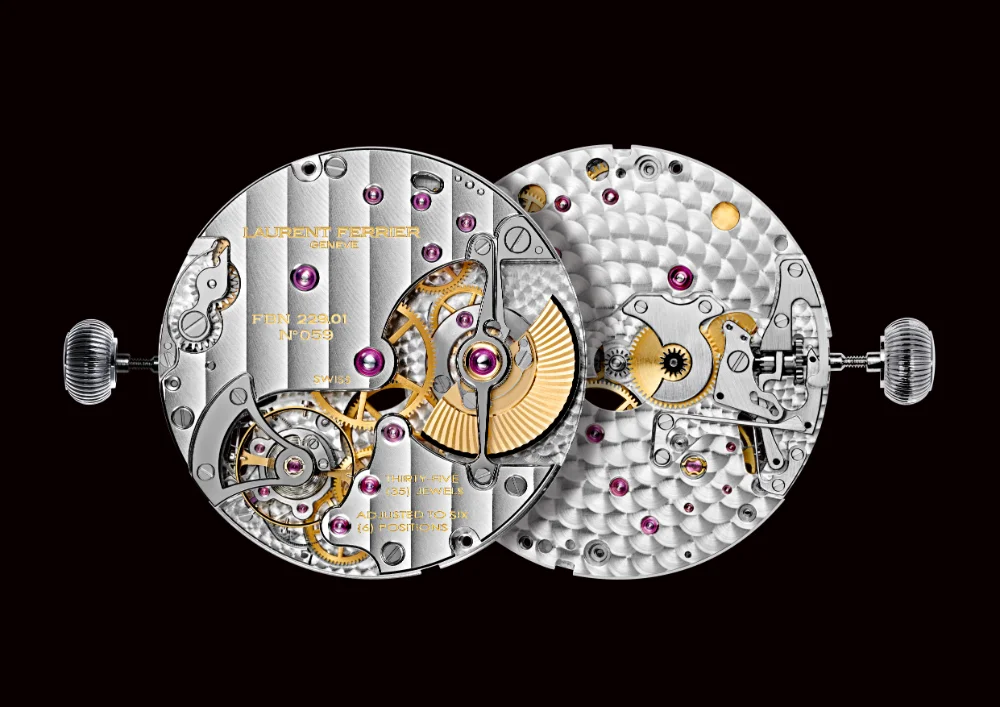
Image – Laurent Ferrier Calibre FBN229.01
Laurent Ferrier surmounted the problems that Breguet encountered with the advent of new technologies and materials. For example, the escape wheels employed within the Calibre FBN229.01 are made of nickel phosphorus, formed using UV-LIGA technology. This fabrication technique involves the use of UV light to create a minuscule mould that is then used for effectively growing parts with a high aspect ratio. The escape wheel, with columns integrated into its upper surface, is made to very precise tolerances not possible using conventional moulding or milling techniques. The resultant components are both smooth and strong.
Furthermore, the lever and double table roller are made of silicium. This glass-like material is made using DRIE (Deep Reactive Ion Etching). The resultant material is light and virtually friction free obviating the need for lubrication.
Using these modern materials and technologies has allowed the Maison to create a lightweight escapement. This means less inertia is required to move components, thereby mitigating energy consumption.
Laurent Ferrier Natural Escapement (Calibre FBN229.01) – micro-rotor
Returning to the original reason for making the Calibre FBN229.01, Laurent Ferrier sought to make an automatic watch equipped with a micro-rotor. This prompts the question why incorporate a micro-rotor?
The benefits of a micro-rotor are that unlike a full-size oscillating weight which sits above the bridges, the micro-rotor sits flush with the neighbouring bridges, thereby mitigating the thickness of the movement. Furthermore, due to the absence of a full-size oscillating weight, the wearer can enjoy unhindered views of the movement and its exquisite finishing; a notable attribute with any LF-branded watch.

Image – Laurent Ferrier Calibre FBN229.01
This then prompts a second question, why doesn’t every brand use a micro-rotor to energise the mainspring? Put simply, they are costlier to produce and present several technical challenges that must be surmounted.
In the case of the Calibre FBN229.01, the micro-rotor employs a ratchet clutch system (aka pawl winding system) that energises the mainspring as it turns in one direction while preventing it from rotating in the opposite direction.
The unidirectional micro-rotor is also made of 18-carat gold, a dense material. Due to its mass, when the micro-rotor is moving, it will want to remain in motion, subscribing to the laws of inertia.
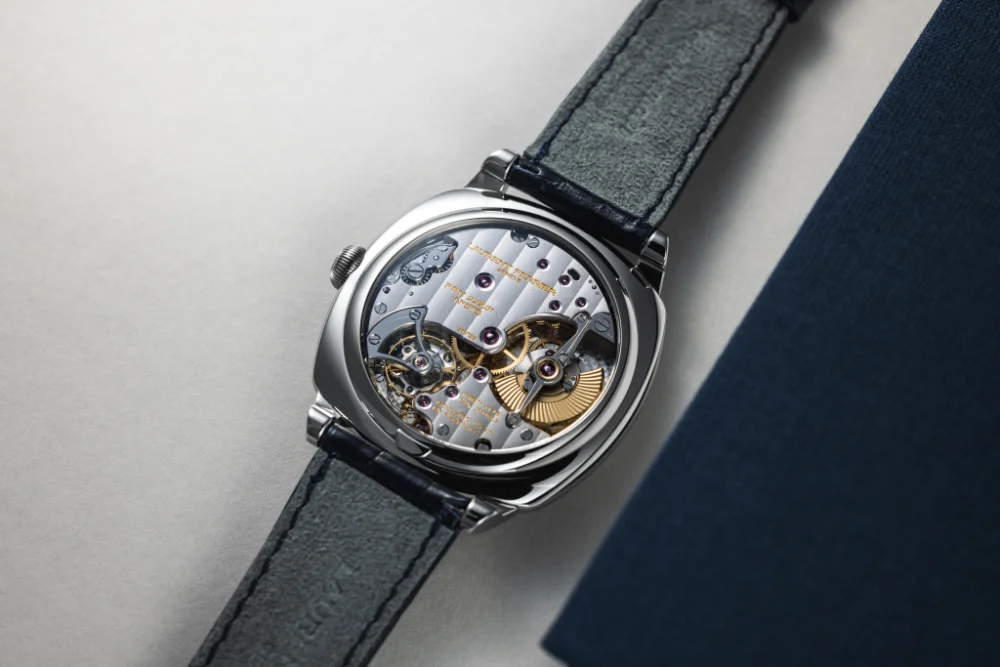
Image – Laurent Ferrier Calibre FBN229.01
Nevertheless, a difficulty sometimes encountered with micro-rotors is that they are often incapable of energising a large mainspring, culminating in a modest power-reserve. From the outset, the team at Laurent Ferrier sought to create a movement with a power-reserve of 3 days (72 hours). The resultant movement (Calibre FBN229.01) works without any ball bearings and with a micro-rotor weighing a mere 2 grammes, a comparatively modest figure. By opting for a natural escapement, Laurent Ferrier has achieved a far more efficient means of controlling the flow of time.
Laurent Ferrier Natural Escapement (Calibre FBN229.01) – closing remarks
When Breguet set out to create his échappement naturel, he wanted to obviate the need for oils and sought to achieve a higher degree of precision. His ambition was thwarted by the materials and technology available at the time.
The natural escapement at the heart of the Calibre FBN229.01 is similar in many ways to Breguet’s original idea. However, its use of cutting-edge materials and technology has allowed Laurent Ferrier to achieve its objective of making an automatic watch equipped with a micro-rotor, able to run autonomously for 72 hours. Indeed, courtesy of silicium (DRIE) and nickel phosphorus (UV-LIGA), Laurent and Christian’s dreams have come true.
So, why don’t all watch companies use a natural escapement? The answer is simple, it takes much time and expertise to fine tune the system in order to make it operate perfectly, factors which preclude mass production. However, Laurent Ferrier is the very antithesis of mass production. The independent company subscribes to low-volume production methods, is blessed with incredible in-house watchmaking expertise and believes in taking its time. It is for these reasons, that the Maison has been able to bring the Calibre FBN229.01 to life.